RESEARCH ARTICLE
BLUETOOTH BASED ADVERTISEMENT SYSTEM
*Lalit Narde, Gaurav Shinde, Rohit Nalla and Prof. A.V. Nadargi
SIT, Lonavala, Maharashtra, India
ARTICLE INFO ABSTRACT
Lately, research for context-aware systems has risen significantly. New social needs require innovation new technology to build rich omnipresent computing spaces. Such spaces allow users to use services without caring of any interaction with the system. For bringing this in existence, some context awareness is needed so computers, based on their environment, can behave accordingly. Mobile Advertising is one of such new needs and has shown to have a large potential due to the very personal and intimate nature of the devices and the possibleness of reaching a broad range of targets. In this paper we discuss Bluetooth Advertisement System, a context-aware pervasive system for advertising in large commercial areas. Bluetooth Advertisement System uses Java and Bluetooth wireless technology making it a very client-specific system. We describe the overall architecture and discuss the execution steps taken to build this application.
Copyright © 2014 Lalit Narde, et al. This is an open access article distributed under the Creative Commons Attribution License, which permits unrestricted use, distribution, and reproduction in any medium, provided the original work is properly cited.
INTRODUCTION
Mobile communications are one of today’s fastest growing markets. In a short amount of time, mobile phones have become multimedia devices and evolved into personal assistants. They are used not only for making phone calls, but also for data services, surfing the Internet and for various multimedia applications. New mobile application domains adapt new paradigms that specifically target the mobile business environment. In marketing, mobile advertising has two distinct meanings: advertisements moving from place to place, like advertisements displayed on the sides of trucks and buses, and advertisements delivered to mobile devices such as mobile phones and personal digital assistants (PDAs). Advertisers typically use a variety of delivery methods to maximize the number of different adverts displayed, and thus increase their overall exposure to target audiences. In this paper we study the latter, focusing on delivering advertisements to our clients’ mobile devices. The term wireless advertising is sometimes used to refer to mobile advertising. Mobile advertisement is a growing area of development. Recently, lots of applications have been developed for mobile devices in a broad range of areas and, in particular, in the advertisement area. Harris Interactive [Bill N. Schilit 1994], a market research company that specializes in public opinion research using both telephone and surveys on online panels, announced the results of new research into consumer acceptance of mobile phone advertisements. The research examined current levels of
*Corresponding author: Lalit Narde SIT, Lonavala, Maharashtra, India.
consumer interest in mobile phone advertisements, preferred advertising formats and the willingness of consumers to be profiled. According to the study, a surprising 35 percent of adult cell phone users are willing to accept in centivebased advertisements which indicate a potential market to invest in.
Allowing clients to receive controlled advertisements and shopping information in their mobile devices without even making any interaction with the system itself grants thema strong grade of integration with their surroundings. This kind of system is called a pervasive system, also known as ubiquitous computing. Users can profit from pervasive computing environments in many ways: context aware applications may actively react, leading to, for example, information being displayed based on the user’s current location. By bringing more and more of these technologies together their potential will rise; yet, the effort to keep these systems running will increase. Usually, a ubiquitous system requires some kind of external information to be able to perform its task properly. Usually, this includes awareness about its surroundings and environment, such as its location and what resources are nearby. These applications gather contextual knowledge about their users and operating environment. Contextual knowledge is typically obtained from time-varying sensory data – in real time and sometimes after making inferences. Equipped with knowledge about the current situation of usage, context-aware applications are able to automatically perform appropriate actions without the user needing to request them explicitly. A system with these capabilities can examine the computing environment and react to changes. In such an environment secure issues become
ISSN: 0975-833X
International Journal of Current Research Vol. 6, Issue, 03, pp.5950-5954, March, 2014
INTERNATIONAL JOURNAL OF CURRENT RESEARCH
Article History:
Received 29thDecember, 2013
Received in revised form 10thJanuary, 2014
Accepted 14thFebruary, 2014
Published online 31stMarch, 2014
Key words:
Bluetooth Advertising, Java, Bluetooth, Ubiquitous computing, Context-aware systems.
RESEARCH ARTICLE
BLUETOOTH BASED ADVERTISEMENT SYSTEM
*Lalit Narde, Gaurav Shinde, Rohit Nalla and Prof. A.V. Nadargi
SIT, Lonavala, Maharashtra, India
ARTICLE INFO ABSTRACT
Lately, research for context-aware systems has risen significantly. New social needs require innovation new technology to build rich omnipresent computing spaces. Such spaces allow users to use services without caring of any interaction with the system. For bringing this in existence, some context awareness is needed so computers, based on their environment, can behave accordingly. Mobile Advertising is one of such new needs and has shown to have a large potential due to the very personal and intimate nature of the devices and the possibleness of reaching a broad range of targets. In this paper we discuss Bluetooth Advertisement System, a context-aware pervasive system for advertising in large commercial areas. Bluetooth Advertisement System uses Java and Bluetooth wireless technology making it a very client-specific system. We describe the overall architecture and discuss the execution steps taken to build this application.
Copyright © 2014 Lalit Narde, et al. This is an open access article distributed under the Creative Commons Attribution License, which permits unrestricted use, distribution, and reproduction in any medium, provided the original work is properly cited.
INTRODUCTION
Mobile communications are one of today’s fastest growing markets. In a short amount of time, mobile phones have become multimedia devices and evolved into personal assistants. They are used not only for making phone calls, but also for data services, surfing the Internet and for various multimedia applications. New mobile application domains adapt new paradigms that specifically target the mobile business environment. In marketing, mobile advertising has two distinct meanings: advertisements moving from place to place, like advertisements displayed on the sides of trucks and buses, and advertisements delivered to mobile devices such as mobile phones and personal digital assistants (PDAs). Advertisers typically use a variety of delivery methods to maximize the number of different adverts displayed, and thus increase their overall exposure to target audiences. In this paper we study the latter, focusing on delivering advertisements to our clients’ mobile devices. The term wireless advertising is sometimes used to refer to mobile advertising. Mobile advertisement is a growing area of development. Recently, lots of applications have been developed for mobile devices in a broad range of areas and, in particular, in the advertisement area. Harris Interactive [Bill N. Schilit 1994], a market research company that specializes in public opinion research using both telephone and surveys on online panels, announced the results of new research into consumer acceptance of mobile phone advertisements. The research examined current levels of
*Corresponding author: Lalit Narde SIT, Lonavala, Maharashtra, India.
consumer interest in mobile phone advertisements, preferred advertising formats and the willingness of consumers to be profiled. According to the study, a surprising 35 percent of adult cell phone users are willing to accept in centivebased advertisements which indicate a potential market to invest in.
Allowing clients to receive controlled advertisements and shopping information in their mobile devices without even making any interaction with the system itself grants thema strong grade of integration with their surroundings. This kind of system is called a pervasive system, also known as ubiquitous computing. Users can profit from pervasive computing environments in many ways: context aware applications may actively react, leading to, for example, information being displayed based on the user’s current location. By bringing more and more of these technologies together their potential will rise; yet, the effort to keep these systems running will increase. Usually, a ubiquitous system requires some kind of external information to be able to perform its task properly. Usually, this includes awareness about its surroundings and environment, such as its location and what resources are nearby. These applications gather contextual knowledge about their users and operating environment. Contextual knowledge is typically obtained from time-varying sensory data – in real time and sometimes after making inferences. Equipped with knowledge about the current situation of usage, context-aware applications are able to automatically perform appropriate actions without the user needing to request them explicitly. A system with these capabilities can examine the computing environment and react to changes. In such an environment secure issues become
ISSN: 0975-833X
International Journal of Current Research Vol. 6, Issue, 03, pp.5950-5954, March, 2014
INTERNATIONAL JOURNAL OF CURRENT RESEARCH
Article History:
Received 29thDecember, 2013
Received in revised form 10thJanuary, 2014
Accepted 14thFebruary, 2014
Published online 31stMarch, 2014
Key words:
Bluetooth Advertising, Java, Bluetooth, Ubiquitous computing, Context-aware systems.
RESEARCH ARTICLE
BLUETOOTH BASED ADVERTISEMENT SYSTEM
*Lalit Narde, Gaurav Shinde, Rohit Nalla and Prof. A.V. Nadargi
SIT, Lonavala, Maharashtra, India
ARTICLE INFO ABSTRACT
Lately, research for context-aware systems has risen significantly. New social needs require innovation new technology to build rich omnipresent computing spaces. Such spaces allow users to use services without caring of any interaction with the system. For bringing this in existence, some context awareness is needed so computers, based on their environment, can behave accordingly. Mobile Advertising is one of such new needs and has shown to have a large potential due to the very personal and intimate nature of the devices and the possibleness of reaching a broad range of targets. In this paper we discuss Bluetooth Advertisement System, a context-aware pervasive system for advertising in large commercial areas. Bluetooth Advertisement System uses Java and Bluetooth wireless technology making it a very client-specific system. We describe the overall architecture and discuss the execution steps taken to build this application.
Copyright © 2014 Lalit Narde, et al. This is an open access article distributed under the Creative Commons Attribution License, which permits unrestricted use, distribution, and reproduction in any medium, provided the original work is properly cited.
INTRODUCTION
Mobile communications are one of today’s fastest growing markets. In a short amount of time, mobile phones have become multimedia devices and evolved into personal assistants. They are used not only for making phone calls, but also for data services, surfing the Internet and for various multimedia applications. New mobile application domains adapt new paradigms that specifically target the mobile business environment. In marketing, mobile advertising has two distinct meanings: advertisements moving from place to place, like advertisements displayed on the sides of trucks and buses, and advertisements delivered to mobile devices such as mobile phones and personal digital assistants (PDAs). Advertisers typically use a variety of delivery methods to maximize the number of different adverts displayed, and thus increase their overall exposure to target audiences. In this paper we study the latter, focusing on delivering advertisements to our clients’ mobile devices. The term wireless advertising is sometimes used to refer to mobile advertising. Mobile advertisement is a growing area of development. Recently, lots of applications have been developed for mobile devices in a broad range of areas and, in particular, in the advertisement area. Harris Interactive [Bill N. Schilit 1994], a market research company that specializes in public opinion research using both telephone and surveys on online panels, announced the results of new research into consumer acceptance of mobile phone advertisements. The research examined current levels of
*Corresponding author: Lalit Narde SIT, Lonavala, Maharashtra, India.
consumer interest in mobile phone advertisements, preferred advertising formats and the willingness of consumers to be profiled. According to the study, a surprising 35 percent of adult cell phone users are willing to accept in centivebased advertisements which indicate a potential market to invest in.
Allowing clients to receive controlled advertisements and shopping information in their mobile devices without even making any interaction with the system itself grants thema strong grade of integration with their surroundings. This kind of system is called a pervasive system, also known as ubiquitous computing. Users can profit from pervasive computing environments in many ways: context aware applications may actively react, leading to, for example, information being displayed based on the user’s current location. By bringing more and more of these technologies together their potential will rise; yet, the effort to keep these systems running will increase. Usually, a ubiquitous system requires some kind of external information to be able to perform its task properly. Usually, this includes awareness about its surroundings and environment, such as its location and what resources are nearby. These applications gather contextual knowledge about their users and operating environment. Contextual knowledge is typically obtained from time-varying sensory data – in real time and sometimes after making inferences. Equipped with knowledge about the current situation of usage, context-aware applications are able to automatically perform appropriate actions without the user needing to request them explicitly. A system with these capabilities can examine the computing environment and react to changes. In such an environment secure issues become
ISSN: 0975-833X
International Journal of Current Research Vol. 6, Issue, 03, pp.5950-5954, March, 2014
INTERNATIONAL JOURNAL OF CURRENT RESEARCH
Article History:
Received 29thDecember, 2013
Received in revised form 10thJanuary, 2014
Accepted 14thFebruary, 2014
Published online 31stMarch, 2014
Key words:
extremely important. In this paper we describe the Bluetooth Advertisement system, a pervasive context-aware application for advertising in large commercial areas. The system delivers advertisements and shopping informationbased on the clients’ current location. Blue-Mall cares about pushing advertisements in a non-intrusive way, taking into consideration ”what” information was sentto ”whom” and ”when”. This is done to avoid advertise spamming and to turn Bluetooth Advertisement System into a user-friendly system; we do not want clients switching off their mobile phones, after all. There are several context-aware applications like Blue-Mall developed for other areas like museums, hospitals, other forms of advertisement and even games.
Bluetooth is a versatile and flexible short-range wireless networking technology with low power consumption. Bluetooth has the ability to locate close-by devices and discover what type of services they offer. For our application, Bluetooth is the best bet to ensure we reach the maximum number of clients. Nowadays, almost every mobile device comes with a Bluetooth interface integrated, and so all of them are potential clients. Moreover, by using a technique known as spread-spectrum frequency hopping and using low power wireless signals, Bluetooth devices mostly avoid interference with other wireless devices. These are the basic reasons why we decided to use Bluetooth as the main wireless technology for Bluetooth Advertisement System instead of 802.11. Our prototype allows us not only to confirm the correct behavior of the designed application, but also to acquire experimental data to evaluate the suitability of Bluetooth for advertisement systems.
The Related Work
[image:2.595.124.476.441.739.2]A mobile marketing is a topic of growing interest and importance (Lei-da and Ravi,2004; Varshney et al., 2004; Leppäniemi and Karjaluoto, 2007). Mobile campaigns encompass acquisition, retention, customer service or Customer Relationship Management applications that use text messages (Short Message Service), picture/audio messages (Multimedia Messaging Service) and the mobile internet (Wireless Application Protocol and General Packet Radio Service; Barnes and Scornavacca, 2004; Karjaluoto, 2006; Shim et al., 2006). They can support responses as varied as requests for information, sales promotion, retail football generation and direct revenue generating sales (Direct Marketing Association, 2005). Yunos, Gao and Shim (2003) presented the opportunities and challenges of the wireless advertising. Bluetooth Mobile Advertising system is developed by Aalto et al. (2004), which used Bluetooth for delivering permission-based location-aware advertisements to mobile phones. Their system had some difficulties related with the reliability and redundancy. Gopal and Tripathi (2006) addressed the key issues pertaining to mobile advertising and analysis of business model for an advertising firm that delivers ads using carrier’s wireless infrastructure. Davidrajuh (2007) described building a wireless information system by using the Bluetooth wireless technology. A Bluetooth-enabled client– server system is underdevelopment to conduct assignment during the lectures. In our paper, we send different kinds of advertisements to mobile phones through their unique Bluetooth-ID. Based on sending the advertisements by category, such as cloths, sports and others, the users will not receive any advertisements which are not of his/her interest.
Different kinds of reports are generated that list all devices according to either the date or a specific device ID. MMTT provides a redundant free service that helps the consumer to avoid repeated messages. The download of the advertisements tooka short time. We adopted the multi-threading applications that enhance the performance of the MMTT.
MMTT
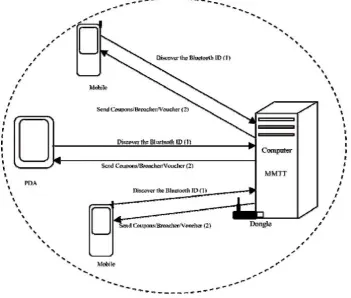
In the revolution of mobile technology and according to the growing radio frequency and wireless market in an unimaginable dimension, we developed MMTT, a new tool for amobile advertising and marketing world. Figure 1 presents the architecture of the system and the sequence of the operation. The main idea of MMTT is to deploy Bluetooth devices in indoor/outdoor areas, creating a Bluetooth umbrella; therefore, we can track people through their mobile phones unique Bluetooth IDs, which enables locating consumers and sending advertisement to their mobile phones. First, the computer equipped with a Bluetooth dongle that connects into a computer’s USB port and enables the computer to communicate with other Bluetooth-enabled devices. Once it discovers the new Bluetooth-enabled devices, such as cell phone, PDAs or any other devices, abraded promotional customized multimedia message is sent in different formats such as text messages, pictures and audio messages from the computer to these devices. MMTT is a convenient and easy-to-use program; it has a kind of diversity and flexibility available for campaign development and enables companies or brands to reach their consumers. It also provides the opportunity to build a closer relationship to the potential consumer, where an ongoing permission-based communication is possible through the individual's mobile phone. It is considered as a successful system due to several facts: it is applicable in different environments and it can be deployed to a wide variety of locations to achieve advertiser's purposes, such as small business, restaurants, gas stations, banks, airport lounges, malls, doctor’s waiting rooms, retail locations, hospitals and university campuses. The main objectives of the MMTT are:
1. Building a complementary advertisement application for marketing in Jordan.
2. Provides a new way of marketing with interaction between users and customers.
3. Making the marketing in Jordan more attractive for public.
We expect the following benefits
1. Delivering high bandwidth of digital data without extra network charges.
2. Provides an easy and a fast access to existing or new mobile multimedia services. Sends different type of contents to handset that will motivate manufacturers to produce new models.
3. Offers several options for area coverage. The recommendation is that there is alwaysa visible call-to-action which alerts target users that the system is available and that transmission range matches the visibility of the call-to-action service.
4. Customers have the option to accept or reject the message; therefore, it is considered as non-intrusive.
5. Provide a new technique which save time, money and effort for customers and users.
System Architecture
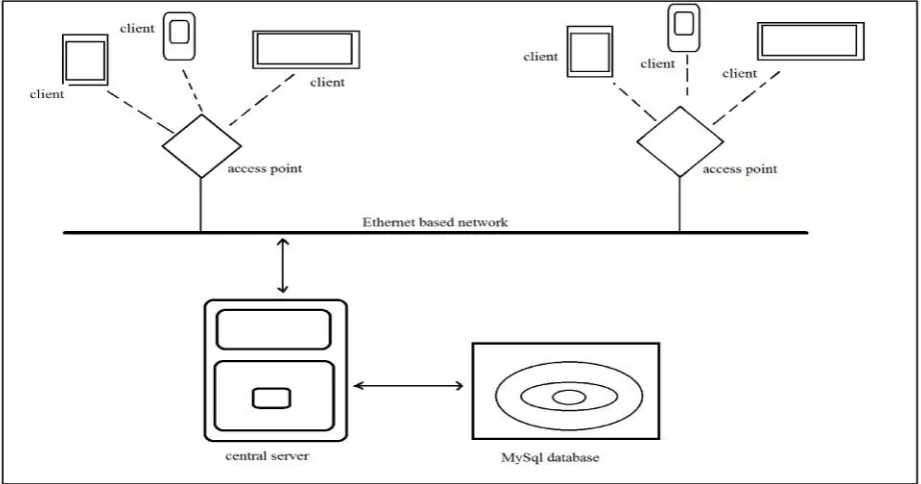
[image:3.595.51.512.512.754.2]The overall network architecture is based on the cooperation of an edge wireless network and a core wired network. The edge side is solely based on Bluetooth technology used by mobile devices like phones or PDAs. The core network is based on a fixed 100 Mbps Ethernet local area network used to connect the system edge infrastructure with the central database and file server. We developed client and server code, providing routines to handle detection of mobile devices, client information gathering and file delivery. To do so, our system employs Bluetooth wireless technology. Figure shows a schematic representation of our system architecture. The system considers three types of software entities: client mobile devices, Thel Access Points (APs) and the Central Database
and File Server. A customer provided with a Bluetooth enabled mobile device is the basic example of a mobile client. There are several Aps scattered all along the mall, and each AP is pre-configured to serve a different zone or area of the mall, although there can be some APs serving the same zone without disturbing each other. While wandering around the mall, a client with a Bluetooth enabled mobile device will occasionally become within range of a well-placed AP. When the client’s mobile device is spotted by the AP, the latter will contact the Central Server, searching for information about that client. If the client didn’t receive some of the advertisements and/or general store information belonging to the zone the AP is serving, our AP will retrieve it from the server and push it to the client.
Bluetooth Advertisement System is able to deliver advertisements to customers without requiring any user interaction or any additional device configuration. The system is capable of determining where the client is located by detecting proximity to an AP and sending the specific advertisements based on this information. Advertisements are carefully kept and managed in the Central Server, who controls when an advertisement is outdated or what information is going to be delivered in each mall zone. These advertisements are literally pushed into the client’s device, waiting for a final confirmation to be transmitted and stored inside the client’s mobile device memory. Our system is capable of controlling when an advertisement is suitable to be delivered and to whom. If that advertisement was delivered some time ago to the same device, it will not be sent again until the system administrator considers the first message old enough. Having this kind of control makes system a non-intrusive advertisement application, consequently gaining the clients’ indulgence.
When deciding what kind of advertisements we were going to deliver, we encountered two distinct options. To send text files in .txt file format was our first idea, but after studying the types of mobile devices currently available in the market we noticed that not all of them were capable of dealing with this sort of format, only the most powerful and expensive ones. So, a better approach came up: to deliver advertisements in the form of .jpg files. This format is recognized by all the mobile devices a possible client could have, and so system can reach a wider range of users. This was without any doubt our best solution.
ALGORITHM
Algorithm for the file transmission:
IF (Access Point has file in cache AND that file is recent) Send cached file to client;
ELSE {
Send Request File Message to Fileserver; Wait for Send File Message from Fileserver; IF (File Not Found)
RETURN ERROR;
ELSE IF (File Not Modified) Send cached file to client; ELSE
Send received file to client;
}
Implementation
The application was developed using the standard Java APIs for Bluetooth wireless technology (JABWT) proposed by the Java Experts Group JSR-82 [10]. The JABWT standard provides many useful APIs to develop applications usingL2CAP and OBEX protocols. In our system we are using OBEX as the main communication protocol. OBEX is a communications protocol that facilitates the exchange of binary objects between devices, similar in design and function to HTTP in that a client uses a reliable transport to connect to a server and may then request or provide objects.
The Bluetooth APs
The APs are located between the Central Server and the clients. First of all, every AP configures itself using aXML file, reading its setup for variables like AP location zone, time elapsed to consider a client’s visit like a new visit and server address. In the previous configuration, we set what amount of time this AP can ignore the mobile device until it is considered as a new visit. In our prototype, weave set this period to one day. When the configuration process concludes, APs start to work. APs can start the Bluetooth inquiry process in search of near by devices with Bluetooth enabled. When an inquiry procedure finishes, all new discovered devices (because it isa first visit or a long time has elapsed) will be added to the database and/or its last visit updated. Then they will be handled using the OBEX Object Push (0x1105) service. This service is supported by the vast majority of devices and, in an advertisement system where our goal is to reach as many clients as possible, it’s our best option. The number of simultaneous service searches supported is determined by the Bluetooth hardware used in our APs. However, notice that specific devices such as the Bluegiga Bluetooth AP could be used in order to support several simultaneous connections. When the required OBEX Object Push service is found in any of the devices, the database is updated accordingly. In the future, the next time the same device is detected, the system can retrieve related information from the data base without performing another unnecessary service search. When we have a list of all devices fulfilling our requisites and ready to be served, a new process will spawn for each device to carry on with the advertisement transmission. Such process will get the service-route from the database in order to connect with the client. Apart from the serviceroute, that process will demand to the database all the general advertisements (sent from any AP, no matter what zone belongs) and those specific to the zone the AP is currently serving. All advertisements not sent before to the device will be sent concurrently. For delivery, all APs maintain alocal file cache in case they have the file prior to requestingit from the server. Algorithm 1 shows this procedure. Furthermore, in order to achieve a better performance and efficiency, there is a table in the database with the mobile MACs of employees to ignore them when performing thein quiry and to avoid sending advertisements to them.
The Central Server
and to run and manage the SQL database accessed by the APs to consult and modify all the information related to mobile devices and advertisements.
The File Server
The Central Server includes a file server to deal with file requests from the APs. On startup, the file servercon figures itself using an XML file. When it’s running, itwaits for an AP connection request on the default serverport, defined as 8060. As soon as a connection request is received, a new server process is spawned to attend it, leaving the main process to continue waiting for new requests. That process receives the AP message and checks if it corresponds with a standard Bluetooth request message or if, other wise, it must be ignored. If everything is correct, the process can obtain the requested file’s name and when wasthe last modification of that file (in case the AP had a copy in cache). When all that information is gathered, the server process checks if that file exists in the central server repository. If no such file is found in the server, a message reporting ”File not found” is sent back to the AP for it to continue working normally, without sending that file. If that file is in the server, the process verifies whether that file is newer than the one in the AP by looking into the last modification dates. In case no updating is necessary, a message containing ”File not updated” is transmitted to the client AP, informing that the file kept by the latter is suitable to be sent, avoiding unnecessary traffic. However, if the file in the AP is older or the AP does not have such file in cache, a message holding the new file will be dispatched and kept in the AP’s cache for future transactions.
The Database
The Central Server stores in an SQL database all the information related to the system. It is based on eleven different tables, containing all kinds of information from mobile devices detected to last visits of customers, mall zones, establishments and advertisements. SQL provides an efficient storage support and maintenance. To facilitate the control of system and manage the database and all the advertisement messages ready to be sent to the clients’ devices, we have developed a management application. By means of it, the complete management of the complete management of the Bluetooth Advertisement System becomes very intuitive.
Conclusion
In this paper we presented m-advertising system using pull-based approach. The advantage of the system is all advertisements received by users are based on their requests. This approach can eliminated spamming issues in m-advertising system. Although security issues not fully address in this project, however, major issues like spamming has been resolved. Users now can freely accept or retrieve any advertisement and not worrying about being flooded by unwanted messages. As mention in the previous section, future enhancement should be focus more on other security issues. Not only issues related to Bluetooth security itself but issues such as content and availability of the system to users. Thus we ensure that the community will enjoy the benefit of mobile lifestyle by making use the benefit of mobile technology and its application.
REFERENCES
Bill N. Schilit, Norman Adams, and Roy Want. Context-aware computing applications. in proceedings of WMCSA 1994, pp.85-90, IEEE computer society.
Bluegiga - bluetooth modules and access servers, aps.http://www.bluegiga.com/.
Department of Computer Science and Engineering, Anna University, Chennai, INDIA (2005), Location Dependent Parking Services through Bluetooth, URLhttp://www.acadjournal.com/2005/v15/part6/p1/Locati on Dependent Parking Service Throught Bluetooth_AOIJ-files/filelist.xml
Java.sun.com, Java Wireless Toolkit.
Kumar B. Jsr-82: Java apis for bluetooth. Availableat: http://www.jcp.org/en/jsr/detail?id=82.
Philip Robinson and Michael Beigl. Trust contextspaces: An infrastructure for pervasive security incontext-aware environments. In SPC, pages 157–172, Telecooperation Office, Institut fur Telematik, Universitat Karlsruhe., 2003.