COMPARISON OF FACIAL EXPRESSION ANALYSIS BASED ON IMAGE PROCESSING TECHNIQUES
Prof. Dr. P. K. Srimani
1
Former
chairman, Department of
2
Assistant Prof and HOD of Physics, Acharya Institute of Technology, Bangalore
ARTICLE INFO ABSTRACT
Comparison of facial expression was studied in this paper using several properties associated with the faces. Actually, as the facial expression changes, the curvatures developed on the face and the dimensions of the objects such as eyebrows, lips and the
exist changes in the intensity of the pixels corresponding to these objects. Therefore it was found that the natural eye could distinguish these sharp changes and understand the facial expressions accordingly. Comp
carried out. We have taken face as one object and compared the facial expressions for five types of emotions in the case of Indian and Japanese faces. The percentage changes wer
regard to certain parameters related to different expressions associated with the face and that of the neutral face of the same person. The experimental results predicted a definite change in every trail. These results can also be used as a
objects in the given environment. The results are found to be of immense scientific interest.
INTRODUCTION
To improve visibility and to extract maximum information from an image, a number of image processing techniques are applied. Techniques include convolution edge detection,
filters, trend removal, and image analysis.
Enhancement techniques make information
particular, histogram equalization will redistribute the intensities of the image of the entire range of possible intensities (usually 256 gray-scale levels). Unsharp masking subtracts smoothed image from the original image to emphasize intensity changes. whereas convolution
program that consists of 3x3 masks operating on pixel neighborhoods. High pass filters application emphasizes regions with rapid intensity changes. Low pass filter smoothen
images blurs regions with rapid ch
filters normally decrease noise by diminishing statistical deviations. Adaptive smoothing filters sets pixel intensity to a value somewhere in between the original value and the mean value corrected up to the degree of noisiness. It is good fo decreasing the statistical, especially single dependent noise. Median filter usually sets pixel intensity equal to median intensity of pixels in neighborhood. This is an excellent filter for eliminating intensity spikes. But, sigma filter sets pixel intensity equal to mean of the intensities in neighborhood within two of the mean which is a good filter for signal independent noise. Trend removal programs remove intensity trends varying slowly over the image. Row column fit fits the image intensity along a row or column by a polynomial and subtract it from the data. It chooses row or column according
*Corresponding author: [email protected]
ISSN: 0975-833X
Article History:
Received 25th October, 2011
Received in revised form
28th November, 2011
Accepted 7th December, 2011
Published online 31st January, 2012
Key words: Pixels, Facial expressions, Intelligent systems, Environment, Kurtosis,
Entropy, skewness, etc,.
RESEARCH ARTICLE
COMPARISON OF FACIAL EXPRESSION ANALYSIS BASED ON IMAGE PROCESSING TECHNIQUES
Prof. Dr. P. K. Srimani
1and Ramesh Hegde
2chairman, Department of Computer Science and Maths,
Bangalore University, Bangalore
Assistant Prof and HOD of Physics, Acharya Institute of Technology, Bangalore
ABSTRACT
Comparison of facial expression was studied in this paper using several properties associated with the faces. Actually, as the facial expression changes, the curvatures developed on the face and the dimensions of the objects such as eyebrows, lips and the area of the mouth change. Naturally there exist changes in the intensity of the pixels corresponding to these objects. Therefore it was found that the natural eye could distinguish these sharp changes and understand the facial expressions accordingly. Comparison of Indian facial expressions with that of Japanese face expressions is carried out. We have taken face as one object and compared the facial expressions for five types of emotions in the case of Indian and Japanese faces. The percentage changes wer
regard to certain parameters related to different expressions associated with the face and that of the neutral face of the same person. The experimental results predicted a definite change in every trail. These results can also be used as a tool to design intelligent systems which recognizes different objects in the given environment. The results are found to be of immense scientific interest.
Copy Right, IJCR, 2012, Academic Journals
To improve visibility and to extract maximum information from an image, a number of image processing techniques are applied. Techniques include convolution edge detection,
filters, trend removal, and image analysis.
techniques make information more visible. In particular, histogram equalization will redistribute the intensities of the image of the entire range of possible scale levels). Unsharp masking subtracts smoothed image from the original image to whereas convolution method is a program that consists of 3x3 masks operating on pixel neighborhoods. High pass filters application emphasizes regions with rapid intensity changes. Low pass filter smoothen
images blurs regions with rapid changes. Noise
normally decrease noise by diminishing statistical deviations. Adaptive smoothing filters sets pixel intensity to a value somewhere in between the original value and the mean value corrected up to the degree of noisiness. It is good for decreasing the statistical, especially single dependent noise. Median filter usually sets pixel intensity equal to median intensity of pixels in neighborhood. This is an excellent filter for eliminating intensity spikes. But, sigma filter sets pixel ensity equal to mean of the intensities in neighborhood within two of the mean which is a good filter for signal programs remove intensity trends varying slowly over the image. Row column fit fits the a row or column by a polynomial and subtract it from the data. It chooses row or column according
to direction that has the least abrupt changes. detection program sharpens intensity transition
helps to draw a line of debarkation between two regions of
different intensity. Image analysis
information from an image. Gray
mapping of intensity of pixels in file to intensity displayed on a computer screen. Slice plots intensity versus position for horizontal, vertical, or arbitrary direction. This will List the intensity versus pixel location from any point along the slice. Image extraction extracts a portion or the whole image and creates a new image with the selected area. Image statistics will calculate the maximum, minimum, average, standard deviation, variance, median, and mean
the image data.
Various image processing approaches based on textures, spatial variation, HSV color
feature based on histogram and some of the pattern recognition methods, like gray level covariance matrix, roughness of the text, perimeter of edge are highlighted. expressions provide an important behavioral measure
study of emotion, cognitive processes, and social interaction. Facial expressions are the means to convey emotions, feelings, warning signs of dangers, happiness, disappointments, confidence etc. of human beings. It is injected into the living things from the womb to tomb. Psychologists, Saints and Men of spirituality consider facial expressions as indications of hidden truth and exposition of sudden feelings, in the right way, at the right time without any reservations. expression analysis and recognition have received substantial attention from researchers in biometrics, pattern recognition,
International Journal of Current Research
Vol. 4, Issue, 01, pp.191-196, January, 2012
INTERNATIONAL
COMPARISON OF FACIAL EXPRESSION ANALYSIS BASED ON IMAGE PROCESSING TECHNIQUES
Bangalore University, Bangalore
Assistant Prof and HOD of Physics, Acharya Institute of Technology, Bangalore
Comparison of facial expression was studied in this paper using several properties associated with the faces. Actually, as the facial expression changes, the curvatures developed on the face and the area of the mouth change. Naturally there exist changes in the intensity of the pixels corresponding to these objects. Therefore it was found that the natural eye could distinguish these sharp changes and understand the facial expressions arison of Indian facial expressions with that of Japanese face expressions is carried out. We have taken face as one object and compared the facial expressions for five types of emotions in the case of Indian and Japanese faces. The percentage changes were computed with regard to certain parameters related to different expressions associated with the face and that of the neutral face of the same person. The experimental results predicted a definite change in every trail. tool to design intelligent systems which recognizes different objects in the given environment. The results are found to be of immense scientific interest.
, Academic Journals. All rights reserved.
to direction that has the least abrupt changes. An edge detection program sharpens intensity transition regions and to draw a line of debarkation between two regions of
Image analysis programs extract
information from an image. Gray-scale mapping alters mapping of intensity of pixels in file to intensity displayed on een. Slice plots intensity versus position for horizontal, vertical, or arbitrary direction. This will List the intensity versus pixel location from any point along the slice. Image extraction extracts a portion or the whole image and with the selected area. Image statistics will calculate the maximum, minimum, average, standard deviation, variance, median, and mean-square intensities of
Various image processing approaches based on textures, space, spatial correlation, and feature based on histogram and some of the pattern recognition methods, like gray level covariance matrix, roughness of the text, perimeter of edge are highlighted. Facial expressions provide an important behavioral measure for the study of emotion, cognitive processes, and social interaction. Facial expressions are the means to convey emotions, feelings, warning signs of dangers, happiness, disappointments, confidence etc. of human beings. It is injected into the living ngs from the womb to tomb. Psychologists, Saints and Men of spirituality consider facial expressions as indications of hidden truth and exposition of sudden feelings, in the right way, at the right time without any reservations. Facial and recognition have received substantial attention from researchers in biometrics, pattern recognition,
and computer vision communities. Their applications are quite large such as security, communication, and entertainment. Facial expression analyses is generally classified in to two methods
1. Geometric feature-based methods- It present the
shape and locations of facial components (including the mouth, eyes, brows, and nose). The facial components or facial feature points are extracted to form a feature vector that represents the face geometry.
2. Appearance- based methods apply image filters such
as Gabor wavelets to either the whole face or specific regions in a face image to extract a feature vector With few exceptions, most AFEA systems attempt to recognize a small set of prototypic emotional expressions (e.g. disgust, fear, joy, surprise, sadness, anger). This practice may follow from the work of Darwin, and more recently Elman and Friesen and Izard et al., who proposed that emotion-specified expressions have corresponding prototypic facial expressions. In everyday life, however, such prototypic expressions occur relatively infrequently. Instead, emotion more often is communicated by subtle changes in one or a few discrete facial features, such as tightening of the lips in anger or obliquely lowering the lip corners in sadness. To capture such subtlety of human emotion and paralinguistic communication, automated recognition of fine-grained changes in facial expression is needed. The facial action coding system (FACS) is a human-observer-based system designed to detect subtle changes in facial features. Viewing videotaped facial behavior in slow motion, trained observers can manually code all possible facial displays, which are referred to as action units and may occur individually or in combinations.
A detailed analysis of a research works on the facial expression recognition over the last decade is found in [Fasel and luettin, 1999]. Recognition of face using eigen space projection methods [Turk and Pentland, 1991] was very well explained which had concentrated on the pixel levels. Each image is treated as a one dimensional vector and compared to detect the correct one. Later this method was improved using fisher space [Yang and Frangi, 2003]. Then facial features are extracted using haar classifiers[ Wilson and Fernandez, 2006]. Eigen decomposition method was developed [Randy and Hoover, 2009] to recognise the sub spaces in a face which was based on the spectral theory. Even the facial features are analysed on the wrapped images[ Hui Li, and Guang Yang, 2006]. Face recognition process has two phases, representation and learning, both of which are recurring topics in computer vision. The primary task of representation is to find efficient salient features from raw face images. There are various methods, by which one can recognize faces accurately, but the recognition of emotions became a topic of high attention as we failed to put a line of demarcation between one expression with the other. Of course, it is subjective and the level of understanding the emotions has changed as the new and sophisticated models and algorithms are developed. For security reasons, the focus is diverted even to understand the true and false expressions in the face. The wide range of potential applications of the present research includes, image
understanding, synthetic animation, psychological study and intelligent human computer interaction and has lead to more attention on the facial expression recognition systems. In man, facial expressions were well studied, since 1971 by the pioneers viz., [Ekman and Friesen, 1971]. Even in the theory of evolution [ Darwin, 1872], there are reminiscence of the rule of automatic facial expression, to grab new shapes and intelligence in the transformation process of one animal into another. The authors are acclaimed of their contributions to the postulation of six primary emotions - happiness, sadness, fear, disgust, surprise and anger. These six distinctive facial expressions are unique in their feature. Emotions often come out as gestures, postures and even body languages in human beings. It may attain different forms with or without voice modulation to convey different needs, feelings, and anticipation. Initially, automatic facial expression was of great concern to psychologists but later it gained momentum due to its application for face detection, face tracking, face recognition, image understanding, facial nerve grading [ Gantz, and Rubinstein, 1999] in medicine etc. Now, around the globe researches are being conducted on different areas like facial image compression, synthetic animation [Koenen, 2000], video-indexing, robotics and virtual reality in addition to psychological studies.
It was difficult to explain facial expressions by simple measurements of wrinkles or textures. So, facial expression intensity measurements were also started. Again, it was further evolved that simple static images do not clearly depict subtle changes in faces and hence accurate timings were also recorded as yet another facial expression parameter. Accordingly, three important temporal parameters viz. onset (attack), apex (sustain), offset (relaxation) were studied. The reliability of these facial measurements was often subjected to errors, since it was being done by human coders. The Facial EMG (electromyographic) [Schwartz and Fair, 1976] was extensively used for automatic computation of onset and offset
of facial expression. Accordingly, two different
methodological approaches came into existence viz. (i) Judgment based and (ii) Sign vehicle based [Ekman, 1982 ]. Through this paper we would like to discuss some of the key parameters which can help in classifying and comparing the facial expressions related to Indian and Japanese faces. A through survey of the literature pertaining to this topic reveals that no work is available in this direction. Therefore the present investigation is undertaken in order to predict qualitative as well as quantitative results pertaining to the comparison of facial expression of deferent continents. It is quite amazing to see how our mind is able to put a line of demarcation between two expressions of the same face. Not only it distinguishes the facial expressions but also faces of different continents. Visual perception may be dependent solely on the curvatures and the resultant geometry and shapes developed on the face. It is unimaginable that the calculations we implement are also happening in our mind before distinguishing different facial expressions. Parametric analysis of facial expressions related to the components such as nose, mouth and eyes on Japanese faces is reflected in [ Srimani and Ramesh Hegde, 2011].
EXPERIMENTS AND RESULTS
expressions of the same face including anger, happy, sad and surprise. Then these results were compared with Japanese faces for the similar expressions. In the following sections the details about the obtained features are discussed.
Data set description
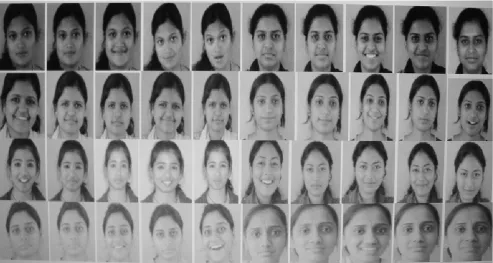
It is important to discuss the facial expression database and calculation of different parameters. We have used the Japanese female Facial expression(JAFFE) database. It si downloaded from the site http://www.kasrl.org/jaffe.html. This (fig.1)is used for testing the variations in them with respect to entropy, skewness and kurtosis. It contains 213 grayscale images of 6 facial expressions (happiness, anger, sadness, fear, disgust and
[image:3.595.75.513.51.291.2]surprise) plus one neutral face posed by 10 Japanese women. The size of each image is 256X256. Tests are performed for investigating the changes with respect to above said parameters on neutral face and different expressions of the same face by using VC++ software. Then the same is tested for the Indian data base (fig.2) created by ourselves using sony cyber shot camera with 12.1mega pixels resolution. This database consists of female faces of 55 students belonging to the final year degree course at Acharya institute of technology, Bangalore, India. In each case five different expressions are considered, ie., angry, sad, surprise, happy along with neutral face.
Fig 1. Sample of Japanese female Facial expression (JAFFE) database
[image:3.595.49.543.325.588.2]
Fig 3. Entropy vs indian face expressions
Fig 4. Entropy vs japanease face expressions
Figure. 3 represents the variation of entorpy of faces with changes in expression on indian faces. From the graph it is clear that variations in entropy is same for face F and G. But the entrpy variations is deeper in case of F than G. Further, figure 4. represents the variation of entropy of faces with changes in expression on the japanease faces. In this case, the face B and D exhibit similar varitions with B having deeper changes.
Fig 5. Skewness vs indian face expression
Fig 6. Skewness vs japanease face expressions
Figure 5. and figure 6. represent the variations of skewness in indian and the japanese faces respectively with the facial expressions. In this case also the variation of skewness for two faces are found to be the same but not in others.
Fig 7. Kurtosis vs indian face expressions
Fig 8. Kurtosis vs japanease face expressions
Figure 7. and figure 8. represent the variations in kurtosis of indian and the japanese faces respectively as the facial expression change. In this case, surprisingly most of them posess similar changes. Incase of japanese faces the variation in kurtosis is large from happy to angry face and then from angry to sad, and the variation is symmetric on either side of
nutral happy angry sad surprise
7.942 7.944 7.946 7.948 7.950 7.952 7.954 7.956 7.958 7.960 7.962 7.964 7.966 Entr o py
facial expressions of indain faces B C D E F G H
Neutral Happy angry Sad Surprise
7.24 7.26 7.28 7.30 7.32 7.34 7.36 7.38 7.40 7.42 7.44 7.46 7.48 7.50 Entrop y
facial expressions with of japanease faces B C D E F G
nutral happy angry sad surprise
0.25 0.26 0.27 0.28 0.29 0.30 0.31 sk ewn e ss
facial expressions of indian faces B C D E F G H
Nutral Happy angry Sad Surprise 0.00 0.05 0.10 0.15 0.20 0.25 0.30 0.35 0.40 0.45 0.50 0.55 0.60 0.65 0.70 0.75 0.80 0.85 0.90 0.95 1.00 sk ewn ess
facial expressions of japanease faces B C D E F G
nutral happy angry sad surprise
0 10 20 30 40 50 60 ku rtosis
facial expression of indian faces B C D E F G H
Neutral Happy angry Sad Surprise
0 20 40 60 80 100 120 kur tos is
the angry faces in both the cases. From the above experiments again it was clear that the entropy and the skewness are inversely proportional to each other. The component with greater entropy will have lesser skewness. I.e., if the information in the image is more, then the image is less asymmetric. From the graphs six out of ten are plotted, two of them show similar changes as the facial expressions change. For the remaining there are no similarities at all. That is just 30% of the human faces will have similar variations with respect to different facial expressions.
Conclusions
Human faces contain abundant information of human facial behaviors. According to Johansson’s point-light display experiment, facial expression can be described by the movements of points that belong to the facial features such as eye brows, eyes, nose mouth and chin and analyzed by the relationships between those features in movements. Hence point based visual properties of facial expressions can then be used for facial gesture analysis. About 55% of human communication relies on facial expressions. The experiments were conducted with regard to facial recognition under expression changes by using parametric analysis based on statistical approach. Our experimental results are found to be very interesting and the predicted results are: (i) Entropy and skewness of any image are inversely proportional to each other. (ii) Higher the entropy value the lesser is the value of skewness and vice versa. (iii) Two out of the six graphs plotted shown exact variations in all parameters such as entropy, skewness. (iv) Thirty percent of the human faces posses similar changes with respect to these set of faces as their expression changes and v) But, surprisingly in the case of kurtosis, majority of the graphs in both Indian and Japanese showed similar changes This shows that human brain does not depend on only the mathematical expressions that are used here but on something else while recognizing facial expressions. Even the natural expression on the face depends on the hardness of the skin and not just on the texture of the skin. More the hardness of the skin greater is the elasticity and lesser is the deformation. Harder the surface of the skin, lesser is the curvature developed and less is the change in intensity. If the change in intensity is less, the asymmetric distribution of pixels having certain intensity is less. This is very much true in cases when we compared kurtosis of Indian faces with kurtosis of Japanese faces. This should play a vital role in the designing of an intelligent system to recognize objects with sharp changes in appearance.
It was concluded that facial behaviors could also be used as another behavioral biometric for human identification and verification. The experimental results showed that a face recognition system with optimal design may eventually be developed, which is robust to the problem of facial expression changes. There is a scope to find new algorithms and new methods which can help to design computer vision system.
REFERRENCES
Darwin, C. 1872. The Expression of the Emotions in Man and Animals, J. Murray, London.
Cohn, J., Zlochower, A., Lien, J. J. & Kanade, T., 1999, Automated face analysis by feature point tracking has
high concurrent validity with manual FACS coding.
Psychophysiology, 36, 35-43.
Donato, G., Bartlett, M. S., Hager, J. C., Ekman, P. &
Sejnowski, T. J., 1999. Classifying facial actions. IEEE
Transactions on Pattern Analysis and Machine Intelligence, 21, 974-989.
Ekman, P. & Friesen, W. V., 1975, Unmasking the Face, New
Jersy, Prentice Hall.
Essa, I. A. & Pentaland, A. P., 1997, Coding, analysis,
interpretation, and recognition of facial expressions. IEEE
Transactions on Pattern Analysis and Machine Intelligence, 19, 757-763.
Fasel and J. luettin, 1999, “Automatic facial expression analysis: A survey”, Pattern recognition, vol. 36, pp. 259-275,.
Fasel, B. & Luettin, J., 2003, Automatic facial expression
analysis: a survey. Pattern Recognition, 36, 259-275.
Schwartz, G., P. Fair, P. Salt, M. Mandel, G. Klerman, 1976, Facial expression and imagery in depression: an electromyographic study, Psychosomatic Med. 38, pp 337–347.
Hui Li, Hui Lin and Guang Yang,” 2006, A New Facial Expression Analysis System Based on Warp Images”, Proc. of Sixth World Congress on Intelligent Control and Automation, Dalian, China.
Johansson, G., 1973, Visual perception of biological motion
and a model for its analysis. Perception & Psychophysics,
14, 201-211.
Johansson, G. 1976, Spatio-temporal differentiation and
integration in visual motion perception. Psychological
Research, 38, 379-393.
Ekman, P., W.V. Friesen, 1971, Constants across cultures in the face and emotion, Journal of Personality and Social Psychology, Vol 17(2), 124–129.
Ekman, P. 1982. Emotions in the Human Face, Cambridge University Press, Cambridge. P. Dulguerov, F. Marchal, D. Wang, C. Gysin, P. Gidley, B. Gantz, J. Rubinstein, S. Sei 7,
Poon, L., K. Lun, Y. Ng, 1999, Review of objective topographic facial nerve evaluation methods, Am.J. Otol. 20 (5), 672–678.
Srimani, P. K. and Ramesh Hegde, 2011, Parametric analysis of facial expressions based on the statistical approach,
International Journal of Current Research, Vol. 3, Issue, 11, pp.152-155, October, 2011
Pantic, M. & Rothkrantz, L. J. M., 2000a Automatic analysis
of facial expressions: the state of the art. IEEE
Transactions on Pattern Analysis and Machine Intelligence, 22, 1424-1445.
Pantic, M. & Rothkrantz, L. J. M., 2000b, Expert system for
automatic analysis of facial expressions. Image and
Vision Computing, 18, 881-905.
Pantic, M. & Rothkrantz, L. J. M. (2004) Facial action recognition for facial expression analysis from static face
images. IEEE Transactions on Systems, Man and
Cybernetics,Part B., 34, 1449-1461.
Koenen, R. 2000, Mpeg-4 Project Overview, International Organization for Standardization, ISO/IEC JTC1/SC29/ WG11, La Baule.
Tian, Y. I., Kanade, T. & Cohn, J. F. (2001) Recognizing
action units for facial expression analysis. IEEE
Turk, M., and Pentalannd, 1991, A. Face recognition using
eigenfaces. In Proc. IEEE Conf. on Computer Vision and
Pattern Recognition , vol. 591.
Valstar, M. & Pantic, M., 2006, Fully Automatic Facial Action
Unit Detection and Temporal Analysis. 2006 Conference
on Computer Vision and Pattern Recognition Workshop
Vetterli, M. Fast 2-D discrete cosine transform. In
ICASSP'85, p. 1538.
Vukadinovic, D. & Pantic, M., 2005, Fully Automatic Facial Feature Point Detection Using Gabor Gesture Based
Boosted Classifiers. IEEE International Conference on
Systems, Man and Cybernetics. Waikoloa, Hawaii. Wilson, P . I., and Fernandez, J., 2006, Facial feature
detection using haar classifiers. J. Comput. Small Coll.
21, 4 ,127-133.
Yang, J . ,and Frangi, A., 2003, Combined fisherfaces
framework. Image and Vision Computing ,21, 12 ,
1037-1044.