© 2019, IRJET | Impact Factor value: 7.211 | ISO 9001:2008 Certified Journal
| Page 2935
Design & Analysis of Multi-Frame for Octo & Quad Copter Drones
Swapnil Yemle
1, Yogeshwar Durgude
2, Ganesh Kondhalkar
3, Ketan Pol
41
P.G. Student (M.E), Department of Mechanical Engineering, Anantrao Pawar College of Engineering & Research,
Pune, Maharashtra, India
2
Master of Science, Advanced Manufacturing, Kingston University, London
3
Professor& HOD, Dept. of Mechanical Engineering, Anantrao Pawar College of Engineering & Research, Pune,
Maharashtra, India
4
M. Tech (Thermal), Dept. of Mechanical Engineering, Sinhgad College of Engineering, Pune, Maharashtra, India
---***---Abstract -
Now a day's multi-rotor commonly known asdrones, are attracting much attention in media and research. Many industries are interested now in using drones because they are fast, cost-effective and efficient solutions. There are many different applications for drones such as parcel delivery, rescue operations, construction drones, infrastructure inspection, military operations, agriculture monitoring and many more. This is very attractive opportunity for entrepreneurs and drone market is growing very fast. Whether it is a new initiative within a company or a new start-up, the problem really is what drone application is worth to develop. At present, drone application are many in 21st century but the
cost of the drones are very high, so in this paper we are trying to reduce the cost of the frame and we are focused only on frame of heavy Octocopter drones which will replacing the Carbone fiber pipe to the aluminum pipe with simple design concept of the drone and compacting the overall size of the drone frame and joining with the 3D printed plastic parts. Our aim in this paper work is we are trying to reduce as much as possible weight and cost for the Octocopter drone frame and easy to manufacturing and assembling the frame are consider while designing the frame of the drone. The design is arrange in a simple way such that we can easily separate in two quad copter or easily combine in one octocopter like that multi-functional frame design is arranged with the all parameters are consider such that payload, battery, motors, propellers and electronic control units etc. The frame is design in CATIA V5 CAD software and static analysis is done in ANSYS 19.2 software and find out the total deformation and stress in the frame body of the drone.
Key Words: Quad copter drone, Octo copter drone, multi-frame, CATIAV5, ANSYS.
1. INTRODUCTION
Drones are now being implemented in various fields such as agriculture, mining, surveillance, mapping, reconnaissance, etc. The versatility of drones has been expanding due to the highly advanced electronics available today. Imaging sensors, thermal sensors, passive infrared sensors, obstacle detection are some of the most commonly used ones today. Infrastructure surveillance and maintenance is done with less use of manpower using drones. Critical structures that require a lot of energy and
time for inspection such as cable towers, wind mills, solar farms, industrial buildings walls and dams, can be easily inspected with the help of drones.
Drones come in a variety of designs, such as a fixed-wing drone, which looks like a plane, or a rotorcraft drone, which looks similar to a helicopter, though often with multiple rotors (usually up to eight). The latter has vertical takeoff and landing capabilities and it can hover, which makes this design particularly attractive in close quarters, such as crowded urban areas. Tilt-wing drones combine features of fixed-wing and rotorcraft drones using wings that can be swiveled. Drones may use different types of propulsive power, including internal combustion engines, electric batteries, and solar and hydrogen fuel cells
1.1 Quad copter drone
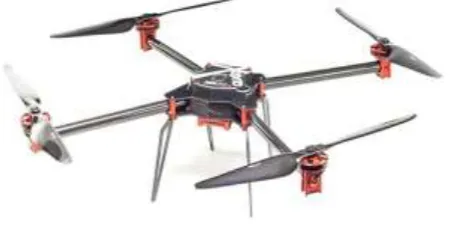
The most popular multi-copter on the market Quad copters is fast, easy to manufacture and affordably priced. These copters utilize four propellers to ensure that the aircraft is able to lift up into the air.
Essentially, there is a 4 propeller layout in the design of a square or rectangle around the body.
Fig -1: Quad copter drone
The one obvious benefit is that with four propellers, the product has a lot more power to be able to lift off of the ground this allows for more payload or overall weight to be added.
[image:1.595.329.555.532.645.2]© 2019, IRJET | Impact Factor value: 7.211 | ISO 9001:2008 Certified Journal
| Page 2936
Relatively cheap to manufacture. Great maneuverability.
Powerful enough to add accessories. Greater thrust and power versus tri-copters
1.2 Octo copter drone
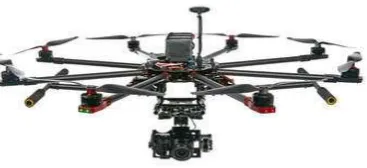
[image:2.595.76.260.308.392.2]The octocopter has all of the benefits seen with the hexacopters, but with even more power. These models are not cheap by any means and are often seen capturing the best aerial footage available. If you’re a professional videographer, you may want to hold onto your hat because what the octocopter has to offer is simply stunning. Design-wise, this copter features 8 motors and propellers. These 8 motors provide the same benefit that the hexacopter provides over the quadcopter
Fig -2: Octo copter drone
Speed: Much faster than the competition and Reach
higher altitudes
Control: Terrific control that is not hindered as much by
wind or rain and More powerful and reliable
Safety: You can lose any one motor and still fly these
copters just as well as you could a hexacopter. Furthermore, you may be able to lose 2 or 3 motors without the craft crashing down, depending on positioning and the overall payload and Very stable flyers, handle better in adverse weather conditions
2. PROBLEM STATEMENT
In this study, the focus is on the use of drones for industrial works and more specifically for multi-purpose application as per the customer required to use in different conditions like heavy and light payload operating of drone for the industrial works and it should be easy and simple design as per the customers required to assembling the drone part frame and others all parameter of the drone.
As per the previous studies, the payload observed for the drone in Indian manufacturing sector was restricted. So I was given a task of improving the payload capacity for the drone. To ensure the same, I was asked to go through the various aspects of design concepts and manufacturing processes to be used.
3. OBJECTIVE
To design simple and multi-functional frame for higher weight capacities (Here – 2.5 kg)
Simple yet aesthetically appealing design Should be cost effective
Easy to assemble and dissemble
4. DESIGN
[image:2.595.354.525.313.633.2]In this paper we have design the quad drone frame in the CATIA V5 CAD software as per the shown below figures there are two type frame design as lower frame and upper frame which is easy to assemble the parts from the packing box and the materials is used as per low cost of manufacturing in which the pipe are use of aluminum material and joint plastic parts are made by 3D printed with 70% fill material which is quite stronger to the strength and we get much reduced weight for the frame design.
[image:2.595.357.527.314.457.2]Fig -3: Upper Quadcopter drone frame
Fig -4: Lower Quadcopter drone frame
[image:2.595.359.522.474.639.2]© 2019, IRJET | Impact Factor value: 7.211 | ISO 9001:2008 Certified Journal
| Page 2937
20000mah battery and for propeller are use in [image:3.595.302.570.75.220.2]quad/octocopter are 14inch diameter with using standard DJI motors are used, all other remaining parameters of electronic such as ESC, flight control, GPS, transmitter /receiver, Camera & Gimbal.
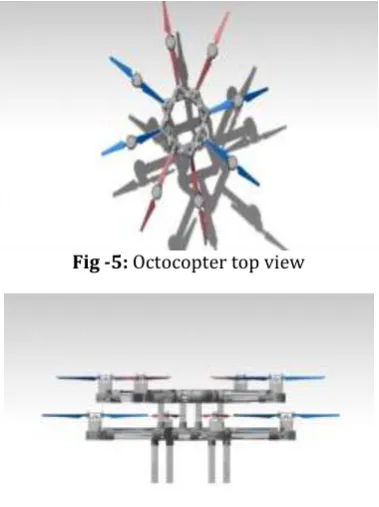
Fig -5: Octocopter top view
Fig -6: Octocopter side view
[image:3.595.74.264.161.415.2]payload is consider as 7-10 Kg for the octocopter drone frame, and propellers are 4 clockwise and 4 anti-clockwise propellers are used by color combination red and blue in isometric diagram of octocopter.
[image:3.595.78.262.512.633.2]Fig -7: Octocopter isometric view
Table No. 1 Approximately Cost& weight of Octocopter drone
Sr No.
Component Name Quantit
y
Per Price
Rs
Total Price in Rs
Wt in gm
1 Electronic Speed
Controller
8 446 3568 184
2 Brushless motor 8 749 5992 280
3 Lithium polymer 4 4389 17556 1440
battery
4 14 inch Propellers 8 446 3568 360
5 Ardupilot APM 2.8
Flight Controller Board
1 2627 2627 43
6
(6061-T6SP40-100-133) Seamless Aluminum Pipe
2meter 1250 /m
2500 700
7 3D Printed Joints 16 560 4500 200
8 GPS, transmission System and Other 17000 100
Approximately Total Cost 57311 3207
4.1 Flight Time Calculation
Quadcopter Flight Times = (Battery Capacity x Battery Discharge /Average Amp Draw) x 60
Quadcopter Flight Times = (5200 × 4 1000) × (80% 30amps) x 60mins = 165.9mins
Obviously this quadcopter battery calculator is a very simplistic calculator base on steady hover. For aerial photography work or FPV flying which the motors will have to spin faster, and thus pull more current. This higher current draw will reduce flight time and your flight times will degrade dramatically with about 75% or up to 50% of the calculated quad copter flight time.
So, 50% is considering as per safety so we get 165.9mins/2= 82.95mins and for Octocopter Drone 82.95mins/2= 41.4mins (self-weight & without Payload capacity of electronic system) While considering the self-weight of system is 3207gm and payload 4000gm is taken we get by analytical iteration calculation chart of Flight time Vs. Payload for Drone hence practically we get 22.5mins flight time with self-weight of the system and 9mins flight time at maximum payload capacity.
For checking the above calculation we have compared with xcopterCalc - Multicopter Calculator form Internet putting all above parameters and conditions for Octocopter drone in that calculator we got results as below shown.
[image:3.595.42.574.525.795.2]© 2019, IRJET | Impact Factor value: 7.211 | ISO 9001:2008 Certified Journal
| Page 2938
5. ANALYSIS
[image:4.595.50.273.164.287.2]The static analysis is done in ANSYS19.2 software for importing the CAD file we selected STEP file format and open the geometry is shown below
Fig -9: Import STEP files of Octocopter drone
6. PER-PROCESSING
[image:4.595.322.558.246.379.2]In the pre-processing the meshing in done on the default module in which software decide the mesh the geometry and gives results, in this we get number of nodes 561996 and number of element 282576 in Coarse mode. It is shown below figure
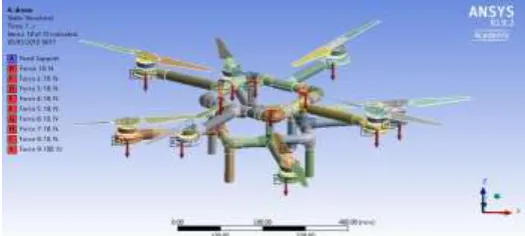
Fig -10: Meshing model of Octo copter drone In the setup mode we decide the fix support and gives loading conditions and apply the forces along the boundary conditions of the setup and we are trying to get maximum safety result according to the maximum loading condition and applied maximum forces in all direction for the static analysis is shown below
Fig -11: Static Setup of Octocopter drone
7. RESULT
The results are gets after solving the all pre-processing work in which all conditions and parameters are set in the software and find out the required results such as deformation, stress and safety factor of the frame is analyzed and shown below all results.
7.1 Total deformation
[image:4.595.37.295.402.529.2]In the loading conditions of all the forces we get 0.05mm deformation to the central of the frame and 0.83 to the edge of the motor as below shown in the figure.
Fig -12: Total Deformation of Octocopter drone frame
7.2 Maximum principal stress
In the loading conditions of all the forces we get 367Mpa maximum principal stress to the central of the frame and 36Mpa to the edge of the motor as below shown in the figure.
Fig -13: Max. Principal Stress of Octocopter drone frame
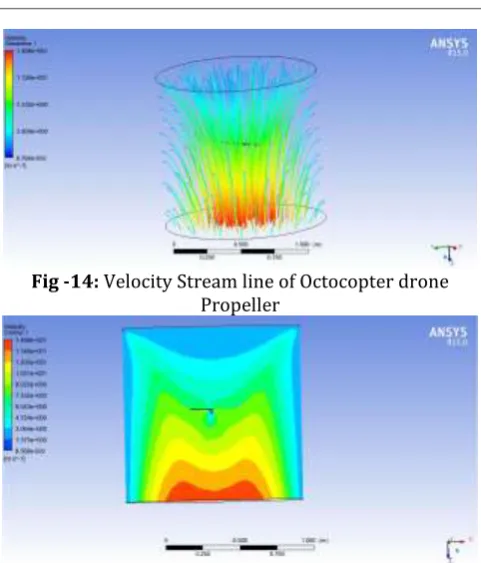
7.3 Fluid flow analysis of Propellers
[image:4.595.311.558.471.601.2] [image:4.595.35.298.624.742.2]© 2019, IRJET | Impact Factor value: 7.211 | ISO 9001:2008 Certified Journal
| Page 2939
Fig -14: Velocity Stream line of Octocopter dronePropeller
Fig -15: Velocity Contour of Octocopter drone Propeller
8. CONCLUSIONS
In this study, the focus was on the use of proposed drone for industrial works more specifically for multi-purpose application as per the customer requirement. The design considerations were explicitly for generic drone uses such as light and heavy duty applications, entertainment, courier services etc. I have tried to keep design as simple as possible so that manufacturing processes used will not cost much. The proposed drone is user friendly and also easy to understand.
In this paper I have tried to reduce (approximately 30 %) the manufacturing cost of the frame. To use it for more heavy applications, I have combined two quad copters in one octocopter. An acceptable safety factor of 3 was observed during static analysis of designed octocopter. This safety factor is very much acceptable considering its manufacturability and the applications for which it was initially targeted
Propeller Design is carried out by importing the airfoil section onto the datum planes. Using the ANSYS workbench software, analysis of the Propeller and Frame were carried out and the results obtained were within the limits. For analyzing the propeller structure ANSYS Workbench is the most efficient software. To achieve optimal aerodynamic performance, the only option would be to design a propeller to suit the specific application of high thrust upward propulsion and can improve the current flight time of Octocopter drone for the heavy applications. After checking the propellers analysis and frame we have to check
correlation of whole system and effect of air pressure while lifting the Octocopter drone.
REFERENCES
[1] Ganesh Redde, Prasad Kulkarni, Prakash Patil,
“VIBRATION ANALYSIS ON FRAME AND PROPELLER OF DRONE”, (International Journal of advance research in science and engineering IJARSE Volume 07, Issue No. 05, March 2018 )
[2] Huy X. Pham, Hung. M. La, “Autonomous UAV Navigation
Using Reinforcement Learning” arXiv preprint arXiv: 1704.02630, 2017.
[3] Naveen Kumar, Shivam, “Thermal Imaging based Search
Operation using Drone” (International Journal of Trend in Scientific Research and Development (IJTSRD) Volume- 2, Issue – 4, 2018)
[4] Abishini A H1, Priyanka Bas B2, “DESIGN AND STATIC
STRUCTURAL ANALYSIS OF AN AERIAL AND UNDERWATER DRONE”International Research Journal of Engineering and Technology (IRJET) e-ISSN: 2395-0056 Volume: 05 Issue: 04 | Apr-2018
[5] Mr. Akash C. Sagari1, Mr. Pratik S. Mundada2
“ROTORCRAFT-Design & Development ofan Unmanned Aerial Vehicle”International Research Journal of Engineering and Technology (IRJET) e-ISSN: 2395 -0056 Volume: 04 Issue: 05 | May -2017
[6] Ana I. de Castro, Francisco M. Jiménez-Brenes, Jorge
Torres-Sánchez, José M. Peña,IreneBorra-Serrano and Francisca López-Granados,“3-D Characterization of Vineyards Using a Novel UAV Imagery-Based OBIA Procedure for Precision Viticulture Applications”, (mdpi.com/journal/remote sensing 10, 584, 2018)
[7] Huy X. Pham, Hung. M. La, David Feil-Seifer, Luan V.
Nguyen, “Autonomous UAV Navigation Using Reinforcement Learning”, (arXiv:1801.05086v1 [cs.RO] 16 Jan 2018)
[8] PriyankaKumari, IshaRaghunath, “Unmanned Aerial
Vehicle (DRONE)” International Journal Of Engineering And Computer Science ISSN: 2319-7242 Volume 5 Issues 6 June 2016.
[9] Moses Bangura, Marco Melega, Roberto NaldiAnd Robert
Mahony, “Aerodynamics of Rotor Blades for Quadrotors”, Australian National University, University Of Bologna, January, 2016.