Side-channel attacks
Peng Wang1 and Dengguo Feng2 and Wenling Wu2 and Liting Zhang2 1 State Key Laboratory of Information Security
Graduate University of Chinese Academy of Sciences, Beijing 100049, China
2 State Key Laboratory of Information Security
Institution of Software of Chinese Academy of Sciences, Beijing 100080, China {feng,wwl,zhangliting}@is.iscas.ac.cn
Abstract. Side-channel attacks are a very powerful cryptanalytic tech-nique. Li and Gu [ProvSec’07] proposed an approach against side-channel
attacks, which states that a symmetric encryption scheme is IND-secure in side-channel model, if it is IND-secure in black-box model and there is no adversary who can recover the whole key of the scheme computa-tionally in side-channel model, i.e. WKR-SCA ∧IND→IND-SCA. Our researches show that it is not the case. We analyze notions of security against key recovery attacks and security against distinguishing attacks, and then construct a scheme which is WKR-SCA-secure and IND-secure, but not IND-SCA-secure in the same side-channel environment.
Further-more, even if the scheme is secure again partial key recovery attacks in side-channel model, this approach still does not hold true.
Key words: Provable security, Side-channel attack, Symmetric encryp-tion.
1
Introduction
show that side-channel attacks are a very powerful cryptanalytic technique. The security of some cryptographic algorithms may collapse suddenly given some tiny side-channel information, even though they are very secure in traditional cryptanalysis.
The black-box model illustrates a theoretical world in which we focus on design in the level of algorithm, on the other hand the side-channel model il-lustrates a practical world in which we have to face the leaked information in implementations. We have millions of experiences on designing secure crypto-graphic algorithms in black-box model. But how to guarantee the security of the algorithms in side-channel model?
Let’s first look at some notions of security. The minimal security requirement is the privacy of the secret key. Key recovery attacks are often used to analyze the security of cryptographic primitives such as block cipher both in black-box model [2, 3] and side-channel model [6]. Recently the researches on how to establish a unified framework to evaluate the implementation security also focus on key recovery attacks [10–12]. If no adversary can recover the whole key computationally, we say it is WKR-secure (in black-box mode) or WKR-SCA-secure (in side-channel model)3. If no adversary can recover any part of key computationally, we say it is PKR-secure (in black-box mode) or PKR-SCA-secure (in side-channel model).
But as to a concrete cryptographic scheme, we need a corresponding security notion. For example, an encryption scheme requires the privacy of the plaintext, i.e. any adversary can not learn any information of the plaintext (except the length) computationally given a challenge ciphertext. This notion was firstly defined by Goldwasser and Micali as semantic security [5], which is equivalent to indistinguishability of the ciphertexts [5, 1]. If no information about the plaintext (except the length) is revealed computationally by the ciphertext, we say the scheme is IND-secure (in black-box mode) or IND-SCA-secure (in side-channel model).
Li and Gu proposed an approach against side-channel attacks in ProvSec 2007 [9], which states that if a symmetric encryption scheme is both WKR-SCA-secure and IND-WKR-SCA-secure, then it is IND-SCA-WKR-SCA-secure. In other words, in order to guarantee the practically security of the scheme, we only need to guarantee the theoretically security of the scheme and there is no adversary who can recover the whole key of the scheme computationally in the practical world.
Unfortunately, it is not the case.
3 The notion of WKR is the same as the notion of UB in [9], which means
Our results are based on the following two basic observations:
– The notion of WKR (WKR-SCA) is much weaker than the notion of IND (IND-SCA).
– The security of the scheme in side-channel model is closely related to the leaked information.
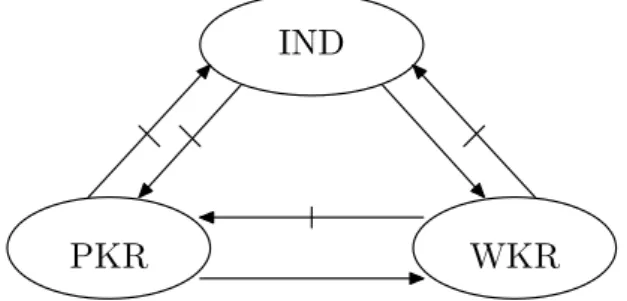
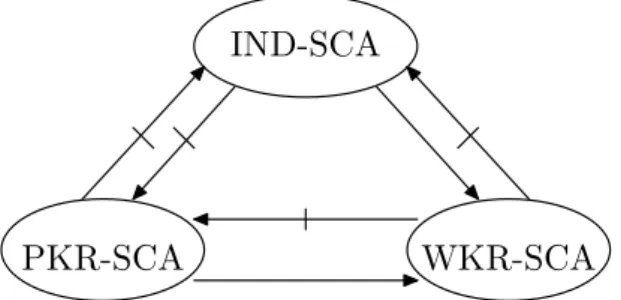
Our contributions. We first analyze the relations among PKR, WKR and IND both in black-box model and side-channel model. Please see Figure 1 and Figure 2, which show that WKR is the weakest notion, and PKR and IND are incomparable. We give proofs for all the implications of the notions and construct concrete examples for all the separations of the notions.
We then explore the security of notion combination. Our results show that WKR-SCA ∧ IND does not imply IND-SCA. Given a symmetric encryption scheme which is secure, we can construct a scheme which is both IND-secure and WKR-SCA-IND-secure, but not IND-SCA-IND-secure in the same side-channel environment.
Furthermore, we show that even the scheme is PKR-SCA-secure and IND-secure, this approach still does not hold. Based on a symmetric encryption scheme which is both PKR-secure and IND-secure, we construct a new scheme which is both PKR-SCA-secure and IND-secure, but not IND-SCA-secure in the same side-channel environment.
2
Preliminaries
Notations. We write s ←−$ S to denote choosing a random element s from a set S by uniform distribution. An adversary is an (randomized) algorithm with access to one or more oracles which are written as superscripts. We write the adversaryA with oracleO outputing a bit b as AO ⇒ b. AdvGGGSSS (A) denotes the advantage of A attacking a scheme “SSS” with a goal of “GGG”.
A→B means any scheme meeting notion A also meets notion B and B A means there exists a scheme meeting notion B but do not meets notion A.
Symmetric Encryption Scheme. A symmetric encryption scheme SE = (K,E,D) consists of three algorithms. The randomized key generation algorithm
keyK and a stringC to return the corresponding plaintextM or the symbol⊥, denoted as x ← D, where x∈ {0,1}∗∪ {⊥}. We require that DK(EK(M)) =M for any plaintext M.
In this paper, we focus on the security of symmetric encryption scheme under chosen plaintext attacks.
Side-channel Leakage Function. In side-channel attacks, the adversary not only can query the encryption oracle EK and get the corresponding ciphertext, but also can get some side-channel information during the computation of the ciphertext. We notice that the side-channel information is relevant to the key K and the queried plaintext M, so we treat it as a function L(K, M) and call it a leakage function. We define a new oracle EK+(M) = (EK(M), L(K, M)) which returns both the ciphertext and the leaked information. Therefore in side-channel attacks, the adversary has actually oracle access to EK+(·)4.
Security against Key Recovery Attacks. Key recovery attacks aim to re-cover the whole or partial key of the cryptographic algorithm. We define two kinds of security of symmetric encryption scheme against key recovery attacks both in black-box model and in side-channel model. In whole key recovery at-tacks, the adversary tries to recovery the full key.
Definition 1 (WKR and WKR-SCA). Let SE = (K,E,D) be a symmetric encryption scheme. Consider following two advantages:
AdvWKRSE (A) = Pr[K ← K,AEK(·) ⇒K :K =K],
AdvWKR-SCASE (A) = Pr[K ← K,AEK+(·) ⇒K :K = K].
We say that SE is secure against whole key recovery attacks in black-box model
(in side-channel model), or WKR-secure (WKR-SCA-secure), if the advantage
AdvWKRSE (A) (AdvWKRSE (A)) is negligible for any adversary A with feasible re-sources.
In partial key recovery attacks, the adversary tries to recover any information of the key. We adopt a simulator-based definition, in which we use a function
f(K) to represent the targeted information of the key and define the security 4 In [9], the adversary has oracle access to E
K(·) and SK∗(·) in side-channel model,
against partial key recovery attacks as whatever an adversaryAwith oracle EK (EK+) can do, a simulator S without oracle also can do.
Definition 2 (PKR and PKR-SCA). Let SE = (K,E,D) be a symmetric encryption scheme. Consider following two advantages:
AdvPKRSE (A,S)
=Pr[K ← K,AEK(·)⇒ b:f(K) =b]−Pr[K ← K,S⇒ b:f(K) =b],
AdvPKR-SCASE (A,S)
=Pr[K ← K,AEK+(·)⇒ b:f(K) =b]−Pr[K ← K,S⇒ b:f(K) =b],
wheref :{0,1}∗ → {0,1}∗ is a function. We say thatSE is secure against partial key recovery attacks in black-box model (in side-channel model), or PKR-secure
(PKR-SCA-secure), if for any function f and any adversary A with feasible resources, there exists an algorithm S (we often call it a simulator) with feasi-ble resources, such that the advantage AdvPKRSE (A,S) (AdvPKR-SCASE (A,S)) is negligible.
Security against Distinguishing Attacks. We adopt the security definition of Real-Or-Random in [1] for symmetric encryptions, which define the security as indistinguishability of ciphertexts of required plaintexts and ciphertexts of random strings.
Definition 3 (IND and IND-SCA). Let SE = (K,E,D) be a symmetric encryption scheme. Consider following two advantages:
AdvINDSE (A) = Pr[K ← K,AEK(·)⇒ 1]−Pr[K ← K,AEK($(·)) ⇒1],
AdvINDSE (A) = Pr[K ← K,AEK+(·)⇒ 1]−Pr[K ← K,AEK+($(·)) ⇒1],
where $(·) returns a random string with the same length of the input. We say that SE is secure against distinguishing attacks in black-box model (in side-channel model), or IND-secure (IND-SCA-secure), if the advantage AdvINDSE (A) (AdvIND-SCASE (A)) is negligible for any adversary A with feasible resources.
3
KR vs. IND in Block-box Model
PKR WKR IND
Fig. 1. Relations among PKR, WKR and IND.
Theorem 1 (PKR → WKR). Let SE be an encryption scheme. If SE is
PKR-secure, then it is WKR-secure as well.
Proof. If A is an adversary against WKR-security, we construct an adversary
B against PKR-security: run A and get K, then return K. We set f = ID where ID is the identical transformation, then for any simulator S, we have
AdvPKRSE (B,S) ≥AdvPKRSE (A)−1/2k, where k is the length of the key.
Theorem 2 (IND → WKR). Let SE be a symmetric encryption scheme. If
SE is IND-secure, then it is WKR-secure as well.
Proof. If A is an adversary against WKR-security, we construct an adversary
B against IND-security: run A and get K, then query M ∈ {0,1}n and get
C, if EK(M) = C, then return 1, else return 0. We have that AdvINDSE (B) ≥
AdvWKRSE (A)−1/2n.
Proposition 1 (PKR IND). There exists a symmetric encryption scheme which is PKR-secure, but not PKR-secure.
Proof. We construct a symmetric encryption scheme SE = (K,E,D), where EK(M) = M, i.e. the encryption algorithm is an identical transformation and has nothing to do with the key K. Hence no matter how the adversary queries the encryption oracle, no information aboutK is obtained. More specifically, for any functionf and adversaryAagainst PKR-security, the simulatorSjust runs
AID(·) and returns whatever A returns, where ID(·) is the identical transfor-mation. Then AdvPKRSE (A,S) = 0.
Furthermore, the identical transformation reveals all the information about the plaintext. More specifically, the adversaryB just queries M ∈ {0,1}n, if the answer is M then return 1, else return 0. We haveAdvINDSE (B) = 1−1/2n.
Proof. Suppose SE = (K,E,D) is IND-secure. We construct SE = (K,E,D) as follows:
SE SE
Key generationK ← K K1 ← K, K2 ←− {$ 0,1}n Encryption EK(M) EK1K2(M) =EK1(M)||K2 Decryption DK(C) DK1K2(C) =DK1(C)
The new encryption scheme SE generates an extra key K2 ∈ {0,1}n, but re-veals it in the ciphertext. IfSE is IND-secure, then SE is also IND-secure. More specifically, for any adversary A attacking SE, we construct adversary BO at-tackingSE:K2 ←− {$ 0,1}n, runA, whenAqueriesM, answer it withO(M)||K2, and return whatever A returns. We have AdvINDSE (B) =AdvINDSE(A).
Furthermore, the ciphertext reveals the partial key of the SE, so it is not PKR-secure. More specifically, given the function f(K1K2) = K2 and the ad-versary A which returns K2 after arbitrary one query, any simulator S has no information about K2, therefore AdvPKRSE (A,S) ≥1−1/2n. Corollary 1 (WKR IND). There exists a symmetric encryption scheme
SE which is WKR-secure, but not IND-secure.
Proof. We have PKR → WKR by Theorem 1. If WKR → IND, then PKR →
IND. That contradicts Proposition 1.
Corollary 2 (WKR PKR). There exists a symmetric encryption scheme
SE which is WKR-secure, but not PKR-secure.
Proof. We have IND → WKR by Theorem 2. If WKR → PKR, then IND →
PKR. That contradicts Proposition 2.
4
KR vs. IND in Side-channel Model
PKR-SCA WKR-SCA IND-SCA
Fig. 2. Relations among PKR-SCA, WKR-SCA and IND-SCA.
5
Failing Combination of notions
From the above section, we know that the notion of WKR-SCA is much weaker than the notion of IND-SCA. Even if we combine the notion of WKR-SCA with that of IND, we can not get the notion of IND-SCA. Therefore we actually overturn the main result in [9].
Proposition 3 (WKR-SCA ∧ IND IND-SCA). Given a symmetric en-cryption scheme SE which is IND-secure, we can construct a symmetric en-cryption scheme SE which is both IND-secure and WKR-SCA-secure for some leakage function, but not IND-SCA-secure for the same leakage function.
Proof. SupposeSE = (K,E,D) which is IND-secure. We constructSE = (K,E,D) as follows:
SE SE
Key generationK ← K K1 ← K, K2 ←− {$ 0,1}n Encryption EK(M) EK1K2(M) =EK1(M) Decryption DK(C) DK1K2(C) =DK1(C)
The new encryption scheme SE generates an extra K2 ←− {$ 0,1}n, but does not used in the encryption. The encryption algorithms of SE and SE are the same, so SE is also IND-secure.
Now we consider the security of SE in side-channel model, given that the leakage function is L(K1K2, M) = K1.
The encryption algorithm of SE does not use the key K2, which is also not revealed by the leakage function, so it is WKR-SCA-secure. More specifically, for any adversary A, AdvWKR-SCASE (A)≤ 1/2n.
Furthermore, the keyK1 used in the encryption algorithm is revealed by the leakage function, soSE is not IND-SCA-secure. More specifically, the adversary
queries M ∈ {0,1}n, gets C. If C = EK1(M), then return 1, else return 0. We
have AdvIND-SCASE (A) = 1−1/2n.
Moreover, we show that even the scheme is PKR-SCA-secure and IND-secure, the approach in [9] still does not hold.
Proposition 4 (PKR-SCA ∧ IND IND-SCA). Given a symmetric en-cryption schemeSE which is both PKR-secure and IND-secure, we can construct a symmetric encryption scheme SE which is both PKR-SCA-secure and IND -secure for some leakage function, but not IND-SCA-secure for the same leakage function.
Proof. Suppose SE = (K,E,D) is both PKR-secure and IND-secure.
Now we consider the security of SE in side-channel model, given that the leakage function is L(K, M) =M.
The leakage function does not reveal any information about the key K, so SE is PKR-SCA-secure.
The leakage function reveals the queried plaintext, so SE is not IND-SCA-secure. More specifically, the adversary A just queries M ∈ {0,1}n and gets (C, M). If M = M then return 1, else return 0. We have AdvIND-SCASE (A) =
1−1/2n.
6
Conclusion
This paper gives implications or separations among the notions of IND, PKR and WKR both in black-box model and side-channel model, which show that the notion of WKR is much weaker than the notion of IND. Then we construct a concrete scheme to show that the approach against side-channel attacks pro-posed in [9] is flawed. The security against key recovery attacks does not help much for a practically cryptographic requirement. We note that the results are not limited to the security of symmetric encryption scheme, as to the security of the other cryptographic algorithms, such as block ciphers or authenticated encryption schemes, the corresponding results still hold true.
References
2. E. Biham and A. Shamir. Differential cryptanalysis of DES-like cryptosystems (extended abstract). In A. J. Menezes and S. A. Vanstone, editors, Advances in
Cryptology - CRYPTO 1990, volume 537 of Lecture Notes in Computer Science,
pages 2–21. Springer-Verlag, 1990.
3. H. Dobbertin, L. Knudsen, and M. Robshaw. The cryptanalysis of the AES - a brief survey. In H. Dobbertin, V. Rijmen, and A. Sowa, editors, Advanced Encryption Standard - AES: 4th International Conference, AES 2004, volume 3373 of Lecture Notes in Computer Science, pages 1–10. Springer-Verlag, 2005.
4. K. Gandolfi, C. Mourtel, and F. Olivier. Electromagnetic analysis: Concrete re-sults. In C¸ . K. Ko¸c, D. Naccache, and C. Paar, editors, Cryptographic Hardware
and Embedded Systems - CHES 2001, volume 2162 of Lecture Notes in Computer
Science, pages 251–261. Springer-Verlag, 2001.
5. S. Goldwasser and S. Micali. Probabilistic encryption. Journal of Computer and System Sciences, 28:270–299, 1984.
6. L. Goubin and J. Patarin. DES and differential power analysis (the “duplication” method). In C¸ . K. Ko¸c and C. Paar, editors,Cryptographic Hardware and Embedded
Systems - CHES 1999, volume 1717 of Lecture Notes in Computer Science, pages
158–172. Springer-Verlag, 1999.
7. P. Kocher, J. Jaffe, and B. Jun. Introduction to differential power analysis and related attacks, 1999. http://www.cryptography.com/dpa/technical/.
8. P. C. Kocher. Timing attacks on implementations of Diffie-Hellman, RSA, DSS, and other systems. In N. Koblitz, editor, Advances in Cryptology - CRYPTO 1996, volume 1109 ofLecture Notes in Computer Science, pages 104–113.
Springer-Verlag, 1996.
9. W. Li and D. Gu. An approach for symmetric encryption against side channel attacks in provable security. In W. Susilo, J. K. Liu, and Y. Mu, editors, Provable Security 2007, volume 4784 of Lecture Notes in Computer Science, pages 178–187. Springer-Verlag, 2007.
10. S. Micali and L. Reyzin. Physically observable cryptography (extended abstract). In M. Naor, editor, Theory of Cryptography Conference, TCC 2004, volume 2951 ofLecture Notes in Computer Science, pages 278–296. Springer-Verlag, 2004.
11. F.-X. Standaert, T. G. Malkin, and M. Yung. A unified framework for the analysis of side-channel key recovery attacks. Cryptology ePrint Archive, Report 2006/139, 2006. http://eprint.iacr.org/.
12. F.-X. Standaert, E. Peeters, C. Archambeau, and J.-J. Quisquater. Towards se-curity limits in side-channel attacks. In L. Goubin and M. Matsui, editors,
Cryp-tographic Hardware and Embedded Systems - CHES 2006, volume 4249 of Lecture