Accelerating SSL using the Vector processors in
IBM’s Cell Broadband Engine
for Sony’s Playstation 3
Neil Costigan, Michael Scott School of Computing Dublin City University
Glasnevin, Dublin 9, Ireland.
[email protected]⋆⋆ [email protected]
Abstract. Recently the major performance chip manufacturers have turned to multi-core technology as a more cost effective alternative to ever increasing clock speeds. Well known examples of multi-core archi-tectures include the Intel Core Duo and AMD Athlon 64 X2 range of chips. IBM have introduced the Cell Broadband Engine (Cell) as their next generation CPU to feed the insatiable appetite modern multimedia and number crunching applications have for processing power.
The Cell is the “Wicked Smart”1
technology at the heart of Sony’s Playstation 3TM
. The Cell contains a number of specialist synergistic processor units (SPUs) optimised for multimedia processing and offer a rich programming interface to applications that can make use of the vec-tor processing capabilities. The specialised hardware design for gaming will always deliver performance gains compared to a more generic proces-sor for its specific domain. Multi-precision number manipulation for use in cryptography is a considerable distance away from this domain. This paper explores the implementation and performance gains when using the vector processing capabilities for SSL and shows that big improve-ments are still possible with the hardware designed primarily for other purposes.
1
Why SSL?
Despite huge gains in computing performance and bandwidth, the widespread use of secure communications on the Internet is still essentially limited to SSL connections for password logins or with credit card payments. Despite this SSL implementations are widely distributed and well analysed for security weaknesses making it the de-facto standard for secure communications. The main reason for such limited usage is the perception that encrypted communication protocols ⋆⋆ Research supported by the Irish Research Council for Science, Engineering and
Tech-nology,(IRCSET). 1
such as SSL place too high demands on bandwidth and processing power at the server side of the communication and can interrupt the browsing experience of the client. This paper sets out to show that with the performance of modern multi-core hardware devices it is now possible to enable secure channels for a wider range of network communications.
2
The Cell Broadband Engine
When Sony examined the options for the Playstation 2’s successor they realised that traditional clock speed improvements were not going to deliver to next generation demands. They wanted something more than the traditional CPU if the Playstation brand was going to maintain its lead over its chief competi-tor Microsoft’s XBoxTM
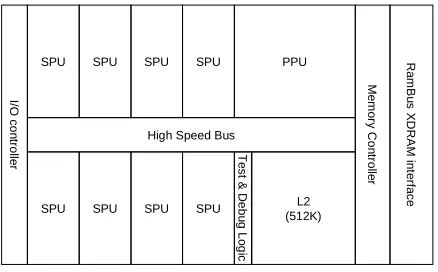
brand of gaming consoles. In early 2001 they turned to IBM and Toshiba. Together they formed a partnership to deliver a chip that would both provide the power for the next generation of media rich gaming con-soles, while also being a scalable, adaptable design that would meet the most demanding computational tasks. The result is a unique architecture combining a traditional central processor and specialised high performance processors similar to those found in graphics cards (GPUs). These processing units are combined across a circular high bandwidth bus to offer a multi-core environment with two-instruction sets and enormous processing power. Sony use a subset of the chip inside its Playstation 3 gaming and media console. IBM offer a range of configurations inside a Blade series suitable for server and super-computing use. Central to the Cell Broadband Engine (more commonly referred to as ‘Cell’) is a 3.2 GHz 64-bit Power Processing Unit (PPU). The PPU is a variant (970) of the G5/PowerPC product line, a RISC driven processor found in IBM’s servers and Apple’s PowerMac range. This PPU works as the primary processor and as supervisor for the other cores.
I/O c o n tr o lle r
High Speed Bus
SPU SPU SPU SPU
SPU SPU SPU SPU
PPU T e s t & D e b u g L o g ic L2 (512K) M e m o ry C o n tr o lle r R a m B u s X D R A M in te rfa c e
2.1 The Cell’s SPU
The real power of the Cell is in the ability to harness the additional Synergistic Processing Units (SPUs). The SPU is a specialist processor with a RISC-like SIMD instruction set and a large (128) array of 128-bit registers. Each SPU has its own local memory store (LS). Currently, and on the Playstation 3, this LS is limited to just 256K. The SPU can access the LS in the same clock cycle as its register operations. The latest SDK (2.0) has a beta software cache implemen-tation. While the SPU does not directly access main memory the central PPU can access each SPU’s local memory store. The SPU has no hardware cache so each software application directly manages data transfer to and from each SPU. This leads to a number of interesting programming models.
While the architecture allows for any number of SPUs, a standard Cell, and those currently in production, has 8 SPUs. Interestingly Sony have chosen to utilise just 7 as they can gain much higher production yields if they can discard an SPU that shows a failure during silicon testing. Furthermore Sony restrict access to one SPU for Digital Rights Management (DRM) purposes on a Playstation running in Linux mode.
A processor with just 256K, no hardware cache and with no access to I/O doesn’t appear to be anything exciting when compared to the PPU or other modern CPUs. The fact that the Cell offers 8 SPUs on one die all designed to operate in parallel combined with the ability to work with up to 4 32-bit integer operations in just one clock cycle (referred to as SIMD) that make the SPU so interesting. The SPU also contains 2 instruction pipelines and while the pipelines are not equal, careful management of the order of instructions can lead to huge amounts of data being processed with very few clock cycles and a very low clock cycles per instruction (CPI) ratio.
2.2 Multi-instruction sets
One interesting issue with the different architectures of the PPU and SPU is the need for multi-instruction set binaries. Traditional applications compile individ-ual source modules and then link the results to bind all program data symbols (variable, types functions etc.), but as the SPUs LS memory is physically sep-arate and makes use of wide 128-bit registers, its program code needs to be compiled and linked separately. Both the SPU and PPU use standard ELF bi-nary formats. An application’s bibi-nary contains 64-bit code for the main PPU but embedded inside this is an object file with the SPU instructions and data ready to be pushed to the SPU on a createthread()call from the PPC. The build process involves two separate compilers and two linkers. The SPU ELF binary is passed through an embedspu command which builds a wrapper (a CESOF linkable) to the SPU binary marking it with PPU compatible symbols. Finally there is one more link stage which binds all executables together. Figure 2 [3] outlines the build process.
Fig. 2.Cell BE build process [3]
2.3 The Cell as a HSM
To operate in a more protected environment the critical SSL code can be run in an SPU inisolated mode. For an SSL accelerator this means that is possible to have any key generation make use of a cryptographically secure random number generator, key data can be protected from other processes running on the Cell, key data can be encrypted in shared memory locations, and program code can check its integrity.
The Cell achieves this level of security by implementing a hardware based process in which
1. The code and data in an SPU can be executed in physically isolated memory space.
2. There is hardware based code signing (referred to as secure boot) where the integrity of code about to be executed can be verified.
3. An isolated process in an SPU can use hardware-key based data encryp-tion/decryption that can only be used by code that has been verified. 4. The random number generator can be configured to use a physical sample
source such as a Cell die. (note: this functionality is limited on our PS3 based Cell)
This extra security comes with a performance penalty. Initialisation would be affected by secure boot, if data were to be stored off SPU then there can be run-time overheads in decryption. The various random number generators degrade in performance as one moves towards a more random, physical sample based libary. Unfortunately implementation details are only available under Non-Disclosure Agreement with IBM and so we are not able to test our SPU acceleration code under this interesting environment.
For further information on the Cell see IBM’s excellent Cell resource centre [5]
2.4 Direct Memory Access
As mentioned above the PPU can access main memory and has instructions to transfer data between the main memory and its registers. The SPU, on the other hand, works with its own smaller local store and so to access data from the main memory the SPU goes through a Memory Flow Controller (MFC) which translates SPU main memory requests over the high speed bus via a set of DMA channel calls. These DMA calls are directional (read or write), blocking or non-blocking, can be issued in parallel, and can be tagged by the programmer to allow for identification management of data.
2.5 Vector Programming
To utilise the full performance of SPU SIMD instructions a developer works with a combination of Vector C extensions with assembly like code. Space is limited so we will look at the following extracts to highlight typical techniques used. We implemented a primitive MADD() commonly used in cryptographic libraries which fully utilises the 128-bit register by implementing a 64x64-bit multiply function.
For example the following code fragment is used to fill a quadword with two scalars (in this case standard C 64-bitunsigned long long) and to ‘splat’ across a vector. Splat is a term used when filling a vector with a mask. In a big number context we utilise splats to allow us operate on different elements of a quadword when filling partial products.
u n s i g n e d l o n g l o n g a , b v e c t o r u n s i g n e d s h o r t AB; AB=( v e c t o r u n s i g n e d s h o r t ) \
s p u i n s e r t ( a , ( v e c t o r u n s i g n e d l o n g l o n g )AB, 0 x1 ) ; AB=( v e c t o r u n s i g n e d s h o r t ) \
s p u i n s e r t ( b , ( v e c t o r u n s i g n e d l o n g l o n g )AB, 0 x0 ) ; /∗ s e l e c t two b y t e s ∗/
c o n s t v e c t o r u n s i g n e d c h a r s p l a t s h o r t 1= \
( v e c t o r u n s i g n e d c h a r ) ( VEC SPLAT U32 ( 0 x80800405 ) ) ;
Here we utilise a C macro to guarantee all vector multiplies (spu mulo()) are at a 16-bit level to efficiently use the 16x16-bit multiplier in the SPU. #d e f i n e MULTIPLY( a , b )\
( s p u e x t r a c t ( spu mulo ( ( v e c t o r u n s i g n e d s h o r t ) spu promote ( a , 0 )\ , ( v e c t o r u n s i g n e d s h o r t ) spu promote ( b , 0 ) ) , 0 ) )
Finally an assembly-like example of a speed up technique when adding a 128-bit value to a 64-bit value where we know there is no need to manage an overflow. This technique is used in summing partial products inside the big number multiply.
v e c t o r u n s i g n e d i n t o u t s , i n a 1 2 8 , i n a 6 4 ; v e c t o r u n s i g n e d i n t sum , c 0 , t 0 ;
c 0 = s p u g e n c ( i n a 1 2 8 , i n a 6 4 ) ; // g e n e r a t e c a r r y b i t s sum = spu add ( i n a 1 2 8 , i n a 6 4 ) ; // add
t 0 = s p u s l q w b y t e ( c 0 , 4 ) ; // s h i f t quadword l e f t 4 b y t e s o u t s = spu add ( sum , t 0 ) ; // add i n t h e c a r r y
3
OpenSSL
team of developers. It has since become the de facto open source SSL toolkit. It is the security sub-system of choice for large open source projects such as Apache [8] and MySQL [13] and included in virtually all UNIX distributions including Linux, MacOSXTM
, and SolarisTM .
The name ‘OpenSSL’ is misleading as the toolkit provides a vast array of building blocks and interfaces from cryptographic primitives through big number routines to PKI components such as certificate authorities and OCSP responders. One of the most useful features is the ability to factor out processing intensive operations to specialist hardware through an ‘engine’ interface. It is through this engine subsystem that we accelerate SSL by using the Cell SPU’s vector processing capabilities.
SSL operates in two phases: an initial handshake and a bulk encryption phase. The purpose of the handshake is to swap identification credentials, algo-rithm capabilities, and negotiate a bulk encryption key. The reason for the key negotiation is that asymmetric cryptography, whilst needed to establish a shared secret, incurs a large computational overhead compared to a symmetric encryp-tion algorithm. By analysing clock cycles, Zhao et al. [2] found that 90.4% of the SSL handshake comprises public key operations. Cryptographic operations take, in total, about 95% of the total CPU load.
Since the CPU load will be heaviest at the server side, and since the main computationally load incurred by the server for its part in the handshake is asymmetric decryption, we focus our attempts on speeding up asymmetric de-cryption.
Isolating the SSL handshake to measure our improvements is a challeng-ing task as there are can be many dependencies (network traffic, HTTP server etc.) on a running machine which make accurate sampling difficult. Fortunately OpenSSL provides the utility openssl speedwhich can measure individual al-gorithms. Using this utility we can demonstrate improvements to the throughput of the critical algorithms. The SSL protocol supports a range of asymmetric algo-rithms, (RSA, DSA, ECC etc.). In this paper we focus on RSA but the technique is relevant to all.
3.1 OpenSSL engine
When taking over computational tasks from OpenSSL two issues which must be considered are
1. How the engine informs the library of the scope of its responsibilities. 2. Marshalling the big number format to and from OpenSSL’s internal
repre-sentation.
To tell OpenSSL exactly what the engine will do the developer provides a static library with a set of defined interfaces with descriptive text to describe the engine. Then, through function pointer replacement, a defining a set of functions which implement the algorithms that the engine intends to provide.
is to statically link the engine code and add a call inside
ENGINE load built in engines(). This will add the engine as an option to any application using the OpenSSL default engine.
Through this call OpenSSL then loads any engine that conforms to the correct interface at start-up, and subsequently any OpenSSL command that uses the
-engine <id>option will redirect to the named engine. At theEngine init()
stage the calling library passes an OpenSSL data structure containing a set of initialisation variables and an opening via a free additional pointer for the engine to append its own data structure which can be accessed later by subsequent engine functions. The engine is responsible for its own memory management. It is through this Engine init()call that we gather OpenSSL parameters and convert the OpenSSL big number representation to the native Cell IBM Multi-precision Big number format.
4
Development
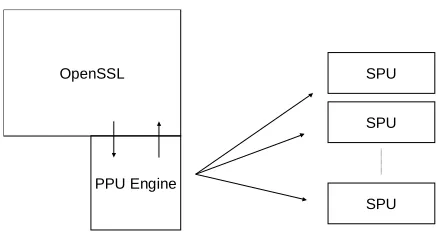
To recap: we need to build a PPU library (32 or 64-bit) that plugs into a PPU build of OpenSSL. Inside this library we embed an SPU ELF executable which can act upon the 128-bit registers and utilises IBM’s MPM library. This SPU ELF executable needs to be under 256K including all code and data. The multi-core environment with the limitations on code and data size requires some uncon-ventional, data centric, programming models which the engineering community are still evolving. The cardinal rule appears to be ‘offload as much as one can to the SPUs’. Many data intensive multimedia applications employ a model where data is streamed through a chain of SPUs with each SPU carrying out a specific operation on the data, then calling another SPU with the processed data. Yet another model makes the PPU act as a scheduler pushing data segments and code ‘blobs’ to any SPU with the PPU managing the operations and data or-dering through double buffering. To fit the OpenSSL engine model, we mirror the operation of a similar engine developed by Geoff Thorpe of the OpenSSL core team for the GNU Multi-Precision library (GMP) [9]. To have the SPUs do as much work as possible we chose to overload theRSA mod exp()function and indicate through control flags that the engine would perform full RSA decryp-tion using the Chinese Remainder Theorem. Figure 3 describes the interacdecryp-tion between the various components. This allows us to potentially parallelise the modular exponentiation calls. We could approach this a number of ways:
1. Have the PPU do the RSA/CRT but invoke SPUs to manage the expensive modular exponential (mod exp()). Different SPUs would handle thepandq
mod exp().
2. Have the PPU pass the whole RSA/CRT to an SPU.
3. Have the PPU pass the whole RSA/CRT to an SPU with this SPU passing the the twomod exp()to two other SPUs.
OpenSSL
SPU
PPU Engine
SPU
SPU
Fig. 3.OpenSSL with Engine and SPUs
There are a number of advantages to each. With (1) the amount of data in the DMA bus is reduced but it breaks the guideline of offloading as much computation as possible to an SPU. With (3&4) the latency per SSL connection will be reduced but, as it adds extra DMA data to the bus, the over all maxi-mum throughput will be affected. With (2, 3 & 4) we can double buffer the data transfer, for example passing thepparameter to the bus while the SPU is pro-cessing the q mod exp(). The double buffering technique would offer relatively small speed gains. We implemented (1) and (2) and found the initial speed up to be marginally higher but the maximum throughput to be slightly lower. This is explained by increased amount of SPU invocation. In an attempt to measure the maximum throughput we chose to focus on (2).
To maintain compatibility with OpenSSL and other engine implementa-tions we use notation matching OpenSSL code:dmp1, the decryption exponent modp−1,dmq1, the decryption exponent modq−1.iqmpis the inverse ofq modp.I0is the cyphertext. A decryption exponentd, for a primep, is a number d, such thatmed modp=mored= 1 mod (p
−1), whereeis the encryption
exponent, commonly chosen to be 3 or 65537.
At the RSA initialisation stage OpenSSL passes the (p, q, dmp1, dmq1, iqmp) parameters to the engine. At this stage we check the parameters, allocate a memory store, fill the store with local copies of the big numbers ready to pass to an SPU, and then pass the memory store pointer back through a thread safe thread local memory store. OpenSSL later makes a call to the main overloaded
RSA mod exp()function withI0 and the same thread memory store parameter. The overloadedmod exp()extracts the thread local data, calls an SPU thread, DMA transfers the location and size of the memory store to the SPU. It then allocates space for the return data from the SPU.
At this stage the SPU thread converts the big number set to the IBM MPM format and carries out the CRT logic. On success it takes the result, pushes it back to the PPU using the DMA tag that theI0parameter was sent with, finally cleaning up any memory used by the engine and exiting.
4.1 RSA/CRT
We implement traditional RSA Decryption using Chinese Remainder Theorem but with a small modification. Because the SPU is restrictive in some respects and as we can’t be certain that the parameter p is always greater than q we need to maintain a sequence of calls that ensure the results of any modular exponentiation stay positive.
1. The SPU compiler optimiser is most efficient when there is no branching. 2. The current version (SDK 2.0) of the IBM MPM is intended to work with
unsigned numbers.
3. Integer comparison operations (less than, greater than) on negative numbers are undefined.
To overcome these restrictions we assumepis always less thanq. A condition OpenSSL guarantees. The modified algorithm is outlined in Algorithm 1.
Algorithm 1RSA Decryption using Chinese Remainder Theorem modified for the IBM MPM unsigned restrictions.Note: We follow OpenSSL notation found in all engine implementations.
INPUT: p, q, I0, dmq1, dmp1, iqmp
OUTPUT: r0
r1←I0 modq m1←r1dmq1 modq r1←I0 modp r0←r1dmp1 modp r0←r0−m1
if r0<0 then r0←r0+p
end if
r1←r0·iqmp r0←r1 modp r1←r0·q r0←r1+m1
5
Results
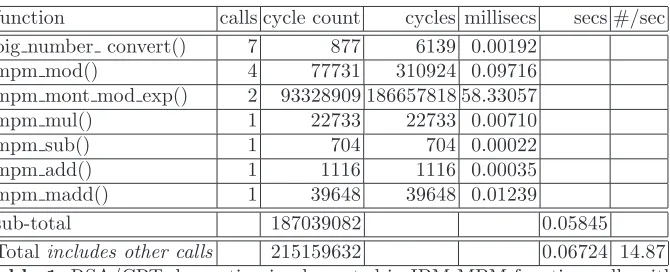
Table 1 lists timings in cycles counts and milliseconds for the time consuming functions of the RSA/CRT implementation. Two totals are presented: sum of these calls and an observed timing for all calls including some initialisation and the DMA receive calls. These timings are made using an engine with just one SPU configured.
function calls cycle count cycles millisecs secs #/sec
big number convert() 7 877 6139 0.00192
mpm mod() 4 77731 310924 0.09716
mpm mont mod exp() 2 93328909 186657818 58.33057
mpm mul() 1 22733 22733 0.00710
mpm sub() 1 704 704 0.00022
mpm add() 1 1116 1116 0.00035
mpm madd() 1 39648 39648 0.01239
sub-total 187039082 0.05845
Totalincludes other calls 215159632 0.06724 14.87
Table 1.RSA/CRT decryption implemented in IBM MPM function calls with cycle count and time in milliseconds for a 4096-bit key
We can see that, as expected, thempm mont mod exp()2
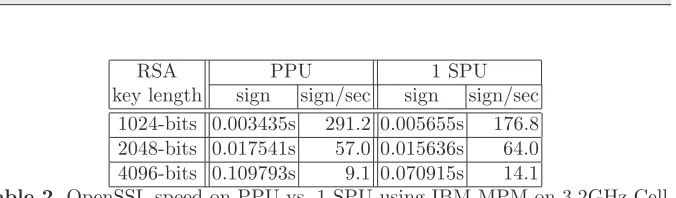
calls represent the bulk of the time consuming operations. A case could be made for a design that offloaded just this call to an SPU. Theoretically (from the results of Table 1) we can expect the SPU to be able to process 14.8 4096-bit decryptions in a second. Interesting (from Table 2) we achieve close to this at 14.1. Obviously there is additional overhead from DMA and the process queue on the main PPU. Cycle counts are from the latest (2.0) version of the SDK’s simulator. Unfortunately the simulator (at this time) cannot measure DMA or PPU latency.
As mentioned previously, to get some sense of the improvements our optimi-sations have made we use theopenssl speedcommand on RSA with the engine off (native OpenSSL on the PPU) and with our engine on utilising the SPU.
Tests are run on a 3.2 GHz Playstation 3 with just6SPUs running Yellow Dog Linux 5.0 [16] with kernel version 2.6.16-20061110.ydl.1ps3. A server/blade Cell system would have up to 16 SPUs. We could expect the Playstation Cell to deliver a throughput of up to 89 sign/sec and a blade server to go as high as 237 sign/sec. Our observations (Table 3) see slightly smaller results. As mentioned there are number of factors that could skew our observed numbers, mainly the design of the OpenSSL speed post-processing, DMA overhead and the fact that the PPU is busy managing the multiprocess queue.
2
We are using theopenssl speed -elapsedtime option instead of the more often quoted CPU user time as on the multi-core processor the CPU timer will just count the CPU time of the driving PPU thread whereas the multi-threaded nature of the SPU based system is better represented by elapsed time. OpenSSL is configured for 64-bit PPC/G5 ASM3
. o p e n s s l s p e e d r s a −e l a p s e d
o p e n s s l s p e e d r s a −e n g i n e cellspumpm −e l a p s e d
RSA PPU 1 SPU
key length sign sign/sec sign sign/sec 1024-bits 0.003435s 291.2 0.005655s 176.8 2048-bits 0.017541s 57.0 0.015636s 64.0 4096-bits 0.109793s 9.1 0.070915s 14.1
Table 2.OpenSSL speed on PPU vs. 1 SPU using IBM-MPM on 3.2GHz Cell
From Table 3 we can see that the overhead of the DMA transfer and the big number conversion impact the performance improvements just below the 2048-bit key. The benefits of the 128-2048-bit registers are apparent at 4096-2048-bit level with improvements in the order of 150% (14.1 vs. 9.1).
To see the full impact of the multi-core we need to use the -multi [n] option to the speed command which can (through fork()) generate multiple simulta-neous RSA operations. We have picked a number (6) of parallel processes to run matching the number of SPUs on the Playstation 3. It is important to note that the -multi option introduces some small processing overhead to the speed com-mand as it uses a fork() invocation whereas the standard calls in single threaded. Again we compare the PPU with an SPU enabled engine.
o p e n s s l s p e e d r s a −e l a p s e d −m u l t i 6
o p e n s s l s p e e d r s a −e n g i n e cellspumpm −e l a p s e d −m u l t i 6
We see from Table 3 similar overheads impacting the 1024-bit keys. However there is huge improvements in 2048-bit (329.7 vs.71.7) and 4096-bit (83.6 vs 11.2). A 749% increase.
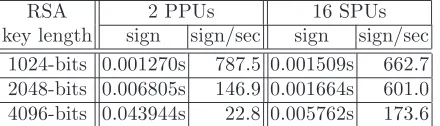
While theopenssl speedutility running on the 6 SPU Cell inside a Playsta-tion 3 gives us a solid basis to develop and measure our improvements, S´ean Starke at IBM was kind enough to try our tests in a full 16 SPU dual Cell blade. These results (Table 4) are preliminary but are consistent with the trend from the Playstation 3 results.
3
RSA PPU 6 SPUs key length sign sign/sec sign sign/sec
1024-bits 0.000724s 384.5 0.001906s 524.7 2048-bits 0.002600s 71.7 0.003033s 329.7 4096-bits 0.089455s 11.2 0.011925s 83.9
Table 3.OpenSSL speed on PPU vs. 6 SPUs using IBM-MPM on 3.2GHz Cell, 6 parallel processes.
RSA 2 PPUs 16 SPUs
key length sign sign/sec sign sign/sec 1024-bits 0.001270s 787.5 0.001509s 662.7 2048-bits 0.006805s 146.9 0.001664s 601.0 4096-bits 0.043944s 22.8 0.005762s 173.6
Table 4.OpenSSL speed on 2 PPUs vs. 16 SPUs using IBM-MPM on 3.2GHz Cell, 16 parallel processes.
6
Conclusions and Future Work
The numbers speak for themselves: over 700% improvement in performance. With the widespread use of specialised multi-core processors there is no reason to prevent the roll out of always on encryption leading to improvements in privacy for the general user.
We believe that we have pushed the Cell SDK’s IBM-MPM library to its limits. The library is an excellent demonstration of the power of SPU intrinsics ‘vector’ programming. However, we believe the introduction of an optimised number library more suited to crypto can substantially improve the performance, possibly doubling the figures presented above.
As mentioned the results are based on using generic Montgomery
mpm mont mod exp() function. This function allows for any size of parameter whereas we know the size of parameters are based on fixed key lengths (1024, 2048 etc.) These fixed lengths can offer further optimisations as they always align on the 128-bit boundaries of the vectors and that the number of partial products to be summed inside any multiplies can be determined allowing for very efficient carry management.
OpenSSL uses this Comba/Karatsuba combination at key lengths above 1024-bit irrespective of the architecture. We hope to swap out the IBM MPM library and use a fine tuned version of MIRACL [14] with fixed key sizes on fixed 128-bit alignment, and utilising the Comba/Karatsuba speed ups on longer key lengths.
The threshold key length to optimally use the Karatsuba method depends heavily on the underlying word size and the architecture’s instruction set, specif-ically how fast the multiplier is compared to the addition. We hope to examine this threshold in more detail with the more flexible, MIRACL library.
The performance figures focus on raw crypto performance. We would like to examine the SSL performance of real word data using a commercial grade SSL/HTTP load testing suite. We also intend to offer support for DSA and ECC algorithms.
7
Acknowledgements
For development tools and background information we turned again and again to the IBM’s ‘DeveloperWorks’ resource centre and the Cell SDK. We would like to thank the Cell development community particularly S´ean Starke and the IBM team. The authors acknowledge Georgia Institute of Technology, its Sony-Toshiba-IBM Center of Competence, and the National Science Foundation, for the use of Cell Broadband Engine resources that have contributed to this research. We would also like to acknowledge the valuable feedback given by the anonymous reviewers from the SPEED 2007 ( Amsterdam) workshop at which this paper was presented. Finally We would also like to thank Augusto Jun Devegili (Unicamp, Brazil), Peter Kehoe (DCU), Noel McCullagh, and Stephen Henson (OpenSSL)[7] for their encouragement, assistance & patience.
References
1. IBM alphaWorks. Cell Broadband Engine SDK. http://www.alphaworks.ibm. com/topics/cell.
2. Zhao Iyer Srihari Makineni Laxmi Bhuyan. Anatomy and performance of SSL pro-cessing. InProc. IEEE Int. Symp. Performance Analysis of Systems and Software, pages 197–206, 2005.
3. Alex Chunghen Chow. Programming the Cell Broadband Engine. Embedded Systems Design, 2006. http://www.embedded.com/columns/showArticle.jhtml? articleID=188101999.
4. P. G. Comba. Exponentiation cryptosystems on the ibm pc. IBM Syst. J., 29(4):526–538, 1990.
5. IBM DeveloperWorks. Cell Broadband Engine resource center. http://www-128. ibm.com/developerworks/power/cell/.
6. IBM DeveloperWorks. Cell Broadband Engine SDK Libaries Multi-Precision Math Library, 2006. http://www-128.ibm.com/developerworks/power/cell/.
8. Apache Foundation. Apache HTTP server project. http://www.apache.org. 9. SWOX / Free Software Foundation. GNU Multiple Precision Arithmetic Library.
http://www.swox.com/gmp/.
10. Freescale. Altivec velocity engine. http://www.freescale.com/altivec.
11. Donald E. Knuth. The art of computer programming, volume 2 (3rd ed.): seminu-merical algorithms. Addison-Wesley Longman Publishing Co., Inc., Boston, MA, USA, 1997.
12. Alfred J. Menezes, Paul C. van Oorschot, and Scott A. Vanstone. Handbook of Applied Cryptography. CRC Press, 2001.
13. MySQL. MySQL open souce database. http://www.mysql.com. 14. M. Scott. MIRACL. http://www.shamus.ie.
15. K. Shimizu, H. P. Hofstee, and J. S. Liberty. Cell Broadband Engine processor vault security architecture. IBM Journal of Research and Development, 51(5):521–528, September 2007.
![Fig. 2. Cell BE build process [3]](https://thumb-us.123doks.com/thumbv2/123dok_us/1857734.1241273/4.595.144.472.322.495/fig-cell-be-build-process.webp)