SYSTEMS.
11. BISEXUAL GENERALIZED NONEPISTATIC SELECTION MODELS SAMUEL KARLIN2 AND URI LIBERMAN3
Manuscript received November 16,1977 Revised copy received May 15,1978
ABSTRACT
This paper is a continuation of the paper “Central Equilibria in Multi- locus Systems I,’’ concentrating on existence and stability properties accru- ing t o central H-W type equilibria in multilocus bisexual systems acted on by generalized nonepistatic selection forces coupled to recombination events. The stability conditions are discussed and interpreted in three perspectives, and the influence of sexual differences in linkage relationships together with sex-dependent selection is appraised. In this case we deduce that the stabil- ity conditions of the H-W polymorphism i n the bisexual model coincide exactly with the conditions for the corresponding monoecious model, provided that the recombination distribution imposed is that of the arithmetic mean of the male and female recombination distributions. A second concern has the same recombination distribution for both sexes, but contrasting selection regimes between sexes. It is then established that, with respect to discerning the relevance of the H-W equilibrium, there is an equivalent monoecious selection regime which is an appropriate “weighted combination” of the male and female selection forms. Finally, i n the case where the selection and recom- bination structures are both sex dependent, a hierarchy of comparisons is elab- orated, seeking to unravel the nature of selection-recombination interaction f o r monoecious uerszu diocecious systems.
HIS paper delineates existence criteria and stability properties accruing to central equilibria in multilocus bisexual systems acted on by generalized nonepistatic selection forces coupled to recombination events. An elaborate dis- cussion of the corresponding monoecious model occurs in KARLIN and
LIBERMAN
(1979).
Consider a trait determined by several loci. The bisexual selection regime comprises a pair of fitness value arrays in the form of generalized nonepistatic viability effects based on a prescribed set of intrinsic loci fitness matrices. More- over, the linkage relationships (i.e., set of recombination-segregation frequencies) may differ between the sexes.
Selection effects are formidable to establish, let alone when these are sex dependent. Identification of many cases of sex-dependent selection differentials in regard to quantitative and polygenic traits is well recognized. These cover Supported in part by Public Health Service Grant GM 10452-15 and National Science Foundation Grant MCS 76- 80624-AOl .
* Department of Mathematics, Stanford University, Stanford, California 94305.
Department of Statistics, Tel-Aviv University, Tel-Aviv, Israel and Department of Mathematics, Stanford University, Stanford, California 94305.
800 S . KARLIN A N D U. LIBERMAN
traits such as stature, weight, a host of disease susceptibilities, metabolic rates, etc. Selection differences can be mediated by hormonal factors, environmental correlates and sex limited gene expression. Having i n mind that the variation in polygenic traits can often be associated with a few to several major loci. entailing some heterogeneous background, the analyses of the appropriate bisexual multi- locus systems may lend insights into mechanisms of polygenic inheritance.
There are multilocus traits connected with color pattern, disease incidence, multiple enzyme functions entailing sex differences in selection expression. etc. For example, genomic complexes that show sex-dependent viabilities include cases related to mimicry and/or crytography based on sex-limited gene expression correlated with predation activities, the t-allele system where males are lethal and females normal, and male recombining genes that cause sterility.
Another significant contrast between the sexes relates to the recombination distributions, where “more” recombination (diminished linkage) tends to occur for the heterogametic sex as compared to the rate of crossover events during homogametic meiosis. There are documented cases where recombination i n females is unrestricted, while male recombination entails absolute linkage or limited numbers of crossover events. The phenomenon of reduced recombination rates f o r males (or, more accurately, f o r the heterogametic sex) as compared t o iemales is colloquially called Haldane’s Rule
(HALDANE
1922). A classic extreme example is manifested in Drosophila populations where usually no recombination for male segregation appears, while varying levels of positive recombination outcomes are realized during female meiosis. Genetical and cytological studies over these past several decades have documented significant numbers of animals with achiasmatic meiosis in one sex, usually the heterogametic sex. These include cases in protozoa, mites, copepods, (having heterogametic females),
mantids, acouple of grasshoppers, a n assortment of Lepidoptera including Bombyx (again the female sex is heterogametic) and various other insects, including Drosophila (see
WHITE
1973). The same is true in many plant species, including hermaphro- ditic species, where particularly meiosis occurs at differing times with respect to male and female gamete production. I n human populations, linkage-mapping .viasegregation and pedigree analysis also tends to confirm diminished intrachromo- soma1 recombination frequencies (e.g., in chromosome I ) for males as against females (MCKUSICK and RUDDLE 1977).
Where selection in the two sexes takes the form of a generalized nonepistatic structure based on the same intrinsic fitnesses and stipulating that these com- ponent fitness matrices exhibit “overdominant selection” (signifying that the marginal fitness matrix at each individual locus in isolation would maintain a stable polymorphism), then a common “central” Hardy-Weinberg (H-W) equi- librium, independent of the specific recombination distributions, is pervasive in the bisexual system. However, the stability endowments of this polymorphic H-W equilibrium are markedly influenced by the recombination mechanisms interacting with the genotypic fitness differentials invoked in the male and female populations.
Our present objective is to discern, in qualitative and quantitative terms, the stability nature of the
H-W
“central” polymorphism in its dependence on the bisexual selection forces and recombination distributions. In the monoecious one- sex case, we recall that i n the presence of pure additive selection any non-zero recombination already ensures local stability (and likely global stability) of theH-W
equilibrium. [For the two-locus, two-allele case, see KARLIN and FELDMAN (1970), and (for the multiallele situation), KARLIN and LIBERMAN (1978).] On the other hand, under pure multiplicative viability effects, the H-W equilibrium is stable only provided that “enough” recombination contingencies are feasible. The precise statement and development of these facts are set forth in KARLIN and LIBERMAN (1979). With this background, it is of interest to unravel the balances attendant to alternative nonepistatic selection forms associated with the two sexes and to show how they account for the degree and strength of stability concomitant to the H-W equilibrium.I n more specific terms we treat the following problems: (1) With the same selection regime but disparate patterns of recombination rates, how does the sta- bility of the H-W polymorphism in the dioecious case compare with the “corre- sponding” monoecious case? Is there a n “equivalent-effective” monoecious recom- bination distribution? (2) Considering the model involving sex-dependent selec- tion intensities but with similar linkage relationships for both sexes, is there a n “equivalent” monoecious selection form effective with respect to the stability analysis of the central H-W polymorphism? (3) How does the dioecious model carrying selection regimes
rm
andrf
in males and females, respectively, compare with the monoecious model acted on by the selection regime,
with reference to the “amount” of recombination needed to maintain the H-W poly- morphism where no sex differences in linkage relationships are assumed.(4)
What is the outcome due to coupling contrasting selection regimes for the sexes? Generallly. what kind of selection-recombination interaction accrues due to bisexuality ?Analysis of bisexual models in the past has focused primarily on one-locus, two-allele models [e.g., OWEN (1953) ; BODMER (1965) ; MBRAT (1969) ; MANDEL
(1971) ; KIDWELL et
al.
( 1 9 7 7 ) l . In this context the realization of multiple stable polymorphisms was uncovered by OWEN (1953). Some contributions to the studyof selection balance for dioecious populations (one-locus, multiallele cases) are
802 S. KARLIN A N D U. LIBERMAN
contained in CANNINGS (1967) and
KARLIN
(1978). The analysis of bisexual linkage selection interaction in multilocus systems is sparse and mostly of recent vintage. GEIRINGER (1 948) andBENNETT
(1 954) previously confined their efforts to the case of no selection differentials operating on both sexes. Each established the property that one can treat the population as a monoecious popu- lation by replacing the recombination rates with the arithmetic mean of the separate recombination frequencies.STROBECK
(1 975) proved the validity of the arithmetic mean effective recombination rate in the framework of the two- locus, two-allele system involving identical multiplicative or symmetric selection forms in both sexes. Roux (1978) extended this conclusion to the two-locus, multiple allele model where both sexes carry the same additive or multiplicative selection modes. In this work we deal with the equivalent arithmetic mean recombination scheme f o r a generalized nonepistatic selection regime.The paper is organized as follows. The precise stability conditions of the
H-W
polymorphism are set forth in Section 1. A number of reduction principles of dioecious systems to monoecious models are developed in Sections 2 to 4. The consequences of distributing selection effects between the sexes is discussed from a variety of perspectives in Sections 5 , 6 and 7.
1.
The
existence and stability criteria for Hardy-Weinberg polymorphic equilibriaW e adhere to the notations and terminology of
KARLIN
andLIBERMAN
(1979) in which mathematical concepts such as Kronecker products of matrices and Schur products are also described.The bisexual model: Consider a diploid dioecious population and a gamete fre- quency array for an n-locus multiallele trait. A gamete is described by n-tuples like io = (io(1),io(z)7
.
.
.
yio(n))7 i, = (il(1)7il(z)7.
.
.
7 i l ( n ) ) , whereio(k)
and &(*I indi- cate the allelic constituents of io and i,, respectively, a t locusk.
A genotype composed of the gametes io and i, is designated by(&)
.
The associated male and female fitness matrices are denoted byrm
and rf, respectively, with com- ponentsw m
($)
and wf(5)
for the relative fitnesses of the genotype(+)
.
The recombination segregation distributions among males (females) depicts the frequency rates of the male (female) output resulting from recombination and segregation. The outcome of meiosis involving the male parental gamete io = (io(1)7io(2)7.
. .
,io(")) and female parental gamete il = (il(1)7il(*)7. . .
,il(n)) can be any of the 2" gametes iE = (i(1)9i(2),. . .
,i:;)) where each E ~ S = 0 or 1 fork
= 1,2,.
.
.
,n. The recombination-segregation distributions R, = {R,(e) } i n males and Rf = { R , ( e ) } in females prescribe probabilities to these 2n mutually exclusive events, such that & ( e ) = R m ( c l , ..
.
,en) [ & ( e ) = R f ( e l , .. .
,en)] is the probability of the recombination-segregation male (female) gamete product i E = (i(*),. . .
,ik:)).Let x and y represent gamete frequency vectors for males and females, respec- tively. Subject to random mating, recombination and selection forces, the popu-
11
11 11 1
E1 E2
lation states x’ and y’ of the succeeding generation are calculated by the transfor- mation equations.
and
where wm(x,y) and wf(x,y) denote the male and female mean fitness values, respectively, evaluated for the population frequency state (x,y)
.
Explicitly,
Of course, if selection expression and the recombination mechanisms are the same between males and females, then the analysis of (1) subsequent to the initial generation parallels the obvious monoecious system. The problems of primary interest in this work involve bona fide differences in selection expression and/or the linkage relationships between the sexes.
We concentrate on the situation where selection operating on both sexes has the form of a generalized nonepistatic regime based on the same intrinsic fitness matrices. Specifically, let W,,W,,
.
.
.
,W,
be the separate loci intrinsic fitness matrices. Following the construction of extended nonepistatic farms circum- scribed inKARLIN
andLIBERMAN
(1979), we haver m = z
cm(7)W(7>, r f = m ( 7 ) W ( 7 ) (3)7 D
where W ( 7 ) = W1(vl)
0
W2(212) 0.
. .
0
Wn(vn) (0 refers to the Kronecker prod- uct of the indicated matrices), and the sums are extended over all n-tuples7 = ( ~ ~ , r ] ~ ,
. . .
,qn) g k = 0 o r 1,k
= l,2,. .
.
,n subject to the special convention Wk(l) = W k , W k ( O ) = E k where Ek is the fitness matrix composed of all unit ele-ments signifying no selection differentials. For each 7, the summand W ( 7 ) =
W1(71) 0 W z ( ~ J
0
. . .
W,(vJ describes an ordinary multiplicative nonepistatic fitness matrix with marginal selection forces operating at those component loci with 7 k = 1 and no selection differentials from the other loci. The nonepistaticcontrasts { c, (7) } and {cy ( 7 ) } can differ between the sexes.
The
existence of a Hardy-Weinberg polymorphic equilibrium: Assume the intrinsic fitness matrices W,,W,,.
.
.
,W, are individually “overdominant”, namely, with each locus( k
= l,2,. .
.
,n), a polymorphism Lk exists which is stable with respect to the fitness matrix W k . Letz&
be the mean fitness at locusk
evaluated atL7,
and let z = z10
k2
0.
.
.
0L,
be the across loci Hardy-Wein- berg polymorphism generated by the frequency vectors&,
. .
.
,&.
We highlight the following basic fact.804 S. KARLIN A N D U. LIBERMAN
I A A A
Result 1 . The population state
(4,;)
where x = y = z = z10
.
.
.
0
in
is aH-W
“central” polymorphic equilibrium of the dioecious system ( l ) , which persists independently of the nature of the recombination-segregation distribu- tions. The associated mean fitnesses arezijm = 2 c, ( q ) C (7) in males, and 0, = Z cf ( q ) zij (7) in females (4)
7 ?I
where zij(7) =II ( z i j L ) v b
.
General conZions for stability of the central
H-W
polymorphism: I n the special case where bothrm
and Tf are generalized nosnepistatic selection regimes based on the same intrinsic loci matrices Wl,W,,.
.
.
,W,, we can apply the methodology in KARLIN and LIBERMAN (1979), in ascertaining the stability of the commonH-W
polymorphism. Accordingly, we find that theH-W
poly- morphic equilibrium (x,y) where x = y = z10
.
. .
0
;,
is stable provided the quantities* * * * .
(the sum extends over all independent choices of 7) and e ) are in magnitude
smaller than one for all choices of ( Xl,pl),
. . .
,
(An+%) excluding the specification of (Al,pl) =. . .
= (h,,p,) = 1, where zijm,Cf and C ( 7 ) are as in (4). Here for each locus k, ( X k , p k ) equals ( 1 , l ) o r is ofihe form ( X k , O ) , where Xk is any eigen-value distinct from unity of the matrix
Wy,
derived from WI, by multiplying on the left by the diagonal matrix having on its diagonal the components of the vector z k / C k .2. The case of the same selection regime for males and females, but divergent linkage distributions
Consider coincident male and female genotype fitness matrices
rm
=rf
not restricted necessarily to be generalized nonepistatic forms, with possibly different recombination distributions.Resutt 2. For a general selection structure,
rm
=rf,
the same for the two sexes, where a monoecious polymorphism exists, with respect tor
=I”
=rf,
which is independent of the recombination rates, then(2,;)
where x = y = z is a poly- morphism of the two-sex system (1) and its stabiltiy conditions reduce to those of a corresponding random-mating one-sex population acted upon by the selection-recombination forces (r,R) withr
=r,
=rf
andR
generated as the arithmetic mean recombination distribution-
Rm f-
R f.
A
* * A
1 1
2 2
scriptions of the recombination-segregation frequencies. Then Result 2 applies such that the stability conditions
(5)
reduce to the one-sex stability conditions with generalized nonepistatic fitness matrixr
=rm
=rf
and recombination dis- tributionR
=-
1R,
+
- 1Rf.
2 2
The general setting of Result 2 covers many cases including that of a general- ized symmetric selection regime (see KARLIN 1979). In the context of no selec- tion, the result was first pointed out by GEIRINGER (1948).
T h e
special case of Result 2 with mu1 tiplicative selection with two loci, two alleles is due to STROBECK(1975), and for two loci and multiple alleles, Roux (1978).
3 . The case of no sexual diflerences in recombination rates, but sex-dependent selection expression
Suppose that the viability regimes for males and females constitute represen- tations of extended nonepistatic viability effects based on the same marginal fit- ness matrices (consult equation 3 )
,
where the weights { cm ( 7 ) } and { cf (7) } that characterizerm
and rf, respectively, are not coincident. On the other hand, we stipulate the same recombination-segregation distribution f o r both sexes. In this situation, we inquire concerning the stability of the two-sexH-W
polymorphism(;I,;)
induced by the one-sex H-W polymorphismi
(see Result 1). More spe- cifically, we wish to determine if a n associated monoecious viability regimer
can be determined within the same generalized nonepistatic family as
rm
andrf,
where the stability conditions of forr
andR
=R,
= Rf are equivalent to thoseof the nascent bisexual model.
Result 3 . Suppose the fitness matrices,
r,
andrf,
in males and females, respec- tively, express distinct representations of extended nonepistatic selection posses- sing the structure ( 3 ),
in conjunction with the identical recombination distribu- tionR,
= Rf. Consonant to Result 1, let(4,;)
be the two-sexH-W
polymorphism where x = y = z = z10
.
. .
0
z,. Then the coaditions affirming the stability of(;I,$)
reduce to those of the monoecious population acted upon by the recombi- nation processR
=R,
= Rf and the extended nonepistatic selection regimer
= Z c ( q ) W ( q ) [see ( 3 ) ] determined by the weights { c ( q ) } , whereA A
n
(6)
Because scaling the { c ( 7 ) } by a positive multiplier produces a n equivalent selection regime, we prefer to include the factor l/(Gm
4-
&jf) which exhibits c ( 7 )as a weighted average of the male and female selection coefficients c,(y) and cf ( 7 )
,
respectively.There is a drawback to the construction of (6). As distinguished from Result 2, entailing only sex-dependent recombination rates, the present “effective” one-sex viability regime involves the actual polymorphic gamete frequency components
via the mean fitness quantities, fi, and &jf.
806 S . KARLIN A N D U. LIBERMAN
weighted combination of straight multiplicative and additve selecton effects. By virtue of the reduction principle of Result 3, we can invoke the stability results of KARLIN and LIBERMAN (1979) for the one-sex case to conclude that under the hypothesis of Result 3 when recombination is sufficiently tight, the two-sex
H-W
polymorphism is never stable, while with free recombination the H-W poly- morphism is stable.
4. The gemral bisexual selection recombination balance
Let the generalized nonepistatic fitness matrices
rm
andrf
possess the repre- sentations ( 3 ) , where the coefficient arrays {c, (7) } and {cf (7) } may differ. LetR,
and Rf, as previously, symbolize the recombination-segregation distributions in males and females, respectively.We commence with the analysis of the H-W equilibrium k~ this general bisexual model by displaying in formal terms the stability conditions for the central
H-W
polymorphism. Some qualitative interpretations and consequences are unveiled subsequently.Result 4. With general extended nonepistatic selection regimes
r,
andrf,
as prescribed in ( 3 ) , and recombination distributionsR,
andRr,
the central H-W polymorphism (x,y) where x = y = z = z10
.
.
.
0
zn is stable provided the requirements of( 5 )
are fulfilled,I n comparing with the one-sex models
(KARLIN
and LIBERMAN 1979), the quantitiesh h * A h *
are recognized as the eigenvalues germane in ascertaining stability of the
H-W
polymorphic equilibrium for the corresponding male and female monoecious models involving selection regimes
rm
andrf
and recombination distributionsR,
and Rf, respectively. The set of eigenvalues A,,f of ( 5 ) , apart from zero terms, coincide with the arithmetic mean of the corresponding A , and A , valuesBased on (7), the following conclusions ensue.
It is of independent interest to detail the stability conditions in the two1 locus case. Then the fitness matrices have the form
rm
= a, W10
W 2 fpb, W ,0
E,+
c, E,0
W z+
d,E,
0
E , in males, andTf = a f
W ,
0
W 2+,bf
W ,0
E,+
cf E, 0W ,
+
df E ,
0
E , in females.
(8) The recombination events are governed simply by the recombination rates r, and rf f o r males and females, respectively. The one-sex stability conditions, apart from the “overdominance” property at each separate locus, require a sufficient rate of recombination to the extent ofam G,G, X,X2
a, G1Gz (1-A,) (1-A,)
+
b,&
( 1 -XI)+
C, $2 (I-&)+
d mand (9)
ai
GIGz
XlX2“
>
ai G l G ~ ( 1 - - ~ , ) (I-&)+
bt Gl(l-Xl)+
cf Gz(l--h2)+
d fr m
>
’
where these inequalities prevail for all relevant choices of X1 and X2 precluding
A, = A, = 1 with the X2’s as specified after ( 5 ) .
Consistent with (7), the bisexual stability conditions for the common
H-W
polymorphic equilibrium, in addition to the marginal overdominance prerequi- sites, comprise the fulfillment of the inequalities
for all choices of A, and X2, precluding X1 = X2 = 1.
In the special case of two alleles per locus imposing, for convenience, the normalization that each marginal heterozygote has relative fitness unity, there is a single eigenvalue, A, and A,, distinct from unity at each locus. Stipulating without loss of generality, a,
+
b,+
cm+
cl,
= 1, we quickly ascertain that the one-sex stability conditions (9),
apart from the requirement of heterozygote advantage at each locus, become.
The condition on the recombination frequencies X l X 2where ro =
(1-A,) (I-Xz)
for the corresponding bisexual model is
808 S. KARLIN A N D U. LIBERMAN
5.
Prospect for conversion of the two-sex dynamics to that of a monoecious modelI n Sections 2 and 3, two reduction procedures that facilitate the stability analysis of the H-W polymorphic equilibrium were reported. It is of interest to pursue the matter more finely in seeking a monoecious model that conveys the dynamics depicting the changes in gamete frequencies for the general bisexual selection-recombination process. Generally, no such recasting is possible. I n this light, it is surprising that in the circumstance of a two-locus selection regime entailing additive nonepistatic viability effects allowing different recombination rates r, and r f , the corresponding monoecious model with the “effective” recom- bination rate ~ rm engenders an equivalent dynamical system as the dioecious
model.
It is important to emphasize that the corresponding reduction method of the bisexual dynamics to a one-sex model, even under the action of an additive non- epistatic selection in the case of three or more loci, fails. We also note that even with two loci and a generalized nonepistatic regime (the only exception being the straight additive nonepistatic viability mode)
,
the bisexual gamete frequency process is not reflected by the transient behavior of any monoecious model.6. Comparisons of a conglomerate of selection effects distributed in different ways between the sexes
Our objective in this section is to contrast the degree of recombination essential in maintaining a H-W polymorphic equilibrium for a bisexual selection regime
{rm,rf}
as against a monoecious viability formr,
wherer
arises as a n appropriate amalgamation ofr,
andrf.
To ensure a meaningful comparison, it is stipulated thatr,,
rf
andr
constitute versions of generalized nonepistasis based on the same overdominant intrinsic fitness matrices. Consider the averaged selection regime2
so that, in particular,
{r,,rf}
andr
confer the same mean fitness values over the two sexes. W e seek to ascertain the “amount” of recombination necessary to establish the stability of the central H-W polymorphism relative to both cases. By virtue of the results set forth in Section 3, we know that the stability con- ditions in the bisexual population{r,,rf}
coincide with the stability conditions for the one-sex population with the same recombination mechanism, but involv- ing the “effective” fitness matrixOur present inquiry concerns the “amount” of recombination required to yield stability of the H-W polymorphic equilibrium in the two-sex models of selection regimes {
rm,rf}
u i s - h i s the monoecious model with selection regime (12).W e start with:
is for the male and female selection regimes at hand, Dm =
Dl
+
0,
+
. . .
+
D,,and litf = &D2
. . .
Dn, respectively. The comparison of stability for the H-W equilibrium turns on the relative magnitudes of Dm and Gr as indicated in the following result.Result
6.
(i) SupposeDl
+
.. .
+
&,>
Dlw2
.
. .
0,. With a given recombina- tion distribution where the H-W polymorphic equilibrium is stable for the bisexual model with additive selection operating in one-sex and multiplicative selection in the other, then tlie H-W state is also stable for the monoecious model involving selection intensities as the average of the additive and multiplicative contributions as i n (12). (ii) IfD l
+
.
.
.+
D,<
G1D2.
.
.
D, holds, then sta- bility of the H-W polymorphism for the one-sex [ (Add+
Mult)/2] selection form (12) implies stability in the bisexual additive-multiplicative model.A general tenet emphasized in
KARLIN
and LIBERMAN (1979) states that a generalized nonepistatic selection regime modified towards a diminished contri- bution of the multiplicative component brings the H-W polymorphism to a stable state with a reduced operating level oif the recombination process. The conclusionof Result 6 conforms to this tenet for the following reasons. Since the two-sex stability conditions for the central H-W equilibrium state can be evaluated uia
the one-sex stability criteria for the fitness matrix (Gfr,
+
D m r f ) / ( D m+
D f ) ,the inequality D,,,
>
Df implies that the relative weight D m / ( D m+
GI,,> of the multiplicative component is greater than 1/2, its weight in the monoecious modelof (12) having r =
(r,
+
rf)/2.Case 2. The influence of a n increased weight of the neutral component in one of the two sexes. Consider the fitness matrix in males,
r,,
as a generalized non- epistatic form, whilerf
=rm
+
(YE, (Y>
0, where E is the fitness matrix convey-ing no difEerentia1 viability effects. Thus, the selection differentials are slightly attentuated in females compared to males. W e observe that the “effective” monoecious model (Result 3 ) engendered by the two-sex model has the fitness matrix
r
=rm
+
( 4 2 ) E which expresses a smaller neutral component. Gener- ally the introduction of reduced neutral effects compels a n intensified recombi- nation process to ensure stability of the H-W polymorphism. In this respect, we have the following result.Result 7. If the H-W polymorphic equilibrium is stable f o r some recombination distribution in the one-sex case with generalized nonepistatic selection
r,
then it is also stable with the same recombination distribution in the two-sex model with selectionr
in one sex andr
+
aE, O(>
0, in the other sex.It is important to emphasize that assessing the amount of recombination required for the stability of the H-W polymorphic equilibrium in comparing two selection regimes is generally a subtle aHair. To illustrate this further we pursue the analysis in terms of the two-locus situation. From KARLIN and LIBERMAN
(1979) we have:
810 S. KARLIN A N D U. LIBERMAN
is stable provided the two loci are individually overdominant and the recombi- nation rate r exceeds
* (14)
a&3, &Az
ro= max
The following comparison obtains.
Result 8. Assunling the two individual loci are heterotic, then the critical level (hl+~.h2+1) aG13, (I-&) ( l--hz)
+
b 0 , (I-&)+
CG,
(I-&)+
dro(rm.rf)
>
ro(r,
+
rf)/2
if and only if the inequalities( Gf-Gm) [ 0, (1
-Al)
(a,bf-b,af) +G2 ( 1 -A,) (amcf-c,af)+
( amdf-d,af) ]>
0(15) prevail for all choices of A, and A, (as described after equation 5) precluding
x 1 = x z = 1.
Note from (15) that the analysis in general is more complex and does not reduce merely to comparing the mean fitness values as in Result 6 .
The comparisons of Result 6 in the case of two loci emanate from (15) for the specification af=l, bf=cf=df=O and G=d,=O, b,=c,=l, while Result 7 refers to the relations a,,,=af, bm=bf, cm=cf, d,,,=df
-
cy.7. Some detailed discussion of symmetric two-locus examples
Consider a trait determined at two loci with two alleles at each locus and assume that the marginal fitness matrices
W ,
= W , = (:i)
coincide in the twoloci. The selection regimes are
Pm = amW1 0
W ,
+
bmW, 0 E ,+
cmEl 0W ,
+
dmEl0
E , in males,Ff = a f W l
0
W ,
+
b f W ,0
E,+
cfE,
0
W z
+
d f E ,0
E ,
in females where, for coiivenience, a,+
b,+
c,+
d, = a f+
bf+
cf+
df = 1. Let r, and r f be the relevant recombination rates in males and females, respectively. Because of the symmetry of the marginal fitness matrices, the two-sexH-W
polymorphism (x,y) manifests each of the four gameteswith
equal frequency, or x = y = (x, x, x,
%
).
Applying the condition (1 1
),
we find that theH-W
polymorphic equilibrium is stable provided the two loci are heterotic (0<
cy<
1) and therecombination rates obey the inequality
A I A A
Grr,
+
GmriG f a m
+
$,afThe critical value [ ( 1 -cy) / 2 ] is the level of recombination necessary for main-
taining the one-sex
H-W
polymorphism under straight multiplicative selectionW ,
0
W,. The quantities 0, and Of are the mean fitnesses at the equilibrium (x,y>,
namely Cm = a,,,6,3,+
bm01+
c,0,+
d m andfif
= a f 3 , 3 ,+
bf01+
c f z h
+
dt where, under the above conditions, 3, = 0, = (1+a)/2.We consider a number of applications of (16) entailing sex contrasts in via- bility expression.
Multiplicative selection in males, additiue selection in females:
In this casea,=I, bm=cm=d,=O, & = [ ( l + a ) / 2 ] 2 , a f = 0 , bf=cf=1/2,
d f = 0, Gf = (1 +a) /2 and condition (16) becomes
The domains of recombination rates (r-,,rf) maintaining a stable H-W poly- morphism are diagrammed in Figure 1.
We underscore two phenomena revealed in these graphs: (1) Where the rela- tive strength oE the marginal heterozygote advantage is attenuated (that is a is
increased)
,
theH-W
polymorphism is stable for an expanded range of recombi- nation frequencies. Thus, with weak selection, the opportunities to establish a stable H-W polymorphism relative to the extent of recombination events are enhanced. (2) The balance of additive nonepistatic selection effects in females as against multiplicative selection in males tends to diminish the extent of recom- bination (in males) essential for establishing the H-W polymorphism. In fact, while r0 = [ ( I - L Y ) ~ / ~ ] is the minimum level of recombination necessary in maintaining a stable H-W polymorphism under the operation of simultaneous multiplicative selection in both sexes, we see that this stability is achieved with reduced recombination rates in the case of contrasting nonepista tic additiveuersus multiplicative viability expression between the sexes.
u = o
rf t
t f
ri
r
h
f
f
(1 -a)*
2(l+a)
~
a = 0 . 2 5
t
a = 0.9
rf
t
U
(1 - a y
~
4
FIGURE 1 .-The shaded area describes the domain of recombination frequencies ( r m , i f ) for which the bisexual H-W polymorphism is stable. Selection is multiplicative in males, additive
812
‘f 1
0 . 0
S. K A R L I N A N D U. L I B E R M A N
a = 0.25
‘fI
I
I
a = 0 . 9
= f
t
I
I
i(.,;E
I
I \ .
I
I \ I .
‘
(1-a)2 =,,,4
FIGURE 2.-The shaded area describes the domain of recombination frequencies (rm,Tf)
for which the bisexual H-W polymorp!iism is stable. Selection is multiplicative in males, neutral
in females and the marginal fitness matrices are
(T
d)
,Multiplicative selection in males, neutral selection
in females:
In this casea, - 1, b,, = cm = dnl = 0, zij,,, = [ (1+a)/2] af = bf = cf = 0, df = 1, Gf = 1, and condition (16) becomes
-
rm
+
(q)’
rf>
(T)
l-ff.
The domains of recombination rates (rm,rf) satisfying (18) are diagrammed in Figure 2.
Compared to the multiplicative-additive case, for given selection intensities it is less likely to encounter a stable H-W pollymorphism with multiplicative- neutral selection as the range of recombination rates is “reduced”.
S U M M A R Y A N D D ISCUSSION
Our studies herein consider the nature of central equilibria for a bisexual n-locus model and their relevance in population genetics theory. In the general formulation, we allow differential viability selection expression between males and females, as well as sexual differences in recombination rates.
females may occur over complementary segments as procentric versus protermi- nal regions of a chromosome. Apparently, in a number of cases, localized chiasma distribution in one sex has revealed a quite different chiasma distribution in the other. The differences in the frequency of recombination events may well be confined to specific portions of any particular genome or may be totally non- existent, specific, or unrestricted, and these occur in all combinations with respect to the sexes.
Thus, in organisms in which crossing over is regularly found in both sexes, the frequency of recombination between any two genes may be much the same in the two sexes (or in the pollen and ovaries of plants) as in garden peas, higher i n males than i n females (as in the pigeon) o r reversed (as in newts, in which chiasmata are liberally distributed throughout the genome, while the female shows a grade of strict localized procentric chiasmata).
Selection differentials for traits determined by many loci varying between males and females are not uncommon. These relate to factors based on sex- limited expressions, fundamental hormonal differences, attributes concomitant to physiological and behavioral dimorphism (see also the introductory section on this matter).
The structure of the model in this work is as follows. The global fitness matrices in force are given by
rm
for males andrf
for females, where bothrm
andrf
represent extended nonepistatic selection regimes based o n the same overdomi- nant marginal fitness matrices. The linkage relationships are summarized byR,
(recombination-segregation distribution in males) and Rf (recombination- segregation distribution in females).For the above selection-recombination structure, a multilocus Hardy-Weinberg polymorphic equilibrium persists independently of the nature of the recombina- tion process. A prime objective of these studies is to ascertain prerequisites and the scope of stability of this “central” H-W equilibrium. Concomitantly, we inquired concerning the grade of stability engendered by sexually divergent recombination distributions, while selection is much the same between the sexes. On the other side, the consequences accruing due to deviant selection forms between males and females, while sharing the same recoiiibination mechanism, are compared to an equivalent monoecious selection-recombination system. With regard to the extent of stability for the
H-W
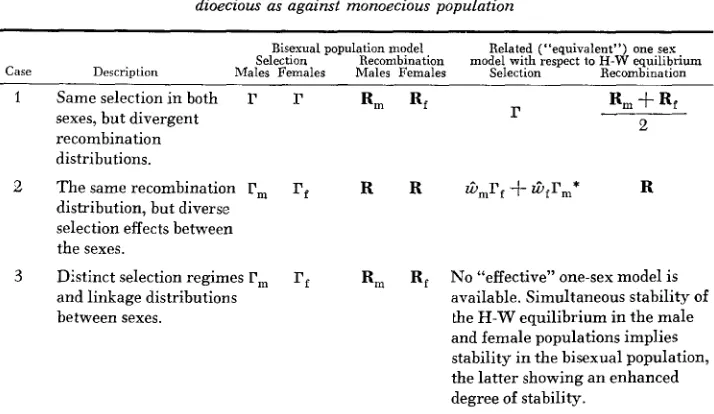
polymorphism, we also attempted to evaluate contrasting bisexual selection regimes as against a merged “averaged” selection regime operating in a corresponding monoecious model. In this frame- work we established a number of reduction principles that help discern the rela- tive influences of recombination and selection forces i n maintaining a bisexual stable H-W polymorphism. I t is useful to display the reduction results in tabular form (Table 1).814. S. KARLIN AND U. LIBERMAN
TABLE 1
Equivalent stability conditions for the H - W polymorphic equilibrium for a dioecious as against monoecious population
Bisexual population model
Case Description Males Females Males Females Selection Recombination Related (“equivalent”) one sex Selection Recombination model with respect to H-W equilibrium
R m
+
Rf__-
r
1 Same selectionin both
r
r
R m R,2 sexes, but divergent
recombination distributions.
2 Thesamerecombination
rm rf
R R 3,r, f G f r m * R distribution, but diverseselection effects between the sexes.
3 Distinct selection regimes ,, I?,
rf
R, R, No “effective” one-sex model is and linkage distributionsbetween sexes.
available. Simultaneous stability of the H-W equilibrium in the male and female populations implies stability i n the bisexual population, the latter showing an enhanced degree of stability.
* A
w, and 3? are the mean fitnesses computed at the H-W polymorphic equilibrium in males and females, respectively.
the equivalent (in evaluating the relevance of the
H-W
central equilibrium) monoecious selection regime is an appropriate “weighted combination” of the male and female selection forms.In
the general Case 3, there is usually no effec- tive reduction of the two-sex model to a corresponding one-sex setup.The results of Sections 1 through 6 suggest the following characteristics ger- mane to the nature of central equilibrium configurations:
( 1 ) The redistribution of selection differentials from a monoecious population to a corresponding dioecious context, retaining the same recombination-segrega- tion mechanism, facilitates the establishment of a stable central
H-W
polymor- phic equilibrium.(2) If for a given level of recombination, the H-W equilibrium is stable with respect to the separate male and female monoecious models, then the same equi- librium is stable for a corresponding generalized nonepistatic bisexual model. In particular, with free recombination, the central H-W polymorphism is always stable in the presence of generalized nonepistatic selection.
(3) The strength of stability for the H-W equilibrium is enhanced for the bisexual model as compared to the individual male and female monoecious models.
(4)
Contrasts in additive as against multiplicative selection effects apportioned among the sexes as they influence the stability nature of the central H-W poly- morphism are sorted out in Section 6. For example, we established the following comparison fact. Suppose 0,+
.
.
.
+
0,,
>
&G2
. .
.
Gn (where 0 k is the meandistribution where the H-W polymorphic equilibrium is stable for the bisexual model with pure additive selection operating in one sex and pure multiplicative selection in the other, then the H-W state is also stable for the monoecious model involving selection intensities as the average of the additive and multiplicative contributions. Where
zit,
+
. . .
+
0,<
zitl6jZ.. .
&
holds, then stability oE the H-W polymorphism for the one-sex [(Add+
Mult)/2] selection form implies stability in the bisexual additive-multiplicative selection regime.What is the evolutionary advantage of cases of lm recombination in the heterogametic sex with higher rates in the homogametic sex? The problem is considered enigmatic, There are two aspects of increased chiasmata that are mostly recognized. The first views the need of chiasmata to insure proper disjunc- tion, preserving the integrity of the two homologous chromosomes at meiosis. The second emphasizes the evolutionary flexibility attendant to recombination events. It is of interest to speculate concerning the evolutionary advantages in diversity of recombination rates between the sexes in the context of the results of this paper. We previously cited examples of extreme differences in chiasmata counts between males and females. For these contrasting sexual linkage relation- ships, we may envision simultaneous stability of H-W polymorphisms and poly- morphic equilibrium exhibiting grades of linkage disequilibrium of various orders.
The analytical theory of n-locus systems as developed in these papers, suggests that with loose linkage there is an increased tendency for the existence of poly- morphism entailing a gamete frequency configuration in near-linkage equi- librium of all orders. With tight linkage, in contrast, the nature of polymorphism when extant (the alternative is usually total fixation) involves a partial set of haplotypes manifesting some strong measures of genic associations. It appears that distinct sex differences in recombination frequencies can more easily allow the coexistence of both of these types of polymorphism, and which type is estab- lished depends on initial conditions or environmental factors. Thus, the evolu- tionary flexibility is certainly expanded with sexuality. Sex-dependent selection and recombination mechanisms apparently engender compensatory balances with
respect to the various ranges of parameters.
I t has been earlier indicated on the basis of theoretical considerations, even with one-locus, two-allele systems, that sex-dependent selection expression admits greater multiplicity and variation in the nature of the stable equilibrium arrays. It is further reasonably demonstrated in our theoretical studies that sexual diversity in recombination rates engenders more scope in polymorphic expression. This finding is consistent with the facts that the rate of recombination may be affected and/or modified by agents such as temperature, age, radiation, internal physiological conditions, general vigor, chemicals and enzymes, among others. These act differentially between the sexes to increase overall fitness and repro- ductive success. In this way, populations can exploit more advantageously intrin- sic environmental potentialities through modifier effects and fitness plasticity.
816 S . KARLIN AND U. LIBERMAN
LITERATURE CITED
BENNETT, J. H., 1954 On the theory of random mating. Ann. Eugen. 18: 311-317.
BODMER, W. F., 1965 Differential fertility in population genetic models. Genetics 51: 411-424. CALLAN, H. G. and P. E. PERRY, 1977 Recombination i n male and female meiocytes contrasted.
CANNINGS, D., 1967 Equilibrium, convergence and stability at sex-linked locus under natural
GEIRINGER, H., 1948 On the mathematics of random mating i n cases of different recombination
HALDANE, J. B. S., 1922 Sex ratio and unisexual sterility in hybrid animals. J. Genet. 7: 106-
KARLIN, S., 1978 Theoretical aspects of multilocus selection balance I. pp. 503-587. In. Studies
KARLIN, S., 1979 Principles of polymorphism and epistasis for multilocus systems. Proc. Natl.
KARLIN, S. and M. W. FELDMAN, 1970 Convergence to equilibrium of the two-locus additive viability model. J. Appl. Prob. 7: 262-271.
KARIIN, S. and U. LIBERMAN, 1978 The two-locus multiallele additive viability model. J. Math. Biol. 5: 201-211. __ , 1979 Central equilibria in multilocus systems. I. Nonepistatic systems. Genetics 91: 777-798.
Regions of stable equilibria for models of differential selection in the two sexes under random mating. Genetics 85:
171-183.
Owen's model of a genetical system with differential viability between
Selection diffkrente dans les deux sexes. Discussion gdndrale des possibilitds
Status of the gene map of the human chromosomes.
A genetical system admitting of two distinct stable equilibria under
Sex differences in linkage between autosomal loci. Theoret. Pop. Biol. 13:
The two locus model with different recombination values in the two sexes. Phil. Trans. R. Soc., London 277: 227-233.
selection. Genetics 56: 613-618.
values for males and females. Genetics 33: 54t-564.
109.
in Mathematical Biology. Edited by S. LEVIN. Math. Assoc. Amer., New York.
Acad. Sci. 76: 541-545.
KIDWELL, J. F., M. T. CLEGO, F. M. STEWART and T. PROUT, 1977
MANDEL, S. P. H., 1971
M ~ R A T , P., 1969
MCKUSICE, V. A. and F. H. RUDDLE, 1977
OWEN, A. R. G., 1953
natural selection. Heredity 7: 97-102. Roux, C. Z., 1978
295-303. STROBECK, C., 1975
Advan. Appl. Prob. 7: 23-26. WHITE, M. J. D., 1973
Cambridge, Massachusetts. sexes. Heredity 26: 49-63.
d'equilibre pour un locus autosomal a deux allelds. Ann. Genet. Sel. Anim. 1: 49-65.
Science 196: 390-405.
Animal Cytology and Evolution, Third Edition, Cambridge Univ. Press,