LETHALITY PATTERNS AND MORPHOLOGY OF SELECTED LETHAL AND SEMI-LETHAL MUTATIONS IN THE ZESTE-WHITE
REGION OF DROSOPHILA MELANOGASTERI
M. P. SHANNON, T. C. KAUFMAN2.3, M. W. SHEN AND B. H. JUDD
Department of Zoology, University of Texas at Austin Austin, Texas 78712
Manuscript received May 31, 1972 Revised copy received August 15, 1972
ABSTRACT
Aspects of the developmental genetics of lethal and semi-lethal mutants representing 13 complementation groups (cistrons) in the 3A-3C region of the X chromosome of Drosophila melanogaster are given. Each of these cistrons is associated with a particular chromomere in the salivary gland chromosome. Mutants within each cistron have similar lethality patterns and morphological attributes, and the characteristics of a given cistron are distinct with respect to other cistrons. These results provide additional evidence that only one function is associated with each chromomere.-The results of the lethality pattern analysis are also compared with previous studies of lethal mutants of Dro- sophila.
cytogenetic study of a segment of the X chromosome of Drosophila melano-
A
gaster led JUDD, S H E N and KAUFMAN (1972) to propose that the cistronic unit in this eucaryote is a complex one, composed of one o r a few structural genes plus a sizeable amount of regulatory DNA, The results of their analysis showed that each chromomere of the 3A2-3C2 region (BRIDGES 1938) in the polytene salivary gland chromosome contains only one complementation group. YetRUDKIN’S
(1965) measurements of the amount of DNA per haploid equivalent strand for this chromosome segment showed that a chromomere of average size contains enough DNA for more than 20 genes, each 1000 nucleotides long.These findings raised some questions about the nature of the unit defined by the cis-trans test. One approach to determining the structure of the cistron and the mechanism of its regulation is to analyze the array of mutants belonging to each cistron. Specifically, we want to know whether all mutations within a given cistron affect the sequence of developmental events in the same manner and at the same time or whether there is some heterogeneity of action and timing.
This kind of analysis should help us decide whether or not the single function aspect of the classical cistron can be retained. On the one hand, heterogeneity in
This investigation was supported in part by U.S.P.H.S. Research Grants GM 12334 and HD 03803 and by U.S.P.H.S.
Present address: Department of Zoology, University of British Columbia, Vancouver, B.C., Canada.
The morphological analysis reported in this paper is drawn from the dissertation presented by T. C. KAUFMAN in
Training Grant GM 00337.
partial fulfillment of the requirements for the degree of Doctor of Philosophy at the University of Texas at Austin.
616 M. P. S H A N N O N et al.
the type of developmental disorders observed among mutants belonging to a single cistron would indicate that several different structural genes are present in the cistron. An important question then would be why the mutations within a cistron fail to complement each other and how such a battery of genes is con- trolled. On the other hand, developmental uniformity among intracistronic mutants would support the notion that only one structural gene is present within the cistron and that a considerable portion of the cistron is devoted to a regulatory role. A critical question then is whether particular intracistronic mutations occur within the structural component or the regulatory component. In other words, do some of the mutations within the cistron represent structural lesions and others regulatory lesions? If the Drosophila cistron does indeed contain both structural and regulatory components, a most intriguing question is: what is the nature of the relationship between the two components?
The mutants in the 3A2-3C2 region were chosen for analysis because there is a high probability that the region is mutationally saturated; i.e., mutations are known for each functional unit within the region. Moreover, a considerable amount of information about these mutants, including both cytological and genetic maps, is available.
The 3A2-3C2 region includes the closely related loci zeste ( z ) and white ( w )
which interact functionally during development. A deletion of the w locus and point mutations located in the righthandjportion of the w locus act as dominant suppressors of z (GANS 1953). This relationship suggested that the region between the z and w loci might be functionally integrated, perhaps under the control of a common genetic unit. The work of JUDD, SHEN and
KAUFMAN
( 1972) provided additional evidence for the close functional relationship between the two genes but did not point to the existence of any obvious functional tie between them and any of the intervening complementation groups.
Zeste is localized in salivary gland band 3A3 of BRIDGES’ (1 938) map ( GANS
1953; JUDD, SHEN and KAUFMAN 1972), and white is localized in band 3C2
(LEFEVRE and WILKINS 1966; JUDD, SHEN and KAUFMAN 1972) o r possibly in the interband space between 3C1 and 3C2 (LEFEVRE and GREEN 1972). JUDD, SHEN and KAUFMAN (1972) recovered 116 lethal and semi-lethal recessive point mutations that map in 12 complementation groups between z and w ; they refer to these groups as the zeste-white (zw) cistrons. Deletion mapping has shown that each zw complementation group is associated with a single chromomere. Two complementation groups, giant ( g t ) and tko, lie outside the z-w interval just to the left of z ; these groups have been localized in salivary gland chromo- some bands of 3A1 and 3A2, respectively. I n all, there are 16 bands in the 3A1- 3C2 interval, which correspond on a one to one basis to the 16 complementation groups that extend from gt through w .
M A T E R I A L S A N D M E T H O D S
Z W MUTANTS O P DROSOPHILA 61 7 groups. The lethality pattern of a mutant includes both its “effective lethal phase” (the stage beyond which further development does not occur and death ensues; HADORN 1955) and observa- tions on its rate of growth and longevity. Second, we have undertaken a morphological charac- terization of many of the mutants. The morphological analysis (which is based largely on
KAUFMAN 1970) has three components: (1) description of the morphology of semi-lethal and temperature-sensitive mutants, (2) description of the morphology of lethal mutants which sur- live when carrying one of three variegating duplications, and (3) use of gynandromorphs to study cellular autonomy or non-autonomy of mutant tissue
Genetic symbols and descriptions of balancer chromosomes and other mutants used in this study can be found in LINDSLEY and GRELL (1968). The methodology used to obtain and map the mutants is given in JUDD, SHEN and KAUFMAN (1972).
Stocks were reared on standard cornmeal-yeast-Karo syrup-agar medium at an ambient tem- perature of about 25°C. In certain experiments constant temperatures of 18°C and 28°C were utilized.
Lethal and semi-lethal mutants were maintained in both male and female stocks. In the male stocks, the mutant genes were balanced to the w + . Y chromosome, in which a section of the X chromosome extending from band 2D1-2 to band 3D3-4 has been inserted into the long arm of the Y chromosome. The presence of this duplicated X chromosome segment allows mutant males to survive; such males were mated to females carrying compund X chromosomes and w + . Y , ( C ( I ) D X / w + . Y ) , establishing a balanced stock. Each mutant gene was carried in a female stock by balancing either to In(I)dl-49, y H w m* g4 or to FM7b (MERRIAM 1968, 1969).
Determination of lethality patterns: The lethality patterns of 42 z w mutants and one tko mutant were determined at a room temperature of about 25°C. The zw mutations were arbi- trarily selected as representatives of their respective complementation groups. Thirty-three of the zw mutations were induced by X rays. Three (121, i24, and g5) were induced by a combina- tion of X rays and ethylenimine ( EI); four (i20, j27, k16, and k22) were induced by E1 alone, and two (a25 and a5) were induced by ICR-170. The tko mutant ( M I ) was induced by a combi- nation of X rays and dimethyl sulfoxide. Relatively few chemically induced mutations were in- cluded in the lethality pattern analysis because most of them were not available at the time the lethality study was undertaken; however, additional information concerning developmental as- pects of a number of chemically induced mutants was obtained as part of the morpholagical analysis.
All mutants for which lethality patterns were determined were marked with the gene yellow ( y ) so that lethal-bearing larvae could be distinguished by the color of mouth parts and setae. A few of the mutant strains also carried one or more additional markers; these included d13, g17, c28, and i1, which carried z, spl, and sn3; 112, which carried z ; and k18, which carried s p l and sn3. We have determined lethality patterns of mutant males; mutant females have not been irlvestigated. The mating procedure from which mutant individuals were obtained is outlined in Figure 1 In the first mating the lethal-bearing chromosome was separated from the w + . Y chromosome by crossing y l ( i ) z w / w + Y males to virgin Oregon-R (Ore-R) females. The virgin heterozygous Ore-R/y Z(1)zz~ females produced by this mating were then mated to Ore-R males (mating 2 ) . About 30 females and 30 males were used as parents in each mating. For each lethal strain, four to six copies of mating 2 were used as a source of lethal larvae. In this manner each lethal gene was introduced into an unselected Ore-R background.
618 M. P. SHANNON et al.
Mating
1
Pl
Fl
88
$3
y
W Z W
'
W ' Y
'
W'Y
??
PQ
Oregon
-
R
Oregon-R
Oregon
-
R
Oregon-R
y
l ( 1 ) z w
Oreqon-R
~~
y
l ( 1 ) Z WOregon-R
Oregon-
R
Oregon
-
R
y
l(1)zw
Mating
2
33
PP
88
33
x -
Oregon- R
Oregon- R
7
$8
FIGURE 1.-Mating procedure to obtain zw male larvae.
carefully at intervals of about 24 h r until all individuals within each sample had died. The de- velopment of the isolated non-lethal larvae was also carefully followed; these animals provided a convenient reference for comparisons of rates of growth, longevity, and general appearance. An organism was considered to be dead when it showed no visible movement and when it gave no response t 3 probing with a dissecting needle.
Mutants are classified according to the degree of viability proposed by HADORN (1948). A lethal mutation causes the death of all individuals carrying the mutant gene in the effective dose. I n the case of a semi-lethal mutation, up to 50% of the mutant individuals may survive.
Z W MUTANTS O F DROSOPHILA 619
sulfonate; one ( f 4 ) by X-rays; one ( h i 0 ) by a combination of X rays and ethylenimine; and one
(k9) by a combination of X rays and dimethyl sulfoxide. Two z w mutations ( g i i and 35n) were
spontaneous. The additional tko mutation (252) was induced by NNG.
The morphology of semi-lethal and temperature-sensitive mutants was studied by use of XY and XO mutant males and homozygous mutant females. The XY males were obtained by mating Z(l)zw/w+.Y males to compound-X females carrying a normal Y chromosome (C(I)DX/Y). The XO males were obtained by mating l(f)zw/w+.Y males t o compound-X females which did not carry a Y chromosome ( C ( i ) R M , yZwabb-/O. The homozygous mutant females were obtained by mating Z(l)zw/FM7b females to the appropriate w+.Y-balanced males. In most cases the fertility of the XY males and the homozygous females was evaluated. If any deviation for normal fertility was noted, the adults were dissected in Ringer's solution and the genitalia examined. Terminology is based on MILLER (1950) and FERRIS (1950) for adult morphology and on KING, RUBINSON, and SMITH (1956) and KING (1957) for ovarian morphology.
Semi-lethal mutants with abnormal phenotypes were preserved in Barber's solution (95% ethanol, ethyl acetate, benzol, and water in a 53: 19: 7: 49 ratio). At a later time these flies were dehydrated through a series of ethanol solutions, cleared in xylene, and mounted in Permount for photography.
The external morphology of s3me of the lethal mutants was studied in males that survive when carrying certah duplications. These duplications, which exhibit a variegated-type position effect, were Dp(I;3)wm49Q (Dp(l:3)3A9-B2; 3E2-3; 80); D P ( I ; ~ ) W ~ ~ ~ O (Dp(1;4)3B1-2; 3C3-
5 ; 101); and Dp(Z;3)Na64-5aa (Dp(1;3)3B%4; 3D5-6; 80). Duplication-carrying mutant males were obtained by mating l(l)zw/w+.Y males to C(I)DX/Y; Dp females under culture con- ditions of 18"C, 25"C, and 28°C. The phenotypes of the recovered I(i)zw/Y; Dp males were studied and recorded. These males were als:, mated to C ( i ) R M ; yZru"bb-/O females to produce l ( l ) z w / O ; Dp males. The XO males were reared at 25°C to determine whether or not the absence of the Y chromosome affected their viability or morphology.
Cellular autonomy of mutant tissue was evaluated by studying gynandromorphs produced by the somatic loss of an unstable ring-X chromosome (HINTON 1955; 1959). A mutation is said to exhibit cellular autonomy (i.e., cellular lethality) when no gynandromorphs bearing patches of mutant (yellow) tissue are recovered. Conversely, a mutation is said to be non-autonomous at the cellular level when such gynandromorphs are recovered.
We have utilized the ring-X chromosome Xro, wvc (kindly supplied by Dr. J. R. M E R N A M ) .
This chromosome is maintained in stock by balancing to In(i)dZ-49, y w tz8, giving Xcp, wvc/ In(I)dl-49, y w 128 females which are mated to In(I)dl-49, y w lzs/sc8.Y males. The balancing chromosome carries a non-autonomous semi-lethal mutation located near y , which is covered by the sc8.Y duplication. In each generation females heterozygous for the ring-X and the balancer chromosome, and showing sectors of y and/or w 1 2 s tissue, were selected and back-crossed to the
appropriate balancer male. This selection of females was necessary in order to maintain the instability of the ring-X.
Females identical to those used to maintain the stock were selected as virgins and mated to y Z(i)zw/w+.Y males. The F, females heterozygous for Xcz, wvc and the y Z ( I ) w , chromosome were then examined for the presence of patches of yellow tissue. The same mutants used in the lethality pattern analysis were employed in the tests for cellular autonomy.
A control rate for instability of the ring-X chromosome was calculated from the frequency of gynandromorphs produced in the stock (26%). The rates observed in the various Xc*, wVC/y 1 f i ) z w flies were compared to this frequency. In the cases of cellular autonomy, we obtained a sample of females heterozygous for the ring-X and the y Z ( l ) z w chromosome that was large enough to have yielded an expected number of gynandromorphs equal to 5 or more.
620 M. P . SHANNON et al.
I
36I
3 C13D
2 F J
3 A' r . 1
: !
i :
! ' 1
1 ;
i ;
....I...!.. I 1
k l l a 2 g10 d28 92* a3 b24 a25 kl e 3 9.27 a 5 f4*
25t* b22 928 e 4 h10* bll b25 e5 k3 920, 11 b18 k18
d13 j25 g l l * i20 c21 95 e13 k9* 31x 20z* 9 3
917 6b* 924 1 2 i c28 h22 9 7 35n* 26j* 3w"
k6 44j* i24 I C 94 k22 112 34i* 14e*
20t* 25f*
7w* 20m* j 2 7 9 6
32 i* k 16 39 p*
29 I
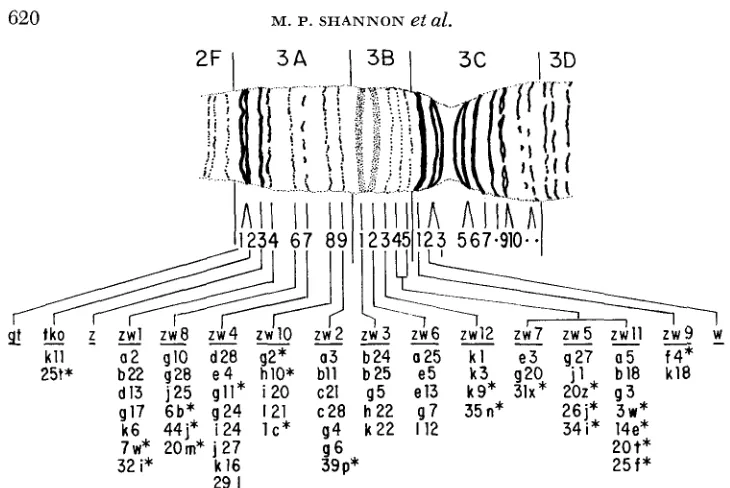
FIGURE 2.-Cytological position of complementation groups in the 3A-3C region of the X chromosome. Only the mutants investigated are indicated. Mutants for which lethality patterns were not determined are marked by asterisks.
RESULTS
Lethality Patterns
Lethal phases: I n the mating scheme we have used, the lethal class constitutes
25% of the offspring. If the effective lethal phase of a mutant occurs in the embryonic period (i.e., any time before hatching of the first instar larvae), the proportion of unhatched eggs should be at least 25%, and there should be no yellow larvae present among the offspring. None of the zw mutants we have examined are distinct embryonic lethals. The percentage of unhatched eggs in matings involving 39 of the 42 zw mutants was low, generally not exceeding
5
%,
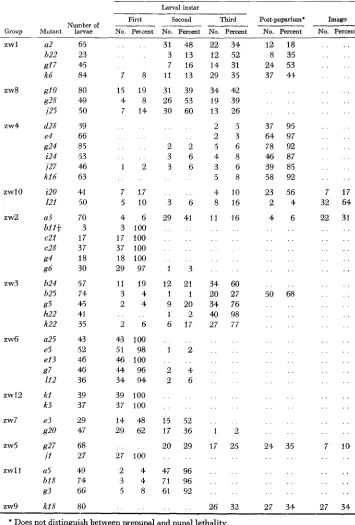
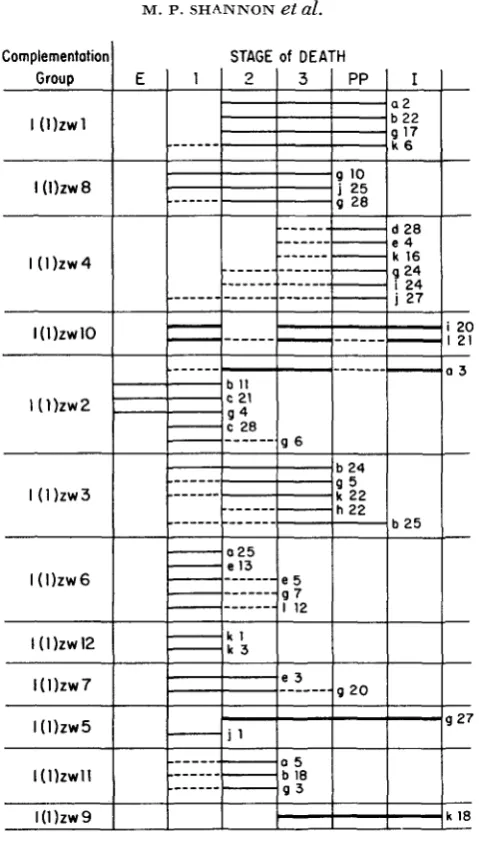
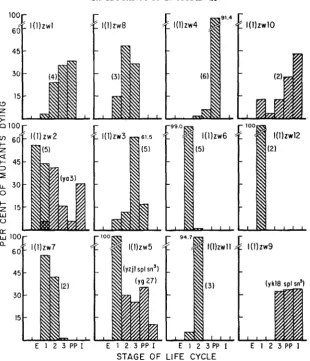
and yellow larvae constituted one-fourth of the progeny. The proportion of unhatched eggs from the Ore-R stock was 5.6%. Examination of dechorionated unhatched eggs from both sources usually showed no visible evidence of embry- onic development; that is, these eggs appeared to be unfertilized. Embryonic mortality occasionally occurred in both the Ore-R stock and the matings segre- gating for a zw mutant. In both instances, the lethal phase occurred near the end of the embryonic period, since the egg membranes contained fully formed larvae. Table 1 summarizes the lethal phases of 41 zw mutants; Figures 3 and 4 are a graphic representation of the same data. The complementation groups in both the table and the figures are arranged according to their genetic and cytological map positions (cf. Figure 2). Data pertaining to the zwl mutant d13 are discussed separately.TABLE 1
Lethal phases of zw males
Group zw 1 zw8 zw4 zwl0 zw2 zw3 zw6 zw12 zw7 zw5 zwll zw9
Number of
Mutant larvae
a2 b22 g17 k6 &!-lo g28 i25 d28 e4 i24 j27 k16 iZ0 I21 a3
b l l f
c21 e28 g4 g6 g24 b24 b25 s5 h22 k22 U25 e5 e13 g7 I12 kl k3 e3 g20 i l U5 b18 g3 k18 g27 65 23 45 84 80 49 50 39 66 85 53 46 63 41 50 70 3 17 37 18 30 57 74 45 41 35 43 52 46 46 36 39 37 29 47 68 27 49 74 66 80
Stage of death
Larval instar
First Second Third Post-puparium'
--
Imago No. Percent No. Percent7 8
15 19
4 8
7 14
1 2
7 17 5 10
4 6
3 100 17 100 37 100 18 100 29 97
11 19
3 4
2 4
2 6
43 loo 51 98 46 100 4 4 9 6 34 94
39 100 37 10.0
14 48 29 62
27 100
2 4
3 4
5 8
No. Percent No. Percent No. Percent
-
31 48 3 13 7 16 11 13
31 39 26 53 30 60
2 2
3 6
3 6
3 6
29 41
1 3
12 21
1 1
9 20
1 2
6 17
1 2
e
4.2 6
15 52 17 36
20 29
47 96 71 96 61 92
22 34 12 52 14 31 29 35
34 42 19 39 13 26
2 5 2 3 5 6 4 8 3 6 5 8
4 10 8 16
11 16
. . . . . . . .
. . . . . . . .
34 60 20 27 34 76 40 98 27 77
. . . . . . . . . . . . . . . . . . . . . . . . . . . . 1 2
17 25
. , . .
. . . .
. . . .
. . . .
26 32
12 18 8 35 24 53 37 49
. . .
. . . . . .
37 95 64 97 78 92 46 87 39 85 58 92
23 56
2 4 4 6 . . . . . . . . . . . . . . . . . . . . . . . .
50 68
. . . . . . . . . . . . . . . . . . . . . . . . . . . . . . . . . . . . . . . . . . . . . . . .
24 35 . . . .
. . . .
. . . .
. . . .
-
27 34 27 34
~~~ . . . . . . . . . . . . . . . . . . . . . . . . . . . . . . . . . . . . . . . . . . . . . . . .
7 17 32 64
22 31
. . . . . . . . . . . . . . . . . . . . . . . . . . . . . . . . . . . . . . . . . . . . . . . . . . . . . . . . . . . . . . . . . . . . . . . . . . . .
7 10
. . . .
. . . .
. . . .
. . . .
* Does not distinguish between prepupal and pupal lethality.
622 M. P. S H A N N O N et al.
Complementotion STAGE of DEATH
Group
I
E I 1 I 2 I 3 I P PI
II (IIZW 1
I (Ilzw 8
I I I I I - I
I I
FIGURE 3.-Ontogenetic distribution of death of 41 zw mutants. A dotted line indicates that less than 10% of the sample died during the indicated stage. A heavy line indicates a semi-lethal mutant, and a thin line indicates a lethal mutant. E, embryo; 1, first larval instar; 2, second larval instar; 3, third larval instar; PP, post-puparium; I, imago.
Three zw2 mutants, b l l , c21, and g4, (Table 2) are late embryonic-first instar “boundary lethals” (HADORN 1951 )
.
These mutants develop into normal-appear- ing first instar larvae, but some die within the egg membranes; others hatch but do not grow. Two zw2 mutants, c28 and g 6 , are post-embryonic lethals; in each case the lethal phase occurs during the first larval instar. According to HADORNZ W MUTANTS O F DROSOPHILA 623
E 1 2 3 P P I E 1 2 3 P P I E 1 2 3 P P I E 1 2 3 P P I
STAGE OF LIFE CYCLE
FIGURE 4+.-Histograms showing the ontogenetic distribution of death of zw mutants when data from mutants within each Complementation group are pooled. The number of mutants examined i n each complementation group is indicated in parentheses. Semi-lethal mutants are represented by histograms with right to left strips. E, embryo; 1, first larval instar; 2, second larval instar; 3, third larval instar; PP, post-puparium; I, imago.
TABLE 2
Egg viability of matings segregating for certain 1 (1) zw2 mutants
Mutant
bi 1 c21 g4
c28
g6
Number of eggs
432 645 563 22 1 159
Number
unhatched
54' 1 085 *
1 I O *
7 t 3 t
Percent
unhatched
13.4 16.3 19.5 3.2 1.9
* The egg membranes contained normal-appearing larvae.
624 M. P. SHANNON et al.
death occurs at the end of the embryonic period or at the beginning of the first larval instar. Since the zw2 first instar lethals die without undergoing significant larval growth, it seems reasonable to regard all of the lethal zw2 mutants examined as monophasic in time of death. One zw2 mutant, a3, is a semi-lethal characterized by polyphasic lethality.
Mutants within four of the complementation groups, zw6, zwl2, z w l l , and zw4, are clearly monophasic in time of death. The zw6 and zwl2 mutants are first instar lethals. Group z w l l is unique in that all three of the mutants examined die during the second larval instar. Mutants in group zw4 die after puparium formation; the proportion of animals that pupate is not known, although some individuals of each genotype examined show imaginal develop- ment.
I n the case of certain monophasic lethals, a small number of individuals die at some stage other than the characteristic lethal phase. Usually such deaths precede the typical lethal phase; less often they follow the critical phase (see Figure 3 ) . HADORN and CHEN (1952) observed a similar phenomenon in a study of autosomal lethal factors of Drosophila melanogaster. HADORN (1951) suggested that lethal mutants may suffer a “general weakness” before they reach their specific lethal phase, leading to an early death of some individuals. The survival of some individuals beyond the ordinary lethal phase may be related to slight variations in penetrance of the lethal factor.
The two zw7 mutants investigated are diphasic lethals; death occurs in either the first or the second larval instar.
Lethal mutants belonging to complementation groups z w l , zw8, and zw3 are polyphasic in time of death. In addition to the information presented in Table 1,
we know from KAUFMAN’S work (1970) that group zwl contains two semi-lethal mutants ( 7 w and
32i),
both of which undergo some lethality late in the pupal period, and that group zw8 contains one semi-lethal mutant ( 2 0 m ) and two temperature-sensitive mutants (6b and 4 4 j ) , which have variable lethal phases embracing both larval and post-puparium stages. All known zw3 mutants are lethals. The third larval instar is the major lethal phase of the zw3 mutants used in the lethality pattern analysis. The lethal b25 differs from other zw3 mutants in that its major lethal phase occurs after puparium formation. but there is no evidence of imaginal development in any b25 animals.Z W MUTANTS O F DROSOPHILA 625 The tko mutant,
kll,
is a diphasic post-embryonic lethal. The total k l l sample consisted of 62 larvae; 50 (81%) died during the second larval instar, and 12died during the third larval instar.
Throughout the course of the letha!ity pattern investigation, the viability of control larvae was high. Only 8% of the non-lethal larvae were inviable; death generally occurred at the end of the third larval instar or at post-puparium stages. The viability of larvae from the Ore-R stock was similar; 5% of the Ore-R larvae did not survive to the adult stage, and lethality was also concentrated at the end of the larval period or at later stages.
Rate of growth and longeuity: The following observations are based on a direct visual comparison of mutant larvae and normally developing non-lethal
F,
larvae from the same matings. Age is given in days after hatching from the egg.l(1)tko. One mutant, k l l , was examined. Molting to the second larval instar is delayed about 24 h r in larvae that die during that stage; these larvae grow slowly but attain full size. and death occurs at 9-18 days. Animals that die as third larval instars molt to that stage about a day later than normal larvae. The inviable third instar larvae do not grow, although they survive until about day 20. l ( 1 ) z w l . The growth rate bcgins to decrease during the first larval instar (g17) o r the second larval instar (a2, b22, k 6 ) . Animals that die during the second and third larval instars reach half to full size; those that die as first instar larvae do not grow beyond their size at hatching. Larval death occurs at 3-4 days (first instar)
,
7-10 days (second instar),
and 7-16 days (third instar). Puparium formation does not occur until days 8-15.The d13 animals that die as first instar larvae do not grow, and death occurs by day 4. Growth of d13 individuals that die during the second larval instar is variable, and death occurs by day 7.
l ( l ) z w 8 : Individuals that die as first instar larvae do not grow. The growth rate of those individuals that die as second or third instar larvae begins to slow down near the end of the first larval instar; these larvae reach only about half the size of the corresponding normal larvae. Larval death occurs at 3-4 days
(first instar) ; 6-12 days (second instar), and 15-20 days (third instar).
l ( l ) z w 4 : Four mutants (e4, i24, j27,
k16)
grow at a normal rate until late in the third larval instar. The mutant d28 begins to grow slowly at the beginning of the second larval instar, and growth of the mutant g24 slows at the beginning of the third larval instar; third instar larvae of both genotypes grow to full size. Some individuals undergo puparium formation at the normal time (about day 4) ;others do not form puparia until days 5-8.
Z(1)zwlO: The growth rate of i20 animals that survive to the adult stage is normal; i.e., imagos hatch on the same day as controls. The growth rate of 121 individuals slows during the second larval instar, and the final size of larvae that die during second and third instar stages is variable. Puparium formation of 121 animals is delayed about 24 hr, and imagos hatch on about day 14. Inviable larvae of both i20 and 121 genotypes survive several days beyond the time when normal larvae have molted to the succeeding stages.
E26 M. P. SHANNON et al.
c21, g4) die within 24 h r after hatching. First instar larvae of the post-embryonic lethals (c28, g 6 ) survive until days 3-4. None of the z w 2 first instar larvae exhibit any growth.
Inviable first instar larvae of the semi-lethal mutant a3 do not grow, and death occurs within 24 h r after hatching. Those individuals which die during the second larval instar grow slowly and attain about half normal size; death occurs on days 3-7. Animals that survive to the third larval instar grow at a normal rate and attain full size; death occurs on days 7-10. Puparium formation occurs on days 7-8, and imagos hatch on about day 14.
l ( l ) z w 3 : The growth rate slows during the first larval instar (b24, h 2 2 ) , the second larval instar ( g 5 ) , or the third larval instar (b25, k 2 2 ) . Animals which die during the first larval instar do not grow, while those that die during the second larval instar usually attain the full size characteristic of that instar; these larvae die several days after normal larvae have molted to the third instar. Indi- viduals which survive to the third larval instar either do not grow (b24 and h22) or do not achieve full growth (b25, g5, k 2 2 ) . Puparium formation of surviving b25 larvae occurs on days 7-1 1.
l ( l ) z w 6 : First instar larvae do not grow (a25, e5, e13) o r grow slightly (g7, 112) ; death occurs on days 3-6. Second instar larvae do not grow but survive for several days.
l ( l ) z w 1 2 : The first instar larvae do not grow. and death occurs on days 3-4. l ( l ) z w 7 : The e3 animals that die as first instar larvae do not grow. and death occurs at about 3 days; animals that survive to the second larval instar grow slowly but attain full size, dying at 6-14 days. The g20 individuals that die as first instar larvae attain full size but die after 1-2 days. The growth of g20 animals during the second larval instar is variable; death occurs on days 6-9.
l ( l ) z w 5 : The growth rate of the first instar larvae of the lethal mutant
il
is variable; death occurs on days 1-3.The semi-lethal mutant, g27, grows at a normal rate until the second larval instar. Individuals that die during the second and third larval instars grow only slightly; death occurs at about 6 days (second instar) and at 7-10 days (third instar). Puparium formation in individuals that survive the larval period occurs on days 9-12, and imagos hatch on days 14-1 7.
l ( 1 ) z w l l : Inviable first instar larvae do not grow. and death occurs on days 1-6. Second instar larvae grow slowly and attain only about half normal size; death occurs on days 9-1 6.
l ( l ) z w 9 : The semi-lethal mutant, k18, grows at a normal rate up to the time of puparium formation; imagos hatch on days 11-13. Inviable third instar larvae die on days 4-7.
Z W M U T A N T S O F DROSOPHILA 62 7
ceding the actual lethal phase. ( 5 ) After maximum development has been reached, the mutant animals survive f o r some time before death occurs. Conse- quently, the duration of the stage in which death occus is prolonged.
The above statements generally apply also to the semi-lethal mutants; how- ever. one semi-lethal mutant (i20) develops at essentially a normal rate.
Morphological Aspects
A detailed description of all the mutants involved in this phase of the study can be found in
KAUFMAN
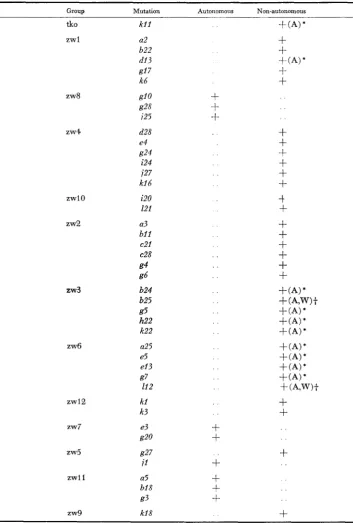
(1970). Descriptions of the gt, z , and w loci are given in JUDD, SHEN and KAUFMAN (1972), and LINDSLEY and GRELL (1968). Table 3summarizes the cellular autonomy characteristics which are detailed in the text.
tko: Two of the three mutants in this group were examined. The mutant 25t is a semi-lethal; surviving males and homozygous females have short thin bristles and are highly sensitive to physical shock (see JUDD? SHEN and
KAUFMAN
1972).The mutant k l l is a lethal. Gynandromorphs of k l l are produced through the loss of the ring-X chromosome; patches of yellow tissue are found only in the abdominal tergites, which lack bristles and appear etched. This phenotype is reminiscent of bobbed.
Z(1)zwl: Seven of the 34 z w l mutants were studied. Two of the mutants, 7 w and 32i, are semi-lethal in both males and homozygous females. Females hetero- zygous for either of these mutant genes and deficiencies of z w l or other z w l mutations are lethal, but 7w/32i females are semi-lethal. Surviving 7 w X Y males occasionally have rough eyes with protruding facets; the wings are often shriveled or blistered, and the metathoracic legs crippled, 7 w
XO
males have a more extreme mutant phenotype, sometimes involving crippling of the meso- thoracic legs as well as the metathoracic legs. 32i males have similar morpho- logical defects; XO males are more severely affected than X Y males. Both 72.9 and 32i X Y males are fertile. Mutant females are phenotypically similar to the mutant males. Homozygous 7 w females and 32i/7w females are sterile; no eggs are deposited. Homozygous 32i female are poorly fertile; only a few eggs are deposited. Mutant females have normal genitalia and sperm storage and develop many stage 14 oocytes. If homozygous 32i females are mated to 7 w or 32i males, the off spring exhibit the lethality pattern characteristic of z w l lethals; therefore, no adult progeny are produced. If homozygous 32i females are mated to FM7b males, only heterozygous female adult progeny are produced.The cellular autonomy characteristics of five z w l mutants (a2, b22, d13, g17, k 6 ) were determined. The mutants a2, b22, g17, and
k6
have the same autonomy pattern. Sectors of yellow tissue are found in all parts of the adult hypoderm. The yellow tissue is in general phenotypically normal; however, in cases where the eye is surrounded by yellow tissue and bristles and is thus apparentlyXO
tissue, it is rough and has some protruding facets. When wings and metathoracic legs are entirely yellow, they are often deformed.
TABLE 3
Cellular autonomy patterns of lethal and semi-lethal mutations in the 3A-3C region
zw8
zw4
ZWIO
zw2
zw3
zw6
Group Mutabon Autonomous Non-autonomous
tk0 k11 + ( A ) *
zw 1 a2
+
b2Z
+
d13 + ( A ) *
g17
+
k6
+
g10
+
g28
+
725
+
d28
+
e4
+
g24
+
i24
+
i27
+
k16
+
i20 -t
121
+
a3
+
b11
+
e21
+
e28
+
g4
+
s6
+
b24 + ( A ) *
b25
+
(&W)t
g5 +(A) *
h22 + ( A ) *
k22 + ( A ) *
a25 + ( A ) *
e5 +(A) *
e13 + ( A ) *
g7 + ( A ) *
112
+
( 4 W )t
zw12 kl
+
k3
+
zw7 e3
+
g20
+
zw5 g27
+
il
+
z w l l a5
+
bl8
+
g3
+
zw9 k1 8
+
* Survives as sectors of mutant tissue only in abdomen; the d13 discrepancy is explained in the
Z W M U T A N T S O F DROSOPHILA 629
abdominal tergites; moreover, the yellow regions lack bristles and appear etched. Because of the peculiar autonomy pattern of d13, in conjunction with an atypical lethality pattern (previously noted)
,
we reexamined the complementation bk- havior of this mutant. W e thereby found that d13 is associated with a second lethal point mutation on the X chromosome which fails to complement with zw3mutants. The autonomy characteristics of zw3 mutants (see below) are similar to that noted in d13. The lethality phases of d13 are, however, shifted to some- what earlier stages than those characterizing most z w l and zw3 mutant indi- viduals. This fact m2y indicate that the two different lethal genes exert a cumu- lative impact on development, causing noticeable phenotypic alterations to appear earlier in ontogeny than when either gene is acting alone.
l ( l ) z w 8 : Six of the eight mutants in this group were investigated. Two of the mutants, 6b and 44j. are temperature-sensitive; these mutants survive when raised at 18°C but are lethal when raised at 25°C and 28°C. Mutant 6b has fine bristles and often lacks the posterior verticals and posterior scutellars; wing veins L2, L3, and L5 are frequently netted a t the distal ends, and there are incisions on the inner wing margin. 6b males are fertile at 18°C; 6b females are weakly fertile at 18°C but become sterile within 48 h r after they are kept at 25°C. 6b
females have normal accessory sex organs, but one ovary is rudimentary. The rudimentary ovary contains stage 6 or 7 oocytes; the functional ovary has a reduced number of ovarioles, but some stage 14 oocytes are present. Females heterozygous either f o r 6b and deficiencies of the zw8 locus or for 6b and zw8
lethal point mutations are lethal even at the permissive temperature (18°C). Females heterozygous for 6b and 2 0 m ( 2 0 m males are semi-lethal) are viable at 18°C and 25°C; these females are weakly fertile and have the same internal morphology as 6b females. 44j mutant males have the same phenotypic and fertility attributes as 6b males.
Both 6b and 44; survive at 25°C and 28°C when Dp(l;4)wmGJg is present in the genome, but the lethals g10,g28, and j25 are not complemented by this dupli- cation at any temperature. Surviving 6b and 44j males express the phenotype described above.
XO
males bearing the duplication are not recovered at 25°C. The mutant 2 0 m is a semi-lethal. Surviving males and females have the 6bbristle and wing phenotype. 2Om males are fertile. 2Om females have low fer- tility and the same internal morphology as 6b females. Females heterozygous f o r 20m and zw8 deficiencies o r heterozygous for 20m and zw8 lethals are lethal. The three lethals g10, g28, and j25 are autonomous for cellular lethality; i.e., gynandromorphs are not recovered.
1(1)zw4: Eight of the 12 mutants in this group were investigated. All zw4
mutants are lethals. The autonomy pattern of six mutants (d28, e4, g24, i24, j27,
k l 6 ) was determined. These six mutants survive in gynandromorphs at the same frequency as controls; yellow sectors are phenotypically normal, but the eye is rough when it is included in the yellow tissue sector.
630 M. P. SHANNON et al.
18"C, 25"C, and 28°C when D p ( l ; 4 ) ~ " , ~ ~ v is present in the genome. Surviving males have the phenotype described above and are fertile. XO males bearing the duplication are not recovered at 25°C.
l(l)zwlO: This group contains five semi-lethal mutants, all of which were analyzed. The frequency of surviving males is variable, being influenced by crowding, culture conditions, and background genotype. Adult males have rough, reduced eyes, and the wings have thickened veins and incisions on the inner margin. Thoracic hairs are often irregularly arranged; dorsocentral, scutellar, ocellar, orbital, and vertical bristles are frequently absent. Males are sterile; sperm are immotile, although they are transferred to the female at mating.
Females, which express the same mutant phenotype as zwl0 males, usually die 24 to 48 hr after eclosion. Ovaries and accessory sex organs are normal. but mating apparently does not occur. Rarely, adult females heterozygous for a z w l 0 mutation and a zwl0 deficiency are recovered, but death occurs within 24 h r after eclosion.
The autonomy characteristics of two zw10 mutants, i20 and 121, were deter- mined. Gynandromorphs with large patches of yellow tissue are recovered. When the yellow tissue includes those areas which are abnormal in adult z w l 0 flies, the characteristic zwl0 phenotype is expressed. The lethal effect is thus non-
autonomous at the cellular level, but the adult phenotype is autonomous. l(l)zw2: Seven of the 20 mutants in this group were examined. Mutant a3 is semi-lethal; the other mutants are lethals. Surviving a3 males have rough eyes and are fertile. Heterozygotes of a3 and a zw2 deficiency o r of a3 and any zw2 mutation except g6 are lethal. The heterozygote a3/g6 is viable but sterile. Gynandromorphs of a3 are produced at a rate similar to that of controls.
Unlike other members of zw2, mutant 39p survives when D p ( l ; 4 ) ~ " ' ~ ~ ~ is present in the genome (at 25°C and 28°C but not at 18°C). Surviving males have rough eyes and die shortly after eclosion without having mated.
The autonomy pattern of five lethal zw2 mutants ( b l l , c21. c28, g4, g6) was determined. Gynandromorphs are recovered, but at a low rate compared to controls. The yellow tissue is phenotypically normal; however, one g4 gynandro- morph had a rough eye on the side of the head that was yellow.
l ( l ) z w 3 : Five (b24, b25, g5, h22, k22) of the nine lethal mutants in this group were studied. All five mutants yield gynandromorphs, but the yellow tissue is restricted to the abdominal tergites (except in the case of b25). When yellow tergites are present, they lack bristles and appear etched, as in bobbed. Tergite-like material is frequently observed on the ventral surface of the abdo- men. In addition to the tergite abnormalities, two of six b25 gynandromorphs bore strips of yellow tissue in the wings, which were deformed.
Unlike other zw3 mutants, b25 survives when D p ( 1 ; 4 ) ~ " ~ ~ 0 is present in the genome (at 25°C). Surviving males are phenotypically normal and fertile.
l(l)zw6: Five (a25, e5, e13, g7,llZ) of the seven lethal mutants in this group were examined. All five mutants survive when Dp(2;4)wmE59 or Dp(1;3) w~~~~
Z W MUTANTS O F DROSOPHILA 63 1
typically normal and fertile.
XO
males bearing either of these duplications are not recovered at 25°C.Gynandromorphs of the five mutants are recovered; they are phenotypically like zw3 gynandromorphs. Two out of four 112 gyandromorphs were the only zw6 gyandromorphs in which both the tergites and the wings bore yellow tissue; the yellow wing tissue resembled that of the b25 gynandromorphs described above.
Heterozygotes of 112 and Df (1)62dl8 occasionally survive; heterozygotes of other zwb mutations and this deficiency do not survive.
2(l)zw12: The four lethal mutants in this group were analyzed. All survive when Dp(1;4)wms5g o r D p ( 1 ; 3 ) ~ " 4 ~ " is present in the genome (at 18"C, 25"C,
and 28°C). Surviving males are phenotypically normal and fertile. XO males bearing either of these duplications are not recovered at 25°C.
The autonomy pattern of two mutants, kl and k3, was determined. Gynandro- morphs are produced but at a much lower rate than in the case of controls. The yellow tissue present in gynandromorphs is otherwise morphologically normal.
l(l)zw7: The three lethal mutants in this group were studied. All survive when D p ( 1 ; 4 ) ~ " ~ ~ 0 , D p ( 1 ; 3 ) ~ " 4 ~ " , or Dp(1;3)N26~-58a is present in the genome (at
18"C, 25"C, and 28OC). Surviving males have slightly rough eyes and are fertile.
XO
males bearing any one of these duplications are not recovered at 25°C.The autonomy pattern of e3 and g20 was determined. Gynandromorphs are not recovered.
l ( l ) z w 5 : The five mutants in this group were studied. Four
(il,
202,26j, 34i) are lethals, and one (g27) is a semi-lethal. All five mutants survive when Dp(1;4)n%659, D p ( 1 ; 3 ) ~ ~ 4 ~ ~ , or Dp(1;3)N264-58a is present in the genome (at18"C, 25"C, and 28°C). Surviving males have rough, reduced dark-colored eyes. The vibrissae are sparse, and orbital, ocellar, and vertical bristles are often absent. Wing veins are thick, and the inner wing margin frequently bears incisions. These males are fertile. XO males bearing any one of these duplications are not recovered at 25
"
C.Surviving g27 males have the phenotype described above but are sterile. The autonomy characteristics of
il
and g27 were determined. Mutantil
appears to be autonomous f o r cellular lethality, but g27 is non-autonomous. Sectors of yellow tissue in the head and wings of g27 gynandromorphs have the morphological abnormalities present in the duplication-bearing mutant males. On the basis of phenotype and map position, we consider zw5 mutants to be synonymous with the previously described mutants vestigium and deformed wing (see JUDD, SHEN and KAUFMAN 1972).l ( 1 ) z w l l : The seven lethal mutants in this group were examined. All survive when Dp(1;4)wms5g7 D p ( 1 ; 3 ) ~ " 4 ~ " , or D P ( ~ ; S ) N ~ ~ ~ - ~ ~ " is present in the genome (at 18"C, 25"C, and 28°C). Surviving males lack varying numbers of orbital, ocellar, and vertical bristles, and the wing veins are occasionally thickened at
632 M. P. SHANNON et al.
The three mutants a5, b18, and g3 have the same autonomy pattern; gynandro-
l(l)zw9: The two semi-lethal mutants in this group
(f4
and k18) were studied. Surviving f4 and k18 males have markedly reduced aristae, and the third antennal segment is blunt and rounded. Males have an additional sex comb on the second tarsal segment of the prothoracic leg. Females express the same antennal phenotype as males. Males have reduced fertility, and k18,f4,
andk18/f4 females are sterile. Females have normal accessory sex organs, but the ovaries are rudimentary with no oocytes more advanced than stage 7.
Females heterozygous for either allele and a zw9 deficiency rarely survive. The mutant k18 yields gynandromorphs. When yellow tissue is present in the antennae o r the prothoracic legs, the characteristic zw9 phenotype is expressed. The zw9 locus is apparently synonymous with sparse arista, which has been described by RAYLE and GREEN (1 968).
morphs are not recovered.
DISCUSSION
The foregoing results bear on several related questions. First, we are interested in how each of 13 adjacent loci functions in the development of the organism. Second, we want to know whether these loci, by virtue of their spatial arrange- ment, interact in obvious ways. Third, we want to know how well these results fit the one chromomere : one function hypothesis as elaborated by JUDD, SHEN and KAUFMAN (1 972), which predicts that mutations within a given complemen- tation group should fall into two classes, structural and regulatory.
zw Lethality Patterns. Comparison with Previous Studies: HADORN (1 948, 1951, 1955) recognized a number of phases in Drosophila development when death caused by lethal mutations was most likely to occur. These phases included the early and the late embryonic period, the beginning of the first larval instar, the beginning and the end of the third larval instar, the beginning of the pre- pupal stage, pupation, the pupal period, and the period just after the emergence of the imago. HADORN (1 948) further maintained that lethal, or sensitive, phases are separated by insensitive “interphases” during which deaths do not occur. Several investigations (cf. OSTER 1952; RIZKI 1952; SETO 1954) basically affirmed HADORN’S generalizations.
The present work also supports and extends the concept of the phase specificity of lethal factors. The zw2 mutants clearly exhibit a late embryonic-early larval lethal phase (cf. LI 1927; BREHME 1939; KALISS 1939; EDE 1956). That the early first larval instar is a sensitive phase is well illustrated by the fact that inviable
Z W MUTANTS O F DROSOPHILA 633
(SCHMID 1949). Four zw3 mutants have a conspicuous sensitive phase near the beginning of the third larval instar. A sensitive phase near the end of the third larval instar is evident in zw semi-lethal mutants, in zw4 mutants, and in the mutant ~ ( l ) ~ w 3 ~ ' ~ . Since b25 animals die either at the end of the larval period or after puparium formation without showing imaginal development, it is prob- able that this mutant is a larval-prepupal boundary lethal. A sensitive phase during the pupal period is apparent in some zw4 individuals and in the semi- lethal mutants. Death just after hatching of the imago occasionally occurs among some of the semi-lethal mutants.
The second larval instar was once regarded as an insensitive interphase during which death caused by lethal mutations is rare or lacking (HADORN 1948). The present work shows that the second instar is often a lethal phase among mutants with polyphasic lethality patterns (cf. the similar observations of SIVERTZEV- DOBZHANSKY 1927; BRODY 1940; RIZKI 1952). Our results agree with previous investigations (MEDVEDEV 1939a; HADORN 2nd CHEN 1952; RIZKI 1952; OSTER
1954) which indicate that the second larval instar is infrequently the character- istic lethal phase among monophasic lethals. Only z w l l mutants are monophasic second instar lethals.
Polyphasic lethality has been noted in a number of lethal Drosophila mutants. Aphasic lethality (the random distribution of death over the whole course of development among individuals of the same genotype), however, apparently does not occur (HADORN 1955). Although many of the zw mutants are poly- phasic in time of death, none are aphasic. The extent of polyphasic lethality among the zw mutants appears to be relatively greater than among other lethals. Seven of the 12 zw complementation groups contain polyphasic mutants, and only one of these is diphasic; all other have lethal phases in at least three stages. I n contrast, among 59 non-allelic lethals HADORN and CHEN (1952) found 46 monophasic mutants, 12 diphasic mutants, and 1 triphasic mutant. In a sample of 44 non-allelic lethals RIZKI (1952) found 35 monophasic mutants, 7 diphasic mutants, and 2 triphasic mutants. HADORN (1940) showed that manipulation of the genetic background of the mutant lethal (2) giant larvae could narrow the number of lethal stages. Although we cannot rule out a possible influence of the genetic milieu on the phasic variation of the zw mutants, our technique of out- crossing the lethal genotype to an Or& background should have given a high degree of heterozygosity, thus reducing the influence of modifying factors.
Semi-lethal mutants are commonly recovered in mutagenesis experiments, but little work has been devoted to analysis of their development (HADORN 1951). I t is thus interesting to note that all five zw semi-lethal mutants we have examined show polyphasic lethality and that each has a discrete ontogenetic distribution of lethal phases (see Figures 3 and 4). Two of the semi-lethal mutants, a3 (at locus zw2) and g27 (at locus Z W ~ ) , are, respectively, the only
634 M. P. SHANNON et a2.
to form a gene product that functions above a critical threshold level during the early larval period. These two mutants can thus “escape” the first sensitive phase but generally succumb during one of the subsequent critical phases.
Many X-ray-induced mutants of Drosophila die during the embryonic period (cf. RIZKI 1952). The high incidence of embryonic lethality among X-ray- induced mutants is presumably related to the presence of genetic deficiencies or chromosomal aberrations which tend to disrupt basic morphogenetic processes (cf. POULSON 1940, 1945). On the other hand, spontaneous mutants (RIZKI
1952), mutants induced by ultraviolet light (OSTER 1952) or chemicals (HADORN
and CHEN 1952), and X-ray-induced mutants which do not have detectable chromosomal defects (OSTER 1954) usually show a higher proportion of post- embryonic lethality than embryonic lethality. Our results are in agreement with the foregoing observations. Most zw mutants utilized in our lethality pattern analysis are of X-ray origin, and all appear to be point mutations by the genetic
and cytological criteria we have employed. The zw lethal phases are primarily post-embryonic, with the highest concentration of mortality occurring in the larval period. The earliest lethal phase of any of the z w mutants occurs at the embryonic-larval boundary and does not involve any striking morphological abnormalities.
The mutants we have investigated resemble other lethal Drosophila mutants in that they commonly survive for a considerable time after development has ceased (cf. LI 1927; MEDVEDEV 193913; BREHME 1939; SCHMID 1949).
W e have noted that the zw mutants are characterized by slower growth than normal animals and that the growth rate often begins to decrease during a stage preceding the actual lethal phase. These facts probably indicate that the effects (functions) of the mutant genes are expressed considerably earlier in ontogeny than the lethal stage. Since zw mutants appear to undergo normal embryo- genesis, we can speculate that the products specified by the zw genes do not become involved in development until about the end of the embryonic period. This is not to say that the zw genes may not be transcribed before the end of the embryonic period, or at any other stages preceding death.
Intercistronic relationships: Mutants within all the cistrons we have studied are developmentally similar in that they are generally characterized by post- embryonic lethality patterns. Although mutants within a cistron sometimes resemble mutants within other cistrons in some respect, no two cistrons have exactly the same complex of lethality pattsrns, morphological attributes, and autonomy characteristics. Mutants within two adjacent cistrons, zw3 and zw6,
have identical autonomy patterns but different lethality patterns. The lethality patterns of mutants within the adjacent cistrons zw6 and zw12 are the same, but autonomy characteristics are different. Mutants within the three adjacent cistrons, zw7, zw5, and zwll, exhibit cellular autonomy (with the exception of
g27) ; however, phenotypes and lethality patterns are specific for each cistron. There thus appears to be no obvious relationship between the spatial arrange- ment of the cistrons in the chromosome and their functions.
Z W M U T A N T S O F DROSOPHILA 635
indicate that mutants within each complementation group have remarkably similar lethality patterns and morphological attributes. W e infer that the muta- tions in any one complementation group are quite specific in action, apparently affecting the same developmental processes. I t is true that there are certain differ- ences among some members of a given complementation group. For example: The zw2 mutation, a3, complements with g6 but not with other zw2 mutations.
The zw2 mutant, 39p, survives when Dp(1;4)~r”~~S is present in the genome, but other zw2 mutants that were tested do not survive when this duplication is present. The zw5 semi-lethal mutant, g27, is non-autonomous for cellular lethal- ity, but the zw5 lethal,
il,
is autonomous. The semi-lethal mutants a3 and g27do not exhibit the major lethal phase characteristic of the lethal mutants within their respective cistrons. The zw3 mutant, b25, often reaches the stage of puparium formation, although other zw3 mutants die before reaching this stage. The zwl0 mutant, i20, has a n essentially normal growth rate. whereas another
zwl0 mutant, 121, has a retarded growth rate.
The intracistronic differences we have observed can be generalized as differ- ences between “leaky” and “non-leaky’’ mutations. Leaky mutations are most likely those which produce a gene product altered in either structure or amount. Some, of course. could represent defects which are being partially repaired by a component in the diet of the animal; such repair may be involved in the case of semi-lethal mutants. Intracistronic differences in patterns of autonomy, such as those between g27 and
il,
could be readily explained in terms of production by the leaky mutant of a defective gene product which still functions well enough to appear to be non-autonomous in a mutant/normal mosaic.On the whole, the intracistronic variations do not appear to differ in scope from the differences often encountered among mutants in a series known to involve a single structural gene. Certainly, we have not found sufficient develop- mental and morphological heterogeneity among mutants within a complemen- tation group to indicate the existence of more than one function. The existence of one function implies that only one product (polypeptide) is specified by each cistron. Obviously, if it could be demonstrated that several gene products were being specified by a single complementation group, the commonly accepted view of the nature of the cistronic unit in eucaryotic organisms would have to be revised.
636 M. P. SHANNON et al.
two mutations even if they are located in different parts of the complex. Such inactivation could occur at the transcriptional or translational level or at the level of interaction between components of an enzyme complex.
A critical question that remains unanswered is whether the Drosophila cistron does actually consist of both structural and regulatory components which interact to specify a particular function in the life of the organism. It has not been possible by means of the developmental and phenotypic analyses described here to dis- tinguish between intracistronic structural and regulatory mutations. We had hoped that the use of variegating duplications might indicate such a dichotomy among members of a complementation group; however, the tests described above do not aid us in this search.
There is a possibility that all of the mutations we have recovered may repre- sent lesions either in structural genes only or in regulatory genes only. It is probable that the actual biological role or roles of the DNA within the chromo- mere will not become known until the product or products it specifies are identi- fied and characterized to a rather high degree. Even when a purified product is available, however, any regulatory mutations which have been recovered are likely to be lumped into the same category as some nonsense mutations in a structural gene.
I n the absence of firm evidence that the cistron is a complex which functions only in the cis arrangement, we are impressed with several facts: (1 ) Each lethal or semi-lethal cistron we have identified is located in an individual chromomere. (We are quite aware that there may be particular classes of mutations that are not represented in our sample and that there may be chromomeres we have failed to identify.) (2) Chromomeres in the 3A-3C region of the chromosome vary in size over several orders of magnitude. (3) Members of an array of non- complementing mutations have remarkably similar lethality patterns and other phenotypic attributes. These facts fit well with the model of chromosome struc- ture postulated by CRICK (1971). If indeed the structural gene o r genes of each cistron are located in the fibrous DNA of the interband regions and the globular DNA of the chromomere is regulatory in function, chromomere size may reflect the complexity of the regulatory system and give a clue concerning how many other cistrons are tied to the chromomere at some level of regulatory interaction. The models of gene regulation proposed both by BRITTEN and DAVIDSON (1969) and by GEORGIEV ( 1 969) would fit our concept of the cistron. These two models have the common feature that each functional genetic unit involves both a num- ber of acceptor or receptor sites and a number of activator or integrator genes in addition to the producer (structural) gene. We believe that mutations in one of these components would fail to complement with mutations in any of the other components of a particular interacting circuit. If the BRITTEN and DAVIDSON
version is correct, we might expect to find non-complementing mutations in two different types of genetic units, the sensor-integrator type and the receptor- producer type. which may or may not map in a single chromomere. Thus far in our study such cytologically separable but non-complementing mutations have not been recognized.
Z W M U T A N T S O F DROSOPHILA 63 7
L I T E R A T U R E C I T E D
BREHME, K. S., 1939 A study of the effect on development of “Minute” mutations in Drosophila melanogaster. Genetics 24: 131-161.
gaster. J. Heredity 29: 11-13.
165: 349-357.
BRIDGES. C. B., 1938 A revised map of the salivary gland X-chromosome of Drosophila melano-
Gene regulation for higher cells: a theory. Science
The time of effect of some second chromosome lethals in Drosophila melano-
General model for the chromosomes of higher organisms. Nature 234:
Studies on the effects of some genetic lethal factors on the embryonic develop- ment of Drosophila melanogaster. I. A preliminary survey of some sex-linked lethal stocks and an analysis of the mutant Lff 11. Wilhelm Roux’ Arch. Entwmech. Org. 148: 416-436.
External morphology of adult Drosophila melanogaster. In: Biology of
Drosophila, p. 368-418. Edited by M. DEMEREC. Wiley, N.Y.
etude gknCtique et physiologique du mutant z de Drosophila melanogasier. Bull. Biol. France et Belg. (Suppl.) 38: 1-90.
On the structural organization of operon and the regulation of RNA synthesis in animal cells. J. Theoret. Biol. 25: 473490.
Pradetermination des Letalitatsgrades einer Drosophila-Rasse durch den mutterlichen Genotypus. Rev. Suisse Zool. 47: 167-176.
-,
1948 Gene action in growth and differentiation of lethal mutants of Drosophila. Symp. Soc. Exptl. Biol. Cam- bridge 2: 177-195. -, 1951 Developmental action of lethal factors i n Drosophila. Adv. Genet, 4: 53-85. -, 1955 Developmental Genetics and Lethal Factors. Wiley, N.Y. (1961 English translation from the German).Untersuchungen zur Phasenspezifitat der Wirkung von Letalfaktoren bei Drosophila melanogaster. Arch. Julius Klaus-Stiftung 27: 147-163.
The behavior of an unstable ring chromosome of Drosophila melanogaster. Genetics 40: 951-961. -, 1959 A cytological study of wvc chromosome instability in cleavage mitoses of Drosophila melanogaster. Genetics 44: 923-93 1.
The anatomy and function of a segment of RRITTEN, R. J. and E. H. DAVIDSON, 1969
BRODY, G., 1940
gaster. Genetics 25: 645-650.
25-27.
EDE, D. A., 1956 CRICK, F. H. C., 1971
FERRIS, G. F., 1950
GANS, M., 1953
GEORGIEV, G. P., 1969
HADORN, E., 1940
HADORN, E. and P. S. CHEN, 1952
HINTON, C. W., 1955
JUDD, B. H., M. W. SHEN and T. C. KAUFMAN, 1972
the X chromosome of Drosophila melanogasier. Genetics 71: 139-156.
KALISS, N., 1939 The effect on development of a lethal deficiency in Drosophila melanogaster:
The genetic anatomy and function of the 3A1-3C7 region of the
x
with a description of the normal embryo at the time of hatching. Genetics 24: 244-270. KAUFMAN, T. C., 1970chromosome of Drosophila melanogaster. Ph.D. dissertation. Unit. of Texas at Austin. KING, R. C., 1957 Oogenesis in adult Drosophila melanogaster. 11. Stage distribution as a func-
Oogenesis in adult Drosophila melano-
Genetic duplication in the white-split interval of the
Cytogenetic studies on the white locus in Drosophila
The effect of chromosome aberrations on development in Drosophila melano- tion of age. Growth 21: 95-102.
KING, R. C., A. C. RUBINSON and R. F. SMITH, 1956
LEFEVRE, G., JR. and M. M. GREEN, 1972 gaster. Growth 20: 121-157.
X chromosome in Drosophila melanogaster. Chromosoma (Berl.) 36 : 391-412.
LEFEVRE, G., JR. and M. D. WILKINS, 1966
LI, J. C., 1927
melanogaster. Genetics 53: 175-187.