Simple Stateless Steganography
Leonid Reyzin and Scott Russell
Department of Computer Science Boston University
111 Cummington St. Boston, MA 02215, USA
freyzin,[email protected]
Abstract
Steganography is the science of hiding the very presence of a secret message within a public com-munication channel. In Crypto 2002, Hopper, Langford, and von Ahn proposed the first complexity-theoretic definition and constructions of stegosystems. They later pointed out a flaw in their basic con-struction. Their proposed fix for this flaw dramatically reduces the efficiency of the construction, because it requires the use of strong error-correcting codes.
Our first contribution is to demonstrate that the construction that was thought flawed is actually often not. By carefully analyzing the severity of the flaw in their original construction, we show that it is safe to use under proper conditions—thus eliminating the need for expensive error-correction. Moreover, when such conditions do not hold, we provide an alternative fix for the flaw, which is often more efficient.
In addition, we demonstrate that for memoryless channels, the construction can be used to send multiple bits statelessly (maintaining synchronized state between the sender and the recipient, as was proposed for the original construction, is particularly problematic in steganography). We provide tight bounds on the security of such an approach.
1
Introduction
1.1 Background
Steganography’s goal is to conceal the presence of a secret message within an innocuous-looking com-munication. In other words, steganography consists of hiding a secret hiddentext message within a public
covertext to obtain a stegotext in such a way that any observer (except, of course, the intended recipient) is
unable to distinguish between a covertext with a hiddentext and one without. In CRYPTO 2002, Hopper, Langford and von Ahn [7] offer the first rigorous complexity-theoretic formulation of steganography. They formally define steganographic secrecy of a stegosystem as the inability of a polynomial-time adversary to distinguish between observed distributions of unaltered covertexts and stegotexts. This brings steganogra-phy into the realm of cryptograsteganogra-phy, unlike many previous works, which tended to be information-theoretic in perspective (see, e.g., [2] and other references in [7]).
The model assumes that the two communicating parties have some underlying distributionDof cover-texts that the adversary expects to see. All parties are allowed to draw fromD; the game for the sender is to alterD imperceptibly for the adversary, while transmitting a meaningful hiddentext message to the recipient. Conversely, the game for the adversary is to distinguish the distribution of transmitted messages fromD.
The Flawed Construction. In addition to providing a model, the authors of [7] also present a number of constructions satisfying the definition. The most elementary of them, on which others rely heavily, is called “Construction 1” in [7]. Subsequently, a subtle security flaw was observed. Though the exact effect of the flaw was not analyzed, the flaw was corrected by the authors in [6]. To distinguish between the original and the corrected versions of this construction, we call themS1
originaland S1
corrected, respectively. The Expensive Fix. S1
original is an efficient construction: it can transmit one bit of hiddentext for each covertext message, and the decoding and encoding algorithms are very fast (involving just a few applications of a pseudorandom function). Unfortunately, the correction of [6] has a detrimental effect on this efficiency.
S1
corrected requires between 5 and 6 covertext messages (for most distributions
Dof interest) to transmit one hiddentext bit, and encoding and decoding involves using expensive error-correcting codes.
The reason for such high cost is the high probability of incorrectly decoding an encoded bit. To provide reliability, therefore,S1
correctedhas to first encode the hiddentext in an error-correcting code and then stego-encode the resulting codewords1. The high rate of error in stego-encoding (between1=4and3=8, depending onD) provides an easy upper bound on the rate of the error-correcting code used, and thus a lower bound on the stretch factor, which must be1=(1 H
2
(1=4))5. The Stateful Multibit Extension. BothS1
originaland S1
correctedencode messages one bit at a time. Note thatS1
corrected, due to the stretch of the error-correcting codes, must necessarily allow transmissions of hiddentexts longer than one bit.
Encoding of multibit messages is accomplished by having the sender and the recipient maintain a syn-chronized counter in order to refresh, for each bit, the pseudorandom function key used in the construction. The need for synchrony presents a particular problem in steganography. Unlike in counter-mode symmet-ric encryption where the counter value can be sent along with the ciphertext in the clear, here this is not possible. Indeed, the counter itself would also have to be steganographically encoded to avoid detection, which brings us back to the original problem of steganographically encoding multibit messages. Thus, strict synchrony between the sender and the recipient is required, and if a single stegotext is dropped, the recipient will fail to decode everything that follows (moreover, standard error-correcting techniques cannot help with this problem).
1.2 Our Contributions
The Fix Is Often Not Needed. Our main result, Theorem 1, demonstrates that the impact ofS1
original’s flaw on its security is irrelevant providedDhas sufficiently high min-entropy. Specifically, we show that the adversary’s advantage in distinguishing transmitted messages fromDis at most2p (plus a negligible amount2
D), where
pis the probability of the most likely element inD. Thus, ifDhas no elements of high probability (in other words, has high min-entropy), the adversary will be unable to breakS1
original. We also show that the bound of2pis tight within a small constant factor.
Taken together these bounds demonstrate that the expensive fix ofS1
correctedis often unnecessary. Thus, our main contribution is to demonstrate that a more efficient construction, once thought flawed, is actually secure under the proper conditions.
1The authors of [6] are content with a stego-system with reliability
Cheaper Fix When Needed. Our second contribution is to describe an alternative fix for the flaw when the min-entropy ofDis not sufficiently high. We propose a generalization ofS1
originalthat simply uses D
n (for a smalln) instead ofD. We call this construction MESS for “Minimum-Entropy-Sensitive Stegosystem” (in particular, forn=1,S1
originaland MESS are the same).
While the technique MESS uses for improving min-entropy is far from novel, proving that the dis-tinguishing advantage of the adversary in this case remains a negligible function of the relevant security parameters is a technical challenge. Because the negligible quantity
D is distribution-dependent and the distribution changes in MESS asngrows, one cannot simply invoke the result of our main theorem directly.
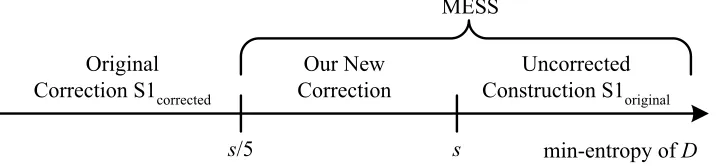
min-entropy of D Uncorrected
Construction S1original Original
Correction S1corrected
Our New Correction
MESS
s/5 s
Figure 1: Stegosystems with Highest Data Rate for2 s
Security Level
For comparison purposes we carefully analyze the gains in efficiency that result from using S1 original or its generalization MESS instead of S1
corrected. In particular, for a security level of 2
s
, using MESS results in shorter stegotexts as long as min-entropy ofDis at least(s+2)=5. For example, for a common security level of2
80
, MESS has a shorter stegotext whenever min-entropy ofDis at least17. The gains in efficiency of encoding and decoding are even more dramatic. This is becauseS1
correctedneeds expensive error-correcting codes, while MESS consists simply of repeated sampling fromD. Thus, MESS may be beneficial at lower min-entropies as well: even though the data rate will be lower, the computations will be faster.
The Stateless Multibit Extension. Our third significant contribution is to prove that for memoryless covertext distributionsD, the schemeS1
originaland its generalization MESS can securely transmit multibit hiddentext messages using bit-by-bit steganographic encoding without additional state. In particular, no synchronization between the sender and the recipient is required; therefore, if a portion of the stegotext gets lost in transit, the rest of the message can be correctly recovered.
Specifically, by a non-trivial extension of the techniques used to bound the flaw ofS1
originaland to prove the security of MESS, we demonstrate that for a hiddentext message of lengthl, the distinguishing advantage of the adversary is no more than6l
2
p(plus4l
D, an amount that remains negligible for reasonable values ofl). This bound is also tight within a small constant factor.
Prior to our work, no analysis of such stateless multibit extension was available in the literature. How-ever, Hopper [5] stated that the advantage of the multi-bit construction was loosely quadratic. (Our bound was derived in an attempt to disprove his statement.)
2
Background: Work of Hopper, Langford, and von Ahn
2.1 Definitions
We reiterate the main definitions and notational conventions from [7] which we utilize herein. Many of these are taken nearly verbatim from the original work.
Define a channelCto be a distribution of bit sequences time stamped with monotonically non-decreasing values. The conditional distributionC
h
describes the channel distribution conditioned on channel historyh of previously drawn bits. All messages are assumed to be of fixed length B bits. Furthermore, assume there exists an oracleM which on inputh efficiently samples the distributionC
B h
. That isM samplesC h in B-bit blocks with the first bit of the block dependent on the history h and each successive bit in the block dependent on the concatenation ofhand all previous bits in the block. Where the specific historyhis irrelevant we will useM forM(h). We also find it convenient to abbreviate the covertext distributionC
B h
by
Dexcept for situations where the original provides additional clarity. Additionally, we will abuse notation and useD=C
B h
in place ofM, particularly when denoting oracle access toDand when the availability or action of the sampler is not of primary interest2.
Definition 1. A stegosystem or steganographic protocol is a pair of probabilistic polynomial time algo-rithmsS=(SE;SD)such that, for a security parameter,
1. SEtakes as input a randomly chosen keyK 2f0;1g
, a stringm 2f0;1g
(called the hiddentext), a message historyh, and a channel sampling oracle M(h); SE
M
(K;m;h)returns a sequence of blocks.c
1 kc
2 k:::kc
l(called the stegotext) each of which is an element of the support of the channel being sampled by the oracleM
2. SDtakes as input a keyK, a sequence of blocksc 1
kc 2
k:::kc
l, a message history
h, and a channel sampling oracleM(h);SD
M
(K;c;h)returns a hiddentextm. 3. SE
M
andSD M
satisfy8m:Pr[SD M
(K;SE M
(K;m;h);h)=m] 2 3
, where the randomization is over any coin tosses ofSE
M ;SD
M
, andM.
Stegosystem Reliability. We believe it useful for later discussions to elaborate on the final point in the definition of a stegosystemS. The reliability of a stegosystemSwith security parameterfor a channelC (for messages of fixed lengthB) is defined as
Rel S();C
= min
m2f0;1g B
f Pr K2f0;1g
[SD
M
(K;SE M
(K;m;h);h)=m]g:
While the above definition from [7] considers reliability of2=3sufficient, we will generally consider more reliable stegosystems, since they will likely be of greater practical use.
The Adversary. In this work only passive (i.e., non-malicious) adversaries mounting chosen hiddentext attacks onSare considered. The capabilities of such an adversary are described next.
Definition 2. A probabilistic polynomial time adversaryW is a(t;q;l)passive adversary for stegosystem S with keyK, if
1. W runs in timet.
2
2. W can make an arbitrary number of draws fromC B h
via the sampling oracleM().
3. W can make at mostq queries of combined lengthl bits to an oracle which is eitherSE(K;;)or O(;), whereOis such thatO(m;h) C
jSE(K;m;h)j h
.
4. W outputs a bit indicating whether it was interacting withSEor withO.
W, sometimes referred to as the “warden”
3, is nothing more than a distinguisher in the usual sense. It
attempts to differentiate between channel messages which have been altered bySE and those which have simply been drawn fromC
B h
as usual and sent without modification.
Stegosystem Advantage and Insecurity. The advantage of a passive adversaryW against stegosystemS with security parameterfor a given channelC(having messages of fixed lengthBbits) is defined as
Adv SS S();C
(W)=
Pr K f0;1g
;r f0;1g
[W
M;SE(K;;) r
=1] Pr
r f0;1g
[W M;O(;) r
=1] where the SS superscript means “Steganographic Secrecy”.
Fort;q;lgiven, the insecurity of stegosystemSwith respect to channelCis defined as
InSec SS S();C
(t;q;l)= max W2W(t;q;l)
fAdv SS S();C
(W)g;
whereW(t;q;l)denotes the set of all adversaries which make at mostqqueries of total length at mostlbits and run in time at mostt.
Definition 3 (Steganographic Secrecy). A stegosystem S = (SE;SD) is (t;q;l;) steganograph-ically secret against chosen hiddentext attacks on channel distribution C, (t;q;l;)-SS-CHA-C, if InSec
SS S();C
(t;q;l).
With respect to the specific constructions discussed herein we need some additional notation which also mirrors that in [7]. LetU(k)denote the uniform distribution on the set ofk-bit strings, andU(B;1)denote the uniform distribution on predicates onB-bit strings. LetF
K, for
K 2f0;1g
, denote a specific member of the family of pseudorandom predicates F : f0;1g
f0;1g L
! f0;1g with keyK (pseudorandom predicates and functions were first defined by [3]).
PRF Advantage and Insecurity. For a probabilistic adversaryA, the PRF-advantage ofA over F is defined as
Adv PRF F()
(A)=
Pr K U();r f0;1g
[A
F K
() r
=1] Pr
g U(L);r f0;1g
[A g r
=1] : Fort;qgiven, the insecurity of the pseudorandom function familyFis defined as
InSec PRF F()
(t;q)= max A2A(t;q)
Adv PRF F()
(A);
whereA(t;q)denotes the set of all adversaries which make at mostqqueries run in timet.
3
Minimum Entropy. Lastly, defineH(D), the minimum entropy of probability distributionD, as
H(D)=max x2D
log
2 Pr
D [x]
:
2.2 Flawed Construction 1
We now give the flawed version of Construction 1 from [7] to concretely ground later discussions of its problem and to make this work more self contained. Also, as our analysis will demonstrate, in many cases Construction 1 can be used without any modification, and even when modification is necessary, it will be very minimal.
Construction 1, henceforth referred to asS1
originalfor brevity, appears in Section 3.2 of [7]. We present it for one-bit messages; as already mentioned, [7] extend it to multibit messages simply by using a synchro-nized counter. We will address multibit messages in Section 5.
S1
original relies on a rejection sampler sub-procedure
RS, which appears in Section 2.3 of [7]. This rejection sampler, and consequentlyS1
original, requires sampling access to the covertext distribution D. We denote this by oracle access toM, a sampling oracle forD(C
B h
) or, when abusing notation, by oracle access toDitself. RS also requires access to a predicate F whose domain is the support ofD. More formally, F :f0;1g
B
! f0;1g. RSon input a target bityand maximum number of allowed iterationscountdraws messagesxfromDuntil one is found that evaluates to the target bityunderF or the maximum number of allowed iterations is reached. In the latter case it outputs the last message drawn. count can and should be thought of asRS’s security parameter. It will become clear later thatcountdirectly influences the reliability ofS1
original. The specification of
RSfollows. ProcedureRS
M;F
(y;count): i=0
repeat:
x M;i i+1 untilF(x)=yorcount =i Output:x
The stego encoding algorithmSEforS1
originaltakes a key
Kfor a pseudorandom functionF, additional security parameterk, hiddentext bitm, and channel historyhas input
4. It runs
RS with inputmandjKj and returns the output ofRS. The stego decoding or extraction algorithmSDforS1
originaltakes the key K and a stegotextxand outputs the image ofxunderF as the hiddentextm.
ProcedureS1 original
:SE(K;k;m;h): ProcedureS1
original
:SD(K;x):
x RS
M(h);F(K;)
(m;k) m F(K;x)
h hkx
Output:x Output:m
From here on we will cease to explicit mention the sampling oracle M and message historyh when discussingRS;SE;andSD.
2.3 How and WhyS1
originalFails Corollary 1 in [7] falsely states thatS1
originalis steganographically secure on all channels
Cwith minimum entropyH(D =C
B h
) >2against wardensW that ask only a single 1-bit query. The corollary is false as a
4
consequence of a subtle but serious flaw in the proof of Theorem 1 which incorrectly bounds the insecurity ofS1
originalby the insecurity of the pseudorandom function family
F. The authors became aware of this issue and published [6] which contains an acknowledgment of this flaw andS1
corrected, a corrected version ofS1
original, which will be discussed later.
The flaw in the proof of their Theorem 1 follows from the false implicit claim that the output of the rejection sampler using a randomly chosen predicate is identical to the covertext distributionD =C
B h
, the input distribution forRS. This is stated more precisely and discussed in greater detail below.
False Claim 1. For any covertext distributionDwith minimum entropyH(D) > 2, fixed bitb, randomly
chosen predicategfromU(B;1), andk2N, the distribution of messagesx 2Doutput byRS D;g
(b;k)is identical to the distribution of messages drawn fromDdirectly (where the probabilities are taken over the random choice ofg).
The flawed proof of the theorem tries to show, using a very straight forward two step reduction, that stegosystemS1
original adversary
W has advantage equal to an adversary A’s advantage against the pseu-dorandom functionF
K. In the first step, the proof shows RS
D;F K
RS
D;g
, and then in the second step infersRS
D;g
= Dusing false Claim 1, and thus concludes the advantages are equal from their respective definitions. The theorem then follows directly from the respective insecurity definitions.
At first glance, false Claim 1, and consequently the flawed proof of Theorem 1, seems quite reasonable. Indeed, as the authors state, for a given bitband randomly choseng, it follows from the independence ofD andgthatPr
D
[xjg(x)=b:g U(B;1)]=Pr D
[x]. However, sinceRS D;g
repeatedly draws blocks from
Dand returns the first to satisfyg(x) = bwithout choosing a new gbefore each draw, the independence breaks down.
2.4 Revised Construction 1
Hopper, Langford, and von Ahn corrected the flaw ofS1
original, described in Section 2.3 of this work, shortly after its publication in [7]. They gaveS1
corrected, a revised version that we describe below, in [6], but did so without any analysis of the severity of the flaw. Our main result, presented in Section 3, shows that the flaw can be precisely quantified. Our second result, presented in Section 4, shows that it can, in fact, be made negligible for any distributionD.
There are two main differences between S1
corrected and S1
original. First, although S1
corrected uses the same rejection samplerRSasS1
originaldid, it forces
RSto give up after onlyk =2attempts. In this case the output distribution ofRScan be shown, as in [6] or using our Lemma 1, to be identical to the covertext distributionD. Unfortunately, as the authors point out, limitingRS to2attempts increases the probability that an encoding error is introduced byRS
D;F K
(b;2)to= 1 2
1 p 4
(plus the PRF insecurity), wherep is the highest probability inD. So, depending on the covertext distributionD,1=4<3=8, where the upper bound of3=8comes from the assumption thatH(D) 1. Essentially, the encoding error increases because there is a good chance the rejection sampler will not find a covertextx2Dsuch thatF
K
(x)=bin just two tries. This motivates the second main difference: the use of an error-correcting code byS1
corrected. In order to achieve reliable (i.e. Rel 1) hiddentext transmission, prior to stego-encoding S1
corrected must first encode the hiddentext input using an error correcting code that corrects fraction of errors. The stego-decoderS1
corrected
3
Main Result: Bounding the Flaw
Despite the seemingly bad news that the rejections sampler perceptibly alters non-uniform covertext source distributionsD, we bound the magnitude of the distortion by giving an upper bound on the statistical differ-ence betweenDandRS
D;g
. We then give a lower bound demonstrating that the upper bound is tight up to a small constant factor.
3.1 Upper Bound
Before presenting the formal theorem statement, we introduce some additional notation. For a function
g:D!f0;1g, define
g to be the weight of
gwhere
g
=
X
x 0
2D:g(x 0
)=1 Pr
D [x
0 ];
and
g the weight of the complement as
g
= 1
g. Similarly, for a subset
S D, define S
= P
x 0
2S Pr
D [x
0 ]and
S
=1
S. Lastly, define
(D;k)= 1 2
jDj X
S(D
k
S and
(D;k)= 1 2
jDj X
SD
k S
=(D;k)+ 1 2
jDj :
Note that, for a fixedD,(D;k)is a negligible function ofk(providedDhas no zero-probability elements), because
S
<1forS(D.
Theorem 1. Let D be any discrete probability distribution, k 2 N and a bit b 2 f0;1g. Let p be the probability of the most likely event in D. Then for a randomly chosen predicate g : D ! f0;1g, the statistical difference betweenDandRS
D;g
(b;k)is at most2pplus a negligible function ink. More precisely, X
8x2D
Pr D
[x] Pr
g2U(B;1);D [RS
D;g
(b;k)!x]
2p+2(D;k):
The remainder of this section is devoted to formulating and proving a number of intermediate results that will yield the proof of Theorem 1.
On the way to proving Theorem 1, the first step is to quantify the output distribution of the rejection sampler. First we consider the limiting case when the maximum number of allowed channel draws made by
RS, the parameterkin the above, is allowed to go to infinity. Note that inS1
original, the security parameter k, which is length of the pseudorandom function keyK, is also used as the cutoff parameter forRS. However, from here on k will only denote the maximum number of attempts made by RS, and will denote the security parameter forS1
originaland the length of the pseudorandom function key
K. The following lemma provides an expression for the probability distribution ofRS in the infinite case. Lemma 2 then uses this expression to give a version of Theorem 1 in the case of an infinitek.
Lemma 1. For x an element from the support of Dand a bit b 2 f0;1g, let us define RS D;g
(b;1) lim
k!1 RS
D;g
(b;k) andPr
g2U(B;1);D [RS
D;g
(b;1) ! x] lim k!1
Pr
g2U(B;1);D [RS
D;g
(b;k) ! x]. Then,
Pr g2U(B;1);D
[RS D;g
(b;1)!x]= Pr
D [x] 2
jDj 0 @
1+
X
g2U(B;1):g(x)=1 1
g 1 A
Proof. The proof of this Lemma is contained in Appendix A.
Now we give the infinite analog of Theorem 1 which we use later in its proof.
Lemma 2. LetDbe any discrete probability distribution andb 2f0;1ga bit. Letpbe the probability of the most likely event inD. Then for a randomly chosen predicateg:D! f0;1g, the statistical difference betweenDandRS
D;g
(b;1)is at most2p. More precisely, X
8x2D
Pr D
[x] Pr
g2U(B;1);D [RS
D;g
(b;1)!x]
2p:
The proof employs the following proposition which is a consequence of the relationship between the har-monic and arithmetic means.
Proposition 1. For a set ofnnon-zero real numbersa 1
;a 2
;:::;a n, 1
a 1
++
1 a
n
n 2 (a
1
++a n
) :
Proof. The proposition can be verified by recalling that the harmonic mean of a set ofnvaluesa 1
;a 2
;:::;a n, is defined asn=(1=a
1
++1=a n
), whereas the usual arithmetic mean is defined as(a 1
++a n
)=n. A well known property of the harmonic mean is that it is less than or equal to the arithmetic mean for the same set of numbers with equality only when alla
iare equal [1, p. 471]. Therefore, inverting both sides of this relation and multiplying byn, gives the above proposition.
Proof of Lemma 2. First we remind the reader of the property of the statistical difference that for any
distri-butionsD 1and
D 2,
X
8x2D1;D2
Pr D1
[x] Pr D2
[x]
=2
X
x2D 1
;D 2
:Pr D
1 [x]Pr
D 2
[x] Pr D1
[x] Pr D2
[x]:
For the remainder of the proof, where not indicated probabilities are with respect toD. Also, definet=jDj. For each function g, let us consider the subset S ofD which is the pre-image of 1 under g, that is S = fx 2 D : g(x) = 1g. Since there are2
t 1
subsets S containing any given element x, rewriting Lemma 1 in terms ofSrather thangand applying the inequality of Proposition 1 to the result gives,
Pr g2U(B;1);D
[RS D;g
(b;1)!x] =
Pr[x] 2
t 0 @
1+ X
SD:x2S 1
S 1 A
2
2(t 1) Pr[x] 2
t P SD:x2S
S
=
2 t 2
Pr[x] P
SD:x2S P 8x2S
Pr[x]
=
2 t 2
Pr[x] 2
t 1
Pr[x]+2 t 2
P x
0 6=x
Pr[x 0 ]
=
Pr[x] 2Pr[x]+1 Pr[x]
=
Pr[x] 1+Pr[x]
Thus,
Pr D
[x] Pr
g2U(B;1);D [RS
D;g
(b;1)!x] Pr[x]
Pr[x] 1+Pr[x]
=
(Pr[x]) 2 1+Pr[x]
(Pr[x]) 2
: Finally, combining these two pieces,
X x
Pr D
[x] Pr
g2U(B;1);D [RS
D;g
(b;1)!x]
= 2
X
fx:Pr[x]Pr
g2U(B;1);D [RS
D;g
(b;1)!x]g
Pr[x] Pr
g2U(B;1);D [RS
D;g
(b;1)!x]
2
X
fx:Pr[x]Pr
g2U(B;1);D [RS
D;g
(b;1)!x]g
(Pr[x]) 2
2 X
8x2D (Pr[x])
2
2p
X
8x2D
Pr[x]=2p;
wherepis the probability of the most probable element inD.
Lastly, we consider the statistical difference between the probability distributions of the finite and infinite rejection samplers.
Lemma 3. For a fixedk2N, X
8x2D
Pr g2U(B;1);D
[RS D;g
(b;1)!x] Pr
g2U(B;1);D [RS
D;g
(b;k)!x]
2(D;k) Proof. The proof of this Lemma is contained in Appendix B.
At this point we have assembled the necessary tools to prove our bound on the statistical difference between an arbitrary message distributionDandRS
D;g
(b;k)for a random functiong. Proof of Theorem 1. The proof follows by first inserting positive and negativePr
g2U(B;1);D [RS
D;g
(b;1)! x]inside the absolute value signs, applying the triangle inequality, and then using Lemmas 2 and 3.
3.2 Lower Bound
Theorem 2. For any p, there exists a probability distributionD with highest-probability elementp such that, for anyk >2, a bitb 2 f0;1gand for a randomly chosen predicateg :D ! f0;1g, the statistical difference betweenDandRS
D;g
(b;k)is at leastp=16. More precisely, X
8x2D
Pr D
[x] Pr
g2U(B;1);D [RS
D;g
(b;k)!x]
p=8:
Proof. For lack of space, we only sketch the proof of this theorem. Simply letDconsist of1=(2p)elements of probabilitypeach, and1=(2q)elements of probabilityq, whereqis very small. Then one can show that the likelihood thatRS
D;g
will pick ap-probability element isp=16less than1=2.
4
Generalizing
S1 originalWe have shown that forDwith sufficiently high min-entropy, S1
original(i.e., Construction 1 of [7]) needs no modification. On the other hand, sincepis fixed for any givenD, the error ofS1
originalis not a negligible function. Thus, whenDlacks sufficiently high min-entropy,S1
originalin its current form is insecure. This brings us to our second contribution: a modified version of S1
original that is secure for all
4.1 Our Construction
The problem withS1
originalis that it is stuck with whatever min-entropy
Dprovides. To fix this, we pro-pose RS-HE, a modified version ofRS, that uses the well known technique of repeated sampling onDto effectively increases the minimum entropy. Specifically, instead of using one covertext messagex 2Dper hiddentext bit, RS-HE usesncovertextsx
i
2D. The concatenation of all of thesex
iis then evaluated under the predicateF (with a suitably expanded domain). The exact value ofndepends onH(D)and is fixed for a givenD. Our proposed stegosystem MESS is the same asS1
original except for a few minor syntactic changes necessary to accommodate its use of RS-HE instead ofRS.
Thus, MESS has three security parameters:=jKj,kandn, which are, respectively, the length of the pseudorandom predicate key, the number of attempts made by RS-HE, and the number of draws fromD that are concatenated and given to the pseudorandom predicate. Let MESS(;k;n)denote our new system instantiated with these parameters. For a formal description of MESS see Appendix C.
4.2 Proof of Correctness
The proof ofS1
originalgiven in [7] only attempted to show security with respect to adversaries making a single 1-bit query. In this section, we will initially do the same, because multi-bit security follows from 1-bit security by use of a synchronized counter as in [7]. Later we will show that for the special case of memoryless channels, our techniques can be adapted to prove stateless multibit security.
The proof that MESS is 1-bit steganographically secure follows (although not immediately) from Theo-rem 1 withD
(n)
in place ofD. Clearly the first term becomes at mostp n
and can be made negligible by tak-ingnsufficiently large. The only complication is that the second term,(D
(n)
;k)=2 jD
(n) j
P S(D
(n)
k S now depends on bothnandk. We need to show that it can be made negligible even asngrows.
Theorem 3. LetDbe a covertext message distribution conditioned on message historyh, and letpbe the probability of the most likely element ofD(p=2
H(D)
). Then for any0<Æ<1=2,
InSec SS
MESS(;k;n);D
(t;1;1)2 p n
+
1 2
+Æ
k +e
b 1 p
n c2Æ
2 !
+InSec PRF F()
(t+O(k);k):
Proof. As already stated, the hard part is to bound(D (n)
;k). We actually bound a closely related value (D
(n)
;k). This relies on two lemmas: Lemma 4 bounds(D;k), for any distribution D, by (U D
;k), whereU
D is the uniform distribution with essentially the same min-entropy as
D. Lemma 5 bounds of this uniform distribution.
The detailed proof of this theorem (including the lemmas) is contained in Appendix D.
4.3 Reliability
We provided an explicit bound on the insecurityInSecof our stegosystem MESS in the previous section. However, there is another important stegosystem property: reliabilityRel, that is, the probability that the recipient decodes the encoded message correctly. While Definition 1 requires onlyRel2=3, in reality the communicating parties will most likely desireRel1. We bound the reliability of MESS in the following theorem.
Theorem 4. LetDbe a covertext message distribution conditioned on message historyh withH(D)> 1 and letpbe the probability of the most likely element ofD(p=2
H(D)
). Then for any0<Æ< 1 2 ,
Rel
MESS(;k;n) 1
1 2
+Æ
k +e
b 1 p
n c2Æ
2 !
InSec PRF F()
Proof. The proof of this Theorem is contained in Appendix E.
4.4 MESS Parameter Choices and Efficiency
Given covertext distribution D with min-entropy H(D), for MESS to operate with 2 s
security and a corresponding reliability of at least1 2
s
(fors13), it suffices to taken=d(s+2)=H(D)e,k=s+6, and such that for the chosen PRF family F, InSec
PRF F()
(O(nk);k) 2 s 3
(the derivation of these parameter values can be found in Appendix F). The stegotext is justncovertexts long.
In Appendix G, we show that to achieve reasonable reliability, S1
corrected needs to send more than 5 covertexts for each hiddentext bit (more for distributions with really low min-entropy). Thus, ifH(D) (s+2)=5, MESS sends fewer covertexts thanS1
corrected, and if
H(D) (s+2), MESS sends only a single covertext, effectively reducing toS1
original. Moreover, MESS requires no computationally expensive error-correction.
5
Stateless Multibit Extension of MESS
Having addressed the security flaw ofS1
original for 1-bit hiddentexts by demonstrating the security of the more general construction MESS in the 1-bit case, we now consider secure transmission of multibit hidden-text messages. As previously mentioned, a secure stateful multibit version of MESS can be obtained, as was done in [7]. Namely, the sender and recipient maintain a synchronized countercand do straightforward bit-by-bit stego-encoding with MESS by providingcas an additional input to the PRF. The counter essentially serves to refresh the pseudorandom function key, thereby making each successive hiddentext bit as secure as the first. However, as we will show next, if the covertext message distributionDis memoryless, we can achieve secure stateless multibit steganographic encodings by directly doing bit-by-bit stego-encoding using MESS, thus eliminating the need for a synchronized counter.
Theorem 5. LetDbe a memoryless covertext message distribution, and letpbe the probability of the most likely element ofD (p = 2
H(D)
). Then for a total ofl 1 hiddentext bits transmitted (chosen by the adaptive warden)
InSec SS
MESS(;k;n);D
(t;l;l)6l 2
p n
+l
1 2
+Æ
k +e
b 1 p
n c2Æ
2 !
+InSec PRF F()
(t+O(lk);lk):
Proof. The proof makes use of two key lemmas for memoryless distributionsD. The first, Lemma 7, shows that the advantage of any adversary adaptively asking for the stego-encoding of a total oflbits of hiddentext can be bounded by the advantage of a non-adaptive adversary that asks2l-bit hiddentext queries of the form 1
l 0
l
. The second, Lemma 8, shows that a stringx = x 1
x 2
:::x
2lthat contains no repeated elements is no less likely to occur as a stego encoding of1
l 0
l
than as a random draw fromD 2l
(provided samplerRS D;g
is allowed to make as many draws as needed, i.e.k=1). The rest follows from (1) using Lemma 8 to argue that the statistical difference is no more than three times the probability of the existence of a collision among
2lelements chosen fromD; (2) bounding the probability of such a collision and (3) dealing with finitek. A more detailed proof of this Theorem (including the lemmas) is contained in Appendix H.
This bound is also nearly optimal: we show that the adversary who asksl=21-queries followed byl=2 0-queries can distinguish with probability roughlyl
2 p
n =4.
Theorem 6. For anyp, there exists a probability distributionDwith highest-probability elementpsuch that, for a randomly chosen predicateg:D!f0;1g, the statistical difference betweenD
l
andRS D;g
(1 l=2
0 l=2
is greater than one half the probability of obtaining a collision amongldraws fromD.
X
8x2D l
Pr g2U(B;1);D
[RS D;g
(m;k)!x] Pr D
l [x]
pl
2 4
pl
2 4
2
:
Proof. The proof of this Theorem is contained in Appendix I. It is obtained by comparing the probability of
a collision between an answer to a 1-query and an answer to a 0-query, which is 0 forRS D;g
and non-zero forD
l .
References
[1] W. Beyer, editor. CRC Standard Mathematical Tables and Formulae. CRC Press, 29 edition, 1991.
[2] C. Cachin. An information-theoretic model for steganography. In Second Internation Workshop on
Information Hiding, volume 1525 of Lecture Notes in Computer Science, pages 306–316, 1998.
[3] Oded Goldreich, Shafi Goldwasser, and Silvio Micali. How to construct random functions. Journal of
the ACM, 33(4):792–807, October 1986.
[4] W. Hoeffding. Probability inequalities for sums of bounded random variables. Journal of the American
Statistical Association, 58(301):13–30, March 1963.
[5] N. Hopper. Private Communication.
[6] N. Hopper, J. Langford, and L. von Ahn. Companion to “provably secure steganography”. available fromhttp://www-2.cs.cmu.edu/˜jcl/papers/papers.html.
[7] N. Hopper, J. Langford, and L. von Ahn. Provably secure steganography. In Moti Yung, editor, Advances
in Cryptology—CRYPTO 2002, Lecture Notes in Computer Science. Springer-Verlag, 18–22 August
2002. Corrected verstion appears in [8].
[8] N. Hopper, J. Langford, and L. von Ahn. Provably secure steganography. Technical Report CMU-CS-02-149, School of Computer Science, Carnegie Mellon University, 2002.
[9] G. J. Simmons. The prisoners’ problem and the subliminal channel. In David Chaum, editor, Advances
in Cryptology: Proceedings of Crypto 83, pages 51–67. Plenum Press, New York and London, 1984,
22–24 August 1983.
A
Proof of Lemma 1
Proof. We will prove the case ofb = 1and argue by symmetry that this also suffices to prove the case of b=0. To compute the probability thatRS
D;g
(1;k)outputsx, simply find the expected value over the2 jDj possible random functionsg:D!f0;1g, as follows,
Pr g2U(B;1);D
[RS D;g
(1;k)!x] = 1 2
jDj 0 @
X
g:g(x)=1 Pr
D [x]
k 1 X
i=0
i g
+ X
g:g(x)=0 Pr
D [x]
k 1 g
1 A
= Pr
D [x] 2
jDj 0 @
X
1
k g
1
g +
X
k 1 g
1 A
Taking the limit ask ! 1, that is as the rejection sampler makes greater and greater numbers of draws fromDbefore “giving up”, we have
lim k!1 Pr g2U(B;1);D [RS D;g
(1;k)!x] = Pr D [x] 2 jDj 0 @ 1+ X g:g(x)=1 1 1 g 1 A = Pr D [x] 2 jDj 0 @ 1+ X g:g(x)=1 1 g 1 A :
It remains to prove the case forb=0. However, by symmetry, for each specific functiongwhich maps an elementx to 0, there exists a uniqueg^such that8x 2 D;g(x)^ = 1 g(x). Consequently, for each functiongwe have,
Pr[RS D;g
(0;k)!x]=Pr[RS D;^g
(1;k)!x]: Generalizing this over all possible choices for the functionggives
Pr g2U(B;1);D
[RS D;g
(0;k)!x]= Pr g2U(B;1);D
[RS D;g
(1;k)!x]
so our consideration ofRS D;g
(1;k)is sufficient and the proof is complete. Remark 1. It can be seen from (1) and some algebra, that whenk=2, in fact,Pr
g2U(B;1);D [RS
D;g
(b;k)! x] = Pr
D
[x]as stated in [6]. Indeed, the proposed fix in [6] is to setk = 2and accept the fact that this causes a high probability (between1=4and3=8) of decoding incorrectly, and thereby reduced reliability.
B
Proof of Lemma 3
Proof. Using (1) from the proof of Lemma 1 it follows that
X 8x2D Pr g2U(B;1);D [RS D;g
(b;1)!x] Pr
g2U(B;1);D [RS
D;g
(b;k)!x] (2) = X 8x2D Pr[x] 2 jDj 1+ X SD:x2S 1 S X SD:x2S k S 1 S 1 X
= 1 2
jDj 1 S6=;
k S
= 1 2
jDj 1 S(D
k
S (9)
2(D;k): (10)
Line (4) follows from the definitions ofand and the symmetry of the set of all functions. To obtain Line (5), combine the sums and remove the term 1 by restrictingS to be a proper subset ofD. Line (6) follows from the same property of statistical difference used in the proof of Lemma 2. Line (8) follows by expanding the sums, gathering common terms with respect to a specific subsetS and rewriting the sums with the appropriate modifications to their bounds (the empty set is excluded because every subsetSmust have at least one element). Canceling the
S denominator and noting that
D
=
;
=0gives us the last line and completes the proof.
C
Formal Description of MESS
C.1 The Memoryless Channel Case
For now, assume that the channel is memoryless: D is independent of the previous message historyh. In other words, successive covertext messages are independent of one another. Consequently h can be completely ignored and is suppressed.
Letnbe an additional security parameter for MESS and RS-HE. It specifies the number elements ofD (covertexts) over which a single hiddentext bit will be encoded. Recall thatS1
originaland
RS had security parameters=jKjandk, the length of the pseudorandom predicate key and the number of attempts made byRSrespectively. As before, in general, RS-HE uses a predicateF, but the domain is expanded, i.e. now F : D
n
! f0;1g. When running as a subroutine of MESS, RS-HE has oracle access toF
K, a specific pseudorandom predicate family member with keyK2f0;1g
. The modified version of RS-HE is:
Procedure RS-HED;F
(y;count;n): i=0
repeat:
forj=1ton: x
j D
x (x
1 kx
2
k:::kx n
) i i+1
untilF K
(x)=yorcount =i Output:x
The only differences between the stego-encoding algorithms for MESS andS1
originalis that MESS :SE has additional input n that it uses when it calls RS-HE, and its stegotext output is ntimes longer. The stego-decoding algorithm MESS:SDis unchanged fromS1
original
:SDexcept that its stegotext input isn times longer. It should be emphasized that with respect to the “flawed”S1
originalgiven in Section 2.2, the only differences in MESS (aside from those between RS-HE andRS) are the additional security parameter ninput to bothSEandSD, the expansion of the domain ofF
K, and the
ntimes longer stegotext output by SEand input toSD.
C.2 The General Case
is conditioned byh. The distribution resulting from sendingnmessages is more complex thanD n
. LetD (n) denote this distribution. With respect to the original channel notation,D
(n) C
nB h
(recall thatC nB h
denotes a conditional distribution of messages of fixed lengthnBbits conditioned on historyh). The general version of RS-HE then is:
Procedure RS-HEM;F
(y;count;n): i=0
repeat:
forj=1ton: x
j
M(h) h hkx
j
x (x
1 kx
2
k:::kx n
) i i+1
untilF K
(x)=yorcount =i Output:x
The resulting MESS:SE and MESS:SD are the same as described for D n
in Section C.1 with the stipulation that nowF
K :D
(n)
!f0;1g.
Remark 2. The inner “for” loop of RS-HE can be thought of as an oracle M (n)
—an efficient sampling oracle forD
(n)
. Observe that such a sampling oracle can always be built givennand access to the original oracleM. Thus, the analysis ofRSgiven in Theorem 1 applies here as well, except thatDmust be replaced withD
(n) .
D
Proof of Theorem 3
Before proving Theorem 3 we deal with the issue of bounding(D (n)
;k)in two steps. It is easier to bound a closely related value
(D (n)
;k)= 1 2
jD (n)
j X
SD (n)
k S
=(D (n)
;k)+ 1 2
jD (n)
j ;
which differs from only by the inclusion of the full subset S = D (n)
in the sum. As we will see in Lemma 6 (in Appendix F),is exactly the failure probability of the rejection sampler RS-HE
D;g . Lemma 4 bounds(D;k), for any distributionD, by(U
D
;k), where U
D is the uniform distribution with essentially the same min-entropy asD. Lemma 5 boundsof this uniform distribution.
Lemma 4. Among all distributions of a given min-entropy, is the largest for the uniform distribution. More precisely, for a distributionDwith minimum entropyH(D), defineU
D
=U(b2 H(D)
c), that isU D is a uniform distribution withb2
H(D)
celements. Then for allk2N,(D;k)(U D
;k) The following two claims will help with the proof of Lemma 4.
Claim 1. IfDhas an element with zero probability andD 0
differs fromDonly by the removal of this zero probability element, then(D
0
;k)=(D;k).
Claim 2. Leta;b be elements ofD with probabilitiesp a and
p
b such that p
a
p
b. Define D
00
to be the distribution with the same probabilities asDexcept withp
a
+andp b
in place ofp aand
p
brespectively
(0 p
b). Then (D
00
;k)(D;k). Proof. For =p
b, a simple proof is obtained by using the definition of
to rewrite the two expressions as sums. Then using binomial series and regrouping the terms the claim follows directly. For the general case one can treat(D
00
;k)as a continuous real-valued function of. Then
(D 00
();k)= 1 2
jDj X
SD:a;b2 S= (
S +p
a +)
k
+(
S +p
b )
k
+
k S
+( S
+p a
+p b
) k
:
Taking the derivative with respect towe obtain
k 2
jDj X
SD:a;b=2S (
S +p
a +)
k 1 (
S +p
b )
k 1 >0;
becausep a
>p b
. Hence(D 00
;k)is a nondecreasing function ofon the interval0 p b. Proof of Lemma 4. We can transformD into U
D by adding the mass to the highest-probability elements until their probability reaches 1=b2
H(D)
c, while simultaneously removing the same mass from lowest-probability elements until their lowest-probability reaches 0. By Claim 2, of the resulting distribution will not decrease. Then we remove all zero-probability elements to obtainU
D (this, by Claim 1, will not change ).
Lemma 5. ForU(t), a uniform distribution ontelements,(U(t);k)can be made negligible for bothtand ksufficiently large. Specifically for0<Æ<
1 2
,(U(t);k) 1 2
+Æ
k +e
2tÆ 2
.
Proof. Consideras a subset of a union of two “bad” events: (1) that fewer than1=2+Æelements ofU(t) map to 1 undergor (2) that more than1=2+Æelements ofU(t)map to 1 underg, but not one of those gets selected afterktries. More precisely, rewriting the definition of,
(U(t);k) =
X
8SU(t)
k S 2
jtj
= 2 4
Pr[ S
(1=2+Æ)]
X
S: S
(1=2+Æ)
k S
3 5
+ 2 4
Pr[ S
>(1=2+Æ)]
X
S: S
>(1=2+Æ)
k S
3 5
1 2
+Æ
k +e
2tÆ 2
:
The exponential term follows from the application of Hoeffding’s Inequality5[4] to Pr
g [
S
>(1=2+Æ)]= Pr
g [t
S
>t(1=2+Æ)]. It is a Chernoff like bound which states that fortindependent0=1random variables X
ieach with probability
p, the random variableS = P
t i=1
X
iobeys,
Pr[S pt+Æt]e 2tÆ
2 :
5
The use of such a bound makes sense since forS U(t),t S
Proof of Theorem 3. We first consider the case of MESS for a truly random predicateF and then add the necessary correction for a pseudorandomF. The security of MESS is completely determined by the security of RS-HE and the pseudorandom random predicateF which it accesses.
Recall thatD (n)
is the covertext distribution consisting ofnsubsequent draws from the given covertext distribution Dvia its sampling oracle M(h) with message history inputh. LetM
(n)
(h) be an efficient sampling oracle forD
(n)
. As we pointed out in the remark at the end of Section C.2, such an M (n)
can be easily constructed fromM and, in fact, RS-HE
M();F
(b;k)is equivalent toRS M();F
(b;k)for the same predicateF. Thus applying Theorem 1 gives,
X
8x2D (n)
Pr D
(n)
[x] Pr
F2U(nB;1);M
[RS-HE M();F
(b;k)!x]
=
X
8x2D (n)
Pr D
(n)
[x] Pr
F2U(nB;1);M [RS
M (n)
();F
(b;k)!x]
2p
n
+2(D
(n)
;k) (11)
where as previously defined,pis the largest probability inDand(D (n)
;k)=2 jD
(n) j
P S(D
(n)
k S . Clearly the first term in 11 can be made negligible sincen is now a system parameter. It remains to show that even with the added dependency onn,(D
(n)
;k)can also be made negligible. Using Lemma 4 and Lemma 5 witht=bp
n
cwe have
(D (n)
;k) < (D (n)
;k)
1 2
+Æ
k +e
bp n
c2Æ 2
(12)
Finally, combining (11) and (12) and accounting for the advantage due to a pseudorandomF,
Adv SS
MESS(;k;n);D
(W) 2p
n +2
1 2
+Æ
k +2e
bp n
c2Æ 2
+Adv PRF F()
(A); where0<Æ<1=2. Therefore by the definition of insecurity,
InSec SS
MESS(;k;n);D
(t;1;1)2 p n
+
1 2
+Æ
k +e
bp n
c2Æ 2
!
+InSec PRF F()
(t+O(k);k):
E
Proof of Theorem 4
Lemma 6. For any distributionDand bitb 2 f0;1g, for a randomly chosen predicateF U(jDj;1), the encoding error introduced by RS
D;F
(b;k) is equal to (D;k), where(D;k) = 1 2
jDj P
SD
k S
as previously defined.
Proof. RS D;F
Proof of Theorem 4. The reliability of MESS(;k;n) is simply one minus the encoding error introduced by RS-HED;F
K
(;k;n) whereF K
2 F(), now a pseudorandom predicate family with security parame-ter on the domain D
(n)
. Recall that in the proof of Theorem 3 it was argued that RS-HED;F K
(;k;n) andRS
D (n)
;F K
(;k)are equivalent (see also Remark 2 of Appendix C.2). So, by Lemma 6 and the defini-tion of pseudorandom funcdefini-tion insecurity, the encoding error introduced by RS-HED;F
K
(;k;n)is at most (D
(n)
;k)+InSec PRF F()
(O(nk);k)(theO(nk)is because the running time of the rejection sampler, which is playing the role of the “adversary” here, isO(nk), not counting time required for answering queries toD and the PRF). Using the upper bound for(D
(n)
;k)from (12) in the proof of Theorem 3 and subtracting from one gives the indicated lower bound for the reliability.
F
Parameter Derivation and Running Time for MESS
Given covertext distributionDwith min-entropyH(D)>1, for MESS to operate with2 s
security and a corresponding reliability of at least1 2
s
, what values of the parameters;k;andnsuffice? First, we taken(s+2)=H(D), so that2p
n <2
s 1
. Then we takek=s+6. If we setÆ =1=(4(s+4)), then the term2(1=2+Æ)
k
=2(1=2) k
(1+2Æ) k
2 k+1
(1+1=k) k
<2 k+3
= 2 s 3
. In order for the third term to be at most2
s 3
, we needb1=p n
c2Æ 2
log 2
es+4. Substituting2 s+2
for1=p n
and1=(4(s+4)) forÆ, we get that we needlog
2 e2
s+2
8(s+4) 3
, which holds as long ass 13(insecurity greater than 2
13
is not acceptable in most applications, anyway, so this is not really a restriction). Finally, is chosen so that the insecurityInSec
PRF F()
(O(nk);k)of the given PRF familyF is at most 2
s 3
. These same parameter choices will also provide the desired reliability level.
Note that the value of k specified here is the maximum number of attempts RS-HE makes, but the expected number of attempts is just2.
For each hiddentext bit, the stego-encoder for MESS essentially just draws, on average, 2n samples from the covertext distributionDand thus evaluates, on average, twice the pseudorandom predicateF
K on the concatenation ofnsamples. Similarly, for each hiddentext bit, our stego-decoder just evaluatesF
K on the stegotext received, i.e., on the concatenation of thenmessages fromD. Thus, the running time of our decoder is essentially one PRF evaluation, and the average running time of our encoder is about twice that. The stegotext length is clearly justncovertexts long.
Final Values: To obtain 2 s
security and a corresponding reliability of at least 1 2 s
for MESS, as long ass 13, it suffices to taken d(s+2)=H(D)e,k = s+6, andsuch that for the chosen PRF familyF,InSec
PRF F()
(O(nk);k) 2 s 3
. Thus for example, for2 80
security and1 2 80
reliability, if
H(D)82then MESS’s stegotext is only one covertext long (that is, MESS simplifies toS1
original).
G
Parameter Derivation for
S1corrected
.
Here we demonstrate that for secure and reliable transmission, S1
corrected needs to send
1 H
2 (1=2 1=4(1 p))covertexts per hiddentext bit, whereH
2is the binary entropy. This value is between 5 and 6 for reasonablep(p<:05).
The error correcting codes needed byS1
correctedto assure reliable hiddentext transmission
6will stretch
each hiddentext message bit by a code-dependent factor` = 1=R, whereR is the rate of the code. Note that the “noisy channel” created by the error-prone stego-encoder is essentially a binary symmetric channel
6We reiterate that the definition of stego-system given in [7] and [6] only requires reliability
with bit-flip probability, and therefore the rateR of the code is bounded by the channel capacityC =
1 H
2
(), whereH 2
()denotes the binary entropy of the distribution(;1 ). Plugging in the bounds ongives
1=51 H
2
(1=4)>C>1 H 2
(3=8)1=22:
H
Proof of Theorem 5
As we did in the proof of Theorem 3 we will develop intermediate results for the simpler case ofS1 original and then generalize the results for MESS. In the following letRS
D;g (1
l 0
l
;1)!xdenote the event that the rejection sampler on bit-by-bit input1
l 0
l
outputsx=x 1
x 2
:::x
2lwhere each x
i
2Dandg:D!f0;1g is a randomly chosen predicate.
Lemma 7. The advantage of any adversaryW 0
that adaptively asks an oracle for MESS(;k;n)for the bit-by-bit stego-encoding of a total oflbits of hiddentext is bound by the advantage of a non-adaptive adversary that asks the same oracle for the bit-by-bit stego-encoding of the2l-bit hiddentexts1
l 0
l .
Proof. Suppose W 0
adaptively asks for the bit-by-bit encoding of m = m 1 m 2 :::m l, m i
2 f0;1g. W simply first asks its corresponding stego-encoding oracle for the bit by bit encoding of1
l 0
l
. Then W just uses the encoding of theith zero or theith one that it received to answerW
0
’sith adaptively chosen query. Since the draws fromDare independent, the distribution of stego-encodings that W
0
receives fromW is identical to that it would have received directly.
Lemma 8. For allx = x 1 x 2 x 2l 2 D 2l
such that8i;jx i
6= x
j, that is for any strings of
2lelements fromDwhich does not contain a repeated element,
Pr g2U(B;1);D [RS D;g (1 l 0 l
;1)!x] Pr D
2l [x]: The proof of Lemma 8 makes use of the following fact.
Proposition 2. For any set ofnnon-negative real numbersa 1
;a 2
;:::;a nand
l>1,
1 n n X i=1 a l i P n i=1 a i n l :
Proof of Lemma 8. Combining the fact that successive draws fromDare independent, i.e. Pr
D 2l
[x]=Pr D [x 1 ]Pr D [x 2
]Pr D
[x 2l
], with line (1) from the proof of Lemma 1 gives,
Pr g2U(B;1);D [RS D;g (1 l 0 l
;1)!x 1
x 2
x
2l
s:t:8i;jx i 6=x j ] (13) = Pr D 2l[x] 2 jDj X
Pr D 2l [x] 2 2l 2 jDj 2l P 2 jDj 2l i=1 1=4 l (18) = Pr D 2l [x]4 l 2 2l (19) = Pr D 2l
[x]: (20)
Line (16) follows from Proposition 2, line (17) from Proposition 1, and line (18) from the fact that
max 0<<1
(1 )=1=4, and the remaining lines follow from algebra.
Corollary 1 (To Lemma 8: Non-collision Statistical Difference). The statistical difference between
RS D;g (1 l 0 l
;1)andD 2l
for elementsx =x 1 x 2 x 2l 2 D 2l
such that no valuex
i is repeated, i.e. 8i;j such that1 i6=j lx
i 6=x
j, is less than probability of drawing an element
xfromD 2l
containing at least one repeated element. Namely,
X x=x 1 x 2 x 2l 2D 2l j8i;jx i 6=x j Pr g2U(B;1);D [RS D;g (1 l 0 l
;1)!x] Pr D 2l [x] X x=x 1 x 2 x 2l 2D 2l j9i;jx i =x j Pr D 2l [x]:
Proof. The proof follows directly from Lemma 8 by opening the absolute value signs on the statistical
difference and replacing the probability of no collisions by the probability of one minus the probability of a collision in each of the distributions. That is,
X x=x1x2 x 2l 2D 2l j8i;jx i 6=x j Pr g2U(B;1);D [RS D;g (1 l 0 l
;1)!x] Pr D 2l [x] = X x=x 1 x 2 x 2l 2D 2l j8i;jx i 6=x j Pr g2U(B;1);D [RS D;g (1 l 0 l
;1)!x] Pr D 2l [x] = X x=x1x2 x 2l 2D 2l j8i;jxi6=xj Pr g2U(B;1);D [RS D;g (1 l 0 l
;1)!x]
X x=x 1 x 2 x 2l 2D 2l j8i;jx i 6=x j Pr D 2l [x] = 0 @ 1 X x=x 1 x 2 x 2l 2D 2l j9i;jx i =x j Pr g2U(B;1);D [RS D;g (1 l 0 l
;1)!x] 1 A 0 @ 1 X
x=x1x2 x 2l 2D 2l j9i;jxi=xj Pr D 2l [x] 1 A = X x=x 1 x 2 x 2l 2D 2l j9i;jx i =x j Pr D 2l [x] X x=x 1 x 2 x 2l 2D 2l j9i;jx i =x j Pr g2U(B;1);D [RS D;g (1 l 0 l
;1)!x]
Corollary 2 (To Lemma 8). The probability thatRS D;g (1 l 0 l
;1)outputs an elementx = x 1 x 2 x 2l 2 D 2l
such that at least one valuex
i is repeated, i.e.
9i;jsuch that1i6=j landx i
=x
j, is less than or equal to the probability of drawing such anxfromD
2l
directly.
Proof. Since by Lemma 8, for every stringxof2lunique elements fromD,Pr
g2U(B;1);D [RS D;g (1 l 0 l
;1)! x]Pr
D 2l [x], X x=x 1 x 2 x 2l 2D 2l j9i;jx i =x j Pr g2U(B;1);D [RS D;g (1 l 0 l
;1)!x]=
1 X x=x1x2 x 2l 2D 2l j8i;jx i 6=x j Pr g2U(B;1);D [RS D;g (1 l 0 l
;1)!x]
1 X x=x 1 x 2 x 2l 2D 2l j8i;jx i 6=x j Pr D 2l [x] = X x=x 1 x 2 x 2l 2D 2l j9i;jx i =x j Pr D 2l [x]:
Lemma 9. LetDbe any memoryless discrete probability distribution andpbe the probability of the most likely event in D. Then for the hiddentext bit string1
l 0
l
for any1 land a randomly chosen predicate g:D!f0;1g, the statistical difference betweenD
2l andRS D;g (1 l 0 l
;1)is at most6l 2
p. More precisely, X 8x2D 2l Pr g2U(B;1);D [RS D;g (1 l 0 l
;1)!x] Pr D 2l [x] 6l 2 p:
Proof of Lemma 9. Splitting the statistical difference into the collision and non-collision components, then
applying Corollary 1 and the triangle inequality, next applying Corollary 2, and finally upper bounding the probability of collisions onldraws fromDby2l
2
p(derived using counting and the union bound) gives the stated results. More precisely,
X 8x2D 2l Pr g2U(B;1);D [RS D;g (1 l 0 l
;1)!x] Pr D 2l [x] = X x=x 1 x 2 x 2l 2D 2l j8i;jx i 6=x j Pr g2U(B;1);D [RS D;g (1 l 0 l
;1)!x] Pr D 2l [x] + X x=x1x2 x 2l 2D 2l j9i;jxi=xj Pr g2U(B;1);D [RS D;g (1 l 0 l
;1)!x] Pr D 2l [x] X x=x 1 x 2 x 2l 2D 2l j9i;jx i =x j Pr D 2l [x]+ X x=x1x2 x 2l 2D 2l j9i;jxi=xj Pr g2U(B;1);D [RS D;g (1 l 0 l
;1)!x] + X x=x1x2 x 2l 2D 2l j9i;jx i =x j Pr D 2l [x] 3 X
Lemma 10. For a fixedk;l2N,
X
8x2D 2l
Pr g2U(B;1);D
[RS D;g
(1 l
0 l
;1)!x] Pr
g2U(B;1);D [RS
D;g (1
l 0
l
;k)!x]
4l(D;k)
Proof. This sum captures the difference in probabilities between the rejection sampler in the infinite and
finite cases. The element x = x 1
x 2
:::x
2l will be output in the infinite case, but not in the finite case, whenever at least onex
i is output by
RS after more than kattempts. Thus, because Dis memoryless, taking the union over the2lcomponents with the probability that each element needed more thankdraws from Lemma 3 for the 1-bit case, the stated bound follows directly.
Proof (sketch) of Theorem 5. The structure of the proof is similar to that of Theorem 3. The proof follows
by first inserting positive and negativePr
g2U(B;1);D [RS
D;g (1
l 0
l
;1)! x]inside the absolute value signs, applying the triangle inequality, and then using Lemmas 9 and 10 withD
n
in place ofDto account for the repeated sampling by MESS. Then(D
n
;k)is bound using Lemma 5 as in the proof of Theorem 3. Finally, adjusting for the advantage due to a pseudorandomF gives the desired result.
I
Proof of Theorem 6
Proof. Assume for simplicity thatlis even and letDbe the uniform distribution: Dhas1=pelements of probabilitypeach. Letx
1 :::x
l be the elements drawn. Simply consider the probability that there exists a collision betweenx
i and x
j,
1il=2<j l. It is 0 in the case ofRS D;g
(1 l=2
0 l=2
;1). Now in the case ofD
l
, first think of choosing all of the elements first and then randomly assigning them to either half. If there is a collision among thelelements drawn, then the probability that colliding elements end up in different halves at least l
2(l 1)
. Next, we lower bound the probability of collisions among andl element draw fromDin general by upper bounding the probability of non-collisions as follows,
X
x=x 1
x 2
x l
2D l
j8i6=jx i
6=x j
Pr D
l
[x] = (1 p)(1 2p)(1 (l 1)p) (21)
e
p 2p (l 1)p
(22)
= e
pl(l 1)=2
(23)
1 pl(l 1)=2+(pl(l 1)=2) 2
=2: (24)
Line (22) and Line (24) follow from the Taylor series expansion of e x
which gives (1 x) e x
1 x+x
2
=2. Thus the probability of collisions among thelelements drawn fromDis, X
x=x1x2x l
2D l
j91il=2<jli:xi=xj Pr D
2l
[x] = 1
X
x=x1x2x l
2D l
j8i6=jxi6=xj Pr D
2 [x]
1
1
pl(l 1) 2
+
(pl(l 1)=2) 2 2
=
pl(l 1) 2
(pl(l 1)=2) 2 2
: Multiplying this by l
2(l 1)
from above gives the lower bound ofpl 2
=4 (pl 2
=4) 2