EVIDENCE ON THE BASIS OF THE CENTROMERE EFFECT I N THE LARGE AUTOSOMES OF DROSOPHILA MELANOGASTERI
PETER E. THOMPSON
Genetics Department, Iowa State University, Ames
Received November 11, 1963
H E “centromere effect” in DrosophiZa melanogaster refers to the usual pat- Ttern of reduced crossing over adjacent to the centromere in normal females (DOBZHANSKY 1930a, 1930b, 1932). It has been shown by BEADLE (1932) that this low frequency of crossing over depends on proximity of the region to the centromere itself. That is, crossing over in a genetic interval can be decreased or increased by translocation to a position nearer to or farther from the centromere. A recent study
(THOMPSON
1963) has shown that the regular absence of crossing over in the small chromosome 4 of D . melanogaster is a kind of centro- mere effect, which somehow depends on the pairing of homologous centromeres. In that study, it was reported that chromosome-4 exchanges could be stimulated by the translocation of one 4 centromere onto a large fragment of chromosome 3. High nondisjunction of 4 indicated a breakdown in centromere pairing, so that distal associations in 4 probably occurred in the absence of centric pairing. With this preliminary evidence that the centromere effect depends on homolo- gous centromere pairing, it has seemed necessary to establish whether similar manipulations of the centric regions of the larger autosomes also produce quanti- tatively significant increases in the frequency of centric crossing over. Since the centromere effect was discovered and characterized on the basis of data on chromosomes 2 and 3, the demonstration of a dependence on centromere pairing in these autosomes might lead to an understanding of its actual nature.METHODS A N D RESULTS
Regions adjacent to the centromere in chromosome 3 were marked i n normally arranged chromosomes with various combinations of the mutants scarlet ( s t ) , Wrinkled ( W ) , inturned ( i n ) , radius-incompletus ( r i ) , pink-peach ( p p ) and curled ( c u ) . Descriptions of all mutants are available i n BRIDGES and BREHME (1944). Control linkage values were established by testcrossing female progeny from crosses of marker stocks with a Canton-S wild stock whose normal crossover properties have been established. The mutant combinations tested were st in ri pp, ri p p cu, and
st W . A testcross of st in ri p p / W females was also carried out. Crosses were of single day-old females from uncrowded stock cultures made on the standard Pasadena medium (LEWIS 1960) with WAGNER’S Y-2 yeast. These females were first mated in vials for one day and transferred to bottles for the subsequent six days. A laboratory temperature of 22” & 1°C was maintained for all phases of the experiment.
1 Journal Paper No. J-4737 of the Iowa Agricultural and Home Economics Experiment
Station, Ames, Iowa. Project No. 1507. This work has received assistance from Public Health Service Grant GM 08912-02.
Normal chromosomes with similar combinations were also paired with the translocations T(2;3)B and T(2;3)bzuV4, and heterozygous females were tested for crossing over i n the 3
centromere region. Conditions of culturing and mating were identical with those employed in the control series. The relative positions of markers and translocation breakpoints are shown in Figure 1. T(2;3)B has a break near the centromere of 3 in the right arm (DOBZHANSKY and STURTEVANT 1933 ) and carried the mutant Dichaete ( D ) as a nearby but easily separable marker in the left arm. T(2;3)bwv4 has a break in the basal heterochromatin of the left arm of chromo- some 3 (GLASS 1933) and was marked only by the brown-variegated position effect of the trans- location itself. This mutant effect provided a useful marker for the translocation breakpoint and adjacent regions.
Control crossover data from structurally normal chromosomes are summarized in Table 1, with the exclusion of females yielding fewer than 50 offspring. While these data show general agreement with established map values, there are indica- tions of consistently lower frequencies of exchange in all crosses involving W .
This might be interpreted as evidence for a small chromosomal aberration, pre- viously undetected. In any event, the data are sufficiently heterogeneous to pre- clude their combination for single control values, and experimental comparisons have been made only with the appropriate control data, with or without W .
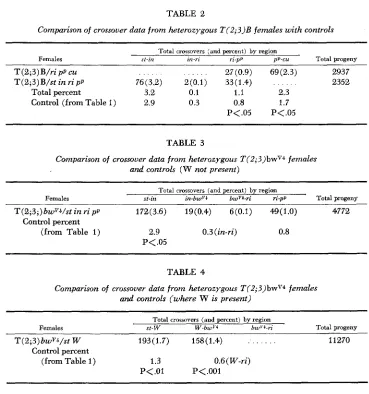
Data from crosses of females heterozygous for T(2;3)B are summarized in Table 2. The probabilities given in Tables 2 to 4 derive from the chi-square value for experimental and control data by region, in the form of a 2 x 2 test. The Yates correction f o r discontinuity of chi-square values was applied. Prob- abilities given are two-tail values, although these tests might properly be con- sidered one-tail tests and the increases more significant than indicated. That is, the aim of the experiments was not merely to test for any differences in fre- quency of crossing over, but rather to test specifically whether translocation heterozygotes show more crossing over in these regions than normal strains.
The results with T(2;3)B are characterized by increases in the frequency of
TABLE 1
Control values of crossing over in the centromere region of chromosome 3
Total crnssorers (and percent) by region
p p - c u Total progeny
Females S I rn in-ri r i - p p
st in ri pP/Canton-S 286(2.9) 28(0.3) 92(0.9) . . . . 9878 ri pp cu/Canton-S . . . 30(0.6) 88(1.7) 5289 st W/Canton-S 122(1.4) . . . 8593 W / s t i n r i p P 79(1.1) 26(0.4) 15(0.2) 33(0.5) . . . . 7124
st-W W-in in-ri r i - p p pp-cu
\
/
-
--
s t
w
in
1
1
ri
pp cu--
TABLE 2
Comparison of crossover data from heterozygous T(2;3)B females with controls
Total crossovers (and percent) by region
Females st-in in-ri ri-DJ’ PP-cu Total progeny
T (2;3) B/ri pp cu 27(0.9) 69(2.3) 2937
T ( 2 ; 3 ) B / s t in ri p p 76(3.2) 2(0.1) 33(1.4) 2352
Total percent 3.2 0.1 1.1 2.3
Control (from Table 1) 2.9 0.3 0.8 1.7
P<.05 P<.05
TABLE 3
Comparison of crossouer data from heterozygous T(2;3)bwv4 females and controls (W not present)
Total crossovers (and percent) by region
Females st-in in-bwv4 bwvr-ri ri-pP Total progeny
T(2;3;)bwv&/st in ri pp 172(3.6) lg(0.4) 6(0.1) 49(1.0) 4772 Control percent
(from Table 1) 2.9 0.3 (in-ri) 0.8
P<.05
TABLE 4
Comparison of crossouer data from heterozygous T(2;3)bwv4 females and controls (where W is present)
Total crossovers (and percent) by region
Females st-W W-bwv4 bwk 4-ri Total progeny
T(2;3)bw”4/st W 193 ( 1.7) 158 (1.4) Control percent
(from Table 1) 1.3 0.6 ( W - r i ) P<.01 P<.OOl
11270
crossing over in the ri-pp and pp-cu regions, presumably just distal to the break- point of the translocation. The in-ri region, i n which the breakpoint is probably located, produced very few changes. Crossing over beyond the centromere, in the st-in region, is essentially normal.
Crossover data from females heterozygous for T(2;3) bwv4 are summarized in Table 3 (crosses not involving W ) and Table
4
(crosses with W ) . It should be noted that in agreement with the findings of EILEEN SUTTON GERSH (DE-MEREC, KAUFMANN and SUTTON 1939) the crossover data place the centromere
breakpoint, normal or higher than normal values in intervals beyond the centro- mere, and decreases only in the immediate vicinity of the centromere.
DISCUSSION
As a general pattern, crossing over in the presence of a heterozygous translo- cation is decreased markedly in the broken arm, especially in regions adjacent to the breakpoint, and increased slightly in the opposite arm (DOBZHANSKY 1930b; BEADLE 1933). The decreases adjacent to the point of translocation have been interpreted as due to incomplete synapsis, resulting from pairing conflicts
(DOBZHANSKY 1931; DOBZHANSKY and STURTEVANT 1931), and might be ex- pected regardless of the position of the break.
DOBZHANSKY (1930b) and BROWN (1940), however, have obtained data sug- gesting that a translocation with a break near the base of an arm reduces crossing over in the affected arm only slightly, if at all. BROWN was led to the conclusion that “When the break is near the centromere, the frequency of single chiasmata is normal or increased.” It was of some consequence for the present study that these earlier data involved the use of st and cu as the markers nearest the cen- tromere, since these loci are almost at the periphery of the centromere effect in chromosome 3. The use, in the present instance, of mutants as close to the cen- tromere as possible has led to the demonstration that it is precisely in the regions nearest the breakpoint, on the distal side, that the most striking increases are ob- tained. The earlier data have shown that the increase disappears in more distal regions.
These increases in the frequency of crossing over just distal to a translocation breakpoint, when the break is located very near a centromere, have been sub- stantiated by data of DR. EILEEN SUTTON GERSH (personal communication). Her crossover data were obtained from females heterozygous for the complex re- arrangements
N284-100
r l and N2GL-100 r20. These rearrangements have in com- mon the detachment of nearly all of 3L from its usual centric association, in one case by translocation with 2L, in the other by a pericentric inversion of most of 3R. An insertion of X-chromosome material including the white locus marks the 3L breakpoint with a white-mottled position effect. With respect to the st-centromere region, they constitute arrangements analogous to T ( 2 ; 3 ) bw’ 4 . I n all structurally heterozygous combinations, including N2h4--100 rZ/+, N L h 6 - 1 0 0 r20/+ and N264-100 rl/N204-100 r20, GERSH has found unexpectedly high frequen- cies of crossing over in the regions just distal to the 3L break. Most striking were the data from the latter cross, which produced 5.0 percent W-in crossovers and 2.0 percent in-w”> (breakpoint) crossovers (GERSH’S data again place the centromere between in and ri). The combination of NZ64-lo0 r l and NZG$-lOO r20
765
adjacent centromeres have paired. Again, the interpretation might be developed that centromere pairing is responsible for the centromere effect. In the present studies involving T(2;3) B and T(2;3) b d ) , however, there are strong indications that the 3 centromeres are pairing in spite of their involvement with transloca- tions. The evidence for very regular pairing of centromeres rests on the normal or more than normal percentages of crossing over in intervals nearest the centro- mere in the untranslocated arm. GERSH also observed increases in the wm(break- point) -PI1 and wm (breakpoint) S b regions when testing linkage with the N264-100
r20 translocation.
A possible argument against the acceptance of these increases in crossing over as genuine, both in the centromere region and intervals distal to the translocation breakpoint, is that crossover tetrads might be strongly selected for. It has been demonstrated that exchanges in translocation arms facilitate normal disjunction
(DOBZHANSKY 1933; BROWN 1940). BROWN has shown, however, that the non- translocated arm disjoins regularly regardless of participation in crossing over and that the selection of exchange products is not likely to bias crossover esti- mates in that arm. While it has been established that normal disjunction is facil- itated by crossing over in the translocated arm, this mechanism of selection for crossovers is apparently countered by a lower efficiency of synapsis, due to pair- ing conflicts. Thus, heterozygous translocations having distal points of breakage invariably cause a considerable net reduction in crossing over in the translocated arm ( DOBZHANSKY 1930b; BEADLE 1933), indicating that selection for exchanges is of minor importance.
With a break near the centromere, the pattern for most of the translocated arm is one of slight decrease (DOBZHANSKY 1930b) with normal or slightly in- creased values nearest the break (BROWN 1940). BROWN (1940) has shown by an extensive correlation of crossing over and nondisjunction that the latter fre- quencies are real, rather than apparent, high values. She has established that nondisjunction of the broken arm is minimal when the break is centric, and that the selection for crossovers is diminished correspondingly.
If the decreases in crossing over produced by more distal translocation breaks demonstrate a n inescapable effect of synaptic conflicts, the present data suggest that reduced pairing of the basal translocation has been dramatically counter- acted by removal of the centromere effect to produce a net increase in crossing over in the centric region. Actually, the capacity for exchange of paired centric regions may be of a much greater magnitude than the data indicate, if mixed pairing situations exist.
categories. Furthermore, the fact that it is always the member with a centric break that undergoes an increase in crossing over shows clearly that the centro- mere is involved in some way. While DOBZHANSKY and STURTEVANT (1931) demonstrated that the further inhibition of crossing over in one translocation member (by adding an inversion) leads to an increase in crossing over in the other member, it was clear that their results derived from the removal of pairing conflicts by eliminating synapsis in one pair of homologues, and are not related to centric increases observed with the translocation alone.
With this evidence that the presence of a basal translocation leads to appreci- able increases in crossing over in the region just distal to the translocation break- point, what structural changes have been critical for the removal of the centro- mere effect? An earlier interpretation (THOMPSON 1963), made on the basis of chromosome-4 crossovers, was that the centromere effect depends on the pairing of homologous centromeres. It was suggested that in normal females the pairing of centromeres initiates a repulsion of these same centromeres, a repulsion oc- curring as a rule just before crossing over. Such an effect would leave the im- mediate centric region unsynapsed (or “desynapsed”) and would produce the observable inhibition of adjacent exchanges, an inhibition which would diminish with increasing distance from the centromere.
In the present configurations, however, it appears that the 3 centromeres still pair regularly, although not in the same synaptic plane as the crossover intervals of the translocated arm. It is this last point which may be of greatest importance. When the basal translocation fails to eliminate centromere pairing, as with T(2;3)B and T(2;3) bw’4, the repulsion phenomenon would presumably take place. Because of the change in planes of pairing, however, the movements of the centromeres would have no direct effect on pairing in the translocated arm, and crossing over should be released in that arm as if no centromere effect had ever been initiated (Figure 2 ) . The increases in crossing over would, of course, be restricted to those centric regions in which the centromere effect is normally most marked.
This scheme for the centromere effect and its removal would apply to any rearrangement having a basal break, as long as the rearrangement does not other- wise interfere with pairing in the broken arm. One might predict on this basis
c
NORMAL
that a pericentric inversion having a break near a centromere should character- istically produce increases in crossing over just distal to the basal breakpoint
(Figure 3 ) . In addition to the
N264-100
r l data of GERSH previously referred to, this pattern has been reported by ALEXANDER (1952) for females heterozygous for the Plum-2 inversion. With a break just left of the centromere of 2, this pericentric inversion increases crossing over in the b-pr interval by about 50 per- cent. The centromere repulsion hypothesis offers a consistent interpretation for such observations, as well as for the results from translocation-bearing and normal females.Since the regions most strikingly influenced by the centromere are precisely the same regions where increases in crossing over are detected in triploid females (REDFIELD 1930)
,
in females carrying heterologous rearrangements (the inter- chromosomal effect, STEINBERG 1936),
and in females subjected to temperature extremes (PLOUGH 1917), one is tempted to attribute all these phenomena to a single underlying cause. Under the hypothesis of centromere repulsion triggered by centromere pairing in normal females, the increase in centric exchanges in triploids could be accounted for with the assumption that pairing switchovers, known to be characteristic of triploid females (REDFIELD 1930), occur near the centromere in an appreciable fraction of nuclei (Figure4).
These changes in theFIGURE 3.-Centromere repulsion in the presence of a pericentric inversion with basal breakpoint.
---
t
___
---
__
---
-
---
FIGURE 4.-Centric switchover of pairing in a triploid, as a possible basis for increased centric crossing over.
association of homologues would have the same general effect as the presence of a basal translocation in that the two homologues involved in centromere pairing (and repulsion) would not always be the same pair of homologues engaged in pairing in the nearby centric regions. If the centric heterochromatin is a region of somewhat unspecific homologies, as appears to be the case, pairing switchovers might occur there with greater ease than elsewhere.
In essentially the same fashion, the increase in centric crossing over with heterologous rearrangements might be due to an association of nonhomologous centromeres, with adjacent switches to homologous pairing (Figure 5 ) . It has been amply demonstrated that, with various kinds of structural heterozygosity, nonhomologous elements may segregate regularly from one another (e.g. GRELL 1959; GRELL and GRELL 1960; FORBES 1960; FROST 1961). The present model would have the advantage over the ingenious model of OKSALA (1 958) of relating the interchromosomal effect to an increased likelihood of nonhomologous pair- ing. Whether paired nonhomologous centromeres repel or not, the predicted effect would be an increase of the same kind observed in triploid females.
Finally, the increases in centric crossing over observed at extremes of tempera- ture (PLOUGH 1917) are consistent with the expectation that any precise mech- anism for the repulsion (as well as for the attraction) of homologous chromo- somes or centromeres would be sensitive to the conditions of their aqueous en- vironment (Yos, BADE and JEHLE 1957; ZYRYANOV 1963). Thus, the centromere effect in normal circumstances may depend on an optimum temperature range, with a disruption of repulsion at either high or low temperature. This agrees with the variations observed by PLOUGH. Again, the postulated pairing-repulsion of centromeres offers a unified interpretation for a great body of hitherto puz- zling crossover data.
SUMMARY
I n the large autosomes of Drosophila rnelanogaster, the centromere effect (an inhibition of centric crossing over in normal females) not only depends on the pairing of homologous centromeres, but also requires that their pairing be in the same plane as the pairing of adjacent centric regions. With translocations or pericentric inversions having a basal break, including some in which the regular pairing of centromeres is strongly indicated, real and quantitatively significant increases in crossing over are observed in the region just distal to the basal breakpoint. These rearrangements typically form pairing configurations in which the centromeres and the region in question are paired in different planes and, presumably, in independent fashion.
for the increases in centric crossing over observed in triploid females and for the interchromosomal effect of heterologous rearrangements.
L I T E R A T U R E C I T E D
ALEXANDER, M. L., 1952
BEADLE, G. W., 1932
The effect of two pencentric inversions upon crossingover in Dro- sophila melanogaster. Univ. Texas Publ. 5204: 219-226.
A possible influence of the spindle fiber on crossing-over in Drosophila. Proc. Natl. Acad. Sci. U.S. 18: 160-165. - 1933 Studies of crossing-over i n hetero- zygous translocations in Drosophila melanogaster. Z. Ind. Abst. Vererb. 65: 11 1-128.
The mutants of Drosophila melanogaster. Carnegie Inst. Wash. Publ. 552.
The relation between chiasma formation and disjunction. Univ. Texas Publ. 4032 : 1 1 4 4 .
The gene. Carnegie Inst. Wash. Yearbook 38: 185-191.
Cytological map of the second chromosome of Drosophila melano- gaster. Biol. Zentr. 50: 671485. - 1930b Translocations involving the third and fourth chromosomes of Drosophila melanogaster. Genetics 15: 347-399. - 1931 The decrease of crossing-over observed i n translocations, and its probable explanation. Am. Naturalist 6 5 : 214-232. - 1932 Cytological map of the X-chromosome of Drosophila melanogaster. Biol. Zentr. 52: 4.93-509. - 1933 Studies on chromosome conjugation. 11. The relation between crossing over and disjunction of chromosomes. Z. Ind. Abst. Vererb.
64: 269-309.
Translocations between the second and third chromosomes of Drosophila and their bearing on Oenothera problems. Carnegie Inst. Wash. Publ. 421 : 30-59.
Non random assortment in primary nondisjunction in Drosophila melano- gaster. Proc. Natl. Acad. Sci. U S . 46: 222-225.
BRIDGES, C. B., and K. BREHME, 1944
BROWN, M. S., 1941)
DEMEREC, M., B. P. KAUFMANN, and E. SUTTDN, 1939
DOBZHANSKY, TH., 1930a
DOBZHANSKY, TH., and A. H. STURTEVANT, 1931
FORBES, C., 1960
FROST, J. N., 1961 GLASS, H. B., 1933
GRELL, R. F., 1959
GRELL, R. F., and E. H. GRELL, 1960
Preferential segregations in triploid females. Genetics 4.6: 373-392. A study of dominant mosaic eye-colour mutants in Drosophila melanogaster.
11. Tests involving crossing-over and non-disjunction. J. Genet. 28: 68-1 12.
Non random assortment of non-homologous chromosomes in Drosophila melanogaster. Genetics 44: 421-435.
The behavior of nonhomologous chromosomal elements involved i n non random assortment in Drosophila melanogaster. Proc. Natl. Acad. Sci. U S . 46: 51-56.
LEWIS, E. B., 1960 OKSALA, T., 1958
PLOUGH, H. H., 1917 REDFIELD, H., 1930
gaster. Genetics 15: 205-252. STEINBERG, A. G., 1936
some of Drosophila melanogaster. Genetics 2 1 : 615-624.
THOMPSON, P. E., 1963
48: 697-701.
Yos, J. M., W. L. BADE, and H. JEHLE, 1957
ZYRYANOV, P. S., 1963
A new standard food medium. Drosophila Inform. Serv. 34: 117-118. Chromosome pairing, crossing over, and segregation i n meiosis in Drosophila
The effect of temperature on crossing over. J. Exptl. Zool. 24: 1M-209. Crossing over in the third chromosomes of triploids of Drosophila melano-
The effect of autosomal inversions on crossing-over in the X-chromo-
Centric pairing and crossing-over in Drosophila melanogaster. Genetics
The specificity of London-Eisenschitz-Wang forces.
Nature of the forces of interactions between chromosomes. Biophysics
melanogaster. Cold Spring Harbor Symp. Quant. Biol. 23: 197-210.
Proc. Natl. Acad. Sci. U.S. 43: 341-348.