rspa.royalsocietypublishing.org
Research
Article submitted to journal
Subject Areas:
Cosmology, Field Theory,
Astrophysics
Keywords:
Cosmological Theory, Early Universe,
Inflation
Author for correspondence:
F. Melia
e-mail: [email protected]
light of the non-zero
k
min
measured in the CMB
power spectrum
Jingwei Liu
1and Fulvio Melia
21Department of Physics, The University of Arizona, AZ
85721, USA
2Department of Physics, The Applied Math Program,
and Department of Astronomy, The University of
Arizona, AZ 85721, USA
Slow-roll inflation may simultaneously solve the horizon problem and generate a near scale-free
fluctuation spectrum P(k). These two processes are
intimately connected via the initiation and duration of the inflationary phase. But a recent study based on
the latestPlanckrelease suggests thatP(k)has a hard
cutoff, kmin6= 0, inconsistent with this conventional
picture. Here we demonstrate quantitatively that most—perhaps all—slow-roll inflationary models fail to accommodate this minimum cutoff. We show that
the small parameter must be&0.9throughout the
inflationary period to comply with the data, seriously violating the slow-roll approximation. Models with
such an predict extremely red spectral indices, at
odds with the measured value. We also consider extensions to the basic picture (suggested by several earlier workers) by adding a kinetic-dominated or radiation-dominated phase preceding the slow-roll expansion. Our approach differs from previously published treatments principally because we require these modifications to—not only fit the measured fluctuation spectrum, but to simultaneously also— fix the horizon problem. We show, however, that even such measures preclude a joint resolution of the horizon problem and the missing correlations at large angles.
1. Introduction
The lack of large-angle correlation in the cosmic microwave background (CMB) anisotropies, confirmed
by three independent satellite missions [1–3], raises
c
The Authors. Published by the Royal Society under the terms of the Creative Commons Attribution License http://creativecommons.org/licenses/ by/4.0/, which permits unrestricted use, provided the original author and source are credited.
2
rspa.ro
y
alsocietypub
lishing.org
Proc
R
Soc
A
0000000
..
..
..
..
..
..
..
..
..
..
..
..
..
..
..
..
..
..
..
..
..
..
..
..
..
..
..
..
..
serious questions concerning the viability of basic slow-roll inflation [4,5]. A reliance on cosmic
variance [6] for the missing correlations cannot avoid the correspondingly small probabilities
(.0.24%) that disfavor the conventional picture at &3σ. This growing tension between the
theoretical predictions and the CMB observations was recently put on a much more rigorous,
formal footing with a detailed analysis of the recent Planck data release [3], showing quite
robustly that the absence of large-angle correlation in the CMB is due to a non-zero minimum
wavenumber,kmin, in the fluctuation power spectrumP(k)[7].
The inflationary paradigm posits that quantum fluctuations were generated shortly after the
Big Bang [8] with a power-law power spectrumP(k)distributed over an indeterminate range
of wavenumbersk. But the latestPlanckmeasurements are precise enough for us to question
whether or notkminis in fact zero. Ref. [7] demonstrated that the lack of large-angle correlation
in the CMB is due to a cutoffkmin6= 0, and measured its value by optimizing the theoretical fits
to the measured angular-correlation function. These authors provided compelling evidence that thePlanckdata clearly rule out a zerokminat a very high level of confidence—exceeding8σ. This
measurement is critically important because—given an inflaton potential,V(φ), and the notion
that a minimum wavenumber corresponds to the first mode leaving the horizon—kminsignals a
precise cosmic time,tstart, at which slow-roll inflation is supposed to have started.
Unconstrained slow-roll inflation would have stretched all fluctuations beyond the horizon,
resulting in aP(k)withkmin= 0, which would have produced strong correlations in the CMB
at all angles, θ, in contrast to what is actually seen, i.e., an angular correlation function that
essentially goes to zero atθ&60◦. Themeasuredminimum wavenumber is instead
kmin=
4.34±0.50
rdec
, (1.1)
whererdecis the comoving distance between us and redshiftzdec= 1080, at which decoupling
in standard ΛCDM cosmology is thought to have occurred. Therefore, for the latest
Planck parameters (see below), one finds rdec≈13,804Mpc, and a corresponding minimum wavenumber
kmin= (3.14±0.36)×10−4Mpc−1. (1.2)
In the conventional inflationary picture, modekexited the horizon at timet∗, satisfying the
simple condition [8]
λk(t∗)
2π =
c
H∗ , (1.3)
where λk(t∗) = 2πa(t∗)/k is its wavelength, a(t∗) is the expansion factor in the
Friedmann-Lemaître-Robertson-Walker metric (FLRW), andH∗is the Hubble constant at that moment. This
strong observational constraint therefore implies that standard slow-roll inflation must satisfy the initial condition
a(tstart)Hstart= 94.3±10.9 km s−1Mpc−1. (1.4)
But as we shall show in this paper, at least some inflationary models fail to solve the horizon problem in light of this new measurement. We shall first consider pure slow-roll inflation on its own, but then also demonstrate that the introduction of a kinetic-dominated (KD) or radiation-dominated (RD) phase preceeding the slow-roll expansion cannot produce consistency with the data either.
The missing angular correlation at large angles is related to the unexpectedly low power
measured in the small`multiple moments. Several workers have previously attempted to resolve
this issue by introducing such an RD or KD phase preceding the flatenning of the inflaton potential. We shall summarize several of these efforts in § 3 below, and provide a set of pertinent
references to this previously published work. Our analysis in this Letterdiffers from many of
these treatments principally because we require such modifications to—not only account for the missing angular correlation at large angles, but simultaneously to also—fix the horizon
3
rspa.ro
y
alsocietypub
lishing.org
Proc
R
Soc
A
0000000
..
..
..
..
..
..
..
..
..
..
..
..
..
..
..
..
..
..
..
..
..
..
..
..
..
..
..
..
..
the measured fluctuation spectrum and the ability of standard slow-roll inflation to equilibrate the CMB temperatue across the visible Universe.
2. Pure Slow-Roll Inflation
We may clearly see the impact of this measurement by considering the simplest case of a pure exponential (i.e., de Sitter) expansion. To ensure that the CMB temperature seen today is equilibrated across the sky, a photon must have traversed a comoving distance prior to
decoupling at least twicerdec. That is, the minimal condition for inflation is
rpreCMB= 2rdec≡2c Zt0
tdec
dt
a(t), (2.1)
wherea(t)is the aforementioned expansion factor. In terms ofH= ˙a/a, we may also put
rdec=c Za0
adec
da
a2H , (2.2)
whereH(a)is the Hubble parameter as a function ofa, anda0is the expansion factor today. The
latest cosmological measurements all seem to be consistent with a spatially flat Universe [3], for
whicha0may be normalized to1.
From the Friedmann equation, we have
H2(a) =H02
Ωm
a3 +
Ωr
a4 +ΩΛ
. (2.3)
Thus, for the Planckoptimized valuesH0= 66.99±0.92 km s−1 Mpc−1, Ωm= 0.321±0.013,
ΩΛ= 0.679±0.013, andΩr= 9.3×10⁻⁵ [3], for the Hubble parameter, and fractional matter
and cosmological constant energy densities, respectively, one finds rdec≈13,804 Mpc. By
comparison,rpreCMBis calculated from the start of inflation,astart≡a(tstart), to decoupling and
is mostly due to the expansion up toaend, when the inflaton field becomes sub-dominant. Thus,
rpreCMB≈c Zaend
astart
da
a2H . (2.4)
In simple exponential (i.e., pure de Sitter) expansion,H(a) =Hstartis constant during inflation,
so
rpreCMB=
c Hstart
1
astart
− 1
aend
, (2.5)
and sinceastartaend, we may also put
rpreCMB=
c Hstartastart
. (2.6)
The newly measured constraint in Equation (1.4) therefore implies thatrpreCMB≈3,181Mpc,
much smaller than the required comoving distance2rdec≈27,608Mpc. This factor9disparity
therefore rules out pure exponential inflationary models, because they could not solve the horizon
problem given the measured value ofkmin.
But the focus today is onslow-rollinflation, for whichH(a)due to the inflaton field is very
nearly—though not exactly—constant. It is not difficult to see that when the small parameter
(see Eq. 2.9 below) is monotonic [9],H(a)≤Hstartfor alla≥astart. As such, one should expect
rpreCMBto be bigger than that in Equation (2.6) (corresponding to pure exponential expansion) if the starting condition (Eq. 1.4) remains the same.
To quantify the difference, let us define a new variable
β(a)≡ 1
Ha2 (2.7)
(i.e., the integrand in Eq. 2.4). The boundaries relevant to the run of β(a) with a are shown
4
rspa.ro
y
alsocietypub
lishing.org
Proc
R
Soc
A
0000000
..
..
..
..
..
..
..
..
..
..
..
..
..
..
..
..
..
..
..
..
..
..
..
..
..
..
..
..
..
b
cutoffb
expb
endb
expansion factor a(t)
a
starta
endb
slowFigure 1.Phase space of permitted β(a) versus a trajectories for slow-roll inflationary models. Here,
βcutoff= (Hstartastart)−1a−1∝1/a (blue solid); βexp= (Hstart)−1a−2∝1/a2 (red dashed); and βend= (Henda2end)
−1=constant (black dashed). The shaded (yellow) area is the dominant contribution to the integral for
rpreCMB, for a specific slow-roll model withβslow(a), and should therefore be compared with the comoving distance
rdecto decoupling.
on whichβcutoff= (Hstartastart)−1a−1∝1/a. Inflation must begin atastartsomewhere on this
curve. For example, ifH is constant (red dashed curve), inflation initiates at the point where the
solid and dashed curves intersect, after whichβexp∝1/a2. Also, the Universe is believed to have
been radiation dominated right after inflation ended, for which
Hend2 =H02
Ωr
a4 end
!
. (2.8)
Again, for exponential inflation with H(a) =Hstart=Hend, Equation (2.8) corresponds to the
horizontal (black) short-dash line, with βend= (Henda2end)−1= constant near the bottom of
the plot. Any slow-roll inflationary model (with H not exactly constant) would then follow a
trajectoryβslow(a) (shown as solid black) somewhere between theβcutoff andβexp curves. It
could never cross the hyperbola becauseHcan never be bigger than its starting valueHstart.
The small parameteris defined according to [9]
≡m
2 Pl 4π
H0 H
2
, (2.9)
wheremPl is the Planck mass and prime denotes a derivative with respect to the inflaton scalar
field,φ. It is not difficult to show that
H(φ) =Hstartexp − Zφ
φstart
s
4π(φ)
m2Pl dφ
!
5
rspa.ro
y
alsocietypub
lishing.org
Proc
R
Soc
A
0000000
..
..
..
..
..
..
..
..
..
..
..
..
..
..
..
..
..
..
..
..
..
..
..
..
..
..
..
..
..
where the subscript ‘start’ has its usual meaning. It is also useful to introduce the number of e-folds during inflation,
N(φstart, φ)≡ln
a astart
= Zφ
φstart
s
4π m2
Pl(φ)
dφ . (2.11)
Clearly,= 0ifH is strictly constant. It is non-zero, but small, ifH changes slowly (hence the
designation ‘slow-roll’). Thus, inflation in slow-roll models must end whenincreases to1, at
which point the slow-roll approximation breaks down.
Let us therefore first consider the extreme case in which = 1throughout the inflationary
phase, for which
H(a) =Hstartexp(−N) =Hstartastart
a . (2.12)
This is in fact the solid black hyperbola shown in figure1. Therefore,
rpreCMB=1 =
c Hstartastart
ln
aend
astart
. (2.13)
This comoving distance is bigger by a factorln(aend/astart)than that for pure de Sitter expansion
(Eq. 2.6), and would be sufficient to account for the required value of2rrec. As we shall discuss
shortly, however, there are compelling reasons why such a persistently large value of is
inconsistent with the data. Typically, slow-roll models have a very tinyduring most of inflation,
approaching 1 only towards the end, when the inflaton field is believed to somehow dissolve into
standard model particles, so that the magnitude ofH0becomes very large.
To more accurately represent such models, we therefore define another new parameter0< b <
1such that2is restricted to values≤bduring most of the inflationary expansion, breaking down
only at the very end. Then we have
H(φ) > Hstartexp − Zφ
φstart
s
4πb m2
Pl(φ)
dφ
!
= Hstartexp(−
√
bN)
= Hstart
a astart
−
√
b
, (2.14)
so that, assumingaend>> astart,
rpreCMB2<b < r 2=b preCMB≡
1
(1−√b)Hstartastart
(2.15)
and, combining this with Equation (2.2), we find that√b >0.875in order for the right-hand side
of Equation (2.15) to exceed2rdecand solve the horizon problem.
In other words,must be quite large compared to typical values required in commonly studied
slow-roll models. Indeed, scenarios with∼1during the whole of inflation have already been
considered and eliminated on observational grounds [10], because either (i) inflation would not
have lasted long enough to fix the horizon problem, or (ii) the predicted extremely red spectral
index (ns1) inP(k)would be substantially different from its observed value0.9649±0.0042
[3]. Inflationary models with2> bare therefore not at all practical.
To demonstrate this general result more practically, let us examine its impact on four rather well-known, specific types of potential that have been studied thus far, beginning with the
evolution of the slow-roll parameterin so-called ‘small-field’ inflation models, for which the
potential may be approximated locally by the expression
V(φ) =V0
1−(φ/µ)p
. (2.16)
As an illustration, we takep= 2and(aend) = 1(the value ofµis irrelevant for the calculation
of [a]). Higher-order terms in V(φ) become important only towards the end of inflation.
6
rspa.ro
y
alsocietypub
lishing.org
Proc
R
Soc
A
0000000
..
..
..
..
..
..
..
..
..
..
..
..
..
..
..
..
..
..
..
..
..
..
..
..
..
..
..
..
..
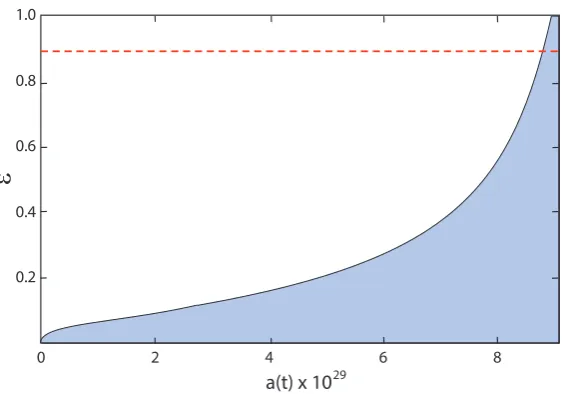
following Eq. 2.3 above), is shown in figure2. Indeed,2> bfor8.5×10−29.a.aend= 8.9×
10−29, but is far too small elsewhere forrpreCMBto exceed2rrec.
0 2 4 6 8
a(t) x 10
291.0
0.8
0.6
0.4
0.2
e
Figure 2.The small parameteras a function of the expansion factora(t)for the ‘small-field’ inflaton potential in Equation (2.16). The (red) dashed line marks the value required for the model to comply with thePlanckmeasurement
ofkmin.
An alernative characterization of such an evolution may be written in terms of the number of e-folds (Eq. 2.11) required during inflation in order to overcome the horizon problem, compared
to the actual number permitted by thekmin constraint in Equation (1.4). We have numerically
calculatedV (see Eq. 2.19 below) andN, subject to this constraint, for the following three
slow-roll potentials:
VQ(φ) = 1
2mφ
2
(Quadratic)
VH(φ) = V0[1−(
φ µ)
2
]2 (Higgs−like)
VN(φ) = V0[cos(
φ
f) + 1] (Natural). (2.17)
For specificity, we have continued to use the Planck optimized parameters. The principal
difference between our calculation and those carried out in previous work is the inclusion of Equation (1.4) as an initial condition. In addition, to this constraint, the other inputs informing
the calculation include: (1) the observed value of the scalar spectral index,ns= 0.96, which was
measured at the pivot pointkpivot≡0.05Mpc−1[3]; (2) an endpoint of inflation atV = 1(see
Eq. 2.19 below); and (3) a smooth transition from this inflated expansion to one driven by a radiation-dominated equation-of-state, as shown in Equation (2.8).
At the early stage of inflation, these potentials may be used to define an alternative set of ‘small
parameters’ηV andV [9], such that
7
rspa.ro
y
alsocietypub
lishing.org
Proc
R
Soc
A
0000000
..
..
..
..
..
..
..
..
..
..
..
..
..
..
..
..
..
..
..
..
..
..
..
..
..
..
..
..
..
0 15 30 45 60 1.0
0.8
0.6
0.4
0.2
e
Number e-folds
V
Quadratic
Higgs-like
Natural
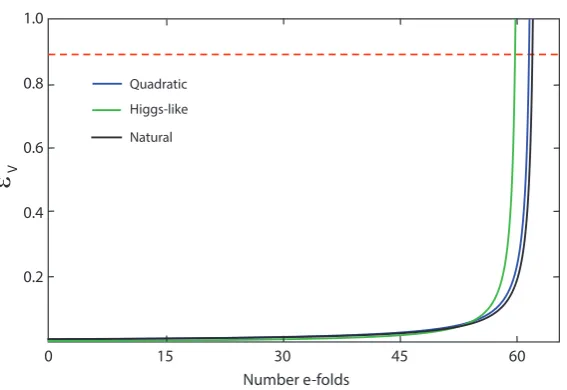
Figure 3.The small parameterVas a function of the number of e-folds (Eq. 2.11) for three illustrative slow-roll potentials
given in Equation (2.17). The (red) dashed line marks the value required for the model to comply with the Planck
measurement ofkmin.
where
V =
m2Pl
16π
V0 V
2
ηV =
m2Pl
8π V00
V . (2.19)
The approximation breaks down whenV is large, which is conventionally taken to indicate the
end of the inflated expansion. The key results of our simulations are as follows:
•Quadratic:rpreCMB= 5,547Mpc, which is still a factor∼5too small compared to2rdec=
27,608Mpc. This potential would have expanded the Universe by 62 e-folds (see fig.3),
but 64 e-folds would have been required to fix the horizon problem. The difference of 2
e-folds accounts for the factor 5 difference betweenrpreCMBand2rdec.
•Higgs-like:rpreCMB= 3,339Mpc, which is a factor∼8too small. In this case, the Universe
would have expanded by 60 e-folds (fig.3), but a little over 62 e-folds would have been
required to mitigate the horizon problem.
•Natural:rpreCMB= 3,650Mpc, which is also a factor∼8too small. The Universe would have expanded by 63 e-folds, but a little over 65 e-folds would have been required to completely mitigate the horizon problem.
For direct comparison, the small parameterV is shown as a function ofNfor each of these
three inflaton potentials in figure3. As discussed earlier, inflation would have ended whenV →
1. As was the case in figure2, the horizontal red (dashed) line indicates the approximate value
V requires to comply with thePlanckmeasurement ofkmin, and we see that, whileV does cross
this mark in each case, it is not sustained at this high level long enough for the Universe to have expanded sufficiently to remove the horizon problem.
3. Slow-roll Inflation Preceeded by a KD or RD Fast-roll Phase
8
rspa.ro
y
alsocietypub
lishing.org
Proc
R
Soc
A
0000000
..
..
..
..
..
..
..
..
..
..
..
..
..
..
..
..
..
..
..
..
..
..
..
..
..
..
..
..
..
standard slow-roll expansion. A closely related problem to the missing correlations at large angles is the observed lack of power on the largest scales. Several authors have previously attempted to mitigate this problem by introducing additional features to inflation, such as the
aforementioned KD and RD phases. For example, ref. [11] showed that an early fast-roll inflation
can lead to a depression of the cosmic microwave background quadrupole moment, with a
characteristic scale k1∼(3,759 Mpc)−1 of the implied attractive potential. This is consistent
with our previously measured minimum cutoffkmin= (3,442 Mpc)−1. These authors did not,
however, simultaneously calculate the comoving distances rpreCMB and rdec to ensure that
rpreCMB≥2rdec. Subsequent work by these authors [12] to include both a decelerated fast-roll and an inflationary fast-roll phase similarly did not address the horizon problem in terms of the required comoving distances. In addition, this work appears to rely on the Bunch-Davies initial conditions, which may be problematic in the context of trans-Planckian physics.
This general approach was followed by other authors [13], who found that a fast-rolling
KD initial phase improves the primordial power spectral fit to the data, but they similarly
did not consider the impact of this treatment on rpreCMB versusrdec. Likewise, the Planck
Collaboration [14] considered the impact of a cutoff on the spectrum, though not the
angular-correlation function. Their treatment apparently also lacks a discussion of the possible impact of
such a cutoff onrpreCMBandrdec.
The work of ref. [15] was published after our measurement ofkmin[7], and they too considered
the impact of a sharp cutoff to the fluctuation spectrum. They concluded that the standard power-law is preferred by the data, but made no mention of the horizon problem and the lack of
correlations at large angles, however, and the impact of this approach onrpreCMBversusrdec.
An early phase of KD inflation was also introduced in ref. [16], though restricted to only
polynomial and exponential potentials. These authors confirmed that such a transition exhibits a generic damping of power on large scales, but did not explicitly consider its impact on the
angular correlation function andrpreCMBversusrdec.
The work that comes closest in spirit to our analysis in this paper is that reported in ref. [17].
These authors, however, considered specifically theλφ4potential and imposed the condition of
“just-enough" inflation. They found that the slow-roll conditions are violated at the largest scales, and that this approach cannot explain the lack of power at the largest angles. In subsequent
work [18], this treatment was expanded to include quadratic and hybrid-type potentials, but still
without a consideration of their impact on the angular correlation function.
Finally, ref. [19] analyzed how much inflation one should expect for a given energy scale of
order1016GeV. But this work lacks direct relevance to our proposed coupling ofkminmeasured
from the angular correlation function to the number of e-folds itself, and its bearing onrpreCMB
versusrdec.
Quite clearly, many authors have by now noted the glaring inconsistency associated with low power in the CMB fluctuations on large scales, which is closely related to their lack of correlation at large angles. Our work amplifies this general view by providing a much stronger
argument for a cutoffkminin the primoridal fluctuation spectrum, and its direct impact also on
the horizon problem itself. To complete this discussion, we shall now consider whether a KD or RD modification to the basic slow-roll inflationary picture can help mitigate the inconsistency
between rpreCMB andrdec when a cutoffkmin is invoked to suppress the correlation at large
angles.
We shall first follow a simplified approach in which we gauge the impact of a KD or RD
modification to the horizon problem based solely on the previously measured hard cutoffkmin. It
is well known, however, that the angular powerC`of each multipole`, from which the angular
correlation function C(θ) is calculated, depends on the entire fluctuation spectrumP(k) [7].
Thus, any modification to the power spectrum produced during the KD or RD phase alters
C(θ) from that expected under pure slow-roll conditions. Following our initial discussion of
the impact of KD or RD on the horizon problem using the previously measuredkmin, we shall
9
rspa.ro
y
alsocietypub
lishing.org
Proc
R
Soc
A
0000000
..
..
..
..
..
..
..
..
..
..
..
..
..
..
..
..
..
..
..
..
..
..
..
..
..
..
..
..
..
correlation function is re-optimized for a representative inflaton potential that contains a KD
phase transitioning into slow-roll at kstart. We shall find that kstart, signalling the start of
inflated expansion, can differ fractionally fromkminwhenC(θ)is fit to thePlanckdata, though
insufficiently to qualitatively alter any of the results.
We begin with a radiation-dominated Universe from the Big Bang to the onset of inflation, during which
H=Qa−2, (3.1)
whereQis a constant. Solving for the scale factor, one therefore has
a2= 2Qt , (3.2)
so that
dt=a da
Q . (3.3)
The comoving distance traveled by a photon during this period is therefore
rRD=c Ztstart
0
dt a =
castart
Q . (3.4)
Thus, combining this with Equation (3.1), we have
rRD=
c Hstartastart
. (3.5)
The addition of an RD period preceeding slow-roll inflation can therefore double the comoving distance travelled by a photon prior to the end of the inflation. Even this, however, is still far too small to solve the horizon problem, which requires the comoving distance to be at least 10 times bigger.
The addition of a KD fast-roll expansion may hold more promise. For such a scalar
field-dominated Universe, we have [9]:
H(φ)2= 8π 3m2Pl
1 2 ˙
φ2+V(φ)
, (3.6)
and
¨
φ+ 3Hφ˙+V0= 0. (3.7)
From these two expressions, we derive
˙
H=− 4π
m2 Pl
˙
φ2, (3.8)
and
˙
φ=−m
2 Pl
4π H
0
. (3.9)
For a KD scalar-field potential, Equation (3.6) reduces to
H(φ)2≈ 8π
6m2Pl
˙
φ2 (3.10)
and, solving forH, we find that
H(φ) =Hstarte 2√3π
mPl(φ−φstart)
, (3.11)
for which
H0=2
√
3π mPl
Hstarte 2√3π
mPl(φ−φstart)
. (3.12)
With Equation (3.9), we therefore find that
dt dφ=−
r
π
3 2
mPlHstart
e
2√3π
10
rspa.ro
y
alsocietypub
lishing.org
Proc
R
Soc
A
0000000
..
..
..
..
..
..
..
..
..
..
..
..
..
..
..
..
..
..
..
..
..
..
..
..
..
..
..
..
..
so that
t−ti= 1 3Hstart
e
2√3π
mPl(φstart−φ)
, (3.14)
wheretiis the time at which the KD expansion begins. Thus, with
˜
t≡t−ti, (3.15)
we also have
˜
t= 1
3H , (3.16)
during this phase prior to the onset of slow-roll inflation.
We may now solve for the scale factora(t), finding that
a=Mt˜1/3, (3.17)
so that
dt=dt˜=3a 2
M3da , (3.18)
whereMis another constant. Therefore, the comoving distance travelled by a photon during this
period is
rKD=c Z˜tstart
˜ ti
dt˜
a =
3c
2M3(a
2
start−a2i). (3.19)
As long as the KD period begins right after the Big Bang, we may therefore approximate this expression as
rKD≈ 3c
2M3a
2
start, (3.20)
and therefore we find, with the use of Equations (3.11) and (3.12), that
rKD≈
c
2astartHstart
. (3.21)
Clearly, even combining this comoving distance with that from the slow-roll inflationary period,
we find thatrpreCMBis still far too small to solve the horizon problem.
Finally, we consider all three phases together, beginning with an RD period, followed by a KD Universe and a subsequent slow-roll expansion. It is not difficult to show that
rRD+KD= 3c
2M3
a2start−a2?
+ca?
Q , (3.22)
wherea?is the scale factor at the RD to KD transition. Thus
rRD+KD=
1 + a
2 ?
a2start
c
2astartHstart
< c astartHstart
. (3.23)
In the last step, we examine the possibility that a more careful calculation of the angular
correlation function C(θ) with a modified P(k) from the KD phase may yield an optimized
wavenumberkstart(signalling the start of inflation) differing from the hard cutoffkminwe have
been using in this analysis. It is not difficult to show from Equations (3.10-3.12) that the fluctuation
spectrum produced during KD isP(k)∼k3. To estimate the change one should expect to see with
this more detailed approach, we therefore now proceed to re-optimizeC(θ)with
P(k) =
(
As(k/k0)ns−1 ifk≥kstart
As(kstart/k0)ns−4(k/k0)3 ifk < kstart,
(3.24)
11
rspa.ro
y
alsocietypub
lishing.org
Proc
R
Soc
A
0000000
..
..
..
..
..
..
..
..
..
..
..
..
..
..
..
..
..
..
..
..
..
..
..
..
..
..
..
..
..
600
500
400
300
200
100
0
-100
-200
C
(
q
)
q
0 20 40 60 80 100 120 140 160 180
u = 4.34
u = 5.90
minstart
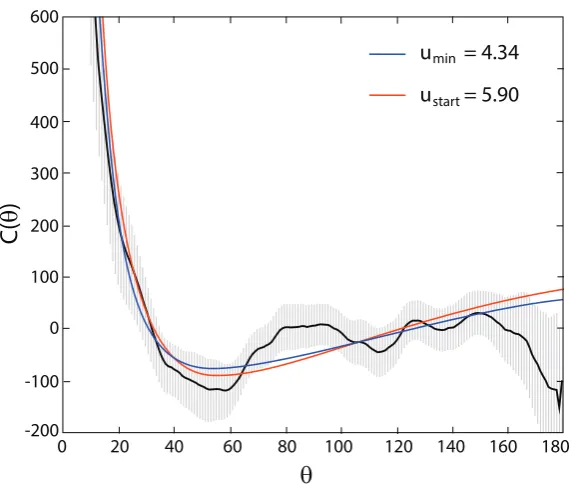
Figure 4.The best-fit angular correlation functions for P(k)with a hard cutoffkmin (blue) and forP(k)given in Equation (3.24) (red), with an optimized valuekstart= 4.12×10⁻⁴Mpc−1. These theoretical curves are compared to the angular correlation function measured withPlanck(dark solid curve) [14], and associated1σerrors (grey). (Adapted from ref. [7])
We follow the procedure outlined in ref. [7], and infer that the angular power of multipole`
relevant to the Sachs-Wolfe domain of fluctuations may be approximated as
C`=B Zustart
0
u ustart
3
j`2(u)
u du+B
Z∞
ustart
j2`(u)
u du , (3.25)
whereBis a normalization constant encompassingAsand several other factors; the variableu
is defined by the expressionu≡krdec, in terms of the comoving distancerdecto the decoupling
surface; andj`is the spherical Bessel function of order`. The angular correlation function itself is
then given by the expression
C(θ) =X `
(2`+ 1)
4π C`P`(cosθ), (3.26)
whereP`(cosθ)are the Legendre polynomials [20].
Using Equation (3.26) to refit the angular correlation function measured byPlanck[7,14], we
find that the optimized fit corresponds to the valueustart= 5.9. Thus, according to the definition
ofu, we find that
kstart= 4.12×10⁻⁴Mpc−1. (3.27)
In figure4, we show a comparison of the optimized angular correlation functions forP(k)with
a hard cutoffkmin(blue) andP(k)given in Equation (3.24) (red) with thiskstart. The curves are
almost indistinguishable, though the blue one is a slightly better fit to thePlanckdata at both small
(θ.45◦) and large (θ&120◦) angles [7]. This difference, however, is too small for us to decide
which of these fluctuation distributions is preferred by thePlanck data. Instead, the principal
outcome of this comparison is the change in wavenumber signalling the initiation of inflated
expansion: fromkminin Equation (1.2) for the hard cutoff, tokstartin Equation (3.27) for the KD
12
rspa.ro
y
alsocietypub
lishing.org
Proc
R
Soc
A
0000000
..
..
..
..
..
..
..
..
..
..
..
..
..
..
..
..
..
..
..
..
..
..
..
..
..
..
..
..
..
Thus, replacingkminin Equation (1.3) withkstart, and using Equations (2.6) and (3.23), we find
thatrpreCMB<4,848Mpc, which is still much smaller than the value (i.e.,27,608Mpc) required
to solve the horizon problem. In effect, the more detailed treatment ofP(k)has increasedrpreCMB
by about50%, but nowhere near the factor∼9required for this purpose.
No matter when the transition from RD to KD would have occurred, we find that no such modification to the basic slow-roll scenario can render inflation consistent with the measured
kmincutoff in the primordial fluctuation spectrum. The key point here is that, while introducing
a cutoff to the fluctuation distribution can account for the observed CMB anisotropies, it cannot simultaneously solve the horizon problem.
4. Conclusion
The most recentPlanckdata have affirmed the absence of large-angle correlations in the CMB
anisotropies, seen previously with several instruments over several decades. A prevailing view is that this feature may simply be due to ‘cosmic variance,’ based on the reasonable argument that we have only one Universe to observe, and that a variation away from its most probable configuration should not be unexpected. Certainly none of the work reported in this paper can completely eliminate that possibility. Nevertheless, seeking to find alternative explanations, as we have attempted to do here, is motivated by the presumed low probability of cosmic variance
being the sole answer. The analysis reported in ref. [7] shows that a more probable explanation
for the lack of large-angle correlations in the CMB is the presence of a hard cutoff kmin in
theP(k)spectrum. If true, this cutoff has profound consequences on the viability of slow-roll
inflationary models becausekmin points to a well-defined time at which inflation could have
started. Quantifying this impact on the possible form of the inflaton potential has been the main goal of this paper.
The constraint implied bykminallows inflation to simultaneously solve the horizon problem
and produce a near power-law fluctuation spectrum only if ≈1 throughout the inflationary
expansion. But such a scenario then predicts an extremely red spectral index completely at odds
with the measured value. Here, we have examined in detail the consequences ofkminon four
well-studied slow-roll inflationary models proposed thus far, showing that, if our interpretation
ofkminis correct, thePlanckCMB data rule out such slow-roll potentials at a very high level of
confidence.
Acknowledgments
FM is grateful to Amherst College for its support through a John Woodruff Simpson Lectureship.
Ethics Statement.This research poses no ethical considerations.
Data Accessibility Statement.All data used in this paper were previously published.
Competing Interests Statement.We have no competing interests.
Authors’ contributions.The authors together conceived the project, carried out the calculations, and wrote the paper. All authors gave final approval for publication.
Funding.None.
References
1. Wright E L Bennett C L Gorski K Hinshaw G and Smoot G F.1996. Angular Power Spectrum of
13
rspa.ro
y
alsocietypub
lishing.org
Proc
R
Soc
A
0000000
..
..
..
..
..
..
..
..
..
..
..
..
..
..
..
..
..
..
..
..
..
..
..
..
..
..
..
..
..
2. Bennett C L et al. 2003. First-Year Wilkinson Microwave Anisotropy Probe (WMAP)
Observations: Foreground Emission.ApJS14897.
3. Planck Collaboration. 2018. Planck 2018 results. VI. Cosmological parameters.A&Ain press
(eprint arXiv:1807.06209).
4. Guth A H. 1981. Inflationary universe: A possible solution to the horizon and flatness problems. Phys. Rev. D23347.
5. Linde A. 1982. A new inflationary universe scenario: A possible solution of the horizon,
flatness, homogeneity, isotropy and primordial monopole problems.Phys. Lett. B108389.
6. Copi C J Huterer D Schwarz D J and Starkman G D. 2009. No large-angle correlations on the
non-Galactic microwave sky.MNRAS399295.
7. Melia F and López-Corredoira M. 2018. Evidence of a truncated spectrum in the angular
correlation function of the cosmic microwave background.A&A618A87.
8. Mukhanov V F Feldman H A and Brandenberger R H. 1992. Theory of cosmological
perturbations.Phys. Rep.215203.
9. Liddle A R. 1994. Formalizing the slow-roll approximation in inflation.Phys. Rev. D49739.
10. Cook J L and Krauss L M. 2016. Large slow roll parameters in single field inflation.JCAP2016
028.
11. Destri C de Vega H J and Sanchez N G. 2008. CMB quadrupole depression produced by
early fast-roll inflation: Monte Carlo Markov chains analysis of WMAP and SDSS data.PRD78
023013.
12. Destri C de Vega H J and Sanchez N G. 2010. Preinflationary and inflationary fast-roll eras
and their signatures in the low CMB multipoles.PRD81063520.
13. Scacco A and Albrecht A. 2015. Transients in finite inflation.PRD92083506.
14. Planck Collaboration. 2016. Planck 2015 results. XIII. Cosmological parameters.A&A594A20.
15. Santos da Costa S Benetti M and Alcaniz J. 2018. A Bayesian analysis of inflationary primordial
spectrum models using Planck data.JCAP2018004.
16. Handley W J Brechet S D Lasenby A N and Hobson M P. 2014. Kinetic initial conditions for
inflation.PRD89063505.
17. Ramirez E and Schwarz D J. 2012. Predictions of just-enough inflation.PRD85103516.
18. Ramirez E. 2012. Low power on large scales in just-enough inflation models.PRD85103517.
19. Remmen G N and Carroll S M. 2014. How many e-folds should we expect from high-scale
inflation?PRD90063517.
20. Bond J R and Efstathiou G. 1984. Cosmic background radiation anisotropies in universes