A Monthly Double-Blind Peer Reviewed Refereed Open Access International e-Journal - Included in the International Serial Directories International Journal in Physical & Applied Sciences
http://www.ijmr.net.in email id- [email protected] Page 39 STATE-LEVEL INSTITUTIONAL FRAMEWORK FOR DISASTER MANAGEMENT: AN OVERVIEW OF J&K
Dr. Qurat-ul-Ain Shah
Assistant Professor, The Business School,
SSM College of Engineering & Technology, Parihaspora, Pattan. Prof. (Dr). Shabir A. Bhat
Professor, The Business School,
University of Kashmir, Hazratbal, Srinagar Kashmir-190006
ABSTRACT
The institutional and policy mechanisms for carrying out response, relief and rehabilitation have been well-established since Independence. These mechanisms have proved to be robust and effective insofar as response, relief and rehabilitation are concerned. The existing mechanisms had based on post-disaster relief and rehabilitation and they have proved to be robust and effective mechanisms in addressing these disaster requirements. The changed policy/approach, however, mandates a priority to full disaster aspects of mitigation, prevention and preparedness and new institutional and policy mechanisms are being put in place to address the policy change. As per the provisions of Disaster Management Act, 2005, the Government of Jammu and Kashmir has constituted the State Disaster Management Authority (SDMA), the State Executive Committee (SEC) and the District Disaster Management Authorities. The Authority would meet as often as required and review the status of warning systems, mitigation measures and disaster preparedness. When a disaster strikes, the Authority will coordinate disaster management activities. The Authority will be responsible for coordinating Government’s policies for disaster reduction/mitigation; ensuring adequate preparedness at all levels in order to meet disasters; coordinating response to a disaster when it strikes; coordination of post disaster relief and rehabilitation. At the State level disaster management was being handled by the Departments of Relief & Rehabilitation. At the district level, the District Magistrate who is the chief coordinator will be the focal point for coordinating all activities relating to prevention, mitigation and preparedness
Key Words Policy Framework, Institutional mechanism, state level disaster authority.
INTRODUCTION
A Monthly Double-Blind Peer Reviewed Refereed Open Access International e-Journal - Included in the International Serial Directories International Journal in Physical & Applied Sciences
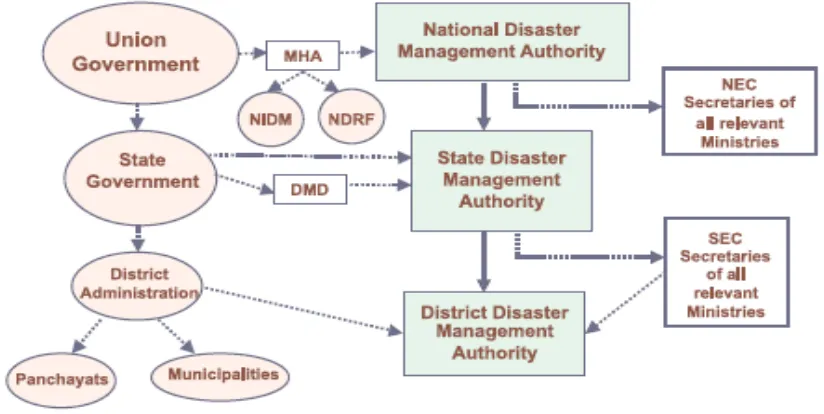
http://www.ijmr.net.in email id- [email protected] Page 40 Figure 1: Schematic representation of role players in Institutional Framework
State Level Institutional Mechanism for Disaster Management
The State of Jammu and Kashmir was amongst the first few states of the Union to enact legislation for natural calamities. The Jammu & Kashmir Natural Calamities Destroyed Areas Improvement Act 1955 was enacted for improvement of towns, villages and other areas destroyed by natural calamities in the State. However, not much mileage was achieved through the availability of the Act. After the enactment of the National Disaster Management Act, 2005, many initiatives have been launched in the State to minimize damage to life and property due to natural disasters.
As per the provisions of Disaster Management Act, 2005, the Government of Jammu and Kashmir has already notified and constituted the State Disaster Management Authority (SDMA), the State Executive Committee (SEC) and the District Disaster Management Authorities. However, considering the special character of the State, there shall be Divisional Disaster Management Authorities, as well.
The State Disaster Management Authority has been constituted under the chairpersonship of Hon’ble Chief Minister. Similarly, the State Executive Committee under the Chief Secretary has also been constituted. The State Disaster Response Force (SDRF) has been formulated and has two Companies are being prepared for field duties and deployment. Existing facilities of the Fire & Emergency Services (F&ES) and SDRF shall be strengthened by provision of capacity-building in terms of equipment and training. The District Disaster Management Authorities under the respective Deputy Commissioners too have been formulated. All these bodies shall be made functional by taking appropriate measures like appointment of personnel, establishing offices, provision of budgetary resources, etc, within one year.
State Disaster Management Authority
A Monthly Double-Blind Peer Reviewed Refereed Open Access International e-Journal - Included in the International Serial Directories International Journal in Physical & Applied Sciences
http://www.ijmr.net.in email id- [email protected] Page 41 This forum needs to be made administratively functional like the NDMA by appointing full time members of SDMA supported by core secretariat. One of the full time members shall be appointed as Vice Chairperson. The members shall be given appropriate powers. Chief Secretary shall be the Ex-officio Secretary General of SDMA and FCR shall be the Executive Secretary.
The SDMA shall lay down policies, plans and programs for disaster risk reduction and management in the State. It will approve the State- level plans in accordance with the guidelines of NDMA, coordinate the implementation of plans, and recommend the provision of funds. The SDMA shall be made functional by appointment of several full-time professional members. One of the full-time members shall be designated as Vice Chairperson of the SDMA. SDMA shall be assisted by the State Executive Committee (SEC) headed by the Chief Secretary. SEC shall also function as the link between NDMA, MHA and other national and international agencies.
The Divisional Disaster Management Authority (Div DMA) shall be created and will be headed by the Divisional Commissioner in both the Divisions of the State. Additional Commissioner will be the Chief Executive Officer of the Divisional DMA. Divisional DMA shall act as the planning, coordinating and implementing body for disaster risk reduction and management at the Divisional level and provide guidance for the purpose of disaster management to the DDMAs in accordance with the guidelines laid down by the NDMA and SDMA.
The District Disaster Management Authority (DDMA) headed by the Deputy Commissioner has been constituted in all the districts. ADC of the district concerned is the Chief Executive Officer of the DDMA. DDMA shall act as the planning, coordinating and implementing body for disaster management at the District level in consultation with the Divisional DMA and take all necessary measures for the purpose of disaster management in accordance with the guidelines laid down by SDMA.
Stakeholders in Disaster Risk Reduction and Management
The State Government acknowledges the following set of institutional stakeholders that play key roles in disaster risk reduction and management and calls for a well laid-down framework of operation under the leadership of J&K State Disaster Management Authority (SDMA):
All concerned departments of the State Government and Central Government agencies present in the State
State, Divisional & District Disaster Management Authorities Local authorities such as ULBs, PRIs
Fire & Emergency Services
State Police & Central Para Military Forces Voluntary and Civil Society organizations
Indian Red Cross Society, Multilateral aid agencies and UN agencies
Public sector undertakings, Corporate Sector, Hoteliers & other allied organizations Armed Forces
Indian Air Force
Airport Authority of India Indian Railways
National Disaster Response Force, State Disaster Response Force Community
A Monthly Double-Blind Peer Reviewed Refereed Open Access International e-Journal - Included in the International Serial Directories International Journal in Physical & Applied Sciences
http://www.ijmr.net.in email id- [email protected] Page 42 Financial Arrangements
Disasters cause extensive strain on financial resources due to activities undertaken under relief, rehabilitation and reconstruction programs. In addition, activities relating to prevention, mitigation and preparedness measures require funds. The Government of J&K is committed to allocating funds in the long term to ensure the sustainability of disaster management activities. The Government intends to have a budgetary allocation for activities related to disaster management.
SDMA shall explore additional sources of funding through aid, grants, loans etc. for activities related to disaster management in the State. The SDMA shall also explore creative means of sharing the costs associated with disaster management through risk sharing and risk transfer.
The State Government shall constitute a Disaster Mitigation Fund at the State, Divisional and District levels in accordance with the provisions of the DM Act, 2005. The Government shall give due priority to projects incorporating disaster risk mitigation measures. State will earmark 2% of the capital part of the Annual Plan outlay, (both State and District sector) which shall be kept apart for
a) Disaster Mitigation Fund, which shall be utilized for the purposes of prevention, preparation, planning, mitigation, training, capacity building, procurement of equipment etc.
b) Disaster Response Fund which shall be utilized for Rescue, Relief, Rehabilitation and Response etc.
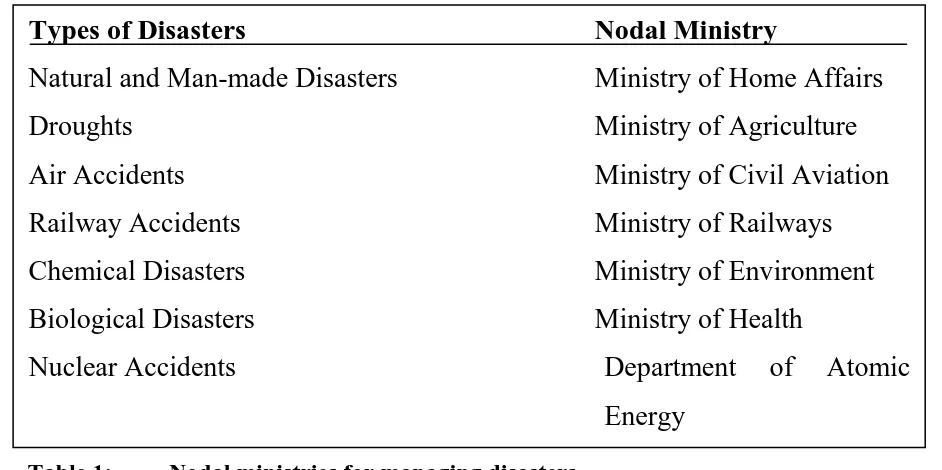
Nodal Ministries for Managing Different Types of Disasters
Types of Disasters
Nodal Ministry
Natural and Man-made Disasters
Ministry of Home Affairs
Droughts
Ministry of Agriculture
Air Accidents
Ministry of Civil Aviation
Railway Accidents
Ministry of Railways
Chemical Disasters
Ministry of Environment
Biological Disasters
Ministry of Health
Nuclear Accidents
Department
of
Atomic
Energy
A Monthly Double-Blind Peer Reviewed Refereed Open Access International e-Journal - Included in the International Serial Directories International Journal in Physical & Applied Sciences
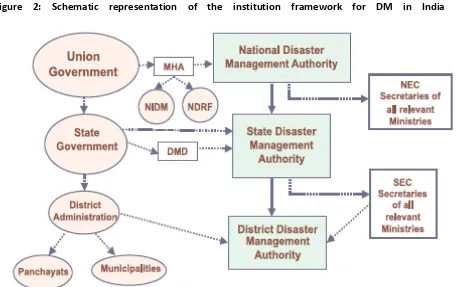
http://www.ijmr.net.in email id- [email protected] Page 43 Figure 2: Schematic representation of the institution framework for DM in India
Source : Dhar Chakrabarti 2006
CONCLUSION
High Powered Commission had observed that disaster management needs full political commitment at all levels of national, state and local government as disaster management occupies an important place in this country’s policy framework. The HPC had recommended that an institutional mechanism needs to be created at the highest level by setting a Cabinet Committee on Disaster Management that would ensure continued and sustained focus on this area at the highest level of the government. Many initiatives have been launched in the State of Jammu & Kashmir to minimize damage to life and property due to natural disasters after the enactment of the National Disaster Management Act, 2005. The State Government acknowledges the different set of institutional stakeholders (e.g. State, Divisional & District Disaster Management Authorities; Local authorities such as ULBs, PRIs; Fire & Emergency Services; State Police; Armed Forces; Indian Air Force; Airport Authority of India; Indian Railways) that play key roles in disaster risk reduction and management. Activities relating to prevention, mitigation and preparedness measures require funds. The Government of J&K is committed to allocating funds in the long term to ensure the sustainability of disaster management activities.
REFERENCES
1. Anderson M. Vulnerability to Disaster and Sustainable Development: A General Framework for Assessing Vulnerability.
2. Annan, K., 1999, The International Decade for Natural Disaster Reduction International Herald Tribune 10.9.99,1-3.
3. DeVellis, R. F., 1991, Scale development: Theory and applications. Newbury, CA, Sage.
4. GOVT OF INDIA(2011), "High Powered Committee on Disaster Management-Report", Department of Agriculture & Cooperation, Ministry of Agriculture, New Delhi
5. GOVT OF INDIA (2014), Disaster Management Status Report 2004, Ministry of Home Affairs, Govt of India, New Delhi.