Article
1
Developing a Business Plan for a Library Publishing
2
Program
3
Kate McCready 1, Emma Molls 2*
4
1 University of Minnesota; [email protected]
5
2 University of Minnesota; [email protected]
6
* Correspondence: [email protected] Tel.: +1-612-626-5218
7
8
Abstract: Over the last twenty years, library publishing has emerged in higher education as a new
9
class of publisher. Conceived as a response to commercial publishing practices that have strained
10
library budgets and prevented scholars from openly licensing and sharing their works, library
11
publishing is both a local service program and a broader movement to disrupt the current scholarly
12
publishing arena. It is growing both in numbers of publishers and numbers of works produced. The
13
commercial publishing framework which determines the viability of monetizing a product is not
14
necessarily applicable for library publishers who exist as a common good to address the needs of
15
their academic communities. Like any business venture, however, library publishers must develop
16
a clear service model and business plan in order to create shared expectations for funding streams,
17
quality markers, as well as technical and staff capacity. As the field is maturing from experimental
18
projects to full programs, library publishers are formalizing their offerings and limitations. The
19
anatomy of a library publishing business plan is presented and includes the principles of the
20
program, scope of services, and staffing and governance requirements. Other aspects include
21
production policies, financial structures, and measures of success.
22
Keywords: business plan; publishing; academic libraries; open access
23
24
1. Introduction
25
Academic publishing, fueled by the boom of digital internet technologies, has created space for
26
new types of publishers, including library as publisher. Because of the growth of new library
27
publishing programs, and the distinctiveness of scholarly communication approaches across
28
institutions, this paper advocates for the creation and adoption of business plans within library
29
publishing programs. The foundations of library publishing are presented, along with examples of
30
current library publishing programs. This paper walks through a business plan template that can be
31
used by current and future library publishers. Readers working in established library publishing
32
programs that currently lack a business plan, and readers who are considering launching a library
33
publishing program, will find a number of guiding questions for each section of the included business
34
plan template. Finally, the authors hope that this paper engages the entire library publishing
35
community and increases the number of publicly available library publishing business plans.
36
2. Development of Library Publishing Programs
37
Academic library publishing programs first saw adoption in the early 2000s and have continued
38
to grow over the last two decades [1]. Since 2014, the Library Publishing Coalition (LPC), a
39
membership organization made up of mostly North American academic libraries, has increased
40
membership by over 35%, and has surveyed 125 academic libraries who identify as actively engaging
41
in publishing. Thirty-six percent of LPC members established their publishing program in the last
42
ten years [2]. Beyond the Library Publishing Coalition, “...most of the 123 ARL (Association of
43
Research Libraries) member libraries are engaged in publishing or publishing support activites” [3].
44
Libraries started publishing programs for a variety of reasons, including “mission-aligned work for
45
exploring new opportunities in the digital age[...], demonstrating the market for scholarly,
peer-46
reviewed, open access monographs, and empowering the library to engage with and effect changes
47
in scholarly publishing “[3]. Although the goals of individual programs may vary, overall, library
48
publishing programs “...are focusing on the capabilities and possibilities of new models” and
49
working to avoid the “replicat[ion of] traditional publishing services” [4].
50
For many libraries, providing publishing services is an extension of a larger suite of scholarly
51
communication offerings, offered frequently to “...advance a strategic objective of transitioning the
52
library’s collecting activities away from licensing content and towards supporting open access to
53
scholarship” [5]. Although libraries addressing scholarly communication issues was discussed as far
54
back as 1979, scholarly communication service efforts vary greatly across libraries [1]. In a 2015
55
survey, Ithaka S+R found that across 10 surveyed institutions, scholarly communication programs
56
rarely share organizational structures, functions, and objectives [5]. The varying makeup of
57
scholarly communication programs, combined with the relatively new, and often experimental
58
nature, of library publishing services, leaves libraries to newly navigate the complex landscape of
59
open access publishing.
60
Unlike other scholarly communication services within a library where the costs have been
61
typically been absorbed by assigning new duties to existing staff, or hiring new staff with new skill
62
sets, the expenditures made on behalf of publishing activities are requiring creative thinking to
63
ensure that the necessary elements that transform a document into a publication (e.g., having a
64
reputable authority vet the content, applying production techniques to the content, making the
65
published work available through distribution networks, etc.). These early days of library publishing
66
are seeing an examination of which elements that go into creating a publication are necessary to instill
67
trust and produce high quality scholarship while also examining how those activities should be paid
68
for. Business planning for library publishing examines both of these elements.
69
2.1. Open Access Context: Library Publishing as Disruption
70
Most library publishers firmly align with the open access movement which “...had its origins in
71
the crisis in scholarly communication and publishing, which has both caused and is the result of
72
declining collections budgets, more demand for newer, expensive resources, and greatly increased
73
pricing for serials, electronic resources, and other library materials [6].” As of 2018, 82% of library
74
publishing programs focused entirely or almost entirely on open access publications [2]. The
75
Budapest Open Access Initiative’ Berlin Declaration on Open Access to Knowledge in the Sciences
76
and Humanities focuses on scholarly publishing’s results: to make the knowledge created and
77
published open for reading and reuse. The process of getting there is less straightforward. Some
78
institutions and individual authors attempt to achieve open access through the piecemeal deposit of
79
a copy of the work in an institutional repository. Others rely on author processing fees (or APCs) to
80
create an open copy of the published work. But there is a finite amount of money within scholarly
81
publishing. Expenditures on these “solutions” are not relieving the pressure on library collection
82
budgets. In the 2017 Monitoring the Transition to Open Access report focused on the UK, the findings
83
(based on a sample of 10 UK universities) suggest that subscription expenditures have grown 20%
84
since 2013 (or an increase of £3 million) while APC expenditures for those institutions grew from
85
£750,000 to £3.4 million. In 4 years, those 10 institutions spent an additional £5.6 million while at the
86
time of publication, 63% of materials remain locked behind a paywall [7]. A growing number of
87
libraries are now asking, can library budgets support the production of scholarly publications
88
differently? Can they instead support the production in a new system where they know and control
89
the costs? Further more, current conversations ask, can academia achieve its open access aspirations
90
while continuing to support the commercial models of production [8]?
91
Although library publishers make up only a tiny fraction of the scholarly publishers in existence,
92
they are attempting to shift the ecosystem. Instead of spending library resources to purchase bundled
93
collections of titles where subscription and production costs are hidden, some institutions are
94
allocating funding to support infrastructure for launching new publications that may not have fit into
96
the legacy commercial publishing model. Charles Watkinson writes “If visualized as a spectrum from
97
informal to formal, the formal book (or journal) occupies a narrow space at the right-hand end of the
98
continuum. To its left lie the many other types of publishing and dissemination needs that a campus
99
community may have” [9].
100
In 2012, the research report “Library Publishing Services: Strategies for Success” noted that “The
101
vast majority of library publishing programs (almost 90%) were launched in order to contribute to
102
change in the scholarly publishing system, supplemented by a variety of other mission-related
103
motivations. The prevalence of mission-driven rationale aligns with the funding sources reported for
104
library publishing programs, including library budget reallocations (97%), temporary funding from
105
the institution (67%), and grant support (57%). However, many respondents expect a greater
106
percentage of future publishing program funding to come from service fees, product revenue,
charge-107
backs, royalties, and other program-generated income” [10]. It is questionable if it is in the best
108
interest of scholarly communications to attempt to continue supporting, or adopting, the business
109
models used by commercial publishers. Libraries are hiring staff, and engaging with third party
110
vendors, to support publishing services that are grounded in providing both technology support for
111
publishing software systems and production services. They are learning about the necessary
112
production work and finding expertise outside of the library to perform required tasks that aren’t
113
typically available within a library’s staff’s skillset. Importantly, they don’t necessarily need to recoup
114
those costs; however, they must spend those dollars judiciously and produce knowledge resources
115
that benefit both their campus and the broader scholarly publishing landscape. Therefore, they need
116
a wholly new business model that holds them accountable to high quality standards, and fulfills their
117
mission, while also being fiscally responsible agents of the dollars entrusted to them.
118
3. Institutional Budget Models and Their Impacts
119
Libraries, and U.S.-based academic libraries in particular, typically receive the majority of their
120
funding from state appropriations, tuition, and grant awards. Based on data collected by the
121
Association of Research Libraries, 90% of public university library budgets are from state or
122
institutional allocations [11]. The type of budget model used at an institution, and how that model
123
determines the process by which money is allocated to units, will likely have an impact on the services
124
offered by the library. Some budget models have disincentives for attempting cost-recovery for
125
operations while others make it politically difficult to serve “clients” that are not directly affiliated
126
with the university. Additionally, an institution’s budget model can have an impact on how library
127
publishing services are funded. A variety of different budget models used in institutions of higher
128
education are explained very well in Budgets and Financial Management in Higher Education by
129
Margaret J. Barr, George S. McClellan. As listed in column 1 of Table 1, the book’s authors detail the
130
types of structures used at institutions of higher education. Examining these structures, the authors
131
of this article outline some potential impacts on starting or funding a library publishing service in
132
column 2.
133
Table 1. Higher Education Institution Budget Models
134
Type of Budget Models This column based on, Budgets and Financial Management in Higher Education [12]
Potential Effect on Library Publishing Programs
AllFunds - Emphasizes a holistic goals-oriented perspective. Takes into account all sources of revenue and expense. Facilitates the monitoring of resource allocation in pursuit of institutional goals.
Formula - Relies on the use of specified criteria in allocating resources.
Development of the formula is critically important. Retrospective in nature.
Formulas are typically developed at a very high level (based on enrollments, or facilities costs) so the overall library budget could fluctuate. Cost recovery may be difficult if units cannot keep their own income.
Performance Based - Allocation of resources premised on attainment of performance measures. Strength in linking state priorities for higher education to resource allocation.
Performance measures are often tied to graduation or job placement rates. Library publishing may not be seen as contributing to those performance measures. Cost recovery may be difficult if units cannot keep their own income.
Incremental - Establishes across the board percentage changes in
expenditures over current budget based on assumptions regarding revenues for coming year.
Assuming the library is allowed to reallocate funds internally, this would allow for the development and growth of library publishing. Cost recovery
revenues may affect future allocations.
Initiative-Based - Requires units to return portion of their budgets for the purposes of funding new initiatives. Units apply to the pool to support new initiatives.
Requires successful application to begin, or grow services. Growth may need to be self-funded through cost-recovery activities if the initiative funding is one-time vs. recurring.
Planning, Programming, and Budgeting Systems - Premises on tightly integrating strategic planning, budgeting, and assessment. Decisions are a function of identified challenges and opportunities, weighing risk/reward ratios, and monitoring performance.
Similar to Performance Based. Cost-recovery income may difficult if units cannot keep their own income. Requires a great deal of planning and staff to calculate and monitor the work.
Responsibility Center - Locates responsibility for unit budget
performance at the local level. Units are seen as revenue centers or cost centers. Units are allowed to retain some portion of end-of-year budget surplus.
Other revenue-generating units are “taxed” for library services making it difficult to do additional cost-recovery. Increased scrutiny on serving externally-owned publications which may require complete cost recovery when serving societies/non-profits. More likely that the program/library would be able to keep cost recovery revenues in their own budget.
ZeroBased - Each item in the budget must be justified at the time the budget is developed. Assures active monitoring of the link between institutional activities and institutional goals
Library publishing must be a goal of the institution. Requires a great deal of staff effort each year to justify the programs’ existence.
Prior to determining the scope of service, or the financial structure of the publishing program,
136
questions about the institution's budget model that should be asked include:
137
Does the institutions’ budget model prevent cost-recovery activities?
138
If costs are recovered, and revenue is generated, does that money need to be given back to
139
the university?
140
Are allocated or revenue generated funds scooped at the end of the year (i.e., spend or return
141
to the university)?
142
Can the library’s publishing unit support external publications? Or, for political reasons, does
143
there need to be a university affiliation with the publication?
144
Does the university recognize the benefits of library publishing? What case needs to be made
145
that library publishers are necessary, effective disruptors to the current scholarly publishing
146
environment?
147
How can library publishing get an initial allocation? Can it be done at the library level or the
148
university level?
149
How can library publishing tie it’s goals to that of the institution’s? Does the university have
150
a mission to support the public (e.g., land-grant mission)?
151
3.1. Content Creation as Service
152
The financial framework in which libraries operate is important to explore before attempting to
153
determine the aspects of a library publishing business plan. Libraries at academic institutions are
154
considered to be a common good. They allocate substantial resources to building collections through
155
traditional collection development activities in order to provide content to users without charge.
156
Libraries typically have missions that aim to provide access to content to all patrons free from
157
barriers. Egalitarian, justice-oriented principles prevail throughout their value statements and are
158
expressed thoroughly in the American Library Association’s Core Values [13]. By their nature and
159
their primary aim, libraries strive to get the information that is needed or wanted into a patrons hands
160
as quickly and barrier-free as possible regardless of who that person is or what they want to do with
161
the information.
162
Academic Libraries may recoup some of their costs, fine patrons for late, damaged, and lost
163
books, or generate income on services such as outward facing research or document delivery services;
164
however, there are no examples of those charges or services fully supporting the primary mission of
165
collecting and delivering resources. As Quinn and Innerd write in their analysis of the integration of
166
their university press into the library: “...the library operates under a budget-allocation model
167
provided entirely by the university…. the centrality of the library to the teaching and research
168
mission of the university is generally accepted and understood. The library’s budget has traditionally
169
been based on historical spending and the ability of the library to articulate its need for additional
170
funding to innovate and meet student and faculty demands. The library’s goal is to spend wisely,
171
efficiently, and as fully as possible within the budget provided” [14].
172
This philosophy and approach applies to nearly all scholarly communication oriented services
173
provided by academic libraries: data curation and management, digital scholarship support,
174
institutional repository services, digital library development, research consultations, etc. This
175
prevailing philosophy and service ethic of libraries can also be applied to scholarly publishing in
176
libraries. When doing so, it informs the development and support of content dissemination in new
177
and interesting ways that primarily support openness rather than cost recovery. Commercial
178
publishers are reliant on serving their shareholders, not content users. Saarti and Tuominen sum this
179
up well when they wrote: “Scholarly interests of sharing collide with commercial interests of
180
generating profits” [15].
181
In the instances where University presses and Libraries have merged, their differing approaches
182
to financial resources and business models has been a source of tension and illustrates how emerging
183
library publishers differ from all other types of publishers. Because nearly all types of publishers in
184
the past have been expected to recover the majority of their costs (along with limited institutional
185
publishing program that doesn’t assume cost recovery as a necessity. Library publishing, however,
187
when seen as an active library-supported collection development strategy, is presenting that
188
challenging question to the scholarly community. Graham Stone, in his thoughtful article about “New
189
University Presses” or NUPs, notes that “These new publishing ventures, often based in the library,
190
have harnessed the changes in the digital landscape and the rise of the open access movement to
191
allow them to publish scholarly works, such as journals and monographs.” He goes on to say that
192
“Furthermore, a business model based on scholarly communication rather than profitability, but
193
working on a cost recovery model appears to be contradictory….The Institution/Funder-pays model
194
is the more appropriate model” [16].
195
Conversations within libraries about philosophy, and the need for cost recovery are essential in
196
the development of library publishing business plans.
197
4. Library Publisher Program Examples
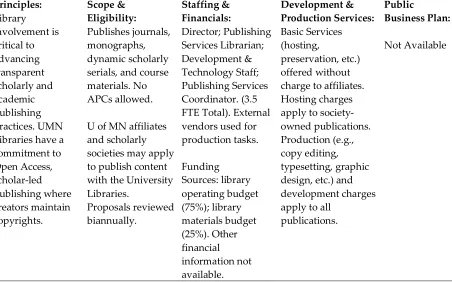
198
Table 2. Three Case Studies of Library Publishing Programs
199
Institution #1: University of Minnesota Libraries – Publishing Services https://www.lib.umn.edu/publishing/about
Operates separately from the University of Minnesota Press which is housed in a different
administrative unit at the institution. Administratively separate from the institutional repository, data repository, & digital humanities.
Principles: Library involvement is critical to advancing transparent scholarly and academic publishing practices. UMN Libraries have a commitment to Open Access, scholar-led publishing where creators maintain copyrights.
Scope & Eligibility: Publishes journals, monographs, dynamic scholarly serials, and course materials. No APCs allowed.
U of MN affiliates and scholarly societies may apply to publish content with the University Libraries.
Proposals reviewed biannually.
Staffing & Financials:
Director; Publishing Services Librarian; Development & Technology Staff; Publishing Services Coordinator. (3.5 FTE Total). External vendors used for production tasks.
Funding Sources: library operating budget (75%); library materials budget (25%). Other financial information not available.
Development & Production Services: Basic Services
(hosting,
preservation, etc.) offered without charge to affiliates. Hosting charges apply to society-owned publications. Production (e.g., copy editing, typesetting, graphic design, etc.) and development charges apply to all
publications.
Public
Business Plan:
Not Available
Institution #2: University of Michigan Libraries – Michigan Publishing Services https://www.publishing.umich.edu/services/
Operates within the same office as the University of Michigan Press. The Press reports up
Principles: MI Publishing Services staff are experts in scholarly publishing and “help increase the visibility, reach, and impact of scholarship.” Emphasis on open access formats that advocate for author rights through new digital publishing models to ensure wider knowledge sharing. Scope & Eligibility: Publishes books, journals, conference proceedings, digital projects, and course materials in print and electronic forms.
Focus: Support for University of Michigan affiliates. Staffing & Financials: Publishing Services Director; Publishing Services Librarian; Publishing Services Coordinators; Community Manager (7 FTE Total). University Press and external vendors are used when needed.
Funding Sources: library operating budget (50%); sales and hosting revenue (30%); charge backs (20%). Other financial information not available. Development & Production Services: Full suite of services offered including: hosting, editing,
typesetting, design, formatting (e.g., pdf, epub, OCR, etc.), digitization, web design, preservation, print on demand,
Charges apply to most services.
Public Business Plan:
Not available.
Institution #3: University of Pittsburgh Library System E-Journal Publishing https://www.library.pitt.edu/e-journals
Operates separately from the University of Pittsburgh Press which is housed in a different administrative unit at the institution.
Principles: Committed to helping research communities share knowledge and ideas through Open Access electronic publishing. They subsidize the costs of electronic publishing so that their “partners can focus on editorial content and scholarly collaboration”. Scope & Eligibility: Publishes Open Access eJournals. APCs allowed but no journals currently charge them.
Focus: Publications that have: rigorous peer-review; an internationally recognized editorial board; a robust staff; and publish selectively from an open call for papers. No U of Pittsburgh affiliation required. Staffing & Financials: Director, Digital Repository Manager, Electronic Publications Manager, Library Specialists (4 FTE)
1 Description of the library publishing program’s principles, scope, eligibility, staffing financials,
200
and services based off of program’s listed website.
201
5. Creating a Business Plan to Library Publishing
202
There has not yet been analysis or work done to define business plans for library publishing
203
programs. This article uses the definition of business plan developed by Collier in 2005, and used in
204
his 2010 edited volume, Business Planning for Digital Libraries: International Approaches:
205
206
Business planning for digital libraries is here defined as the process by which the
207
business aims, products and services of the eventual system are specified,
208
together with how the digital library service will contribute to the overall
209
business and mission of the host organizations. These provide the context and
210
rationale, which is then combined with normal business plan elements such as
211
technical solution, investment, income, expenditure, projected benefits or
212
returns, marketing, risk analysis, management and governance [17].
213
214
The anatomy of a library publishing business plan closely mirrors a template for a traditional,
215
stand-alone business. However, because a library publishing program is nested within a larger
216
organization, the financial section varies based on a university’s budget model (discussed in Section
217
X) and their library’s approach to funding these services. The authors of this paper recommend that
218
libraries first identify the university’s current budget model prior to writing a library publishing
219
business plan.
220
The basic template for a library publishing business plan includes the following sections:
221
I. Principles of Service
222
II. Scope of Service
223
III. Staffing and Governance
224
IV. Development & Production
225
V. Financials
226
VI. Measures of Success
227
It is important to note, that if the institutional context calls for it, additional sections can be added
228
to the business plan to strengthen alignment. This is especially true for libraries that are venturing
229
into library publishing on an experimental basis--and for libraries that are in the process of
230
advocating for the formalization of a publishing program. Useful additional sections for libraries in
231
these positions include a PEST analysis (political, economic, social, technological) and a SWOT
232
analysis (strengths, weaknesses, opportunities, threats). These sections can further illustrate the
233
rationale behind the development of a publishing program [18].
234
The template used in this paper does not include a section on technology. Publishing
235
technologies, specifically open source publishing technologies, are constantly growing in number
236
and functionality. The authors highly recommend conducting a review of available publishing
237
platforms. The Library Publishing Coalition offers members and non-members a number of resources
238
on available technologies. (https://librarypublishing.org/)
239
The finalized business plan should be inclusive and detailed enough that administrators and
240
campus partners can reference the plan and understand the functions and goals of the publishing
241
program. The business plan can also act as a reference when questions arise from clients about the
242
viability and sustainability of a new service. The ability to communicate the structure of and financial
243
commitments of the publishing program is essential to conveying stability, knowledge of process,
244
and boundaries. With the exception of the principles of service, it is expected that the business plan
245
will need additional updates as staffing changes, library priorities shift, and as the program matures
246
and grows.
247
A library publishing business plan is a roadmap for the service. It explains to internal and
249
external partners the details of how the program will travel from point A to point B. Principles of
250
service, in turn, explain to partners why the program is traveling at all. This is the intrinsic lead-in to
251
a library publishing business plan. Principles can touch on themes mentioned earlier in this article,
252
including: transparency, openness, and institutional support.
253
As a department or service offering of the library, library publishing programs inherit
254
established mission statements, goals, and other strategic planning objectives from the library, and
255
in turn the University. Although these objectives may convey the spirit of the service, a library
256
publishing program will benefit from principles of service that are specific to the program.
257
Developing and adopting principles of service will clearly define a library publishing program,
258
communicate the program’s purpose, and create a shared expectation of goals and outcomes.
259
Unlike an annual or strategic plan, principles of service should remain true given the, often
260
unpredictable, ebbs and flows of passing years. Principles of service can be considered the “core” of
261
the program and should not depend on a specific project or specific person. Principles should clear,
262
accessible, and easy to share with clients and partners. Libraries with suites of scholarly
263
communication services can leverage principles of service to help distinguish publishing services
264
from other services offered within the organization. Drafting principles with library colleagues,
265
including perspectives from digital humanities, copyright, and administration, allow for language
266
that works in harmony among other services.
267
5.2 Scope of Service
268
One of the most challenging sections of the business plan, and the section most likely to change
269
as the service is updated, is the scope of service. This section should address specific services that the
270
library publishing program will provide, it could also highlight related services that the program will
271
not provide. (For example, the library publishing program will not manage the inventory of print
272
publications.) Additionally, this section is the section that will likely have the most dependencies
273
with other sections. For established programs, this section will likely be a formal write-up of currently
274
provided services within the program. For newly developed programs, this section should include
275
the services that the program is ready to offer, and exclude services that the program hopes to provide
276
in the future. Generally, this section should address the following questions:
277
What type of publications will be published?
278
Which authors/editors are eligible?
279
What level of service will be provided to each publication?
280
Each of these questions requires a deeper consideration based on selected technologies, availability
281
of staffing/personnel, and cost.
282
The most common types of publications published by library publishing programs are journals,
283
monographs, and textbooks. However, as digital publishing tools grow, and the definition of
284
scholarship broadens, programs may become publishers of increasingly difficult to categorize modes
285
of scholarship. No matter the breadth of publication types, libraries should consider:
286
What technologies will be needed to host and produce each type of publication?
287
Are there other library or campus programs that currently serve the needs of the identified
288
publication type?
289
Will publishing staff be available to assist the editors of publications on an on-going basis
290
(serials) or for only a limited time (monograph)?
291
What is the average cost associated with each type of publication? Are these one-time costs
292
or on-going?
293
Identifying the type of eligible clients for the publishing program will help the library build a
294
customer profile for a marketing base. Even though the program may not be “selling” the final
295
outputs, identifying who the service is for, will help communicate the program’s principles of service
296
to the appropriate audience. In specifying the programs’ eligible clients, libraries should further
297
consider:
298
Does the program have a discipline speciality or focus?
300
Can the program’s selected technology work with affiliates and non-affiliates? Or are there
301
EZproxy or Shibboleth requirements?
302
Can the library and/or university budget cover expenses of non-affiliates?
303
Will the program prioritize the works of different groups? (e.g., faculty, graduate students,
304
undergraduates)
305
Across all the above mentioned points, is the question of what level of service the program will
306
provide. This may be one of the harder questions to answer for a program that is just developing.
307
However, once one publication is published, a program can run a project post-mortem to help
308
identify how the skill sets of the individuals staffing the publishing program was leveraged and how
309
much time went into the publication. Similarly, this question can also be answered throughout the
310
initial publishing technology review--what processes can be automized using the available
311
technology? (e.g. assigning DOIs, creating article metadata, password resets for platform users.)
312
Generally, all of the following points should be considered:
313
What can the technology for each type of publication automize?
314
Do all publication types require the same amount of time and attention from the program
315
staff?
316
What will the editors of each publication be responsible for? What will the publisher be
317
responsible for?
318
How will clients contact the publisher?
319
How will customer service be approached in relation to existing library services?
320
5.3 Staffing
321
Staffing within library publishing programs vary greatly. The 2018 Library Publishing Coalition
322
Directory includes listings for programs with 0.25% of a full-time professional staff, all the way up to
323
16 full-time professional staff. [2]. As noted in the previous section, the availability of staff directly
324
impacts the services that a program can provide. A library can anticipate that this section of the
325
business plan is inseparable to the program’s Scope of Services.
326
Libraries drafting this section of the business plan should also consider where the publishing
327
program is organizationally situated within the library. Since publishing may be a
cross-328
departmental or cross-divisional effort, it is important to clearly describe where the program sits
329
within the organization. Including this description for brand new programs will help colleagues
330
throughout the library understand the reporting structure of the program.
331
Publishing programs need to define roles and responsibilities for each element identified in the
332
Scope of Services. Programs that depend on the labor and/or time of library staff members in other
333
units or departments, can formalize these relationships in the business plan in order to solidify
cross-334
library buy-in. Although each element in the Scope of Services should be addressed in this section,
335
the business plan is not an internal workflow document, so responsibilities may be identified at a
336
general level and individual staff members may be identified by position, rather than name. These
337
responsibilities will likely include:
338
Technology development and support
339
Marketing of services and recruitment of publications
340
Production and development of publications, including additional processes identified in
341
Section IV: Development & Production
342
Assessment, discovery, and promotion of individual publications
343
Long-term strategic planning and goal setting (at publishing program level)
344
In addition to staffing, library publishing programs may find it beneficial to implement a
345
governance structure. Unlike the day-to-day operations of the program, a governance structure can
346
provide recommendations to enhance the quality and future viability of the program. Building in the
347
development of a governance structure can be a way to incorporate disciplinary faculty and other
348
5.4 Development & Production
350
A variety of policies are required in order to make a library publishing program successful and
351
sustainable. Policies guide decision making and can be referred to by administration or clients when
352
questions arise. The need for policies is best summarized in The Handbook of Journal Publishing as
353
policies address “what is to be published, how and why” [19]. Although an individual library
354
publishing program may have policies unique to the program’s goals and needs, there are a handful
355
of policies that are essential to any publishing program.
356
5.4.1 Accepting Publications
357
Whether a publishing program anticipates publishing 1 or 100 publications a year, the program
358
needs to consider how publications will be received by the library publisher. Many publishers use a
359
call for proposals (CFPs) to solicit publications. Using a CFP, even if the respondents are few, enables
360
publishers to advertise their service, while giving guidelines as to what will be accepted. Even for
361
library publishing programs that are experimental, and willing to publishing content with limited
362
traditional publishing options, each program will likely have some limitations--especially involving
363
staffing and technology. For library publishing programs just getting off the ground, and unsure of
364
limitations, consider a CFP with open ended questions, this will enable submitters to describe their
365
project without limiting answers to checkboxes.
366
Once proposals are submitted, each publishing program will need to determine how proposals
367
are accepted or rejected. Again, the library publisher will want to consider which proposals are
368
actually doable based on staffing and technology. There will likely be publications and projects that
369
are just not possible given the program’s available support. For proposals that are viable, each
370
program will need to determine who gets to say “yes” and “no” to publications. This can be done by
371
the staff working in the program, by a committee established by the program, or by library
372
administration.
373
After a proposal is accepted, the library publishing program will need to develop an MOA
374
(memorandum of agreement) or MOU (memorandum of understanding) for each publication. An
375
MOA/MOU will clearly layout the expectations from each party and can include any necessary legal
376
agreements or policies that are relevant to the relationship between publisher and publication. For
377
libraries not familiar with MOA/MOU, consult the institution's office of general council or contract
378
office.
379
5.4.2 Rights
380
Library publishers need clear statements about rights related to each publication. Policies may
381
vary across individual publications, but the publishing program should create policies that address
382
the following:
383
Who does the copyright of a publication belong to?
384
Who does the title of the journal belong to? (Could an editorial board member find a new
385
publisher and move the journal/book series/conference proceeding?
386
How can the content be used? (This question can be addressed by the addition of a Creative
387
Commons license.)
388
How can either party end the business relationship between publisher and publication?
389
Individual publications, especially those with multiple authors, will need to create
publication-390
specific policies to ensure that content within the publication is following copyright and/or licensing
391
policies. As a publisher, it is important to assist editors or editorial boards that are new, or those that
392
have questions related to rights. Set up formal channels of communication and encourage publication
393
editors to reach out for support.
394
5.4.3 Privacy
395
User privacy statements need to be included on each digital publication or digital publication
396
solution, will include a privacy policy. Make sure that staff working on publications understand the
398
privacy policies and are able to communicate the policies to users of the platform. For publications
399
that require registration for readers, authors, or reviewers, make sure that any default privacy
400
statements are correct and that all users are prompted to read the privacy/user agreement before
401
entering any information into the system.
402
5.4.4 Distribution & Marketing Policies
403
Because the majority of library publishers publish content that is openly accessible, publishing
404
programs will need to have unique marketing and distribution tactics not as common among
405
traditional publishers and university presses. Setting distribution and marketing policies will clarify
406
expectations between authors/editors and the publisher. If the publishing program sells print copies
407
of books, will there be a markup fee? Can the author, as the copyright holder, set up their own digital
408
storefront? Even in the world of open access publishing there is a need for policies related to
409
distribution. A library publisher with the staff time and expertise may want to be the party
410
responsible for applying to databases and indexes for each publication. Additionally, the publisher
411
can take the lead on advertising or marketing publications. This may be something that the
412
author/editor does not think of, especially if the publication is available online for free, however, the
413
publisher will want to see a publication attract as many readers as it can. It is never too soon to work
414
with editors/authors to develop a strategy for distribution and marketing, having a policy in place
415
when a potential publication reaches the library publishing program will make any effort much more
416
successful.
417
5.4.5 Preservation Policies
418
Preservation of library published content continues to be an area under investigation. In 2017,
419
the Library Publishing Coalition noted that programs are ..”.making slow but thoughtful progress on
420
digital preservation” [2]. Although libraries continue to improve policies around the preservation of
421
library published content, there are a number of approaches that can be taken to ensure that
422
published works are preserved. Public Knowledge Project (PKP) and bepress, common library
423
publishing platforms, allow users to set up accounts through Global CLOCKSS program (Controlled
424
Lots of Copies Keeps Stuff Safe from Stanford University). Additionally, PKP offers a private
425
preservation network available to platform users who are unable to join the Global CLOCKSS
426
program. Portico is also an option for library publishers, and is the most common journal and ebook
427
preservation tool used by libraries to preserve purchased content. Portico requires membership with
428
fees based on journal or ebook revenue [20].
429
Regardless of whether or not a library publishing program is connected with preservation tools,
430
a library publishing program should develop a clear policy that can address author/editor questions
431
about both short- and long-term preservation. The policy should also address what content is to be
432
preserved. Additionally, programs will want to consider:
433
Will the publishing program preserve all publications?
434
What about publications that cease or move to another publisher?
435
Will a journal’s webpages be preserved, or just PDFs?
436
Will production files be preserved, or just version of record?
437
Preservation will likely be a policy that requires the expertise of librarians beyond the publishing
438
program. It is also a policy that will need updating as technologies and best practices change. Editors
439
and authors want a publisher that will look out for published content for the long term, a successful
440
preservation policy should address this.
441
5.5 Financials
442
Unlike other scholarly communication services, publishing has well-documented, though
443
debated, costs associated with the service. [21]. Libraries are especially sensitive to costs set by
444
in the costs associated with publishing. The development of the financials section of the business plan
446
will need to be done in close consultation with library administration, it is likely that library has
pre-447
developed language and/or templates for communicating costs. The basic financial structure of the
448
program will likely be addressed in earlier sections of the business plan, however, the financials
449
section should address the following questions:
450
How will the service fit into the library’s budget model?
451
How can/will the service leverage the university’s budget model?
452
o Will staffing and core technologies be paid for by the library’s budget or covered by
453
publishing revenue?
454
o Will the service charge fees for any/all services?
455
o How will service rates be calculated?
456
o What expenses will potential revenue cover?
457
Which expenditures are flat versus usage-based?
458
Which pre-existing memberships or technologies will the program use?
459
How will costs, charged directly to clients or covered by the library, be communicated to
460
clients?
461
Like earlier sections, the financials section requires that libraries estimate growth of the program
462
in order to calculate costs. In addition to staffing and core technologies (digital publishing platforms),
463
libraries need to consider expenses that fluctuate based on volume. Some of these costs may be:
464
Identifiers (DOIs, ISSNs, ISBNs)
465
Graphic design for individual publications
466
Material for marketing and promotion
467
Licenses for production tools (InDesign, iThenticate, Overleaf)
468
Memberships for preservation and publishing best practices (Portico, COPE, etc.)
469
Additionally, each individual title should also have a budget assigned to it. The program’s
470
approach to publication level planning should be included in the financials section, this can be done
471
by including a template or spreadsheet that is used to structure the relationship between
472
author/editor and publisher. Being able to express to authors what resources are needed to launch
473
and maintain their publication helps communicate expectations and outlines where they need to
474
partner to provide additional resources for elements or features that are not currently supported by
475
the service.
476
5.6 Measures of Success
477
Given the often experimental nature of library publishing, and the lack of longitudinal studies
478
on library publishing, determining measures of success for a library publishing program can be a
479
challenge. Measures of success will be determined based on each publishing program’s principles of
480
service and the parent institution’s mission and vision.
481
To do this, Publishing programs may find measures of success tied to individual publications
482
and projects. Measures of success for individual publications, especially those available free of cost,
483
and therefore not being measured based on revenue, frequently fall into three general areas:
484
Sustainability: Is the publication able to recruit reviewers, editors, and authors? Is the
485
publication meeting publication-specific goals?
486
Scalability: Is the publication able to respond to increased readership? Are editorial
487
workflows keeping up with an increase in content?
488
Visibility: Is the publication attracting readership? Is the publication being cited? When
489
eligible, is the publication included in disciplinary-appropriate indexes?
490
However, the diversity of library publishing portfolios means that measures of success do not
491
always work when tied to specific publications, especially books and other non-serials, whose content
492
is not likely to grow over time. Measures of success for the overall publishing program “…must also
493
be able to demonstrate that they are fulfilling the traditional roles of scholarly publishers” [19]. Some
494
library publishers have principles of service that may vary drastically from “traditional publishers,”
495
clients. With that in mind, the same measures of success used to evaluate individual publications can
497
be used to measure the success of the overall publishing program:
498
Sustainability: Is selected technology still meeting publication needs? Are publishing staff
499
able to maintain developed workflows?
500
Scalability: Is there a growth in number of publications? Are additional services being added
501
as requested?
502
Visibility: Is there campus awareness of the publishing program?
503
Additionally, staff in library publishing should be aware of other measures of success that are
504
used across library services. If a publishing program has services that include outreach and
505
education, consider meeting with colleagues in library information literacy units to determine
506
appropriate evaluation metrics for publishing services that extend beyond publications. Measures of
507
success is another section of a library publishing business plan that can benefit greatly from vertical
508
alignment with a library’s related services and units.
509
6. Conclusion
510
In response to the variety of issues in scholarly communication, the development of library
511
publishing programs is one way libraries have become active participants in the growing open access
512
publishing landscape. Business plans for library services, especially for scholarly communication
513
services, are not yet commonplace. However, by creating and adopting a business plan for library
514
publishing programs, libraries can formalize a relatively new service within the unique structures of
515
academic libraries. A library publishing business plan will provide a clear understanding of the
516
program’s goals and services, and will provide a path for growth and assessment in the long and
517
short term. It’s development offers the opportunity for the library’s leadership and staff to discuss
518
and create framing principles, which provide a foundation for communicating the goals and purpose
519
of the service. The remaining elements of a robust business plan provide a structure for a program’s
520
operations and clear communication.
521
522
Author Contributions: Conceptualization, X.X. and Y.Y.; Introduction, E.M. and K.M.; Background and
523
Development, K.M.; Anatomy, E.M. and K.M.; Conclusion, K.M.; Writing-Original Draft Preparation, K.M. and
524
E.M.
525
Funding: This research received no external funding
526
Acknowledgments: The authors thank Shann Hamilton for his feedback on Section 3: Institutional Budget
527
Models and Their Impacts.
528
Conflicts of Interest: The authors declare no conflict of interest.
529
References
530
1. Gillman, I. The Evolution of Scholarly Communication Programs. In Library Scholarly Communication
531
Programs - Legal and Ethical Considerations, 1st Edition; Chandros Publishing: Oxford, England, 2013; pp.
532
3-10, ISBN 9781843347170
533
2. Library Publishing Coalition Directory Committee (Ed.). Library Publishing Directory 2018. Library
534
Publishing Coalition: Atlanta, GA, 2018.
535
3. Taylor, L. N.; Keith, B. W.; Dinsmore, C.; Morris-Babb, M. Libraries, Presses, and Publishing, SPEC Kit 357.
536
Association of Research Libraries: Washington DC, 2017.
https://publications.arl.org/Libraries-Presses-537
Publishing-SPEC-Kit-357/
538
4. Hahn, K. L. Research Library Publishing Services. Association of Research Libraries: Washington DC, 2008.
539
5. Marcum, D.; Schoenfeld, R.; Thomas, S. Office of Scholarly Communication Scope, Organizational
540
Placement, and Planning in Ten Research Libraries. Ithaka S+R: New York, NY, 2015.
541
6. Collister, L. B.; Deliyannides, T. S.; Dyas-Correia, S. The Library as Publisher. Serials Librarian 2014 66, 20–
542
29. https://doi.org/10.1080/0361526X.2014.879524.
543
7. Michael Jubb, M.; Plume, A.; Oeben, S.; Brammer, L.; Johnson, R.; Bütün, C.; Pinfield, S. Monitoring the
544
https://www.universitiesuk.ac.uk/policy-and-analysis/reports/Pages/monitoring-transition-open-access-546
2017.aspx
547
8. Ghamandi, D.S. Liberation through Cooperation: How Library Publishing Can Save Scholarly Journals
548
from Neoliberalism. Journal of Librarianship and Scholarly Communication 2018 6(2),
549
http://doi.org/10.7710/2162-3309.2223.
550
9. Watkinson, C. Three Challenges of Pubrarianship. Against the Grain 2015, 26, 22–23,
551
http://hdl.handle.net/2027.42/110771.
552
10. Mullins, J. L.; Murray-Rust, C.; Ogburn, J. L.; Crow, R.; Ivins, O.; Mower, A.; Nesdill, D.; Newton, M. P.;
553
Speer, J.; Watkinson, C. Library Publishing Services: Strategies for Success: Final Research Report. SPARC:
554
Washington, DC, 2012.
555
11. Collier, M. Business Planning for Digital Libraries. In Business Planning for Digital Libraries: International
556
Approaches, Collier, M., Ed.; Leuven University Press: Leuven, Belgium, 2010; pp. 13-22, ISBN
557
9789058678379
558
12. Barr, M.; McClellan, G. Budgets and Financial Management in Higher Education Margaret. 1st Edition; John
559
Wiley & Sons: San Francisco, California, 2018; pp. 72-74.
560
13. ALA Council. Core Values of Librarianship. Available online:
561
http://www.ala.org/advocacy/intfreedom/corevalues (accessed on 20 July 2018).
562
14. Quinn, L.; Innerd, C. The Evolution(s) of Wilfrid Laurier University Press: Toward Library-University Press
563
Integration. Journal of Scholarly Publishing 2018, 49, 153–165, https://doi.org/10.3138/jsp.49.2.153.
564
15. McIntyre, G.; Chan, J.; Gross, J. Library as Scholarly Publishing Partner: Keys to Success. Journal of
565
Librarianship and Scholarly Communication 2013 2, 1-12, https://doi.org/10.7710/2162-3309.1091.
566
16. Stone, G. Sustaining the growth of library scholarly publishing in a New University Press. Information
567
Services & Use 2016, 36, 147–158, https://doi.org/10.3233/ISU-160812.
568
17. Collier, M. The business aims of eight national libraries in digital library co-operation: A study carried out
569
for the business plan of The European Library (TEL) project. Journal of Documentation 2005 61, 602–622.
570
https://doi.org/10.1108/00220410510625822.
571
18. Saarti, J.; Tuominen, K. From paper-based towards post-digital scholarly publishing: an analysis of an
572
ideological dilemma and its consequences. Information Research 2017, 22, 1–15,
573
http://InformationR.net/ir/22-3/paper769.html.
574
19. Koerbin, P. Issues in business planning for archival collections of web materials. In Business Planning for
575
Digital Libraries: International Approaches, Collier, M., Ed.; Leuven University Press: Leuven, Belgium,
576
2010; pp. 101-111, ISBN 9789058678379
577
20. Morris, S.; Barnas, E.; LaFrenier, D.; Reich, M. Managing Journals. In The Handbook of Journal Publishing,
578
Morris, S., Barnas, E., LaFrenier, D., Reich, M; Cambridge University Press: Cambridge, UK, 2013; pp.
28-579
31, ISBN: 9781107653603.
580
21. Van Noorden, R. The true cost of science publishing. Science 2013, 495, pp. 426-429,
581
https://www.nature.com/news/open-access-the-true-cost-of-science-publishing-1.12676