3054
English Students’ Perceptions of Using WhatsApp
in Paragraph Writing Class
Zidni Ma’ruf, Nurul Fadilah, Pegiawan Basofi, AkmalAbstract: This research aims to investigate English students’ perceptions of using WhatsApp in paragraph writing class in one public university. Paragraph writing class is a part of language disciplines which may get some benefits from the usage of SNS. This qualitative research with a case study approach explores the perceptions of English students on the benefits and limitations of using WhatsApp during their learning activities. There were six participants in this research that the researcher got through purposive sampling; two students who got high, average, and low score of pre-test. The data were collected through questionnaire and interview. The data were analyzed in three major themes; 1. General background of the participants using WhatsApp, 2. Benefits of WhatsApp in paragraph writing class, and 3. Limitations of WhatsApp in paragraph writing class. The findings of the current research indicate that there were positive perceptions of the students in using WhatsApp in paragraph writing class to enhance teaching and learning process in the 21st century such as: 1. Offering peer review, 2. Independence from time and location, 3. Perceived progress of vocabulary, and 4. Grammatical improvement. However, there were two limitations emerged which are: 1. Unstable internet connection, and 2. Costly to use. Moreover, suggestions and pedagogy recommendations are offered to all related parties such as: 1. Lecturers, 2. Policymakers of higher education, 3. Higher education students, and other stakeholders.
Index Terms: English Students, Perception, WhatsApp, Paragraph Writing Class.
—————————— ——————————
1 INTRODUCTION
hatsApp is part of social networking services which is free for everyone to use plays an important role in our life these days [1]. Nowadays, WhatsApp has become very popular and has been used by many people in the world. Social networking service is mobile-based applications which design to facilitate world citizen to communicate, collaborate, and share things. Due to the popularity of SNS among university students in higher education, some lecturers have implemented those technologies in their classroom. Muhammed [2] has shown that 99% of his participants in his study considered the use of mobile phones for learning English language are so effective. In addition, Mondahl and Razmita [3] informed that language learning can be mediated by the use of SNS. The implementation of SNS in the classroom has brought some learning advantages such as reduce level of anxiety, increase the efficiency and mastery of task, contribute to making the score higher, and improve social interactions [4], [1]. SNS itself has been implemented for recent years by lecturers in writing classroom [5]. In paragraph writing class, peer review is one of important activities. To develop collaborative learning skills, sense of reader awareness, and improve the quality of writing, classroom peer review is really beneficial for English learners [6]. Yet, classroom peer review seems to have several issues for the students such as feeling of embarrassment and fear [7].Regarding these issues, Wu et al. [7], and Saeed & Ghazali [8] stated that technology may contribute to make peer review is at ease compared to face to face. In short, learners’ peer review on writing can be promoted through the use of social networking services. Thus, English learners may use social networking service to maximized peer review outside their classroom [9]. Even though there are so many benefits regarding the use of SNS in language learning, Wang, Woo, Quek, Yang, & Liu [10] stated that not all of the students are likely mixing their social lives with learning. Further, Hadiyanto et al. [11] indicated that technology application and other devices are mostly used on the basis of personal communication rather than learning activities by students and teachers. In addition, research about students’ perceptions on the limitations and benefits of using social networking services is comparatively rare in Indonesia. Furthermore, Kuo, Walker, Schroder, & Belland [12] stated that many researches that have been conducted about SNS focus on the forms of interactions, rather than users’ perceptions. To see the sustainability and to establish the future implementation of SNS, students’ perceptions are important to be known since Hamid, Kurnia, Waycott, and Chang [1] argued that technologies integration in education should be done by the lecturers only if they see educational values on it. Thus, this research aimed to examine English students’ perceptions on the limitations and benefits of using SNS in paragraph writing class in English teacher education program at a public university. The networking type included in this research is Whatsapp. To achieve the purpose of this study, one major research question is: what are the perceptions of second-semester students of English education study program of using WhatsApp in a paragraph writing class?
————————————————
Zidni Ma’ruf is currently pursuing master degree program in English Education in Ahmad Dahlan University, Indonesia. E-mail:
Nurul Fadilah is currently pursuing master degree program in English Education in Ahmad Dahlan University, Indonesia. E-mail:
Pegiawan Basofi is currently pursuing master degree program in English Education in Ahmad Dahlan University, Indonesia. E-mail:
Akmal is currently a lecturer and a chairman of English Education in Ahmad Dahlan University, Indonesia. E-mail: [email protected]
3055
2 LITERATURE REVIEW
2.1 Social Networking Services
Social networking services are mobile-based applications which design to facilitate world citizen to communicate, collaborate, and share things. Further, Lowedahl [13] stated that SNS can be implemented in education through SNS educational activities. Some educational activities that could be done in SNS according to Pursel & Xie [4] are content sharing, interacting, and collaborating. Social networking services are able to provide the users to be more flexible in the teaching and learning process, public publication, re-utilizing of study content, and to provide the sharing of ideas. Those benefits are some of the reasons that made much higher education implement them in teaching and learning activities [5].
2.2 Benefits and Limitations of Using WhatsApp for Language Learning
In educational purposes, SNS can be appropriately utilized. Pursel & Xie [4] has shown that social networks give contribution to higher the score, increase the efficiency, and mastery of task. Furthermore, Balci [14] states that there are several possible benefits of using social networking in education as follows; 1). Independence from time and location, 2). Quality improvement and educational efficiency, 3). Learn more systematically, 4). Self-learning, 5). Ability to get instant feedback, 6). Offer students the ability to repeat the lesson, 7). Ease of displaying content, 8). Allow design of visual and auditory learning environments, 9). Archive synchronized course content, 10). More voluntary behavior trends 11). Offering the possibility to evaluate students’ performance, 12). Minimizing the risk of errors in measuring evaluation, and 13). Increasing skill to achieve, evaluate, use, and cite knowledge efficiently by students and teachers. The integration of SNS in language learning also contributes to some specific benefits for language learning. According to Stevenson & Liu [15], Mills [16] there are at least five benefits gained through the use of SNS in language learning such as: 1). Vocabulary acquisition, 2). Increasing the confidence to use the target language, 3.) Creating an interactive community for discussion, 4). Increasing oral proficiency, and 5). Improving grammar. However, there are still some limitations when lecturers integrate SNS in teaching and learning activities such as: 1). Time management issues, 2). Lack ICT skills, 3). limited technical infrastructure in some higher learning institutions [17].
2.3 The Use of WhatsApp in Paragraph Writing Class Paragraph writing class is a part of language disciplines which may get some benefits from the usage of SNS [18]. Through the use of SNS, students may express themselves freely in an interesting learning environment. In addition, SNS also gives an opportunity to the students to write for their lecturer and other students which will make them to actively involved in teaching and learning activities. Further, through the use of SNS, lecturers may have opportunity to teach outside the classroom since social networking services provide the users to interact everywhere. Thus, this application would create a
certain community for the students and teachers to communicate with each other. Habibi [5] has proved that the use of social networks in teaching writing has strengthened students’ ability and motivation. Thus, this research aimed to know the perceptions of the students on the benefits and limitations of using WhatsApp in paragraph writing class. Andrej Demuth [19] states that the basics of the perception process are physical stimuli that we face in the environment (recognizing, regulating, and interpreting sensory information). In short, perception is the process of interpreting the world.
2.4 Previous Research
The research related to the use of social networks in educational purposes has drawn interest among the experts over the years. Elham, Wafa & Ali [20] conduct research entitled ―Adoption of Social Networking in Education: A Study of the Use of Social Networks by Higher Education Students in Oman.‖ There were a total of 106 students, of which 56% were female, and 44% were male. The aim of the research is to explore the need to change the traditional style of teaching and learning. For the technique of data collection, the researcher used a questionnaire. The results showed that most of the students (63%) state that the traditional style of teaching does not attract them because it is a poor, obsolete way of presenting course material. Helen, Charles & Jennifer [21] also conduct a research entitled ―Use of Social Networking Sites among the Undergraduate Students of the University Nigeria, Nsukka.‖ This research was conducted to investigate the use of social networking sites among undergraduate students from the Nigerian University of Nsukka using a self-constructed questionnaire. One hundred fifty undergraduate students participated in the study on a volunteer basis. The results of this research reveal that most students use social networking sites in interactions with friends, connect with their classmates to study online, and to discuss severe national problems, and each other. Another research conducted by Marzulina et.al [22] entitled ―The Integration of Social Networking Services in Higher Education: Benefits and Barriers in Teaching English‖. This mixed-method study using a survey and interview data collection focuses on the lecturers’ perspectives in educational purposes. 239 EFL lecturers participated in this research and found so many benefits rather than limitation in using SNS in the classroom. These studies have provided valuable information on the use of SNS in education, but they were only limited to specific time and subject and not explain deeper perspective of the students. Therefore, by conducting a qualitative with case study approach, the researcher hopes this research can explain deeper understanding in students’ perception of using WhatsApp in paragraph writing class.
3
R
ESEARCHM
ETHOD3.1 Research Design
3056 Case study approach was chosen in this research because not
all of English lecturers use WhatsApp to support their teaching and learning activities in paragraph writing class. One of the four-paragraph writing classes was selected in this research. There were six participants in this research that the researcher got through purposive sampling; two students who got high, average, and low score of pre-test as the sample. The purposive sampling was used to get equitable perceptions among students who have a good, middle, and low ability in a paragraph writing class in order to be able to represent all the population in this research.
3.2 Research Instruments
The research instruments that were used to accomplish the research purpose were demographic questionnaire and interview. The researcher adapted both the demographic questionnaire and interview questions from previous research related to the students’ perceptions towards the use of SNS. A demographic questionnaire was designed to help the researcher to determine what factors may influence a respondent’s answers, while the interview was designed as the primary sources to gather all information needed by the researcher to answer the research question. This research used a semi-structured interview in order to get in-depth data or idea from the participants.
3.3 Data Analysis
The analysis was done in order to answer the purpose of this research in describing English students’ perceptions regarding the use of WhatsApp in paragraph writing class. The data were analyzed with the following steps: 1). All of interview data were transcribed, 2). The transcripts than printed and translated, 3). The transcripts were read carefully several times, 4). The transcripts then coded and divided into themes to be presented.
4
R
ESULT AND DISCUSSION4.1 General Background of Participants
Six participants in this research are Rose, Bella, Salsa, Jack, Ira, and Tulip. The names are pseudonyms in order to respect the participants’ privacy. These six participants were chosen using purposive sampling based on their pre-test score in order to be
able to represent all the population.
From the table above, we can see that Rose and Bella represent
the high achiever students who got 85-80 of pre-test score, Salsa and Jack represent the medium achiever students who got 75 of pre-test score, and Ira and Tulip represent the low achiever students who got 60 of pre-test score. Further, all the participants stated that they are very familiar with many kinds of social networking services such as WhatsApp and have used it for years. In addition, they also stated that they spend 5-7 hours using it in a day.
4.2 Benefits of WhatsApp in Paragraph Writing Class The current research has found some benefits regarding the use of WhatsApp in paragraph writing class through interview which are offering possibility of peer review, independence from time and location, perceived progress in vocabulary, and grammatical improvement.
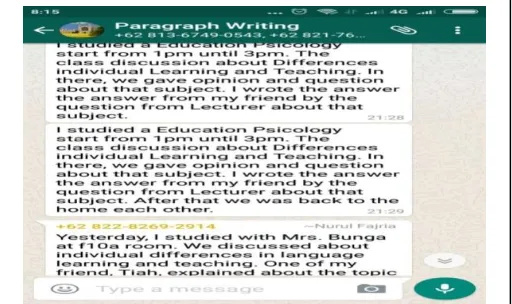
Figure 1: Example of WhatsApp used in paragraph writing.
4.2.1 Offering Possibility of Peer Review
The first benefit which stated by the participants regarding to the integration of WhatsApp in paragraph writing class used by their lecturer is offering possibility of peer review. This data are consistent with the eleventh benefit, offering possibility to evaluate students’ performance, which stated by Balci [14] when teacher or lecturer using SNS in education. In paragraph writing class, peer review is one of important activities. Peer review refers to the sharing of information about the paragraphs they have written to support learning activities. The analysis found when WhatsApp was used, the students may share knowledge with each other freely. Peer review is a writing activity which demands the students to read and to give some comments, suggestions, and corrections to their friends’ paragraphs. The students may give any comments, suggestions as well as corrections freely if they found any mistakes made by their friends such as grammatical errors, punctuations, contents, and etc. WhatsApp provides the paragraphs not only can be seen by the lecturer, but also by all of the students in the classroom. Regarding to this, everyone (lecturer-students) may have the same chance to give comments, suggestions, and corrections to the students. The participants realized that this activity is really helpful in improving the quality of their writing in order not to make the same mistakes in the next assignment.
TABLE1:
3057 “Through the use of WhatsApp, not only my lecturer, but also all my
friends can see my paragraph. If I do some mistakes, my lecturer, as well as my friends, can give their feedback. And it makes my paragraph is better”. (Jack)
“With the help of my lecturer and friends through their corrections in WhatsApp, I think my paragraph is getting better so that I will not make the same mistakes anymore”. (Rose)
Almost all of the participants agreed that the corrections and comments given by their lecturer and friends to their paragraphs through WhatsApp benefit them to improve the quality of their writing in order to write a better paragraph. All the participants believed that each of them has different strengths and weaknesses in some aspects such as vocabulary, grammar as well as ideas in writing a paragraph. Through peer review that was done by their lecturer and friends in WhatsApp, they can share their ideas so that they may have some new insights for future assignments.
4.2.2 Independence from Time and Location
The second benefit emerged in this research from the interview is independence of time and location. Through the use of WhatsApp, the participants are not needed to submit their assignments directly in their university. This data is consistent with the first benefit stated by Balci [14] which is independence from time and location. In short, WhatsApp makes the participants free of doing the assignments everywhere. Bella, one of the participants, stated that she prefers doing the assignments of paragraph writing in WhatsApp. She stated that it is because it makes her easier to send the assignments everywhere.
“Basically, for paragraph writing, the students need to write in a piece of paper, but I prefer to write it in WhatsApp because it makes me able to do it everywhere with my phone”. (Bella)
Furthermore, Salsa, strengthen her opinion by stated that she is so glad to use WhatsApp in paragraph writing class. WhatsApp makes her able to do and submits the assignments everywhere. She added that in the conventional ways of learning, the students should give the assignments directly before the due date which implied that she and her friends have to go directly to the university to meet the lecturer. However, with the help of WhatsApp, she is able to send the assignments without going to university anymore.
“WhatsApp makes me easier to submit the assignment which allows me not needs to go to campus directly”. (Salsa)
In addition, her friend, Rose, believed that through social networking service, she enjoys learning more because she believed that WhatsApp is something new to use in education. She emphasized that university students in these days are very welcome to such learning media in Smartphone such as by using WhatsApp. For her, it makes her easy to go everywhere because she always goes with her smartphone, so it increases the effectiveness of the learning process.
“In my opinion, it is very effective because besides helping university students to have more enjoyment in learning because the system that is used by other lecturers still conventional ways, but this lecturer of paragraph writing use new way which is fresh so we can easy to go to use our smartphone” (Rose)
4.2.3 Perceived Progress of Vocabulary
Perceived progress in vocabulary is another benefit that emerged from using WhatsApp in paragraph writing class. This benefit is stated by Stevenson & Liu [15] and Mills [16] about vocabulary acquisition. This data shows that the theory is consistent with the findings in this research. Two of the participants, Ira and Tulip, realized that when using WhatsApp, their vocabulary becomes richer.
“Because we have a group in social networking service which members are all of the class, so we can add vocabularies and can be a reference to write the next assignments” (Ira)
“Because all of my friends also write their paragraphs in WhatsApp so that we can see their paragraphs and we also understand and looking for new sentences and see new vocabularies” (Tulip)
The data showed that the participants realized that each student has different kind of vocabularies. Through the use of WhatsApp, there are able to see their friends’ paragraphs as well as the vocabularies and make their vocabularies richer. They believed that the paragraphs are interesting to read if they have a lot of vocabulary choices.
4.2.4 Grammatical Improvement
The last benefit claimed by the participants when using WhatsApp for language learning in paragraph writing classes is grammatical improvement. This benefit is in line with the last benefits stated by Stevenson & Liu [15] and Mills [16] which is grammatical improvement. The participants believed that their paragraphs are better in term of grammar because many of their friends in peer reviews focus on grammatical errors. One of the participants, Ira, stated that the most significant improvement that she got most likely in term of grammar.
“I think my grammar is getting better through the peer review from my friend. That is the most significant improvement that I got”. (Ira)
Coming from different high schools, one of the participants realized that they do not have the same experience in learning English that makes their ability is not at the same level. Through WhatsApp, she believed that sharing knowledge such as vocabulary, grammar, and others becomes easier. Through the use of WhatsApp in paragraph writing class, the students may create discussions among the students.
3058
4.3 Limitation of WhatsApp in Paragraph Writing Class Although there are a lot of benefits through the use of WhatsApp in paragraph writing class, there are still some limitations in using SNS in education. The findings of current research found two major problems faced by the students in using WhatsApp in paragraph writing class which are internet connection and costly to use.
4.3.1 Internet Connection
It is no doubt that all the participants agreed that they faced the same problem; internet connection. Internet connection is an important factor in order to use any kind of social networking service. It is challenging for the participants to have a good connection in their university especially in Faculty of Teacher Training and Education.
“The only limitation that I face is the connection in this faculty. It is difficult for me to have a good signal”. (Bella)
This data is in line with Hamid, Kurnia, Waycott, and Chang [17] about the limitations of technical infrastructure in several higher institutions. Having the same problem with Bella, Salsa also stated that the main problem in using WhatsApp in paragraph writing class is the connection.
“The problem that I face is about the signal. This faculty does not have a good signal for my operator”. (Salsa)
The data showed that all participants agreed that they were having the same difficulties with the internet connection in their university and this problem also relates to another problem which is costly to use.
4.3.2 Costly to Use
The data of the research emerge another limitation stated by the participants. The participants agreed that they have to prepare a good-expensive operator which only used for paragraph writing class purposes such as doing and sending assignments. Most of the participants admitted that they are used to buying the cheap operators for daily internet purposes namely 3 and XL (low-cost operator). As a result, sometimes the participants were having the problem with the connection which makes them unable to do the assignments in some places due to bad connection. Regarding this problem, the participants have to use a better operator to make them able to writes and send the assignments everywhere.
“I will buy another operator card which specifically used for paragraph writing which makes me be able to connect me in this faculty”. (Bella)
The findings of the current investigation indicate that most of the students perceived numerous benefits related to the use of WhatsApp which is part of social networking services in language learning, especially in paragraph writing class. Some benefits stated by Balci [14], Stevenson & Liu [15], and Mills
[16] are in line with the findings of this research. Those benefits are: 1). Independence from time and location, 2). Vocabulary acquisition, 3). Offering the possibility to evaluate students’ performance, 4). Improving the grammar, 5). Quality improvement and educational efficiency, and 6). Creating an interactive community for discussion. Besides, all the participants reported that they have an account with WhatsApp long before their lecturer use it in their class. The results of the current research also provide the evidence that social networking services can give some educational values when it was used in educational environment in higher education. Even though most of the findings showed positive perceptions among the participants, some limitations were still faced by them in using WhatsApp in paragraph writing class. There are at least two out of three limitations which stated by Hamid, Kurni, Waycott, and Change [17] emerged in this research. Those two limitations are: 1). Technical infrastructure (internet connection), and 2). Costly to use. In regard to those problems, the participants have to prepare a good operator which used for paragraph writing class purposes only. However, those limitations can be solved by the participants. Furthermore, the findings of current research showed that the students are welcome to such learning media in their smartphone by using WhatsApp in language learning, especially in paragraph writing class.
5 CONCLUSION
A detailed explanation of students’ perceptions through the use of WhatsApp in paragraph writing class in higher education has shown in the findings. The current research showed that the participants are familiar with many kinds of social networking services and are actively used those social networking services which not limited to WhatsApp only. Thus, the findings indicate that those social networking services potentially provide significant benefits for the students in higher education. Furthermore, all of the participants agreed that WhatsApp can be implemented to support their learning activities in language learning, especially in paragraph writing class. Based on these findings, the popularity of social networking services should be well-utilized by educators to use WhatsApp or other social networking services as one of their teaching and learning media. However, it should be noted that some courses which required special setting do not support the integration of networking services as additional learning media. Finally, the findings of the current research could help educational practitioners to make decisions on whether to use and implement WhatsApp or other social networking services as one of the teaching media in their teaching and learning process.
ACKNOWLEDGMENT
3059
R
EFERENCES[1] Hamid, S., Kurnia, S., Waycott, J., & Chang, S. (2015). Understanding students' perceptions of the advantages of online social networking use for teaching and learning. Internet and Higher Education, 26, 1–9.
[2] Muhammed, A. (2014). The impact of mobiles on language learning on the part of english foreign language (EFL) university students. Procedia – Social and Behavioral Sciences 136 ( 2014 ) 104 – 108.
[3] Mondahl, M., & Razmerita, L. (2014). Social media, collaboration, and social learning – a case study of foreign language learning.
Electronic Journal of E-Learning, 12(4), 339-352.
[4] Pursel, B.K., & Xie, H. (2014). Patterns and pedagogy: Exploring student blog use in higher education. Contemporary Educational Technology, 5(2), 96–109.
[5] Habibi, A. (2015). Utilizing a Facebook group in teaching writing in higher intermediate classes. LIA Research Journal, 8(1), 204-211. [6] Hanjani, A. M., & Li, L. (2014). Exploring L2 writers’ collaborative revision interactions and their writing performance. System, 44,
101-114. Retrieved from
https://doi.org/10.1016/j.system.2014.03.004
[7] Wu, W. C. V., Petit, E., & Chen, C. H. (2015). EFL writing revision with blind expert and peer feedback using a CMC open forum.
Computer Assisted Language Learning, 28(1), 58-80. Retrieved from https://doi.org/10.1080/09588221.2014.937442
[8] Saeed, M. A., & Ghazali, K. (2017). Asynchronous group review of EFL writing: Interactions and text revisions. Language Learning & Technology, 21(2), 200-226.
[9] Chen, T. (2016). Technology-supported peer feedback in ESL/EFL writing classes: A research synthesis. Computer Assisted Language Learning, 29(2), 365-397. Retrieved from https://doi.org/10.1080/09588221.2014.960942
[10] Wang, Q., Woo, H.L., Quek, C.L., Yang, Y., & Liu, M. (2012). Using the Facebook group as a learning management system: An exploratory study. British Journal of Educational Technology, 43(3), 428–438.
[11] Hadiyanto, Mukminin, A., Arif, N., Fajaryani, N., Failasofah, & Habibi, A. (2017). In search of quality student teachers in a digital era: Reframing the practices of soft skills in teacher education. The Turkish Online Journal of Educational Technology, 16(3), 71-78.
[12] Kuo, Y. C., Walker, A.E., Schroder, K.E.E., & Belland, B.R. (2014). Interaction, internet self-efficacy, and self-regulated learning as predictors of student satisfaction in online education courses. The Internet and Higher Education, 20, 35-50.
[13] Lowedahl, J.M. (2011). Hype cycle for higher education 2011. Gartner research report Retrieved from http://www85.homepage.villanova.edu/timothy.ay/DIT2160/BY
OD/hype_cycle_for_education_201_214466.pdf).
[14] Balci, B. (2010). E-ogrenme sistemindeki basari faktorleri. In U. Demiray, G. Yamamoto, M. Kesim. (Eds.). Turkiye’de e-ogrenme: Gelismeler ve uygulamalar. [E- learning in Turkey: Developments and applications]. Ankara: Cem Web Ofset.
[15] Stevenson, M., & Liu, M. (2010). Learning a language with Web 2.0: Exploring the use of social networking features of foreign language learning websites. CALICO Journal, 7, 233-259. Retrieved from
https://www.calico.org/memberBrowse.php?action=article&id=7 91
[16] Mills, N. (2011). Situated learning through social networking communities: The development of joint enterprise, mutual engagement, and a shared repertoire. CALICO, 28(2), 345-368. [17] Hamid, S., Kurnia, S., Waycott, J., & Chang, S. (2011). Exploring
Malaysian students' perspectives of Online Social Networking (OSN) use for higher education. Paper presented at the 22nd Annual Conference ISANA International Education Association
(ISANA) 2011, Hobart, Tasmania.
[18] Hemmi, A., Bayne, S., & Land, R. (2009). The appropriation and repurposing of social technologies in higher education. Journal of Computer Assisted Learning, 25 (1), 19–30.
[19] Demuth, A. (2013). Perception theories. Innovative Forms of Education in Transforming University Education. The University of Trnava.
[20] Elham, M., Wafa, S., & Ali, H. (2014). The Adoption Of Social Networking In Education: A Study Of The Use Of Social Networks By Higher Education Students In Oman. Journal of International Education Research – Second Quarter.
[21] Helen, D., Charles, O., & Jennifer, N. (2014). The Use of Social Networking Sites among the Undergraduate Students of the University of Nigeria, Nsukka. Library Philosophy and Practice (e-journal).