Customer Attitude towards Payback Card-A Study with Special Reference to Select City Dr. K. Balasubramanian. MBA, PhD
Associate Professor, Department of Business Management,
Villa Marie PG College for Women, Somajiguda, Hyderabad, TS - 500 082, INDIA
Abstract
In todays’ environment where marketers are facing cut-throat competition, in order to tackle such situation marketers are showing interest in customer loyalty programs as consumer retention strategy. Loyalty programs have turn out to be one of the most serious means by which companies are able to manage their relationships with customers. Customer loyalty is among one of the chief objectives of the marketing determinations. In this study payback card has been selected to conduct the study of customer attitude. An attempt has been made to study the customer attitude towards Payback Indiacard is a multi-brand loyalty program in India which have leading partners with outlets. The study has been conducted through survey method with a list of questionnaires over 50 sample size in Hyderabad city of Telangana State, India. The study reveals that most of the consumers are not worrying about the points and does not show any interest in using redemption of payback points.
Key words: Customer Attitude, Customer Loyalty, Payback Membership Card, Payback Reward Program
Introduction
Customer loyalty programs are usually watched as long-standing accomplishments where consumers can accumulate their points which can later be redeemed for free merchandise, services, or discounts applied to future purchases. The more value that earned merchandise or services has for customers, the more attractive the program and the more likely customers will participate (Liu & Yang, 2009). The commercial goal of a customer loyalty program is to retain customers and originate more returns from them in the future, eventually increasing the profit of the firm (Noone& Mount, 2008). Many loyalty programs have shown some success in raising attitudinal loyalty as well as behavioural loyalty (Daams, Gelderman&Schijns, 2008).
Todays’ modern technology such as POS (point-of-sale) systems in retail outlets, customer databases with purchasing history and contact information, and company websites that deliver sales or service backing have all prolonged options to device and maintain customer loyalty programs. The technology also enables merchants plus financial service enterprises to develop customized offerings to entice a wider variety of customers (Angrisani, 2008; Gallagher, 2008; Gillen, 2008).
Even though customer loyalty programs look as if to be offered by companies everywhere, constructing an effective program necessitates considerable effort and can be expensive. Furthermore, not all the loyalty programs have been prosperous or cost effective. To regulate if a company is succeeding a respectable return on investment from a customer loyalty program entails continuous monitoring and analysis. When results are not adequate it is time to review what types of programs are attractive to customers and to revamp a program to meet changing customer expectations and desires.
effective tool to relationship building. The primary objective of this study is to investigate the customer attitude towards Payback card loyalty program and their perception towards it.
In this study Payback card has been taken as it the largest multi brand loyalty program in India which have multiple partners. It allows customers to earn points from over 50 in store and online partners with just a single card.
Literature Review
Adams (2008) Companies can increase sales volume by getting existing customers to buy more often and to buy greater quantities or by attracting new customers Several factors can affect both sales strategies, including the type of product, economic conditions, and the perceived or actual need for a product
Pringle & Field (2009)A well-designed customer loyalty program can contribute to repeat purchases by existing customers, help attract new customers, and influence the perceived need for and value of product.
Nunes&Dreze, (2006) However, designing an effective customer loyalty program requires a realistic and accurate definition of what a company wants to gain from the program. Without clear business goals it is difficult, if not impossible, to design an effective customer loyalty program and develop appropriate business systems to support the program. The business systems need to be capable of aiding in analyses to determine whether the program is effective and if it provides a favourable return on investment
Levitt (2004)A loyalty program is not a replacement for good service, ongoing positive customer relations, or failure to deliver upon promises or warranties In many ways management perspectives need to be seriously retooled. The principle that a business is customer-satisfaction oriented as opposed to goods-production oriented is one that all managers must grasp. In other words, a business is its customers not its products
Hallberg (2004) It is also important to have a real-world understanding of a company's customers as well as a company's competitors. The design of an effective customer loyalty program will largely depend on how easy a product or service can be replicated by a competitor and how important price and customer service are to the buyer. In addition, company reputation and the status that customers gain from being a buyer or user of services offered can have a significant impact on creating emotional loyalty. An emotional attachment to a company or brand can drive behavioral loyalty and the higher the level of emotional loyalty the more likely a customer will be retained and repeat buying will continue
also have a consistent and frequent message that convinces the customer to view their relationship with the seller as a long-term relationship and that reinforces the point that a long series of purchases will reap a worthwhile reward. But relationship building cannot be left up solely to the customer. Company staff should also be trained into the perspective that every transaction with a customer can build loyalty.
Getting a Loyalty Program off the Ground
Woodward (2009)When loyalty programs have a strong technology element it is also possible to collect data on customers and design individualized marketing efforts. Such a closed-loop loyalty system enables a seller or service provider to access a database of customers in the loyalty program in order to implement targeted marketing programs. Vendor supported loyalty programs, of course, come with joining fees starting at about $300 and monthly fees at about $600.
Many large companies also offer co-branded credit cards through various banks. These programs usually provide some sort of point accumulation that can be redeemed for a product or service. United Airlines, for example, offers a credit card that provides one point for every dollar spent using the card and the points can be redeemed for airline tickets. Amazon also introduced a co-branded credit card that provides points for dollars spent with the card and the points can be used towards purchases from Amazon.com. The co-branded card comes with considerable expense to implement and to promote for a business. If the potential volume is not readily apparent, then the approach may not meet an organization's needs.
Fowler (2003)If a company decides to build its own loyalty program, or even if it chooses to contract with a loyalty program vendor, there are several principles to keep in mind during the process. Above all, a customer loyalty program should be built on the same business values, management beliefs and attitudes, and the basic business benefits that a company provides its customers.
Cebrzynski (2006)It is also beneficial if a loyalty program is simple and straightforward so customers can understand and relate to the reward benefits as well as be able to reap those rewards without excessive time and effort.
Objectives of the study
To know the customer attitude towards Payback loyalty card To know the customer perception towards loyalty scheme
Scope of the study
The study has a broader scope in understanding the customer attitude and perception towards Payback card loyalty scheme which is one of the leading loyalty programs with high number of loyalty partners in India and also understanding customer attitude towards loyalty schemewhich is one of the on-going customer retention strategies by most of the companies.
Research Methodology Research design
This studyis Quantitative research study (survey method) has been conducted through a list of questionnaire after screening the eligibility of the participants.The data has been analysed with SPSS 20 and MS Excel.
The sample of 50 respondents who are using Payback card since one year has been taken for survey on random basis sampling technique. The study has been carried out at two major store partners of Payback like Brand Factory and Hyderabad Central in Hyderabad city of Telangana State, India.
Data Analysis
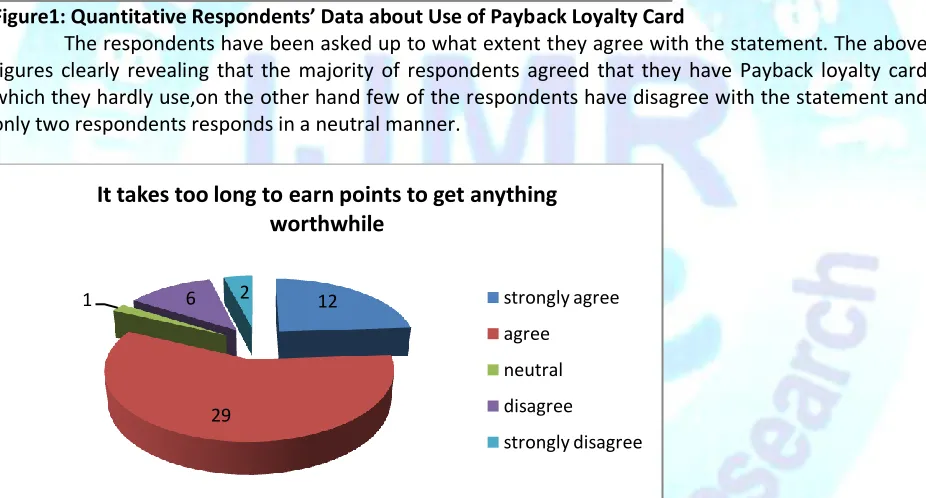
Figure1: Quantitative Respondents’ Data about Use of Payback Loyalty Card
The respondents have been asked up to what extent they agree with the statement. The above figures clearly revealing that the majority of respondents agreed that they have Payback loyalty card which they hardly use,on the other hand few of the respondents have disagree with the statement and only two respondents responds in a neutral manner.
Figure 2: Quantitative Respondents’ Data about Redemption of Payback Loyalty Card Reward points The respondents have been asked their views on Payback card takes too long to earn points to get anything worthwhile or redemption of reward points. From the above figure it makes clear that the majority of the respondents have agree with the statement that Payback card takes too long to earn points to get anything worthwhile or redemption of reward points. On the other side, very few of the respondents disagree with statement.
9
26 2
9
4
I have Payback loyalty card which I hardly use
stongly agree
agree
neutral
disagree
strongly disagree
12
29
1 6 2
It takes too long to earn points to get anything
worthwhile
strongly agree
agree
neutral
disagree
Figure 3: Quantitative Respondents’ Data about shopping anywhere regardless of Payback Loyalty Card
The respondents have been asked up to what extent they agree with the statement that shopping I any store that suits regardless of whether they had a loyalty scheme or not. From the above figure, the data shows that the majority of the respondents said that they do shopping any store that suits them regardless whether they have Payback loyalty scheme or not. On the other side, very few of the respondents disagree with the statement and very few among respondents respond in a neutral manner.
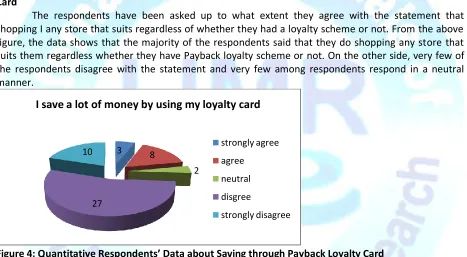
Figure 4: Quantitative Respondents’ Data about Saving through Payback Loyalty Card
From the above figure, the respondents have been asked up to what extent they would agree with the statement. The majority of the respondents disagree with statement and believe that so far they do not save a lot of money by using Payback loyalty card while few of the respondents agree with the statement and believes that they save lot of money by using Payback loyalty card.
7
32 4
6 1
I would shop in any store that suits me regardless
of whether they had a loyalty scheme
strongly agree
agree
neutral
disagree
strongly disagree
3 8
2
27 10
I save a lot of money by using my loyalty card
strongly agree
agree
neutral
disgree
Figure 5: Quantitative Respondents’ Data about Getting Better Discounts from In-Store Promotion than Payback Loyalty Schemes.
From the above figure, the respondents have been asked up to what extent they agree with the statement. An almost half of the respondents agree with statement and believes that they usually gets better discount from in-store promotion than loyalty schemes similarly on the other side almost half of respondents disagree with statement whereas very few among respondents responded in a neutral manner.
Conclusion
It has been concluded that the most of the Payback card holder are not using their cards while they are shopping with Payback Partners. It has also been concluded that most of the respondents believes that it takes too long to earn points to get worthwhile or to redeem it. It has also been concluded that majority of the respondents have nowhere interested whether the outlet is loyalty partner or not. They just love to shop wherever they want. It has also been concluded that the majority of the respondents believe they have not save any considerable amount through Payback card. It has also been concluded that the almost half of the respondents believe that they usually gets better discount from in-store promotion than loyalty schemes and on the other side with reasonable. Therefore, the marketers need to modify the on-going strategy of maintaining the card which perhaps may be toughest part for the customer to keep his card at every point of transaction for adding the loyalty points rather they could maintain the account of the customer as loyalty member so that every time the transaction made point added by default.
References
Baumann, Chris, Suzan Burton, and Greg Elliott (2005)”Determinants of Customer Loyalty and Share of Wallet in Retail Banking”, Journal of Financial Services Marketing, 9 (3), 231-249. Bendapudi, Neeli and Berry Leonard L. (1997), “Customer Receptivity to Relationship Marketing,” Journal of Retailing, 73 (1), 15-37.
Bolton, Ruth N., P.K. Kannan and Matthew D. Bramlett (2000), “Implications of Loyalty Program Membership and Service Experiences for Customer Retention and Value,” Journal of the Academy of Marketing Science, 28 (1), 95-109.
Burnham, Thomas A., Judy K. Frels, and Mahajan Vijay (2003), “Consumer Switching Costs: A Typology, Antecedents, and Consequences,” Journal of the Academy of Marketing Science, 31 (2), 109-126. Butcher, Ken, Beverley Sparks, and Frances O’Callaghan (2001), “Evaluative and Relational Influences on Service Loyalty,” International Journal of Service Industry Management, 12 (4), 310-327.
7
16
6 19
2
I usually get better discounts from in-store
promotions than loyalty schemes
strongly agree
agree
neutral
disagree
Dick, Alan S., and KunalBasu (1994), “Customer Loyalty: Toward an Integrated Conceptual Framework,” Journal of the Academy of Marketing Science, 22 (2), 99-113.
Dowling, Grahame R., and Mark Uncles (1997), “Do Customer Loyalty Programs Really Work?” Sloan Management Review, 38 (4), 71-82.
Gruen, Thomas W. (1994), “Exploring Consumer Behavior with Respect to Memberships,” Asia Pacific Advances in Consumer Research, 1, 265-272.
Guiltinan Joseph P. (1989), “A Classification of Switching Costs with Implications for Relationship Marketing” in AMA Winter Educators’ Conference: Marketing Theory 21 and Practice, T.L. Childers, Richard P. Bagozzi, J.P. Peter eds, Chicago Il. AMA, 216-220
Gummesson, Evert (1995), “Relationship Marketing: Its Role in the Service Economy,” in Understanding Services Management, ed. W. Glynn and J. G. Barnes, 244-268.
Jones, Michael A., David L. Mothersbaugh, and Sharon E. Beatty (2000), “Switching Barriers and Repurchase Intentions in Services,” Journal of Retailing, 76 (2), 259- 274.
Keiningham, Timothy, Tiffany Perkins-Munn and Heather Evans (2003), “The Impact of Customer Satisfaction on Share of Wallet in a Business-to-Business Environment,” Journal of Service Research, 6 (1), 37-49.
Kivetz, Ran (2005), “Promotion Reactance: The Role of Effort-Reward Congruity,” Journal of Consumer Research, 31 (4), 725-737.
Kumar, V. and Denish Shah (2004), “Building and Sustaining Profitable Customer Loyalty for the 21st Century,” Journal of Retailing, 80 (4), 317-330.
Lam, Shun Yin, Venkatesh Shankar, M. Krishna Erramilli, and Bvsan Murthy (2004), "Customer Value, Satisfaction, Loyalty, and Switching Costs: An Illustration From a 22 Business-to-Business Service Context," Journal of the Academy of Marketing Science, 32 (3), 293–311.
Lee, Jonathan, Janghyuk Lee, and Lawrence Feick (2001), “The Impact of Switching Costs on the Customer Satisfaction-Loyalty Link: Mobile phone service in France,” Journal of Services Marketing, 15 (1), 35-48.
Lichtenstein, Donald R., Scot Burton, and Eric J. Karson (1991), “The Effect of Semantic Cues on Consumer Perceptions of Reference Price Ads,” Journal of Consumer Research, 18 (December), 380-391. Liddy, A. (2000), “Relationship Marketing, Loyalty Programs and the Measurement of Loyalty,” Journal of Targeting Measurement Analysis for Marketing, 8 (4), 351-362.
Lovelock, Christopher and JochenWirtz (2007), Services Marketing: People, Technology, Strategy, 6th ed. Upper Saddle River, New Jersey: Prentice Hall.
Magi, Anne, (2003), “Share of Wallet in Retailing: The Effects of Customer Satisfaction, Loyalty Cards and Shopper Characteristics,” Journal of Retailing, 79 (2), 97-106.
Noordhoff, Corine, Pieter Pauwels, and Gaby Odekerken-Schröder (2004), “The Effect of Customer Card Programs: A Comparative Study in Singapore and The Netherlands,” International Journal of Service Industry Management, 15 (4), 351-364.
Oliver, Richard L. (1999), “Whence Customer Loyalty,” Journal of Marketing, 63 (Special Issue), 33-44. O’Malley, Lisa (1998), “Can Loyalty Schemes Really Build Loyalty?” Marketing Intelligence and Planning, 16 (1), 47-55.
Patterson, Paul G. and Tasman Smith (2001), “Relationship Benefits in Service Industries: A Replication in a Southeast Asian Context,” Journal of Services Marketing, 15 (6), 425-443.
Perkins-Munn, Tiffany, LerzanAksoy, Timothy Keiningham and DemitryEstrin (2005), “Actual Purchase as Proxy for Share of Wallet,” Journal of Service Research, 7 (3), 245-257.
Pritchard, Mark P., Mark E. Havitz, Dennis R. Howard (1999), “Analyzing the CommitmentLoyalty Link in Service Contexts,” Journal of the Academy of Marketing Science, 27 (3), 333-348.
Reicheld, Frederick (2003), “The One Number You Need to Grow”, Harvard Business Review, 81 (12), 46-54.
Reinartz, Werner J. and V. Kumar (2000), “On the Profitability of Long-life Customers in a Non-contractual Setting: An Empirical Investigation and Implications for Marketing,” Journal of Marketing, 64 (October), 17-35.
Shankar, Venkatesh, Amy Smith and ArvindRangaswamy (2003), “Customer Satisfaction and Loyalty in Online and Offline Environments,” International Journal of Research in Marketing, 20 (2), 153-168. Shapiro, C. and V. Hal (2003), Information Rules, Boston:MA, Harvard Business School Press.
Shugan, Steven (2005), “Brand Loyalty Programs: Are They Shams?”, Marketing Science, 24 (2), 185-194. Too, Leanne H.Y., Anne L. Souchon, and Peter C. Thirkell (2001), “Relationship Marketing and Customer Loyalty in a Retail Setting: A Dyadic Exploration,” Journal of Marketing Management, 17 (3/4), 287-319. Wirtz, Jochen and Anna Mattila (2003), “The Effects of Customer Expertise on Evoked Set Size and Service Loyalty,” Journal of Services Marketing, 17 (7), 649-665.
Wright, Claire and Leigh Sparks (1999), “Loyalty Saturation in Retailing: Exploring the End of Retail Loyalty Cards?” International Journal of Retail and Distribution Management, 27 (10), 429-439.