DEVELOPING SIXTH FORM
STUDENTS UNDERSTANDING OF
THE RELATIONSHIPS BETWEEN
ENVIRONMENT AND DEVELOPMENT
ISSUES
SOPHIE YANGOPOULOS
Thesis submitted for the degree of Doctor of Philosophy
ABSTRACT
The focus of the research for this thesis is the development
of critical pedagogy for a greater understanding of
environment/development issues among sixth form A Level
geography students. The thesis first considers the concept
of sustainable development which can provide a framework
for supporting the close integration of
environment and
development issues. Caution is necessary, however, given
the various interests it serves and resulting
contradictions inherent in proposed radical change within
traditional economic, social and political structures.
Within this context student perceptions of
environment/development issues were investigated using
phenomenography as a methodology. However, a critique of
the methodology was necessary, given contradictions in
accepting multiple realities of phenomena based on
conceptualisation through experience while also seeking a
limited number of categories of description of phenomena.
Out of the action research undertaken, a curriculum module
based on critical pedagogy (influenced by critical theory)
was developed to encourage critical thinking by students on
a case study example of an environment/development issue.
The research shows that the students could perceive
environment/development issues as complex inter-related
phenomena, but only to a limited extent did it enable them
to be confident in challenging systems which perpetuate or
ACKNOWLEDGEMENTS
I would like to thank my tutor, Dr. Frances Slater, for her
encouragement in completing this thesis. I also thank the
A level geography students at Esher College and Grey Coat
Hospital School. Through their hard work and stimulating
discussions they have contributed enormously to my data
collection. I would particularly like to thank Catherine,
Kelly and Rebecca for the time they took to evaluate the
CONTENTS
PAGE
I NTRODUCT ION 11
1. SUSTAINABLE DEVELOPMENT 17
-The concept 17
-Sustainable growth or sustainable development 21
-The critique of sustainable development 26
-The United Nations Conference on Environment 33
and Development (UNCED) and sustainable
development
-Conclusion: Sustainable development - beyond 41
our reach?
2. EDUCATION FOR SUSTAINABLE DEVELOPMENT 48
-The influence of critical theory on education 54
for sustainability
-So what is education for sustainability? 60
-Geography and education for sustainability 64
-Environmental geography in the 71
national curriculum
-16-19 A Level Geography and education for 81
3. RESEARCH METHODOLOGY 88
-Phenomenography 88
-Critical action research 97
-Action research in the light of previous 103
initiatives to develop environmental education
4. PHENOMENOGRAPHICAL RESEARCH 112
-Aims and data collection 112
-Analysis and evaluation part 1 114
-Analysis and evaluation part 2 130
-A comparison of phenomenographical research 139
undertaken at Esher College and Grey Coat
Hospital schools
-A critical analysis of phenomenography as a 143
research method in the context of this study
5. THE ACTION RESEARCH SPIRAL 151
THE PLANNING STAGE 15
-Case study curriculum unit based on education 156
for sustainability
THE ACTION AND REFLECTION STAGES 177
-Implementation, observations/data collection 177
REFLECTIVE STAGE 206
-Conclusions and Reflections 206
FURTHER EVIDENCE OF STUDENT UNDERSTANDING
OF SUSTAINABLE DEVELOPMENT 212
6. THE SECOND ACTION RESEARCH SPIRAL 224
THE PLANNING STAGE 224
THE ACTION AND REFLECTION STAGES 227
-Implementation, observation/data collection 227
and data analysis
REFLECTIVE STAGE 237
-Conclusions and Reflections 237
7. REFLECTIONS ON THE CURRICULUM UNIT TRIALLED 242 IN A COMPLETELY DIFFERENT EDUCATIONAL SETTING
8. CONCLUSION 252
APPENDIX 1. Transcripts of conversations on the 277 environment and development
A. Esher College - development 277
B. Esher College - development 283
C. Esher College - environment 286
D. Esher College - environment 290
E. Grey Coat School - development 293
F. Grey Coat School - environment 298
APPENDIX 2. Transcripts of conversations on 304 problems facing farmers in Yemen
A. Esher College 305
B. Esher College 309
C. Grey Coat School 313
L
LIST OF FIGURES
1
F I GURE PAGE
1. Environmentalism (O'Riordan, 1981) 20
2. Sustainable Growth and Sustainable Development 22
(Huckle, 1991)
3. The sustainable growth and sustainable 24
development approaches to sustainability (Fien & Trainer, 1991)
4. The nature of ecological sustainability: the 25
sustainable development mode (Fien & Trainer, 1991)
5. Changing education through the emergence of a 53
holistic paradigm (Stirling, 1993)
6. The 'F' model of environmental education 53
(Stirling, 1993)
7. Political Literacy (Gerber, 1988) 57
8. A model of suggested relationships between 61
modes of education and modes of environmentalism (Stirling, 1993)
9. The contemporary dynamics of environmentalism, 65
social change and environmental management. (Stirling, 1993)
10. Attainment Target 5: environmental geography 72
11. An alternative geography attainment 5. 76 (Huckle, 1994)
12. Managing environments and sustainable 77
development (SCAA, 1994)
13. Level descriptions for the geography 79
attainment target (SCAA, 1994)
13a & b. Content structure Diagram and Pupil's 93
labelled-line concept map.
14. The action research spiral (Robottom, 1987) 110
15. Phenomenographic analysis of
conversations
115on development - Outcome Space (Esher College)
16. Phenomenographic analysis of conversations 125
on environment & Outcome Space (Esher College)
17. Phenomenographic analysis of conversations on 131
development - Outcome Space (Grey Coat School)
18. Phenomenographic analysis of conversations on 136
environment - Outcome Space (Grey Coat School)
19. Traditional agricultural systems in North 160
Yemen
20. Agricultural change in the Yemen 161
(student resource)
21. Sustainable development (teaching resource) 164
22. Principles for living sustainably 165
23. United Nations development programme and arid 168
(student resource)
24. World Bank information briefs 169
(student resource)
25. Projects in Progress: the World Bank at work 170
(student resource)
26. The World Bank perspective 172
(teaching resource)
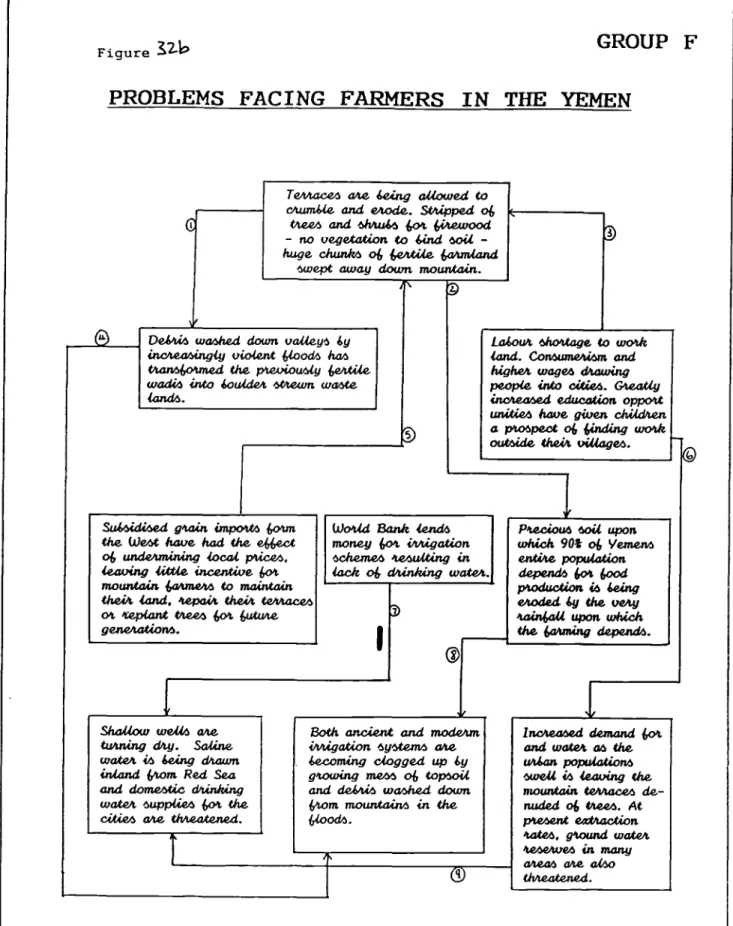
27a & b - 32a & b. Systems diagrams of problems 180 facing farmers in North Yemen -188 (Esher College)
33. Student links between environment and 190
development problems
34. Problems facing farmers in Yemen 191
(teaching resource)
35. Solutions to the agricultural problems 200
in Yemen
36. Environmental planning methodologies 201
(Redclift, 1987)
37. Cross modular A level exam question 214
38. Views of environmentalism 215
39-43. Examples of student answers to exam 217
questions -221
44. Systems diagram of problems facing farmers 229
in North Yemen (Grey Coat School)
45a-. Resources and Student work at "Tchico Té" 244
INTRODUCTION
THE RESEARCH CONTEXT
Concern for environment and development issues in both
the rich and poor world has been given a high profile in
recent years, particularly through the media, large
charity events, consumer organisation, businesses and
schools. Young people have a heightened awareness of
many issues. However, the particular relationships
that exist between improving people's lives and the
effects on the environment are not always explicitly
addressed. Environmental problems often occur as a
result of a particular approach to development,
decided upon by particular groups in society who have
the power to make decisions.
"The challenge is not to seek to protect the environment from man, but to alter the global economy in which our appetites pressure on the outer limits of resources. This can only be done by altering the entitlements of the poor in the South so that environmental discourse becomes a development discourse."
-(Redclift in Johnston 1989, p. 196)
The broad aim of this research is to explore the ways in
which A level geography students make sense of
environment/development issues within the A level
geography curriculum and to develop more effective
teaching strategies to enable them to achieve a greater
relationship between environment and development in
the context of their geographical education.
Below are the questions which set the agenda for the
research.
RESEARCH QUESTIONS
1. What contribution has the concept sustainable development made to our understanding of
environment and development issues?
2. In what ways do students make sense of the
environment and development as concepts used in geographical enquiry?
3. Do students perceive a relationship between environment and development issues?
4. To what extent can students explore conflicting interests, attitudes and values towards
environment and development issues, evaluate attempts to solve the problems, identify constraints on possible solutions and seek strategies to overcome them?
5. How can teaching strategies and resources be
developed to enable students to explore environment and development Issues in a more integrated
manner?
about 'sustainable development' - a concept integrating environment and development issues - defined by the Brundtland report 'Our Common Future' (WCED, 1989). The research sets out to explore the critique of the concept and it's relative importance given the high profile of education for sustainable development in Agenda 21 of the United Nations Conference on Environment and Development (UNCED) in Rio de Janeiro in 1992. (IJNCED, 1992 ch.36.3)
"Education is critical for promoting
sustainable development and improving the capacity of the people to address environment and development issues... It is also critical for effective participation in
decision-making."
Chapter 1 explores the critique of the concept and its
contribution to our understanding of
environment/development issues as in the first
research question above.
Chapter 2 also seeks to explore the extent to which
sustainable development has influenced the
understanding of environment/development issues in
relation to education, in particular the ways in which
it has influenced curricula and the development of
teaching about the relationship between the
environment and development. This is put in the context
of the development of geography as an academic
discipline and in the context of educational academic
writing about environmental education,in terms of it
being seen by some as an agent of social change and the
contribution of critical theory in realising this aim.
the 4th research question above. In order to enable
students to consider and ultimately contribute to
working towards a 'better world' they need to develop
the skills to effectively debate and communicate.
Critical theory as a tradition of social and political
thought, has contributed to the promotion of a language
of discursive political democracy, demanding not only
a consciousness raising of issues but also the
articulation and evaluation of various views and value
systems underpinning the way society works.
Students will then be empowered to challenge existing
social and political structures that result in
environment and development problems. A discursive,
critical and highly interactive form of education is
therefore a prerequisite to the development of
solutions to articulate a plurality of future
scenarios, probable, possible and preferred.
Chapter 3 describes and discusses the methodology
adopted to investigate the second research question.
This research methodology is qualitative, since the
focus will be on 16-19 year old geography A Level
students and their perception and understanding of
environment and development relationships. The
methodology will involve phenomenography which
"...is a research method for mapping the qualitatively different ways in which people experience, conceptualise, perceive and
Environment and development are concepts or phenomena
which students will be describing and their
experiences and conceptualizations will be elicited
from taped
conversations.
The data will then beanalysed by sorting the understandings into conceptual
categories of their statements. Chapter 4 deals with
the data collection, analysis, conclusions and a
critique of the methodology used.
Chapter 3 also outlines and justifies action research
as the methodology to investigate research questions
three to five. Chapters 5, 6 and 7 present the planning,
implementation, analysis and evaluation stages of the
action research spirals used to focus on the
development of effective teaching strategies and
resources to facilitate students to test out and
reconstruct their understandings and perceptions of
environment and development issues as elicited through
the phenomenographical research. This is set in the
context of the sixth form 16-19 Project A Level
geography course. It takes a predominantly student
centred approach. The teaching and
learning
content involves a module of work on changing agriculturalsystems in Yemen. It was developed specifically as part
of the research, using a variety of strategies and
teaching techniques to address research questions
three, four and five and set in the context of the
concept of sustainability and the development of
In the wider context of geographical education the
research aims to contribute to the development of
resources and strategies for teaching and learning for
sustainability given the international importance
1. SUSTAINABLE DEVELOPMENT
The Concept
Sustainable development has been described as
"development that meets the needs of the present without compromising the ability of future
generations to meet their own needs." (Our common future WCED 1987 p 43)
Implicit in this concept is the relationship between
development - meeting the needs and improving the quality
of life for human kind - and the resource base on which that
development depends, i.e. the environment. Sustainable
development should result in the
"amelioration of the quality of life and minimise the degradation or destruction of the bases of production" (Gallopin, 1989 page 394).
Q ad
Brundtland identifies some of the dimensions of
sustainability
"first it requires the elimination of poverty and deprivation. Second it requires the conservation and enhancement of the resources base which alone can ensure that the elimination of the poverty is permanent. Third it requires a broadening of the concept of development so that it covers not only economic growth but also social and cultural
development. Fourth and most important, it requires the unification of economics and ecology and
decision making at all levels."
( Brundtland , l986 in Pearce et al 1989 p 174)
The term sustainable development has been used widely in a
variety of contexts as a jargon phrase by politicians,
international institutions, non-governmental
organisations and the media since Our Common Future was
published. It also provided a rationale for the framework
of negotiations at the United Nations conference on
Environment and Development (UNCED) in Rio de Janeiro in
1992. Environment and development
aspects of
a numberof
issues
were discussed on an integratedbasis.
Although theconcept embraces both environment and development issues
there has been a powerful
critiqueof
the concept(as
defined by the Brundtland Report, Our Common Future) and
contradictions have been examined. Hence, there have been
many interpretations of sustainable development in the
literature to support a variety of values, attitudes and
beliefs which are essentially rooted in the various
ideological stances adopted in addressing
environment
anddevelopment issues as distinct areas of study. The aim of
this chapter is to explore these ideological stances and
the context in which sustainable development has
emerged
asan 'integrating concept (about environment and development
issues) and to go some way towards a conclusion as to
whether it is actually a theoretical concept
or
as Adams(1990, p.3) suggests merely
.rhetorical flags under which ships of very different kinds can sail."
Sustainable development as a concept needs to be examined
in relation to the development and classification of
since it is a term used uniformally by adherents of many
forms of environment/development ideologies. There is a
dialectic between O'Riordans technocentrist and
ecocentrist views of environmentalism in the debate over
sustainable development which is mirrored by a dialectic
between radical and liberal/conservative approaches to
development. O'Riordan (1981a) provides a framework of
environmentalism (fig. 1, p 20) from the almost laissez
faire optimism of the cornucopia technocrats to a new
legislative order of economic adjustment to guarantee a
minimum level of environmental quality, to the more radical
ecocentrist approaches. These include self reliant
communities using soft technology to minimise human
activity in the environment, recognising the intrinsically
interconnected web of relations between people and
environments.
Economic growth should be directed toproviding for basic needs of the poorest and the deep
ecologists recognise the rights of nature before
humankind. These are also some of the underlying principles
of 'ecodevelopment' discussed later in the chapter.
Modernisation views of development reflect those of the
technocentrists and include the
continuing
globalisationof economies locked into world market systems and the
continuing
capital accumulation of capitalist societies,driven by increasing consumption patterns in the North paid
for by exploitation in the South. Capital generated will
eradicate poverty and restore damaged environments through
are calls for a new world order giving members of all
communities a democratic voice in self determination and
the power to challenge the existing political and economic
structures so that societies have a fair share of resources
at first hand rather than waiting for 'trickle down'.
Figure 1
Source: O'Riordan l98lA p 376
Sustainable Growth or Sustainable Development
As a result of the differing perspectives above,
sustainable development has been interpreted and
criticised from a variety of standpoints, giving rise to a
distinction between 'sustainable growth' and 'sustainable
development' as discussed by }Iuckle (1991). As figure 2 (page 22) illustrates, sustainable growth is essentially
reformist, modifying the economic system, monitoring and
protecting the environment through increased energy
efficiency and legislative control in order to protect the
ecological conditions of production and ensure capital
accumulation. This capital accumulation or economic
growth is seen as essential for financing the technology
and legislation initiatives to more effectively and
'efficiently' manage our resource base. It is also used by
extreme technocentrists' or those Vidal (1995) describes as
'contrarians' to justify supplying the demands of an ever
increasing world population and the amelioration of
poverty in the world. Sustainable development is
fundamentally technocratic (referring back to O'Riordan's
classification of environmentalism) and politically
expedient. Development will be achieved through a shallow
green approach by 'reactive' policy to fix environmental
'problems', minimising conflicts inherent in the
exploilation of the environment and to change the
parameters of our resource base through biotechnology for
example. It does not challenge the status quo, the dominant
Figure 2
Source: Huckle 1991, p.47
22
essential for
"...achieving green growth whereby the quality of life is sustained by the rich and improved for the poor.. .green growth will not be achieved
without a growing role for environmental policy." (Pezzey, 1989, pp 22-23)
This 'green growth' is economic growth tempered and
generated by having environmental considerations in terms
of resource utilisation in the generation of capital.
Sustainable development on the other hand is essentially
radical, recognising a need to fundamentally change social
and economic systems to ensure
".. .intergenerational equity and democracy" (Huckle, 1993, p 58
It is ironic that while it has been a premise of sustainable
development to steer away from dualisms such as that
dividing environment and development issues (and instead
view issues in a holistic, integrated manner), dualisms
still dominate the way in which the concept has been
interpreted by creating a distinction between sustainable
growth and development. This distinction, however, does
highlight the point that although there is no disagreement
over the broad notion of sustainable development as
• .a kind of development that provides real improvement in the quality of human life and at the same time conserves the vitality and
diversity of the Earth. .." (IUCN WWF UNEP, 1991 p 8)
there are very differing views as to how it can be
Fien and Trainer (1993b) have drawn up a Continuum between
sustainable growth and sustainable development (fig.3
below) which broadly corresponds with O'Riordans views of
environmentalism (fig.l p 20).
Figure 3
Source: Fien & Trainer 1993b p. 34
It shows the dominant social paradigm of unfettered
economic growth deemed essential for sustainable
development against the 'new' environmental paradigm which
doesn't place an emphasis on growth. it requires
considerations of social, economic and environmental goals
in balance (fig.4 p 25) so that none are considered to the
exclusion' of another.
Figure 4
Source: Fien & Trainer 1993b p. 35
However, there is an argument that growth is not compatible
with sustainable development at all, since it demands
continued consumer consumption at rates which are
ecologically unsustainable, primarily by the 'rich world'.
Four fifths of the world's income rests in the 'North' which
also has only one third of the world's population. The North
consumes 70% of the world's energy, 75% of the world's
metals and 85% of the world's wood , a large proportion of
these resources coming from the South. The argument that
economic growth can alleviate poverty and supply the
growing developing world population in this context seems
impossible when the very economic growth generated in the
North is dependent on exploiting the people and
environments of the South. 'Green growth' is also
considered uneconomic because
"...If the ecosphere were fully priced not free, such consumption patterns could not continue."
(UNDP, 1994, p.18)
This fundamental contradiction, part of the radical
critique of sustainable development is discussed below.
The Critique of Sustainable Development
Porritt (1992) warns of the dangers of too readily
accepting sustainable development as a principle to be
applied to policy making, in that it is often espoused on a
superficial level without addressing major issues of the
world's structural political economy. As with other
radical theorists Porritt identifies the contradictions
within the concept of sustainable development, seeing it as
a term interpreted to justify "sustaining the patently
unsustainable" (1992) in terms of economic growth and
consumerism exploiting the natural -resource base. This
resource base is under threat, given that
"...a three percent per annum growth rate actual means a doubling of production and consumption in
just 25 years." (Porritt, 1992, p 39)
Fien and Trainer (1993b)also question how we can continue
economic growth, solve problems of global poverty and
prevent environmental degradation when present levels of
resource use are unsustainable. The World Commission on
Environment and Development's (WCED) Brundtland Report
'Our Common Future', has been criticized for not addressing
means of managing the earth's resources. It has a
utilitarian argument and a tempered neo-malthusian
deterministic message of the environmental system setting
limits on human action and suggests that a growing world
economy can organise and manage sustainable development.
Critics have also identified a tendency for WCED to
interpret manifestations of poverty as major causes of
environmental degradation, failing to recognise poverty as
symptoms of northern policies and patterns of growth and
does not examine the social and political changes necessary
to meet conservation goals.
"The environment cannot be the starting point from which to derive a coherent prescription for global reform; nor is it a mere technical problem soluble by scientific means alone; it is a
function of the prior transnational system of domination and subordination of empowerment and disempowerment." (Graff, 1992, p 557)
Our Common Future (WCED 1987) has been described as an
"unsustainable fiction, riddled with
structuralist assumptions emphasising order,
linear development and control."(Gough 1991 p39).
Meadows (1992), although criticizing Brundtland for
failing to recognise the underlying political economy does
not, however, consider a 'no growth' policy to development.
Instead development should be qualitative and material
growth used as a 'considered tool'. This perhaps indicates
a 'growth with equity' approach (fig.3) rather than a truly
sustainable development approach. This view of economic
growth is also an inherent and necessary component of what
'Sustainable Human Development'. They argue that there
need not be any tension between economic growth and
environmental protection and regeneration. It is the
character and consumption of that growth which is
important. Growth is seen as a means not an end to
protecting the life opportunities of future generations.
Redclift views the environment within the perspective of
the political economy, relating environmental change to
superstructural factors such as ideology and policy at
various levels of complexity and suggests that
environmental issues are socially constructed under
capitalism. The process of capital accumulation cannot be
achieved without the exploitation and marginalisation not
only of the workforce and conditions of production (from a
Marxist perspective) but also of the environment in policy
making. In other words the hegemony of a value system based
on consumption to stimulate production and capital
accumulation has led to a crisis of reproduction and a
crisis of sustainability.
The conditions of production , the environment on which we
depend has been neglected from economic planning and as a
dwindling resource base threatens future capital
accumulation. The UNDP Human Development Report (1994)
also recognises this crisis of sustainability. It states
that future generations will be left with economic debts
('postponed' debts from the present) which will "mortgage
sustainability" (UNDP, 1994, p.18) as will the ecological
resource base and people in order to achieve short term
economic growth.
"Current consumption cannot be financed for long by incurring economic debts that others must
repay.. .and it means that resources must be used in ways that do not create ecological debts by over
exploiting the carrying capacity and productive
capacity of the earth." (UNDP, 1994, p.18).
To try and avoid this crisis sustainability has been taken on board by market welfare liberals as 'green consumerism'
and 'commodity fetishes' to once again legitimate a system
of production and consumption. Structural relationships
between North and South are also tied within this political
economy, supporting the development of underdevelopment in
the South and continuing the exploitation of the
environment for human consumption in the North through
unfair trade (Multi-national companies control 70% of
world trade), inappropriate aid and developing world debt
($ 1 trillion in the 1990s).
The modernisation theory to development, which is embedded
in the prevailing political economy between North and
South, can, however, claim that development can be
sustainable, taking into account the accumulation of
capital for development projects. Capital will trickle
down to those in need and provide funding for technological
development to fix environmental problems. These values
regard the environment in utilitarian terms and technology
as enabling the shifting of the frontiers of sustainability
(finding new resources or new ways of adapting/using
seeing the resource base as an absolute Malthusian entity
(limited in its carrying capacity, the environment as a
finite collection of resources).
"The government espouses the concept of sustainable economic development. Stable prosperity can be achieve
throughout
the world, provided theenvironment is nurtured and safeguarded."
(Thatcher 1988 in Pearce et al 1989 pp 182-183)
This "technological optimism". (Meadows 1991, p. 154) gives
rise to a narrow definition of sustainable development,
which
• .requires maximising the net benefits of economic development subject to maintaining the services and quality of natural resources."
(Barbier, 1989 in Pearce et al 1989, p.174).
The South itself does not necessarily recognise that
economic growth, a conserved resource base and social
equity are mutually exclusive.
"Environmental problems cannot be dealt with separately; they must be linked to the
development process by which the environmental interests are in line with the imperatives of economic growth and development. The right to develop for the developing countries must be fully recognised."
(Beijing Declaration of the Group of Southern Industrial Countries in Sachs, 1992, p.27)
One must consider, however, from a radical perspective that
those who attended the Group of Southern Industrialised
Countries have most to gain, belonging to the elite who are
already locked in and benefit from the rewards of the
political economy before a small percentage of economic
growth trickles down to enhance the lives of the majority of
In contrast to the above approach are the advocates of the
"bottom up, periphery inward development paradigm" (Stohr
1981) who call for development from grassroots based on
basic needs, self reliance, an emphasis on community
capabilities and appropriate technology. This also draws
on Schumacher's 'Small is Beautiful' ideas. Without
depending on the world economy, communities can break from
structural dependence and the processes of capital
accumulation. These ideas have also been developed by the
ecodevelopment movement whose advocates regard an
alternative approach as essentially political and deal
with the 'power' variable.
"Naive statements on needs, participation and environmental compatibility are espoused in many papers... but whose needs are going to be met and whose are not; who will participate and who
not; and which lobbies, international groups and economic and political entities will be hurt by environmental compatibility?" (Favar and Glaeser4 1971 in Redclift, 1987, p 34)
Ecodevelopment is an approach to environmentalism in which
basic needs, self reliance and ecological sustainability
all need to be considered since development will not be
sustainable unless poor people are involved in meeting
their aspirations. This also relates to the deep ecology
movement, whose ideas have been classified by O'Riordan
(1981a) as deep green. They advocate a neopopulist approach
of the decentralisation of society into small units where
• distinction between humans and nature can begin to dissolve..." (Simmons, 1992, p 14)
giving greater intrinsic value to nature rather than
instrumental or utilitarian value. Power must be located
within those communities requiring greatest need. An
example of this is the organisation of 'groupement
villageois' in Burkino Faso, West Africa. These are
pimarily womens' groups addressing their key development
needs through collective action to change their
conditions. Twenty five villages close to Garango are
helped by the Association Dakupa based in Garango. They are
representative of a world wide movement over the last five
years which has seen an explosion of indigenous development
groups in the developing world. The villages around Garango
gain access to support from Western charities which they
can direct and use according to their own decisions
-grassroots society and democracy.. In the village of
Sabtenga the 'groupement' has decided how to distribute and
use a $1000 loan from a french agency, Afrique Verte to be
prepaid with 10% interest within 10 months - credit they
could never get from a bank. However, Redclift does not
believe that the poorest can effectively be given priority
at a local level while the
"...effects of international development
The United Nations Conference on Environment and Development (UNCED) and Sustainable Development
Many of the contradictions and difficulties expressed
about the concept sustainable development are also
reflected in the nature of the UNCED in Rio de Janeiro (The
Earth Summit, June 1992) and it's outcomes. UNCED was to
begin a process of institutional reform to challenge and
extend a framework of law to embrace common global rights
with respect to natural resources. It covered almost every
conceivable issue related to sustainable development. It
established a Commission on Sustainable Development to
monitor the performance of governments and international
institutions
to live up to the precepts of sustainabledevelopment as defined in Agenda 21 which should reflect
"... a global awareness and political commitment at the highest level of development and
environmental co-operation"
(preamble to Agenda 21, 1992 in Holmberg, 1993 p 35)
Agenda 21 addresses the environment and development
aspects of each issue, dealt with on an integrated basis. It
also focuses on the idea of participation, incorporating
'bottom up' principles of development. It argues that the
transition to sustainable development can only be
effective if it
"gradually evolves as a result of the
various trade-off s in reconciling environment and development objectives."
(Ch.37, Agenda 21, 1992, in Holmberg, 1993, p 12)
However, UNCED can be critically evaluated against the
critique of sustainable development already discussed.
Firstly it has institutionalised further collaboration
among sets of
transnational
northern and southern eliteswho have the power to reinforce the northern global
hegemony.
Johnston (
1989,in Huckle 1991 p 43) recognisesthat these
"...institutions capable of change are controlled
by a powerful minority with strong interests in the status quo."As a result reform was extremely unlikely, every principle
being agreed to the lowest common denominator to satisfy a
variety of interest groups within a group of powerful
elites.
While environment and development aspects to a number of
issues were addressed, once again the structural nature of
the global political economy was not tackled. Calls for a
New International Economic Order (NIEO) from the South were
still not given a platform for debate. There was
"little scientific let alone political
consensus.. .
on the relationship betweenenvironmental
degradation and the state of theinternational
economic environment."(Holmberg, 1993, p 7).
The prevailing economic policy paradigm of the free market
protection and equity of opportunity, through improved
institutional frameworks and management - a technocentric,
reformist approach. There is no conflict recognised
between profit and records of environmental excellence.
This is in contrast to the radical criticism of the
sustainable growth paradigm already discussed whereby it
is argued that
"Today's patterns of production and consumption, besides not being sustainable are the principal cause of the threat facing the global ecosystem, and that the northern states therefore have to accept substantial blame for environmental degradation in the poorer countries." (Havel, 1992, p 20)
Indeed Rajiv Gandhi has suggested the idea of a Planet
Protection Fund of an official 0.1% of GNP
"...not as a measure of charity but more as a measure of the payments that the rich ought to be making for their existing consumption"
(Centre for Science and Environment, 1992, p 275)
Given the fact that most countries in the North fail to meet
the UN suggested 0.7% of GNP for development aid, Gandhi's
idea is unlikely to be seen as a realistic solution and
perhaps will only fuel the sustainable growth argument in
order to pay for such a fund.
By 1995 UNCED in its recommendations through Agenda 21 has
suggested that all governments should have 'mutually
productive dialogues' (Holmberg, 1993, p 19) with
non-governmental organisations (NGOs) and that they should be
rise and success of environmental and development NGOs that
UNCED took place. During the 1980s the influence of
environmental
groupsin
particular was builton
the success of their 'watchdog'function.
They drew attention to environmental degradation and political and institutionalinaction. They have been central to
continuing
environmental concern. However, Porritt (1988) considers in some respects that the green movement is in danger ofbeing compromised, encouraged as it is to take active roles
as policy members on regulatory and advisory committees.
There is a tension developing between responding quickly to
opportunities for influence and
retaining
the independenceto keep pushing the agenda forward.
The variety of environmental groups also reflects a variety
of ideological stances from the essentially private
interests of NIMBYs (Not In My Back Yard) and the public
interest environmental groups' technocentric/ecocentric
tendencies. These tendencies have supported alternative
subcultures from green consumerism (the technological
response to threatened resources by the production and
consumption of enironmentally friendly products) to a deep
green biorights alternative. Most environmental groups
claims Porritt, pursue reformist policies and
"...only Friends of the Earth have argued that growth is ecologically impossible. The vast
majority of environmental groups have been co-opted by the growthist obsessions of our industrial culture." (Porritt, 1988, p 22)
UNCED to progress much beyond a shallow green approach to
dealing with strategies to achieve sustainable development
in the context of radical theorists arguments.
UNCED is also largely unfinanced. It has failed to
encourage the 0.7% of GNP target for aid and the newly
created Global Environment Facility (GEF) administered by
UNDP, UNEP and the World Bank is considered inadequate. The
World Bank integrated environmental considerations into
development policy making in 1987 and a presidency for
'environmentally sustainable development t was created.
Despite acknowledging the three main objectives of
sustainable development, economic social and ecological,
(as in Fien and Trainer l993) and the multifaceted,
integrated nature of relevant issues, it continues to
espouse the view that
'.. .the positive aspects between growth and environment need to be aggressively exploited."
(World Bank, 1993)
The World Bank has a questionable record in environment and
development projects. The failure rate of projects funded
is around 37%. Technocratic solutions override ecocentric
values and considerations in that
"Human and environmental concerns have been
subordinated to engineering and construction demands."
(Morse in Chatterjee, 1992, p 21)
Although investments in environmental projects have
quadrupled from $404 million to $1.6 billion during 1992,
the money, it is alleged has gone to existing projects to
"...merely greenwash the environmental and social destruction of the old."
(Chatterjee, 1992, p 21)
Sustainable development is unlikely to be realised for many
if the mechanisms through which change will take place
continue to be part of the existing dominant political and
economic order of global capital and global institutional
decision making.
Participatory democracy is also called for in sustainable
development. Empowerment given to people to take control of
their own development is strongly endorsed by UNCED. UNCED
is, however, unclear on how this can come about given that
the thrust of responsibility for implementing
reconunendations lies with governments whose aims are
primarily short term political expediency and maintaining
the status quo of control and decision making. UNCED
recommends that
"...governments should support a community driven approach to sustainability that would. . . enable communities to gain sustained access to resources needed by the poor to overcome their poverty."
(Ch.3, Agenda 21 in Holmberg, 1993, p 13) a . #j
If it is assumed that grass roots movements should be
encouraged to shape environmental decisions, what are the
mechanisms by which it should happen and how far are
governments prepared to let these groups challenge
political decisions? There has been a proliferation of NGOs
in the South but it is an ever demanding struggle to fight
institutions. The Kalparvriksh, an environment action
group is working with and on behalf of the Bhils people of
the Narmada valley in India. The people are faced with the
threat of the Narmada Dam project, funded largely by the
World Bank.
It is to be aseries
of 30 large dams and hundreds of smaller ones, flooding 120 miles of forest andfarmland in the state of Gujarat. Community campaigns with
the help of NGOs did result in the World Bank pulling out of
financially backing the project in November 1992 but should
such attempts to achieve sustainable development by people
be such a struggle? Decision making should be a democratic
process involving the representation of all groups
affected from the grassroots to international bodies in the
first instance.
"Democratisation of the world order at all levels is.. .necessary if communities are to realise
sustainable development." (Huckle, 1991, p 51).
Unless societies are reshaped and power is distributed more
evenly the mass action of campaigns such as those over the
Narmada Dam will remain marginal. There has to be
participatory democracy in environment and development
decision making at the outset of any proposed project. This
does, however involve a nation state abandoning some of its
sovereignty. This should be not only to multilateral and
international forms of government capable of securing
ecological and collective security, but also dispersing
that sovereignty within the nation to recognise a diversity
of values and a range of knowledge systems crucial for
be the case that
"sustainable development ceases to be the quest for unlimited growth tempered by economic care -as advocated by the Brundtland Commission - but becomes the quest for environmental and economic
justice at the local level." (Harding, 1992, p 25)
There needs to be change from above to allow substantial
change from below to begin to realise the long term aims of
sustainable development in the short term.
"Society can only be reconstructed from below if there has to be coordination and planning from above." (Huckle, 1991, p 50).
UNCED assumed a consensual co-operative North/South
dialogue, however the geopolitical reality of differing
interests albeit within a broadly sustainable growth
ideology results in a stumbling block to realising
sustainable development. There was no real communicative
rationality, no discursive dialogue that could transform
the dominant ideology towards a new paradigm of values
associated with sustainable development as opposed to
sustainable growth. UNCED was essentially a conference of
organisations
and governments based firmly- within the dominant political economy excluding any other interest groups. The NGOs were not represented at the negotiationsand ran their own parallel Global Forum. As a result, UNCED
as with other national and international attempts to
achieve sustainable development, may only
of the rich across the world but it will care little whether the present generations of the poor can even be assured of a bare survival."
(Centre for Science and Environment, 1992, p 264)
Conclusion: Sustainable Development - Beyond Our Reach?
Sustainability will be seen as an idealist future as long as
the contradictions inherent in the concept of sustainable
development as a result of its critique remain unresolved.
Differing views tackle the concept by either putting an
emphasis on the environment itself as a resource base to be
nurtured, protected, repaired and extended to facilitate
development or by putting the focus in the political
economy addressing development issues of empowerment and
democratic participation. The former seeks to address the
symptomatic environmental problems of economic development
whereas the latter seeks to identify the causal
relationships giving rise to environmental problems and
change the structural nature of society. However,
sustainable development can provide a framework for
supporting the close integration of environment and
development issues in this latter context, accepting that
underlying environmental problems are economic and social
problems, functions of a particular form and process of
development. Adams (1990) suggests that degraded
environments are not an unfortunate byproduct of the
development process but an inherent part of the process
itself. We can no longer see environmental and development
"Environmental problems are usually development problems in disguise and in turn create economic and development burdens." (Holmberg, 1991, p 6)
Too often development issues have been hidden behind the
high profile that is accorded to the description of and
limits to growth warnings of environmental 'problems',
without addressing the complex causal factors.
"The challenge is not to seek to protect the
environment from man but to alter the global economy in which our appetites pressure on the outer
limits of resources. This can only be done by altering the entitlements of the poor in the South so that environmental discourse becomes a development discourse."
(Redclift in Johnston, 1989, p 196).
Therefore, in searching for a strategy for sustainable
development it is fundamental that the root causes of
environmental problems are established and tackled rather
than 'reactive' planning to merely address the symptoms.
"We have to disaggregate the socio-ecological system into a set of relevant subsystems and their linkages."
(Gallopin, 1989, p 384)
Simmons (1992, p 13) points out that
"...we use language to load the problem away from the human component onto the natural"
in our use of the phrase 'environmental problems'. It is
"...as if the environment was somehow behaving in an awkward or even bad fashion and exhibiting problems like a recalcitrant child."
It is perhaps more appropriate that we think of
environmental problems as
"...a set of human problems which have an environmental delivery route."
(Simmons, 1992, p 13).
The problems ultimately delivered through the environment
then result in knock on problems for society in terms of a
diminished resource base resulting in further
impoverishment and inequity. Concerns must focus
• .primarily on the set of human actions that impinge on the natural ecological effects
generated in nature and impinging on the social system." (Gallopin, 1989, p 387).
From the search in this chapter for the meaning of the term
sustainable development, three conceptual understandings
can be identified in terms of how the term is used. The first
is as a theoretical concept It has a theoretical basis as a
concept in terms of structurally relating environment and
development problems through cause/effect and cyclical
relationships. It provides a theoretical context in which
to explore the nature of the relationships and the causes
and effects of human actions on the environment and
communities.Second is a consideration of the term as a set
of goals, shared and conflicting (depending on the ideology
of their proponents) about for example, the amelioration of
quality of life, political democracy, the conservation and
regeneration of environment all in the context of inter and
intra-generational equity. Thirdly and finally sustainable
development is understood and proposed as a strategy or
process for achieving the above aims. This is perhaps the
most contentious and problematic area of understanding
about the concept in terms of it's applicability to reality
and the realisation of sustainability as a set of defined
goals. The two dominant processes of change that are
espoused are economic growth (more specifically green
growth) and participatory democracy. The two are mutually
exclusive under the present world economic and political
order since much economic growth is dependent on
disenfranchising communities of power over their right to a
fair share of global resources.
Sustainable Development cannot amount to a strategy or even
represent a new paradigm when the interpretations of it are
based in what Redclift (1987, p.20) calls different
"environmental rationalities".
"Different perceptions of the environment are neither more or less rational. They merely
ref lect the way we look at the world.. . (there is a) clash of plural rationalities, each using impeccable logic to derive different conclusions from different premises." (Thompson in Redclift, 1987, p. 201).
Thompson argues, however, that in recognising these
contrasting rationalities and their underlying values we
Redclift (1987), however, argues that the different
rationalities are closely related to economic and
political realities. Therefore, better decision making
depends on the degree of power held by different groups
regardless of open debate and dialogue. Sustainable
development cannot therefore succeed as a strategy when
democratic decision-making does not extend beyond
debate.
Hence, this recognition of multiple environmental
rationalities may not help in democratic decision making
unless power is redistributed to enable the poorest members
of global society to alter the mechanisms by which they are
disenfranchised from their share of global resources and
their role in strategies developed to attain the goals
identified by the Brundtland definition of sustainable
development. Even if sustainable development is being
achieved, there is no guarantee that the empowerment is
itself sustainable, such is the case of Burkino Faso. From
1983-1987 Thomas Sankara led a revolution decentralising
power to rural areas, reducing dependence on foreign taidi,
empowering women and initiating environmental protection
Sahara. He had the support of the population and achieved
considerable success in realising goals of self reliance,
economic independence, helping the poorest and protecting
the environment also goals of sustainable development from one perspective. However, in 1987 he was assassinated and
Compaorè assumed the presidency. Since then Burkino Faso
has pursued westernisation in terms of development, in the
process doubling the country's debt and accepting IMF loans
and structural adjustment on the condition of continuing
the implementation of free market policies. The greatest
increase in per capita GDP predates these policies. In 1994
at the insistence of Paris and the West the CFA franc was
devalued causing widespread hardship amongst the poor.
Burkino Faso's traditionally strong cattle industry has
been destroyed by the European Union dumping off its beef
mountain as aid. Power is increasingly concentrated with allegations of corruption and nepotism. What processes
there were working towards sustainability in Burkino Faso
during the time of Sankara have disappeared.
"Development ought to be what communities do to
themselves. In practice, however, it is what is done to them by states, their bankers and expert agents in the name of modernity, national integration and economic growth...." (Adams, 1990, p.199)
The example of Burkino Faso (New Internationalist 1995)
reflects the concerns of Redclift and others in that
concentrated economic and political power jeopardise the
realisation of sustainability and prohibit sustainable
Sustainable development is a concept eclectic in nature
which can be used to represent an assortment of paradigms on environment and development. The very nature of-its
inherent contradictions provides a forum to challenge our
attitudes towards and assumptions about development in
achieving an improvement in peoples lives and the state of
our environment. Sustainable development provides an
".. .environmental rationale through which the claims of development to improve the quality of life can be challenged and tested."
(Redclift, 1987, p 33)
In response to Adams' quote at the beginning of this
chapter (page 18) sustainable development is a
theoretical concept as discussed above and can also be
used to identify those flags under which ships of very
different kinds can sail. The strength of the term lies in
the use to consider in which direction those ships are
sailing and why, which will reach their destination and by
which method. Of course the answer depends on which ship
you yourself are sailing in. It is these questions the
educational action research of this thesis hopes to
encourage geography students to reflect on . The term is
best used as a tool for critical reflection about
environment/development issues rather than a universally
accepted and agreed concept.
It contains the broad tenets by which we should reflect
on our actions, after all,
"It makes better sense to reshape ourselves to fit a finite planet than to attempt to reshape the planet to,f it our infinite wants."
2.EDUCATION FOR SUSTAINABLE
DEVELOPMENT
"Education is critical for promoting sustainable development and improving the capacity of the people to address environment and development
issues (...). Both formal and non formal education are indispensable to changing people's attitudes so that they have the capacity to assess their sustainable and development concerns. It is also critical for achieving environmental and ethical awareness, values and attitudes, skills and behaviour consistent with sustainable development and for effective participation in decision
making. To be effective, environment and development education should deal with the
dynamics of both the physical/biological and socio-economic environment and human development and
should be integrated into all disciplines." (Ch.36.3 Agenda 21, UNCED, 1992)
Within Agenda 21, education for sustainable development is
accorded a very high profile. Under section IV (Means of
Implementation), chapter 36 focuses on reorientating
education towards sustainable development. However, the
recommendations have been brought to attention before. The
first inter-governmental co-operation on environmental
education took place at the 1972 United Nations Conference
on the Environment in Stockholm. It recommended a programme
for interdisciplinary environmental education and initiated
the United Nations Environment Programme (UNEP). As a
result of the Belgrade International Workshop in 1975, the
Belgrade Charter (UNESCO-UNEP 1976) sought to integrate
ecological sustainability and social justice.
based on this charter and related to the global movement for
a New International Economic Order (NIEO).
"Inequality between the poor and the rich among nations and within nations is growing and there is
evidence of increasing deterioration of the physical environment.. .it is within this context that the
foundations must be laid for a worldwide
environmental education programme that will make
it possible to develop new knowledge and skills,
values and attitudes, in a drive towards a better
quality of environment and indeed towards a higher
quality of life for the present and future generations living within that environment."
(UNESCO-UNEP 1976:1-2)
The World Conservation Strategy (IUCN, UNEP, WWF 1980) also
recognised the role of environmental education, as did the
World Commission on Environment and Development in it's
report, Our Common Future in 1987. The UNESCO
inter-governmental conference in Tbilisi in 1977 put forward
recommendations to establish programmes of action for
environmental education at the national level. This
eventually led to the Resolution of Council of Ministers of
Education of the European Community May 1988, which
suggested European governments put these recommendations
into practise. 1991 saw the publication of Caring for the
Earth: A Strategy for Sustainable Living, which emphasised
the importance of the role of education in moving towards a
more sustainable society.
"Sustainable living must be the new pattern for all levels; individuals, communities, nations and
the world. To adopt the new pattern will require
In the same year the Council of Europe reiterated the
importance it attached to environmental education as
". . .one of the best ways of restoring a balance between the individual and nature and guaranteeing a rational and reasonable management of planetary resources in the context of sustainable
development." (UNESCO/UNEP, Connect 1992 XVII no 1 March p 4)
UNCED in 1992 again recognised the pivotal role of
environmental education with a series of recommendations
for governments.
"Governments should strive to update or prepare strategies aimed at integrating environment and development as a cross cutting issue into education at all levels within the next three years (1992-5)."
(UNCED 1992 ch.36.5(a))
UNCED also recommended that co-ordinating bodies be
established to strengthen centres of excellence in research
and education and
"...to strengthen information exchange...to
promote environment and development education and public awareness." (UNCED, 1992 ch.36.5a)
Despite the various international commitments to
environmental education and education for sustainable
development there does seem to be a gap between declarations
and conference reports and practical implementation. This
is particularly the case when one considers the implicit
critical approach that any analysis of the causes and
interrelationships between environment/development
problems necessitates. Williams in Fien, 1993 p.34)
".. .the espousal and advocacy of a holistic critical education approach to teaching about environment and development within the school curriculum has become a controversial political issue. The consequence of this has been to play it safe; environmental studies or environmental science, being the acceptable substitutes or
alternatives, bury the problems within legitimate subjects."
This problem is illustrated by the introduction of
environmental education into the hR National Curriculum in
1990. First of all it was included as a separate attainment
target within the geography curriculum rather than
integrated throughout. The Interim Whole Curriculum
committee (IWCC) that was set up under the auspices of the
National Curriculum Council (NCC) to ensure a broad and
balanced curriculum, established a cross curricular theme
environmental education.
The non statutory nature of the document and overload of
content in the core and foundation subjects resulted in a
limited integration of environment/development education
within the school curriculum. The National Curriculum
Guidance 7 gives limited examples of topics to cover. The
document emphasises a concern for aesthetic values towards
individuals changing their behaviour which will then solve
environmental problems. It does not recognise the wider
societal and institutional processes which contribute
towards an understanding of environment/development issues.
It fails to address differing /alternative value systems
contributing to current perceptions and utilisation of the
environment. The document reflects a 'pale green' approach
to education for sustainable development with a reformist
and technocentric bias which aims to highlight awareness of
environmental problems with no mention of related and
integrative development issues. At present there is also
national initiative for integrating education for
sustainability in Post 16 geography curricula.
Stirling (1993) considers that education for sustainable
development should be delivered through a holistic paradigm
not only integrating environment and development issues but
also in terms of wider educational aims. This involves
moving towards an integration of intrinsic and instrumental
educational values to achieve learning not only for the
child but for the 'wider society' At present a reductionist
view of education is dominant based on principles of
scientific rationality and simple cause-effect dualisms.
Stirling suggests that education is changing through the
emergence of a holistic paradigm integrating ideas and
developing an education closer to the reality of an
interdependent world rather than the fragmentation of
Figure 5
Stirling suqgests a 'P' model to environmental education
(fig. 6 below). Of central concern is the opportunity to
question and analyse patterns and value positions of
environmental/de velopment issues so that students can
"...further the cause of social justice, to
achieve environmental protection, to be tolerant towards social, political and religious systems which differ from their own, ensuring that
commonly accepted humanistic values and
human rights are upheld and work for international peace and solidarity in an interdependent world."
(Stirling, 1993 p.3)
Figure 6
Source: Stirling 1993, p. 92
THIS IMAGE HAS BEEN REDACTED DUE TO THIRD PARTY RIGHTS OR OTHER LEGAL ISSUES
This form of education should facilitate a paradigm shift
from a technocentric approach to dealing with
environment/development issues to an ecocentric approach
encouraging 'deep green' management strategies geared to
retaining
global stability. Stirling advocates a movetowards a radical approach to
learning
and a pedagogicalframework that is socially critical. The role of critical
theory has been
influential
in the development of thisapproach.
The Influence of Critical Theory on Education for
Sustainability
Critical Theory is a tradition of social and political
thought which addresses the connection between human agency
and social structures - how do people act given the social
structures of power and influence that govern our lives. The
central
concern
is the historicity of social action. Itaims to identify past and present social patterns, causal
relationships and change (drawing on Marx's historical
materialism) in order to help develop effective strategies
for change in the future. In terms of sustainable
development this relates to the recognition of the causal
relationships between environment and development issues
and the economic and political structures which have to date
prevented
significant
moves towards sustainabledevelopment. If we can critically evaluate the wider
structures and dynamics in society and learn the ways in