Article
1
PEDOT:PSS-based temperature-detection thread for
2
wearable devices
3
Jin-Woo Lee 2, Dong-Cheul Han 1, Han-Jae Shin1, Se-Hyeok Yeom1, Byeong-Kwon Ju2, **, and
4
Wanghoon Lee 1,*
5
1 Smart Device Research Center, Gumi Electronics and Information Technology Research Institute, Gumi,
6
Gyeongbuk 39171, Korea(Republic); [email protected]
7
2 Display and Nanosystem Lab., College of Engineering, Korea University, Anam-ro, Seongbuk-gu, Seoul
8
02841, Korea(Republic); [email protected]
9
* Correspondence 1: [email protected]; Tel.: +82-54-479-2162
10
** Correspondence 2: [email protected]; Tel.: +82-2-3290-3237
11
12
Abstract: In this research, we developed a wearable temperature-sensing element by dip dyeing
13
threads in poly (3, 4-ethylenedioxythiophene) polystyrene sulfonate (PEDOT:PSS) (p-type
14
conducting polymer) solution. The PEDOT:PSS was used to dye the textile and it exhibited
15
negative temperature coefficient characteristics in which the resistance decreases as the
16
temperature increases. The fabricated temperature-detection thread achieved a sensitivity of 167.1
17
/C with 99.8% linearity in the temperature range of -50 to 80 C. We anticipate that temperature
18
sensors that apply our technology will be made as stitch- or textile-type for wearable devices, and
19
they will be widely adopted for different applications such as in fitness, leisure, healthcare, medical
20
treatment, infotainment, industry, and military applications, among others.
21
Keywords: temperature-detection; thread; PEDOT:PSS; wearable devices
22
23
1. Introduction
24
Wearable technology — a promising technology that will offer us lighter, more flexible and
25
more mobile electronic devices — has recently gained increasing attention [1]. The category of
26
wearable technology goes beyond that of conventional portable electronics carried by hand, such as
27
smart phones and laptops, so now it includes electronic devices that can be worn close to the body
28
[2, 3]. With technological advancement, the boundaries of electronics have been stretched from what
29
we can carry to what we can wear [4]. Because of their ability to continuously communicate near
30
human body; wearable devices can collect real-time information of the body and in the environment
31
[5, 6]. However, the current status of wearable technology still remains at a research level where
32
computing devices are simply miniaturized and attached to apparel to monitor vital signals, e.g.
33
smart watches and smart shirts [7]. A more meaningful deployment of the technology will be
34
achieved once the technology matures to a point where we can form electronic circuits in textile
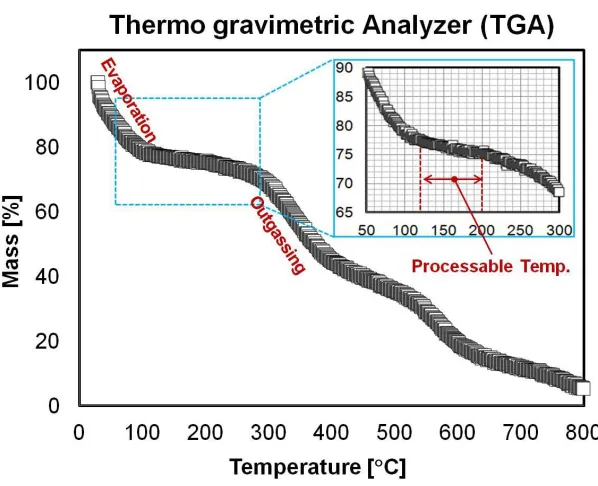
35
threads [8]. As the interdisciplinary research between thread manufacturing and IT has recently
36
accelerated, various cases of smart textile that incorporate display elements have been reported, and
37
smart textile technology is evolving to integrate information-processing and data-transmission
38
elements into textiles [9]. Smart textiles that incorporate sensors can be utilized in various
39
applications such as in military [10], medical [11-16], fashion, and sport [17] applications. Because of
40
their flexibility and stretchability, textiles can be easily applied to large surface areas, and
41
approximately 70% of the surfaces that people touch every day (e.g., clothes, beds, wall materials,
42
interior decorations, and floor materials) use textiles. We believe that textile-based materials and
43
structures integrated with active electronic elements/ systems will enable emergence of more
44
efficient and sustainable electronic textiles and bring about a groundbreaking technological turning
45
point in improving mechanical properties during bending, one of the biggest issues in the field of
46
modern flexible electronics/displays [18, 19]. Electronic textiles — threads dyed with conductive inks
47
— can be prepared by the following methods: dip dyeing, roller printing, screen printing, inkjet
48
printing, spray printing, and transfer printing (which includes spin coating). In the current research,
49
we prepared temperature sensors for wearable devices by dip dyeing threads in poly (3,
50
4-ethylenedioxythiopene) polystyrene sulfonate (PEDOT:PSS) (conductive polymer) solution and
51
evaluated their characteristics.
52
2. Design and Fabrication
53
Textile temperature-sensor samples were prepared by dip dyeing 3-cm cotton threads with a
54
diameter of 0.25 mm (cross-sectional area: 0.049 mm2) in PEDOT:PSS (Heraeus, CLEVIOSTM PH1000).
55
In cotton threads, the sericin layer swells when it comes in contact with water; thus, cotton threads
56
have the best swelling capacity compared with other threads. They also possess excellent thermal
57
conductivity; thus, they were chosen as dip dyeing material [20]. Fig. 1 shows the changes in the
58
resistance of the PEDOT:PSS ink dip-dyed textile temperature sensors according to the variations in
59
the annealing temperature and time.
60
61
Figure 1. Influence of annealed time and temperature on the resistance of a thread-type sensor. The
62
resistance of PEDOT:PSS changes depending on the annealing temperature and time.
63
The resistance of the PEDOT:PSS (a mixture of PEDOT, a conductive polymer, and PSS, a
64
water-soluble polymer electrolyte) changes depending on the annealing temperature. As the
65
annealing temperature increases, the PSS that surrounds the PEDOT disassociates, decreasing the
66
resistance [21-24].
67
A thermogravimetric analyzer (TGA) was used to monitor the changes in the weight of the
68
PEDOT:PSS due to the chemical and physical changes according to temperature. Fig.2 shows two
69
regions where decrease in the PEDOT:PSS is apparent.
70
The first decrease (up to 150 °C) was due to water evaporation; the second decrease (220-320 °C)
71
observed at the PSS dissociation phase was due to SO2/SO3 outgassing around 250 °C [21, 25].
72
Therefore, we chose 200 °Ϲ as the annealing temperature to obtain maximum conductivity without
73
exceeding 250 °Ϲ. At 200 °Ϲ, different annealing times (10 and 20 min) yielded similar low resistance
74
values; therefore, we chose 10 min as the annealing time for higher efficiency with respect to the
75
77
Figure 2. Thermogravimetric analyzer (TGA) curve of PEDOT:PSS. It shows two regions where
78
decreases in the PEDOT:PSS are apparent. The first decrease (up to 150 C) was due to water
79
evaporation. The second decrease (220-320 C) observed at the PSS dissociation phase was due to
80
SO2/SO3 outgassing around 250 C.
81
The optimal recipe we used to prepare the sensors was to first dip dye the thread samples for 10
82
min then perform annealing at 200 °C for 10 min (Fig. 3). The procedure was repeated twice to
83
increase the density of the PEDOT:PSS absorbed in the threads [20]. Electrical pads were formed at
84
the two ends of the PEDOT:PSS-dyed threads by applying a silver paste. To protect the sensors from
85
moisture and dust, an encapsulation layer was formed by dip dyeing the threads in polystyrene
86
[(C8H8)n] solution [(C8H8)n:tolune = 1:10] and air drying them at room temperature.
87
88
(a) (b)
89
Figure 3. Schematic of the process of the thread dyeing. (a) Dip dyeing and (b) annealing.
90
3. Result and Discussion
91
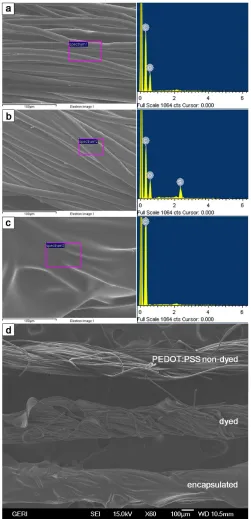
Scanning electron microscope (SEM) and energy dispersive X-ray spectroscopy (EDX) images
92
(Fig.4 left and right, respectively) show the micromorpology and components of the fabricated
93
textile sensors. The non-dyed cotton threads (Fig. 4(a)) were composed of cellulose polymer
94
((C6H10O5)n·H2O), apparent in the EDX results, confirming the presence of C and O [26]. The
95
PEDOT:PSS-dyed cotton thread (Fig. 4(b)) showed EDX peaks in the locations of C, O, and S,
96
confirming the presence of PEDOT:PSS [27]. The PEDOT:PSS-dyed cotton threads encapsulated
97
with (C8H8)n (Fig. 4(c)) showed the most prominent EDX peaks in the location of C [28,29]. Fig. 4(d)
98
shows the SEM image of all three thread types: non-dyed (original cotton thread) (upper),
99
PEDOT:PSS-dyed threads shows that the spaces between threads are filled with PEDOT:PSS (clearly
101
different from the non-dyed threads). The SEM image of the encapsulated threads failed to show the
102
threads because the (C8H8)n solution has completely covered them.
103
104
Figure 4. EDX analysis of the PEDOT:PSS non-dyed, dyed, and encapsulated threads. Surface
105
morphological and componential analysis of (a) the PEDOT:PSS non-dyed thread, (b) dyed thread,
106
and (c) dyed and encapsulated thread. (d) SEM micrograph of the PEDOT:PSS non-dyed,
107
PEDOT:PSS dyed, and PEDOT:PSS dyed and encapsulated threads.
108
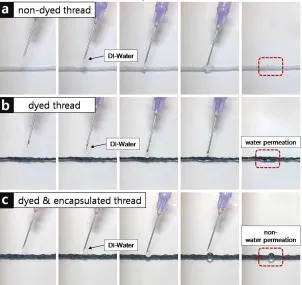
The non-dyed, PEDOT:PSS-dyed, and PEDOT:PSS-dyed and encapsulated threads were tested
109
under water to test the encapsulation effect, i.e., the hydrophobic properties of (C8H8)n [30]. The
110
non-dyed threads showed hydrophilic behavior (Fig. 5(a)) as deionized (DI)-water droplets applied
111
to the non-dyed threads were absorbed. The PEDOT:PSS-dyed threads showed similar hydrophilic
112
PEDOT:PSS-dyed threads, the PEDOT:PSS-dyed and encapsulated threads showed hydrophobic
114
behavior (Fig. 5(c)) as the DI-water droplets applied to the PEDOT:PSS-dyed and encapsulated
115
threads remained on the threads without being absorbed.
116
117
Figure 5. Hydrophilic test by dropping water on each thread sample. (a) PEDOT:PSS non-dyed
118
thread, (b) PEDOT:PSS dyed thread, and (c) PEDOT:PSS dyed and encapsulated thread.
119
The resistance of the textile temperature sensors under different textile lengths was measured at
120
25 °C. By dip dyeing at a uniform amount of time, the amount of absorbed PEDOT:PSS was the
121
same, which yielded a uniform thread thickness. To verify this result, the resistance of the textile
122
sensors under different textile lengths was measured as shown in Fig. 6. As the textile length
123
increased, the resistance of the textile sensors proportionally increased with a slope of 12.03 k Ω/cm
124
and linearity of 99.98%.
125
126
Figure 6. Resistance of a length of the PEDOT:PSS dyed thread.
127
PEDOT:PSS exhibits p-type semiconductor properties and forms an impurity state (acceptor
128
level) near the valance band with a Fermi energy level that can be calculated as follows:
129
Where Ef is the Fermi level of the extrinsic semiconductor, Efi is the Fermi level of the intrinsic
130
semiconductor, k is the Boltzmann constant, T is the temperature in Kelvin, Ni is the carrier
131
concentration of the intrinsic semiconductor, and Po is the hole concentration of the p-type extrinsic
132
semiconductor.
133
Electrical conductivity increases as the temperature increases because electrons are excited in
134
the valence band due to thermal energy, which creates holes in the valance band [31, 32]. In other
135
words, the resistance decreases as the temperature increases, which is a negative temperature
136
coefficient (NTC) of the resistance characteristic.
137
The fabricated textile temperature sensors possess an NTC characteristic, and their thermal
138
responsivity was obtained by measuring the sensor resistance (using a fixed textile length of 3 cm) as
139
the temperature was increased at an increment of 1 °Ϲ from -50 to 80 °Ϲ. The sensors exhibited a
140
sensitivity of 167 Ω/°Ϲ with 99.8 % linearity as shown in Fig. 7. The prepared textile temperature
141
sensors were used for a normal fabric stitch application and a textile-type application in which a
142
PEDOT:PSS-coated fabric for temperature sensors was woven using normal threads as shown in
143
Fig.7(b).
144
145
Figure 7. Resistance-temperature characteristics of a temperature-detection thread. (a) The
146
temperature detection thread exhibited a sensitivity of 167 /C with 99.8% linearity. (b) The
147
fabricated thread is possible to utilize as stitch and textile type wearable temperature sensor.
148
5. Conclusions
149
In this research, we have developed wearable textile temperature sensors by dip dyeing cotton
150
threads in p-type conductive polymer (PEDOT:PSS) solution. The fabricated sensors achieved a
151
sensitivity of 167.1 Ω/°Ϲ with 99.8% linearity in the temperature range of -50–80 °Ϲ. The applicability
152
of the developed textile sensors was demonstrated by sewing or weaving them into an actual cloth
153
Our developed sensors have an advantage in terms of flexibility, low cost, simple and fast
155
fabrication processes, and applicability to light and small devices. We anticipate that they will be
156
useful in various applications such as in fitness, well-being, leisure, healthcare, medical,
157
infotainment, industry, and military applications.
158
Acknowledgments: This research was supported by a grant (#365) from Gumi Core Components and
159
Materials Technology Development Program of the Gumi Regional Government.
160
Conflicts of Interest: The authors declare no conflict of interest
161
162
References
163
1. A. Lymberis; R. Paradiso. Smart fabrics and interactive textile enabling wearable personal applications:
164
R&D state of the art and future challenges. 30th Annual international IEEE EMBS conference, Vancouver,
165
British Columbia, Canada, 20-24 August; 2008; pp. 5270-5273.
166
2. C.C.Y. Poon; Yuan-Ting Zhang; Shu-Di Bao. A novel biometrics method to secure wireless body area
167
sensor networks for telemedicine and m-health. IEEE communications Magazine, 2006, 44, pp. 73-81, DOI:
168
10.1109/MCOM.2006.1632652.
169
3. C.C.Y. Poon; Benny P.L. Lo; Mehmet Rasit Yuce; Akram Alomainy; Yang Hao. Body sensor networks: In
170
the era of big data and beyond. IEEE Reviews in Biomedical Engineering, 2015, 8, pp. 4-6, DOI:
171
10.1109/RBME.2015.2427254.
172
4. A. Pentland. Looking at people: Sensing for ubiquitous and wearable computing. IEEE Transactions on
173
Pattern Analysis and Machine Intelligence, 2000, 22, pp. 107-119, DOI: 10.1109/34.824823.
174
5. Vincenzo F. Curto; Nikolay Angelov; Shirley Coyle; Robert Byrne, Sarah Hughes; Niall Moyna; Dermot
175
Diamond; Fernando Benito-Lopez. “My sweat my health”: Real time sweat analysis using wearable
176
micro-fluidic devices. 5th International Conference on Pervasive Computing Technologies for Healthcare
177
(PervasiveHealth) and Workshops, Dublin, Ireland, 23-26 May; 2011; pp. 196-197.
178
6. Andrea Ceccarelli; Andrea Bondavalli; Joao Figueiras; Boris Malinowsky; Jurij Wakula; Francesco
179
Brancati; Carlo Dambra; Andrea Seminatore. Design and implementation of real-time wearable devices
180
for a safety-critical track warning system. IEEE 14th International Symposium on High-Assurance
181
Systems Engineering, Omaha, NE, USA, 25-27 Oct.; 2012; pp. 147-154.
182
7. Young-Dong Lee; Wan-Young Chung. Wireless sensor network-based wearable smart shirt for ubiquitous
183
health and activity monitoring. Sensors and Actuators B: Chemical, 2009, 140, pp. 390-395, DOI:
184
10.1016/j.snb.2009.04.040.
185
8. J. Mitchener. What we’ll wear. Engineering & Technology, 2008, 3(18), p. 74, DOI: 10.1049/et:20081814.
186
9. Stephanie J. Benight; Chao Wang; Jeffrey B.H. Tok; Zhenan Bao. Stretchable and self-healing polymers
187
and devices for electronic skin. Progress in Polymer Science, 2013, 38, pp. 1961–1977, DOI:
188
10.1016/j.progpolymsci.2013.08.001.
189
10. C.A. Winterhalter; J. Teverovsky; P. Wilson; J. Slade; W. Horowitz; E. Tierney; V. Sharma. Development
190
of electronic textiles to support networks, communications, and medical applications in future U.S.
191
military protective clothing systems. IEEE Transactions on Information Technology in Biomedicine, 2005, 9(3),
192
pp. 402–406, DOI: 10.1109/TITB.2005.854508.
193
11. Geert Langereis; Lenneke de Voogd-Claessen; Arthur Spaepen; Auli Siplia; Christian Rotsch; Torsten
194
Linz. Context: Contactless sensors for body monitoring incorporated in textiles. IEEE International
195
Conference on Portable Information Devices, Orlando, FL, USA, 25-29 May; 2007; pp. 1–5.
196
12. Davide Curone; Gabriela Dudnik; Giannicola Loriga; Jean Luprano; Giovanni Magenes; Rita Paradiso;
197
Alessandro Tognetti; Annalisa Bonfiglio. Smart garments for safety improvement of emergency/disaster
198
operators. Engineering in Medicine and Biology Society, 29th Annual International Conference of the IEEE
199
Engineering in Medicine and Biology Society, Lyon, France, 22-26 Aug.; 2007; pp. 3962-3965.
200
13. Dittmar, A., Meffre, R., Oliveira, F. D., Gehin, C., & Delhomme, G. Wearable medical devices using textile
201
and flexible technologies for ambulatory monitoring. IEEE Engineering in Medicine and Biology 27th
202
14. Alexander J. Casson; David C. Yates; Shelagh J.M. Smith; John S. Duncan; Esther Rodriguez-Villegas.
204
Wearable electroencephalography. IEEE Engineering in Medicine and Biology Magazine, 2010, 29(3), pp.
205
44–56, DOI: 10.1109/MEMB.2010.936545.
206
15. S. Led; J. Fernandez; L. Serrano. Design of wearable device for ECG continuous monitoring using wireless
207
technology. 26th Annual International Conference of the IEEE Engineering in Medicine and Biology
208
Society, San Francisco, CA, USA, 1-5 Sept.; 2004; pp. 3318-3321.
209
16. Shirley Coyle; Yanzhe Wu; King-Tong Lau; Gordon G. Wallace; Dermot Diamond. Fabric-based fluid
210
handing platform with integrated analytical capability. 29th Annual International Conference of the IEEE
211
Engineering in Medicine and Biology Society, Lyon, France, 22-26 Aug.; 2007; p. 6450.
212
17. Hassnaa Moustafa; Holger Kenn; Kamran Sayrafian; William Scanlon; Yan Zhang. Mobile wearable
213
communications. IEEE Wireless communications, 2015, 22(1), pp. 10–11, DOI: 10.1109/MWC.2015.7054713.
214
18. Christoph Zysset; Thomas Wilhelm Kinkeldei; Niko Munzenrieder; Kunigunde Cherenack; Gerhard
215
Troster. Integration method for electronics in woven textiles. IEEE Transactions on Components, Packaging,
216
and Manufacturing Technology, 2012, 2(7), pp. 1107–1117, DOI: 10.1109/TCPMT.2012.2189770.
217
19. Simone Locci; Maurizio Maccioni; Emanuele Orgiu; Annalisa Bonfiglio. Woven electronics: A new
218
perspective for wearable technology. 29th Annual International Conference of the IEEE Engineering in
219
Medicine and Biology Society, Lyon, France, 22-26 Aug.; 2007; pp. 3940-3973.
220
20. Yujie Ding; Michael A. Invernale; Gregory A. Sotzing. Conductivity trends of PEDOT-PSS impregnated
221
fabric and the effect of conductivity on electrochromic textile. ASC Appl. Mater. Interfaces, 2010, 2(6). pp.
222
1588-1593, DOI: 10.1021/am100036n.
223
21. Bettina Friedel; Panagiotis E. Keivanidis; Thomas J.K. Brenner; Agnese Abrusci; Christopher R. McNeill;
224
Richard H. Friend; Neil C. Greenham. Effects of layer thickness and annealing of PEDOT:PSS layers in
225
organic photodetectors. Macromolecules, 2009, 42, pp. 6741–6747, DOI: 10.1021/ma901182u.
226
22. Liam S.C. Pingree; Bradley A. MacLeod; David S. Ginger. The changing face of PEDOT:PSS films:
227
Substrate, bias, and processing effects on vertical charge transport. J. Phys. Chem. C, 2008, 112, pp.
228
7922–7927, DOI: 10.1021/jp711838h.
229
23. Youngkyoo Kim; Minjung Shin; Hwajeong Kim. Annealing temperature effect of hole-collecting
230
polymeric nanolayer in polymer solar cells. Macromolecular Research, 2008, 16, pp. 185-188, DOI:
231
10.1007/BF03218850.
232
24. M. Kemerink; S. Timpanaro; M.M. de Kok; E.A. Meulenkamp; F.J. Touwslager. Three-dimensional
233
inhomogeneities in PEDOT:PSS Films. J. Phys. Chem. B, 2004, 108, pp. 18820–18825, DOI:
234
10.1021/jp0464674.
235
25. G. Greczynski; Th. Kugler; W.R. Salaneck. Characterization of the PEDOT-PSS system by means of X-ray
236
and ultraviolet photoelectron spectroscopy, Thin Solid Films, 1999, 354, pp. 129–135, DOI:
237
10.1016/S0040-6090(99)00422-8.
238
26. Jian Le; Long Yan; Yuzhu Zhao; Fei Zha; Qingtao Wang; Ziqiang Lei. One-step fabrication of robust
239
fabrics with both-faced superhydrophobicity for the separation and capture of oil from water. Phys. Chem.
240
Chem. Phys., 2015, 17, pp. 6451–6457, DOI: 10.1039/c5cp00154d.
241
27. Hu Young Jeong; Jong Yun Kim; Tae Hyun Yoon; Sung-Yool Choi. Bipolar resistive switching
242
characteristics of poly (3,40ethylene-dioxythiophene): poly (styrenesulfonate) thin film. Current Applied
243
Physics, 2010, 10, pp. 46–49, DOI: 10.1016/j.cap.2009.12.011.
244
28. Xiaona Wang; Rongchun Xiong; Gang Wei. Preparation of mesoporous silica thin films on polystyrene
245
substrate by electrochemically induced sol–gel technique. Surface & Coatings Technology, 2010, 204, pp.
246
2187-2192, DOI: 10.1016/j.surfcoat.2009.12.003.
247
29. Qinhui Chen; Qingqin Li; Jinhuo Lin. Synthesis of Janus composite particles by the template of
248
dumbbell-like silica/polystyrene. Materials Chemistry and Physics, 2011, 128, pp. 377–382, DOI:
249
10.1016/j.matchemphys.2011.03.009.
250
30. Sanjay S. Latthe; Chiaki Terashima; Kazuya Nakata; Akira Fujishima. Superhydrophobic surfaces
251
developed by mimicking hierarchical surface morphology of lotus leaf. Molecules, 2014, 19, pp. 4256–4283,
252
DOI: 10.3390/molecules19044256.
253
31. Walid A. Daoud; John H. Xin; Yau S. Szeto. Polyethylenedioxythiophene coatings for humidity,
254
temperature and strain sensing polyamide fibers. Sensors and Actuators B, 2005, 109, 329–333, DOI:
255
32. A. Elshchner; S. Kirchmeyer; W. Lovenich; Udo Merker; K. Reuter. PEDOT:PSS. PEDOT, Principles and
257
Applications of an Intrinsically Conductive Polymer, CRC Press: Boca Rato, FL, USA, 2011; pp. 113–166,