Rescue Robot for A-Live Human Detection in
Disaster Zones Using MEMS
Deepa S1Anjali M.A2, Parkavi.G G3, Srilatha S4, Sushmitha A.R5,Manimurugan M6
Associate Professor, Dept. of EEE, Panimalar Institute of Technology, Chennai, Tamilnadu, India1
UG Student, Dept. of EEE, Panimalar Institute of Technology, Chennai, Tamilnadu, India2,3,4,5
Assistant Professor, Dept. of EEE, Panimalar Institute of technology, Chennai, Tamilnadu,India6
ABSTRACT: The number of man-made and natural disasters in the past years has urged rescue communities and international emergency search to seek for novel technology to enhance operation efficiency. Tele-operated rescue robots search that can navigate deep to search for victims and to transfer critical field data back to the control room has gained much interest among emergency response institutions. In response to this need, a low-cost robot equipped with PIR sensor, accelerometer, camera and wireless communication module is developed. The robot can navigate autonomously between damaged areas to look for living body heat and can send back audio and video information to allow the operator to determine if the found object is a living human.
KEYWORDS: PIR sensor, MEMS Wireless Network, Intelligent Unmanned Robot
I.INTRODUCTION
Emergency search and rescue is an integral part of most large-scale humanitarian operations. With the rising awareness of world humanitarian crisis, Non Governmental Organization humanitarian relief operations are gaining more support from the public financially and their annual expenditure on relief missions around the globe are comparable to the military expenditures of many countries. International Committee of Red Cross for example has spent 958.7 million Swiss Franc on its worldwide relief projects in 2005, which is comparable to the military expenditure of Philippines. ICRC for example has increased its mission expenditures by 16% since year 2000, and MSF has also increased by 13% from 2000 to 2004. In contrary to the rich financial resources, search and rescue technology to-date still rely on search dogs, camera mounted probes; mainly technology that has been in service for decades. With the increasing demand for scapegoats to go into dangerous environment, robots are being identified as good candidates to step in for human rescuers. Robots equipped with advanced sensors have therefore become more and more popular in the search and rescue theatre. This paper begins with brief introductions on emergency search and rescue operations and robotics search and rescue systems, then moves on to describe the design principle of the newly developed robot prototype and details of its mechatronic design. The design of the distributed control system is also discussed before conclusions at the end of the paper.
II.ROBOT-ASSISTED SEARCH AND RESCUE SYSTEMS
increment in the speed and capability of microcontrollers, rescue robots small enough to thread through rubbles are rolling out of experimental laboratories into catastrophic areas. The first real research on search and rescue robot began in the aftermath of the Oklahoma City bombing in 1995 (Murphy 2004a). Robots were not used at the bombing response, but suggestions as to how robots might have been applied were taken. In 2001, the first documented use of urban search and rescue robots took place during the 9/11 World Trade Center (WTC) disaster. Mobile robots of different sizes and capacities were deployed. These robots range from tethered to wireless operated, and from the size of a lunch box to the size of a lawnmower (Snyder 2001). Their primary functions are to search for victims and paths through the rubble that would be quicker to excavate, perform structural inspection and detection of hazardous material. During the WTC response, four teams of scientists coordinated by Center for Robot-Assisted Search and Rescue (CRASAR) were called to the operation. These groups of scientists were from a variety of sectors include University of South Florida (USF), Space and Naval Warfare Systems Command (SPAWAR), Foster-Miller Inc., and iRobot Inc. Despite many robots were present with these groups, only two types (three robots) were officially used on the rubble pile (Murphy 2004b). These robots were Micro-VGTV (Variable Geometry Tracked Vehicle) by Inuktun Service Ltd. (Micro-VGTV 2006), and Solem and Talon by (Foster-Miller Inc. 2007). Though current search and rescue robots are far from perfect and are not likely to replace human rescuers and search dogs in the near future, they have demonstrated promising characteristics to assist human rescuers.
III BLOCK DIAGRAM
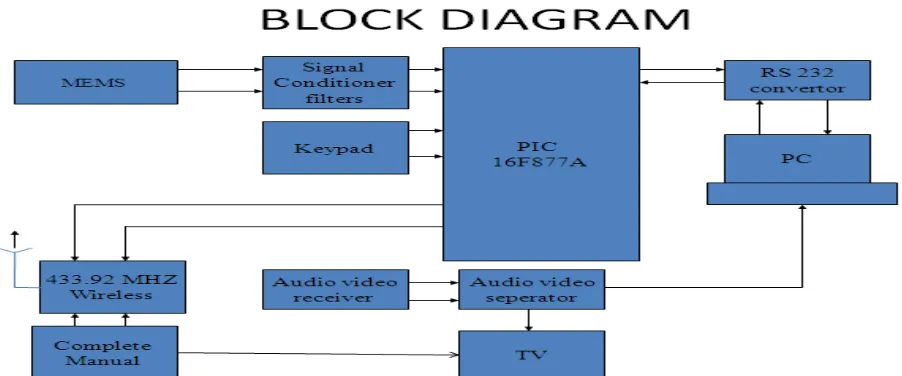
In control room we are going to monitor the images received from audio, video transmitters and appropriate control action will be delivered by embedded system with the support of pc and wireless.
1. MEMS:
Micro Electro Mechanical system are expected to detect a variety of signals associated with accelerations (velocity and forces), biological and biomedical, chemical, forces (eg. Micro accelerometers and gyroscopes), optical, pressure, thermal (temperatures), etc
2. SIGNAL CONDITIONERS:
This circuit will receive analog signal of 5mv -20mv and amplify then up to 5v to have interface with embedded microcontroller. This circuit will consist of amplifier, zeroing circuit, span control circuit, filters and current amplifiers. Output of this circuit will be ripple free, noise and distortion free output of this will be fed to an op amp with 5v protected zener in parallel.
3. KEY PAD:
This is an alternative for biological input, if the concern person is unable to create biological data this can be used as an option to execute the work in time accurately .this will be connected to logical port of Embedded controller.
4. RS 232 CONVERTER:
This circuit is essential to convert embedded level data in to computer level data i.e.., converting 5v into 20v and vice versa. This is a international standard of serial computing.
5. PC:
On pc we can able to view the magnitude of biological data, selection of input type, data base, voice output and image.control action related software will be developed on pc environment.
6. PIC 16F 877A EMBEDDED CONTROLLER:
This is a state of art embedded controller can access analog inputs, digital inputs, serial inputs and can process at very higher speed interface with computer.
This eye interacts with many built in features to reduce electronic complexity of our project. Because our project controls room system requires both analog and digital computing.
7. WIRE LESS TRANSMITTER:
We are going to implement 433.92 MHz zigbee band based RF transmitter to our project for effective, quick, reliable type and 12v dc operated. This can be switched by relays.
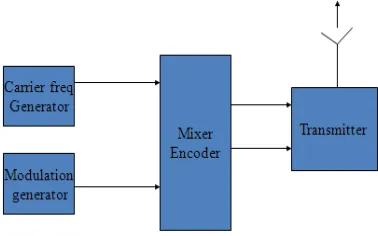
Block diagram for transmitter
433.92 MHz carrier frequency generator will be used in this for short distance reliable data communicate. In winter, distance of communication is 100metres and in summer this will be approximately 300 meters.
Fig 2: Block diagram of Transmitter
36,37,38,39 kHz modulation frequency generators will be used to differentiate the signal delivered for various applications. This is the real data to be executed for mechanical movement.
MIXER ENCODER: This is to mix carrier and modulation system and encoded for signal transmission.
COMPLETE MANUAL:
This is to enable redundancy operations in emergency case. If the control person feels, the operation from control room is inadequate and wants to move towards the field along with the above, in such case carrying computer, biological senor and associated system will not be a carry small LCD TV take control action is essential.
When all the above are integrated together, it will form a best control room for virtual human.
IV. FIELD DEVICE
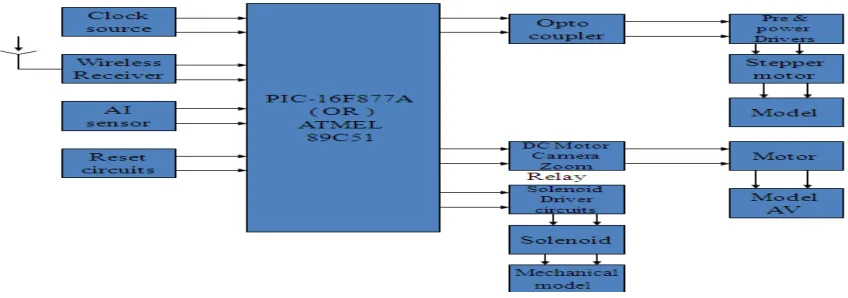
The field device is a mechatronics device consisting of mechanical model and electronic circuit required to control the mechanical model as per the instruction give from control room.
1. WIRELESS RECEIVER:
The data send from the control room will be received by this device and decodes and fed to microcontroller port the receiver will be 4 channels.
2. AI SENSORS:
Predictive type Artificial intelligence is used in this project to safeguard the mechanical model from hazardous problems. The problem may be hazardous or simple, the sensor senses and provides logical data to the port, as per the program given to it, the movement will be controlled. Sensors for fire detection, intrusion detection, electromagnetic field detector, and landmine detectors are few examples for AI sensors.
All the AI sensors will be connected through transistor amplifiers and Schmitt triggers for perfect impedance matching. The sensors will be 12v operated, but the Microcontroller and eye need only 5V logic input. So transistor and Schmitt triggers will accept 12 V signal and provides 5V logic to microcontrollers with good noise rejection.
Fig 3: Block diagram of Field control
3. PIC 16F877A (or) ATMEL 89C51:
4. ASSOCIATED CIRCUITS FOR MICROCONTROLLER:
Components required working with micro Controllers like reset Switches, crystal oscillators for clock generation and pull up resistor package for P1.0 in case of ATMEL 89C51
5. OPTOCOUPLERS:
This device is very much essential to avoid back emf, which may be generated by stepper motors during turn off conditions. Back EMF may destroy all electronic components. CNY 17 II type opto couplers will be used to pass the data by means of IR with greater electrical isolation.
6 .PREDRIVERS AND POWER DRIVERS:
These devices are medium and light current amplifiers to drive stepper motor by accepting logical data’s from opto-coupler. Approximate amplification at predriver is 10 and power drivers will be 200 overall gain will be 2000.
7. STEPPER MOTOR:
This is employed to rotate the mechanical model as prescribed by the program and flow of work. Stepper motors are the only suitable option for our project because of the following options.
The speed of the stepper motor will not be affected by change in voltage, Change in current, Change in torque
Stepper motor does not have inertia
Stepper motors are bipolar
No need of commutation & cooling.
Easy speed control by PWM
So stepper motors are good choice for basic movement for camera movement we are going to use DC motor, because the whole operations will be limited to 180˚ like whiper motor.
8. Mechanical Model:
Mechanical model can be created according to the need and imagination using fabric grade by sheet metals.
9. W/L IR CAMERA:
A hybrid IR enabled camera made up of CMOS technology will be employed in our project .The camera will have hybrid circuit to sense the ambient exit and activates IR radiation as and when required. This will have built in audio receiving MIC and both AV will be converted as wireless signal.
10. AMMUNITION DELIVERY SYSTEM:
This will be made up of solenoid valve and mechanical spring arrangement to deliver ammunition, which should be stacked.
V. FUTURE ENHANCEMENTS
This project can be enhanced in future as follows:
Fire fighting robot to rescue people who are struggling to come out of the fire, to dispose the fire by using the extinguishing gas.
Robot for Image restoration, processing, transfer using Bluetooth
The other latest technologies like GSM, GPS (Global Positioning System) etc.
VI. CONCLUSIONS
This paper presented a low-cost search and rescue robot system that can navigate into voids in rubbles, avoid obstacles, detect living human body temperature, transfer video image, and communicate in a low-Power MEMS network. The robot system consists of two robots and one operator console and can be expended to include any number of robots. The immunity-based control system enables the system to be controlled in decentralized manner using simple commands and limited communication power. In spite of the technological challenges and mistrust of new technologies in human nature, search and rescue robots will become an indispensable tool in future rescue operations. Starting to develop and field search and rescue robots with regular rescue teams can help scientists to better understand the strength and weaknesses of different robot designs under different situations.
Having robots working in parallel with regular rescue team can also help scientists to investigate how robots should behave to comply with their operators’ instructions and to best assist the rescue effort in general. User friendly operation control interface allows amateur rescuers to be trained to operate the robot in a shorter period of time, eliminating the need to occupy limited professionals to look after each robot. Low manufacturing cost allows robots to be deployed in mass quantity to increase the chance of finding survivors. Battery is the heart of robots; it keeps electricity pumping inside the robots. Lighter, smaller and more powerful battery is also an important constituent of effective search and rescue robots. Emergency wireless network for communication is also important for coordinating actions between robots, collecting visual image from the robots, and to communicate with the victim when the robot finds one.
REFERENCES
[1] B. Bharathi, B. Suchitha Samuel “Design and Construction of Rescue Robot and Pipeline Inspection Using Zigbee” International Journal Of Scientific, Engineering and Research (IJSER) Volume 1 Issue 1, September 2013.
[2] Sridhar Palaniswamy “ Life Saving Machine” the first International Conference on Interdisciplinary Research and Development, 31 May-1 June 2011, Thailand.
[3] O. Tatar, D. Mandru, “Design of in-pipe modular robotic systems”, Vol.147-149, pp. 49-54, 2009.
[4] Alan Mutka and Zdenko Kovacic “A Leg-wheel robot based approach to the solution of flipper-track robot kinematics”, IEEE International Conference on Control Applications, 28-30 September, 2011, USA.
[5] Camera - Direct web search on google.com
[6] J. Burke and R.R.Murphy, “Human-robot interaction in USAR technical search: Two heads are better than one,”in Proc.IEEE Int. Workshop ROMAN, Kurashiki, Japan, 2004, pp. 307-312.
[7] J. Casper and R. R. Murphy, “Human-robot interactions during the robot assisted urban search and rescue response at the world trade center,” IEEE Trans. Syst., Man, Cybern. B, Cybern. Vol. 33, no. 3, pp. 367–385, Jun. 2003.