Available online:
https://edupediapublications.org/journals/index.php/IJR/
P a g e | 570Design and Optimization of Route Selection in Wireless Sensor
Networks using Fuzzy Logic and Genetic Algorithm
Rupinder Kaur & Prof.Mandeep Kaur
Department of Electronics and Communication Baba Banda Singh Bahadur Engineering College Fatehgarh Sahib, Punjab
[email protected] & [email protected]
Abstract—
Due to the advancements in the selection process of routing, several researchers have given their solutions which have faced several issues. Considering this fact, a combination of fuzzy and genetic algorithm has been proposed in the paper. The proposed work evaluates the shortest distance between the sources to the destination. In the traditional fuzzy approach, the parameters were speed, energy and hop count only. Thus, the proposed method extends the number of parameters, the performance parameters such as Distance and Delay in the system to enhance the proficiency of the work In the proposed work, fuzzy approach has used to calculate the fitness value and the genetic algorithm has used to optimize the results. Consequently, the experiential analysis has performed between the proposed work and the traditional in terms of different parameters such as throughput, Packet delivery ratio and the packet loss. From the analysis, it has concluded that the proposed work outperforms the traditional approach where the total numbers of packets sent at the destination are higher and acquires the shortest distance from source to the destination.Keywords—
Routing, Genetic Algorithm, Fuzzy Logics, Optimization.I.
I
NTRODUCTIONMobile networks have distinctive features as compared to wired networks. Node mobility may cause regular network topology modifications in mobile networks, which are unusual in wired networks. In comparison with the stable link ability of wired networks, wireless link capacity frequently changes due to the impacts from transmission power, receiver sensitivity, noise, fading and interference [1][2]. Moreover, wireless mobile networks have a high error rate, energy limitations and bandwidth restrictions. Mobile networks can be categorized into infrastructure networks and mobile ad hoc networks as per their dependence on fixed infrastructures. In an infrastructure of a mobile network, mobile nodes consist of wired access points (also known as base stations) within their range of transmission [3]. These base stations construct the backbone for a network infrastructure. Moreover, mobile ad hoc networks are autonomously self-organized networks without requiring the aid of any infrastructure. In a mobile ad
hoc network, nodes move randomly, hence the network may experiences quick and volatile modifications in topology [4]. Some of the nodes cannot communicate with each other directly because of the restricted transmission ranges in a mobile ad hoc network. Therefore in mobile networks, multiple hops are possibly contained within routing paths and each individual node has the responsibility of performing as a router in mobile ad hoc networks [5].
Mobile ad hoc networks commenced from the DARPA Packet Radio Network (PRNet) and SURAN project. Being autonomous on infrastructure that is pre-recognized; some of the benefits that mobile ad hoc networks include: quick and easy deployment enhanced mobility and low costs [6]. Whether it is an unfriendly application where no infrastructure exists or a provisional mobile application where cost is the critical part, mobile ad hoc networks are suitable for both the mobile applications [7]. The significance of mobile ad hoc networks have increased in current years in multiple domains of application such as industrial areas, non-military public organizations and in commercial regions. The fundamental cases of these application domains in which mobile ad hoc networks are used: rescue missions, the law enforcement operations, the traffic management, the educational operations in campus and the cooperating industrial robots [8].
The main key features in MANETs are to choose a node to transmit the data and generate a path from source to the destination. In order to establish a route, several techniques have been proposed that uses few parameters for the selection of route and lacking in providing a shortest path [9]. The only parameter which considered for the route selection was Energy. Therefore, a single energy parameter cannot rely on the efficiency of the route [10][11]. Consequently, two more parameters have used to select the route where the Genetic Algorithm is used to attain the maximum fitness value. So, the node having maximum fitness value than before has been saved and used for the route evaluation. In such case, the process will be continued to the formation of route.
Available online:
https://edupediapublications.org/journals/index.php/IJR/
P a g e | 571II. BACKGROUND
Routing in the wireless network is the vital issue as there is not any fixed architecture for communication. Each node in the network can behaves as if router and sends packet further to the destination node. Various routing techniques have been developed for efficient routing in order to establish the proper communication and data transmission among sender and receiver node. After studying the work that had been done in past few years, it is observed that traditionally various soft computing techniques were used for finding the shortest and suitable route for data delivery, but the problem was that the parameters that were considered for route selection were lesser in number or not relevant to create an shortest path between sender and receiver node. Another lacking point was that the nodes for route creation were selected randomly which affects the overall performance and lifetime of the network. Hence there is a need to develop such a system which can consider all the relevant parameters for route selection and data transmission and also selects the nodes for creating a route on the basis of some practical criteria that enhances the lifetime or performance of the network.
III. PRESENT WORK
Hence the proposed work will be created by considering the lacking points of traditional work. The proposal is a combination of fuzzy system and Genetic algorithm. The purpose behind using the fuzzy system is to evaluate the fitness value and GA aims to optimize the observed results for effective route creation. The numbers of parameters are enhanced by adding to more parameters to the traditional work i.e. Distance and Delay. At last the results will be calculated and compared with the traditional results for evaluating the proficiency of proposed work as compare to traditional work. The evaluation of the proposed parameters is mentioned as:
1. Distance
This parameter is used to calculate the distance between two nodes in order to select an appropriate node for the transmission of data. The formula which is used for the calculation of this parameter is:
𝐷𝑖𝑠𝑡𝑎𝑛𝑐𝑒 =√(𝑋1−𝑋2)2+(𝑌1−𝑌2)2
2 …….(1)
2. Delay
In order to acquire the overall delay in the network, a delay parameter is used. This parameter estimates the competence of the proposed work. Less delay in the network ensures higher feasibility of the particular technique. The equation used to evaluate the Delay parameter is as follows:
𝐷𝑒𝑙𝑎𝑦 = 𝐷𝑖𝑠𝑡𝑎𝑛𝑐𝑒
𝑆𝑝𝑒𝑒𝑑 𝑜𝑓 𝑙𝑖𝑔ℎ𝑡………(2)
IV. METHODOLOGY
The proposed has combined the fuzzy logics with the genetic algorithm which provides more accurate and efficient results.
4.1 Block Diagram
The Block Diagram of the proposed work has shown below which portrays the flow of the work.
Design a Fuzzy interface system
Design Network structure i.e. area, number of nodes
Calculate parameters such as speed, hop count
Perform Crossover Initialize the initial
population
Calculate the fitness value
Calculate the fitness parameter
If newfit>
initial fit Save result Yes
No
Perform Mutation
Available online:
https://edupediapublications.org/journals/index.php/IJR/
P a g e | 572Figure 1 Block Diagram of the proposed work
The methodology for the proposed work is described below: 1. Initially designed the fuzzy interface system to
operate with number of inputs.
2. Secondly, designed the network with number of nodes, defined areas, source and the destination. 3. Calculate the parameters in the network such as:
Speed and Hop count.
4. Now initialize the initial solution to the problem or the initial population to start the execution of the work.
5. Calculate the fitness value of the Genetic Algorithm to initiate the process and then perform the crossover over the acquired fitness value.
6. After performing the crossover over the fitness value, again calculate the value of the fitness.
7. Now compare the before crossover and after crossover fitness value. If the new fitness value is greater than the initial fitness value then saves the result.
8. If the fitness value i.e. new fitness value is not greater than the initial fitness value than again perform the crossover over the acquired fitness value.
9. After applying crossover, now perform mutation over the fitness value on which crossover has performed before.
10. Once the crossover and the mutation have performed then again calculate the result of after and before mutation’s fitness value. The process will be continued to the number of iterations defined. Once the result has acquired from the process, performance parameters will be calculated to know the efficiency of the proposed work in comparison with the traditional approach.
V. RESULTS AND DISCUSSION
The result section of the paper illustrates the traditional and the proposed technique in terms of different performance parameters such as Packet loss, Packet Delivery Ratio and the throughput. From the results acquired, it can be concluded that the proposed technique outperforms the traditional technique. The evaluation of performance parameters has done using following equations such as:
1. PDR: Packet Delivery Ratio performance parameter is used to estimate the total number of packets received at the destination with respect to the total number of packets sent in the network.
𝑃𝐷𝑅 =𝑃𝑎𝑐𝑘𝑒𝑡 𝑅𝑒𝑐𝑒𝑖𝑣𝑒𝑑
𝑃𝑎𝑐𝑘𝑒𝑡 𝑇𝑜𝑡𝑎𝑙 ∗ 100………(1)
2. Packet Loss: the total number of packets lost at the time of transmission has been evaluated in this performance parameter.
𝑃𝑎𝑐𝑘𝑒𝑡 𝑙𝑜𝑠𝑠 = 𝑃𝑎𝑐𝑘𝑒𝑡𝑇𝑜𝑡𝑎𝑙− 𝑃𝑎𝑐𝑘𝑒𝑡𝑅𝑒𝑐𝑒𝑖𝑣𝑒𝑑 .(2)
3. Throughput: identifies the capability of the network in terms of receiving packets at the destination. The evaluation of the throughput in the proposed work is done as:
𝑇ℎ𝑟𝑜𝑢𝑔ℎ𝑝𝑢𝑡 = 𝑃𝑎𝑐𝑘𝑒𝑡𝐿𝑜𝑠𝑠
𝑆𝑖𝑚𝑢𝑙𝑎𝑡𝑖𝑜𝑛𝑇𝑖𝑚𝑒… … (3)
On the basis of above described parameters, performance of individual technique has evaluated and concludes their performance separately.
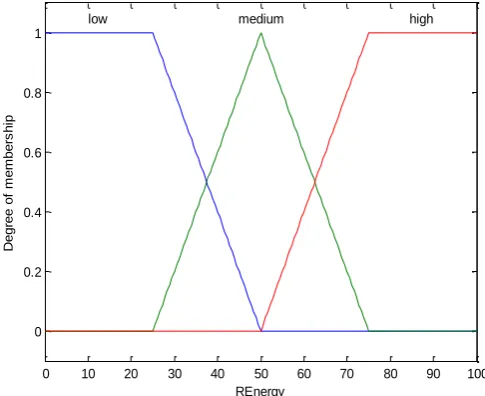
The below figure shows the membership functions of the parameters which have been used in the proposed work. The first parameter used as an input to the Fuzzy Inference System is Residual energy of each node in the network. The membership functions of the first input REnergy are Low, Medium and High which varies from o to 1.
Figure 2 Residual Energy of the proposed work
0 10 20 30 40 50 60 70 80 90 100
0 0.2 0.4 0.6 0.8 1
REnergy
D
e
g
re
e
o
f
m
e
m
b
e
rs
h
ip
Available online:
https://edupediapublications.org/journals/index.php/IJR/
P a g e | 573Figure 3 Speed of the proposed work
The figure above depicts the speed of the proposed work as a second input whose membership functions is low, medium and high varies from 0 to 1.
Figure 4 Hop Count of the proposed work
The figure 4 exemplifies the hop count of the proposed work considered as a third input to the FIS. The range varies from 0 to 1 with membership functions of Short, Medium and Long.
Figure 5 Deployed nodes in the network
The figure 5 depicts the deployment of nodes in the network. The nodes which are green in color are treated as a source and the destination. The area defined for the network is 100 by 100 and total number of nodes deployed in the network is also 100. Among the 100 nodes, node 5 is considered as a source node and node number 95 is taken as destination node.
Figure 6 Calculated path from source to the destination
The figure 6 exemplifies the path which has chosen from source to destination. In the above figures, different parameters have shown on the basis of which a node has
0 5 10 15 20
0 0.2 0.4 0.6 0.8 1
Speed
D
e
g
re
e
o
f
m
e
m
b
e
rs
h
ip
low medium high
0 2 4 6 8 10 12
0 0.2 0.4 0.6 0.8 1
HopCount
D
e
g
re
e
o
f
m
e
m
b
e
rs
h
ip
short medium long
0 10 20 30 40 50 60 70 80 90 100
0 10 20 30 40 50 60 70 80 90 100
X-axis
Y
-a
x
is
Network Structure
0 10 20 30 40 50 60 70 80 90 100
0 10 20 30 40 50 60 70 80 90 100
X-axis
Y
-a
x
is
Available online:
https://edupediapublications.org/journals/index.php/IJR/
P a g e | 574selected to transmit the data and thus a shortest route has defined.
The figure 7 depicts the performance parameter of fuzzy approach and the proposed technique termed as Genetic Algorithm and the Fuzzy approach. From the figure, it is clear that packet loss ratio of the fuzzy approach is higher in comparison with the proposed work. Moreover, the Packet Delivery ratio is less and Throughput is higher in the proposed work which resultant into high efficiency of the system.
Figure 7 Performance parameter of fuzzy and proposed work
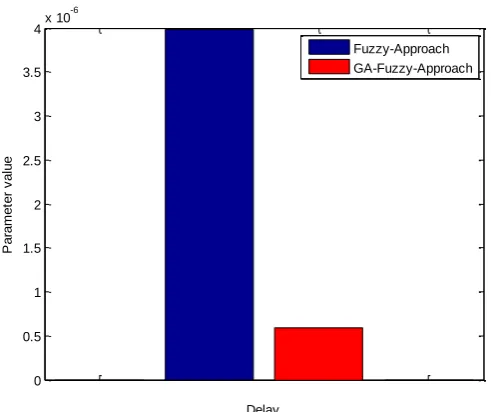
Figure 8 Delay parameter of the different techniques
The figure 8 illustrates the Delay parameter of the traditional and the proposed model. The proposed technique has less delay in comparison with the traditional fuzzy approach. The
delay of the GA-Fuzzy approach is 0.5 whereas the delay of the traditional model is around 4 which is quite higher.
Figure 9 Distance parameter of the traditional and the proposed technique
The figure 9 represents the Distance parameter of the traditional and the proposed work. The table clearly concludes that the proposed technique forms shortest distance from source to the destination in comparison with the fuzzy approach.
Figure 10 Packet Delivery ratio of traditional and proposed technique
Packet Loss PDR Throughput
0 50 100 150 200 250 300 350
P
a
ra
m
e
te
r
v
a
lu
e
Fuzzy-Approach GA-Fuzzy-Approach
0 0.5 1 1.5 2 2.5 3 3.5
4x 10
-6
P
a
ra
m
e
te
r
v
a
lu
e
Delay
Fuzzy-Approach GA-Fuzzy-Approach
0 200 400 600 800 1000 1200
P
a
ra
m
e
te
r
v
a
lu
e
Distance
Fuzzy-Approach GA-Fuzzy-Approach
0 100 200 300 400 500 600 700 800 900
S
e
n
t
Packet
Available online:
https://edupediapublications.org/journals/index.php/IJR/
P a g e | 575The total packet sent at the destination has shown in the below figure 10. The total packets sent by the proposed GA-Fuzzy are around 850 whereas only 695 packets have sent to the destination by fuzzy approach.
VI. CONCLUSION AND FUTURE SCOPE
In this work the concept of routing in a network is implemented by using Fuzzy approach and the Genetic Algorithm. The aim of using the GA-fuzzy approach for routing is to enhance the performance of the network. Fuzzy method is suitable for creating the robust routes or path in a network and GA ensures the optimization of the selected route as compared to the traditional fuzzy approach. The proposed technique has measured in terms of different performance parameters such as Packet loss, PDR, Throughput, Delay and the total distance. The performed analysis confirmed the efficiency of the proposed technique. The total packet sent at the destination using the proposed technique are higher i.e. 850 whereas the traditional approach remains at 650. Moreover, the proposed technique routes the shortest distance as compared to the tradition fuzzy approach. Consequently, the proposed technique is more efficient from every aspect such as highest throughput, high mobility environment and more enhanced efficiency of the network.
More research can be done in the future on the input parameters of fuzzy approach such as parameters of real scenario, rule based parameters can be considered for establishing more reliable and robust route in the network. Additionally, the fuzzy approach can be collaborated with more advanced soft computing techniques.
REFERENCES
[1] Seema, Reema Goyal, “A Survey on Deployment
Methods in Wireless Sensor Networks”, ijarcsse, vol 3 (7), Pp 540-544, 2013
[2] Amith Khandakar , “ Step by Step Procedural
Comparison of DSR, AODV and DSDV Routing protocol “, ICCET, vol 40, Pp 36-41, 2012
[3] Vibha Yadav , “Localization Scheme For Three
Dimensional Wireless Sensor Networks Using Gpsenabled Mobile Sensor Nodes”,ijngn, vol 1(1), Pp 60-73, 2009
[4] Rajesh Sharma, “ Dynamic Source Routing Protocol
(DSR) “, ijarcsse, vol 3 (7), Pp 239- 241, 2013
[5] Amit N. Thakare , “Performance Analysis of AODV &
DSR Routing Protocol in Mobile Ad hoc Networks”, ijca, vol 4, 2010
[6] Rajeshwar Singh , “Performance Evaluation of DSR and
DSDV Routing Protocols for Wireless Ad Hoc Networks. “ ,ijana, vol 2(4), Pp 732-737, 2011
[7] Pallavi Sahu, , “ Deployment Techniques in Wireless
Sensor Networks”, ijsce, vol 2(3), Pp 525-526, 2012
[8] Guoyou He,” Destination-Sequenced Distance Vector
(DSDV) Protocol, An ad hoc network is a collection of mobile nodes forming an instant network without fixed topology.” ,
[9] Hemanth Narra, “Destination-Sequenced Distance Vector
(DSDV) “, 2011
[10] Manish Kushwaha, “Sensor Node Localization Using
Mobile Acoustic Beacons”, IEEE, Pp 1-9, 2005
[11] Haitao Zhang , “A Review on Node Deployment of
Wireless Sensor Network”, ijcsi, vol 9(6), Pp 378-383, 2012
[12] Rabeb.F , “ An extensive comparison among DSDV, DSR and AODV protocols in Wireless Sensor Network”, IEEE, Pp 1-5, 2012
[13] Fasee Ullah , “Simulating AODV and DSDV For A
dynamic Wireless Sensor Networks”, 2010
[14] Andreas Savvides, “ Localization in Sensor Networks,”
IEEE, Pp327-349, 2014
[15] Nandkumar P. Kulkarni, “Performance Evaluation of AODV, DSDV & DSR for Quasi Random Deployment of Sensor Nodes in Wireless Sensor Networks”, IEEE, Pp 5,2011
[16] Yih-Chun Hu , “SEAD: Secure Efficient Distance Vector Routing for Mobile Wireless Ad Hoc Networks “, ELSEVIER, Pp 175-192, 2013
[17] Ramakrishna M, “DBR: Distance Based Routing Protocol
for VANETs “, ijiee, vol 2(2), Pp 228-232, 2012
[18] J.J. Garcia, “Name-Based Content Routing in
Information Centric Networks Using Distance Information “,IEEE, Pp 7-16, 2014
[19] Sumitha J, “Routing Algorithms in Networks “,isca, vol 3,
Pp 1-3, 2014
[20] Antonio Carzaniga, “A Routing Scheme for
Content-Based Networking”
[21] Cheng-Fu Chou , “Straight line routing for wireless sensor networks”, IEEE, June 2005
[22] Prosenjit Bose , “Routing with Guaranteed Delivery in Ad Hoc Wireless Networks ”, Vol 7, pp 609-616, 2001
[23] Alex Hinds, “A Review of Routing Protocols for Mobile
Ad-Hoc NETworks (MANET)”,IJIET,Vol 3, Pp 1-5, 2013
[24] Parminder Kaur , “Improved Chain Based Routing