ISSN 2286-4822 www.euacademic.org
Impact Factor: 3.4546 (UIF)
DRJI Value: 5.9 (B+)
Evaluation of Microbial Contamination during Beef
Sausage Processing as Biological Hazard
TAG EL DIN ALI ABDEL RAHMAN AHMED
Department of Food Science and Technology Faculty of Agriculture, Al- Zaiem Al- Azhari University
Khartoum, Sudan
Abstract
The total mould and yeast not detected in sausage produced by modern line A and sausage produced by medium processing line B, while sausage produced by processing line C reported the highest mean value of mould and yeast (5.40 X 10³). The staphylococcus aureus of sausage produced by modern processing line A found to be nil, while the highest mean value reported by sausage C (9.00 X 10⁴) step four during stuffing. The traditional line C of producing sausage revealed highly contamination with Salmonella styphi except in step six after cold storage. The result also showed that the highest mean value of total Coliform group in sausage produced by medium line B (241.00), while the lowest mean value of total Coliform group reported by sausage produced by modern line A (150.00).data revealed that sausage produced by modern processing line A did not showed any E. coli growth even after storage.
Keywords: Microbial Contamination, Beef Sausage processing, biological hazard
INTRODUCTION
Meat and meat products are perishable, so special care and handling must be exercised. It is necessary to minimize deterioration to prolong the time during which an acceptable level of quality is maintained. A number of methods are employed throughout the meat industry to retard deteriorative changes and extend the length of the acceptability period. In recent years there has been a large increase in the production and consumption of meat and meat products, at the same time there is an increasing consumer demand for a healthy and
balanced diet(Ordonez et al., 2000).
Food safety has been of concern to humankind since the drawn of history and many of the problems encountered in our food supply go back to the earliest recorded years. Many rakes and recommendation advocated in religious or historical texts are evidence of the concern to protect people against food-born hazards and food adulteration (Yasmine, 2001).
point in a food production system where hazardous or critical situations could occur. Hazards include biological, chemical, or physical contamination of food products, as described by (Food safety and inspection service USDA, 1999).The HACCP has become an internationally recognized tool for managing the safety aspects of the production, processing, preparation and distribution, of food. HACCP in relation to microbiological food safety and born pathogens, the concept is recommended as the best insurance policy against undesirable microorganisms.
The traditional approach to food safety assurance is based on applying codes of Good Hygiene Practice (GHP) and Good Manufacturing Practice (GMP) in food processing where confirmation of safety and identification of potential problems are obtained by end – product testing and the check for compliance with the codes by sampling the foods for laboratory analysis.
In Sudan, the meat industry is one of the food processing sectors that are in the process of implementing certain hygienic measures to assure safety (Mohammed, 2007). The objective of this study was to evaluate the microbial contamination during beef sausage processing as biological hazard.
MATERIALS
Samples: Fresh meat (After post mortem completed) frees of contamination and deterioration or deteriorated part purchased from local slaughter house. The sample processed in three level of processing line plane (Modern plane line, Medium plane line, and Traditional plane line). Samples were taken from different steps in sausage processing plant, after deboning, after mincing, after mixing, after stuffing, after freezing, and after storing for one month. All sanitary and hygienic condition consider, also good manufacture practice, good hygienic practice, and good veterinary practice applied.
ANALYTICAL METHODS
Microbiological analysis
Media preparation: All media plate count agar, malt-extract agar, Staphylococcus medium 110, nutrient broth, selenite broth, Bismuth sulphate agar, triple sugar iron agar, McConkey broth, brilliant green bile 2% broth, EC broth medium, eosin ethylene blue agar were prepared according to the methods described by DIFCO and BBL Manual (2003).
Preparation of serial dilution: Thirty gram from each sample of sausage processing steps was weight aseptically in sterile bottles and then blended with 270 ml distilled water by using an electric blender. Then an electric shaker was used for shaking to give 1/10 dilution, as described by (Harrigan, 1998) and (Harrigan and Mac cance ,1976).
Microbial parameters:
Total viable count, Mould and yeast enumeration, Staphylococcus and Salmonella were described by (Harrigan, 1998) and (Harrigan and Mac cance, 1976).
Coliform test (Escherichia coli): Presumptive coliform test, confirmed coliform test, faecal coliform test and differentiation of faecal coliform (E. coli) test were described by (FAO, 1992).
Statistical analysis: The experiment was designed using Duncan's Multiple Range test [DMRT]. The data obtained were subjected to Statistical Analysis System [SAS] using Randomized Complete Design [RCD] (Mead and Gurnow, 1985). Significant attributes were further analyzed using Duncan's Multiple Range Test [DMRT] at 5% level of significant, as described by (Duncan, 1955).
Microbiological properties of sausage during different processing steps
sensitive raw materials which used in processing line were defined as water, wheat flour, and dried milk powder (Corlett, 1998).
Table (1) showed that the microbiological load of different raw materials which used in the processing line of sausage products, it is clear from the obtained data, the highest mean value of total viable count of bacteria reported in raw meat, spices and soy bean (6.50 X
105a), (8.40 X 10⁵a) and (3.37 X 10⁵a) respectively, the main sources of
contamination during processing come from mention raw material,
while water recorded the lowest mean value (1.67 X 10²d)of bacteria.
The result agrees with SSMO (2010) limits who state that, the total
bacterial count not exceeded (2.25×10⁵).
Shrestha et al., (2016) who studied hazard analysis critical
control point (HACCP) system was conducted in “buff sausage” production plants of two private sausages (i.e. industry A and industry B) and found the total bacterial count of raw meat was found
to be 1.2x10⁶cfu/gm, sample spices contained 2.4x10³cfu/gmand
sample water had total bacterial count of 4.5x10³cfu/ml, moreover the
total bacterial count in industry B showed the raw meatwas
2.2x10⁷cfu/gm, sample spices contained 1.9x10³cfu/ml and water
sample was 6.4x10³.
Also data in table (1) showed that there are significant differences total mould and yeast detected, where gastrointestinal tract (casings) showed the highest mean value of total mould and
yeast (4.00 X 10³a). While spices reported the lowest mean of value
(6.20 X 10²c). Generally the study proved that the raw material
increased the microbial load significantly specially spices and bread crumbs.
Shrestha et al., (2016) who studied hazard analysis critical
control point (HACCP) system was conducted in “buff sausage” production plants of two private sausages in industry A found the
total moulds and yeasts (cfu/g) of the raw meatwas 6.1x10⁵cfu/gm,
sample spices had found to be 3.4x10³cfu/gm and water sample had
contained 2.7x10²cfu/ml, moreover the total bacterial count in
industry B showed the raw meatwas found to be 5.5x10⁶cfu/gm,
sample spices had found to be 2.5x10³ccfu/gmand water sample had
Microbiology properties of equipment cfu/g
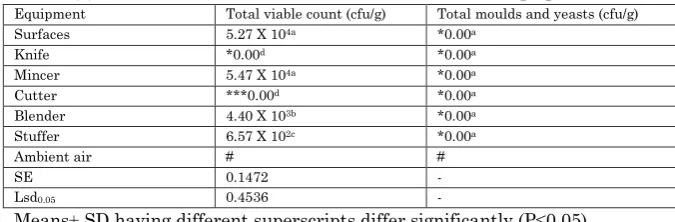
The analysis of the swab samples presented in table (2) for the counter surfaces, knife, mincer, cutter, blender and stuffer before the beginning of the processing showed that the level of total viable count
of bacteria reported by counter surfaces of (5.27 X 10⁴a) and mincer
(5.47 X 10⁴a), while the lowest mean value reported by stuffer (6.57 X
102c), where knife not showed any growth. Analysis showed no growth
of mould and yeast. The study proved that, the prolonged time of the equipment remained without being washed after the working increased microbial load, especially counter surfaces and mixing equipment could allow the initial contamination to increase on the surface of equipment.
Microbiology properties of sausage product during processing cfu/g
Microbiological profiles of sausage as function of processing steps presented in table (3). Results showed that, the total viable count of bacteria on sausage products indifferent line reported significant different, where produced by traditional processing line C reported
the highest mean value of TVCB (7.00 X 10⁵), followed by sausage
produced by medium processing line B (6.00 X 10⁵), while the modern
processing line A shown the lowest mean value (1.80 X 10⁴) of TVCB.
The change during storage presented (3). Data showed highly significant differences. Where sausage produced by modern processing
line A with (3.50 X 10²) reported the lowest mean value, while the
highest mean value of TVCB recorded by sausage produced by
traditional processing line C (9.80 X 10⁴).These decreased may due to
effect of cold storage during storage. The range of a viable count of beef sausages product, minced beef, beef burger kofta products showed high levels of contamination in ranges more than 2.5 x
104 (cfu), which considered as a critical microbiological condition when
compared with fresh meat (Ashton, 1981; FAO, 2000; Youssif, 2015).
Normal range is 103 to 104 organisms per gram as mentioned
by Heinz and Hautzinger, (2007); Ashton, (1981) who stated that it is quite normal and unavoidable to find bacterial counts of viable count
of the order of several thousand per cm2 on meat surfaces in
commercial slaughtering and meat handling. However, viable count
numbers exceeding 100,000 per gram (105 per cm2) on fresh meat are
on Veterinary Measures estimate the infectious dose range to be from
0.1x10² to 0.1x10⁴ (cfu). Thus the detected range has clear
implications on public health (Youssif, 2015).
Data in table (3) showed the results of total mould and yeast that not detected in sausage produced by modern line A and sausage produced by medium processing line B, while sausage produced by processing line C reported the highest mean value of mould and yeast
(5.40 X 10³), these slight growth may due to cross contamination
during analysis, because study showed that no significant effect of mould and yeast in processing lines , and these may due to nature of ingredients and their moisture content and may be effect of spices.
The change during storage did not showed any significant difference except in sausage produced by traditional processing line C reported significant decreasing in mean value of mould and yeast.
Data presented in table (3) revealed that, sausage produced by
traditional processing line C (4.00 X 10⁴) reported the highest mean
value of staphylococcus aureus, while not detected in sausage
produced by modern processing line A.
The change during cold storage did not showed any growth for
staphylococcus aureus except in sausage produced by traditional
processing line C showed slight growth (1.10 X 10⁴), these decreased
may due to effect of storage temperature degree.
In various levels, Staphylococcus aureus was isolated from the
most processed beef products sampl ed.With regard to the potentiality of Staphylococcus aureus pathogen, it is commonly found on the skin and mucous membranes of humans and warm blooded animals (Banwart, 1981; Wilks and Humble, 1997). Usually, the symptoms of staphylococcal intoxication appear when consuming food contains a toxin of less than1.0 microgram.
This toxin level is reached when Staphylococcus
aureus populations exceeds 105 per gram. However, the study showed
that the viable count of S.aureus was at the range of more than
104 was 11.1% in minced beef, 38.9% in beef burger, 27.8% in beef
kofta, and 11.1% in beef sausage products samples. Such contamination level is considered hazardous since meat products might not be thermally treated to the degree that is capable of inactivating the heat resistance of enterotoxins which is commonly
encountered in this bacterium species. Foodborne illness caused by S.
handling personnel and is generally associated with temperature abuse of cooked products (Bryan, 1992; Bergdoll, 1989).
Table (3) revealed that there are not contamination of
Salmonella styphi in both samples produced by modern processing line A and medium line B, while sausage produced by traditional line
C showed growth of Salmonella styphi, but immediately disappeared
after cold storage, these disappearing may due to the effect of cold storage which may caused cell injured. Three site of microbial load increased, in step one during deboning the main causing of contamination lack of personal hygiene, step three mixing of ingredients the main sources of contamination the raw material and mixing equipment specially spices and step four stuffing during linking and tying and may due lack of personal hygiene, while the are significant decrease in step six cold storage, the accumulation action of microorganism during processing.
The total mould and yeast during processing cfu/g: Table (4) revealed the result of total mould and yeast during processing, where showed no contamination during different steps of processing but there contamination In sausage produced by traditional processing
line C (3.50 X 10³c) in steps three during mixing of ingredients,
reported the lowest mean value these growth may due to initial microbial load of raw material and/or cross contamination during processing.
Data revealed that there are contamination in traditional processing line in step three mixing of ingredients and slight increased during stuffing, these increased may due to lack of personal hygiene during linking and tying, and decreasing again and disappearing at step six during cold storage.
The contamination with Staphylococcus aureus during processing cfu/g: Data obtained from table (5) revealed that there were significant differences in staphylococcus aureus of investigated sausage products as a result of processing steps. The staphylococcus aureus of sausage produced by modern processing line A found to be
nil, while the highest mean value reported by sausage C (9.00 X 10⁴)
step four during stuffing, and followed step three in both line B (8.20
X 102) and C (7.00 X 10⁴), while highly decreased in step six in both
may due to effect of storage temperature and pressure of ice crystal form during freezing.
Mohammed, (2007) who studied the extent of implementing the hazard analysis critical control point (HACCP) system in
Sudanese beef and fund that, the occurrence of Staphylococci in beef
products. Staphylococci counts ranged between 3.9 × 10² - 8.0 × 10³
(CFU)/ gram. Workers, hands, equipment and environmental conditions (Shapon and Shapon,1994). The FAO (1992) reported that
the presence of Staphylococci in beef products indicated the
contamination from skin, mouth and nose of the employees.
It is clear data revealed that staphylococcus aureus of different sausage sample affected by cold storage. Also staphylococcus aureus increased in two site in step three mixing of ingredients and step four during stuffing where there direct contact between workers and products through linking and tying of sausage.
The contamination with Salmonella styphi during processing cfu/g: Generally data in table (6) revealed that the traditional line C of producing sausage highly contamination with Salmonella styphi except in step six after cold storage. It could be concluded that, the very important concept in the manufacturing of meat product, in addition to mixing step, and stuffing, since ingredients which used in these step contain spices which considered as an essential source of contamination with pathogen Salmonella styphi. Hygienic condition and lack of personal hygiene which clear in step four due to direct contact of water with product during linking and tying after stuffing. Mohammed, (2007)who studied the extent of implementing the hazard analysis critical control point (HACCP) system in Sudanese beef and
fund that, the occurrence of Salmonella in beef products. With the
exception of Agwat sausage results showed that Salmonella was not
detected in all the samples under investigation. Presence of
The contamination with Coliform group during processing cfu/g: The result of total Coliform group in table (7) indicates that the treatment samples differ scientifically (P< 0.05). The result also showed that the highest mean value of total Coliform group in sausage produced by medium line B (241.00), while the lowest mean value of total Coliform group reported by sausage produced by modern line A (150.00). After storage there are highly decreased in load of total Coliform group, where the lowest mean value reported by sausage produced by medium line B (8.87) and the highest mean value in sausage produced by traditional line C (100.00), however sausage produced by modern processing line A not detected, the decreased may due to the effect of cold storage mainly. As table (7) reveled that sausage produced by modern processing line A with mean value (5.00) showed the lowest mean value of total Coliform group in step one, while the highest mean value of total Coliform group reported sausage produced by processing line C (460.00), in step three mixing, the increasing of total Coliform group observed in step four stuffing.
The contamination seen in traditional processing line C and increased step by step till reach the maximum level in step three and then decreased due to the effect of cold storage, while the level of contamination stable with slight increase in step three mixing and step four stuffing, these contamination due to the lack of personal hygiene and poor sanitation and hygienic condition, the medium processing did not showed any odd contamination.
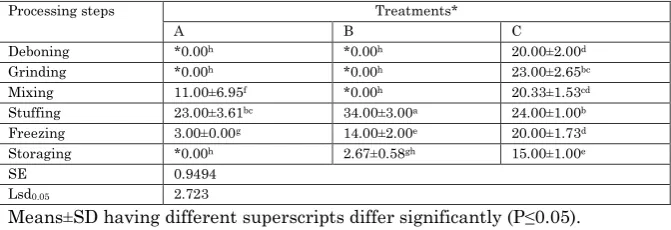
The contamination with Escherichia coli during processing cfu/g: Escheriashia coli of different sausage samples presented in table (8). data revealed that sausage produced by modern processing line A did not showed any E. coli growth even after storage, these referred to good hygienic practice [GHP], while sausage produced by medium line B (34.00) showed the highest mean value of Escherichia coli, but there highly decreased after storage (2.67) followed by sausage produced by traditional line C (15.00).
training, while the lowest mean value revealed by sausage produced by modern line step five ( 3.00) freezing.
Youssif, (2015) who study the applicability of hazard analysis and critical control points (haccp) system in beef processing factories in Khartoum state and stated that, the higher contamination level by E. coli was found in 5.6% of beef sausage product and the
bacterium counts was reached more than 104 gram. Despite E.
coli is usually used as an indicator of faecal contamination of food or water (Martins and Germano, 2008) however, certain strains are known to be pathogenic and some produce a toxin in the intestine that results in symptoms of abdominal pain and diarrhoea. The result
showed that 50.0% of the isolated E. coli found grow and multiply for
more than 102 colonies and 11.1% for more than 104, this considered
spoilage causes growth (Banwart, 1981).Certain strains are enter pathogenic and represent food born infection, and it can be used as an indicator organism of faecal contamination from raw material or during processing, the same method was followed in my previous study in Al Kadaro abattoir (Youssif, 2004).
The most unusual result was the presence of E. Coli in cooked
(smoked) ready to eat mortadella product and the total viable count of E. Coli on mortadella product was found more than the infective dose (less than 10) microorganisms per gram was in 87.5%, and from
102 to less than 103 was in 12.5% of samples. This unexpected
contamination might have been occurred either due to insufficient cooking temperature or after smoking (Youssif, 2015).
The sausage produced by traditional processing lie C showed highly contamination with E. coli in different steps, these due to poor hygienic condition and lack of [GHP], while the three are different sausage samples showed high level of contamination in step four stuffing mainly during linking and tying, these due to lack of personal hygiene, It could be concluded that, the very important step in the manufacturing of sausage in addition to deboning, mixing and stuffing, since there direct contact with person which considered as an essential source of contamination with pathogens E. coli.
CONCLUSION:
that, the prolonged time of the equipment remained without being washed after the working increased microbial load. Also the study proved that the manufacture of sausage in traditional and medium processing scale exposed to microbiological contamination and absent of inspection and control. Furthermore, all pathogens [Salmonella styphi, staphylococcus aureus and Escherichia coli] appeared in sausage processing in two step especially in step four (stuffing) during linking and tying and step three during ingredient mixing.
REFERENCES
1. Ashton, D. H.(1981)Thermophilic organisms involved in food spoilage: thermophilic anaerobes not producing hydrogen
sulphide. Journal of FoodProtection 44.2: 146-148.
2. Banwart, G. J. (1981) Basic food microbiology. Connecticut. The AUI Publishing Company.
3. Bergdoll, M. S. (1989) Staphylococcus aureus. In: Foodborne Bacterial Pathogens”. Marcel Dekker, Inc., New York, NY: USA.
4. Bryan, F. L. (1992) Hazard Analysis Critical Control Point Evaluations. Geneva: WHO.
5. Corlett, D. A. (1998) User manul of Hazard Analysis and Critical Control Point. Food and Environmental Sanitation, 18 418–23. Aspen Publishers. Inc-Maryland.
6. Dancan, D. B. (1955) Multiple range and multiple F-test. Biometrics, 11:1-42. U.S. pork- issue review (1999) National pork board as implemented by national pork producers council. Meat export federation, 1050 17th street, suite 2200, Denver, co, 80265.U.S. www.usmef.org.
7. Difcoand BBL Manual, (2003): Manual of Microbiological Culture Media. BD Diagnostic Systems. Difco Laboratories. Inc., subsidiary of Becton, Dickinson and Company. Sparks, Maryland 21152 -ISBN 0-9727207-0-7.United States of America.
9. FAO, (2000) Animal health Rome, European Commission for control of foot-and-mouth disease, last modified: 06/13/2002 12:22:50.
10. Food Safety and Inspection Service (1999) Guidebook for the Preparation of HACCP Plans. Inspection Systems Development Division -Room 202, Cotton Annex Building 300 12th Street SW
11. Harrigan, F.W. and Mac cance, M.E. (1976)laboratory methods in microbiology .3003 Academic press of London .P.p27. London and New York.
12. Harrigan, F.W.(1998) Laboratory methods in food microbiology. 3rd edition. Academic press of London. U.K. London.
13. Heinz, G and Hautzinger, P. (2007) Meat processing technology for small- to medium- scale procedures\ Food and Agriculture Organization of the United Nations, regional office for Asia and the Pacific: Bangkok.
14. Martins, E. A and Germano, P. M. (2008) Microbiological indicators for the assessment of performance the hazard analysis and critical control points (HACCP) system in meat lasagna production”. Journal of Food Control 19.8: 764-771. 15. Mead. B. and Gurnow, R.W.(1985) Statistical methods in
agricultural experimental biology. London. New York, Chapman and Hall.
16. Mohammed, E. O. B. (2007) Extent of Implementing the Hazard Analysis Critical Control Point (HACCP) system in Sudanese Beef Industry. A Thesis submitted to the University of Khartoum in Partial Fulfillment of the Degree of Master of Food Science and Technolog
17. Ordonez, M.; Rovira, J. and Jaime, I. (2000)The relationship between the composition and texture of
conventional and low-fat frankfurters. International journal of
food science and technology. Volum36, 749-758.Blackwell Science Ltd.
19. Shapton, D. A., and Shapton N.F. (1994). “Principalles and
Practiceas for the Safe Processing of Foods,”
Butterwoth/Heinimann, Oxford.
20. Shrestha, B. K.; Sapkota, B.; Shrestha, R. and Karki, T. B. (2016) Study of Hazard Analysis Critical Control Points
(HACCP) System in Sausage Production Plants. IJETAE.
Volume 6, issue 5,
21. SSMO (2010) Sudanese Standards Meteorology Organization. Khartoum, Sudan.
22. Tompkin, R.B. (1995)The Use of HACCP for Producing and Distributing Processed Meat and Poultry Products. In Advances in Meat Research. Volume 10.
23. Wilks, C. R and Humble, M. W. (1997)Zoonoses in New Zealand. 2nd ed. Palmerston North: Massey University. 24. Yasmine, M. (2001) Introduction to the HACCP system and
its application to fermentation foods. In R.A.Martin and Robert, M.J.(ED) fermentation and food safety p.p 53-67.Aspen publishers Maryland .U.S.A.
25. Youssif, A. (2015) Applicability of Hazard Analysis and Critical Control Points (HACCP) System in Beef Processing Factories in Khartoum State. EC Microbiology 1.2: 70-87. 26. Youssif, A.Y. (2004) Application of Hazard Analysis Critical
Table (1): Mean values and their standard errors for raw materialsvarious treatments (interactions)
Raw materials Total viable count
(cfu/g)
Total moulds and yeasts (cfu/g)
Meat 6.50 X 105a *0.00d
Spices 3.37 X 10⁵a 6.20 X 10²c
Bread crumbs 7.00 X 10⁴b **1.20 X 10³b
Soy bean 8.40 X 105a *0.00d
Water 1.67 X 102d *0.00d
Gastrointestinal tract (casings) 3.50 X 10⁴c 4.00 X 10³a
SE 0.07071 0.04472
Lsd0.05 0.2179 0.1378
Means± SD having different superscripts differ significantly (P≤0.05). [* No growth - ** No fungi growth- *** Negligible growth]
Table (2): Mean values and their standard errors for equipment
Equipment Total viable count (cfu/g) Total moulds and yeasts (cfu/g)
Surfaces 5.27 X 104a *0.00a
Knife *0.00d *0.00a
Mincer 5.47 X 104a *0.00a
Cutter ***0.00d *0.00a
Blender 4.40 X 103b *0.00a
Stuffer 6.57 X 102c *0.00a
Ambient air # #
SE 0.1472 -
Lsd0.05 0.4536 -
Means± SD having different superscripts differ significantly (P≤0.05). # = Medium microbial growth.
[* No growth - ** No fungi growth- *** Negligible growth]
Table (3): Mean values and their standard errors for total viable count (cfu/g) of the various treatments (interactions)
Processing steps Treatments
A B C
Deboning 1.8 X 10⁴j 6.00 X 10⁵ef 7.00 X 10⁵de
Grinding 1.60 X10⁴j 5.80 X 10⁵ef 2.70 X 10⁶c
Mixing 1.40 X 10⁵g 8.60 X 10⁵d 8.00 X 10⁶a
Stuffing 7.00 X 10⁵de 3.20 X 10⁶c 6.00 X 10⁶b
Freezing 6.00 X 10⁴i 9.80 X 10⁴h 5.00 X 10⁵f
Storaging 3.500 X 10²l 4.80 X 10³k 9.80 X 10⁴h
SE 0.04082
Lsd0.05 0.1171
Means± SD having different superscripts differ significantly (P≤0.05).
Table (4): Mean values and their standard errors for total moulds and yeasts (cfu/g) of the various treatments (interactions)
Processing steps Treatments*
A B C
Deboning *0.00d *0.00d *0.00d
Grinding *0.00d *0.00d *0.00d
Mixing *0.00d *0.00d 3.50 X 10³c
Stuffing *0.00d *0.00d 5.60 X 10³a
Freezing *0.00d *0.00d 4.30 X 10³b
Storaging *0.00d *0.00d *0.00d
SE 0.0001826
Lsd0.05 0.0005237
Means± SD having different superscripts differ significantly (P≤0.05). [* No growth - ** No fungi growth- *** Negligible growth]
A ≡ Modern processing line of sausage; B ≡ Medium processing line of sausage; C ≡ Traditional processing line of sausage
Table (5): Mean values and their standard errors for Staphylococcus
aureus (cfu/g) of the various treatments (interactions)
Processing steps Treatments
A B C
Deboning *0.00i 7.00 X 10³d 4.00 X 10³c
Grinding *0.00i 3.00 X 10²fg 5.80 X 10⁴b
Mixing *0.00i 8.20 X 10²b 7.00 X 10⁴b
Stuffing *0.00i 8.30 X 10²e 9.00 X 10⁴a
Freezing *0.00i 4.00 X 10²g 5.00 X 10²f
Storaging *0.00i *0.00i 1.10 X 10²h
SE 0.03162
Lsd0.05 0.09070
Means± SD having different superscripts differ significantly (P≤0.05).
A ≡ Modern processing line of sausage; B ≡ Medium processing line of sausage; C ≡ Traditional processing line of sausage
Table (6): Mean values and their standard errors for Salmonella
styphi(cfu/g) of the various treatments (interactions)
Processing steps Treatments*
A B C
Deboning -ve -ve +ve
Grinding -ve -ve +ve
Mixing -ve -ve +ve
Stuffing -ve -ve +ve
Freezing -ve -ve +ve
Storaging -ve -ve -ve
- +ve = positive: Detected. - -ve = negative: Not detected.
Table (7): Mean values and their standard errors for total coliform (cfu/g) of the various treatments (interactions)
Processing steps Treatments
A B C
Deboning 5.00±1.00g 92.70±1.53e 206.70±7.64c
Grinding 15.00±1.73g 241.00±4.36b 240.00±8.88b
Mixing 36.00±3.61f 240.00±2.00b 460.00±26.46a
Stuffing 150.00±17.32d 241.00±4.36b 160.00±17.00d
Freezing 9.00±1.73g 43.00±2.65f 153.30±10.41d
Storaging 0.00±0.00g 8.67±1.53g 100.00±8.00e
SE 5.558
Lsd0.05 15.94
Means± SD having different superscripts differ significantly (P≤0.05).
A ≡ Modern processing line of sausage; B ≡ Medium processing line of sausage; C ≡ Traditional processing line of sausage
Table (8): Mean values and their standard errors for E. coli (cfu/g) of the various treatments (interactions)
Processing steps Treatments*
A B C
Deboning *0.00h *0.00h 20.00±2.00d
Grinding *0.00h *0.00h 23.00±2.65bc
Mixing 11.00±6.95f *0.00h 20.33±1.53cd
Stuffing 23.00±3.61bc 34.00±3.00a 24.00±1.00b
Freezing 3.00±0.00g 14.00±2.00e 20.00±1.73d
Storaging *0.00h 2.67±0.58gh 15.00±1.00e
SE 0.9494
Lsd0.05 2.723
Means±SD having different superscripts differ significantly (P≤0.05).