International Journal of Research (IJR)
e-ISSN: 2348-6848, p- ISSN: 2348-795X Volume 2, Issue 4, April 2015Available at http://internationaljournalofresearch.org
Effect of Black Tea on Some Visual Functions of Young Adults
O C Ahuama1*; E H Akubuokwu2; O R Nwala3 & M O Ohiri4
1Department of Optometry, Abia State University, Uturu, Abia State, Nigeria
2Department of Optometry, Abia State University, Uturu, Abia State, Nigeria
3Department of Optometry, Abia State University, Uturu, Abia State, Nigeria
4Ophthalmology Department, Federal Medical Centre Owerri, Imo State, Nigeria
* Corresponding authors: Ahuama Okezie C and Nwala Onyinye R
Email: [email protected], [email protected]
ABSTRACT
Black tea which is often taken to alert the mental state of the mind is the fermented category of camellia sinensis plant. It contains theophylline, theaflavin, caffeine, polyphenols, flavonoids, theanine and catechins, and because of the stimulatory effects of these constituent compounds, it affects the central nervous system. This research work was carried out to determine the effects of black tea on some visual functions such as amplitude of accommodation, near point of convergence, pupillary size, lateral phoria at far and near of young adults aged 16-30 years old. 50 subjects were used andbaseline measurements of their pupillary size, amplitude of accommodation, near point of convergence and lateral phoria at far and near were taken prior to their consumption of black tea.Measurements were taken again 30, 60 and 90 minutes post administration of black tea in order to obtain the induced values. From the statistical analysis using t-test, results revealed that black tea slightly increased pupillary size and habitual phoria at near while its effects on amplitude of accommodation, near point of convergence and habitual phoria at far, were not statistically significant. More work should be done using green tea which is not fermented. Also, the middle aged should be used for the study, as this group usually consumes more tea.
Keywords: Black tea, Amplitude of
accommodation, Near point of
convergence,Pupillary size, Lateral phoria.
INTRODUCTION
Plants have been in existence since the creation of the world. Some plants can be poisonous to man, while some are of great benefits, as their leaves, shoots or roots serve as food, medicine or items for beautification.
These plants whenconsumedproduce
biochemical effects on the human body of which the human eye is not an exception. The Black tea plant with the botanical name camellia sinensis and which is an evergreen shrub that grows mainly in tropical or sub-tropical regions is a typical example of beneficial plants.Tea derived from Camellia sinensis plantis a popular beverage with
worldwide consumption only second to water1.
International Journal of Research (IJR)
e-ISSN: 2348-6848, p- ISSN: 2348-795X Volume 2, Issue 4, April 2015Available at http://internationaljournalofresearch.org
Tea is grown on hill sides and the bushes are severely pruned and plucked to keep them at the correct density. There are three major categories of tea which are; the black tea (fermented), the Oolong (semi-fermented) and
the green tea (not fermented) 1. These different
teas are all harvested from the Camellia sinensis plant species, but are processed to attain different levels of oxidation. Several varieties of Camellia sinensis are used for tea production and they include; Assam variety, China variety and Cambodian variety. While green tea usually loses its flavour within a year, black tea preserves its flavour for several years.
Tea is the most important non-alcoholic beverage in the world and black tea makes up about 78% of the commercial tea drink
throughout the world2. The British are the
world’s biggest tea drinkers consuming over 70 billion cups each year. Tea has also been extensively studied for its potential health effects. Epidemiological and laboratory studies have suggested that tea has preventive activity against a number of chronic diseases, including heart diseases, neurodegenerative
diseases, cancer, diabetes and obesity1,3-6.The
stimulating effect of tea is due to the caffeine contained in the leaves, while the brown colour comes from the tannins present. Theophylline, a treated compound found in tea is a licensed medicine for the treatment of
respiratory diseases such as asthma7. Tea also
contains flavonoid compounds which have been reported to have anti-oxidant properties. Recent study hasalso shown that tea can also prevent stroke and that it has a restorative effect8.
On the other hand, excessive consumption of tea with its constituent caffeine may cause headache, anxiety, heart problems such as palpitation, sickness, insomnia and convulsion.
It has been reported that there may be some link between the occurrence of cancer of the esophagus and excessive consumption of tea that contains high amount of condensed tannin
compound9.
Black tea has active ingredients that can affect the central nervous system which also innervates the eye, and since it is the most popular non-alcoholic beverage consumed all over the world in large quantities, especially among females and males who often use it for slimming purposes, to keep away sleep, cold, and in most countries as a regular drink, it becomes important to determine its effects on
the visual functions (amplitude of
accommodation, near point of convergence, pupillary size, lateral phoria at far and near) of young adults.
Methodology
This was a prospective study carried out to determine the effect of black tea on the visual functions: amplitude of accommodation, near point of convergence, pupillary size, lateral phoria at far and near. The study was carried out at the optometry clinic of Abia State University, Uturu and involved fifty (50) volunteers who were all students and between the ages of 16-30 years.The subjects were briefed about the study and their consent obtained.
To ensure accuracy and validity of this study, subjects who had manifest deviations (tropia), ocular pathologies and other ocular anomalies, and those who were under any form of therapy or medication, were all excluded from the study.
International Journal of Research (IJR)
e-ISSN: 2348-6848, p- ISSN: 2348-795X Volume 2, Issue 4, April 2015Available at http://internationaljournalofresearch.org
phoria at far and near of each of the 50 subjects were measured. Amplitude of accommodation was measured using the minus lens to blur method and near point of convergence was determined using a fine point target and by measuring the distance between the point where the target doubles and the subject’s eye. Pupil size was determined under normal illumination using a pupillary distance rule and by taking measurement from the temporal to the nasal pupil margins.Proper phoropter adjustments were made for each subject and the Von Graffe technique was used
in measuring the lateral phoria10. Exophoria
was represented with a negative (-) sign while esophoria was identified with a positive (+) sign. One tea bag was allowed to steep in a teacup with 200mls of hot water for about 2-3 minutes. The subjects were then given 200mls of black tea each (caffeine content =
17.75mg/100ml)which wasorally
administered. Their amplitude of
accommodation, near point of convergence, pupillarysize and lateral phoria at far and near weremeasured after 30 minutes of consuming the black tea. Subsequent measurements were taken 60 and 90 minutes post administration. Data obtained were presented in tables and analyzed using t-test statistics. P<0.05 was considered as significant.
RESULTS
Table 1: Mean baseline and mean induced Amplitude of Accommodation(AA) after intake of 200mls of Black Tea
(Mean baseline AA = 7.35D) Post
intake time (Minutes)
Mean induced
AA (D)
Induces change in
AA (D)
Percentage Induced Change in
AA (%)
30 7.66 0.31 4.22
60 7.49 0.14 1.91
90 7.17 -0.18 2.45
0.27
Average Mean induced AA=0.27/3=0.09D
The above table 1 showed that there was an increase in AA from the mean baseline value amplitude of accommodation of 7.35D to an induced AA of 7.66D 30 minutes post administration of the black tea. After this, there was a decrease towards the direction of the baseline valuebut still higher than the baseline amplitude of accommodation 60 minutes post administration (AA = 7.49D). The least Amplitude of accommodation value of 7.17Dwas recorded 90 minutes after the administration of the black tea. The increasein AA occurred between 30-60 minutes post administration. However, this shift in AA after administration of black tea was not statistically significant.
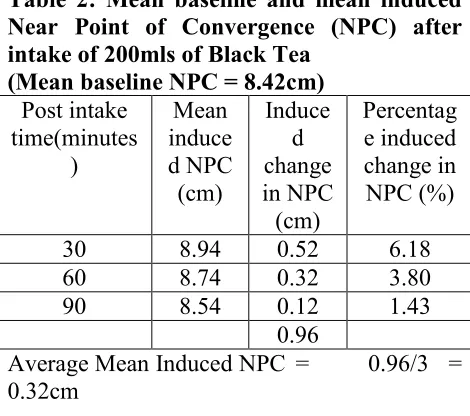
Table 2: Mean baseline and mean induced Near Point of Convergence (NPC) after intake of 200mls of Black Tea
(Mean baseline NPC = 8.42cm) Post intake
time(minutes )
Mean induce d NPC
(cm)
Induce d change in NPC (cm)
Percentag e induced change in NPC (%)
30 8.94 0.52 6.18
60 8.74 0.32 3.80
90 8.54 0.12 1.43
0.96
Average Mean Induced NPC = 0.96/3 = 0.32cm
International Journal of Research (IJR)
e-ISSN: 2348-6848, p- ISSN: 2348-795X Volume 2, Issue 4, April 2015Available at http://internationaljournalofresearch.org
minutes post administration), there was a progression towards the baseline value with a recorded value of 8.74cm (Table 2). A further progression was recorded 90 minutes post administration with an NPC value of 8.54cm (Table 2). The effect of black tea on near point of accommodation was not statistically significant as well.
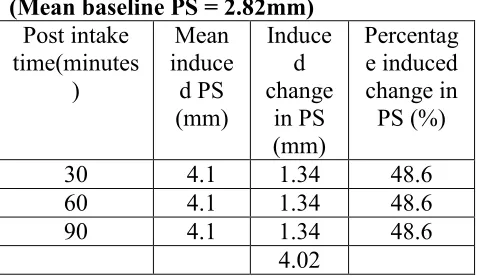
Table 3: Mean baseline and mean induced Pupillary Size (PS) after intake of 200mls of Black Tea
(Mean baseline PS = 2.82mm) Post intake
time(minutes )
Mean induce d PS (mm)
Induce d change
in PS (mm)
Percentag e induced change in PS (%)
30 4.1 1.34 48.6
60 4.1 1.34 48.6
90 4.1 1.34 48.6
4.02
There was a significant induced dilation and increase in pupillary size from the mean baseline value of 2.82mm to a mean induced value of 4.1mm 30 minutes post administration of black tea (Table 3). This induced pupillary size of 4.1mm was sustained throughout 60 and 90 minutes post administration of black tea (Table 3).
Table 4: Mean baseline and mean induced Lateral Phoria at Far(LPF) after intake of 200mls of Black Tea
(Mean baseline LPF = -0.09∆D)
Post intake time(minutes
)
Mean induce d LPF
(∆D)
Induce d change in LPF (∆D)
Percentag e induced change in LPF (%)
30 -0.43 -0.34 44.2
60 -0.86 -0.77 100.0
90 -0.36 -0.27 35.1
-1.38
**Exophoria = ̶ , Esophoria = + Average
mean induced LPF = -1.38/3 = -0.46∆D
(exo)
There was a shift of lateral phoria at far towards exophoria (-) but this change was statistically insignificant.This shift was at its
peak (0.86∆D exophoria) 60 minutes after
administration of the black tea (Table 4). The average mean induced lateral phoria at far
(LPF) was 0.46∆Dof exophoria.
Table 5: Mean baseline and mean induced Lateral Phoria at Near(LPN) after intake of 200mls of Black Tea
(Mean baseline LPN = ̶ 4.02∆D)
Post intake
time (minutes)
Mean induced
LPN (∆D)
Induced change in
LPN(∆D)
Percentage induced change in
LPN (%)
30 -4.54 -0.52 12.9
60 -4.72 -0.70 17.4
90 -4.00 +0.02 0.5
-1.2
**Exophoria = ̶ , Esophoria = +Average
mean induced LPN = -1.2/3 = -0.4∆D (exo)
After 30 minutes post administration of black
tea, result showed a 0.52∆D shift towards
exophoria (-) of lateral phoria at near with
respect to the mean baseline value of 4.02∆D
exophoria (Table 5). This shift in lateral phoria at near towards exophoria was at its peak60 minutes after administration of the black tea
with a recorded value of 4.72∆D
exophoria.After this peak, there was a reversal
to a value (-4.00∆D)closer to the mean baseline
value but with a 0.02∆Dshift towards the
International Journal of Research (IJR)
e-ISSN: 2348-6848, p- ISSN: 2348-795X Volume 2, Issue 4, April 2015Available at http://internationaljournalofresearch.org
baseline) at 90 minutes post administration. This effect was statistically significant.
DISCUSSION
There was an increase in amplitude of accommodation 30 and 60 minutes after administering black tea and a lower value than the baseline was recorded 90 minutes post administration.These effects of black tea on amplitude of accommodation were statistically insignificant, transient and could not be sustained.
Consumption of black tea caused transient and insignificant change in near point of convergence (NPC) as well. This was characterized by a brief markedrecession of near point of convergence30 minutes after consumption and a reversal after that to NPC values close to, but slightly recessed than the baseline value.
There was also a significant sustained dilationand increase in size of the pupil after consumption of black tea by the young subjects.One of the constituents of black tea is
caffeine9. Caffeine has a known
sympathomimetic and stimulant effect on the central nervous system and many other areas of the body and can as such stimulate the eye
muscles11.It activates noradrenaline neurons
causing a release of adrenaline in the body. The release of this fight or flight hormone, adrenaline,creates analerting effecton the individual thus triggering a number of effects such as pupil dilation.This probably accounts for the dilation and increase in pupil size recorded in this study after the consumption of black tea.However, it was assumed that the stimulant effect of black tea was not potent enough as to produce a sustained effect on amplitude of accommodation and near point of convergence.
There was a also shift of lateral phoria towards exophoria both at far and near. However, this shift was only significant at near and could be
accounted for by the same stimulant effect of black tea discussed above.
The changes in visual function after the consumption of black tea couldalso be attributed to the effects of theophylline, polyphenol and theaflavin, which are some of black teasmajor compounds, on the central
nervous system12. The central nervous system
coordinates the brain and the spinal cord and also controls the muscles and nervous supply of the human eye.
CONCLUSION
Black tea caused a significant increase in pupillary size, which was sustained throughout the test duration. It also caused a significant shift in lateral phoria at near towards the
exophoria direction.However,it had no
significant effect on amplitude of
accommodation, near point of convergence and habitual phoria at far.
The effect of black tea consumption on amplitude of accommodation, near point of convergence and lateral phoria at far and near was transient and could not be sustained unlike its effect on pupil size which was sustained throughout the test duration; hence their returning to values close to or below the baselinebefore the test could come to an end. It is thus recommended that more work be done using the middle aged subjects as people within this age group consume more tea. Also the effect of green tea which is unfermented on visual functions should be studied.
REFERENCES
[1.]Grove, K.A. and Lambert, J.D.
International Journal of Research (IJR)
e-ISSN: 2348-6848, p- ISSN: 2348-795X Volume 2, Issue 4, April 2015Available at http://internationaljournalofresearch.org
[2.]Gayla, M. (2003). Moore Coffee and Tea.
The perfect cup.Honest Puck publications. Canada pg 994-8060.
[3.]Yang, C.S., Lambert, J.D., Ju, J., Lu,G.
and Sang, S. (2007). Tea and cancer prevention: molecular mechanisms and human relevance. Toxicol Appl Pharmcol, 224: 265-273.
[4.]Higdon, J.V. and Frei, B. (2003). Tea
catechins and polyphenols: health effects, metabolism, and antioxidant functions. Crit Rev Food Sci Nutr, 43: 89-143.
[5.]Wolfram, S., Wang, Y. and Thielecke, F.
(2006). Anti-obesity effects of green tea: from bedside to bench. Mol Nutr Food Res, 50:176-187.
[6.]Kao, Y.H, Chang, H.H, Lee, M.J. and
Chen, C.L. (2006). Tea, obesity and diabetes. Mol Nutr food Res, 50: 188-210.
[7.]Welsh, E.J., Bara, A., Barley, E. and Cates,
C.J. (2010). Caffeine for asthma. Cochrane database of systematic reviews, 2010(1): CD001112.
[8.]Green, M.S. and Haran, G. (1992);
Association of Serum lipoproteins and Health-related habitswith coffee and Tea Consumption in free-living subjects examined in the Israeli CORDIS Study. Prev. Med 21(4): 532-545.
[9.]Brown, C.A., Bolton-Smith, C.,
Woodward, M. and Tunstall – Pedoe, H. (1993): Coffee and Tea Consumption and the prevalence of Coronary heart Disease in Men and Women: results from the
Scottish Heart Health Study. JEpidemiol. Community Health 47(3): 171-175.
[10.] Borish, I.M. (1987): Clinical
Refraction, 3rd Edition.Professional Press
Inc. Chicago, 1255pp.
[11.] Nehlig, A., Daval, J. and Debry, G.
(1992). Caffeine and the central nervous
system: mechanisms of action,
biochemical, metabolic and
psychostimulant effects. Brain Research Reviews, 17(2): 139-170.
[12.] Kivits, G.A.A, Van der Sman, FJ.P and
Tijburge, L.B.M. (1997): Analysis of catechins from green and black tea in
humans: a specific and sensitive