ISSN 2348 – 7968
Mood Based Music Classification
Susheel Sharma1, Rakesh Singh Jadon2
1
Department of Computer Applications MITS, Gwalior, M.P. 474005, India
2
Department of Computer Applications MITS, Gwalior, M.P. 474005, India
Abstract
Due to enhancement in technology in the recent years lots of music is available as handy media for various devices. Thus there is an urgent need of analyzing music for storage, indexing and retrieval. In this paper we aimed at classifying music on the basis of their moods. We have identified three moods for this purpose: happy, angry and sad. These cognitive styles have few things in common. Identifying and extracting these features is a challenging problem. On the basis of our observations and literature review we have identified the eight features namely energy, entropy, zero-crossing rate, spectral rolloff, spectral centroid, spectral flux, RMS of signal and MFCC. After extracting features we have used neural network based training for classification. We have used Matlab 7.0.1 neural net tool for this purpose. We have populated a database of 150 songs consisting of 50 songs of each category. In this population 90 songs are used for training set and 60 for testing. The experimental results demonstrate the effectiveness of our classification system. We have obtained an overall accuracy of nearly 75%. The complete system is developed in MATLAB 7.0.1 including the GUI of the system.
Keywords: Audio samples, neural networks, mood classification, learning, matlab.
1.0 INTRODUCTION
With the growing market of portable digital audio players,
the number of digital music files inside personal computers
has increased. It can be difficult to choose and classify
which songs to listen to when you want to listen to specific
mood of music, such as happy music, sad music and angry
music. Not only must the consumer classify their music,
but online distributors must classify thousands of songs in
their databases for their consumers to browse through.
In music psychology and music education, emotions based
components of music has been recognized as the most
strongly component associated with music expressivity.
Music information behavior studies have also identified
music mood emotion as an important criterion used by
people in music seeking indexing and storage. However,
evaluation of music mood is difficult to classify as it is
highly subjective. Although there seems to be a very strong
connectivity between the music (the audio) and the mood
of a person. There are many entities which explicitly
change our mood while we are listening music. Rhythm,
tempo, instruments and musical scales are some such
entities. There is one very important entity in the form of
lyrics which directly affects our minds. Identifying audible
words from lyrics and classifying the mood accordingly is
a difficult problem as it includes complex issues of Digital
Signal Processing. We have explored rather a simple
approach of understanding the mood on the basis of audio
ISSN 2348 – 7968
pattern recognition. We have made an effort to extract
these patterns from the audio as audio features.
There can be other music moods also like- bored,
sleepy, passionate, tensed, calm, relaxed etc. which
seems to be difficult to classify. Therefore we have
limited our problem on three prominent moods
namely happy, angry and sad.
How can music be easily classified without human
interaction? It would be extremely tedious to go through
all of the songs in a large database one by one to classify
them. A neural network could be trained to determine the
difference between three different moods of music: happy
music, sad music and angry music.
For this work, we have taken 90 sample songs for training,
30 songs for each mood and analyzed the 10 lakhs samples
from the middle part of the each song to classify the music.
Frequency content of the audio files can be extracted using
the Fast Fourier Transformation in Matlab. The songs were
recorded at a sampling rate of 22.05 KHz, so the largest
recoverable frequency is 11.025 KHz.
We have collected approximately ten lakhs of music
samples. From these samples of a song we have extracted 8
important features. These features are then actually used to
classify the song. We have done classification using the
feed-forward neural network. Firstly we train the Neural
Network using training data set obtained from the Internet
[30]. This trained neural network is then used for
classification.
2.0 Literature Review
Music mood classification is the process of assigning
moods such as happy, angry and sad. Different pieces of
music in the same mood are thought to share the same
“basic musical language”.
The most common of the categorical approaches to
emotion modeling is that of Paul Ekman’s[1] basic
emotions, which encompasses the emotions of anger, fear,
sadness, happiness, and disgust. A categorical approach is
one that consists of several distinct classes that form the
basis for all other possible emotional variations.
Categorical approaches are most applicable to
goal-oriented situations.
A dimensional approach classifies emotions along several
axes, such as valence (pleasure), arousal (activity), and
potency (dominance). Such approaches include James
Russell’s two-dimensional bipolar space (valence-arousal)
[2], Robert Thayer’s energy-stress model [4,5] where
contentment is defined as low energy/low stress, depression as low energy/high stress, exuberance as high
energy/low stress, and anxious/frantic as high energy high
stress, and Albert Mehrabian’s three-dimensional PAD
representation (pleasure-arousal-dominance) [6].
One of the publications on emotion detection in music is
credited to Feng, Zhuang, and Pan. They employ
Computational Media Aesthetics to detect mood for music
information retrieval tasks [7]. The two dimensions of
tempo and articulation are extracted from the audio signal
and are mapped to one of four emotional categories;
happiness, sadness, anger, and fear. This categorization is
based on both Thayer’s model [51] and Juslin’s theory [8],
where the two elements of slow or fast tempo and staccato
or legato articulation adequately convey emotional
ISSN 2348 – 7968
domain energy of the audio signal issued to determine
articulation while tempo is determined using Dixon’s beat
detection algorithm [9].
Single modal and multi modal mood classification has
been done by various researchers. Kate Hevner’s Adjective
Circle[10] consists of 66 adjectives thar are divided into 8
circles(which consistes of moods). Chetan et al [11] chose
emotional states based on Hevner’s circle for their
motion-based music visualization using photos. The eight classes
in the order of the numbers are called: sublime,sad,
touching, easy, light, happy, exciting and grand.
Farnsworth modified Hevner’s concept and arranged the moods in ten groups [12].
Rigg et al [13,14] experiment includes four categories of
emotion; lamentation, joy, longing, and love. Categories
are assigned several musical features, for example ‘joy’ is
described as having iambic rhythm (staccato notes), fast
tempo, high register, major mode, simple harmony,and
loud dynamics (forte) .
Watson et al[58] study is different from those of Hevner
and Rigg because he uses fifteen adjective groups in
conjunction with the musical attributes pitch (low-high),
volume (soft-loud), tempo (slow-fast), sound (pretty-ugly),
dynamics (constant-varying), and rhythm (regular
irregular). Watson’s research reveals many important
relationships between these musical attributes and the
perceived emotion of the musical excerpt. As such,
Watson’s contribution has provided music emotion
researchers with a large body of relevant data that they can
now use to gauge the results of their experiments
Automatic mood classification for music is a comparatively
common technique. The used musical attributes are
typically divided into two groups, timbre-based attributes
and rhythmic or tempo-based attributes. The tempo-based
attributes can be represented by e.g. an Average Silence
Ratio or a Beats per Minute value.
Lu [16] uses amongst others Rhythm Strength, Average
Correlation Peak, Average Tempo and Average Onset
Frequency to represent rhythmic attributes. Frequency
spectrum based features like Mel- Frequency Cepstral
Coefficients(MFCC), Spectral Centroid, Spectral Flux or
Spectral Rolloff are also used.
Wu and Jeng [17] use a complex mixture of various
features: Rhythmic Content, Pitch Content, Power
Spectrum Centroid, Inter-channel Cross Correlation,
Tonality, Spectral Contrast and Daubechies Wavelet
Coefficient Histograms. For the classification step in the
music domain Support Vector Machines (SVM) [18] and
Gaussian Mixture Models (GMM) [19] are typically
applied. Liu et al. [20] utilize a nearest-mean classifier.
The comparison of classification results of different
algorithms is difficult because every publication uses an
individual test set or ground-truth. E.g. the algorithm of
Wu and Jeng[17] reaches an average classification rateof
74,35% for 8 different moods with the additional difficulty
that the results of the system and the ground- truth contain
mood histograms which are compared by
aquadratic-cross-similarity. Jadon et al[21,22] have extracted time domain,
pitch, frequency domain, sub band energy, and MFCC
based audio features .
Another integral emotion detection project is Liand
Ogihara’s content-based music similarity search [23].
Their original work in emotion detection in music [27]
utilized Farnsworth’s ten adjective groups [13]. Li and
Ogihara’s system extracts relevant audio descriptors using
MARSYAS [24] and then classifies them using Support
ISSN 2348 – 7968
Hevner’s eight adjective groups to address the problem of
music similarity search and emotion detection in music.
Daubechies Wavelet Coefficient Histograms are combined
with timbral features, again extracted with MARSYAS,
and SVMs were trained on these features to classify their
music database implementing Tellegen, Watson, and
Clark’s three-layer dimensional model of emotion [25],
Yang and Lee developed a system to disambiguate music
emotion using software agents[26].This platform makes
use of acoustical audio features and lyrics, as well as
cultural metadata to classify music by mood. The
emotional model focuses on negative affect, and includes
the axes of high/low positive affect and high/low negative
affect. Tempo is estimated through the autocorrelation of
energy extracted from different frequency bands. Timbral
features such as spectral centroid, spectral rolloff, spectral flux,and kurtosis are also used to measure emotional intensity.
.Another implementation of Thayer’s dimensional model
of emotion is Tolos, Tato, and Kemp’s mood-based
navigation system for large collections of musical data
[27]. In this system a user can select the mood of a song
from a two-dimensional mood plane and automatically
extract the mood from the song. Tolos, Tato, and Kemp
use Thayer’s model of mood, which comprises the axes of
quality (x-axis) and activation (y-axis). This results in four
mood classes, aggressive, happy, calm, and melancholic.
Building on the work of Li and Ogihara, Wieczorkowska,
Synak, Lewis, and Ras conducted research to automatically
recognize emotions in music through the parameterization
of audio data [28]. They implemented a k-NN classification algorithm to determine the mood of a song. Timbre and chords are used as the primary features for
parameterization. Their system implements single labeling
of classes by a single subject with the idea of expanding
their research to multiple labeling and multi-subject
assessments in the future. This labeling resulted in six
classes: happy and fanciful; graceful and dreamy; pathetic
and passionate; dramatic, agitated, and frustrated; sacred
and spooky; and dark and bluesy.
Lastly, an emerging source of information relating to
emotion detection in music is the Music Information
Retrieval Evaluation eXchange’s (MIREX)[29] annual
competition, which will for the first time include an audio music mood classification category5. This MIR community has recognized the importance of mood as a relevant and salient category for music classification. They believe that this contest will help to solidify the area of mood
classification and provide valuable ground truth data. At the moment, two approaches to the music mood taxonomy
are being considered. The first is based on music perception, such as Thayer’s two-dimensional model. It
has been found that fewer categories result in more accurate classifications. The second model comes from music information practices, such as All Music Guide and
MoodLogic, which use mood labels to classify their music
databases. Social tagging of music, such as Last.FM, is
also being considered as a valuable resource for music
information retrieval and music classification.
3.1 Characterizing the mood using
audio elements
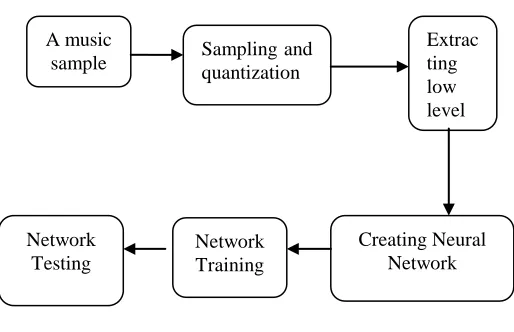
The overall schematic diagram in order to classify the
mood of the songs is shown in figure 1. The input to the
system is a song in wav form, while the output is a mood of
the defined types. The following figure reflects the
ISSN 2348 – 7968
Figure 1
We have taken the song as input and using Matlab’s
wavread function we sampled the audio WAV file and convert it into text format. These functions sample
the audio signal at 44.1 KHz and stored in the text
files. Sampling is a process of converting continuous
time domain signal into discrete signal. It can be done
in matlab using “wavread” function. wavread supports multichannel data, with up to 32 bits per
sample, and supports reading 24- and 32-bit .wav files.
We then extracted the audio based features: entropy of
the signal, energy of the signal, zero crossing rate,
spectral rolloff, spectral centroid, spectral flux, RMS
of the signal, and MFCC form the sampled file. A feed
forward neural network is created in this step. The
network is formed by selecting the best set of network
attributes. Two hidden layers are taken each layer
contains 10 neurons and default activation functions
are used for each layer. The network is trained with
the features matrix of 90 songs of three different
moods. Number of epochs is selected to 1000, training
goal is set to 0.1, learning rate is set to 0.05, training
time to 32, mem_reduc is set to 2 etc. After successful
training the network is then tested to the known moods
songs. Basically network is tested to draw out the
efficiency rate. Testing ensures implementation of the
system.
The network efficiency can be improved by applying
certain techniques that are based on the concept of
probabilistic reasoning. Baye’s Theorem is one such
concept. If one found satisfying results after applying
Baye’s reasoning it can then be implemented to increase
the efficiency rate but again remember it is purely based on
probabilistic reasoning, thus there are issues in adopting
this concept.
Bayes' Theorem is a theorem of probability theory
originally stated by the Reverend Thomas Bayes. It can be
seen as a way of understanding how the probability that a
theory is true is affected by a new piece of evidence. It has
been used in a wide variety of contexts, ranging from
marine biology to the development of "Bayesian" spam
blockers for email systems. In the philosophy of science, it
has been used to try to clarify the relationship between
theory and evidence. Many insights in the philosophy of
science involving confirmation, falsification, the relation
between science and pseudoscience, and other topics can
be made more precise, and sometimes extended or
corrected, by using Bayes' Theorem. These pages will
introduce the theorem and its use in the philosophy of
science.
Begin by having a look at the theorem, displayed
below. Then we'll look at the notation and
terminology involved.
P(A/B)= (P(A) * P(B/A)) / P(B)
Where,
P(A) and P(B) are probability of two events A
and B.
A musicsample Sampling and quantization
Creating Neural Network Network
Testing
Extrac ting low level
ISSN 2348 – 7968
P(A/B) signifies probability of event A if event
B is true.
P(B/A) signifies probability of event B if event
A is true.
3.1 Features Extraction for Music
Classification
Feature extraction requires an in-depth understanding of
the signal processing theories. In this chapter we will be
discussing the theoretical aspects of these features and
feature extraction process.
1) Entropy: Entropy is a property that can be used to determine the energy not available for work. It is also a
measure of the tendency of a process. It is a measure of
disorder of a system.
Entropy refers to the relative degree of randomness. The
higher the entropy, the more frequently are signaling
errors. Entropy is directly proportional to the maximum
attainable data speed in bps. Entropy is directly
proportional to noise and bandwidth. It is inversely
proportional to compatibility.
Entropy also refers to disorder deliberately added to data
in certain encryption process.
2) Energy:
Signal energy refers to strength of
signal amplitude. In signal processing, the
energy
of a continuous-time signal x(t) is
defined as
Energy in this context is not, strictly speaking,
the same as the conventional notion of energy in
physics and the other sciences. The two concepts
are, however, closely related, and it is possible to
convert from one to the other:
where Z represents the magnitude, in appropriate units of measure, of the load driven by the signal.
For example, if x(t) represents the potential (in
volts) of an electrical signal propagating across a
transmission line, then Z would represent the
characteristic impedance (in ohms) of the
transmission line. The units of measure for the
signal energy
would appear as volt
2-seconds,
which is not dimensionally correct for energy in
the sense of the physical sciences. After dividing
by
Z, however, the dimensions of E would
become volt
2-seconds per ohm, which is
equivalent to joules, the SI unit for energy as
defined in the physical sciences.
3) Zero Crossing Rate:
It refers to number of
times the signal crosses zero line. The
zero-crossing rate
is the rate of sign-changes along a
signal, i.e., the rate at which the signal changes
from positive to negative or back. This feature
ISSN 2348 – 7968
and music information retrieval, being a key
feature to classify percussive sounds
[2].
ZCR is defined formally as
where is a signal of length and the indicator
function
is 1 if its argument is true and
0 otherwise.
In some cases only the "positive-going" or
"negative-going" crossings are counted, rather
than all the crossings - since, logically, between
a pair of adjacent positive zero-crossings there
must be one and only one negative zero-crossing.
For monophonic tonal signals, the zero-crossing
rate can be used as a primitive pitch detection
algorithm
4) Spectral Rolloff: Flatness of sound. The decrease in energy with increase in frequency, ideally described in the
sound source as 12 dB per octave. Spectral rolloff is
defined as the frequency where 85% of the energy in the
spectrum is below this point. It is often used as an indicator
of the skew of the frequencies present in a window.
5) Spectral Flux: It determines changes of spectral energy (variation of harmonics). A feature extractor that extracts
the Spectral Flux from a window of samples and the
proceeding window. This is a good measure of the amount
of spectral change of a signal.
Spectral flux is calculated by first calculating the
difference between the current value of each magnitude
spectrum bin in the current window from the
corresponding value of the magnitude spectrum of the
previous window. Each of these differences is then
squared, and the result is the sum of the squares.
6) Spectral Centroid: Spectral Centroid is the balancing point of sub-band energy distribution. It determines the
frequency area around which most of the signal energy
concentrates and is thus closely related to the time domain
ZCR feature.
It is also frequently used as approximation for a perceptual
brightness measure. A feature extractor that extracts the
Spectral Centroid. This is a measure of the "centre of
mass" of the power spectrum.
This is calculated by calculating the mean bin of the power
spectrum. The result returned is a number from 0 to 1 that
represents at what fraction of the total number of bins this
central frequency is.
7) Root Mean Square: It refers to the mathematical implementation of root of mean of square of the signal
value (discrete sampled value). A feature extractor that
extracts the Root Mean Square (RMS) from a set of
samples. This is a good measure of the power of a signal.
RMS is calculated by summing the squares of each sample,
dividing this by the number of samples in the window, and
finding the square root of the result.
8
) MFCC (Mel Frequency Cepstral Coefficient): Mel-frequency cepstral coefficients (MFCCs) are coefficientsISSN 2348 – 7968
a linear cosine transform of a log power
spectrum on a nonlinear mel scale of frequency.
They are derived from a type of cepstral
representation of the audio clip (a nonlinear
"spectrum-of-a-spectrum"). The difference
between the cepstrum and the mel-frequency
cepstrum is that in the MFC, the frequency bands
are equally spaced on the mel scale, which
approximates the human auditory system's
response more closely than the linearly-spaced
frequency bands used in the normal cepstrum.
This frequency warping can allow for better
representation of sound, for example, in audio
compression.
MFCCs are commonly derived as follows:
1. Take the Fourier transform of (a windowed
excerpt of) a signal.
2. Map the powers of the spectrum obtained above
onto the mel scale, using triangular overlapping
windows.
3. Take the logs of the powers at each of the mel
frequencies.
4. Take the discrete cosine transform of the list of
mel log powers, as if it were a signal.
5. The MFCCs are the amplitudes of the resulting
spectrum.
3.2
Learning and Classification using
Neural Network
Learning using neural network requires input feature
matrix and output target matrix. The input feature matrix is
created from discrete samples values of the input songs for
training by calculating different audio features values.
We have taken the song as input and using Matlab’s
wavread function we sampled the audio WAV file and convert it into text format. These functions sample the
audio signal at 44.1 Khz and stored in the text files. We
then extract the audio based features entropy of the signal,
energy of the signal, zero crossing rate, spectral rolloff,
spectral centroid, spectral flux, RMS of the signal, and
MFCC form the sampled file.
We then supply the extracted audio features and their
expected outcomes as inputs to create the network. The
classifier is implemented using MATLAB’s Neural
Networking toolbox. The classifier is a feed forward neural
network with back propagation learning algorithm. Once
the classifier is trained we simulate the classifier and get
the mood of the song.
Process of creating Feedforward Neural Network:
Collect data: We have taken 90 songs (30 for each category : happy, sad and angry). We have extracted
10 lakhs discrete samples from the middle part of
song’s signal to reduce the length of each song. Then
we have calculated the values of seven features
described above using matlab script. We have
prepared feature input matrix of each song which will
be given as input to a feed forward neural network.
ISSN 2348 – 7968
each and 1 output layer with 3 neurons.The transfer
function of 2 hidden layers is “tansig” and “purelin”
respectively and the transfer function of the output
layer is “logsig”.
Configure the network :
In this process we can change the attribute values of
network to make the network learn in an efficient way.
Matlab code of configuring a network-
net.trainParam.epochs=1000;
net.trainParam.goal=.1;
net.trainParam.lr=0.05;
net.trainParam.time=32;
net.trainParam.mem_reduc=2;
where,
epochs signifies number of iterations of network.
goal signifies tolerance range under which output can vary.
lr is learning rate, which is one of the parameters which governs how fast a neural network learns and how effective
the training is.
Time signifies time taken by neural network to learn.
Mem_reduc is an attribute which signifies reducing the memory to increase efficiency.
Initialize the weights and biases :
The
configure
command configures the network objectand also initializes the weights and biases of the network;
therefore the network is ready for training. There are times
when you might want to reinitialize the weights, or to
perform a custom initialization. Initializing Weights (init)
explains the details of the initialization process. You can
also skip the configuration step and go directly to training
the network. The
train
command will automaticallyconfigure the network and initialize the weights.
Weights are saved in network attributes “net.iw”.
Train the network:
Once the number of layers, and number of units in each
layer, has been selected, the network's weights and
thresholds must be set so as to minimize the prediction
error made by the network. This is the role of the training algorithms.
Train function is used to train the network.
Matlab code to train the network:-
net=train(net,p,t);
save 'network.mat''net';
Where
“net” is the network variable “p” is input feature matrix “t” is target matrix
Save function is used to save the network “net” in the file named ”network.mat”
Test the network:
Testing is done to check whether the network is producing
the desired output or not. We tested the network with 45
songs(15 for each category).
Use the network: If the testing is successful and the efficiency of results is around 60-70% then we can use
the network to test the new songs of unknown mood
by simulating the saved trained network.
4.0 Implementations, Results and
ISSN 2348 – 7968
We have implemented this system on windows
platform in MATLAB 7.0.1. Both GUI and the
classifier is implemented using MATLAB. Initially we
have collected the database of various Hollywood
songs in WAV format. We have taken songs from all
three moods. Out of all songs we have reserved 90
songs for training purpose, 30 songs from each of the
three mood i.e. happy, angry and sad. Songs are then
sampled and samples are then cut to fixed lengths i.e.
10 lakhs samples from middle of each song. The 8
selected audio features are then extracted from each
song and features values of all 90 songs are stored in a
feature matrix. This feature matrix is used as input
feature matrix with 8 rows containing features values
and 90 columns for 90 songs, for training the neural
network. Each column of this matrix represents
features of one song. An output target matrix is
constructed according to the input matrix representing
the known mood of the 90 songs. The output target
matrix contains 3 rows representing mood and 90
columns for 90 songs.
Neural Network can be created using “newff” function
in Matlab. NEWFF Creates a feed-forward back
propagation network. Since there are 8 input features,
initially we started with 6 hidden neurons. We ran the
training and testing sets through the network 10 times.
But there was always the requirement to have right set
of attribute values and the result of the simulation of
the network is not good as expected. Therefore we
then have chosen 2 hidden layers each layer
containing 10 neurons. The no. of iterations (epoch) is
most important. We kept the no. of epochs to 1000.
Though maximum amount of learning is done by 2000
epochs but it is by 1000 that the learning curve
becomes nearly horizontal. The performance function
value (goal) is kept to .01 during the training process.
Values around .002-.003 are the minimum
performance function values that we reach during the
training and the networks trained up to these values
produced satisfactory results .So we keep the value to
.01 because by that value the network would really be
trained enough. Learning rate is kept to .05. The no. of
epochs after which the status of the level of training
done is displayed (show) is kept to 50. Other
parameters are kept to default value. This time
network is trained 10 times to obtain the network that
can be efficiently adopted after adjusting some
network parameters. Then after training with 10
hidden neurons and fixed set of network attribute
values we have computed the results. In order to
increase the efficiency rate we have applied
probabilistic reasoning through “Bayes theorem”.
4.1 Performance Evaluation
Performance evaluation can be done by testing the
network with different songs with known mood and
check their efficiency rate.
With the 8 important features selected, the approach
was to determine how well the multilayer feed forward
neural network would classify the songs. First, we
determined how many hidden neurons should be in the
hidden layer of the network.
We have extracted a clip from a song (between 30-50
secs) and started the training. When we have tested
these results we didn’t get the desired efficiency so we
have decided to have a different approach. After
testing the new results obtained we have noticed that
ISSN 2348 – 7968
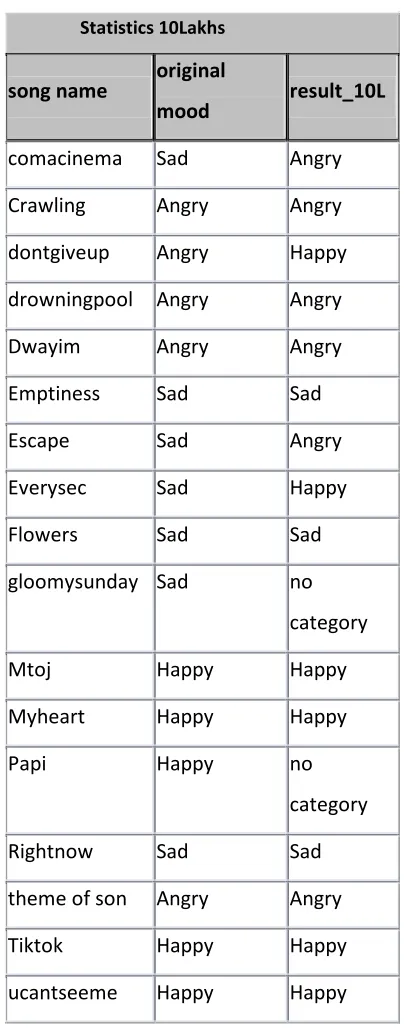
shows the results of this new testing scheme, a
comparison is shown between tested results through
the system and the original known mood the songs:
Statistics 10Lakhs
song name
original
mood
result_10L
Activate
Angry
Angry
Addicted
Sad
Angry
Ajks
Angry
Sad
Alldcold
Sad
Sad
Amyrica
Angry
Sad
Backst
Sad
Angry
beastie boys
Angry
Happy
Beforewebegu
n
Sad
Happy
Blameit
Sad
Sad
Bottomsup
Angry
Angry
Breakstuff
Angry
Happy
Breathme
Sad
Sad
Brick
Sad
Sad
Burndown
Angry
no
category
burnground
Angry
Angry
Camarada
Happy
Happy
Careless
Happy
Happy
chickenwire
Sad
Sad
claymoreparty
Angry
Sad
Statistics 10Lakhs
song name
original
mood
result_10L
comacinema
Sad
Angry
Crawling
Angry
Angry
dontgiveup
Angry
Happy
drowningpool
Angry
Angry
Dwayim
Angry
Angry
Emptiness
Sad
Sad
Escape
Sad
Angry
Everysec
Sad
Happy
Flowers
Sad
Sad
gloomysunday
Sad
no
category
Mtoj
Happy
Happy
Myheart
Happy
Happy
Papi
Happy
no
category
Rightnow
Sad
Sad
theme of son
Angry
Angry
Tiktok
Happy
Happy
ucantseeme
Happy
Happy
Table -1
We can see here in this testing we got 18 out 36 songs
are correctly matched. These 10 lakhs samples were
from the start of the song that does not ensure
ISSN 2348 – 7968
zeros in the starting duration which would not be
efficient.
Therefore we have decided to have another approach
and extracted samples from middle part of the song.
We have taken 10 lakhs fixed length samples from the
middle part of every song and then repeated the
process. Since there are 8 input features, initially we
started with 6 hidden neurons. We ran the training and
testing sets through the network 10 times. But there
was always the requirement to have right set of
attribute values. This time network is trained 10 times
to obtain the network that can be efficiently adopted
after adjusting some network parameters. This time we
then have chosen 2 hidden layers each layer
containing 10 neurons. The network goal, learning rate
and training time is adjusted such that to have the best
network that could be selected after modifying the
parameters values and testing some songs hand in
hand. Then after training with 10 hidden neurons and
fixed set of network attribute values we have
computed the results. In order to increase the
efficiency rate we have applied probabilistic reasoning
through “Baye’s theorem”.
Method of increasing efficiency:
P(A) is maximum component of any of the mood.
P(B) refers to the case when a song does not belong
to any of the category and the output matrix is
[0;0;0] (zero matrix).
P(B/A) refers to the probability of output matrix is
zero matrix when the maximum component refers to
original mood of the song.
Thus, the probability of maximum component refers
to the original mood when the output matrix is zero
matrix.
In our case,
P(A)=24/42;
P(B)=6/42;
P(B/A)=3/24;
P(A/B)=((24/42)*(3/24))/(6/42);
=1/2 = 50%
Baye’s Theorem gives satisfying results, thus we’ve
decided to implement Baye’s Theorem to increase
our efficiency rate. Statistics obtained after applying
Baye’s Theorem are is shown in Table-2
Test Statistics Table
Song name
original
mood
tested result
Activate
Angry
Angry
Addicted
sad
Angry
Ajks
angry
Angry
all d cold
sad
angry
Amyrica
angry
Angry
Backst
sad
Happy
beastie boys
angry
Angry
before we
begun
ISSN 2348 – 7968 Test Statistics Table
Song name
original
mood
tested result
blame it
sad
Happy
bottoms up
angry
no category
break stuff
angry
Happy
breathe me
sad
Sad
Brick
sad
Sad
burn down
angry
Angry
burn ground
angry
Angry
Camarada
happy
Sad
Careless
happy
Angry
chicken wire
sad
Sad
clay more
party
angry
Sad
coma cinema
sad
Happy
Crawling
angry
Angry
dont give up
angry
Angry
drowning
pool
angry
Happy
Emptiness
Sad
Sad
Escape
Sad
Angry
every second
Sad
Sad
Flowers
Sad
Sad
gloomy
Sunday
Sad
Sad
heal the
world
Happy
Sad
Test Statistics Table
Song name
original
mood
tested result
Mtoj
Happy
Sad
my heart
Happy
Happy
null sleep
Happy
Happy
Papi
Happy
Angry
right now
Sad
Angry
stuck in
infinity
Sad
Sad
the guest
Sad
Sad
the way We
am
Angry
no category
theme of son
Angry
Angry
Tiktok
Happy
happy and
angry
United
Happy
no category
waving flag
Happy
Happy
you cant see
me
Happy
Happy
Table- 2
We got 25 songs out of 42 test songs correctly
matched to the original mood. So our efficiency rate is
59.53% (around 60%).
ISSN 2348 – 7968
In this work we have characterized song into different
moods using multi layer feed forward neural network with
supervised back propagation learning algorithm. We have
taken 8 audio features to form one single feature vector
and then trained the network with audio features.
Training a neural network is a typical process. A network
must be trained with accurate set of feature values and with
accurate set of network attribute values. Features
extraction is the core part of determination of the mood of
a song that is highly dependent on features values. A
thorough, deep and accurate study must be made in order
to identify best set of features that can be extracted out of
an audio song. Any miss of accuracy will definitely
produce false results.
Experimental results show the robustness of the system.
The system classifies audio into happy, angry and sad
mood.
Although we’ve taken care of accuracy as best we can do,
still trained network has produced only 60% efficiency.
The mood classification system was developed as a
feasibility study for the development
of a system that would classify, successfully, music files
according to their mood . This section will discuss future
work that needs to be done in order to further study this
problem and develop such a system.
Biblography
[1] P. Ekman. An argument for basic emotions. Cognition
& Emotion, 6(3/4):169–200, 1992.
[2] J. A. Russell. Affective space is bipolar. Journal of
Personality and Social Psychology,37(3):345–356, 1979.
[3] J. A. Russell. A circumplex model of affect. Journal of
Personality and Social Psychology,39(6):1161–1178,
1980.
[4] R. E. Thayer. The Biopsychology of Mood and
Arousal. Oxford University Press, Oxford, 1989.
[5] R. E. Thayer. The origin of everyday moods: managing
energy, tension, and stress. Oxford University Press, New
York, 1996.
[6] A. Mehrabian. Pleasure-arousal-dominance: A general
framework for describing and measuring individual.
Current Psychology, 14(4):261–292, 1996.
[7] Y. Feng, Y. Zhuang, and Y. Pan. Music information
retrieval by detecting mood via computational media
aesthetics. In Proceedings of the IEEE/WIC International
Conference on Web Intelligence, page 235, Washington,
USA, 2003.
[8] [24] P.N.Juslin. Cue utilization in communication of
emotion in music performance: relating performance to
perception.Journal of Experimental Psychology: Human
Perception and Performance, 26(6):1797–1813, 2000.
[9] S. Dixon. A lightweight multi-agent musical beat
tracking system. In Proceedings of the Pacific Rim
ISSN 2348 – 7968
[10] K. Hevner. Experimental studies of the elements of
expression in music. The American Journal of Psychology,
48(2):246–268, 1936.
[11] C.H. Chen, M.F. Weng, S.K. Jeng, and Y.Y.
Chuang.Emotion-Based Music Visualization Using
Photos.LNCS, 4903:358–368, 2008.
[12] P. R. Farnsworth. A study of the hevner adjective list.
The Journal of Aesthetics and Art Criticism, 13(1):97–103,
1954.
[13] M. G. Rigg. What Features of a Musical Phrase Have
Emotional Suggestiveness?,volume36 of Bulletin of the
Oklahoma Agricultural and Mechanical College.
Oklahoma Agricultural and Mechanical College,
Stillwater, Oklahoma, 1939.
[14] M. G. Rigg. The mood effects of music: A
comparison of data from four investigators.The Journal of
Psychology, 58:427–438, 1964.
[15] K. B. Watson. The nature and measurement of
musical meanings. In Psychological Monographs, volume
54, pages 1–43. The American Psychological Association,
Evanston, IL, 1942.
[16] L. Lu, D. Liu, and H.J. Zhang. Automatic mood
detection and tracking of music audio signals. IEEE Trans.
Audio, Speech & Language Process, 14(1), 2006.
[17] T.L. Wu and S.K. Jeng. Probabilistic estimation of a
novel music emotion model. In 14th International
Multimedia Modeling Conference. Springer, 2008.
[18] S. Kim, S. Kim, S. Kwon, and H. Kim. A music
summarization scheme using tempo racking and two stage
clustering. IEEE Workshop on Multimedia Signal
Processing, pages 225–28,2006.
[19] L. Lu, D. Liu, and H.J. Zhang. Automatic mood
detection and tracking of music audio signals. IEEE Trans.
Audio, Speech & Language Process, 14(1), 2006.
[20] C.C. Liu, Y.H. Yang, P.H. Wu, and H.H.
Chen.Detecting and classifying emotion in popular music.
In JCIS, 2006.
[21] Sanjay Jain and R.S. Jadon, “Audio Based Movies
Characterization using Neural Network”, published in
International Journal of Computer Science and
Applications(IJCSA ISSN 0974-1003), Vol 1 No.2, PP 87-
91, Aug, 2008.
[22] Sanjay Jain and R.S. Jadon, “Features Extraction for
Movie Genres Characterization”, in Proceeding of
WCVGIP-06, 2006.
[23] T. Li and M. Ogihara. Content-based music similarity
search and emotion detection.In Proceedings of the IEEE
International Conference on Acoustics, Speech, and Signal
Processing, volume 5, pages 705–708, 2004.
[24] G. Tzanetakis and P. Cook. Marsyas: a framework for
audio analysis. Organised Sound, 4(3):169–175, 1999.
[25] A. Tellegen, D.Watson, and L. A. Clark. On the
dimensional and hierarchical structure of affect.
Psychological Science, 10(4):297–303, 1999.
[26] D.YangandW.Lee. Disambiguating music emotion
ISSN 2348 – 7968
International Conference on Music Information Retrieval,
Barcelona,Spain, 2004.
[27] M. Tolos, R. Tato, and T. Kemp. Mood-based
navigation through large collections of musical data. In
Consumer Communications and Networking Conference,
pages 71–75,Las Vegas, USA, 2005.
[28] A. Wieczorkowska, P. Synak, R. Lewis, and Z. Ras.
Extracting emotions from music data. In Proceedings of
the 15th International Symposium on Methodologies for
Intelligent Systems, Saratoga Springs, USA, 2005.
[29] ww.mathworks.com/help/pdf_doc/nnet/nnet_ug.pdf.