Scholarship@Western
Scholarship@Western
Electronic Thesis and Dissertation Repository
8-28-2014 12:00 AM
Reductive Depolymerization of Kraft Lignin for Chemicals and
Reductive Depolymerization of Kraft Lignin for Chemicals and
Fuels Using Formic Acid as a In-Situ Hydrogen Source
Fuels Using Formic Acid as a In-Situ Hydrogen Source
Shanhua Huang
The University of Western Ontario
Supervisor
Chunbao (Charles) Xu
The University of Western Ontario
Graduate Program in Chemical and Biochemical Engineering
A thesis submitted in partial fulfillment of the requirements for the degree in Master of Engineering Science
© Shanhua Huang 2014
Follow this and additional works at: https://ir.lib.uwo.ca/etd
Part of the Biochemical and Biomolecular Engineering Commons, and the Catalysis and Reaction Engineering Commons
Recommended Citation Recommended Citation
Huang, Shanhua, "Reductive Depolymerization of Kraft Lignin for Chemicals and Fuels Using Formic Acid as a In-Situ Hydrogen Source" (2014). Electronic Thesis and Dissertation Repository. 2323.
https://ir.lib.uwo.ca/etd/2323
This Dissertation/Thesis is brought to you for free and open access by Scholarship@Western. It has been accepted for inclusion in Electronic Thesis and Dissertation Repository by an authorized administrator of
REDUCTIVE DEPOLYMERIZATION OF KRAFT LIGNIN FOR
CHEMICALS AND FUELS USING FORMIC ACID AS AN
IN-SITU
HYDROGEN SOURCE
(Thesis format: Integrated Article)
by
Shanhua Huang
Graduate Program in Chemical and Biochemical Engineering
A thesis submitted in partial fulfillment of the requirements for the degree of
Mater of Engineering Science
The School of Graduate and Postdoctoral Studies The University of Western Ontario
London, Ontario, Canada
ii
Abstract
In this thesis work, formic acid (FA) proved to be an effective in-situ hydrogen donor for the reductive depolymerization of kraft lignin (KL). At the optimum conditions without catalysts, i.e., 300 oC, 1 h, 18.6 wt.% substrate concentration, 50/50 (v/v) water-ethanol medium at a FA-to-lignin mass ratio of 0.7, KL (Mw ~10,000 g/mol) was effectively
depolymerized, producing depolymerized lignin (DL, Mw 1, 270 g/mol) at a yield of ~90
wt.% and <1 wt.% yield of solid residue (SR). The effects of heterogeneous catalysts on KL reductive depolymerization in 50/50 (v/v) water-ethanol medium were also investigated. At all conditions, FHUDS-2 (W-Mo-Ni) catalyst showed very high efficiency in sulfur-removal, and Ru10%/C exhibited excellent activity for depolymerization and hydrogenation of the
depolymerized lignin products. However at a lower temperature (200 C), Ni10%/Zeolite
catalyst demonstrated superb catalytic activity for reductive depolymerization of KL, producing 93.5(±4.1) wt.% yield of DL of Mw = 3150 g/mol.
Keywords
iii
Co-Authorship Statement
Chapters 3 and 4 are manuscripts submitted to peer-reviewed journals for consideration of publication. The contribution of each author is stated below.
Chapter 3:
Reductive Depolymerization of Kraft Lignin for Chemicals and Fuels using Formic
Acid as an In-situ Hydrogen Source
Authors: Shanhua Huang, Nubla Mahmood, Matthew Tymchyshyn, Zhongshun Yuan, Chunbao (Charles) Xu
Status: Accepted by Bioresource Technology in August 2014, currently the paper is in press.
Experimental work and data analysis were performed by Shanhua Huang under the supervision of Dr. Chunbao (Charles) Xu and Dr. Zhongshun Yuan. Matthew Tymchyshyn and Nubla Mahmood provided consultation regarding experimental work and interpretation of results. The manuscript was drafted by Shanhua Huang, and reviewed and revised by all co-authors.
Chapter 4:
Reductive Depolymerization of Kraft Lignin for Bio-chemicals or Fuels in Formic Acid
with Supported Metal Catalysts
Authors: Shanhua Huang, Nubla Mahmood, Matthew Tymchyshyn, Yongsheng Zhang,
Zhongshun Yuan, Chunbao (Charles) Xu
Status: Submitted to Applied Catalysis B: Environmental
iv
Acknowledgments
I would like to express my deepest appreciation to my supervisors Prof. Chunbao (Charles) Xu and Dr. Zhongshun (Sean) Yuan for their effective supervision/guidance and great support/encouragement in the past two years. The completion of this thesis would not have been possible without their support and encouragement.
I would like to thank Matthew Tymchyshyn, Nubla Mahmood, Fang (Flora) Cao and Sadra Souzanchi for their continuous assistance on the experiments and product analyses and characterizations such as GPC, FTIR, NMR, TGA and BET surface area and porosity analysis.
I would also like to thank many other group members, to list a few: Shanghuan (Shawn) Feng, Yongsheng (Ryan) Zhang, Izad Behnia, Francisco Javier Sanchez Careaga and Alejandro Montes, et al., for their advices and suggestion on my thesis project. In addition, the support and care from the faculty and staff at the Institute for Chemical and Fuels from Alternative Resources (ICFAR) and Department of Chemical/Biochemical Engineering are gratefully appreciated.
I would like to acknowledge Prof. Jin Zhang, Prof. Shazhad Barghi and Prof. Paul J. Ragogna to review my thesis and attend my presentation.
I would like to acknowledge the funding support from NSERC Biomaterials and Chemicals Strategic Research Network (Lignoworks) partnered with FPInnovations, Lignol and Weyerhaeuser, and the NSERC Discovery Grant, NSERC/FPInnovations Industrial Research Chair program and the ORF-RE grant in Forest Biorefinery awarded to Prof. Xu.
v
Table of Contents
Abstract ... ii
Co-Authorship Statement... iii
Acknowledgments... iv
Table of Contents ... v
List of Tables ... viii
List of Figures ... x
Preface... xii
Chapter 1 Introduction ... 1
1.1 Lignin and its utilizations... 1
1.2 Thesis objectives ... 4
1.3 Thesis overview ... 4
References ... 6
Chapter 2 Valorization of Lignin for Chemicals and Materials - Literature Review ... 8
2.1 Lignin – A Potential Source for Chemicals and Materials ... 8
2.2 Industrial Production of Lignin ... 10
2.3 Gasification of Lignin into H2 or Syngas ... 12
2.4 Wet Oxidation ... 13
2.5 Pyrolysis of Lignin ... 14
2.6 Hydrothermal Liquefaction or Hydrolytic Depolymerization of Lignin ... 15
2.6.1 The Processes ... 16
2.6.2 Composition and properties of depolymerized lignin ... 19
2.6.3 Effects of process conditions ... 23
2.7.1 Effects of catalysts ... 26
vi
2.8 Summary and conclusions ... 33
References ... 35
Chapter 3 Reductive Depolymerization of Kraft Lignin for Chemicals and Fuels using Formic Acid as an In-situ Hydrogen Source ... 44
3.1 Introduction ... 44
3.2 Materials and Methods ... 46
3.2.1 Materials ... 46
3.2.2 Depolymerization of kraft lignin ... 47
3.2.3 Characterization of reaction products ... 48
3.3 Results ... 49
3.3.1 Effects of FA-to-lignin mass ratios ... 49
3.3.2 Effects of solvent composition... 51
3.3.3 Effects of reaction time ... 52
3.3.4 Effects of reaction temperature ... 53
3.3.5 Effects of substrate concentration ... 55
3.3.6 Chemical analyses of the DL products ... 56
3.4.1 Roles of FA in lignin depolymerization... 62
3.4.2 Effects of hydrogen source ... 64
3.5 Conclusions ... 65
3.6 References ... 67
Chapter 4 Reductive Depolymerization of Kraft Lignin for Bio-chemicals or Fuels in Formic Acid with Supported Metal Catalysts ... 71
4.1 Introduction ... 71
4.2. Materials and Experimental Methods ... 73
4.2.1 Materials ... 73
4.2.2 Catalyst preparation ... 73
vii
4.3. Results and Discussion ... 78
4.3.1 Effects of catalysts and temperature on products yields and Mw of the DLs ... 78
4.3.2 Effects of reaction time on products yields and Mw of the DLs ... 82
4.3.3 Analyses of the DLs ... 84
4.3.3.1 Elemental analysis ... 84
4.3.3.2 1HNMR analysis ... 85
4.3.3.3 TGA/DTG analysis ... 88
4.3.4 Analysis of gaseous products ... 90
4.3.5 Characterization of the spent catalysts ... 92
4.4. Conclusions ... 97
4.5 References ... 100
Chapter 5 Conclusion and Recommendations for Future Work ... 103
5.1 Conclusions ... 103
5.2 Recommendations for Future Work... 105
Appendices ... 106
viii
List of Tables
Table 2- 1 Proportion of major linkages in lignin, reprinted (adapted) with permission from (Pandey and Kim, 2011). Copyright © 2011 Wiley. ... 10
Table 2- 2 GC-MS analysis of the depolymerized lignin, reprinted (adapted) with permission from (Cheng et al.,2012). Copyright Copyright © 2010 Elsevier ... 21
Table 2- 3 Performances of various supported metals catalysts in reductive lignin
depolymerization... 28
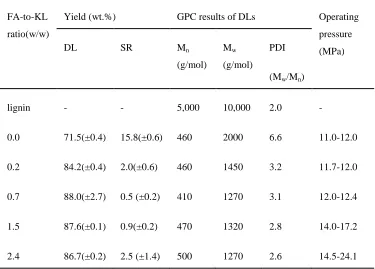
Table 3- 1 Effects of FA-to-lignin mass ratio on the products yield and molecular weights and distribution of DL ... 50
Table 3- 2 Effects of reaction time on the yields and GPC results of DL and SR [water-ethanol co-solvent (50:50 v/v), 300 °C, FA-to-lignin mass ratio of 0.7] ... 53
Table 3- 3 Effects of lignin-to-solvent ratio (w/w) on yields of DL and SR (other reaction conditions: 300 °C, 1 h, water-ethanol co-solvent (50:50 v/v), FA-to-lignin mass ratio of 0.7) ... 56
Table 3- 4 Quantitative 1H NMR analysis results for acetylated KL and DLs obtained from the experiments under the following conditions: 300C with 1000 psi H2 or with FA at
FA-to-lignin mass ratio of 0.7, using water-ethanol co-solvent (50%/50% v/v) for 1 h. ... 58
Table 3- 5 Elemental composition of the KL and the DLs from the KL depolymerization in ethanol-water co-solvent (50/50, v/v) at 300°C for 1 h with FA at various FA-to-lignin ratios ... 59
Table 3- 6 Carbon distributions in the SR and DL products and total carbon recovery from typical experimental runs under different conditions (FA-to-lignin mass ratio of 0.7, 1h) .... 61
ix
Table 4- 2 Yields of DL, SR and molecular weight and distribution of DLs in KL
depolymerization with various catalysts at different temperatures ... 79
Table 4- 3 Elemental composition of KL and DLs from reductive catalytic depolymerization in ethanol-water mixture (50/50, v/v) at 200 and 300 °C for 1h with FA-to-lignin mass ratio of 0.7 ... 84
Table 4- 4 Quantitative 1H NMR analysis results for acetylated KL and DLs obtained from the experiments under the following conditions: 300 C with or without catalyst at FA-to-lignin mass ratio of 0.7, using water-ethanol mixture (50%/50% v/v) for 1 h. ... 87
Table 4- 5 Yields of gas products from the KL depolymerization at various temperatures in ethanol-water mixture (50/50, v/v) at FA-to-lignin mass ratio of 0.7 with and without
catalysts. ... 91
Table 4- 6 BET surface and total pore volume and average pore size of fresh and spent catalysts of Ni10%/Al2O3, Ni10%/Zeoliteand Ru5%/C after the KL depolymerization
x
List of Figures
Figure 1- 1 Typical composition of a woody biomass ... 1
Figure 1- 2 Model structure of lignin (Lignoworks, http://www.lignoworks.ca/content/what-lignin) ... 2
Figure 2- 1 Structure of p-coumaryl, coniferyl, and sinapyl alcohols , reprinted (adapted) with permission from (Mohan et al., 2006). Copyright © 2006, American Chemical Society. ... 9
Figure 2- 2 Sketch diagram of a batch reactor with a temperature PID controller and a stirrer ... 17
Figure 2- 3 Schematic diagram of the continuous-flow process for lignin depolymerization, reprinted (adapted) with permission from (Nguyen et al., 2014). Copyright © 2014 Elsevier ... 18
Figure 2- 4 Equilibrium yields of gaseous species, calculated using HSC 5.1 software for the reaction system under the conditions of (FA-to-lignin mass ratio of 0.7, ethanol-water co-solvent (50/50, v/v), 1 h, 300 °C, 2 MPa initial N2 pressure) ... 32
Figure 3- 1 Effects of ethanol volume fraction in water-ethanol co-solvent on the DL and SR yields and molecular weights of DLs (other reaction conditions: 300 °C, 1 h, FA-to-lignin mass ratio of 0.7)... 52
Figure 3- 2 Effect of temperature on product yields (Other reaction conditions: water-ethanol co-solvent (50%/50% v/v), 1 h, FA-to-lignin mass ratio of 0.7) ... 54
Figure 3- 3 1H NMR spectra of the acetylated KL (a) and DLs obtained at 300C with 1000 psi H2 (b) or with FA at FA-to-lignin mass ratio of 0.7 (c) using water-ethanol co-solvent
(50%/50% v/v) for 1 h ... 58
xi
co-solvent (50/50, v/v) at FA-to-lignin mass ratio of 0.7 for 1 h... 63
Figure 3- 6 Effect of FA-to-lignin mass ratio on the formation of gas product (ethanol-water co-solvent (50/50, v/v), 1 h, 300 °C) ... 64
Figure 4- 1 Possible reaction mechanism of reductive depolymerization of lignin over a supported metal catalyst with formic acid as the in-situ hydrogen source ... 81
Figure 4- 2 Effect of reaction time on the DL and SR yields and weight-average Mw of DLs
in KL depolymerization at 200 °C in water-ethanol mixture (50:50 v/v) at an FA-to-lignin mass ratio of 0.7 ... 83
Figure 4- 3 1H NMR spectra of the acetylated KL (a) and 300C-DLs obtained using water-ethanol mixture (50%/50% v/v) for 1 h at FA-to-lignin mass ratio of 0.7 without (b) or with Ni10%/Zeolite (c) ... 87
Figure 4- 4 TG and DTG profiles of the KL and 300°C-DLs from the KL depolymerization in ethanol-water mixture (50/50, v/v) for 1 h with FA at 0.7 mass ratio with or without catalysts ... 90
Figure 4- 5 TG and DTG profiles of the spent Ni10%/Zeolite catalysts from the KL
depolymerization in ethanol-water co-solvent (50/50, v/v) at 200 and 300 °C for 1 h with FA-to-lignin mass ratio of 0.7. ... 96
Figure 4- 6 XRD patterns for fresh Ni10%/Zeolite and spent catalyst from the 200C test (▲:
xii
Preface
Chapter 1 Introduction
1.1 Lignin and its utilizations
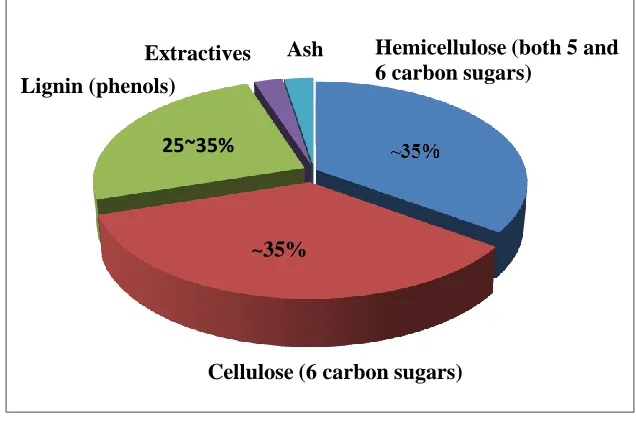
Lignocellulosic biomass such as wood and crop residues consists of three main components (lignin, cellulose and hemicellulose), and a small amount of other components (ash and extractives). Typical composition of a woody biomass is shown in Figure 1-1, from which it can be seen that a wood biomass is comprised of 25-30 wt% lignin, ~35 wt% cellulose, ~35 wt% hemicellulose and 0-5wt% (extractives + ash).
Figure 1- 1 Typical composition of a woody biomass
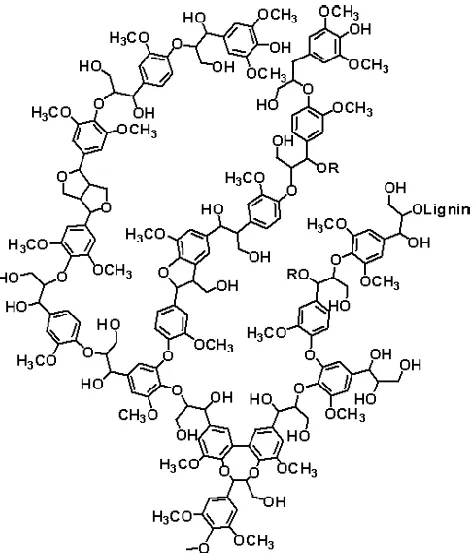
Lignin provides support and rigidity to the cell walls and is more resistant to most forms of biological attack in comparison with cellulose and other polysaccharides (Akin and Benner, 1988; Baurhoo et al, 2008; Kirk, 1971). It constitutes 15-30 wt% of the lignocellulosic biomass (wood or crop residues) and is a natural polymer made up mainly by three basic phenylpropane units (monomer), namely guaiacyl alcohol (G), syringyl alcohol (S), p-coumaryl alcohol (H) (Mohan et al., 2006). A model structure of lignin can be illustrated in Figure 1-2.
Cellulose (6 carbon sugars)
Hemicellulose (both 5 and 6 carbon sugars)
Lignin (phenols)
Extractives Ash
Figure 1- 2 Model structure of lignin (Lignoworks,
http://www.lignoworks.ca/content/what-lignin. No copyright permission is needed)
To date, enzymatic hydrolysis of lignocellulosic biomass in the ethanol plants has made it possible to separate celluloses and hemicelluloses from the whole biomass, leaving lignin (may be called hydrolysis lignin, or HL in short) (in average 15-30 % by weight, 40 % by energy) as by-products (Perlack et al., 2005). Kraft lignin (KL) – another type of lignin is produced in large amount in the form of “black liquor” in the kraft pulping industry, mainly utilized in recovery boilers for heat and power generation in pulp/paper mills. According to the International Lignin Institute, worldwide about 40-50 million tons of kraft lignin is generated each year, and the production of the “black liquor” exceeds the demands for generating energy to fulfill the operation of paper mills. This has become a bottleneck for the kraft pulping industry (accounting for 60-70% of North American kraft mills) due to the surplus of lignin generation and limited recovery boilers’ capacity.
mainly burned as low value fuel for energy generation, while kraft pulping process is the predominating process in pulp and paper industry. Thus, intensive research has been being carried out to investigate valorization of kraft lignin for various high-value chemicals such as antioxidants, antimicrobial, antifugal agents (Cruz et al., 2001), flame-retardants (Reti et al., 2008), or anti-sunlight/frost coating (Miidla, 1980) and UV-absorbent films (Liu et al., 2014).
However, the lower reactivity and high steric hindrance effects, caused by its branched structure, limits the direct use of lignin for the replacement of petroleum-based materials. New methods are developing to increase the value of lignin-based products. One of the most effective approaches to increase lignin’s chemical reactivity and decrease its steric hindrance effects is to de-polymerize lignin into oligomers and aromatic chemicals, for the production of bio-based phenolic adhesives, polyurethane foams, flocculants and epoxy coating and their properties were found to be similar or perform even better than the petroleum-based products (Khitrin et al., 2012; Cheng et al., 2013).
Various lignin depolymerization processes have been reported in the literature. Lignin depolymerization methods mainly include biological method using enzyme and thermal method using heat (such as pyrolysis) and thermochemical methods using heat and chemicals, such as hydrolytic depolymerization using water and alkaline catalyst and reductive depolymerization using hydrogen. Among those methods, biological process is a very slow process, while pyrolysis operated at 400-800°C is fast, but lignin pyrolysis resulted in a low oil product yield (20-40 wt.%) with high energy consumption in particular for wet feedstocks (Pandey et al., 2008). In contrast, hydrolytic depolymerization of lignin operates under milder conditions requiring moderate temperatures (200-300C) but higher pressures (50-150 bar). Hydrolytic depolymerization of lignin can be realized through the hydrolytically cleavage of ether bonds in lignin catalyzed by an acid or base catalyst (Yuan et al., 2010).
is needed (Yan et al., 2008). In a recent thesis work by Cheng from our group (Cheng, 2011), formic acid was employed in the depolymerization of alkali lignin (AL) and organosolv lignin (OL) in a water-ethanol (50/50, v/v) medium at 300-350 C, obtaining 70-80% DL yields.
1.2 Thesis objectives
The overall objective of the research conducted for this thesis was to investigate the effect of formic acid addition and catalyst on lignin depolymerization in water/ethanol co-solvent at moderate temperature (200-350 C). Continuing the work of Cheng (2011), this thesis work aimed to perform a systematic study on the reductive depolymerization of kraft lignin in ethanol-water and as co-solvent with formic acid under various conditions (temperature, pressure, reaction time, and ethanol concentration in the ethanol-water reaction media, and types of heterogeneous catalysts).
1.3 Thesis overview
Chapter 1 provides a short discussion about the importance of utilization of lignin for value-added bioproducts (bio-fuels, bio-chemicals and biomaterials), and presents an overview of the sources, industrial production and current utilizations of lignin and various depolymerization processes to increase lignin’s chemical reactivity and decrease its steric hindrance effects.
Chapter 2 presents a comprehensive review of literature on valorization of lignin for energy, fuels and chemicals..
focuses on the optimization of reaction parameter (e.g., reaction, temperature, time, solvent composition, and substrate concentration, as well as the amount of formic acid). Chapter 4 aimed at lowering the reaction temperature and pressure by using heterogeneous catalysts.
References
Akin, D.E., Benner, R., 1988. Degradation of polysaccharides and lignin by ruminal bacteria and fungi. Applied and Environmental Microbiology, 54, 1117-1125.
Baurhoo, B., Ruiz-Feria, C.A., Zhao, X., 2008. Purified lignin: nutritional and health impacts on farm animals-a review. Animal Feed Science and Technology, 144, 175-184.
Cheng S., Bio-based phenolic resins and adhesives derived from forestry residues and lignin. PhD thesis, Lakehead University, 2011
Cruz, J.M., Dominguez, J.M., Dominguez, H., Parajo, J.C., 2001. Antioxidant and antimicrobial effects of extracts from hydrolysates of lignocellulosic materials.
Journal of Agricultural and Food Chemistry, 49, 2459-2464.
Perlack, R.D., Wright, L.L., Turhollow, A.F., Graham, R.L., Strokes, B.J., Erbach, D.C. U. S. Department of energy, biomass as feedstock for a bioenergy and bioproducts industry: technical feasibility of a billion-ton annual supply, 2005.
Kelly, J.R., 1983. Drilling fluid composition. US Patent 4,374,738
Khitrin, K.S., Fuks, S.L., Khitrin, S.V., Meteleva, D.S., 2012. Lignin utilization options and methods. Russian Journal of General Chemistry, 82(5), 977-984.
Kirk, T.K., 1971. Effects of microorganisms on lignin. Annual Review Phytopathology, 9, 185-210.
Liu, X., Wang, J., Li, S., Zhuang, X., Xu, Y., Wang, C., Chu, F., 2014. Preparation and properties of UV-absorbent lignin graft copolymer films from lignocellulosic butanol residue. Industrial Crops and Products, 52, 633-641.
Miidla, H., 1980. Lignification in plants and methods for its study. Regul. Rosta Pitan. Rast., 87.
Mohan, D., Pittman, C.U. Jr., Steele, P.H. , 2006. Pyrolysis of wood/biomass for bio-oil: a critical review. Energy & Fuels, 20, 848-889.
Pandey, M.P., Kim, C.S., 2008. Lignin depolymerization and conversion: a review of thermochemical methods. Chemical Engineering & Technology, 34 (1), 29-41.
Reti, C., Casetta, M., Duquesne, S., Bourbigot, S., Delobel, R., 2008. Flammability properties of intumescent PLA including starch and lignin. Polymers for Advanced Technology, 19 (6), 628-635.
Yan, N., Zhao, C., Dyson, P.J., Wang, C., Liu, L., Kou, Y., 2008. Selective degradation of wood lignin over noble-metal catalysts in a two-step process. Chem. Sus. Chem., 626–629
Chapter 2 Valorization of Lignin for Chemicals and Materials
- Literature Review
2.1 Lignin – A Potential Source for Chemicals and Materials
There are increasing concerns worldwide over declining non-renewable fossil resources, energy security, climate change and sustainability. It is thus of strategic significance to explore alternatives to fossil resources for energy, but particularly for chemicals production. Among all the potential alternatives to fossil resources, lignocellulosic biomass such as wood and wood waste, forestry residues (limbs, bark, sawdust, etc.) are promising because they are on non-food basis, immense, renewable, and hence sustainable sources for both energy and chemical production.
Chemicals and materials much more valuable than energy and fuels according to a lesson learnt from petroleum industry, where 70% of crude oil is used for transportation fuels and only 4% for chemicals, plastics and rubbers. However, almost equal amounts of revenues (~$380 billion, respectively) are generated from the sector of transportation fuels and that of the chemicals/plastics/rubber. As reported by Bhima (2011), the three trillion dollars global chemical market will be occupied by bio-derived chemicals up to 15% in 2025. As such, exploring technologies to produce bio-chemicals and biomaterials from lignocellulosic biomass will yield both environmental and economic benefits.
(S), p-coumaryl alcohol (H) (Mohan et al., 2006), whose structure is presented in Figure 1-1.
Figure 2- 1 Structure ofp-coumaryl, coniferyl, and sinapyl alcohols , reprinted (adapted) with permission from (Mohan et al., 2006). Copyright © 2006, American Chemical
Society.
The actual structure of lignin also depends on the plant origin. For example, softwood lignins are made up of mainly guaiacyl units (coming from conferyl alcohol) while hardwood lignins contain various ratios of guaiacyl and syringyl units (Rohella et al., 1997). However, grass lignin is comprised of all types of monomers, i.e., all guaiacyl, syringyl and p-hydroxphenyl units.
As also presented in the model structure of lignin (Figure 2–1), lignin contains mainly -O-4 aryl ether, -O-4 aryl ether, 4-O-5 diaryl ether, -5 phenylcoumaran, 5-5 biphenyl,
-1-(1,2-Diarylpropane) and --(Resinol) linkages, depending on the source of lignin
Table 2- 1 Proportion of major linkages in lignin, reprinted (adapted) with permission from (Pandey and Kim, 2011). Copyright © 2011 Wiley.
2.2 Industrial Production of Lignin
In the ethanol plants, lignin is separated from lignocellulosic biomass through enzymatic hydrolysis where celluloses and hemicelluloses are separated from the whole biomass, leaving lignin (hydrolysis lignin, HL) as by-products (Perlack et al., 2005). In the kraft pulping industry, kraft lignin (KL) as another type of lignin is produced in large amount in the form of “black liquor”. According to the International Lignin Institute, about 40-50 million tons of kraft lignin is generated worldwide each year. KL-containing “black liquor” is mainly utilized in recovery boilers for heat and power generation. However, the production of the “black liquor” exceeds the demands for generating energy to fulfill the operation of paper mills, and 60-70 % of North American kraft mills have a bottleneck in recovery boilers capacity due to the surplus of lignin generation and limited recovery boilers’ capacity.
currently worldwide 1-1.5 million tonnes/year of lignin is employed for a wide range of applications (Lora and Glasser, 2012), almost all of this is lignosulfonates from sulfite pulping. Lignosulfonates are water-soluble, and highly sulfonated substances, quite different from kraft lignin. Until recently, the only commercial source of kraft lignin has been from Mead-Westvaco, which produces approximately 20,000 metric tons/year of kraft lignin under the trade name Indulin from a plant in South Carolina. However, in the first half of 2013, Domtar has begun operation of a 75 tonnes/day kraft lignin plant at its mill in Plymouth, North Carolina. In addition, FPInnovations has successfully developed a proprietary lignin extraction process – LignoForce™ systems, and a lignin pilot plant (in a capacity of 100 kg/day) in Thunder Bay, ON has been running for more than two years. This provides tremendous opportunities for the utilization of kraft lignin for value-added applications such as biofuels, bio-chemicals and biomaterials, which would help to create additional revenue stream for the pulp and paper industry.
Not surprising, the type of the pulping processes affects the structure of lignin resulted from the pulping process, owing to different chemical transformation reactions involved during the pulping (Doherty et al., 2011). For instance, lignosulfonate is produced from sulfite process where wood chips undergo an acidic liquid containing sulfur dioxides at 140 and 160 °C for liberating lignin. The lignosulfonate is highly cross-linked and have two types of ionizing functional groups: sulfonate and phenolic hydroxyl group, due to the extended lignin chains formed in the process of the sulfite delignification (Doherty et al., 2011). Thus, the lignin produced from this process is water-soluble, making it good commercial dispersants. In kraft or soda pulping processes, however, wood chips are heated up to 150 and 170 °C in an alkaline liquid (so-called “white liquor”), where lignin is separated from cellulose and hemicelluloses. Then the white liquor (alkaline liquid) turns into “black liquor”, and is evaporated in multiple effect evaporators before it is burned in a recovery boiler for recovery of the inorganic chemicals and generation of heat and power.
environmental positive gains. Lignins produced from kraft pulping process were found to contain more phenolic hydroxyl groups and had a weight-average molecular weight (Mw) of ~10,000 (Schorr et al., 2014). To the contrary, soda lignins contain a high
carboxylic acid content, making it a good candidate for dispersants (Doherty et al., 2011). Other pulping processes, such as the Alcell process, employing organic solvents (e.g., ethanol and water) to remove lignin from cellulose, produces a low-sulfur and low molecular weight lignin, often called organolsolv lignin.
Currently, only lignosulfonates are used to produce a variety of value-added products for specialty products such as concrete additives, and dispersants in oil well drilling fluids (Kelly, 1983). Lignins produced from kraft process or soda process are mainly burned as low value fuel for energy generation, while kraft pulping process is the predominating process in pulp and paper industry. Thus, intensive research has been carried out to investigate valorization of kraft lignin for various high-value chemicals such as antioxidants, antimicrobial, antifugal agents (Cruz et al., 2001), flame-retardants (Reti et al., 2008), or anti-sunlight/frost coating (Miidla, 1980) and UV-absorbent films (Liu et al., 2014).
However, the lower reactivity and high steric hindrance effects, caused by its branched structure, limits the direct use of lignin for the replacement of petroleum-based chemicals and materials. Chemical modifications or conversions of lignin are needed to enhance its reactivity and reduce the steric hindrance effects of lignin to facilitate the use of lignin for chemicals and materials. The following sections overview various lignin modification or conversion processes.
2.3 Gasification of Lignin into H
2or Syngas
water as the reaction medium (Guo et al, 2007; Ji et al, 2007). For example, “black liquor” was gasified in supercritical water (SCW) (Naqvi et al, 2010). However, it was found that lignin cannot be completely gasified due to the existence of thermal stable phenolic units at low temperature (250-400 °C) (Osada et al, 2004). As a result, the gas yield of lignin is relatively low (~30 %). Although hydrothermal gasification of lignin is promising approach to produce syngas, this technology is still under investigation due to its technical immaturity.
The gas products from lignin gasification comprise mainly CO2, H2, CO, CO2, CH4 with
little amount of C2H4 and C2H6. The gas products can be applicable in fuel cells, gas
turbine and as syngas for chemical synthesis. Due to the existence of CO2 and other
impurities, separation/purification of the gas products is necessary for syngas application.
Ji et al. (2006) reported that the use of 1-hexanol instead of water produced gas products of higher hydrogen purity. An effective approach for gas purification using iron oxide and calcium oxide packed beds were reported by Campen et al. (2007), where 99 wt.% hydrogen gas streams was obtained at 650 °C. The need of gas purification processes, the lower energy efficiencies plus the low gasification efficiencies at lower temperatures, make the lignin gasification processes expensive to build on an industrial scale (Calzavara et al., 2005).
2.4 Wet Oxidation
Wet oxidation is a thermal transformation where organic and inorganic chemicals are oxidized by oxidant in aqueous medium at elevated temperatures ranging from 100 to 400 °C and pressure from 0.5 - 20 MPa (Mishra, et al, 1995). The products of wet oxidation of lignin include aromatic aldehydes such as vanillin, syringaldehyde, and p-hydroxy-benzaldehyde.
effective way to isolate vanillin) and ion-exchange and crystallization (Silva et al, 2009; Zabkova et al, 2007).
Vanillin is presently produced from lignin on an industrial scale in Norway by Borregaard company. However, this process might phase out due to its low vanillin yield (12-13 wt.%) and the challenges in waste treatment and other environmental issues. Moreover, the production cost of vanillin produced from lignin has been consistently at $100-200 kg-1, which was much higher than the global market price of about $15 kg-1 (Nair, 2005; Triumph Venture Captical Ltd, 2004), which makes the lignin-to-vanillin process not economically viable.
2.5 Pyrolysis of Lignin
Pyrolysis of lignin aims to obtain lower- molecular-weight liquid products (i.e., bio-oil or pyrolysis oil) and gas products (H2, CO, CO2, and CH4, etc.). In this process, lignin is
2.6 Hydrothermal Liquefaction or Hydrolytic
Depolymerization of Lignin
The concept of biomass hydrothermal liquefaction (HTL) process originated from coal liquefaction research in Germany more than a century ago. Lignin, a natural polymer containing aromatic/phenolic ring structures, is produced in a large amount as a byproduct from pulp and paper mills and ethanol plants. Many technologies, including the previously discussed pyrolysis and HTL or hydrolytic depolymerization discussed in this section, have been applied to liquefy (or de-polymerize) lignin into phenolic oils mainly as chemical feedstock for the production of bio-based phenolic resins, polyurethane and epoxy resins. As discussed previously, the oil yields are quite low in lignin pyrolysis processes, leaving a large amount of char. In contrast, HTL or hydrolytic depolymerization technology provides various benefits that are unparalleled in comparison with other technologies such as gasification, wet oxidation and pyrolysis. Hydrothermal liquefaction does not use severe reaction conditions as gasification and are flexible with moisture content, provided that drying of feedstock is always costly. Additionally, lower-oxygen oils (10% and 15%) can be produced from liquefaction as part of oxygen exists in organic compounds could be hydrolyzed into the aqueous phase (He et al, 2008).
2.6.1 The Processes
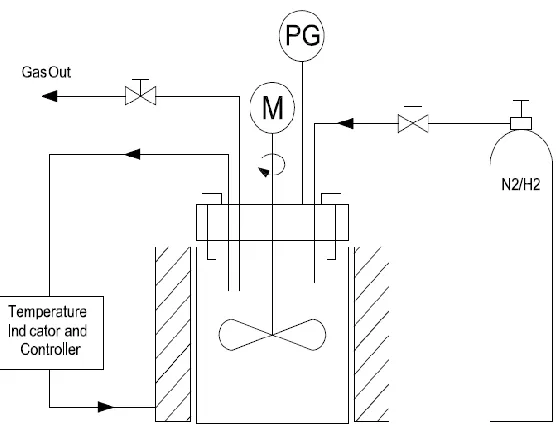
Lignin HTL or hydrolytic depolymerization process conditions such as substrate concentration, temperature, time, type of catalyst and solvent composition are reviewed by Zakzeski et al. (2010) and Akhtar and Amin (2011). The process is usually carried out in lab or pilot scale. Batch reactors and continuous flow reactors have been both used towards liquefaction/depolymerization of lignin into small molecules in literature (Roberts et al., 2011; Cheng et al., 2012; Nguyen et al., 2014).
Figure 2- 2 Sketch diagram of a batch reactor with a temperature PID controller and a stirrer
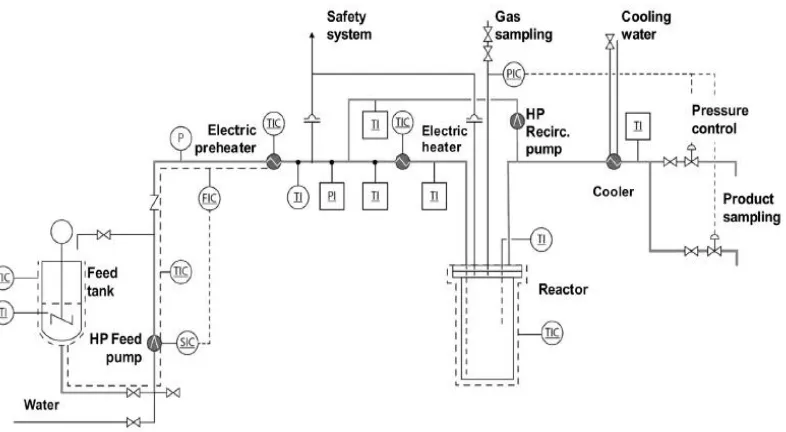
When it comes to continuous-flow reactor, the feeding of lignin is a challenge as it has to be crushed into smaller size for pumping and the concentration cannot be too high.
Figure 2- 3 Schematic diagram of the continuous-flow process for lignin depolymerization,reprinted (adapted) with permission from (Nguyen et al., 2014).
Copyright © 2014 Elsevier
Compared with batch operation, continuous-flow reactor systems are more complex involving more reactor components/valves to avoid congestion of lignin and control the reactor pressure, as shown in above Figure 2-2. The products contained oil, aqueous phase and char. The oil yield in the process was as high as 70 wt.% with a char yield of 17-20 wt.% (Nguyen et al., 2014). In order to produce better quality of fragmented products and facilitate the continuous-flow operation, lignin was also first fragmented into small species in batch process before entering the fixed-bed reactor (Yoshikawa et al., 2013), where the yield of 1-ring aromatic compounds attained up to 27 wt.%. However, in Yoshikawa et al. (2013)’s work, the mass ratio of lignin to solvent was very
low, as low as only 1:30, which is less economically attractive for operation in industrial scale.
flow reactor at 270 °C. Other types of reactors such as a semi-continuous tubular reactor (using crushed lignin particles and water solvent continuously fed in the reactor) were also investigated for lignin depolymerization (Horacek et al., 2012). The products yields at 380°C were found to be 20 wt.% solid residue, 30 wt.% in aqueous phase and 10 wt.% in oil phase (or DL).
In summary, batch reactors provide a simple and effective means for lignin HTL or hydrolytic depolymerization, but the batch processes are less efficient. The main challenge for a continuous-flow reactor is the clogging of the reactor system during the reaction due to char formation.
2.6.2 Composition and properties of depolymerized lignin
The hydrothermal liquefaction or hydrolytic depolymerization of lignin is still in lab scale, so the composition and properties of the DL products varied from one study to another. In general, the degraded products from lignin contain gaseous products, solid residue, some small aqueous products (such as organic acid compounds), oligomers-rich fraction and monomers-rich fraction. Separation of these fractions is time-consuming and labor-intensive, so in most studies, gas, aqueous phase and oil phase lumped products were separated. The aqueous phase usually comprises small organic acids and water-soluble monomers-rich fraction. The oil phase consists of mainly oligomers-rich fraction with a relatively higher molecular weight. The oligomers-rich phase makes up more than half of the DL products by weight. For example, Beauchet et al.(2012) reported that 72.1 wt.% oligomers-rich fraction and 10.8 wt.% monomers-rich fractions were produced using a continuous-flow reactor at 270 °C. The degraded lignin (DL) often refers to the oligomers-rich fraction with little amount of monomers-rich fraction.
common tools to measure the molecular weight distribution of the DL products. The weight-average molecular weight (Mw) of DL products varies with different analytical
methods. Those results from GPC-MALLS are believed to be more accurate than those from GPC-UV measurements based on polystyrene standard. Normally the DL products soluble in THF have a Mw of 10, 000-60, 000 g/mol (Cheng et al., 2013; Yuan et al., 2010), depending on the type of lignin on the reaction conditions. For example, Yuan et al. (2010) produced oligomers/polyols (Mw ≈1000 g/mol and Mn ≈450 g/mol) through
hydrolytic depolymerization of alkaline lignin or kraft lignin (Mw ≈60,000 g/mol and Mn
≈10,000 g/mol) using NaOH in a water-ethanol mixture and phenol as a capping agent (lignin to phenol ratio =1:1 (w/w)). With ESI-MS, the molecular weight of DL products was detected by in the range of 200-400 g/mol, which was similar to the structure of diesel fuel (Kleinert et al., 2009). However, this method fails to ionize many non-polar components such as alkanes and aromatics hydrocarbons. Song et al. (2013b) analyzed the DL products using MALDI-TOF. The research discovered that the lignin was first decomposed into smaller lignin species with molecular weight m/z ca. 1100 to ca. 1600 via alcoholysis before they were further depolymerized into monomeric phenols over Ni/C catalyst.
Gas Chromatography-Mass Spectrometry (GS-MS) is a useful tool to analyze the chemical compositions of the DL products. However, in most case, the DL products are composed of hundreds of chemicals with different structure and it is very difficult to determine compositions of all compounds using GC-MS. Moreover, the GC-MS has its own limitation in providing real composition of the DL products, as the degraded lignin contains significant amounts of high boiling-point oligomers, which cannot be detected by GC-MS due to their low volatility. For instance, the GC-MS spectra for DL products obtained with and without catalysts at 300 oC, particular in the 50/50 (v/v) water-ethanol co-solvent, had very few compounds detectable (Cheng et al., 2012). This implies that the depolymerized product at a relatively lower temperature was composed mostly of large oligomers molecules with a high boiling-point.
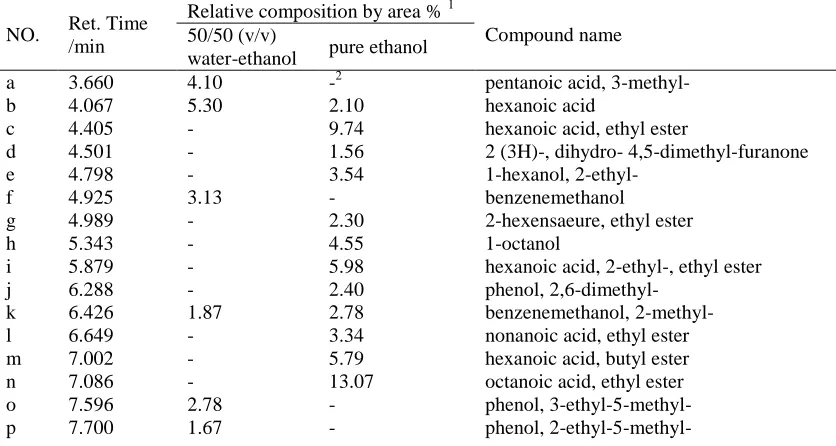
given in Table 2-2. As shown in the Table 2-2, only monomers and a few dimers were detectable in both DLs, while oligomeric products were not detectable due to their low-volatility. The compositions of the DLs are significantly different: The DL from the treatment with pure ethanol is rich in esters (total relative area percentage of ~44 %), phenolic derivatives (total relative area percentage of ~19 %), and alcohols (total relative area percentage of ~10 %). The esters might be generated by esterification between ethanol and some lignin-derived intermediates, as similarly observed by Tang et al. (2010) in catalytic hydrocracking of pyrolytic lignin to liquid fuel in supercritical ethanol. The subsequent major groups were monomeric phenolic compounds and derivatives, ascribed to the cleavage of Cα/Cβ, or Cβ/Cγ, or α-O-4 and β-O-4 linkages of lignin in
supercritical ethanol at a high temperature. However, in the DL from the treatment with 50/50 (v/v) water-ethanol, the major identified compounds are almost exclusively monomeric phenolic and derivatives compounds (total relative area percentage of ~65 %). Typical compounds are 2-ethyl-5-propyl-phenol, diethyl-phenol, 2-ethyl-6-methylphenol, 2,6-bis(1-methylethyl)-phenol, and 1-isopropyl-2-methoxy- 4-methylbenzen.
Table 2- 2 GC-MS analysis of the depolymerized lignin, reprinted (adapted) with permission from (Cheng et al.,2012). Copyright Copyright © 2010 Elsevier
NO. Ret. Time /min
Relative composition by area % 1
Compound name 50/50 (v/v)
water-ethanol pure ethanol
a 3.660 4.10 -2 pentanoic acid, 3-methyl- b 4.067 5.30 2.10 hexanoic acid
c 4.405 - 9.74 hexanoic acid, ethyl ester
d 4.501 - 1.56 2 (3H)-, dihydro- 4,5-dimethyl-furanone e 4.798 - 3.54 1-hexanol, 2-ethyl-
f 4.925 3.13 - benzenemethanol
g 4.989 - 2.30 2-hexensaeure, ethyl ester
h 5.343 - 4.55 1-octanol
i 5.879 - 5.98 hexanoic acid, 2-ethyl-, ethyl ester j 6.288 - 2.40 phenol, 2,6-dimethyl-
q 7.986 2.50 - 2-ethyl-6-methylphenol
r 8.127 - 1.63 1-decanol
s 8.289 - 2.19 phenol, 2-methyl-5-(1-methylethyl)
t 8.710 4.57 - phenol, diethyl-
u 8.714 - 1.77 2-ethyl-4,5-dimethylphenol v 8.854 1.78 - phenol, 2,3,5,6-tetramethyl w 9.200 6.68 4.11 phenol, 2-ethyl-5-propyl-
x 9.409 3.6 1.90 2-methoxy-4-(1-methylethyl) toluene
y 9.673 - 1.83 butyl octanoate
z 9.768 - 2.06 decanoic acid, ethyl ester
a1 10.142 3.86 - 1-isopropyl-2-methoxy-4-methylbenzene b1 10.204 5.71 1.61 phenol, 2,6-bis(1-methylethyl)-
c1 10.261 4.39 - 1,3-cyclohexadiene, 1,3,5,5,6,6-hexamethyl
d1 11.014 1.54 - 2-tert-butyl-1-methoxy-4-methylbenzene e1 11.115 2.63 - phenol, 3,5-bis(1-methylethyl)-
f1 11.358 2.16 - 2-methoxy-4-ethyl-6-methylphenol g1 12.128 1.51 - benzene, 1,2,4-triethyl-5-methyl h1 12.213 1.57 - 3,4,5,6-tetraethyl-2h-pyran-2-one i1 12.722 3.50 - benzene,
1,4-dimethoxy-2,3,5,6-tetramethyl-
g1 12.962 1.93 - benzene, 1,3,5-tris(1-methylethyl)- k1 17.741 1.65 - 1,1,3,3-tetramethyl-5,6-benz-2-indanone l1 18.846 1.64 1.79 phenanthrene, 2,4,5,7-tetramethyl- m1 20.260 1.87 - dehydroabietic acid
n1 21.328 2.38 - 1,2-benzendicarboxylic acid, dioctyl ester Total area/% 74.32 76.04 -
1 Total area was obtained based on the integration of 50 major peaks, without including the small peaks
with an area % < 1.5%; 2Not detectable.
hydrogen species from alcohol instead of the presence of gaseous H2 plays a key role in
lignin depolymerization.
2.6.3 Effects of process conditions
Type of Solvents
Liquefaction of lignin or biomass in sub-/super-critical fluids such as water (Lawson and Klein, 1985; Benigni and Goldstein, 1971), methanol (Tsujino et al., 2003; Minami et al., 2003), and ethanol (Miller et al., 1999) has been studied by many researchers to obtain bio-oil products or phenolic chemicals with low molecular weights. Miller and co-workers (Miller et al., 1999) showed that supercritical ethanol was more reactive than methanol in the depolymerization of lignin and model compounds in a batch micro-reactor with base catalysts, resulting in less solid residual products. Cheng et al. (2010)
also demonstrated that sub/supercritical ethanol was more reactive than methanol for liquefying woody biomass into oil products. The higher reactivity of ethanol than methanol might be owing to the slightly lower dielectric constant of ethanol (24.3 %) than that of methanol (33 %). As a result, ethanol in particular at its supercritical state may be expected to more readily dissolve and stabilize the relatively high molecular weight liquid products/intermediates derived from lignocellulosic biomass during the liquefaction/depolymerization process. Furthermore, Cheng et al. (2010) also showed that co-solvent of 50/50 (v/v) water-ethanol is much more reactive then either pure ethanol or water, leading to much higher biomass conversion and biocrude yields (up to 65 wt.%).
Effective depolymerization of kraft lignin was achieved by hydrothermal treatment in 50/50 (v/v) ethanol-water at 200 oC to 450 oC under 5 MPa H2 with or without catalyst (Cheng et al., 2012). The treatment at 300 oC for 2hr led to a yield of degraded lignin (DL, acetone-methanol soluble fraction) close to 90%. Molecular weights of the lignin were markedly reduced from its original Mw and Mn of 60,000 g/mol and 10,000 g/mol,
respectively to (Mn 415 g/mol, Mw 1010 g/mol) for the DL. Compared with that in 50/50
g/mol in the 300 oC treatment). Moreover, the DLs from pure ethanol treatment are completely soluble in THF, compared with only ~30% solubility in tetrahydrofuran (THF) for the DLs from 50/50 (v/v) ethanol-water treatment.
Reaction temperature and time
Temperature plays a dominating role in lignin depolymerization. Extensive lignin depolymerization occurs only when temperature is increased sufficiently larger than the activation energies threshold for the chemical bond cessation. However, the effects of temperature are also bi-fold: a higher temperature could not only promote depolymerization of lignin, but also leads to the repolymerization of fragmented species. The competition between depolymerization and repolymerization defines the role of temperature of lignin depolymerization. At lower temperatures, depolymerization reactions dominate while increasing the reaction temperature, but the repolymerization reactions are promoted at higher temperatures resulting in formation of more char (solid residues). An intermediate temperature is usually the optimal temperature when the highest DL yield can be obtained. Akhtar et al. (2011) studied the process condition for HTL of biomass and reported that 300-350 °C is the best temperature range for biomass decomposition. Yuan et al. (2010) reported that 260 °C is the best temperature for NaOH-catalyzed hydrolytic lignin degradation process. The reaction temperature drastically influenced the DL product yields and properties: 300-350 oC appeared to be the optimal temperature for the process with 50/50 (v/v) ethanol-water (Cheng et al., 2012). In hydrolytic depolymerization of kraft lignin with NaOH catalyst, very high yield of DL (in the range of 85-92 wt.%) was obtained at 250-300 °C (Mahmood et al., 2013).
lignin depolymerization. Yuan et al. (2010) carried out the lignin depolymerisation in water-ethanol with NaOH as catalyst and phenol as capping agent at 260 °C in batch reactor from 0.5 to 2 h. They found that 1 h reaction time appeared to be the optimal reaction time for their system. Further increase in reaction time promotes the formation of solid residue due to repolymerization or cross linking of fragmented products. Cheng et al. (2012) reported that although the reaction time from 15 min to 360 min do not exhibit big difference in product yield and molecular weight distribution, 1-2 h reaction time was the optimal reaction condition for lignin depolymerization in water-ethanol co-solvent. Formic acid and alcohol mixtures have been found to be effective in decomposition of lignin, producing 25-35 wt.% phenolic oil yield at 380 °C, but a very long residence time (17 h) was needed. The produced DL products were found to have high H/C ratio of 1.66 and low O/C ratio of 0.17 (Kleinert and Barth, 2008).
Capping agents
In lignin depolymerization, lignin is first decomposed in to smaller lignin species before further depolymerization or repolymerization reactions occurs. In order to avoid repolymerization of reactive species, capping agents, most commonly phenol proved to be effective (Yuan et al., 2010). Nguyen et al. (2014) studied the lignin depolymerization using base catalyst K2CO3 and also phenol as capping agent in a continuous-flow
fixed-bed reactor. The oxygen content in the oil phase was found to be reduced by 10 wt.% along with an increased heating value (HHV of the DL attained 32 MJ/kg). The 1-ring aromatics compounds produced were increased from 17 to 28 wt.% by the addition of K2CO3. Toledano et al. (2014) investigated two capping agents, phenol and boric acid, on
improving base catalyzed lignin depolymerization by avoiding lignin repolymerization. Phenol capping agent was found to favor production of phenolic compounds while boric acid capping agent increased char formation
2.7 Reductive depolymerization of lignin
solvent and a supported catalyst (such as expensive carbon-supported Pt or Ru catalysts) is needed (Yan et al., 2008). The reactive hydrogen could be obtained from gaseous hydrogen in combination with suitable catalysts or a solvent medium. From the report by
Yan et al. (2008), wood lignin (using pine and birch sawdust as the lignin source) could be effectively degraded into monomers of guaiacylpropane, guaiacylpropanol, syringylpropane and syringylpropanol in hot-compressed water at 200 C for 4 h under 4 MPa (cold pressure) H2 with carbon-supported Pt or Ru catalysts, where the
biomass-to-solvent ratio was fixed at about 1:15 (wt/wt). The yield of total mono-phenols was as high as 45 % of the total amount of C9 units in the lignin when co-solvent of
dioxane/H2O (1:1 wt/wt) with 1 H3PO4 (1 wt.% of the solvent) was used combined with
Pt/C catalyst (5 wt.% of the sawdust). In a recent work by Cheng et al. (2012), effective depolymerization of kraft lignin was achieved by hydrothermal treatment in 50/50 (v/v) ethanol-water at 200 oC to 450 oC under 5 MPa H2 with or without catalyst of alumina or
activated carbon supported metal catalysts (Pt, Ru, Ni). The treatment at 300 oC for 2hr led to a yield of degraded lignin (DL, acetone-methanol soluble fraction) close to 90%. Molecular weights of the lignin were markedly reduced from its original Mw and Mn of
60,000 g/mol and 10,000 g/mol, respectively to (Mn 415 g/mol, Mw 1010 g/mol) for the
DL. The use of alumina or activated carbon supported metal catalysts (Pt, Ru, Ni) did not affect the yields of DL, but it could slightly reduce the molecular weights of the DLs and greatly increased the solubility of DLs in THF, particularly in the process with 50/50 (v/v) ethanol-water.
2.7.1 Effects of catalysts
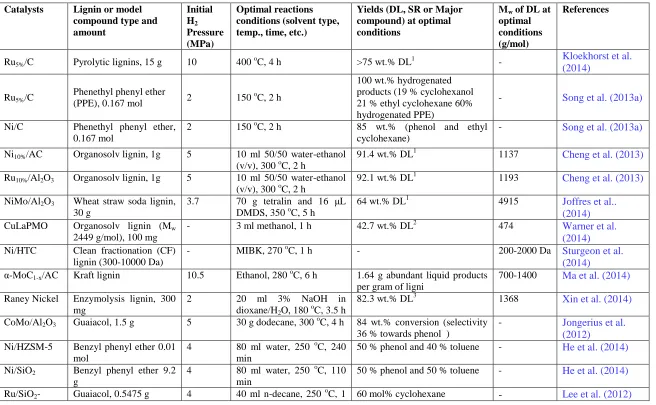
The most common catalyst types in reductive depolymerization of lignin are supported metals. The performances of various supported metals catalysts in reductive lignin depolymerization are summarized in Table 2-3.
From the results outlined in Table 2-3, some key conclusions may be drawn as follows:
(1) Ru5%/C as the commercial catalyst is highly effective for reductive lignin
yield at 400 C for 4 h reaction. Model compound studies using PPE showed that
Ru5%/C was effective in hydrogenation of benzene rings rather than C-O bond
cleavage that lead to low yield of degraded lignin.
(2) Ru is an expensive noble metal, some inexpensive metals (Ni, Mo, etc) catalysts are more attractive for industrial applications. For instance, with Ni10%/AC, organosolv
lignin was converted into DL at 91.4 wt.% yield and an Mw of 1137 g/mol at 300 C
for-2 h. With CoMo/Al2O3 catalyst, conversion of 84 wt.% for guaiacol was achieved
with 36 % selectivity towards phenol at 300 C for 4 h.
(3) Ni-based catalyst was demonstrated to be effective for producing lower molecular weight lignin oligomers and bio-oils from lignin. 85 wt.% conversion of phenethyl phenyl ether (PPE) into phenol and ethyl cyclohexane was realized at a low temperature 150 C for 2 h under 2 MPa hydrogen pressure, and Birch lignin was successfully converted into DL at 42 wt.% yield with Mw of 1409 g/mol when Ni/C
catalyst was applied.
(4) Supported catalysts based on CuO, Pt and CuLa were also found to be active in converting lignin into hydrogenated products or low molecular weight degraded products under reductive condition. 17.3 wt.% phenol was produced from ethyl acetate using CuO/Al2O3 while 97 wt.% propycyclohexane was obtained from
Table 2- 3 Performances of various supported metals catalysts in reductive lignin depolymerization
Catalysts Lignin or model compound type and amount Initial H2 Pressure (MPa) Optimal reactions conditions (solvent type, temp., time, etc.)
Yields (DL, SR or Major compound) at optimal conditions
Mw of DL at
optimal conditions (g/mol)
References
Ru5%/C Pyrolytic lignins, 15 g 10 400 oC, 4 h >75 wt.% DL1 -
Kloekhorst et al. (2014)
Ru5%/C
Phenethyl phenyl ether
(PPE), 0.167 mol 2 150
o
C, 2 h
100 wt.% hydrogenated products (19 % cyclohexanol 21 % ethyl cyclohexane 60% hydrogenated PPE)
- Song et al. (2013a)
Ni/C Phenethyl phenyl ether, 0.167 mol
2 150 oC, 2 h 85 wt.% (phenol and ethyl cyclohexane)
- Song et al. (2013a)
Ni10%/AC Organosolv lignin, 1g 5 10 ml 50/50 water-ethanol
(v/v), 300 oC, 2 h
91.4 wt.% DL1 1137 Cheng et al. (2013) Ru10%/Al2O3 Organosolv lignin, 1g 5 10 ml 50/50 water-ethanol
(v/v), 300 oC, 2 h
92.1 wt.% DL1 1193 Cheng et al. (2013) NiMo/Al2O3 Wheat straw soda lignin,
30 g
3.7 70 g tetralin and 16 μL DMDS, 350 oC, 5 h
64 wt.% DL1 4915 Joffres et al.. (2014) CuLaPMO Organosolv lignin (Mw
2449 g/mol), 100 mg
- 3 ml methanol, 1 h 42.7 wt.% DL2 474 Warner et al. (2014) Ni/HTC Clean fractionation (CF)
lignin (300-10000 Da)
- MIBK, 270 oC, 1 h - 200-2000 Da Sturgeon et al. (2014) α-MoC1-x/AC Kraft lignin 10.5 Ethanol, 280 oC, 6 h 1.64 g abundant liquid products
per gram of ligni
700-1400 Ma et al. (2014) Raney Nickel Enzymolysis lignin, 300
mg
2 20 ml 3% NaOH in dioxane/H2O, 180
o
C, 3.5 h
82.3 wt.% DL3 1368 Xin et al. (2014) CoMo/Al2O3 Guaiacol, 1.5 g 5 30 g dodecane, 300
o
C, 4 h 84 wt.% conversion (selectivity 36 % towards phenol )
- Jongerius et al. (2012)
Ni/HZSM-5 Benzyl phenyl ether 0.01 mol
4 80 ml water, 250 oC, 240 min
50 % phenol and 40 % toluene - He et al. (2014) Ni/SiO2 Benzyl phenyl ether 9.2
g
4 80 ml water, 250 oC, 110 min
Al2O3 h
Pt/AC 4-propyl-phenol, 272 mg 4 40 ml water, 280 oC, 1 h 97 wt.% propycyclohexane - Ohta et al. (2014) Ni/C Birch lignin, 2.0 g 5 40 ml methanol, 200 oC, 6
h
42 wt.% DL2 1309 Song et al. (2013b) CuO/Al2O3
2-phenoxy-1-phenylethanone 0.12 mg
2.5 10 ml ethyl acetate, 150
o
C, 21 h
96.7 wt. conversion (17.3 wt.% phenol)
- Strassberger et al. (2013)
NiAu
2-phenoxy-1-phenylethanol 0.22 mmol
1 3 ml water, 130 oC, 2.5 h 87 wt.% monomer - Zhang et al. (2014)
1
2.7.2 Effects of hydrogen source
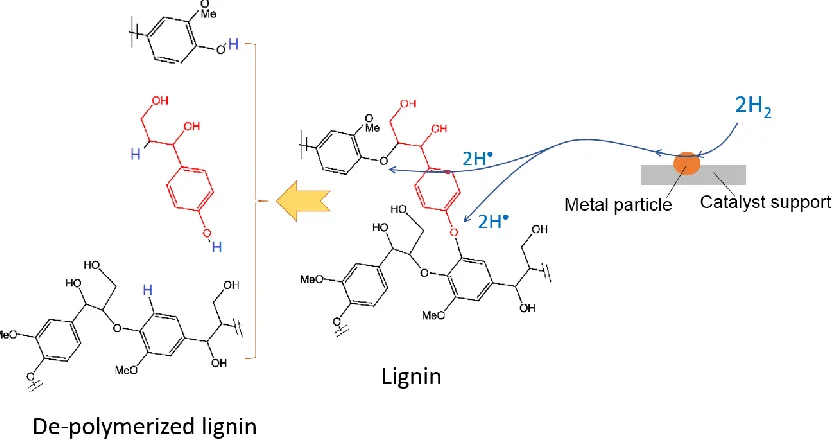
Reductive lignin depolymerization is mostly carried out in hydrogen gas atmosphere in combination with a supported metal catalyst and a suitable solvent such as alcohol and acetone, as described in Table 2-3. At elevated temperatures, the H2 would diffuse from
the gas phase into the solvent and get adsorbed by the metal followed by dissociation into hydrogen atom or radical (H or H) on the metal particle surface. The Hradicals would move into the lignin structure and cleave lignin’s ether linkage to de-polymerize macromolecules into monomers and oligomers. This possible reaction mechanism of reductive depolymerization of lignin is illustrated in Figure 2-3,
Figure 2-3. Possible reaction mechanism of reductive depolymerization of lignin
Instead of using external H2 gas, there is internal or in-situ hydrogen source coming from
decomposition of solvents such as formic acid and 2-propanol that are less thermally stable and will decompose to give hydrogen atom (or radicals or H2) and CO2 and
HCOOH 2H (2H or H2) + CO2, G = H - TS= -32.9 kJ/mol (Loges et al, 2010)
CH3CH(OH)CH3 2H (2H or H2) + CH3C(=O)CH3, G = H - TS=-25.05 kJ/mol
(Bo et al., 2004)
Recently, hydrogen-donating solvents have found special applications in reductive depolymerization of lignin. As reported by Kleinert et al. (Kleinert and Barth, 2007; Kleinert and Barth, 2008, 2008a; Kleinert et al., 2009; Kleinert and Barth, 2011), formic acid and 2-propanol were used as hydrogen donors to de-polymerize and hydrogenate lignin. Reductive depolymerization/hydrogenation of lignin in formic acid (and ethanol as a co-solvent) and 2-propanol that generates in-situ hydrogen was demonstrated, although the yields of DL products or phenolic oil were low, being only 25–35 wt.% at 380 C and a very long residence time (8-54 h). Nevertheless, the DL products were exclusively composed of monoaromatic phenols with alkylation ranging from C1–C7 in
the side chain(s), and the yield was 2 or 3 times that of earlier work by Dorrestijn et al. (1999) using AnH2 for depolymerization of wood lignin at 352 C.
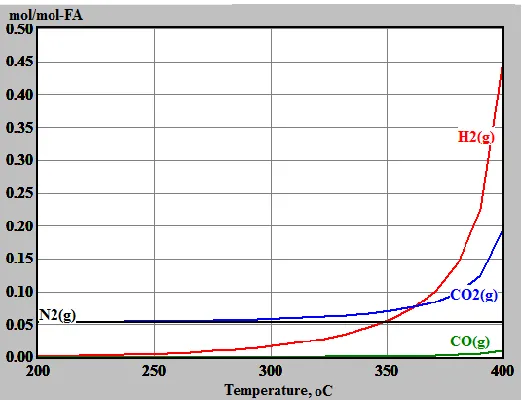
Figure 2- 4 Equilibrium yields of gaseous species, calculated using HSC 5.1 software for the reaction system under the conditions of (FA-to-lignin mass ratio of 0.7, ethanol-water
co-solvent (50/50, v/v), 1 h, 300 °C, 2 MPa initial N2 pressure)
In a recent work by Cheng (2011), formic acid that can act as a hydrogen donor at elevated temperatures was employed for depolymerization of alkali lignin (AL) or kraft lignin (KL) and organosolv lignin (OL) in the medium of sub-/super-critical 50/50 (v/v) water-ethanol. The obtained DL products were further analyzed by gel permeation chromatography (GPC) and proton nuclear magnetic resonance (1H NMR). The depolymerization of AL and OL led to 77 wt% and 80 wt% yield of DL, and 5 wt% and 0.4 wt% yield of solid residue (SR), respectively. The relative molecular weights of the DL products were significantly decreased compared to those of the original lignin samples. For instance, Mn of the AL reduced from 10,000 to 295 g/mol, while the Mn of
2.8 Summary and conclusions
(1) Lignin can be an abundant natural source of aromatics (phenolic chemicals or bio-polyols) after liquefaction or depolymerization.
(2) Degraded/depolymerized lignins are more chemically reactive for the synthesis of bio-based phenolic resins, polyurethane resins and epoxy resins, as they have a smaller molecular weight, less steric hindrance effects and more active functional groups.
(3) Many technologies, such as pyrolysis and HTL or hydrolytic depolymerization have been applied to liquefy (or de-polymerize) lignin into phenolic oils or depolymerized lignin. The oil yields are quite low in lignin pyrolysis processes, leaving a large amount of char. In contrast, HTL or hydrolytic depolymerization technology provides various benefits that are unparalleled in comparison with other technologies such as gasification, wet oxidation and pyrolysis.
(4) The hydrolytic depolymerization mechanism involves cleaving of mainly the β-O-4 ether bond under base or water condition, accompanied with dealkylation of side chains and hydrolysis of methoxyl groups.
(5) Depolymerization of lignin can be effectively achieved by cleaving the ether bonds present in the lignin molecules with hydrogen molecules or atoms – so called reductive depolymerization. In this process, an organic solvent and a supported catalyst (such as expensive carbon-supported Pt or Ru catalysts) is needed.
(6) The reactive hydrogen could be obtained from gaseous hydrogen in combination with suitable supported metal catalysts and a solvent medium, or from an internal or in-situ hydrogen source coming from decomposition of solvents such as formic acid and 2-propanol upon heating at elevated temperatures.
References
Akhtar, J., Amin, N.A.S., 2011. A review on process conditions for optimum bio-oil yield in hydrothermal liquefaction of biomass. Renewable and Sustainable Energy Review, 15, 1615-1624.
Akin, D.E., Benner, R., 1988. Degradation of polysaccharides and lignin by ruminal bacteria and fungi. Appllied Environmental Microbiology, 54, 1117-1125.
Baurhoo, B., Ruiz-Feria, C.A., Zhao, X., 2008. Purified lignin: nutritional and health impacts on farm animals-a review. Animal Feed Science and Technology, 144, 175-184.
Bo, X.C., Chen, W.X., Yao, T.Y., Hou, W.H., 2004. Appendix IV. Physical Chemistry. (pp. 484-489). China: Higher Education Press.
Beauchet, R., Monteil-Rivera, F., Lavoie, J.M., 2012. Conversion of lignin to aromatic-based chemicals (L-chems) and biofuels (L-fuels). Bioresource Technology, 121, 328-334.
Benigni, J.D., Goldstein, I.S., 1971. Neutral hydrolysis of alkali lignin to monomeric phenols. Journal of Polymer Science Part C: Polymer Symposia, 36, 467–475.
Bhima V. (2011, April). Biobased chemicals: Technology, Economics and Markets. Biobased Chem Asia conference in China, April 14-15, 2011 proceedings. Shanghai.
Calzavara, Y., Joussot-Dubien, C., Boissonnet, G., Sarrade, S., 2008. Evaluation of biomass gasification in supercritical water process for hydrogen production. Energy Conversion and Management, 46(6), 615-631.
Campen, A., Mondal, K., Wiltowski, T., 2007. Separation of hydrogen from syngas using a regenerative system. International Journal of Hydrogen Energy. 33, 332-339.
Cheng, S., Bio-based phenolic resins and adhesives derived from forestry residues and lignin. PhD thesis, Lakehead University, 2011
Cheng S., Wilks, C., Yuan, Z., Leitch, M., Xu, C., 2012. Hydrothermal degradation of alkali lignin to bio-phenolic compounds in sub/supercritical ethanol and water-ethanol co-solvent. Polymer Degradation Stabability, 97, 839-848.
Cheng, S., Yuan, Z., Leitch, M., Anderson, M., Xu, C., 2013. Highly efficient
depolymerization of organosolv lignin using a catalytic hydrothermal process and production of phenolic resins/adhesives with the depolymerized lignin as a substitute for phenol at a high substitution ratio. Industrial Crops and Products, 44, 315-322
Cruz, J.M., Dominguez, J.M., Dominguez, H., Parajo, J.C., 2001. Antioxidant and antimicrobial effects of extracts from hydrolysates of lignocellulosic materials.
Journal of Agricultural and Food Chemistry, 49, 2459.
Doherty, W.O.S., Mousavioum, P., Fellows, C.M., 2011. Value-adding to cellulosic ethanol: lignin polymers. Industrial Crops and Products, 33, 259-276.
Dorrestijn, E., Kranenburg M, Poinsot D, Mulder P., 1999. Lignin depolymerization in hydrogen-donor Solvents. Holzforschung, 53 (6), 611–616
Eddy, L.B., Wolstenholme, J., Tiege, P.B., Meza, N.Y., Quwzada, J.J., 2014. Biochar products ad method of manufacture thereof. US Patent 20140030250 A1.
El Mansouri, N.E., Salvado, J., 2007. Analytical methods for determining functional groups in various technical lignins. Industrial Crops and Products, 26, 116-124.
Guo, L.J., Lu, Y.J., Zhang, X.M., Ji, C.M., Guan, Y., Pei, A.X., 2007. Hydrogen
production by biomass gasification in supercritical water: a systematic experimental and analytical study. Catalysis Today, 129, 275-286.
He, W., Li, G., Kong, L., Wang, H., Huang, J., Xu, J., 2008. Application of hydrothermal reaction in resource recovery of organic wastes. Resource, Conversion and Recycling, 52, 691-699.
Horacek, J., Homola, F., Kubickova, I., Kubicka, D., 2012. Lignin to liquids over sulfide catalysts. Catalysis Today, 179, 191-198.
Ji, P., Feng, W., Chen, B., Yuan, Q., 2006. Finding appropriate operating conditions for hydrogen purification and recovery in supercritical water gasification of biomass.
Chemical Engineering Journal, 98, 105-113.
Ji, C., Guo, L., Lu, Y., Pei, A., Guo, X., 2007. Experimental investigation on hydrogen production by gasification of lignin in supercritical water. Acta Energiae Solaris Sinica, 28, 291-296
Jin, Y., Ruan, X., Cheng, X., Lü Q., 2011. Liquefaction of lignin by polyethyleneglycol and glycerol. Bioresource Technology , 102, 3581–3583.
Joffres, B., Lorentz, C., Vidalie, M., Laurenti, D., Quoineaud, A.A., Charon, N., Daudin, A., Quignard, A., Geantet, C., 2014. Catalytic hydroconversion of a wheat straw soda lignin: Characterization of the products and the lignin residue. Applied Catalysis B: Environmental, 145, 167-176.
Jongerius, A.L., Jastrzebski, R., Bruijinincx, P.C.A., Weckhuysen, B.M., 2012. CoMo sulfide-catalyzed hydrodeoxygenation of lignin model compounds: An extended reaction network for the conversion of monomeric and dimeric substrates. Journal of Catalysis, 285, 315-323.
Kleinert M., Barth T.,2007. One-step conversion of solid lignin to liquid products. EP Patent 2190949 A2.
Kleinert, M., Barth, T., 2008a. Phenols from lignin. Chemical Engineering &Technology, 31(5), 736-745.
Kleinert, M., Gasson, J.R., Barth, T., 2009. Optimizing solvolysis conditions for integrated depolymerisation and hydrodeoxygenation of lignin to produce liquid biofuel. Journal of Analytical and Applied Pyrolysis, 85, 108-117.
Kleinert, M., Gasson, J.R., Eide I, Hilmen, A-M, Barth, T., 2011. Developing solvolytic conversion of lignin-to-liquid (LtL) fuel components: optimization of quality and process factors. Cellulose Chemistry and Technology, 45 (1-2), 3–12.
Kelly, J.R., 1983. Drilling fluid composition. US Patent 4,374,738
Kirk, T.K., 1971. Effects of microorganisms on lignin. Annual Review Phytopathology, 9, 185-210.
Kloekhorst, A., Wildschut, J., Heeres, H.J., 2014. Catalytic hydrotreatment of pyrolytic lignins to give alkylphenolics and aromatics using a supported Ru catalyst. Catalysis Science & Technology, 4, 2367-2377.
Lawson, J.R., Klein, M.T., 1985. Influence of water on guaiacol pyrolysis. Industrial & Engineering Chemistry Fundamentals, 24, 203–208.
Lee, C.R., Yoon, J.S., Suh, Y.W., Choi, J.W., Ha, J.M., Suh, D.J., Park, Y.K., 2012. Catalytic roles of metals and supports on hydrodeoxygenation of lignin monomer guaiacol. Catalysis Communications, 17, 54-58.
Liu, X., Wang, J., Li, S., Zhuang, X., Xu, Y., Wang, C., Chu, F., 2014. Preparation and properties of UV-absorbent lignin graft copolymer films from lignocellulosic butanol residue. Industrial Crops and Products, 52, 633-641.
Loges, B., Boddien, A., Gartner, F., Junge, H., Beller, M., 2010. Catalytic Generation of Hydrogen from Formic acid and its Derivatives: Useful hydrogen storage materials.