Micro-Expression Extraction: An Alternative for
Traditional Lie Detection System
Kondapalli Charita Navya; Sri K. Prasada Rao & Sri T. Chalapthi Rao,
1
Student of M.Tech (CSE), AITAM, TEKKALI-532201 ,
2
Sr.Asst.Professor,
3
Asst.Professor,
2.3
Department of CSE,AITAM, TEKKALI-532201 ,
[email protected]
;
[email protected]
;
[email protected]
ABSTRACTMicro-expressions are the facial expressions that
last less than a second which helps to determine
the true feelings or emotions of the sender in the
communication. Lie-detection has been an
evergreen and evolving subject. Till date,
Polygraph techniques have been the most popular
and successful technique. The main drawback of
the polygraph is that the results cannot be
attained without any physical contact. Sometimes,
this
physical
contact
could
add
extra
consciousness in the subject. Observing at the
facial micro-expressions in a person without
contacting physically and implementing these
techniques using artificial intelligence is one such
method.
Background
subtraction
algorithm
extracts the features of an image. On the whole,
this proposed system helps in detecting the
micro-expression emotions for the purpose of lie
detection.
Keywords —
Lie Detection; Facial
Micro-Expressions;
Image
Processing;
Polygraph
Techniques; Artificial Intelligence; Background
Subtraction Algorithm.
I.INTRODUCTION
As long as human beings have been deceived one another, people have tried to develop different techniques to detect deception in order to find the truth. This is the reason why the traditional polygraph technique has been developed. On
a polygraph test, examiners observe the charts of the above measures in response to questions, and then infer whether a person is lying or telling the truth [1]. Polygraph testing is used for three main purposes: event-specific investigations, employee screening, and reemployment screening. Each of the use involves the search for Different kinds of information and have different implications [2]. This technique is not only used for lie detection, but can be used in detecting some diseases or in testing for alcohol where some changes in the face may occur. Another domain that may use these kinds of systems is psychiatry [3]. Facial micro-expressions were proven to be an important for finding behavioral source , hostile intent and for the danger demeanor detection [4]. The specific objective of this paper is to design and develop a lie detection system using facial micro expressions recognition in real-time.
II. RELATED WORK
basically eight facial expressions: anger, contempt, disgust, fear, happiness, joy, sadness, and surprise. They are encoded as combinations of Action Units (AU) of different muscles in the face according to the Facial Action
TABLE-I EMOTIONS AND THEIR EQUIVALENT CODES
Coding System (FACS) developed by Ekman and summarized in Table I [10-12]. As its name implies, the micro movement occurs in 1/25 of a second. The 3D
gradient descriptors were proved to be an effective approach for classifying motions in video signals [13]. FACS CODES ASMs are statistical models of the shape of an object fit an example of the object [14].
The face detector employs boosting techniques in a generative framework; it is an extension on the work done by Viola & Jones in 2001. The system works in real time at 30 frames per second on a fast PC [15]. Differences
regarding individual facial muscle changes associated with specific emotions in posed and evoked expressions remain unclear [16].
In 2001, Tian et al. divided the face in two areas and used two artificial neural networks to classify AUs in real time. The recognition of AUs averaged of 93.3% and their system achieved automatic face detection while handling head motion [17]. While in 2002, Pardas and Bonafonte used Hidden Markov Models to achieve 98% recognition with joy, surprise, and anger [18].In 2003, Michel and Kaliouby used Support Vector Machine to build a real-time system that does not require any preprocessing [19]. A year later, Buciu and Pitas published their research in facial expression recognition using nearest neighbor classifiers [20]. Later on, Pantic and Patras achieved a 90% average recognition using temporal rules on 27 AUs and invariant to occlusions such as glasses and facial hair [21-22]. Kernel Canonical Correlation Analysis (KCCA) was used to learn the correlation between the LG vector and the semantic vector [23]. In 2007, Sebe et al. evaluated different machine learning algorithms to recognize spontaneous expressions where subjects are showing their natural facial expressions [24]. And in the same year, Kotsia and Pitas attained very high recognition rates with six basic expressions and then worked with occlusions [25-26]. More research was also conducted in facial micro-expressions, among which [27-29].
III. MATERIALS AND METHODS A. Materials
FIGURE 1 The lie detection system
The proposed facial micro expression based lie detection system is composed of both hardware and software. A high speed camera is used to capture the face which is then divided to specific regions. For testing this approach, a new
EMOTION
MUSCLE DESCRIPTION ASSOCIATED AU‟s
ANGER
NOSTRILS-RAISED,MOUTH COMPRESSED,
FURROWED BROW, EYES WIDE OPEN, HEAD ERECT 4,5,24,38 CONTEMPT LIP-PROSTRUSION,NOSE WRINKLE, PARTIALCLOSURE OF EYELIDS,
TURN AWAY EYES, UPPER LIP RAISED
9,10,22,41,61 OR 62
DISGUST
LOWER-LIP TURNED DOWN, UPPER LIP RAISED,
EXPIRATION, MOUTH OPEN, BLOWING OUT, PROTRUDING LIPS, LOWER LIP, TONGUE PROTRUDED 10,16,22,25 OR 26 FEAR
EYES-OPEN, MOUTH OPEN, LIPS RETRACTED,
EYE BROWS RAIDES
1,2,5,20
HAPPINESS
EYES SPARKLE,
SKIN UNDER EYES WRINKLED, MOUTH DRAWN BACK AT CORNERS
6,12
JOY
ZYGOMATIC,ORBICULARIS, UPPER LIP RAISED,
NASOLABIAL FOLD FORMED
6,7,12
SADNESS
CORNER MOUTH DEPRESSED, INNER CORNER EYEBROWS RAISED
1,15
SURPRISE
EYEBROWS RAISED, MOUTH OPEN, EYES OPEN, LIPS PROTRUDED
dataset of facial micro-expressions, is created and manually tagged as a ground truth. High speed camera is one of the most important components in the system. In order to detect a facial micro expression, which takes 1/25 of a second, a minimum of ten frames per second needs to be captured and analyzed. The camera used in the study captures 25 frames per second. In the overall settings of Figure1, the camera lens needs to have a focal length between 50 mm and 180 mm in order to get the best quality. The lens employed has a focal length of 90 mm offering the desired sharpness. The camera and the lens were mounted on a tripod facing the subject‟s face at a distance of two meters. In order to minimize reflections and shadows, a light gray background is used ensuring the capture of pre-filtered video.
B. Methods
The hardware setup is the first stage in the method used to detect facial micro-expressions and therefore, infer that the interviewed individual is lying or telling the truth. In preparing the subject for interview, his/her face should always be facing the camera in order to detect all possible muscle changes. The rotation of the individual‟s head may lead to a miss prediction. That is why; prior to shooting, these restrictions are needed to be applied. First the video is converted into a sequence of frames for analysis. Second, the features are extracted by using background subtraction algorithm (such as the eyes, the mouth, the cheeks, etc.) Algorithm Steps for Background Subtraction:
Background subtraction, also known as
Foreground Detection, is a technique in the fields of image processing and computer vision wherein an image‟s foreground is extracted for further processing (object recognition etc.). Generally an image‟s regions of interest are objects (humans, cars, text etc.) in its foreground. Background subtraction is a widely used approach for detecting moving objects in videos from static cameras.
%Read Background Image
Background=imread(„background.jpeg‟);%Read Current Frame
CurrentFrame=imread(„original.jpeg‟); %Display Background and Foreground
subplot(2,2,1);imshow(Background);title(„BackGround‟); subplot(2,2,2);imshow(CurrentFrame);title(„Current Frame‟);
%Convert RGB 2 HSV Color conversion
[Background_hsv]=round(rgb2hsv(Background)); [CurrentFrame_hsv]=round(rgb2hsv(CurrentFrame)); Out = bitxor(Background_hsv,CurrentFrame_hsv); %Convert RGB 2 GRAY
Out=rgb2gray(Out);
%Read Rows and Columns of the Image [rows columns]=size(Out);
%Convert to Binary Image for i=1:rows
for j=1:columns
if Out(i,j) >0
BinaryImage(i,j)=1;
else
BinaryImage(i,j)=0;
end
end
end
%Apply Median filter to remove Noise FilteredImage=medfilt2(BinaryImage,[5 5]);
%Boundary Label the Filtered Image [L num]=bwlabel(FilteredImage);
STATS=regionprops(L,‟all‟); cc=[];
removed=0;
%Remove the noisy regions for i=1:num
dd=STATS(i).Area;
if (dd < 500)
L(L==i)=0;
else
end
end
[L2 num2]=bwlabel(L);
% Trace region boundaries in a binary image.
[B,L,N,A] = bwboundaries(L2);
%Display results
subplot(2,2,3), imshow(L2);title(„BackGround Detected‟); subplot(2,2,4), imshow(L2);title(„Blob Detected‟);
hold on;for k=1:length(B),
if(~sum(A(k,:))) boundary = B{k};
plot(boundary(:,2), boundary(:,1), „r‟,'LineWidth‟,2);
for l=find(A(:,k))‟ boundary = B{l};
plot(boundary(:,2), boundary(:,1), „g‟,'LineWidth‟,2);
end
end
end
The program starts by reading one frame at a time and simultaneously processing the extracted frame by two parallel loops. The first loop plays back to the video on the computer screen. While the second loop inputs the frame into a vision assistant block that saves the frame as image into an already specified path, and then, processes the saved image according to neutral value.
Suppose I(x, y) is the gray value of a pixel at location (x, y) of an image, the vertical integral projection V(x) in intervals [y1, y2] and the horizontal integral projection H(y) in intervals [x1, x2], the horizontal and
vertical projections can be observed in figure 2, figure 3and they can be defined respectively as:
FIGURE-2: VERTICAL PROJECTION
FIGURE-3: HORIZONTAL PROJECTION
Horizontal integral projection:
Eyebrows and Eyes Regions: The length between the first minimum value (wave trough) and the second minimum value is indicated by VH1. The upper bound of the eyes and eyebrows area is H1-0.2*VH1. The lower bound of the eyes and eyebrows area is H2+0.8*VH1. Mouth Regions: If we indicate the length between the last wave trough and the second last wave trough by VH2, the upper bound of the mouth region is H3-0.4*VH2, where VH2=H4-H3. The lower bound of the mouth region is H4+0.7*VH2. The Horizontal projection can be observed in figure 4, figure 5.
FIGURE-4:HORIZONTAL
FIGURE-5: HORIZONTAL PROJECTION AFTER SMOOTHENING
Vertical integral projection
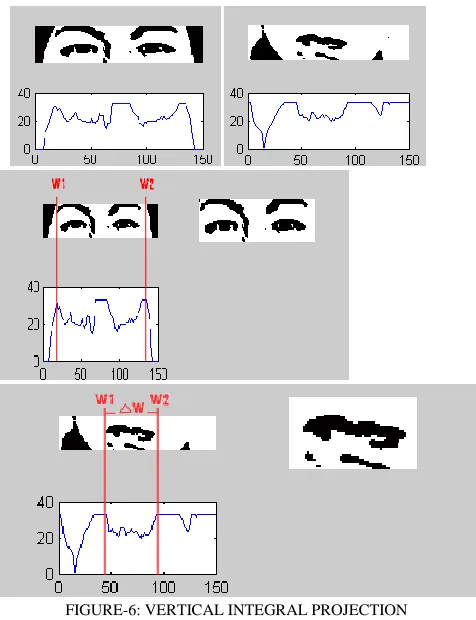
Final Extracted Eyebrows and Eyes Regions: is between the left most maximum value (wave crest), indicated by W1, and the right most maximum value, indicated W2.
Final Extracted Mouth Region: is between, from the left to the right, the right most maximum value and from the right to the left, the left most maximum value. The Vertical projection can be observed in figure 6, figure 7, figure 8 and figure 9.
FIGURE-6: VERTICAL INTEGRAL PROJECTION
Expression Classification
After the process of feature detection and extraction, the final step is to classify the facial features using Support
Vector Machines (SVMs). Creating training data sets: define the seven basic facial expressions for each image to generate a pattern file, when a new image comes, the system will compare the image with the pattern file to classify expression automatically.
SUPPORT VECTOR MACHINE:
%# load dataset load fisheriris
[g gn] = grp2idx(species); %# nominal class to numeric
%# split training/testing sets
[trainIdx testIdx] = crossvalind('HoldOut', species, 1/3);
pairwise = nchoosek(1:length(gn),2); %# 1-vs-1 pairwise models
svmModel = cell(size(pairwise,1),1); %# store binary-classifers
predTest = zeros(sum(testIdx),numel(svmModel)); %# store binary predictions
%# classify using one-against-one approach, SVM with 3rd degree poly kernel
for k=1:numel(svmModel)
%# get only training instances belonging to this pair idx = trainIdx & any( bsxfun(@eq, g, pairwise(k,:)) , 2 );
%# train
svmModel{k} = svmtrain(meas(idx,:), g(idx), ... 'BoxConstraint',2e-1, 'Kernel_Function','polynomial', 'Polyorder',3);
%# test
predTest(:,k) = svmclassify(svmModel{k}, meas(testIdx,:));
end
pred = mode(predTest,2); %# voting: clasify as the class receiving most votes
%# performance
cmat = confusionmat(g(testIdx),pred); acc = 100*sum(diag(cmat))./sum(cmat(:));
Every basic expression is interpreted from the AUs in Table I as a combination of changes in the distances stored in the arrays between different frames. The system takes the first element of each array and checks the variation of the distance between the points; each basic expression has specific point measurements and distances combination. The program iterates over the expression codes in the array and notes the time taken by each expression. Accordingly, the program can distinguish whether the subject is lying or saying the truth.
IV. TESTING AND RESULTS
The system was tested on four subjects. The following questionnaire containing seven control questions and eight relevant questions based on [30]. The questions asked during the interview are:
1. Is your name Shiva? (Control question) 2. Are you 25 years old? (Control question) 3. Is your pets's name Audi? (Control question) 4. Were you born in 1991? (Control question) 5. Do you own a car? (Control question)
6. Do you live on gajapathi street? (Control question) 7. Is today (date of the day)? (Control question)
8. Have you ever copied in your exam? (Relevant question) 9. Have you ever committed any negative act against anyone? (Relevant question)
10. During a domestic dispute, have you ever physically harmed your friend? (Relevant question)
11. Prior to your application, did you ever lie to someone in a position of authority? (Relevant question)
12. Before this year, did you ever put false information on an official document? (Relevant question)
13. Prior to this year, did you ever betray someone who trusted your word? (Relevant question)
14. Before this year, did you ever take credit for something you didn't do? (Relevant question)
15. Prior to this year, did you ever deceive a family member? (Relevant question)
The system, when detecting an certain expression, stores this expression and analyzes it; when it detects a micro-expression on the face of the subject, a green light flashes, indicating the presence of the micro-expression resulting from the subject‟s attempt to hide the real answer and lie.
V. CONCLUSIONS AND FUTURE WORK
The purpose of this system is to analyze the realistic facial motions in order to derive the spatial and temporal patterns exhibited by the human face while attempting to lie. The system analyzes facial expressions by observing significant articulations of the subject‟s face over a sequence of frames extracted from a video. By observing the parameters over a wide range of frames, a parametric representation of the face which could be useful for static analysis of facial expression in other fields of studies was extracted. This motion is then coupled to a physical model by which geometric-based dynamic templates are applied on the facial structure. Human emotion on the basis of facial micro-expressions is an important topic of research in psychology. It is believed that the developed system can be useful in many areas where psychological interpretation is needed such as in police interrogations, airport and homeland security, employment, and clinical tests. It is an off-line design which requires a pre-recorded video to work. This can be coded into a DSP for on-board processing and to give a result in real-time.This study works only for videos taken in one-to-one interview set-up and has few constraints, it can be made available for all the conditions of videos.