ISSN 2286-4822 www.euacademic.org
Impact Factor: 3.4546 (UIF) DRJI Value: 5.9 (B+)
Comparative Study of Gamma Radiation Shielding
Parameters for Different Oxide Glasses
AMAL A. EL- SAWY1
A. M. MADBOULY
Radiation Safety Department Egyptian Nuclear and Radiological Regulatory Authority (ENRRA)
Abstract:
The goal of this work was investigated materials that can be used as good gamma shielding materials. In this paper a comparative study of the barium bismuth and barium lead borosilicate glass samples as radiation shielding parameters and optical properties was presented. Bismuth oxide glasses are very useful for developing as lead-free, high density and radio shielding glasses. The eleven cylindrical geometries barium bismuth and barium lead borosilicate glass samples have been prepared in different percentages and investigate for radiation shielding properties of gamma rays from,
137Cs and 60Co radioactive point sources. All glass samples have been
prepared by melt-quenching method. The mass attenuation coefficients (μm) for all glass samples are measured experimentally and also
calculated theoretically by WinXCom program and Monte Carlo Model MCNP-5. The mean free path (mfp), effective atomic numbers (Zeff) and
the effective electron densities (Neff) have been determined for all glass
samples at different photon energies. Theoretical optical basicity (Λth)
of the glasses and the % of heaviness with lead normalized to 100% for all glasses samples shielding materials have been calculated. The obtained results show that the experimental values of the glass samples are found to be in a good agreement with the theoretical values. From the results it has been observed that the values of μm, mfp, Zeff, Neff, Λth
and % of heaviness for all PbO and Bi2O3 studied glasses samples at
the same concentration are approximately equal. So, Bi2O3 and BaO
glass will open new possibility for a lead-free radiation protecting glass with non-toxicity to our environment.
Key words: Oxide glasses, gamma radiation shielding, attenuation
coefficients, XCOM Program, MCNP-5 code.
1-INTRODUCTION
their transparency to visible light, and their properties can be modified by using composition and preparation techniques [9]. Lead oxide (PbO) is a promising gamma ray shielding materials due to its strong absorption of gamma rays [10]. Glasses containing heavy metal oxide such as PbO have many advantages due to their high density and high refractive index. These properties are making them important materials for development of advanced optical telecommunication and gamma-ray shielding materials [11-13]. Due to toxicity of lead on human beings as well as on the environment, commercial lead –free glasses based on other heavy elements such as barium and bismuth offer comparable gamma radiation shielding. The samples colors turned from colorless to yellow with increasing Bi2 O3 contents [14].
Duffy and Ingram have made a great contribution for development of the Lewis acid-base principles by introducing the "optical basicity" concept. The concept was developed for quantitative determination of the acid-basic properties of a large number of oxides, glasses, alloys, slags, molten salts, etc. In the contents of this concept the oxygen behaves as base in the Lewis sense and the metal ions behave as Lewis acids. The ability of oxygen to transfer electron density to surrounding cations depends from the degree of its polarization. Increase in optical basicity results in increasing ability of oxide ions to donate electrons to surrounding cation. This suggests that the present glasses are more basic [15].
2. THEORY BACKGROUND
2.1 Gamma Radiation Shielding Parameters
The measured intensity (I) of the transmitted gamma ray through layer of material thickness (x) and the initial intensity of gamma ray (Io) are related to the linear
attenuation coefficients (
and can be given by the following expression:(1)
Mass attenuation coefficient (µm) of the material is obtained by
dividing µ by the material density (ρ). The mass attenuation coefficient, for a compound or mixture is given by [17]:
∑ (2)
Where wi and (µm)i are the weight fraction and mass
attenuation coefficient of the ith is constituent element,
respectively.
Attenuation of X-rays and gamma-rays in matter is related to density and atomic number. The effective atomic number (Zeff) of compounds and composite materials plays a
crucial role in representing the attenuation of X-rays and gamma-rays, particularly for dose calculations in radiation therapy. This parameter has gained composite materials. Zeff
can be calculated based on knowledge of the total atomic cross-section (σa) for materials that can be obtained from the measured values of using the following relation [18, 19]:
∑
Where NA is Avogadro's number and Ai is the atomic weight of
ith element. Similarly, the total electronic cross section is given
by [18, 19]:
Where fi denotes the fractional abundance of the element i with respect to the number of atoms such that f1 + f2 + f3 + . . . + fi
=1, Zi is the atomic number of ith element.
The effective atomic number (Zeff) can be defined as [18, 19]:
(5) The effective electron number or electron density (Neff) (number
of electrons per unit mass) can be given by the formula [19]:
(6)
The mean free path (MFP), which is defined as the average distance between two successive interactions of photons in an absorber [20], was calculated for glass samples using the following equation:
MFP cm (7) Where µ is linear attenuation coefficient of the material at a given photon energy.
2.2 Theoretical Optical basicity
The optical basicity addresses the ability of oxide glass in contributing the negative charges in the glass matrix. In other words it defines the electron donating power of the oxygen in the oxides glass. The theoretical optical basicity can be calculated by the equation proposed by Duffy and Ingram [21].
Λth = X1 Λ1 + X2 Λ2 +…+ Xn Λn (8)
where X1 , X2 , X3 , X 4 , , Xn are equivalent fraction based on
the amount of oxygen each oxide contributes to the overall glass stoichometry and Λ1 , Λ 2 , Λ 3 , Λ 4 , , Λn are basicities assigned
to the individual oxides. The values of optical basicity of each oxide are: Λ (B2O3) = 0.425, Λ (Bi2O3) = 1.19, Λ (PbO) =1.18, Λ
(Na 2O) = 1.55, Λ (BaO) = 1.33, Λ (Al 2O3) =0.61, Λ (SiO2) =
0.926, Λ (K 2O) = 1.4.
2.3 Heaviness
the % of heaviness of the other predictable shielding materials was evaluated using the following relation [22]:
% of heaviness=
X100 % (9)
3. MATERIALS AND METHODS
A- Samples preparation
The eleven barium bismuth and barium lead borosilicate glass samples were prepared in different percentages with 5 mm thickness. The glass samples were prepared by melt quenching technique. Melts of the aforesaid systems with different compositions were obtained in electrically heated furnace (at around 1050-11000 C). Dry Oxygen was bubbled through melt
using quartz tube to ensure homogeneity. The melt was annealed in another furnace at 2700C in preheated copper
mould. Samples were grounded and polished by using different grades of silicon carbide and aluminum paper respectively. Density of these samples was measured by Archimedes’ principle using benzene as the immersion liquid. The chemical composition and densities of glass samples are shown in Tables 1 and 2, respectively.
Table 1. The fractional by weight and densities of the barium bismuth and barium lead borosilicate glass samples
Sample code Density
(g/cm3 )
Bi2 O3 PbO BaO Borosilicate
glass
Pb-Bi 0% 1.83 0 0 40 60
Pb5% 2.31 0 5 40 55
Pb10% 2.78 0 10 40 50
Pb15% 3.25 0 15 40 45
Pb20% 3.72 0 20 40 40
Bi 5% 2.27 5 0 40 55
Bi10% 2.60 10 0 40 50
Bi15% 2.96 15 0 40 45
Bi20% 3.51 20 0 40 40
Pb10Bi10% 3.68 10 10 40 40
Bi 15 Pb 5% 3.44 15 5 40 40
Table 2. Chemical composition by weight of borosilicate glass
Component %
B2O3 19.2
Na2O 9.3
Al 2O3 16.5
SiO2 47.4
K2 O 7.6
B- Experimental setup
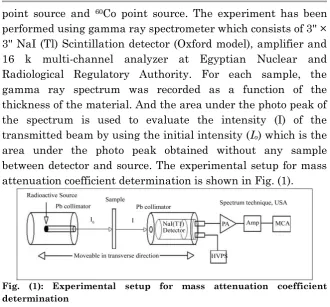
point source and 60Co point source. The experiment has been
performed using gamma ray spectrometer which consists of 3'' × 3'' NaI (Tl) Scintillation detector (Oxford model), amplifier and 16 k multi-channel analyzer at Egyptian Nuclear and Radiological Regulatory Authority. For each sample, the gamma ray spectrum was recorded as a function of the thickness of the material. And the area under the photo peak of the spectrum is used to evaluate the intensity (I) of the transmitted beam by using the initial intensity (Io) which is the
area under the photo peak obtained without any sample between detector and source. The experimental setup for mass attenuation coefficient determination is shown in Fig. (1).
Fig. (1): Experimental setup for mass attenuation coefficient determination
3.2 XCOM program
The µ/ρ values of the samples were calculated by mixture rule
(µ / ρ) composite = ∑wi (µ / ρ)i
Where wi is the proportion by weight and (µ /ρ)I is mass
attenuation coefficient of the ith element by using XCOM [23].
industrial, radioactive source transportation and other shielding applications. Hence uncertainty in the result may not have any impact for practical applications [24].
3.3MCNP-5 Theoretical Model
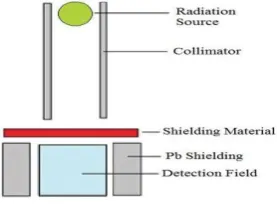
In this study, Monte Carlo code has been used for investigations on mass attenuation coefficients of the barium bismuth and barium lead borosilicate glass samples. In present simulation, each simulation parameters have been defined in input file by considering the material properties and experimental setup. In this study, the geometrical forms and physical parameters for simulation have been defined in cell card and surface card of MCNP-5 input file.
Cylindrical geometries were employed for the modeling of eleven glass samples with 5 mm thickness. MCNP-5 simulation geometry for calculations mass attenuation coefficients is shown in Fig. (2). A point source with collimator was putting on z axis and defined in an MCNP-5 data card with ERG commands for energy, type of particles respectively. The point detector tally F2 for the model was used to calculate the photon intensity. This tally calculates average gamma ray flux over the surface. The percentages by weight of each element in the glass samples used in the material card of MCNP-5. Simulations were performed with 1 million histories and all results simulated by MCNP-5 code were reported with less than 0.1% error.
4. RESULTS AND DISCUSSIONS
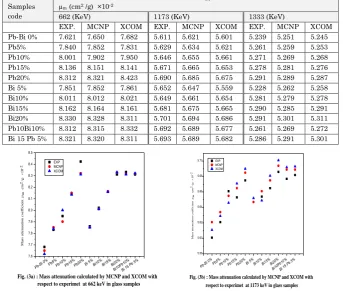
The mass attenuation coefficients have been calculated and measured at the photon energies 662, 1173 and 1333 KeV. Both calculated and measured results are recorded in Table (3) and displayed in Fig. (3).
Pb-Bi 0% Pb5
%
Pb10%Pb15%Pb20%Bi 5%Bi10%Bi15%Bi20%
Bi10Pb
10%
Bi 15 Pb
5% 7.6 7.7 7.8 7.9 8.0 8.1 8.2 8.3 8.4 8.5
Fig. (3a) : Mass attenuation calculated by MCNP and XCOM with respect to experimet at 662 keV in glass samples
EXP. MCNP XCOM M as s at tenuat ion coef fi ci ent µm ( cm
2 /
g ) × 10 -2
Pb-Bi 0% Pb5 %
Pb10%Pb15%Pb20% Bi 5%Bi10%Bi15%Bi20% Bi10Pb
10% Bi 15 Pb
5% 5.58 5.60 5.62 5.64 5.66 5.68 5.70 EXP.
MCNP XCOM M as s at tenua ti on coe ff ici ent µ m ( cm
2 /g
)
×
10
-2
Fig. (3b) : Mass attenuation calculated by MCNP and XCOM with respect to experimet at 1173 keV in glass samples
Table 3. The experimental mass attenuation coefficient and theoretical by MCNP and XCOM for different concentration of all studies borosilicate glass samples at different energies.
Mass attenuation coefficient at different energy MCNP and XCOM µm (cm2 /g) ×10-2
Samples
code 662 (KeV) 1173 (KeV) 1333 (KeV)
Pb-Bi 0 %
Pb5%Pb10%Pb15%Pb20%Bi 5%Bi10%Bi15%Bi20%
Bi10Pb
10%
Bi 15 Pb 5
%
5.23 5.24 5.25 5.26 5.27 5.28 5.29 5.30 5.31 5.32 5.33
EXP. MCNP XCOM
M
as
s at
tenua
ti
on coe
ff
ici
ent
µ
m
(
cm
2 /g
)
×
10
-2
Fig.(3c): Mass attenuation calculated by MCNP and XCOM with respect to experimet at 1333 keV in glass samples
In fig. 3 (a-c), the mass attenuation coefficients decrease with the increase in photon energies. This is because the interaction mechanism of photons with the matter is different for different photon energy [25]. In this work, the total mass attenuation coefficients of the glasses increase with increasing Bi2O3 and
PbO concentration because of increasing photoelectric absorption interaction of all glass samples. The total mass attenuation coefficients of the Bi2O3 glasses and the PbO
glasses are comparable.
This indicates that Bi2O3 can be used for radiation
shielding glasses. The Bi2O3 and BaO glass will open new
possibility for a lead-free radiation protecting glass with non-toxicity to our environment. The theoretical values of gamma ray attenuation coefficients were generally in good agreement with experimental values.
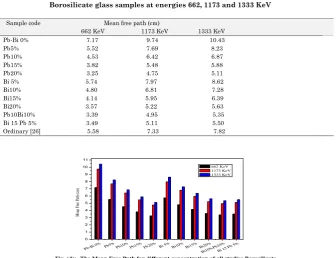
The obtained results of barium bismuth and barium lead borosilicate glasses have been compared in terms of mean free path (mfp) values with standard radiation shielding ordinary concretes used by Bashter [26] and given in table (4) and plotted in fig. (4). It is notice that the mfp was decreasing with increasing Bi2O3 and PbO concentration. This table shows that
radiation shielding materials in comparison to standard shielding concretes.
Table 4. The Mean Free Path for different concentration of all studies Borosilicate glass samples at energies 662, 1173 and 1333 KeV
Sample code Mean free path (cm)
662 KeV 1173 KeV 1333 KeV Pb-Bi 0% 7.17 9.74 10.43 Pb5% 5.52 7.69 8.23 Pb10% 4.53 6.42 6.87 Pb15% 3.82 5.48 5.88 Pb20% 3.25 4.75 5.11 Bi 5% 5.74 7.97 8.62 Bi10% 4.80 6.81 7.28 Bi15% 4.14 5.95 6.39 Bi20% 3.57 5.22 5.63 Pb10Bi10% 3.39 4.95 5.35 Bi 15 Pb 5% 3.49 5.11 5.50 Ordinary [26] 5.58 7.33 7.82
Pb-Bi
0% Pb5%Pb10%Pb15%Pb20%Bi 5%Bi10%Bi15%Bi20% Bi10%
Pb10% Bi 15 Pb
5%
0 1 2 3 4 5 6 7 8 9 10 11
Fig. (4):- The Mean Free Path for different concentration of all studies Borosilicate glass samples at energies 662, 1173 and 1333 KeV.
M
ean
Fr
ee
Pat
h
(cm
)
662 KeV 1173 KeV 1333 KeV
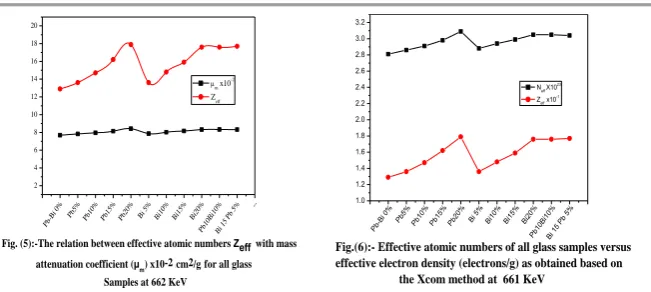
Using the mass attenuation coefficient (cm2/g), the effective
atomic numbers (Zeff) for glass samples at the photon energy
662 KeV have been calculated and the results have been displayed in Fig. (5) versus mass attenuation coefficients.
The calculated effective electron density (electros/g) and the effective atomic numbers (Zeff) for glass samples at the
Pb-B
i 0%Pb5%Pb10
%
Pb15 %
Pb20 %
Bi 5% Bi1 0% Bi1 5% Bi2 0% Pb10 Bi1 0%
Bi 1 5 Pb
5%
--2 4 6 8 10 12 14 16 18 20
Fig. (5):-The relation between effective atomic numbers Zeff with mass
attenuation coefficient (µ
m) x10-2 (cm2/g) for all glass
Samples at 662 KeV m x10
-2
Zeff
Pb-Bi 0%
Pb5%Pb10 %
Pb15 %
Pb20 %
Bi 5 % Bi10 % Bi15 % Bi20 % Pb10 Bi10 %
Bi 1 5 Pb 5% 1.0 1.2 1.4 1.6 1.8 2.0 2.2 2.4 2.6 2.8 3.0 3.2
Fig.(6):- Effective atomic numbers of all glass samples versus effective electron density (electrons/g) as obtained based on the Xcom method at 661 KeV
Neff X10 23 Zeff x10
-1
From these figures we can conclude that values of effective atomic number (Zeff) and the mass attenuation coefficient
increase as the amount of Bi2O3 and PbO increase This is due
to the ratio of high atomic number elements in the glass samples composition and indicates that the composite materials having high Zeff values with effectively absorbed incoming
photos. From the theoretical approach, the photoelectric absorption is related to more the atomic number than Compton scattering; which depends more on the density of the glass [27]. Moreover, the effective atomic number of lead glasses is relatively equal that of bismuth glass. It is evident from fig. (6) that the effective electron density (Neff) varies in the range of
(2.81-3.09) x1023 electron/g. The effective atomic number Zeff and electron density Neff are found to increase with PbO and
Bi2O3 contents. It was found that the Zeff value rather than
the Neff value is a better indicator for PbO and/or
Bi2O3 contents.
The theoretical calculated of optical basicity (Λth) for all
glass samples have been displayed in Fig. (7). The calculated optical basicity (Λth) values increases with increase in Bi2O3 and
PbO content. The increased optical basicity of the glasses with large Bi2O3 and PbO content indicates that the acid-base
properties of Bi2O3 and PbO have a significant effect. The low
electrons to the surrounding cations. The barium bismuth and barium lead borosilicate glass samples with a large amount of Bi2O3 and PbO content possess high optical basicity. High
optical basicity means high electron donor ability of the oxide ions to the cations. The understanding of optical basicity would be useful for the design of the novel optical functional materials with higher optical performances
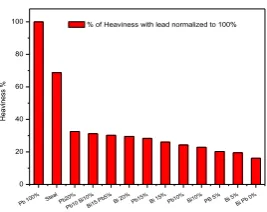
With reference to lead, the % of heaviness of the other conventional shielding materials along with barium bismuth and barium lead borosilicate glass samples was evaluated and shown in Fig. (8). With lead at 100% heavier than other shielding materials under consideration, steel is at 69.47%, heavier of lead. In case of barium bismuth and barium lead borosilicate glasses composites, all eleven samples were lighter than lead and steel. From this figure it is observed that the glass samples having mole % of bismuth oxide are less heaviness than samples having mole % of lead oxide. These results prove that barium bismuth borosilicate glasses composites considered exhibit excellent lightness when compared to conventional radiation shielding materials such as lead and steel.
Pb-Bi 0% Pb5 %
Pb10%Pb15%Pb20%Bi 5%Bi10%Bi15%Bi20% Pb10Bi1
0%
Bi 15 Pb 5%
103 104 105 106 107 108 109 110 111
Fig. (7):- Variation of optical basicity with different concentration of lead and bithmuth in glass samples.
Op
tical
b
asi
city
Pb 100% Ste al
Pb20% Pb10
Bi10% Bi15 Pb5% Bi 20
%Pb15% Bi 15%Pb10% Bi10% PB 5% Bi 5%Bi Pb 0
%
0 20 40 60 80
100 % of Heaviness with lead normalized to 100%
Hea
vi
ne
ss
%
Fig. (8) : Variation of heaviness % with different materiales
5. CONCLUSIONS
experimentally and theoretically with Mont Carlo Method and Xcom code. The simulations show that theoretical values of gamma ray attenuation coefficients were generally in good agreement with experimental obtained value.
From this study it can be concluded that:
- Mass attenuation coefficient (μm) of the studied glasses
sampled increase with increasing Bi2O3 and PbO concentration
because of increasing photoelectric absorption interaction of all glass samples. The obtained result show that the values of mass attenuation coefficient (μm) for Bi2O3 glasses samples at
different concentration are approximately closed to that in PbO glasses samples.
- We have succeeded in developing gamma-ray shielding materials from borosilicate glass. The results show that the minimum value of the mfp is observed in glass samples Pb20% and Pb10%Bi10%. Therefore, we reported here that the lower mean free path (mfp) values of the BaO–Bi2O3 glasses are the
better radiation shielding materials in comparison to standard shielding concretes.
- The effective atomic number of lead glasses is relatively equal that of bismuth glass.
- By comparing the variation of ratio of % heaviness of all samples with respect to lead and steel materials we conclude that, all samples showed better shielding effectiveness than lead glass. The barium bismuth borosilicate glasses samples having mole % of bismuth oxide are less heaviness than samples having mole % of lead oxide.
The Bi2O3 and BaO glass will open new possibility for a
of radiation such as nuclear medicine and high energy radiation.
Acknowledgment
The authors would like to thank member of National Research Center for helping us in preparation samples.
REFERENCES
1- Sandeep Gupta, Gurdeep Singh Sidhu. "Study of Photon Interaction Parameters for Some Oxide Glasses as Gamma Ray Shielding Materials", International Journal of Innovative Research in Science, Engineering and Technology (An ISO 3297: 2007 Certified Organization) Vol. 4, Issue 2, February (2015).
2- Reza Bagheri, Alireza Khorrami Moghaddam, and Hassan Yousefnia. "Gamma Ray Shielding Study of Barium-Bismuth-Borosilicate Glasses as Transparent Shielding Materials using MCNP-4C Code, XCOM Program, and Available Experimental Data", Nuclear Engineering and Technology, 49 (2017) 216 -223.
3- Sh Sharifi, R. Bagheri, S.P. Shirmardi. "Comparison of Shielding Properties for Ordinary, Barite, Serpentine and Steel Magnetite Concretes Using MCNP-4C Code and Available Experimental Results”, Ann. Nucl. Energy 53 (2013) 529-534. 4- S.P. Shirmardi, M. Shamsaei, M. Naserpour. “Comparison of photon attenuation coefficients of various barite concretes and lead by MCNP code, XCOM and experimental data”. Ann. Nucl. Energy 55 (2013) 288e291.
6- S.R. Manohara, S.M. Hanagodimath, L. Gerward. "Photon Interaction and Energy Absorption in Glass: A Transparent Gamma Ray Shield", J. Nucl. Mater. 393 (2009) 465-472.
7- A. M. Madbouly, E. R. Atta. "Comparative Study between Lead Oxide and Lead Nitrate Polymer as Gamma-Radiation Shielding Materials", Journal of Environmental Protection, (2016), 7, 268-276.
8- K. Kirdsiri, J. Kaewkhao, N. Chanthima, P. Limsuwan. "Comparative Study of Silicate Glasses Containing Bi2O3, PbO
and BaO": Radiation Shielding and Optical Properties, Ann. Nucl. Energy 38 (2011) 1438-1441.
9- Abbas J. Al-Saadi, and Abbas K. Saadon. "Gamma Ray Attenuation Coefficients for Lead Oxide and Iron Oxide Reinforced In Silicate Glasses as Radiation Shielding Windows", Ibn Al-Haitham Jour. for Pure & Appl. Sci., Vol. 27 (3) (2014).
10- Singh, K.J.; Singh N.; Kaundal, R.S. and Singh, K. "Gamma-ray Shielding and Structural Properties of PbO-SiO2 Glass", Nucl. Instr. and Meth.B, 266, (2008), 944–948.
11- P. Limkitjaroenporn, J. Kaewkhao, P. Limsuwanand and W. Chewpraditkul. "Physical, Optical, Structural and Gamma-Ray Shielding Properties of Lead Sodium Borate Glasses", Journal of Physics and Chemistry of Solids, 72, (2011), 245–251 12- M. Kurudirek, Y. Ozdemir, O. Simsekand and R. Durak. "Comparison of Some Lead and Non-Lead Based Glass Systems, Standard Shielding Concretes and Commercial Window Glasses in Terms of Shielding Parameters in the Energy Region of 1 keV-100 GeV, A Comparative Study", Journal of Nuclear Materials, 407 (2), (2010), 110-115.
13- Sandeep kaur and K.J. Singh. "Comparative Study of Lead Borate and Lead Silicate Glass System Doped with Aluminum Oxide as Gamma Ray Shielding Materials", IJITEE, 2, (2013), 172-175
Optical and Radiation Shielding Properties of (Na2O, K2O)-SiO2–CaO- Al2O3–B2O3 Glass System", Optoelectronics and Advanced Materials – Rapid Communications Vol. 3, No. 6, June (2009), p. 525 -527.
15- V. Dimitrov, T. Komatsu. "An Interpretation of Optical Properties of Oxides and Oxide Glasses in Terms of the Electronic Ion Polarizability and Average Single Bond Strength (review)" , Journal of the University of Chemical Technology and Metallurgy, 45, 3, (2010), 219-250.
16- K. Kirdsiri, J. Kaewkhao, N. Chanthima, P. Limsuwan. "Comparative Study of Silicate Glasses Containing Bi2O3, PbO and BaO": Radiation Shielding and Optical Properties, Ann. Nucl. Energy 38 (2011), 1438-1441.
17- Raje D.V. and Chaudhari L.M.). "Mass Attenuation of Soil Samples in Maharashtra (India) by Using Gamma Energy at 0.662 MeV", Bulg. J. Phys. 337, (2010), 158-164.
18- Niranjan, R.S., Rudrasw, B. and Dhananjaya, N. "Effective Atomic Number, Electron Density and kerma of Gamma Radiation for Oxides of Lanthanides", Pramana J. Phys., 78, No. 3, (2012), 451–458.
19- Hana, I. and Demirb, L."Studies on Effective Atomic Numbers, Electron Densities and Mass Attenuation Coefficients in Au Alloys", Journal of X-Ray Science and Technology (2010)18, 39–46.
20- N. Tsoulfanidis, S. Landsberger. "Measurement and Detection of Radiation", Fourth ed. CRC Press, Boca Raton, Florida, (2015).
21- Beena Bhatia, S. L. Meena, Vishal Parihar, Monika Poonia. "Optical Basicity and Polarizability of Nd3+-Doped Bismuth Borate Glasses", New Journal of Glass and Ceramics, (2015), 5, 44-52.
Pure and Applied Physics Vol. 50, November (2012), pp. 847-850.
23- Berger MJ, Hubbell JH, Seltzer SM, Chang J, Coursey JS, et al. XCOM: "Photon Cross Sections Database", NIST Standard Reference Database (XGAM) (2010).
24- Medhat ME, Shirmardi SP and Singh. "Comparison of Geant 4, MCNP Simulation Codes of Studying Attenuation of Gamma rays through Biological Materials with XCOM and Experimental Data", J. Appl Computat Math, 3:6 (2014). http://dx.doi.org/10.4172/2168-9679.1000179
25- Akkurt I, Basyi it C, Kilincarslan S. "The photon Attenuation Coefficients of Barite, Marble and limra". Ann. Nucl. Energy, 31(2004), 577.
26- Bashter, I.I. "Calculation of Radiation Attenuation Coefficients for Shielding Concretes", Ann. Nucl. Energy 24, (1997), 1389–1401.