ISSN 2286-4822 www.euacademic.org
Impact Factor: 3.4546 (UIF)
DRJI Value: 5.9 (B+)
Exploring the problem situation of parallel trading
in Hong Kong with the enriched rich picture
building exercise (ERPBE)
JOSEPH KIM-KEUNG HO
Independent Trainer Hong Kong, China
Abstract:
Parallel trading has been a conflictual societal issue in Hong Kong for several years. By means of the newspaper article study, the paper carries out an enriched rich picture building exercise (ERPBE) to expose the tremendous soft complexity of the problem situation of parallel trading. Other than serving the purpose of exploring the parallel trading issue in Hong Kong, the paper provides an example of how to carry out the newspaper article study and the ERPBE, both of which are relatively new research topics. In this regard, the paper can be conceived as a follow-up paper on the recent writings by the writer on the research topic of newspaper article study and ERPBE.
Key words: Newspaper article study; Parallel trading; Soft complexity; The rich picture building exercise (RPBE); The enriched rich picture building exercise (ERPBE); The problem situation; The Soft Systems Methodology (SSM)
Introduction
intellectual exercise has the practical value to inform exploration of constructive measures to address such an issue of substantial concern in the society of Hong Kong. Via the application of the rich picture building exercise (RPBE) and the newspaper article study, the paper also has certain academic value by illustrating these two practices and contributing to the development of them.
The notions of “the problem situation” and soft complexity
The notion of “the problem situation” as considered here comes from the conventional 7-stage Soft Systems Methodology (SSM) of Checkland (1981). This notion has been explained by other writers (Ho, 1986; 2015a). To comprehend the “problem situation notion in the context of the SSM, it is useful to refer to the 7 stages of the SSM (Checkland and Scholes, 1990)1, which
are:
Stage 1: “Problem situation considered problematic” Stage 2: “Problem situation expressed”
Stage 3: “Root definitions of relevant purposeful activity systems”
Stage 4: “Conceptual models of the systems (holons) named in the root definitions”
Stage 5: “Comparison of models and real world”
Stage 6: “Changes: systemically desirable and culturally feasible”
Stage 7: “Action to improve the problem situation”
The 7-stage SSM has long been superseded by an improved version, which is explained by Checkland and Scholes (1990). There are also other Soft Systems Methodologies and models specifically for information systems planning and development,
1 Readers need to refer to Checkland (1981) and Checkland and Scholes
see, for examples, Stowell (1995), Wilson (1984) and Checkland and Holwell (1998). Nevertheless, the 7-stage methodology remains popular for teaching SSM to students. In particular, the rich picture building exercise (RPBE), which is employed in stage 2 of the methodology, has been being researched on in the academic community (Ho, 2015a). This paper is yet another work that examines this rich picture building exercise.
From the Soft Systems Thinking perspective, problems do not exist objectively in the real world waiting to be discovered. In a particular problem context, different stakeholders may be unhappy about the situation for dissimilar reasons and thus perceive different problems about the situation. All the stakeholders involved do consider the situation to be problematic though. It is due to this reason that stages 1 and 2 of the conventional SSM talk about the problem situation as problematic, thus sparing minimal efforts to discover agreed-on problems from the problem situation. To express the problem situation, at stage 2 of the conventional SSM, efforts are made to involve stakeholders to participate in a brainstorming session that makes use of drawing in cartoon form. The cartoon diagram is the rich picture produced from such a brainstorming rich picture building session.
stakeholders, so that different stakeholders have different concerns and hold diverse problem perceptions that are often incompatible. The nature of soft complexity can be further analysed by means of the System Complexity Model of Ho, see Ho (1986), Ho and Sculli (1995) and Ho (2014). By gaining a fuller understanding of the problem situation via the RPBE, the stakeholders involved in the collective SSM learning process are then better prepared to generate insightful ideas that can alleviate the problematic situation. This latter process of brainstorming solutions in a collaborative learning mode is again guided by the SSM. This part of the SSM process is outside the scope of study in this paper, however.
The conventional and unconventional RPBE
trading in Hong Kong. This is done by the construction of two rich pictures, i.e., the conventional one with cartoon drawings and the unconventional one with a cognitive map. The whole exercise is informed by the practice of newspaper article study.
Using newspaper article study on the issue of parallel trading in Hong Kong for the ERPBE
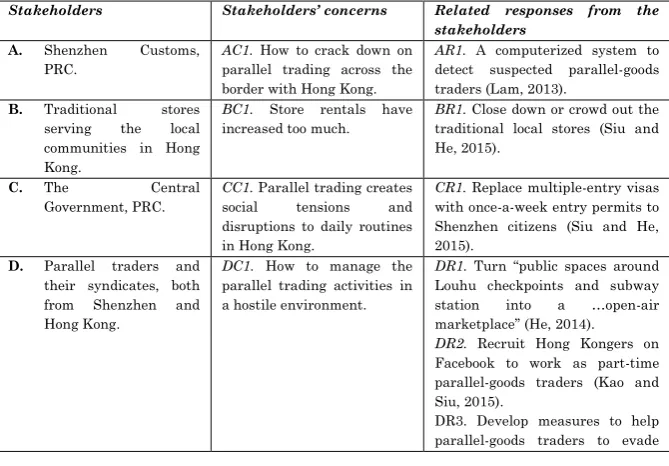
using the RPBE based on the SSM is appropriate to explore this quite unbounded issue. However, it is not feasible for the writer to involve all the stakeholders related to the parallel trading issue to go through a collaborative RPBE together. Instead, the writer makes use of the newspaper article study to inform the RPBE in a single-person way in this case. Specifically for this paper, the writer makes use of the online search engine of the South China Morning Post to access archived newspaper articles on parallel trading, see appendix 1. Newspaper article study as a method to inform academic research projects has been explained by Ho (2015c), thus not further elaborated on here. Out of the newspaper article study exercise, the major stakeholders, the major stakeholders‟ concerns and related responses on the issue of parallel trading are identified. The information so gathered are organized and presented in Table 1.2
Table 1: Stakeholders, stakeholders‟ concerns and related responses on parallel trading in Hong Kong
Stakeholders Stakeholders’ concerns Related responses from the stakeholders
A. Shenzhen Customs,
PRC.
AC1. How to crack down on parallel trading across the border with Hong Kong.
AR1. A computerized system to detect suspected parallel-goods traders (Lam, 2013).
B. Traditional stores
serving the local
communities in Hong Kong.
BC1. Store rentals have increased too much.
BR1. Close down or crowd out the traditional local stores (Siu and He, 2015).
C. The Central
Government, PRC.
CC1. Parallel trading creates
social tensions and
disruptions to daily routines in Hong Kong.
CR1. Replace multiple-entry visas with once-a-week entry permits to Shenzhen citizens (Siu and He, 2015).
D. Parallel traders and their syndicates, both from Shenzhen and Hong Kong.
DC1. How to manage the parallel trading activities in a hostile environment.
DR1. Turn “public spaces around Louhu checkpoints and subway
station into a …open-air
marketplace” (He, 2014).
DR2. Recruit Hong Kongers on Facebook to work as part-time parallel-goods traders (Kao and Siu, 2015).
DR3. Develop measures to help parallel-goods traders to evade
2 Due to limited space in this paper, the information provided in Table 1 is
arrest (Lo, 2015). E. Anti-parallel trading
activists.
EC1. Feel strongly disturbed by the parallel trading activities in Hong Kong and motivated to protest.
ER1. Organize protests against parallel trading activities at various places, e.g., Chief Executive Leung Chun-ying‟s residence (Siu, Kao and Chan, 2015).
F. The Chief Executive
Leung Chun-ying, Hong Kong.
FC1. How to alleviate the negative impacts of parallel trading and anti-parallel trading activities in Hong Kong?
FR1. Complain that the anti-parallel trading activities harm the local tourism sector (Nip, 2015).
G. The Hong Kong
Government, including
the Immigration
Department and the Police in Hong Kong.
GC1. How to combat parallel
trading-related illegal
activities in Hong Kong?
GR1. Arrest mainlanders who participate in parallel trading under the Immigration Laws of Hong Kong (Tsang, 2014).
GR2. Combat and arrest anti-parallel trading protestors with batons and pepper spray (Kao, 2015).
GR3. Blacklist and, sometimes, refuse mainlanders as parallel-goods traders to enter into Hong Kong (Chan, 2015).
GR4. Implement measures to limit milk formula exports from Hong Kong (Lee and Ho, 2013; Lai 2013; Ng, 2013; Tsang 2013). H. Affected local citizens
in Hong Kong.
HC1. Feel disturbed by the negative impact of parallel trading on their daily life.
HR1. Complain in private and openly about the disturbances caused by the parallel trading activities (Tsang, 2014; Kao and Siu, 2015; SCMP Editorial, 2015a).
I. Retail shops serving
mainlanders and
transport companies.
IC1. Feel disturbed by the
anti-parallel trading
activities and mood towards their mainland customers in Hong Kong.
IR1. Complain about the negative impacts that anti-parallel trading activities create on their businesses of serving mainland customers in Hong Kong (SCMP Editorial, 2015b).
J. Political groups against anti-parallel trading activities.
JC1. Feel disturbed by the
anti-parallel trading
activities and mood toward their mainland customers in Hong Kong.
JR1. Monitor and record anti-parallel trading protests as well as protest against anti-parallel trading activities direct on the spots (Tsang, 2015).
K. Shenzhen residents. KC1. Feel disturbed by the anti-parallel trading protests in Hong Kong.
KR1. Complain about the anti-parallel trading protests in Hong Kong (Sung, 2015).
L. Miscellaneous interest groups in the society on the parallel trading issue in Hong Kong.
LC1. Feel the need to more productively evaluate the impacts of parallel trading activities in Hong Kong.
LR1. University students produce humorous Youtube videos on parallel trading to raise social awareness of the parallel trading issue (Kung, 2015).
parallel trading activities, e.g., building border shopping in Hong Kong, and establishing duty-free shopping centers in Shenzhen (Wong, 2015).
M. Parallel-goods traders and parallel trading syndicates.
MC1. Feel the pressure from anti-parallel trading protests and the law enforcement from the HK Police, the HK
Immigration Department
and the mainland Customs Department.
MR1: Develop new tactics to evade arrest (Lo, 2015).
The information from Table 1 can be quite readily utilized in a conventional RPBE, as it also needs to identify stakeholders and their respective concerns in a problem situation (Ho, 2015a). More than that, the newspaper article study is able to inform the construction of a cognitive map to further express the problem situation of parallel trading in Hong Kong. The ERPBE, comprising the conventional and unconventional RPBE, is presented in the next section.
An analysis of the parallel trading problem situation based on the ERPBE
From the rich picture of Figure 1, the main rich picture elements can be identified as follows:
Element 1: Stakeholders and their concerns:
Local residents in Shenzhen; the main concern is: how to ensure supply of reliable goods from Hong Kong?
Shenzhen Customs; the main concern is: how to crack down on parallel trading?
Train passengers: the main concern is: the railway station and trains are very crowded.
Parallel-goods traders; the main concern is: can the current form of parallel trading activity be sustained? Anti-parallel trading activists (including the protesters);
the main concern is: parallel trading activities are unbearable.
Opponents of anti-parallel trading protesters; the main concern is: very upset with anti-parallel trading protests.
The Hong Kong Police; the main concerns are: (i) how to combat parallel trading? (ii) law and order gets worse. The local community of Hong Kong; the main concern is:
daily life is disrupted.
The Chief Executive of Hong Kong; the main concern is: many trouble-makers (i.e., anti-parallel trading activists) are around.
Retailers and transport companies; the main concern is: can high profit be maintained by serving the large group of parallel-goods traders?
Other tourists; the main concern is: the city of Hong Kong is terrible.
Element 2: Directions of attention [the “eye” symbols]:
Local residents in Shenzhen pay attention to the supply of parallel trading goods to Shenzhen.
Shenzhen Customs pays attention to the severity of parallel trading activities across the border.
Anti-parallel trading activists (and protesters) monitor the impacts of parallel trading activities on the local community in Hong Kong.
Opponents of anti-parallel trading activists monitor anti-parallel trading protests.
The local community in Hong Kong monitor the impacts of parallel trading activities on their daily life.
The Chief Executive of Hong Kong monitors the anti-parallel trading protests and the impacts of anti-parallel trading activities on the society.
The Hong Kong Police and the Hong Kong Immigration
Department monitor the impact of anti-parallel trading protests on law and order as well as the severity of parallel trading activities in Hong Kong.
Other tourists monitor the attractiveness of Hong Kong as a tourism destination.
Element 3: Tangible structures:
Examples of tangible structures are (i) the Shenzhen Customs building and (ii) the railway stations in Hong Kong and Shenzhen.
Element 4: Intangible structures:
Examples of intangible structures are (i) the working relationship between the Chief Executive of Hong Kong and the Hong Kong Police, (ii) the working relationship between the Chief Executive of Hong Kong, (iii) the Central Government, and (iv) the working relationship between the Hong Kong Police, the Immigration Department and the Shenzhen Customs.
Element 5: Processes:
community of Hong Kong, and (iii) the protest activities of anti-parallel trading and that of opponents towards the anti-parallel trading activists.
Element 6: Conflicts [the “swords‟ symbols]:
Examples of conflicts are those between: (i) the local community of Hong Kong and the retailers and transport companies, (ii) the Chief Executive of Hong Kong and anti-parallel trading activists, (iii) the Hong Kong Police and the anti-parallel trading activists, (iv) the Hong Kong Police/ the Hong Kong Immigration Department and the parallel-goods traders, (v) the anti-parallel trading activists and their opponents, (vi) the anti-parallel trading activists and the parallel-goods traders, (vii) the train passengers and the parallel-goods traders, and (viii) the parallel-goods traders and the Shenzhen Customs.
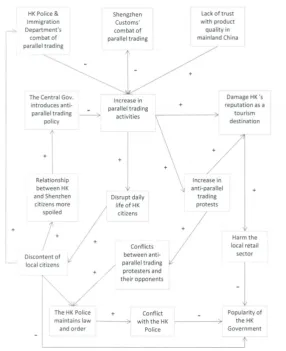
between anti-parallel trading protesters and their opponents”. The arrows in Figure 2 represent cause-effect relationships. A + sign means that an increase in variable A leads to an increase in variable B while a – sign shows that an increase in variable A leads to a decrease in variable B. In addition, some of the variables form feedback loops, which implies mutual causality among the variables. For feedback loops that are positive, they are self-amplifying. As to those feedback loops that are negative, they are self-stabilizing. An example of a negative feedback loop in Figure 2 involves the variables of “The Central Gov. introduces anti-parallel trading policy”, “Increase in parallel trading activities”, “Disrupt daily life of HK citizens”, “Discontent of local citizens”, and “Relationship between HK and Shenzhen citizens more spoiled”. [The signs involved in this feedback loop are -, +, +, +, +. Overall, it is a negative feedback loop.] Broadly speaking, the variables in the cognitive map of Figure 2 are of three types:
Type 1 - policy option variables: This type of variables has outgoing arrows, but may have no incoming arrows. Examples are: “The Central Government introduces anti-parallel trading policy” and “HK Police & Immigration Department‟s combat of parallel trading”.
Type 2 – intermediate variables: This type of variables unfailingly has both incoming and outgoing arrows. Examples are: “Disrupt daily life of HK citizens” and “Conflicts between anti-parallel trading protesters and their opponents”.
Comparing Figures 1 and 2, Figure 1 is clearer in expressing the inter-subjective (soft) aspect of a problem situation because different concerns of various stakeholders are clearly indicated while Figure 2 is better at capturing the systemicity of the problem situation with explicit cause-effect relationships among various variables. All in all, Figures 1 and 2, as the outputs of the ERPBE, complement each other in rendering a rich picture of the problem situation as full of soft complexity. In current form, Figures 1 and 2 are intended to highlight in a holistic way the main factors perceived by the writer, based on the newspaper article study, to be valuable to comprehend, communicate and stimulate discussion of the Hong Kong parallel trading issue in the Soft Systems Thinking mode. However, the enriched rich picture, as portrayed by Figures 1 and 2 together, is not intended to be an “objective” picture of the problem situation and it is definitely not meant to prove that there are “objective” systems about parallel trading out there in the real world. To think this “objective” way would be anti-Soft Systems Thinking whereas the ERPBE is theoretically anchored on Soft Systems Thinking or Critical Systems Thinking (Hom 2015a).
Concluding remarks
work out desirable and feasible solutions as guided by the SSM. Moreover, this paper provides an illustration on the practice and value of the newspaper article study and the ERPBE, both of which are quite recent research topics raised by Ho (2015a; 2015c). In this respect, the paper is a follow-up paper on these two research topics. It is foreseeable that the illustrative example with parallel trading will be revisited in future research on these two research topics. Finally, both the newspaper article study and the ERPBE can also be considered as a valuable means for managerial intellectual learning (Ho, 2013). Therefore, refining knowledge on them also contributes to the theoretical development of the managerial intellectual learning topic.
BIBLIOGRAPHY:
Ansoff, H.I. 1984. Implanting Strategic Management. Prentice/ Hall International. Englewood Cliffs. New Jersey.
Chan, S. 2015. “Hong Kong immigration department has a list of suspected parallel-goods traders: director” South China Morning Post February 13.
Checkland, P.B. 1981. Systems Thinking, Systems Practice. Wiley. Chichester.
Checkland, P.B. and J. Scholes. 1990. Soft Systems Methodology in Action. Wiley. Chichester.
Checkland, P.B. and S. Holwell. 1998. Information, Systems and Information Systems – making sense of the field. Wiley. Chichester.
Eden, C., S. Jones and D. Sims. 1983. Messing about in Problems: An informal structured approach to their identification and management. Pergamon Press. Oxford.
Ho, J.K.K. 1986. A study of problem contexts, problems, and attempted solutions using systems concepts at Harlands
of Hull. MA in Management Systems thesis.
Department of Management Systems and Sciences. The University of Hull. UK.
Ho, J.K.K. 2013. “A Research Note: An exploration on the intellectual learning process of systems thinking by managers in the digital social media ecosystem” European Academic Research 1(5) August: 636-649. Ho, J.K.K. 2014. “An Elaboration of a Systems-based Housing
Imagination Evaluation Framework for Research and Pedagogical Practices” European Academic Research 2(4) July: 5099-5121.
Ho, J.K.K. 2015a. “An updated review on the conventional and unconventional rich picture building exercises (RPBEs) in P.B. Checkland‟s Soft Systems Methodology (SSM)” American Research Thoughts 1(7) May: 1516-1527. Ho, J.K.K. 2015b. Parallel trading (Hong Kong) study.
Facebook group (public) created by J.K.K. Ho. (url address:
https://www.facebook.com/groups/1607475099511119/) [visited at May 24].
Ho, J.K.K. 2015c. “Establishing the basic knowledge required for the local English newspaper article study in academic research projects (NASARP): the Hong Kong case” European Academic Research 3(2) May: 1723-1742. Ho, J.K.K. and D. Sculli. 1995. “System Complexity and the
Design of Decision Support Systems” Systems Practice 8(5) Plenum Press: 505-516,
Kao, E. 2013. “Formula curbs not aimed at mainland tourists, say food chief” South China Morning Post March 6. Ho, J.K.K. and M.C. Jackson. 1987. “Building a “rich picture”
Kao, E. 2015. “Pepper spray and arrests as Tuen Mun parallel trader protest ends in chaos” South China Morning Post February 8.
Kao, E. and P. Siu. 2015. “Slashing visits by Shenzhen residents „won‟t end‟ parallel trading problem” South China Morning Post April 12.
Kung, K. 2015. “Students‟ video takes satirical look at Sheung Shui trader influx problem” South China Morning Post March 18.
Lai, Y.K. 2013. “Three fined for breaching new milk formula quota” South China Morning Post March 5.
Lai, Y.K. and J. Li. 2015. “Hong Kong and mainland China are „brothers‟, says Beijing official amid tourist protests.” South China Morning Post March 4.
Lai, Y.K., P. Siu and E. Kao. 2015. “Beijing pledges to adjust entry rules to Hong Kong after mainland tourist „saturation‟.” South China Morning Post March 11. Lam, J. 2013. “New system detects 150 potential smugglers at
border daily” South China Morning Post August 10. Lee, A. and J. Ho. 2013. “Police intervene as tempers rise over
milk formula trade” South China Morning Post February 3.
Lo, C. 2015. “Parallel trading syndicates issue smugglers with „receipts‟ to evade arrest” South China Morning Post April 15.
Mak, K.C.C. 2015. “The Effectiveness of Legislation Towards Parallel Trading” Hong Kong Law Blog February 25. (url address: http://hklawblog.com/2015/02/25/the-effectiveness-of-legislation-towards-parallel-trading/) [visited at May 26, 2015].
Health and Agricultural Innovation: A Handbook of Best Practices. MIHR. Concept Foundation. (url address: http://www.iphandbook.org/handbook/ch15/p04/) [visited at May 26, 2015].
Mintzberg, H. 1983. Structure in Fives. Prentice-Hall International. Englewood Cliffs, New Jersey.
Ng, S.T.M. 2013. “No easy formula to resolve row over milk powder” South China Morning Post March 12.
Nip, A. 2015. “CY Leung blames anti-parallel trade protests for „alarming‟ drop in Hong Kong tourism” South China Morning Post April 8.
SCMP Editorial. 2015a. “Parallel trading, not mainland visitors, is the real problem” South China Morning Post March 4.
SCMP Editorial. 2015b. “Hong Kong should facilitate trade at border towns, not vilify it” South China Morning Post February 11.
Siu, P. 2015. “Shenzhen‟s parallel universe: action to stop street traders divides city” South China Morning Post April 16. Siu, P. and H.F. He. 2015. “Shenzhen visa restrictions open up new job opportunities for Hongkongers” South China Morning Post April 14.
Siu, P., E. Kao and S. Chan. 2015. “Hong Kong anti-parallel trading protesters stay away from Government House open day” South China Morning Post March 16.
Siu, P., C. Lo and T. Cheung. 2015. “Hong Kong chief blasts anti-mainlander protests after suspected traders „abused and kicked‟.” South China Morning Post March 9.
South China Morning Post (url address:
http://www.scmp.com/frontpage/hk)
Sung, T. 2015. “Views sharply divided over mainland Chinese shoppers visiting Hong Kong‟s Yuen Long” South China Morning Post March 2.
Tsang, E. 2013. “Parallel trading of baby milk formula still rampant despite Hong Kong restrictions” South China Morning Post April 1.
Tsang, E. 2014. “20 mainland Chinese traders arrested in quick-fire swoop by Hong Kong authorities” South China Morning Post December 20.
Tsang, E. 2015. “Political group to monitor protest against „parallel traders‟ in Yuen Long” South China Morning Post March 1.
Tsang, E. and A. Nip. 2013. “Can restricting exports on milk formula prove best for Hong Kong‟s babies?” South China Morning Post May 27.
Wikipedia. 2015. “Parallel trading in Hong Kong”
Wikipedia.com. (url address:
http://en.wikipedia.org/wiki/Parallel_trading_in_Hong_K ong) [visited at May 24, 2015].
Wilson, B. 1984. Systems: concepts, methodologies, and applications. Wiley. Chichester.
Appendix