Scholarship@Western
Scholarship@Western
Electronic Thesis and Dissertation Repository
12-7-2015 12:00 AM
Recent Advances in Accumulating Priority Queues
Recent Advances in Accumulating Priority Queues
Na Li
The University of Western Ontario
Supervisor
Dr. David A. Stanford
The University of Western Ontario
Graduate Program in Statistics and Actuarial Sciences
A thesis submitted in partial fulfillment of the requirements for the degree in Doctor of Philosophy
© Na Li 2015
Follow this and additional works at: https://ir.lib.uwo.ca/etd
Part of the Statistics and Probability Commons
Recommended Citation Recommended Citation
Li, Na, "Recent Advances in Accumulating Priority Queues" (2015). Electronic Thesis and Dissertation Repository. 3401.
https://ir.lib.uwo.ca/etd/3401
This Dissertation/Thesis is brought to you for free and open access by Scholarship@Western. It has been accepted for inclusion in Electronic Thesis and Dissertation Repository by an authorized administrator of
RECENT ADVANCES IN ACCUMULATING PRIORITY QUEUES
(Thesis format: Integrated Article)
by
Na Li
Graduate Program in Statistics and Actuarial Sciences
A thesis submitted in partial fulfillment
of the requirements for the degree of
Doctor of Philosophy
The School of Graduate and Postdoctoral Studies
The University of Western Ontario
London, Ontario, Canada
c
This thesis extends the theory underlying the Accumulating Priority Queue (APQ) in three
di-rections. In the first, we present a multi-class multi-server accumulating priority queue with
Poisson arrivals and heterogeneous services. The waiting time distributions for different
class-es have been derived. A conservation law for systems with heterogeneous servers has been
studied. We also investigate an optimization problem to find the optimal level of
heterogene-ity in the multi-server system. Numerical investigations through simulation are carried out to
validate the model.
We next focus on a queuing system with Poisson arrivals, generally distributed service
times and nonlinear priority accumulation functions. We start with an extension of the
power-law APQ in Kleinrock and Finkelstein (1967), and use a general argument to show that there
is a linear system of the form discussed in Stanford, Taylor and Ziedins (2014) which has the
same priority ordering of all customers present at any given instant in time, for any sample path.
Beyond the power-law case, we subsequently characterize the class of nonlinear accumulating
priority queues for which an equivalent linear APQ can be found, in the sense that the waiting
time distributions for each of the classes are identical in both the linear and nonlinear systems.
Many operational queuing systems must adhere to waiting time targets known as Key
Per-formance Indicators (KPIs), particularly in health care applications. In the last aspect, we
address an optimization problem to minimize the weighted average of the expected excess
waiting time (WAE), so as to achieve the optimal performance of a system operating under
KPIs. We then find that the Accumulating Priority queuing discipline is well suited to systems
with KPIs, in that each class of customers progresses fairly towards timely access by its own
waiting time limit. Due to the difficulties in minimizing the WAE, we introduce a surrogate
objective function, the integrated weighted average excess (IWAE), which provides a useful
proxy for WAE. Finally, we propose a rule of thumb in which patients in the various classes
accumulate priority credit at a rate that is inversely proportional to their time limits.
Keywords: Accumulating priority queue, Heterogeneous servers, Waiting time
distribu-tions, Nonlinear priority function, Optimization.
Co-Authorship Statement
Paper title: Multi-server Accumulating Priority Queues with Heterogeneous Servers
Publication: Submitted to European Journal of Operational Research
List of authors: Na Li, David A. Stanford
I defined the heterogeneous multi-server accumulating priority queuing model, derived the
waiting time distributions for different classes, and studied the optimization problem on the
level of heterogeneity in the system. Dr. Stanford proposed a conservation law for M/Mi/c systems. I performed the calculations, derivations and numerical investigations in this paper.
Both authors contributed with corrections and recommendations to the contents and relevance.
Paper title: On Waiting Times for Nonlinear Accumulating Priority Queues
Publication: Submitted toOperations Research
List of authors: Na Li, David A. Stanford, Peter Taylor, Ilze Ziedins
I initiated an extension of Kleinrock and Finkelstein’s model, and derived the waiting time
distributions for various classes in the power-law APQs. Dr. Stanford introduced the idea of
pairing the sample path of the power-law APQ with that of a corresponding linear APQ (named
“linear proxy”) to show the equivalence. Then, Dr. Taylor raised the question whether there
exist other nonlinear APQs with linear proxies than the power-law APQ. Dr. Ziedins first stated
the criterion (equation (4.15)) for the existence of a linear proxy. I proceeded the derivations
and calculations for most of the proofs in the paper, expect for the necessary and sufficient
proof for the criterion, which was derived by Dr. Taylor, whereas I proved its sufficient
con-dition through constructing the maximum priority process for nonlinear APQs. I performed
all the examples and numerical investigations. All authors contributed with corrections and
recommendations to the contents and relevance.
Publication: Submitted toOperations Research
List of authors: Na Li, David A. Stanford, Azaz B. Sharif, Richard J. Caron
The optimization problem to minimize the weighted average of the total expected excess
wait-ing time (WAE) was formulated by Dr. Stanford, together with Azaz B. Sharif and Dr. Caron
in 2014. A rule of thumb for the optimality of TEE (short for “total expected excess”, which
is the equal-weighted case) was introduced based on a variety of numerical calculations done
by the other PhD candidate, Azaz B. Sharif. I joined this work in April 2015, and performed
extensive numerical investigations combined with theoretical derivations to validate the rule of
thumb. Then, I proposed a surrogate objective function, the integrated weighted average excess
(IWAE), as a proxy for WAE, and obtained an explicit expression for the optimal solution of
IWAE. Overall, I contributed to the paper with regards to the formulation of IWAE, as well as
the derivations, calculations, and numerical investigations for both the WAE and IWAE
opti-mization problems. A discussion of the convexity in the two-class APQ optiopti-mization problem
was presented by Dr. Stanford. Dr. Caron provided the guidance with his expertise on
opti-mization. All authors contributed with corrections and recommendations to the contents and
relevance.
Acknowledgments
This thesis couldn’t have been completed without the assistance of many individuals and I
would like to express my deepest appreciation to them.
I would like to express my gratitude to my supervisor, Dr. Stanford, whose guidance,
understanding, and caring, added considerably to my graduate experience. I appreciate his vast
knowledge on queuing theory, and his assistance in formal English writing. His advice on both
research and my career path have been valuable.
I would like to thank Dr. Taylor and Dr. Ziedins for their valuable suggestions and
contri-butions to our paper, together with Dr. Stanford who inspired me to make further developments
regarding more general problems on the nonlinear accumulating priority queues. I would also
like to thank Dr. Caron for his guidance on optimization techniques and advice on writing.
A very special acknowledgment goes to Dr. John Braun, without whose motivation and
encouragement I would not have considered to pursue a PhD.
I would also like to thank my husband and my son for keeping me company, along with
endless touching and joyful moments.
Last but foremost, I would like to thank my parents for their perpetual and unconditional
love and support through my life.
Abstract ii
Co-Authorship Statement iii
Acknowledgments v
List of Figures x
List of Tables xii
List of Appendices xiii
List of Abbreviations xiv
List of Symbols and Definitions xv
1 Introduction 1
1.1 Background and motivation of this thesis . . . 1
1.2 Outline of this thesis . . . 5
References . . . 7
2 Preliminaries 9 2.1 Laplace-Stieltjes transforms . . . 10
2.2 Accumulating priority queues . . . 11
2.2.1 Average waiting times in APQs . . . 12
2.2.2 Waiting time distributions in APQs . . . 13
2.2.3 Other work on APQs . . . 16
2.3 FCFS queues with heterogeneous servers . . . 17
2.3.1 The classical heterogeneous queue under RCS . . . 18
2.3.2 Heterogeneous queues under general dispatch polices . . . 19
2.4 Conservation laws . . . 22
2.4.1 TheM/G/1 conservation law . . . 23
2.4.2 TheG/G/1 conservation law . . . 23
2.4.3 A general conservation law . . . 24
2.4.4 ModifiedGI/G/1 conservation law . . . 25
2.5 The Poisson mapping theorem . . . 25
2.6 Gaver-Stehfest numerical inversion of LST . . . 26
References . . . 29
3 Multi-server accumulating priority queues with heterogeneous servers 32 3.1 Introduction . . . 32
3.2 Model description . . . 37
3.3 A conservation law forM/Mi/csystems . . . 39
3.4 The stationary probability of the system being busy forM/Mi/cqueues . . . 43
3.5 Optimizing the level of heterogeneity inM/Mi/2 systems . . . 48
3.6 Waiting time distributions forM/Mi/cqueues under APQ and related disciplines 51 3.7 Numerical investigations . . . 54
3.7.1 Gaver-Stehfest evaluation and simulation . . . 54
3.7.2 The impact of the level of heterogeneity . . . 56
3.7.3 What are the optimalband maximumρ? . . . 60
References . . . 63
4 On waiting times for nonlinear accumulating priority queues 66 4.1 Introduction . . . 66
4.2 Model description . . . 69
4.4 Linear proxies for general nonlinear APQs . . . 77
4.5 Waiting time distributions for the nonlinear APQ with a linear proxy . . . 80
4.6 Discussion on the maximum priority process for a nonlinear APQ . . . 80
4.7 Examples of nonlinear APQs . . . 86
4.7.1 Power functions . . . 86
4.7.2 Exponential functions . . . 86
4.7.3 Logarithmic functions . . . 86
4.8 Numerical examples . . . 87
References . . . 92
5 Optimization of queues operating under waiting time limits 93 5.1 Introduction . . . 93
5.2 Formulation of the optimization problem . . . 97
5.2.1 Formulating the WAE optimization problem for APQ systems . . . 98
5.3 Convexity in the two-class APQ optimization problem . . . 99
5.4 Optimizing IWAE . . . 101
5.5 Optimizing WAE . . . 105
5.6 Numerical investigations . . . 108
5.7 Discussion . . . 118
References . . . 122
6 Conclusions and future work 125 6.1 Main contributions . . . 125
6.2 Future work . . . 128
Appendix A Additional materials in Chapter 3 130 A.1 Waiting times of accredited customers in anM/Mi/cAPQ . . . 130
A.2 Additional materials for the average waiting times in a linear APQ . . . 132
A.3 The stationary probabilityπ(µ,3;r) for RCS, FSF, SSF and RBS . . . 132
Appendix B The proofs and additional materials in Chapter 5 136 B.1 The proofs in Section 5.3 . . . 136
B.2 Waiting times in the two-class multi-server APQ . . . 140
B.3 The proofs in Section 5.5 . . . 141
B.4 Further investigations on the TEE for a two-class APQ . . . 144
Curriculum Vitae 150
2.1 State-transition-rate diagram with two heterogeneous servers. . . 20
2.2 State-transition-rate diagram with three heterogeneous servers. . . 21
3.1 A sample path of the release time. . . 40
3.2 State-transition-rate diagram with arbitrary number of servers. . . 46
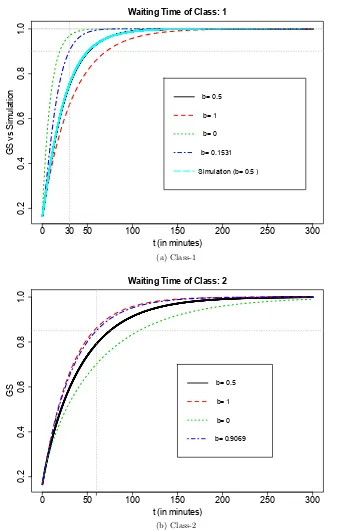
3.3 The GS evaluation of the waiting time distribution function for class-1 and class-2 customers under RCS (G=0.9). . . 55
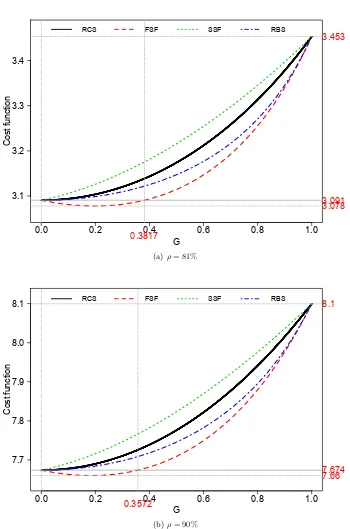
3.4 Range of the level of heterogeneity that minimizes the cost function. . . 57
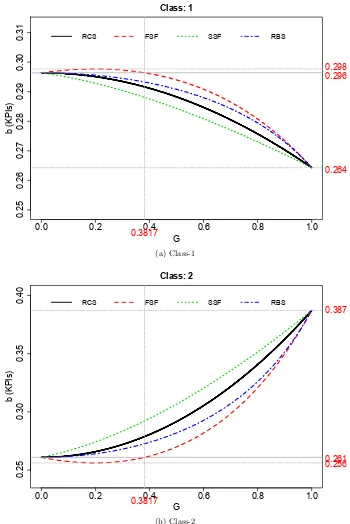
3.5 Relationship between the value ofb2= bfor which KPI targets can be met and level of heterogeneity (G) with equal arrival rates and two servers (ρ=81%). . 59
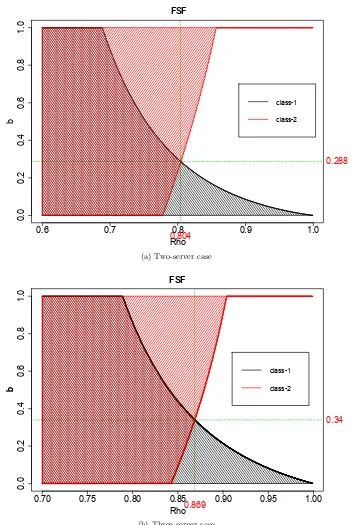
3.6 Permissible range of values of 0< b2 = b < 1 to meet the class-1 and class-2 KPIs in the two-server and three-server case under FSF (G=0.9). . . 61
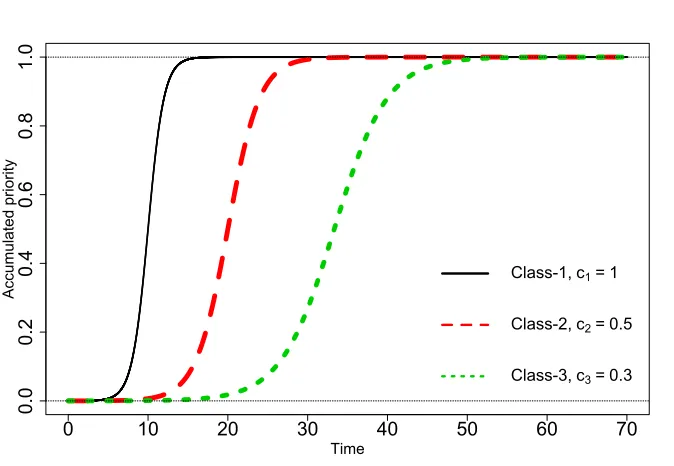
4.1 An example of priority accumulation function. . . 68
4.2 Accumulating priority functions for different priority classes. . . 71
4.3 An example of two accumulating priority functions. . . 72
4.4 A sample path of an APQ with a number of different customers. . . 73
4.5 Maximum priorities. . . 82
4.6 The priority process at a departure time: case 2. . . 83
4.7 The priority process at a departure time: case 3. . . 83
4.8 A customer of class jbecoming accredited with respect to classk. . . 85
4.9 Waiting time distributions for a two-class APQ with the accumulation functions proposed in Section 4.1. . . 88
4.10 Waiting time distributions for the power-law APQ. . . 89
4.11 Waiting time distributions for a three-class APQ with the accumulation func-tions proposed in Section 4.1. . . 90
5.1 WAE (ρ=90%) with the parametersµ= 2,λ1 =λ2,l1 =15 mins and f =1/4. 108 5.2 IWAE (ρ=90%) with the parametersµ= 2,λ1 =λ2, and f =1/4. . . 109
5.3 TEE and WAE (ρ=90%) with parameters: l1 =20 mins, f =1/2. . . 110
5.4 The optimalbto minimize TEE with parameters:l1 = 20 mins and f =1/2. . . 111
5.5 The optimalbto minimize TEE with parameters:λ1 =λ2andl1 =20 mins. . . 112
5.6 The optimalbto minimize WAE (3:1) withλ1 =λ2 andl1 =20 mins. . . 114
5.7 The optimalbto minimize IWAE (1:1) with equal arrivals. . . 115
5.8 The optimalbto minimize IWAE (3:1) with equal arrivals. . . 116
5.9 The difference between the optimalbto minimize IWAE (1:1) and the optimal bto minimize TEE (l1 =20 mins) with equal arrivals. . . 117
5.10 The difference between the optimalbto minimize IWAE (3:1) and the optimal bto minimize WAE (3:1;l1 =20 mins) with equal arrivals. . . 118
B.1 Impact of change in accumulation rate. . . 139
B.2 Numerical values of∂Zg(b)/∂b|b=f under the GS algorithm with 8 points. . . 146
B.3 Numerical values of∂2Zg(b)/∂b2under the GS algorithm with 8 points. . . . . 147
B.4 Numerical values of∂Zg(b)/∂b|b=f/2 under the GS algorithm with 8 points. . . . 149
1.1 CTAS Key Performance Indicators (KPIs) . . . 4
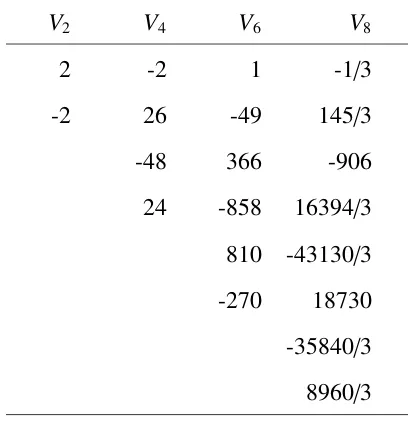
2.1 Coefficients for the Gaver-Stehfest Algorithm . . . 27
3.1 CTAS Key Performance Indicators (KPIs) . . . 35
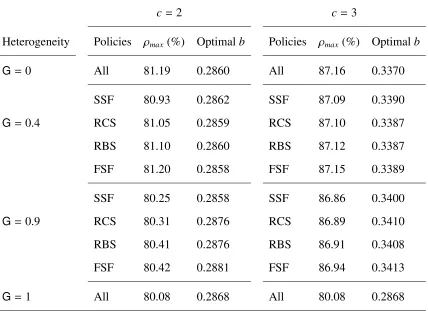
3.2 Maximumρand optimalbwith different levels of heterogeneity . . . 62
5.1 CTAS Key Performance Indicators (KPI) . . . 94
5.2 The values ofρspandb † maxfor different values of f . . . 113
A.1 The stationary probabilityπ(µ,3;r) whenρ=40% . . . 135
A.2 The stationary probabilityπ(µ,3;r) whenρ=75% . . . 135
A.3 The stationary probabilityπ(µ,3;r) whenρ=90% . . . 135
A.4 The stationary probabilityπ(µ,3;r) whenρ=98% . . . 135
List of Appendices
Appendix A Additional materials in Chapter 3 . . . 130
Appendix A.1 Waiting times of accredited customers in an M/Mi/cAPQ . . . 130
Appendix A.2 Additional materials for the average waiting times in a linear APQ . . . . 132
Appendix A.3 The stationary probabilityπ(µ,3;r) for RCS, FSF, SSF and RBS . . . 132
Appendix B The proofs and additional materials in Chapter 5 . . . 136
Appendix B.1 The proofs in Section 5.3 . . . 136
Appendix B.2 Waiting times in the two-class multi-server APQ . . . 140
Appendix B.3 The proofs in Section 5.5 . . . 141
Appendix B.4 Further investigations on the TEE for a two-class APQ . . . 144
APQ Accumulating priority queue
c.d.f. Cumulative distribution function
CTAS Canadian Triage and Acuity Scale
EE Expected excess waiting time per unit of time
FCFS First come first serve
FSF Fast server first dispatch policy
GS Gaver-Stehfest numerical inversion algorithm
i.i.d. Independent and identically distributed
IWAE Integrated delay of the weighted expected excess waiting time
KPI Key Performance Indicators
LST Laplace-Stieltjes Transform
p.d.f. Probability density function
RBS Rate balancing selection dispatch policy
RCS Randomly chosen server dispatch policy
r.v. Random variable
SDP Service dispatch policies
SSF Slowest server first dispatch policy
TEE Total expected excess waiting time (equal-weighted)
WAE Weighted average of the total expected excess waiting time
List of Symbols and Definitions
Queuing models and their descriptions
M/G/1 A single-server queue with Poisson arrivals and general service duration distributions.
G/G/1 A single-server queue with general inter-arrival distributions and general service duration distributions.
GI/G/1 A single-server queue with independent general inter-arrival distributions and general service duration distributions.
M/M/c A multi-server queue with Poisson arrivals and a common exponential service distribution.
M/Mi/c A multi-server queue with Poisson arrivals and heterogeneous exponential service distributions.
GI/Mi/c A multi-server queue with independent general inter-arrival distributions and heterogeneous exponential service distributions.
Linear APQ An accumulating priority queue with linear priority accumulation functions.
Power-law APQ of orderr An accumulating priority queue with the power-law priority accumulation functions with a parameterr.
Nonlinear APQ An accumulating priority queue with general nonlinear priority
accumulation functions.
N Positive integers: 1,2, . . ..
R Real numbers.
K Kclasses of customers.
c cservers.
bk The linear accumulation rate of class-kcustomers;k=1,2, . . . ,K. Particularly, in the two-class case,b= b2/b1 whereb1is usually set to be one. (Denoted bybLk in Chapter 4.)
b(kr) The accumulation rate for class-kcustomers;k= 1,2, . . . ,Kin the power-law APQ of orderr.
λk The arrival rate of class-kcustomers;k=1,2, . . . ,K.
λ Total arrival rate ofKclasses, i.e.,λ= PK
k=1λk.
µi The service rate ofithserver;i= 1,2, . . . ,c.
µ Total service rate ofcservers, i.e.,µ=Pc
i=1µi. (Denoted byµain Chapter 3.)
ρ Server utilization of the system, i.e.,ρ=λ/µ.
πn The stationary probability ofnthstate;n= 0,1,2, . . ..
mk The average waiting time for class-kcustomers;k=1,2, . . . ,K.
U(t) The unfinished workload process at timet, i.e., the total amount of work present in the system at timetstill to be completed by the server.
¯
U The limiting average of the unfinished work, i.e., ¯U = limt→∞E{U(t)}.
x2
k The second moment of service time for a customer from classk;k=1,2, . . . ,K.
W0 The residual life of the customer found in service upon an arrival’s entry.
M The maximum priority process at timet, i.e., M= {Mi(t); t≥ 0, i=1, . . . ,K}.
transform inversion for a given real-valued function f(t);t≥0. ˜
f The Laplace-Stieltjes transform of a distribution function.
Frequently used symbols in Chapter 3
µa Total service rate ofcservers, i.e.,µa= Pci=1µi.
µ Service rate vector, i.e.,µ=(µ1, µ2, . . . , µc).
C The set of idle servers for the current state.
r A givenr-dispatch policy.
pi(C;r) The probability that serveri∈Cis chosen to serve the newly-arriving customer under ther-dispatch policy.
V(t) The release time at timet, i.e., the amount of time until a server can become idle, given the work present at timet.
¯
V The limiting expected value ofV(t) over time, i.e., ¯V =limt→∞E{V(t)}.
V0 The expected residual cohort inter-completion time.
G A vector of Gini-like coefficients to measure the level of heterogeneity in
multi-server queues, i.e.,G={Gi,i=1, . . . ,c.}.
G The largest level of heterogeneity in the system, i.e.,G= Gc.
π(µ,c;r) The probability that allcservers are simultaneously busy in a stationaryM/Mi/c queue.
Frequently used symbols in Chapter 4
F A set of priority accumulation functions{fk(.),k=1, . . . ,K}in nonlinear APQs.
r A given power-law APQ of orderr.
lk The delay limit for class-kcustomers;k =1,2, . . . ,K.
pk The compliance probability for class-kcustomers;k= 1,2, . . . ,K.
f1,k The ratio of the delay limits between class-1 and class-k;k= 1,2, . . . ,K. Particularly, in the two-class case, f = f1,2.
αk The weights for the expected excess waiting for class-kcustomers;k=1,2, . . . ,K.
m(2)k The second moment of the waiting time distribution for class-kcustomers;
k= 1,2, . . . ,K.
Gk The expected excess waiting for class-k;k=1,2, . . . ,K customers integrated over the whole range of the class-1 delay limit.
πbusy The probability that all servers are simultaneously busy in a stationary M/Mi/c queue.
Chapter 1
Introduction
1.1
Background and motivation of this thesis
Long waiting time has been a serious problem for a very long time in many public systems,
especially in health care systems. The issues caused by long waiting time are getting more
and more attention from researchers. In most cases, a health care (or other) system inclines
to separate patients (customers) into different priority groups according to their urgencies for
commencement of service. In order to reduce waiting time, many different techniques have
been studied by researchers, where classical priority queuing models appear to be the most
popular approach in such a system. However, a classical priority queue, which only selects a
customer of a given class when no customers of higher priority classes are waiting, can cause
the customers from lower classes to experience extremely long waiting times which may result
in serious outcomes. For example, the classical priority queuing discipline is commonly used
by medical physicians and decision makers in the health care systems where the Canadian
Triage and Acuity Scale (CTAS) [1] is applied. The CTAS classifies patients into five distinct
priority classes according to the Key Performance Indicators (KPIs), which specify a time
limit and a corresponding compliance probability for each class of patients. An extended wait,
caused by the classical priority discipline, for the patients from lower priority classes may lead
to critical consequences, for instance, a deterioration of a patient’s condition or even death.
In 1964, Kleinrock [4] proposed a time-dependent priority queuing model, which was
mo-tivated by a problem in the context of computer processor design. He recommended that
cus-tomers may accumulate priority as a linear function of their waiting time in the queue, at a rate
that reflects their urgency or classification. Consequently, in such a queue, the customers from
a lower-priority class will eventually earn enough priority to enter service, in all likelihood, at
an earlier point in time than in a classical priority queue when their waiting times were ignored.
He derived a set of expressions for the expected waiting times for different classes, under the
assumptions of Poisson arrivals and a single server working at an exponential service rate.
Motivated by the applications of KPIs, Stanford, Taylor and Ziedins [11] reconsidered
Kleinrock’s model, renamed as the “accumulating priority queue” (APQ). They derived the
waiting time distributions for different priority classes in a single server system with
gener-al service times. This discipline provides a more bgener-alanced approach to select customers for
service, and consequently better regulates wait times for various classes of customers, by
al-lowing customers to accumulate priority credit while they wait. As an extension of Stanfordet al. [11], Sharifet al.[10] considered a multi-class multi-server APQ with Poisson arrivals and a common exponential service distribution, where waiting time distribution for each class was
derived. Both Stanfordet al. [11] and its successor Sharifet al. [10] showed that by varying the rates of priority accumulation for different classes, the time limits and corresponding
com-pliance probabilities stated in KPIs can be met in an accumulating priority queue, which might
not possibly to be achieved in a classical priority system.
This thesis extends the research on the accumulating priority queues to three directions:
APQs with heterogeneous servers, APQs with nonlinear accumulation functions, and
opti-mization problems for APQs. All three aspects are motivated by the issues appearing in the
real systems.
The first direction in which this thesis extends current theory pertains to the case where
heterogeneous servers are present. In many situations, most service sections have multiple
servers working simultaneously. A common assumption in such multi-server queuing models,
1.1. Background and motivation of this thesis 3
speed. It is more reasonable to take the heterogeneity among different servers into account
when constructing a queuing model to describe real systems, e.g. a health care system.
By taking account of the heterogeneity among servers in the analysis of APQs, a multi-class
multi-server queue with Poisson arrivals and heterogeneous exponentially distributed service
times under the APQ and related queuing disciplines is investigated in the first part of this
thesis. Different service dispatch policies among the servers are considered in order to provide
the decision makers more flexibility to manage the system. The waiting time distributions for
different classes are derived in such a model. We also formulate an optimization problem to
find the optimal level of heterogeneity, and discuss how the APQ approach would affect the
optimal solution in terms of minimizing a well-defined cost function.
The second direction in which we build upon existing theory pertains to how priority is
accumulated over time. We extend the accumulating priority queues of Stanfordet al. [11] to allow a customer’s priority to accumulate as a nonlinear function of its waiting time, which is
motivated by Kleinrock and Finkelstein [5]. In 1967, Kleinrock and Finkelstein [5] proposed
a queuing model where customers accumulate priority as a power r of their waiting time. We refer to such queues as the power-law APQs. They stated that an rth order system is equivalent to a linearly-increasing priority system, in the sense that the expected waiting times
for customers of all classes are the same. Invoking the results of Kleinrock [4], they obtained
a set of expressions for the expected waiting times for different classes in a given rth order system.
We then focus on the study of a multi-class APQ with Poisson arrivals, general service
times and a class of nonlinear priority accumulation functions. The work is initiated by the
analysis of the power-law APQ where the waiting time distributions of all classes of customers
are obtained in an APQ setting with the power-law priority accumulation functions in Kleinrock
and Finkelstein [5]. Subsequently, we show that when certain conditions are met, we can create
an equivalent linear APQ with the same set of waiting time distributions of different classes.
Such an extension provides the policy makers a much wider range of priority accumulation
taken into consideration.
Table 1.1: CTAS Key Performance Indicators (KPIs)
Level Level of acuity Response time Sample diagnosis Targets
1 Resuscitation Immediate Cardiac arrest 98%
2 Emergent <15 mins Chest pain 95%
3 Urgent <30 mins Moderate asthma 90% 4 Less urgent <60 mins Minor trauma 85% 5 Non urgent <120 mins Common cold 80%
The last direction in which the thesis extends upon the existing work pertains to the matter
of optimality of APQ systems. Optimization problems are formulated for the queues under
waiting time limits, such as the KPIs in Table 1.1. As stated earlier, KPIs are widely used to
regulate the health care systems in Canada, not only for “visible” queues but also for wait lists.
The time limits and the corresponding compliance probabilities in KPIs were determined by
medical professionals according to the clinical need of different patient classes from the history,
prior to any consideration of the traffic characteristics of the patient classes (i.e., frequency of
demand, treatment time distributions). A simple patten can be observed from Table 1.1, such
that for the patients from Level 2 and onwards, the time limit for the next level doubles the
one above and the compliance probability is simply reduced by 5%. The systems which meet
the KPIs are considered to be in compliance. Even in such systems, the small percentage of
patients who miss their time limits tend to be ignored, with no consequence specified for them.
Certainly, it is irrational and unacceptable to neglect these patients; on the contrary, they should
become a greater concern to the system managers.
Thus, proper optimization functions to minimize the delays beyond the time limits for
var-ious classes of patients are established to achieve an optimal performance of a KPI system.
The optimization problems we define address this fundamental oversight with objective
func-tions that seek to quantify how much excess is occurring under a given queuing discipline.
1.2. Outline of this thesis 5
the classical priority discipline and the accumulating priority discipline. We do so initially
by seeking to minimize the total expected amount of waiting time excess; in the sequel, we
minimize a weighted sum of the expected amount of excess waiting for each class. We will
be particularly interested in the performance of a “Rule of Thumb” that we propose, which
ensures that all patients have the same total amount of accumulated priority credits when they
reach their respective time limits, and are thereby considered to be equally urgent, as desired
in the systems operating under KPIs.
1.2
Outline of this thesis
As discussed in the last section, this thesis consists of three major topics on the accumulating
priority queues. The reminder of this thesis is arranged as follows.
A detailed review of related literature is presented in Chapter 2, including the work on
accumulating priority queues, the researches on heterogeneous FCFS queues, the conservation
laws in the single-server systems and a discussion of the Gaver-Stehfest numerical inversion
algorithm.
In Chapter 3, the multi-class accumulating priority queuing model with heterogeneous
servers is specified. A conservation law for the multi-class heterogeneous-server systems is
presented, and following by a discussion of the calculations for the stationary probabilities in
such a system. An optimization problem for the optimal level of heterogeneity is established
for different service dispatch policies. The waiting time distribution for each priority class in
the multi-class heterogeneous system under APQ and related queuing disciplines is derived.
Finally, various numerical investigations are explored to address the impact of the level of
heterogeneity in multi-server systems, as well as the advantage of the APQ approach.
In Chapter 4, the accumulating priority queue with nonlinear accumulation functions is
described. With an initial discussion on the waiting times for the power-law APQ, the linkage
between the APQs with a more general class of nonlinear accumulation functions and the linear
for the nonlinear APQ with a linear proxy are derived.
Chapter 5 focused on optimization problems of queues operating under waiting time
lim-its. An optimization problem to minimize the weighted average of total expected excess is
formulated, followed by a related optimization problem to resolve the difficulties of finding
the optimality of the original objective function. Extensive numerical calculations have been
conducted to investigate the behavior of the objective functions. Finally, a “rule of thumb” is
introduced, which can be easily applied to the real systems by medical professionals.
The main contributions are summarized in Chapter 6, as well as some future research
References
[1] Canadian Association of Emergency Physicians. The Canadian Triage and Acuity
Scale (CTAS). From the website. htt p ://www.calgaryhealthregion.ca/policy/docs/
1451/Admission over capacity AppendixA.eps.
[2] Grassmann, W., & Zhao, Y. Q. (1997). Heterogeneous multiserver queues with a general
input. INFOR. 35, 208–224.
[3] Gumbel, H. (1960). Waiting lines with heterogeneous servers.Operations Research. 8(4), 504–511.
[4] Kleinrock, L. (1964). A delay dependent queue discipline. Naval Research Logistics
Quar-terly. 11, 329–341.
[5] Kleinrock, L., & Finkelstein, R. (1967). Time dependent priority queues.Operations Re-search. 15, 104–116.
[6] Krishnamoorthi, B. (1963). On Poisson queue with two heterogeneous servers.Operations Research. 11, 321–330.
[7] Mokaddis, G. S., & Matta, C. H. (1998). On Poisson queue with three heterogeneous
servers. Information and Management Sciences. 9, 53–60.
[8] Saaty, T. L. (1960). Time dependent solution of the many-server Poisson queue.Operations Research. 8, 768–771.
[9] Shalit, H. (1985). Calculating the Gini index of inequality for individual data. Oxford
Bul-letin of Economics and Statistics. 47, 185–189.
[10] Sharif, A. B., Stanford, D. A., Taylor, P. & Ziedins, I. (2014). A multi-class multi-server
accumulating priority queue with application to health care.Operations Research for Health Care 3(2), 73–79.
[11] Stanford, D. A., Taylor, P. & Ziedins, I. (2014). Waiting time distributions in the
Chapter 2
Preliminaries
In this chapter, we start with a brief introduction of the Laplace-Stieltjes transforms, then
fol-lowing with a thorough review of the literature on the accumulating priority queues, including
the time-dependent priority queue in Kleinrock [17], the rth order system in Kleinrock and Finkelstein [19] which we refer to as the power-law APQ, the single-server APQ in Stanfordet al. [29], the homogeneous multi-server APQ in Sharifet al. [26] and the work on preemptive APQs in Fajardo’s PhD thesis [7]. Previous researches on the FCFS queues with heterogeneous
servers are reviewed in this chapter, as well as the conservation laws in single-server systems.
Followed by a review of the Poisson mapping theorem in Kingman [15], the Gaver-Stehfest
numerical inversion algorithm (Gaver [9], Stehfest [30]) and a modified version proposed in
Abate and Whitt [1] are discussed in the last section.
The models we consider in this thesis operate under fairly standard assumptions in the
queuing literature, which we now enumerate. First and foremost of these is that all of our
models constitute non-preemptive and work-conserving queues. A work-conserving discipline
is one in which the work requirements of customers remain unchanged by the passage of time,
customers neither balk nor renege, and servers are never idle if there is anyone waiting. The
non-preemptive discipline is such that a customer entering service remains in service without
interruption until completion. The second most important is that all the models are operating
in a stable regime; that is, the long-run service capacity exceeds the long-run demand. Other
standard assumptions include an infinite customer population, an unbounded waiting area, and
constant arrival and service rates over time. Moreover, we presume the queues have operated
sufficiently long to have reached stationarity.
These assumptions need to be kept in mind when the models are applied in the health
care setting. In particular, it is frequently the case that healthcare queues are operating close
to 100% utilization, and may not operating in a stable regime, and furthermore that balking,
reneging, and reordering of priorities frequently occur due to changes in patient health status.
The decision maker needs to take account of such realities when making inferences from the
numerical results these models provide.
2.1
Laplace-Stieltjes transforms
Laplace-Stieltjes transforms (LSTs) are widely used in probability, particularly the moment
generating function. The LST is well suited when dealing with the distribution function of a
nonnegative random variable (r.v.), which we will use extensively in the following chapters in
this thesis.
The Laplace-Stieltjes transform of a functionF defined in Feller [8] is given by ˜
f(s)=
Z ∞
0
e−sxdF(x) (2.1)
for all sfor which this integral converges. It can be found immediately from the definition of the LST that ˜f(0)= 1 for any distribution functionF.
From equation (2.1), the LST of the distribution function F of a nonnegative r.v. X can be written as ˜f(s) = E(e−sX). Moreover, if ˜f(s) is n times differentiable at the origin, then
E(Xn)=(−1)nf˜(n)(s).
IfF has a density function f, then equation (2.1) reduces to the Laplace transform ˜
f(s)=
Z ∞
0
e−sxf(x)dx. (2.2)
LSTs are very useful in queuing theory (e.g., the analysis for M/G/1 queues in Conway
2.2. Accumulating priority queues 11
mass at zero, representing the probability of the system being idle, while the remaining mass
is distributed across (0,∞]. Furthermore, the original functionFcan be numerically computed to arbitrary precision from a given LST ˜f(s) using numerical inversion algorithms, which we would introduce in the last section of this chapter.
2.2
Accumulating priority queues
This queuing discipline was first proposed by Kleinrock [17] as “time-dependent priority
queue”, and recently developed by Stanford et al. [29] and Sharif et al. [26]. In all three papers, they assume:
There are K ∈ N classes of customers. Customers of class k arrive independently to the queue according to a Poisson process with rateλk,k = 1,2, . . . ,K. From the moment of their arrival, a customer of class k accumulates priority at ratebk where b1 ≥ b2 ≥ · · · ≥ bK ≥ 0. Thus a customer of classk arriving to the queue at timetwill have accumulated priority as a linear functionbk(t0−t) by timet0. At a service completion instant, the next waiting customer to be served will be selected according to the greatest accumulated priority in the queue at that
instant.
Different assumptions of the service durations are made among the three models above.
Kleinrock [17] studied a single-server queuing model with exponentially-distributed service
times. Stanford et al. [29] extended Kleinrock’s model to a single server working under general service distributions, while Sharif et al. [26] considered a multi-server model with homogeneous exponential service times.
On the other hand, Kleinrock and Finkelstein [19] extended the model in Kleinrock [17]
to another direction, in which a customer’s priority increases in proportion to some arbitrary
nonnegative power rof its waiting time, and named it an “rth order delay dependent priority discipline”. They, too, studied the single-server case with exponential service times.
the same for the service duration distribution, andc denotes the number of servers. Further-more, we use “linear APQ” to indicate the system with linear accumulation functions, whereas
“nonlinear APQ” for the system with general nonlinear accumulation functions. Thus, the
models in Kleinroch [17], Stanfordet al. [29] and Sharifet al. [26] can be represented as the
M/M/1 linear APQ, M/G/1 linear APQ and M/M/clinear APQ respectively, whereas we re-fer to the model in Kleinrock and Finkelstein [19] as the “M/M/1 power-law APQ of orderr”. The main results of these developments on accumulating priority queues are described below.
2.2.1
Average waiting times in APQs
TheM/M/1linear APQ
Kleinrock [17] derived a set of recursive formulas for the average waiting times of various
customer classes in an M/M/1 linear APQ, where the customers from class-k has a required service time selected from an exponential distribution with mean 1/µk.
For k = 1,2, . . . ,K, they obtained the average waiting time for class-k, denoted by mk, recursively fork= K,K−1, . . . ,1 as
mK =
W0/(1−ρ)
1−PK−1
j=1 ρj(1−bK/bj)
, and (2.3)
mk =
W0/(1−ρ)−PKj=k+1ρjmj(1−bj/bk) 1−Pk−1
j=1ρj(1−bk/bj)
, (2.4)
whereW0 =PKk=1ρk/µk,ρk =λk/µk andρ=PKk=1ρk <1. Although Kleinrock [17] constructed this analysis for the M/M/1 APQ, it is equally applicable to the M/G/1 case where the form ofW0is given by equation (2.14). Lastly, he performed a set of numerical calculations for the
average waiting times in the accumulating priority and FSFC disciplines.
TheM/M/1power-law APQ of orderr
Kleinrock and Finkelstein [19] studied the average waiting time for each class of customers
in a single-server APQ with Poisson arrivals, exponential service times, and a set of
2.2. Accumulating priority queues 13
order r is defined in terms of a sequence{bk(r)},k = 1, . . . ,K of positive constants such that
b1(r) ≥b(2r) ≥ · · · ≥bK(r)≥ 0, and with a function form ofb(kr)trfor allk.
They established in Kleinrock and Finkelstein [19, Theorem 1] that if one were to select
the constants so that
bk(r+)1/bk(r)1/r= b(kr+0)1/b(kr0)1/r
0
for k =1,2, . . . ,K, (2.5) then the expected waiting times of all customer classes in the corresponding power-law APQs
of ordersrandr0 would be identical.
From this, using the results in Kleinrock [17] for the first order systems, they obtained the
expected waiting times for different classes of customers in the power-law APQ of orderr.
2.2.2
Waiting time distributions in APQs
TheM/G/1linear APQ
Stanfordet al. [29] determined the waiting time distributions for each class of customers in a single-server linear APQ with Poisson-arrivals and general service distributions.
A key element in their derivation was the stochastic process named themaximum priority process, M={Mi(t); t≥ 0, i= 1, . . . ,K}, which gave the least upper bound of the accumulated priorityMi(t) for each priority class at given instant in time.
They began with the accumulating priority queue in the two-class case with M = {M1(t),
M2(t)),t ≥0}, whereMi(t);i=1,2 is an upper bound on the possible value of the maximal
ac-cumulated priority for a class-icustomer by timet; moreover,M1(t)≥ M2(t) for allt. A class-1
customer in the queue with accumulated priority at timetthat lies in the interval (M2(t),M1(t)]
is referred to as “accredited relative to class-2”, or simply, “accredited”, since it is certain that
there are no class-2 customers in the system with as much priority. Those customers with
pri-ority in the interval [0,M2(t)) are referred to as “non-accredited”. An accreditation interval is
defined as consisting of the service time of a non-accredited customer followed by a sequence
there are no accredited customers left. During an accreditation interval, the instants that
cus-tomers become accredited constitute a Poisson process with rateλ1(1−b2/b1). By analogy to
similar constructs in the classical M/G/1 queue, they obtained the expression of the Laplace-Stieltjes transform (LST) of the duration of an accreditation interval and its mean duration.
Customers who are selected for service during an accreditation interval gain additional
credit, up to the point in time when they enter service. Consider a random variable ˆV to be the accumulated priority of a customer at the point that it enters service during an accreditation
interval. Suppose the accreditation interval commences at timet0. The random variable ˆV can
be written as ˆV = Vinit +V where V is the additional priority that the customer accumulates during the accreditation interval, after having accumulated priority Vinit. Let B(i) denote the
service time r.v. for the customers from classi, i= 1,2. When the service times are the same for the two classes, set B(1) = B(2) = B. By modifying the delay cycle approach of Conwayet
al. [3, page 151], they obtained the LST of the distribution ofV, given parametersb1, b2, λ1
andB,
˜
V∗(s;b1,b2, λ1,B)=
(µ−λ1(1− b2
b1))( ˜Γ(b2s)− ˜
B(b1s))
(1− b2
b1)(b1s−λ1(1− ˜
B(b1s)))
,
where ˜Γ(s) is the LST of the duration of an accreditation interval, which is the solution of ˜
Γ(s)= Γ˜(s;b1,b2, λ1,B)= B˜(s+λ1(1−b2/b1)(1−Γ˜(s))). (They also discussed the case when
B(1) , B(2)which we choose not to review here.)
The non-accredited customers can be equivalently viewed as all arriving to the system in an
aggregate Poisson process with rateλ2+λ1b2/b1and all accumulating priority at rateb2. Then,
the LST of the stationary accumulated priority of the non-accredited customers at the time
that they enter service, conditional on it being positive, is given by the accumulated priority
distribution with parametersb2, 0,λ2+λ1b2/b1,Γas
˜
V(2)(s)=V˜(s;b2,0, λ2+λ1b2/b1,Γ).
Thus the LST of the stationary waiting time for class-2 customers is given by,
˜
2.2. Accumulating priority queues 15
The probability that a class-1 customer, arriving during a busy period, becomes accredited
is (b1−b2)/b1, while the probability that it enters service while unaccredited isb2/b1. Thus, the
LST of the distribution of the priority of a class-1 customer when it enters service, conditional
on this being positive, is
˜
V(1)(s)= b2
b1
˜
V(2)(s)+ (1−ρ)(b1−b2)
b1(1−σ1)
+ (ρ−σ1)(b1−b2)
b1(1−σ1)
˜
V(2)(s)
!
˜
V(1,0)(s), where ˜V(1,0)is the LST of the stationary accumulated priority of a class-1 customer, and
˜
V(1,0)(s)=V˜(s;b1,b2, λ1,B).
Finally, based upon the same logic as was used for class-2, the LST of the waiting time for
class-1 customers is
˜
W(1)(s)=(1−ρ)+ρV˜(1)(s/b1). (2.7)
The authors also obtained a recursive equation to find the LST of the waiting time
distribu-tion for class-k, conditional upon it being positive, in a multi-class single server system, ˜
W+(k)(s)= bk+1
bk
!
˜
W+(k+1) bk+1 bk
s
!
+ 1− bk+1
bk
!
˜
Wacc(k)(s), (2.8) to which we refer with greater detail later when we present our work to a multi-class APQ with
heterogeneous servers.
TheM/M/clinear APQ
Sharifet al. [26] considered a multi-class multi-server linear APQ with Poisson arrivals and a common exponential service distribution for all classes of customers with equal service rates,
i.e., µ1 = µ2 = · · · = µK = µ. They also commented on how to choose feasible accumulation rates to satisfy KPI targets in CTAS [2].
They presented the LST of the waiting time distribution function, ˜W(k)(s), for customers of
classk;k= 1, . . . ,K, ˜
whereC(A,c) denotes the Erlang-C delay probability; that is, the probability that all servers are simultaneously busy in a stationary M/M/cqueue withA = λ/µ andλ= PK
k=1λk, and where
˜
W+(k)(s) is the LST of the class-kwaiting distribution, conditional on it being positive.
Sharifet al. [26] established that the LST of the waiting time distribution, conditional upon it being positive, in a homogeneous multi-server queue with common mean 1/µis the same as that in a single server queue with a exponential service rate ofcµ:
˜
W+(k)(s;µ,c)= W˜+(k)(s;cµ,1); k= 1, . . . ,K. (2.10) The results were evaluated through several numerical investigations, and an algorithm was
presented for finding the maximum ρand optimal b, which are the maximum amount of the utilization level and the optimal value of the accumulation rate for which a given set of KPI
targets can be met.
2.2.3
Other work on APQs
In Fajardo’s PhD thesis [7], they investigated two types of preemptive linear APQs. The first
one they considered is the fully preemptive variant of the linear APQ in Stanford et al. [29], where a recursive procedure for obtaining the waiting time distributions was developed. They
studied the waiting time distributions for this preemptive model under each of the three
tradi-tional preemption disciplines (i.e., resume, repeat-different and repeat-identical), as well as for
a new hybrid-based preemption discipline which they called the Bernoulli-based decision for
resumption of service discipline.
The second linear APQ they investigated is similar to the model in Stanford et al. [29], but incorporates the notion of urgent-type customers whose arrivals may preempt lower
pri-ority customers and whose pripri-ority is assigned in the classical (or static) sense. Furthermore,
this model generalizes several previously-analyzed static priority models including the
classi-cal preemptive/non-preemptive models, the static priority model under a preemption distance
rule, and the priority model under threshold-based discretion rules considered by Drekic and
2.3. FCFSqueues with heterogeneous servers 17
a customer blocking policy, namely the q-policy. They found that the level-crossing
methodol-ogy may provide a nice interpretation for each components in the LST of the additional priority
accumulated by an accredited customer, by which they presented an alternate proof to the main
theorem in Stanfordet al.[29].
Haviv and Ravner [13] studied the strategic purchasing of priorities in an M/G/1 linear APQ. They formulated a non-cooperative game in which customers purchase priority coeffi
-cients (i.e., the slope of the linear accumulation function) with the goal of reducing waiting
costs in exchange, where the unique pure Nash equilibrium was obtained explicitly for the case
with homogeneous customers, and a general characterisation of the pure Nash equilibrium was
provided for the heterogeneous-customer case.
2.3
FCFS queues with heterogeneous servers
Many papers have studied the queuing systems with heterogeneous servers. The pioneering
work of Morse [23] in 1958 was the first to consider the analysis of multi-server systems
(although his main focus was on homogeneous case). Saaty [24] found the LST of the transient
probabilities of multi-server FCFS queues with Poisson arrivals and exponential service times
at a common rate, where the explicit expressions for the stationary probabilities were derived
for the two-server case. Subsequently, he discussed the LST of the transient probabilities in
the two-server system with two different exponential service distributions operating under a
specific service dispatch policy (i.e., when both servers are idle, the server is chosen by an
arriving customer according to the proportion of its service rate to the total service rate).
In 1960, Gumbel [12] discussed the multi-server heterogeneous FCFS queue under the
ran-domly chosen server (RCS) dispatch policy. He derived the expressions in closed form of the
steady state probabilities and the expected queue length assuming the steady-state condition.
He also pointed out there is no “equivalent” system with homogeneous servers present and
analyzed the error incurred from the assumption that each server is working at an equal rate
various servers are replaced by the average service rate, the probability of the system being
busy (or, delayed probability) is inconsistent with the one in the original heterogeneous
sys-tem; whereas if the delayed probabilities are the same in both systems, the common service
rate in the respective homogeneous queue is not equal to the mean of the service rates in the
heterogeneous system.
Krishnamoorthi [21] studied a Poisson queue with two heterogeneous servers with
mod-ified allocation disciplines. Singh [28] analyzed a Poisson queue with three heterogeneous
servers, where an optimal combination of the service rates to minimize the performance
mea-sures of the system was presented. Sharma and Dass [27] considered theM/M/2/Nqueue with heterogeneous servers to derive the probability density function of the busy period. Mokaddis
and Matta [22] studied a Poisson-arrival queue with three heterogeneous servers under various
allocation policies. Grassmann and Zhao [11] studied a queuing system with multiple
hetero-geneous servers and general inputs, where the steady state probabilities were calculated using
different rules to allocate the arriving jobs.
In a queuing system with heterogeneous servers, the service dispatch policy, also known
as the allocation policy, is defined as a method that determines which idle server is assigned
to the next arriving job. While we consider a fairly general rule in this regard, we are
particu-larly interested in four specific dispatch policies: 1) “randomly chosen server” (RCS), which
assigns the next job to any of the idle servers with equal likelihood; 2) “fastest server first”
(FSF); 3) “slowest server first” (SSF); and 4) “rate balancing selection” (RBS), where an idle
server will be chosen according to its proportion of the total service rate among all idle servers.
Steady state probabilities have been discussed in the past researches of the FCFS systems with
heterogeneous servers under different dispatch policies, which are presented in what follows.
2.3.1
The classical heterogeneous queue under RCS
Gumbel [12] derived the stationary state probabilities under the assumptions of Poisson arrivals
and exponentially distributed service times, with a different service rate for each server under
2.3. FCFSqueues with heterogeneous servers 19
Letπnbe the steady state probability ofncustomers (n≥0) in the system. He derived that
πn =
(c−n)!Ccc−nπc, (0≤n<c)
πc/(C1c)n−c, (n≥ c) where
Ccn = c−n+1
X
a1=1 c−n+2
X
a2=a1+1
· · ·
c−n+n−1
X
an−1=an−2+1 c
X
an=an−1+1
µa1µa2· · ·µan
λn ;
whereaiare members of sets ofkindices out ofcindices. Note thatCcc = Π c i=1
µi
λ,C1c =
Pc i=1
µi
λ =
1/ρandCc
0 =1.
He also showed that an “equivalent” system with homogeneous servers, which has the same
steady state probabilities as the heterogeneous case, does not exist. Thus, the device of
replac-ing the unequal servers by an equal number whose mean service rate is the arithmetic mean
of the individual service rates leads to computational errors. The error incurred in assigning
each server the arithmetic mean of the service rates is analysed and illustrated using expected
number in the system as the criterion of comparison.
2.3.2
Heterogeneous queues under general dispatch polices
In 1963, Krishnamoorthi [21] studied the Poisson queue with two heterogeneous servers, where
the steady state probabilities were given. Subsequently, in 1998, Mokaddis and Matta [22]
ob-tained the steady state probabilities of a Poisson queue with three heterogeneous servers. They
both solved the probabilities via differential-difference equations in terms of state probabilities.
Here, we present the work using global balance equations.
Figure 2.1 illustrates the state transition diagram with two heterogeneous servers, where
customers arrive to servers according to Poisson distribution with rateλand the two servers’ service times follow exponential distribution with ratesµ1andµ2respectively whereµ1 ≥ µ2.
The states (1,0) and (0,1) in the figure means that one server is busy in the system, with the position of the 1 indicating which server is busy. When a customer arrives to an idle system,
0 start
1,0
0,1
2 3 · · ·
p1λ
µ1
p2λ
µ2
λ
µ2
λ
µ1
λ
µa
λ
µa
Figure 2.1: State-transition-rate diagram with two heterogeneous servers.
properties of Poisson distribution, the transition rate from state 0 to state (1,0) is p1λand the
transition rate from state 0 to state (1,0) is p2λ. By global balance, we have the following
equations:
λπ0 =µ1π1,0+µ2π0,1,
(λ+µ1)π1,0 = p1λπ0+µ2π2,
(λ+µ2)π0,1 = p2λπ0+µ1π2,
πn+1 =ρπn, n≥2. Then, the steady state probabilityπn can be solved,
π0=
(2ρ+1)(1−ρ)
(µ1/µ2+µ2/µ1)ρ2+(2+ p1µ2/µ1+ p2µ1/µ2)ρ+1
,
π1,0= ρ(1+µ2/µ1)(ρ+ p1)(1 −ρ)
(µ1/µ2+µ2/µ1)ρ2+(2+ p1µ2/µ1+ p2µ1/µ2)ρ+1
,
π0,1= ρ(1+µ1/µ2)(ρ+ p2)(1−ρ)
(µ1/µ2+µ2/µ1)ρ2+(2+ p1µ2/µ1+ p2µ1/µ2)ρ+1
, (2.11)
π2=
λ2(λ+µ
1p2+µ2p1)
µ1µ2(2λ+µa)
π0,
πn= ρn−2π2, n≥2.
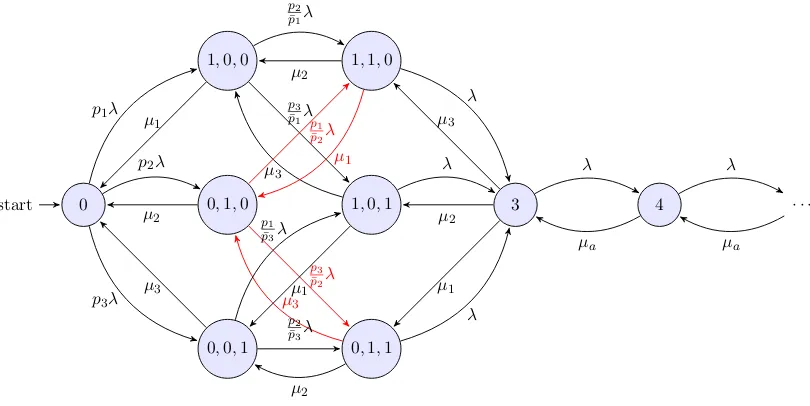
Let us consider the three heterogeneous servers case with Poisson arrivals and exponential
2.3. FCFSqueues with heterogeneous servers 21
1,0,0
0,1,0
0,0,1 0
start
1,1,0
1,0,1
0,1,1
3 4 · · ·
p1λ µ 1
p2λ
µ2
p3λ
µ3
p2
¯
p1λ
µ2
p3
¯
p1λ
µ3
p1 ¯
p2λ
µ1
p3 ¯
p2λ
µ3
p1
¯
p3λ
µ1
p2
¯
p3λ
µ2 λ µ3 λ µ2 λ µ1 λ µa λ µa
Figure 2.2: State-transition-rate diagram with three heterogeneous servers.
it can be assigned to serveriwith probability pi fori = 1,2,3. A partially idle system in this case involves the six states from state (1,0,0) to state (0,1,1) in the figure. Assuming the busy server as a customer arrives is server 1, then the system is currently in state (1,0,0). At the instant of a customer arrives to state (1,0,0), it can be assigned to server 2 with probability
p2/p¯1 and to server 3 with p2/p¯1 where ¯p1 = p2+ p3. All the state transition rates are shown
in Figure 2.2. Then, by global balance, we have,
λπ0= µ1π1,0,0+µ2π0,1,0+µ3π0,0,1,
(λ+µ1)π1,0,0= p1λπ0+µ2π1,1,0+µ3π1,0,1,
(λ+µ2)π0,1,0= p2λπ0+µ1π1,1,0+µ3π0,1,1,
(λ+µ3)π0,0,1= p3λπ0+µ1π1,0,1+µ2π0,1,1,
(λ+µ1+µ2)π1,1,0=
p2
¯
p1
λπ1,0,0+ p1
¯
p2
λπ0,1,0+µ3π3, (2.12)
(λ+µ1+µ3)π1,0,1=
p1
¯
p3
λπ0,0,1+ p3
¯
p1
λπ1,0,0+µ2π3,
(λ+µ2+µ3)π0,1,1=
p2
¯
p3
λπ0,0,1+ p3
¯
p2
λπ0,1,0+µ1π3,
Mokaddis and Matta used Gauss-Jordan elimination method with 52 defined variables to
solve the probabilities. The interested readers are directed to Mokaddis and Matta [22] for
details. (However, we notice some errors may exist in their derivation.) The explicit expression
for the stationary probability for each state has been solved with at most three heterogeneous
servers in the queues under different dispatch policies, except for the RCS case considered
above, in which an explicit solution is available for any number of servers.
In 2004, Grassmann and Zhao [11] studied a GI/Mi/c queue with heterogeneous servers and general input, where equilibrium equations for the steady state probabilities were
con-structed, both at random-times and at the times preceding an arrival. They first determined the
probabilities for all states in which there is no queue, and then calculated the probabilities in
which customers are waiting. Three types of computational issues were addressed in their
pa-per, namely the algorithm used to implement their formulas, the performance of the algorithm,
and the accuracy of the results. Various algorithms were compared, however, they found that
the correspondence between the results calculated by different methods was surprisingly high,
normally, because of rounding errors. They stated that their algorithm run into performance
problems as the number of servers increases. More specifically, the computational effort would
increase by a factor of 8 if the number of servers increases by 1, which implies that even a
large increase in computer speed would have only a marginal impact on the maximum size of
the problem that can realistically be solved (e.g. less than 20 servers). In their paper, they
performed the calculations for the systems with less than 10 servers. Some further discussion
on the computational issues in Grassmann and Zhao [11] has been presented in Chapter 3.
2.4
Conservation laws
Conservation laws for the single-server queuing systems have been studied in the past
2.4. Conservation laws 23
development by introducing the “virtual load” concept.
In summary, the conservation laws state that in single-server work-conserving queues, the
queuing discipline can only change the order of customers’s services, so that the total amount
of work in the system is unaffected. Thus, the sum of mean waiting times for different classes
of customers weighted by their respective occupancies is always a constant. Any attempt to
improve the service for some class must inevitably come at the expense of some other class. In
this section, we will review some important conservation laws.
2.4.1
The
M/G/
1
conservation law
Kleinrock [20, page 114] proved that for any M/G/1 system and any non-preemptive work-conserving queuing discipline it must be that
K
X
k=1
ρkmk =
W0/(1−ρ)−W0 =ρW0/(1−ρ), ρ <1;
∞, ρ≥1;
(2.13)
whereρk =λk/µkandρ=PkK=1ρk. W0, which represents the residual life of the customer found
in service upon an arrival’s entry, is given by
W0 =
K
X
k=1
λkx2k
2 (2.14)
where x2
k is the second moment of service time for a customer from classk. In other words, the conservation law states that the weighted sum of the average waiting times mk for k = 1,2, . . . ,K can never change no matter how sophisticated or elaborate the queuing discipline may be.
2.4.2
The
G/G/
1
conservation law
The conservation law was extended (Schrage [25]) to theG/G/1 queues, where both the Pois-son arrival assumption and the independence assumption were dropped. Kleinrock [20, page
law: Given a specific work-conservingG/G/1 queuing system with a non-preemptive priority queuing discipline, then the linear equality constraint
K
X
k=1
ρkmk =U¯ −W0 (2.15)
must be satisfied regardless of the queuing discipline, where ¯U is the limiting average of the unfinished work [20, page 114]. In the M/G/1 case, ¯UequalsW0/(1−ρ) as shown in equation
(2.13).
2.4.3
A general conservation law
Gelenbe and Mitrani [10, page 174] introduced a stochastic process, named “virtual load”.
For a particular queuing disciplineS, the virtual load at timet,VS(t), was defined as the total amount of work in the system at timet, i.e., the sum of the remaining required service times for all jobs, including both the unfinished work and the residual service time, that are in the system
at timet. They assumed the existence of the equilibrium distribution forVS(t) and denoted its steady-state average byVS:
VS = lim
t→∞E[VS(t)]. (2.16)
They obtained the general conservation law in Theorem 6.1 [10, page 174]:
For any single-server queuing system in equilibrium there exists a constantV, determined only by the parameters of the arrival and required service times processes, such that
VS = V (2.17)
for all work-conserving queuing disciplinesS.
By Theorem 6.1, with the condition that “only information about the current state and the
past of the queuing process is used in making scheduling decisions”, they restated the M/G/1 conservation law in Kleinrock [20].
Theorem 6.2 [10, page 176] stated that when the required service times are distributed
2.5. ThePoisson mapping theorem 25
and by the parametersµ, such that
K
X
k=1
ρkmk =V, (2.18)
for all work-conserving queuing disciplines. Thus, by equation (2.13), the constant V =
ρW0/(1−ρ) forρ <1.
2.4.4
Modified
GI/G/
1
conservation law
With the references of Kleinrock [20] and Schrage [25], Theorem 6.3 in Gelenbe and Mitrani
[10, page 177] presented theGI/G/1 conservation law:
For any multi-class GI/G/1 queuing system in the steady-state, there exists a constant V
determined only by the inter-arrival and service time distributions, such that
K
X
k=1
ρkmk =V + K
X
k=1
ρk
1 µk
−γk
(2.19)
for all non-preemptive work-conserving queuing disciplines, where γk = µkxk2/2, for k = 1,2, . . . ,K, is the average residual life of the class-kservice time.
2.5
The Poisson mapping theorem
Kingman [15, page 17] introduced a great property of Poisson processes: in summary, if the
state space is mapped into another space, the transformed random points again from a Poisson
process.
He defined Π to be a Poisson process on the state space S, having mean measure µ, and
f as a function from S into another (or the same) spaceT. They assumed thatT, likeS, is a measure space satisfying three conditions: 1) the empty set is measurable, 2) the complement of
a measurable set is measurable, 3) the union of countably many measurable sets is measurable.
They also assumed that f is measurable in the sense that
is a measurable subset ofS for every measurableB⊆T.
The points f(x) for x∈Πform a random countable set f(Π)⊆T. The number
N∗(B)=#{f(Π)∩B} (2.21) of points of f(Π) in B, so long as the points f(x) (x∈Π) are distinct, and
N∗(B)=#{x∈Π;f(x)∈B}=N(f−1(B)) (2.22) which has distributionP(µ∗), where
µ∗= µ∗
(B)= µ(f−1(B)). (2.23) Moreover, if B1,B2, . . . ,Bk are disjoint, so are their inverse images, so that the N∗(Bj) are independent.
Finally, he proved the Poisson mapping theorem in Kingman [15, Mapping Theorem],
which was stated as “LetΠ be a Poisson process with σ-finite mean measure µ on the state space S, and let f : S → T be a measurable function such that the induced measure has no atoms. Then f(Π) is a Poisson process on T having the induced measure µ∗ as its mean
measure.” This property has profound implications, which has been applied in various journals
(e.g. del Barrioet al. [4], Eliazaret al. [6], Holroydet al. [14]). We will refer to this theorem in Chapter 4.
2.6
Gaver-Stehfest numerical inversion of LST
The Gaver-Stehfest (GS) technique for numerical inversion of LST was developed by Gaver [9]
in 1966 in the probabilistic context of order statistics, and modified by Stehfest [30] through
accelerating the convergence to obtain a better performance in 1970. It is becoming more
refined and increasingly more acceptable in different areas because of its simplicity and good