QUANTUM COMPUTATION AND MEASUREMENTS FROM AN EXOTIC SPACE-TIME R4
MICHEL PLANAT†, RAYMOND ASCHHEIM‡, MARCELO M. AMARAL‡AND KLEE IRWIN‡
Abstract. The authors previously found a model of universal quan-tum computation by making use of the coset structure of subgroups of a free group G with relations. A valid subgroup H of index d in G leads to a ‘magic’ state|ψiind-dimensional Hilbert space that encodes a minimal informationally complete quantum measurement (or MIC), possibly carrying a finite ‘contextual’ geometry. In the present work, we chooseG as the fundamental group π1(V) of an exotic 4-manifold V, more precisely a ‘small exotic’ (space-time) R4 (that is
homeomor-phic and isometric, but not diffeomorhomeomor-phic to the Euclidean R4). Our
selected example, due to to S. Akbulut and R. E. Gompf, has two re-markable properties: (a) it shows the occurence of standard contextual geometries such as the Fano plane (at index 7), Mermin’s pentagram (at index 10), the two-qubit commutation picture GQ(2,2) (at index 15) as well as the combinatorial Grassmannian Gr(2,8) (at index 28) , (b) it allows the interpretation of MICs measurements as arising from such exotic (space-time) R4’s. Our new picture relating a topological
quantum computing and exotic space-time is also intended to become an approach of ‘quantum gravity’.
PACS: 03.65.Fd, 03.67.Lx, 03.65.Aa, 03.65.Ta, 02.20.-a, 02.10.Kn, 02.40.Pc, 02.40.-k, 03.65.Wj
MSC codes: 81P68, 57R65, 57M05, 32Q55, 57M25, 14H30
Keywords: Topological quantum computing, 4-manifolds, Akbulut cork, exotic R4,
fundamental group, finite geometry, Cayley-Dickson algebras
1. Introduction
Concepts in quantum computing and the mathematics of 3-manifolds could be combined in our previous papers. In the present work, 4-manifolds are our playground and the four dimensions are interpreted as a space-time. This offers a preliminary connection to the field called ‘quantum gravity’ with unconventional methods. In four dimensions, the topological and the smooth structure of a manifold are apart. There exist infinitely many 4-manifolds that are homeomorphic but non diffeomorphic to each other [1]-[4]. They can be seen as distinct copies of space-time not identifiable to the ordinary Euclidean space-time.
A cornerstone of our approach is an ‘exotic’ 4-manifold called an Akbulut cork W that is contractible, compact and smooth, but not diffeomorphic to the ball [4]. In our approach, we do not need the full toolkit of 4-manifolds since we are focusing on W and its neighboors only. All what we need is to understand the handlebody decomposition of a 4-manifold, the fundamental group π1(∂W) of the 3-dimensional boundary ∂W of W, and related fundamental groups. Following the methodology of our previous work, the subgroup structure of such π1’s corresponds to the Hilbert spaces
1
of interest. One gets a many-manifold view of space-time -reminiscent of the worlds- where the manifolds can be considered as many-quantum generalized measurements, the latter being POVM’s (positive op-erator valued measures).
In quantum information theory, the two-qubit configuration and its prop-erties: quantum entanglement and quantum contextuality have been dis-cussed at length as prototypes of peculiarities or resources in the quantum world. We are fortunate that the finite geometrical structures sustaining two-qubit commutation, the projective plane or Fano plane P G(2,2) over the two-element field F2, the generalized quadrangle of order two GQ(2,2), its embedding 3-dimensional projective spaceP G(3,2), and other structures relevant to quantum contextuality, are ingredients in our quantum comput-ing model based on an Akbulut cork. Even more appealcomput-ing, is the recovery of the Grassmannian configuration Gr(2,8) on 28 vertices and 56 lines that connects to Cayley-Dickson algebras up to level 8.
Our description will be as follows.
In Sec. 2, one sums up the peculiarities of small exotic 4-manifolds of type R4. This includes the handlebody structure of an arbitrary 4-manifold in Sec. 2.1, the concept of an Akbulut cork in Sec. 2.2 and examples of small exotic 4-manifolds that are homeomorphic but not diffeomorphic to the Euclidean space R4 in Sec. 2.3.
In Sec. 3, one first gives an account of the model of quantum compu-tation developed by the authors in their previous papers. The connection to a manifold M is through the fundamental group π1(M). The subgroup structure of π1(M) is explored whenM is the boundary ∂W of an Akbulut cork (in Sec. 3.1), the manifold ¯W in Akbulut h-cobordism (in Sec. 3.2) and the middle level Q between diffeomorphic connnected sums involving the exotic R4’s (in Sec. 3.3).
Sec. 4 is a discussion of the obtained results and their potential interest for connecting quantum information and the structure of space-time.
Calculations in this paper are performed on the softwares Magma [5] and SnapPy [6].
2. Excerpts on the theory of 4-manifolds and exotic R4’s
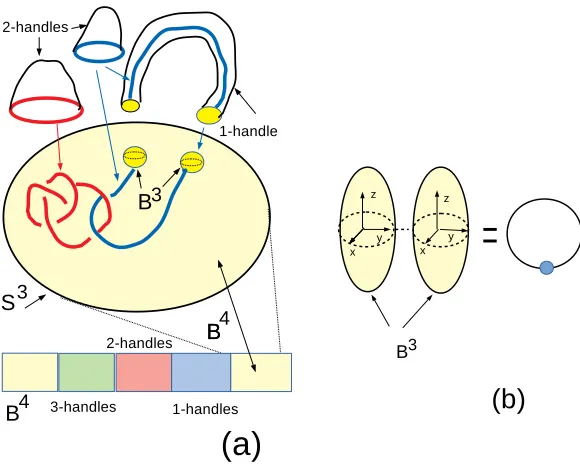
Figure 1. (a) Handlebody of a 4-manifold with the struc-ture of 1- and 2-handles over the 0-handleB4 , (b) the struc-ture of a 1-handle as a dotted circle S1×B3.
as shown in Fig. 1b. For the attaching region of a 2- and a 3-handle one needs to enrich our knowledge by introducing the concept of an Akbulut cork to be described later on. The surgering of a 2-handle to a 1-handle is illustrated in Fig. 2a (see also [2, Fig. 5.33]). The 0-framed 2-handle (left) and the ‘dotted’ 1-handle (right) are diffeomorphic at their boundary ∂. The boundary of a 2- and a 3-handle is intimately related to the Akbulut cork shown in Fig 2b as described at the subsection 2.3.
2.2. Akbulut cork. A Mazur manifold is a contractible, compact, smooth 4-manifold (with boundary) not diffeomorphic to the standard 4-ballB4 [1]. Its boundary is a homology 3-sphere. If one restricts to Mazur manifolds that have a handle decomposition into a single 0-handle, a single 1-handle and a single 2-handle then the manifold has to be of the form of the dotted circle S1×B3 (as in Fig. 2a) (right) union a 2-handle.
Recall that, given p, q, r (with p ≤ q ≤ r), the Brieskorn 3-manifold Σ(p, q, r) is the intersection in the complex 3-spaceC3 of the 5-dimensional sphereS5 with the surface of equationz1p+z2q+z3r= 0. The smallest known Mazur manifold is the Akbulut cork W [4, 7] pictured in Fig 2b and its boundary is the Brieskorn homology sphere Σ(2,5,7).
Figure 2. (a) A 0-framed 2-handle S2 ×B2 (left) and a dotted 1-handle S1 ×B3 (right) are diffeomorphic at their boundary ∂ =S2×S1 , (b) Two equivalent pictures of the Akbulut cork W.
2.3. Exotic manifold R4. An exoticR4 is a differentiable manifold that is homeomorphic but not diffeomorphic to the Euclidean space R4. An exotic R4 is called small if it can be smoothly embedded as an open subset of the standard R4 and is called large otherwise. Here we are concerned with an example of a small exotic R4. Let us quote Theorem 1 of [4].
There is a smooth contractible 4-manifoldV with∂V =∂W, such thatV is homeomorphic but not diffeomorphic to W relative to the boundary.
Sketch of proof [4]:
Letα be a loop in∂W as in Fig. 3a. α is not slice inW (does not bound an imbedded smooth B2 in W) but φ(α) is slice. Then φdoes not extend to a self-diffeomorphism φ:W →W.
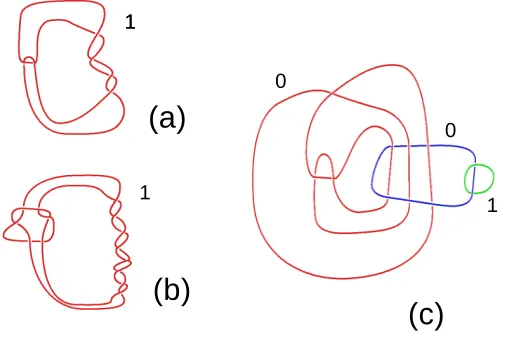
Figure 3. (a) The loop α is not slice on the Akbulut cork, (b) the non-trivial h-cobordism between small exotic mani-folds V andW, (c) the mediating 4-manifold ¯W.
between M and N is called an h-cobordism if W0 is homotopically like the trivial cobordism. The h-cobordism due to S. Smale in 1960, states that if Mm and Nm are compact simply-connected orientedM-manifolds that are h-cobordant through the simply-connected (m+ 1)-manifold W0m+1, then M and N are diffeomorphic [3, p. 29]. But this theorem fails in dimension 4. IfM and N are cobordant 4-manifolds, thenN can be obtained fromM by cutting out a compact contractible submanifold W and gluing it back in by using an involution of ∂W. The 4-manifold W is a ‘fake’ version of the 4-ball B4 called an Akbulut cork [3, Fig. 2.23].
The h-cobordism under question in our example may be described by at-taching an algebraic cancelling pair of 2- and 3-handles to the interior of Ak-bulut corkW as pictured in Fig. 3b (see [4, p. 343]). The 4-manifold ¯W me-diatingV and W is as shown in Fig. 3c [alias the 0-surgeryL7a6(0,1)(0,1)] (see [4, p. 355]).
Following [7], the result is relative since V itself is diffeomorphic to W but such a diffeomorphism cannot extend to the identity map ∂V → ∂W on the boundary. In [7], two exotic manifolds Q1 and Q2 are built that are homeomorphic but not diffeomorphic to each other in their interior.
between two manifolds) and Q is called the middle level between such con-nected sums. This is shown in Fig. 4 for the two R4 manifoldsQ1 and Q2 [7],[9, Fig. 2].
Figure 4. Exotic R4 manifolds Q1 shown in (a) and Q2
shown in (b). The connected sumsQ1#S2×S2andQ2#S2× S2 are diffeomorphic with middle level Qshown in (c).
3. Finite geometry of small exotic R4’s and quantum computing
From now, we focus on the relationship between the aforementioned small exotic R4’s and a model of quantum computing and (generalized) quantum measurements based on the so-called magic states [10]-[13]. This connection is established by computing the finite index subgroup structure of the fun-damental group for the boundary ∂W of Akbulut cork W, for ¯W in Fig. 3 and for Q in Fig. 4 and by making use of earlier results of the authors.
Our model of quantum computing is based on the concept of a magic state - a state that has to be added to the eigenstates of thed-dimensional Pauli group- in order to allow universal quantum computation. This was started by Bravyi & Kitaev in 2005 [14] for qubits (d= 2). A subset of magic states consists of states associated to minimal informationally complete measure-ments, that we called MIC states [10], see the appendix 1 for a definition. We require that magic states should be MIC states as well. For getting the candidate MIC states, one uses the fact that a permutation may be realized as a permutation matrix/gate and that mutually commuting matrices share eigenstates. They are either of the stabilizer type (as elements of the Pauli group) or of the magic type. One keeps magic states that are MIC states in order to preserve a complete information during the computation and mea-surements. The detailed process of quantum computation is not revealed at this stage and will depend on the physical support for the states.
the source of MIC states [11, 12]. Recall thatGis a free group with relations and that a d-dimensional MIC state may be obtained from the permutation group that organizes the cosets of an appropriate subgroup of indexdofG. It was considered by us quite remarkable that two group geometrical axioms very often govern the MIC states of interest [13], viz (i) the normal (or conjugate) closure {g−1hg|g ∈G and h ∈ H} of the appropriate subgroup H of G equals G itself and (ii) there is no geometry (a triple of cosets do not produce equal pairwise stabilizer subgroups). See [13, Sec. 1.1] for our method of building a finite geometry from coset classes and Appendix 2 for the special case of the Fano plane. But these rules had to be modified by allowing either the simultaneous falsification of (i) and (ii) or by tolerating a few exceptions. The latter item means a case of geometric contextuality, the parallel to quantum contextuality [15].
In the present paper, we choose Gas the fundamental group π1(M4) of a 4-manifold M4 that is the boundary ∂W of Akbulut corkW, or governs the Akbulut h-cobordism. More precisely, one takes the manifold M4 as ¯W in Fig. 3 and Q in Fig. 4. Manifolds Q1 and Q2 are the small exotic R4’s of Ref. [7, Fig. 1 and 2]. There are homeomorphic but not diffeomorphic to each other in their interiors. This choice has two important consequences.
First of all, one observes that axiom (i) is always satisfied and that (ii) most often is true or geometric contextuality occurs with corresponding finite geometries of great interest such as the Fano plane P G(2,2) (at index 7), the Mermin’s pentagram (at index 10), the finite projective space P G(3,2) or its subgeometry GQ(2,2) -known to control 2-qubit commutation- [13, Fig. 1] (at index 15), the Grassmannian Gr(2,8) -containing Cayley-Dickson algebras- (at index 28 ) and a few maximally multipartite graphs.
Second, this new frame provides a physical interpretation of quantum computation and measurements as follows. Let us imagine that R4 is our familiar space-time. Thus the ‘fake’ 4-ballW -the Akbulut cork- allows the existence of smoothly embedded open subsets of space-time -the exotic R4 manifolds such asQ1 andQ2- that we interpret in this model as 4-manifolds associated to quantum measurements.
3.1. The boundary ∂W of Akbulut cork. As announced earlier ∂W = K(1,1)≡Σ(2,5,7) is aBrieskorn spherewith fundamental group
π1(Σ(2,5,7)) =
a, b|aBab2aBab3, a4bAb
, where A=a−1, B=b−1. The cardinality structure of subgroups of this fundamental group is found to be the sequence
ηd[π1(Σ(2,5,7))] = [0,0,0,0,0, 0,2,1,0,3, 0,0,0,12,145, 178,47,0,0,4,· · ·]. All the subgroups H of the above list satisfy axiom (i).
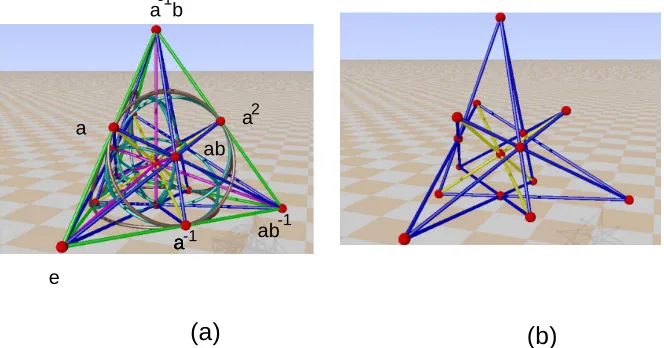
Figure 5. (a) A picture of the smallest finite projective space P G(3,2). It is found at Frans Marcelis website [16]. The coset coordinates shown on the Fano plane with red bul-lets ofP G(3,2) correspond the case of Table 2. (b) A picture of the generalized quadrangle of order two GQ(2,2) embed-ded in P G(3,2). It may also be found at Frans Marcelis website.
Apart from these exceptions, the permutation group organizing the cosets is an alternating group Ad. The coset graph is the complete graph Kd on d vertices. One cannot find a triple of cosets with strictly equal pairwise stabilizer subgroups of Ad (no geometry), thus (ii) is satisfied.
At index 15, when (ii) is not satisfied, the permutation group organizing the cosets is isomorphic to A7. The stabilized geometry is the finite projec-tive spaceP G(3,2) (with 15 points, 15 planes and 35 lines) as illustrated in Fig. 5a 1. The geometry is contextual in the sense that all lines not going through the identity element do not show mutually commuting cosets.
At index 28, when (ii) is not satisfied, there are two cases. In the first case, the group P is of order 28 8! and the geometry is the multipartite graph K4(7). In the second case, the permutation group is P = A8 and the geometry is the configuration [286,563] on 28 points and 56 lines of size 3. In [18], it was shown that the geometry in question corresponds to the combinatorial Grassmannian of type Gr(2,8), alias the configuration obtained from the points off the hyperbolic quadricQ+(5,2) in the complex projective space P G(5,2). Interestingly, Gr(2,8) can be nested by gradual removal of a so-called ‘Conwell heptad’ and be identified to the tail of the sequence of Cayley-Dickson algebras [18, 22, Table 4].
With the Freudenthal–Tits magic square, there exists a connection of such a symmetry to octooctonions and the Lie group E8 [19, 20] that may be useful for particle physics. Further, a Cayley-Dickson sequence is proposed to connect quantum information and quantum gravity in [21].
The [286,563] configuration. Below are given some hints about the con-figuration that is stabilized at the index 28 subgroup H of the fundamental group π1(∂W) whose permutation group P organizing the cosets is isomor-phic to A8. Recall that ∂W is the boundary of Akbulut cork W. The 28-letter permutation group P has two generators as follows
P =h28|g1, g2i with g1 = (2,4,8,6,3)(5,10,15,13,9)(11,12,18,25,17) (14,20,19,24,21)(16,22,26,28,23), g2 = (1,2,5,11,6,7,3)(4,8,12,19,22,14,9)
(10,16,24,27,21,26,17)(13,20,18,25,28,23,15).
Using the method described in Appendix 2, one derives the configuration [286,563] on 28 points and 56 lines. As shown in [Table 4][18], the configu-ration is isomorphic to the combinatorial Grassmannian Gr(2,8) and nested by a sequence of binomial configurations isomorphic to Gr(2, i), i ≤8, as-sociated with Cayley-Dickson algebras. This statement is checked by listing the 56 lines on the 28 points of the configuration as follows
{1,7,27},→Gr(2,3)
{1,15,23},{15,17,27},{7,17,23},→Gr(2,4)
{1,5,26},{5,18,27},{5,15,24},{23,24,26},{17,18,24},{7,18,26},→Gr(2,5)
{12,14,17},{1,9,22},{5,8,9},{9,14,15},{7,12,22},{8,12,18},
{8,14,24},{8,22,26},{14,22,23},{9,12,27},→Gr(2,6)
{3,10,15},{3,6,24},{3,17,25},{3,23,28},{1,10,28},{3,14,19},{7,25,28},{6,8,19},
{19,22,28},{5,6,10},{12,19,25},{10,25,27},{9,10,19},{6,18,25},{6,26,28},→Gr(2,7)
{4,11,12},{11,21,25},{6,20,21},{2,3,21},{2,4,14},{7,11,16},{2,16,23},{1,13,16},
{2,11,17},{4,19,21},{16,20,26},{2,13,15},{11,13,27},{16,21,28},{2,20,24},
{5,13,20},{11,18,20},{4,9,13},{4,8,20},{4,16,22},{10,13,21} →Gr(2,8).
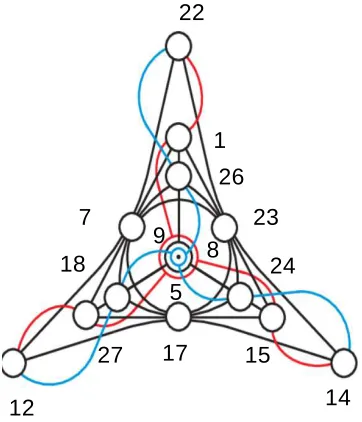
Figure 6. The Cayley-Salmon configuration built around the Desargues configuration (itself built around the Pasch configuration) as in [22, Fig. 12].
Not surprisingly, geometric contextuality (in the coset coordinatization not given here) is a common feature of all lines except for the ones going through the identity element.
3.2. The manifold W¯ mediating the Akbulut cobordism between exotic manifolds V and W. The fundamental group π1( ¯W) of the h-cobordism ¯W is as follows
π1( ¯W) =
a, b|a3b2AB3Ab2,(ab)2aB2Ab2AB2 .
The cardinality structure of subgroups of this fundamental group is
ηd[π1( ¯W)] = [0,0,0,0,1, 1,2,0,0,1, 0,5,4,9,7, 1· · ·]
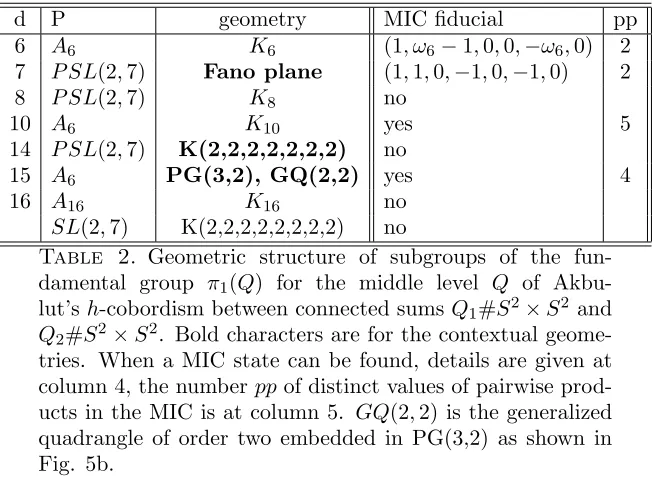
As for the previous subsection, all the subgroups H of the above list satisfy the axiom (i). When axiom (ii) is not satisfied, the geometry is contextual. All the cases are listed in Table 1. Column 4 and 5 give details about the existence of a MIC at the corresponding dimension when this can be checked, i.e. is the cardinality of P is low enough.
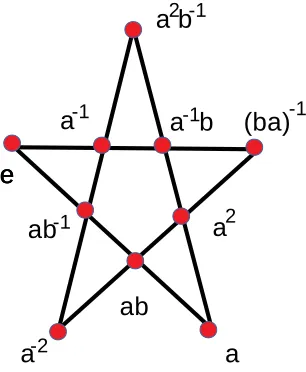
Figure 7. Mermin pentagram as the contextual geometry occuring for the index 10 subgroup in the fundamental group π1( ¯W) of the h-cobordism ¯W between exotic manifolds V and W.
3.3. The middle levelQbetween the diffeomorphic connected sums.
The fundamental group for the middle level Q between diffeomorphic con-nected sums Q1#S2×S2 andQ2#S2×S2 is as follows
π1(Q) =a, b|a2bA2ba2BAB, a2BA3Ba2b3.
The cardinality structure of subgroups of this fundamental group is
ηd[π1(Q)] = [0,0,0,0,0, 2,2,1,0,1, 0,0,0,2,2, 3· · ·]
d P geometry MIC fiducial pp
5 A5 K5 (0,1,−1,−1,1) 1
6 A6 K6 (1, ω6−1,0,0,−ω6,0) 2
7 A7 K7
10 A5 Mermin pentagram no
12 A12 K12
A5 K(2,2,2,2,2,2) no
13 A13 K13
14 G1092,A14 K14 26⋊A5 K(2,2,2,2,2,2,2)
15 A15 K15
A5 K(3,3,3,3,3) yes 3
A7 PG(3,2)
16 A16 K16
Table 1. Geometric structure of subgroups of the
funda-mental group π1( ¯W) for the h-cobordism ¯W between exotic manifolds V and W. Bold characters are for the contextual geometries. G1092 is the simple group of order 1092. When a MIC state can be found, details are given at column 4, the numberppof distinct values of pairwise products in the MIC is at column 5.
d P geometry MIC fiducial pp
6 A6 K6 (1, ω6−1,0,0,−ω6,0) 2 7 P SL(2,7) Fano plane (1,1,0,−1,0,−1,0) 2
8 P SL(2,7) K8 no
10 A6 K10 yes 5
14 P SL(2,7) K(2,2,2,2,2,2,2) no
15 A6 PG(3,2), GQ(2,2) yes 4
16 A16 K16 no
SL(2,7) K(2,2,2,2,2,2,2,2) no
Table 2. Geometric structure of subgroups of the
fun-damental group π1(Q) for the middle level Q of Akbu-lut’s h-cobordism between connected sumsQ1#S2×S2 and Q2#S2×S2. Bold characters are for the contextual geome-tries. When a MIC state can be found, details are given at column 4, the number ppof distinct values of pairwise prod-ucts in the MIC is at column 5. GQ(2,2) is the generalized quadrangle of order two embedded in PG(3,2) as shown in Fig. 5b.
4. Conclusion
As recalled in Sec. 2.3, the h-cobordism theorem in four dimensions is true topologically - there is an homotopy equivalence of the inclusion maps of 4-dimensional manifolds M and N into the 5dimensional cobordism -but is false piecewise linearly and smoothly - a piecewise linear structure or atlas cannot be smoothed in an unique way. These statements had to await topologists Michael Friedmann and Simon Donaldson in twentieth century to be rigorously established [1]-[3]. Handle decomposition in a way described in Sec. 2, handle trading, handle cancellation and handle sliding are the main techniques for establishing the failure of the 4-dimensional h-cobordism theorem and the possible existence of infinitely many (exotic)R4 manifolds that are homeomorphic but not diffeomorphic to the Euclidean R4. It has been emphasized that the non-trivial h-cobordism between exotic R4 manifolds may occur through a ‘pasting’ ingredient called an Akbulut cork W whose 3-dimensional boundary ∂W is described explicitely as the Brieskorn sphere Σ(2,5,7).
We did use of the fundamental groupπ1(∂W) as a witness of symmetries encoded into the 4-manifolds under investigation. Interpreting R4 as the ordinary time, the symmetries have potential applications to space-time physics (e.g. cosmology) and quantum mechanics (e.g. particle physics and quantum computation). In the past, the Brieskorn sphere Σ(2,3,5), alias the Poincar´e dodecahedral space, was proposed as the ‘shape’ of space because such a 3-manifold -the boundary of the 4-manifold E8- explains some anomalies in the cosmic microwave background [23],[24]. It would be interesting to use Σ(2,5,7) as an alternative model in the line of work performed in [25],[26] and related work.
We found in Sec. 3 subgroups of index 15 and 28 of π1(∂W) connect-ing to the 3-dimensional projective space P G(3,2) and to the Grassman-nian Gr(2,8), respectively. The former finite geometry has relevance to the two-qubit model of quantum computing and the latter geometry connect to Cayley-Dickson algebras already used for particle physics. In our previ-ous work, we found that MICs (minimal informationally complete POVMs) built from finite index subgroups of the fundamental group π1(M3) of a 3-manifold M3 serve as models of universal quantum computing (UQC). A MIC-UQC model based on a finite index subgroup of the fundamental group π1(M4) of an exoticM4 has interest for interpreting (generalized) quantum measurements as corresponding to the non-diffeomorphic branches (to the exotic copies) ofM4 or its submanifolds.
To conclude, we are confident that an exotic 4-manifold approach of the-oretical physics allows to establish bridges between space-time physics and quantum physics as an alternative or as a complement to string theory and loop quantum gravity.
Data accessibility. The codes were written on softwares Snappy and Magma. Part of the calculation is detailed in Sect. 3.1 and Appendix 2.
Authors’ contributions. All authors contributed significantly to the con-ceptualization and methodology of the paper. M. P. wrote the paper and coauthors R. A., M. A. and K. I. gave final corrections and approval for publication.
Funding. Funding was obtained from Quantum Gravity Research in Los Angeles, CA.
Appendix 1
A POVM is a collection of positive semi-definite operators{E1, . . . , Em} that sum to the identity. In the measurement of a state ρ, the i-th outcome is obtained with a probability given by the Born rule p(i) = tr(ρEi). For a minimal and informationally complete POVM (or MIC), one needs d2 one-dimensional projectors Πi =|ψii hψi|, with Πi =dEi, such that the rank of the Gram matrix with elements tr(ΠiΠj), is precisely d2.
A SIC (a symmetric informationally complete POVM) obeys the remark-able relation
|hψi|ψji|2 = tr(ΠiΠj) =
dδij + 1 d+ 1 , that allows the recovery of the density matrix as
ρ= d2 X
i=1
(d+ 1)p(i)−1 d
Πi.
This type of quantum tomography is often known as quantum-Bayesian, where the p(i)’s represent agent’s Bayesian degrees of belief, because the measurement depends on the filtering of ρ by the selected SIC (for an un-known classical signal, this looks similar to the frequency spectrum) [27].
In [10], new MICs are derived with Hermitian angles |hψi|ψji|i6=j ∈A = {a1, . . . , al}, a discrete set of values of small cardinality l. A SIC is equian-gular with |A|= 1 anda1 = √d1+1.
Appendix 2
Let us summarize how a finite geometry is build from coset classes [13, 15]. Let H be a subgroup of index d of a free group G with generators and relations. A coset table over the subgroupH is built by means of a Coxeter-Todd algorithm. Given the coset table, on builds a permutation group P that is the image ofG given by its action on the cosets ofH.
First one asks that the d-letter group P acts faithfully and transitively on the set Ω ={1,2,· · ·, d}. The action ofP on a pair of distinct elements of Ω is defined as (α, β)p = (αp, βp),p∈P,α6=β. The number of orbits on the product set Ω×Ω is called the rank r of P on Ω. Such a rank of P is at least two, and it also known that two-transitive groups may be identified to rank two permutation groups.
Figure 8. The Fano plane as the geometry of the subgroup of index 7 of fundamental group π1( ¯W) for the manifold ¯W mediating the Akbulut cobordism be-tween exotic manifold V and W. The cosets of π1 are organized through the permutation group P = h7|(1,2,4,5,6,7,3),(2,5,6)(3,7,4)i. The cosets are labelled as [1, . . . ,7] =
e, a, a−1, a2, ab, ab−1, a−1b
. The two-point stabilizer subgroups of P for each line are distinct (act-ing on different subsets) but isomorphic to each other and to the Klein group Z2 × Z2. They are as follows s1 = h(2,7)(4,5),(2,4)(5,7)i, s2 = h(1,6)(5,7),(1,7)(5,6)i, s3 = h(1,5)(2,3),(1,2)(3,5)i, s4 = h(3,5)(4,6),(3,6)(4,5)i, s5 = h(2,6)(3,7),(2,7)(3,6)i, s6 = h(1,7)(3,4),(1,4)(3,7)i, s7 = h(1,2)(4,6),(1,6)(2,4)i.
References
[1] S. Akbulut, 4-manifolds, Oxford Graduate Texts in Mathematics, Vol. 25 (Oxford University Press, 2016).
[2] R. E. Gompf and A. I. Stipsicz, 4-manifolds and Kirby calculus, Graduate Studies in Mathematics, Vol. 20 (American Mathematical Society, Providence, Rhode Island, 1999).
[3] A. Scorpian,The wild world of4-manifolds(American Mathematical Society, Provi-dence, Rhode Island, 2011).
[4] S. Akbulut, A fake compact contractible 4-manifold, J. Diff. Geom. 33 335-356 (1991).
[5] W. Bosma, J. J. Cannon, C. Fieker, A. Steel (eds), Handbook of Magma functions, Edition 2.23 (2017), 5914pp (accessed on 1 January 2019).
[6] M. Culler, N. M. Dunfield, M. Goerner, and J. R. Weeks, SnapPy, a computer program for studying the geometry and topology of 3-manifolds, http://snappy.computop.org (accessed on 1 January 2019).
[7] S. Akbulut, An exotic 4-manifold,J. Diff. Geom.33357-361 (1991).
[8] S. Akbulut and S. Durusoy, An involution acting nontrivially on Heegard-Floer ho-mology, inGeometry and topology of manifolds(Fields Inst. Commun., Amer. Math. Soc., Providence, Rhode Island,47, 1–9 ( 2005)).
[9] R. E. Gompf, An exotic menagerie,37199-223 (1993).
[10] M. Planat and Z. Gedik, Magic informationally complete POVMs with permutations, R. Soc. open sci.4170387 (2017).
[11] M. Planat, R. Aschheim, M. M. Amaral and K. Irwin, Universal quantum computing and three-manifolds, Universal quantum computing and three-manifolds Symmetry
10773 (2018).
[12] M. Planat, R. Aschheim, M. M. Amaral and K. Irwin, Quantum computing, Seifert surfaces and singular fibers,Quantum Reports112-22 (2019).
[13] M. Planat, R. Aschheim, M. M. Amaral and K. Irwin, Group geometrical axioms for magic states of quantum computing,Mathematics7 948 (2019).
[14] S. Bravyi and A. Kitaev, Universal quantum computation with ideal Clifford gates and noisy ancillas,Phys. Rev.A71022316 (2005).
[15] M. Planat, Geometry of contextuality from Grothendieck’s coset space,Quantum Inf. Process.142563-2575 (2015).
[16] F. Marcelis, https://fgmarcelis.wordpress.com/pg32/pg32-1/ and https://fgmarcelis.wordpress.com/mermin-cayley-salmon-desargues, accessed on January 1, 2020.
[17] J. P. Marceaux and A. R. Rau, Mapping qubit algebras to combinatorial designs, Quant. Inf. Proc.(2020), 29 pp.
[18] M. Saniga, The complement of binary Klein quadric as a combinatoriam Grassman-nian,Mathematics3481-486 (2015).
[19] J. C. Baez, The Octonions,Bull. Amer. Math. Soc.39145-205 (2002).
[20] J. Koeplinger, Nonassociative quantum theory on octooctonionalgebra, J. Phys. Math.1, Article ID S090501, 14 pages (2009).
[21] R. Aschheim and K. Irwin, Constructing numbers in quantum gravity: infinions, J. Phys. :Conf. Series1194012008 (2019).
[22] M. Saniga, F. Holweck and P. Pracna, From Cayley-Dickson algebras to combinatorial Grassmannians,Mathematics,3, 1192-1221 (2015).
[23] S. Antoniou, L. H. Kauffman and S. Lambropoulou, Topological surgery in cosmic phenomena, Preprint 1812.00837 [math.GT].
[24] J. P. Luminet, J. Weeks, A. Riazuelo, R. Lehoucq and J.-P. Uzan, Dodecahedral space topology as an explanation for weak wide-angle temperature correlations in the cosmic microwave background,Nature,425593-595 (2003).
[25] T. Asselmeyer-Maluga and J. Krol, How to obtain a cosmological constant from small exoticR4,Phys. of Dark Universe1966-77 (2018).
[27] C. A. Fuchs, On the quantumness of a Hibert space, Quant. Inf. Comp. 4467-478
(2004).
†Universit´e de Bourgogne/Franche-Comt´e, Institut FEMTO-ST CNRS UMR 6174, 15 B Avenue des Montboucons, F-25044 Besanc¸on, France.
Email address: [email protected]
‡ Quantum Gravity Research, Los Angeles, CA 90290, USA