Dynamical holographic QCD model
Danning Li1,2,aand Mei Huang1,3,b
1Institute of High Energy Physics, Chinese Academy of Sciences, Beijing 100049, China 2Institute of Theoretical Physics, Chinese Academy of Sciences, Beijing 100190, China
3Theoretical Physics Center for Science Facilities, Chinese Academy of Sciences, Beijing 100049, China
Abstract.We develop a dynamical holographic QCD model, which resembles the renor-malization group from ultraviolet (UV) to infrared (IR). The dynamical holographic model is constructed in the graviton-dilaton-scalar framework with the dilaton back-ground fieldΦand scalar fieldX responsible for the gluodynamics and chiral dynam-ics, respectively. We summarize the results on hadron spectra, QCD phase transition and transport properties including the jet quenching parameter and the shear/bulk viscosity in the framework of the dynamical holographic QCD model.
1 Introduction
Quantum chromodynamics (QCD) in the infrared (IR) regime still remains as an outstanding chal-lenge in the formulation of QCD as a local quantum field theory. In recent decades, the anti-de Sitter/conformal field theory (AdS/CFT) correspondence [1–3] provides a revolutionary method to tackle the problem of strongly coupled gauge theories. The gauge/gravity duality has been widely used in investigating hadron physics, strongly coupled quark gluon plasma and condensed matter. In general, holography maps quantum field theory (QFT) in d-dimensions to quantum gravity in (d+ 1)-dimensions, and the gravitational description becoming classical when the QFT is strongly-coupled. The extra dimension is normally regarded as an energy scale or renormalization group (RG) flow in the QFT [4].
In this talk, we introduce our recently developed dynamical holographic QCD model [5], which resembles the renormalization group from ultraviolet (UV) to infrared (IR). The model is constructed in the graviton-dilaton-scalar framework, the dilaton background fieldΦ(z) is dual to the dimension-4 gluon operator, and the scalar fieldX(z) is dual to the dimension-4 gluon operator at the UV boundary. In the IR region, the dilaton background field and scalar field are responsible for nonperturbative gluodynamics and chiral dynamics, respectively. The metric structure at IR can be automatically deformed by the nonperturbative gluon condensation and chiral condensation in the vacuum. We then summarize our results on hadron spectra, QCD phase transitions, equation of state and transport properties in this model.
ae-mail: [email protected] be-mail: [email protected]
DOI: 10.1051/ C
Owned by the authors, published by EDP Sciences, 2014
/2 0148000011
2 The scalar glueball spectra and meson spectra
We construct the quenched dynamical holographic QCD model for the pure gluon system in the graviton-dilaton framework by introducing a scalar dilaton fieldΦ(z) in the bulk. The 5D graviton-dilaton coupled action in the string frame takes the form of:
SG= 1 16πG5
d5x√gse−2Φ
Rs+4∂MΦ∂MΦ−VGs(Φ), (1)
withG5the 5D Newton constant,gs,ΦandVGs are the 5D metric, the dilaton field and dilaton potential in the string frame, respectively. The metric ansatz is chosen to be
ds2=b2s(z)(dz2+ημνdxμdxν), bs(z)≡eAs(z). (2)
The dilaton field takes the form ofΦ(z)=μ2
Gz2tanh(μ4G2z
2/μ2
G), which is dual to the dimension-4 gauge invariant gluon operator TrG2 at UV Φ(z)z→→0μ4
G2z
4 to meet the requirement of gauge invariance
for gauge/gravity duality, and it has the quadratic form of Φ(z)z→∞→ μ2Gz2 at IR to produce linear confinement [6].
By self-consistently solving the Einstein equations, the metric structure will be automatically deformed at IR by the dilaton background field. The glueball can be excited from the QCD vacuum described by the quenched dynamical holographic model, we can solve the scalar glueball spectra and the result is shown in Fig.1, for details, please refer to [5]. The dots are lattice data taken from [7]. It is a surprising result that if one self-consistently solves the metric background under the dynamical dilaton field, it gives the correct ground state and at the same time gives the correct Regge slope.
1.0 1.5 2.0 2.5 3.0 3.5 4.0 n 5
10 15 20 mn2
Figure 1.The scalar glueball spectra in the quenched dynamical holographic QCD model withμG=1GeV and μG2=1GeV.
We add light flavors in terms of meson fields on the gluodynamical background. The total 5D action for the graviton-dilaton-scalar system takes the form of
S =SG+ Nf
NcSKKS S, (3)
SG=
1 16πG5
d5x√gse−2ΦR+4∂MΦ∂MΦ−VG(Φ), (4)
SKKS S = −
d5x√gse−ΦT r(|DX|2+VX(X+X,Φ)+ 1 4g25(F
2
L+F2R)). (5)
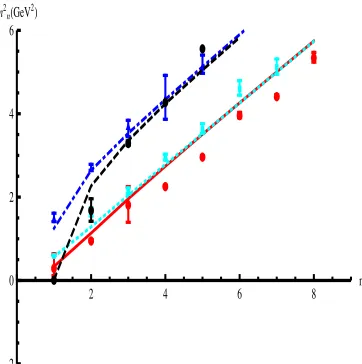
The meson spectra produced from this model is summarized in Fig.2. It is observed that in our graviton-dilaton-scalar system, the generated meson spectra agree well with experimental data.
2 4 6 8 n
2 0 2 4 6 m2 nGeV2
Figure 2.Meson spectra in the dynamical soft-wall model comparing with experimental data. The red and black lines are for scalars and pseudoscalars, the green and blue lines are for vectors and axial-vectors.
3 Phase transition and equations of state
To study the thermodynamics, it’s natural to introduce a black hole in the 5D gravity side and study the black hole thermodynamics. The finite temperature metric ansatz in string frame becomes
ds2S=e2As
−f(z)dt2+dz 2
f(z)+dx idxi
. (6)
Under this metric ansatz, from the Einstein equations we get the following equations of motion:
−As +A
2 s + 2 3Φ −4 3A sΦ
= 0, (7)
f(z)+3As(z)−2Φ(z)
f(z) = 0, (8)
8 3∂z
e3As(z)−2Φf(z)∂ zΦ
−e5As(z)−103Φ∂ΦVE
G = 0, (9)
withVGE=e4Φ/3Vs
G. At the UV region, we require the asymptotic AdS boundary condition and we also requireΦto be finite atz=0,zhwithzhthe black-hole horizon where f(zh)=0. The temperature of the solution would be identified with the Hawking temperature
T = e
−3As(zh)+2Φ(zh)
4π 0zhe−3As(z)+2Φ(z)dz
By taking the dilaton profile ofΦ =μGz2, the metric prefactorAscould be solved analytically as
As(z)=log(L
z)−log(0F1(5/4, μ4
Gz4 9 ))+
2 3μ
2 Gz
2,
(11)
whereLis the AdS radius.
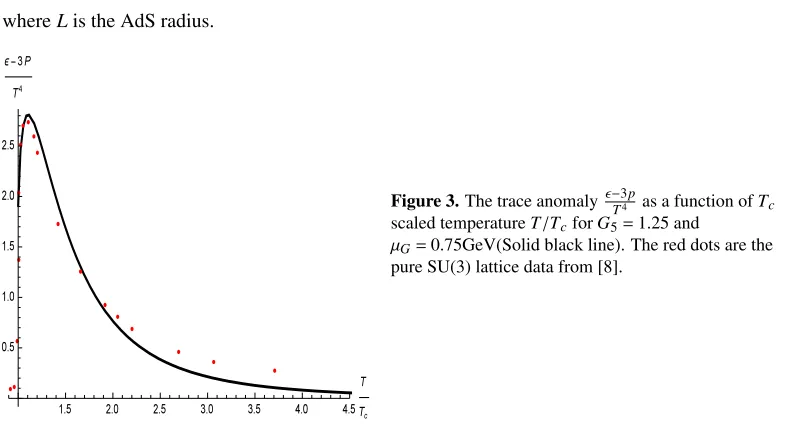
Figure 3.The trace anomaly −T34pas a function ofTc scaled temperatureT/TcforG5=1.25 and
μG=0.75GeV(Solid black line). The red dots are the pure SU(3) lattice data from [8].
The black-hole entropy densityscould be easily read from the Bekenstein-Hawking formula,
s= 1 4G5e
3As(zh)−2Φ(zh), (12)
and the pressure densityp, energy densitycan be solved from the following equations:
dp(T)
dT =s(T), =−p+sT. (13)
We compare the result on trace anomaly−3pwith the pure SU(3) lattice data from [8] in Fig.3. It can be seen that the thermodynamical quantities in the quenched dynamical holographic QCD model can describe the pure gluon system quite well. The nearTcsharp peak in the trace anomaly shows that we have encoded the correct IR physics in the 5D model.
4 Transport coefficients in the dynamical holographic QCD model
4.0.1 Jet quenching parameterqˆ
Jet quenching measures the energy loss rate of an energetic parton going thorough the created hot dense medium. In [9] we have had a detailed study on the temperature dependence behavior of ˆq. Following the method in [10], the jet quenching parameter is related to the adjoint Wilson loop by the following equation
WAd j[C]≈exp(− 1 4√2qLˆ
In gravity side, the Wilson loop is dual to the on-shell value of the string Nambu-Goto action. Choos-ing proper parametrization of strChoos-ing configuration (for details, please see [9]), one can get
ˆ q=
√
2√λ
πz3 h
1 0 dν
e−4As(νzh)
z4
h
1−f(νzh) 2 f(νzh)
. (15)
The numerical results on ˆq/T3as a function of temperature is shown in Fig.4. It is seen that around T=1.1Tc, there’s peak with the height around 40, which is totally different from the pure AdS case.
ΜG0.75 GeV
ΜG0.60 GeV ΜG0.50 GeV
ΜG0.43 GeV
+ + + Pure AdS
1 2 3 4
T
Tc 20
25 30 35 40 q
T3
Figure 4.q/ˆT3as a function of temperatureT
withG5=1.25 andλ=6π.
4.0.2 Shear/bulk viscosity
In the case ofAdS5, the shear viscosity over entropy density is 1/4πan the bulk viscosity is zero for a conformal system. However, it has been observed that the shear viscosity over entropy density ratioη/shas a minimum in the phase transition region in systems of water, helium, nitrogen [11] and the same feature is expected to show up for QCD phase transition, and the lattice QCD shows that the temperature dependence of bulk viscosity over entropy density [12] exhibits a peak around the phase transition. We derive the shear/bulk viscosity in the dynamical holographic QCD model, and the details will be given in [13].
The bulk viscosity can be extracted by using the Kubo formula
ζ=1 9ωlim→0
1
ωImTxx(ω)Txx(0) , (16)
calculation quite complicated. Fortunately, as pointed in [14], one can use the gauge degree of free-dom to eliminatehtzandδΦ, leaving only the diagonal perturbation. Besides, the authors also prove that the imaginal part of the retarded Green functionGRis related to a conserved fluxF(ω) by the following equation
ImGR=F(ω) 4πG5
, (17)
where under the metric ansatz
ds2=e2A(−f dt2+dxidxi)+e 2B
f dz 2
(18)
and coordinate definitionΦ(z)=z, the conserved flux takes the form
F(ω)=e
4A−Bf
4A2 |Imh
∗
xxh
xx|. (19)
More conveniently, the equation of motion forhxx component is simply independent onhzz,htt and takes the following form
hxx=(− 1 3A−4A
+3B−f
f )h
xx+(e
−2A+2B
f2 ω 2+ f
6f Ahxx). (20) These results are quite general within graviton-dilaton system. Therefore, it’s very easy to extract the bulk viscosity in our quenched dynamical holographic QCD model by taking a new fifth coordinate as z=μ2Gz2, which satisfies the requirementΦ(z)=z. Then we can derive the new metric form under the new coordinate
ds2=e2As(−f dt2+dxidxi)+e 2As
f Z2dz
2
. (21)
withZ(z)=μG2z2. Then it’s easy to seee2A=e2As ande2B=e2As
Z2. Solving Eq.(20), one can get the
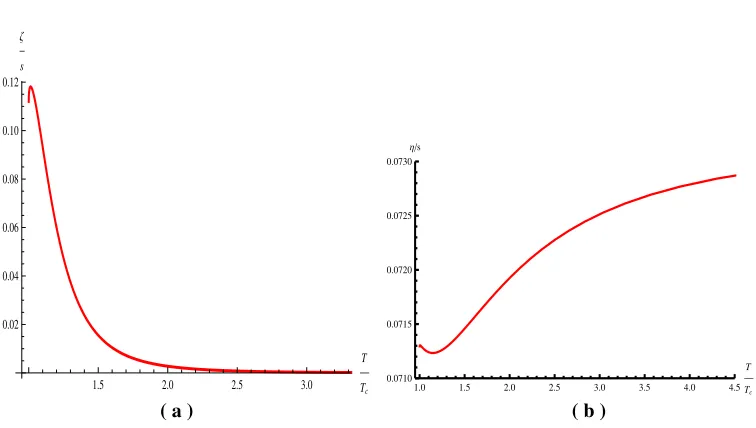
temperature behavior of the bulk viscosity as shown in Fig.5(a) withμG=0.75GeV andG5=1.25. It is found that the bulk viscosity over entropy density shows a sharp peak near the transition temperature, and this feature is in agreement with lattice results in [12].
For shear viscosity, any isotropic Einstein gravity system generates universalη/s=1/4πresult. In order to introduce temperature dependence to shear viscosity, we follow [15] and introduce higher derivative corrections of the following form
S = 1
16πG5
d5x√−gR−4 3∂μΦ∂
μΦ−
V(Φ)+βe√2/3γΦRμνλρRμνλρ.
Here the extra √2/3 factor in the coupling ofRμνλρRμνλρ is to keep our parameterγcomparable to the one in [15]. As mentioned above, to calculate shear viscosity, one has to consider the metric perturbationhxy, and the shear viscosity could be extracted through the Kubo formula
η=lim ω→0
1
ωImTxy(ω)Txy(0) . (22) Up toO(β), the shear viscosity over entropy density ratio results read
η/s= 1 4π
1− β c0e
√
2/3Φh(1−2/3γzhΦ(zh))
, (23)
withc0=−z5h∂z
1.5 2.0 2.5 3.0 T
Tc 0.02
0.04 0.06 0.08 0.10 0.12 Ζ
s
1.0 1.5 2.0 2.5 3.0 3.5 4.0 4.5
T
Tc 0.0710
0.0715 0.0720 0.0725 0.0730 Ηs
( a ) ( b )
Figure 5.Bulk viscosity over entropy density and shear viscosity over entropy density in the quenched dynamical QCD model.
5 Discussion and summary
In this work, we construct a dynamical holographic QCD (hQCD) model in the graviton-dilaton-scalar framework, where the dilaton background field and scalar field are responsible for the gluodynamics and chiral dynamics, respectively. The dynamical holographic model can resemble the renormaliza-tion group from ultraviolet (UV) to infrared (IR). The metric structure at IR will be automatically deformed by the nonperturbative gluon condensation and chiral condensation in the vacuum. The produced scalar glueball spectra in the graviton-dilaton framework and the light-flavor meson spectra generated in the graviton-dilaton-scalar framework agree well with lattice data and experimental data. The equation of state and transport properties are investigated in the dynamical holographic pure gluon system. It is found that the trace anomaly (−3p)/T4, the ratio of the jet quenching parameter over cubic temperature ˆq/T3 and the bulk viscosity over entropy density show a peak around the critical temperature Tc, and the shear viscosity over entropy density shows a valley around phase transition.
In summary, our dynamical holographic QCD model can describe hadron physics, QCD phase transition, thermodynamical properties and transport properties quite successfully.
Acknowledgements
This work is supported by the NSFC under Grant Nos. 11275213, 11261130311(CRC 110 by DFG and NSFC), CAS key project KJCX2-EW-N01, and Youth Innovation Promotion Association of CAS.
References
[2] Gubser S. S., Klebanov I. R. and Polyakov A. M., Phys. Lett. B428, 105 (1998). [3] Witten E., Adv. Theor. Math. Phys.2, 253 (1998).
[4] Adams A., Carr L. D., Schaefer T., Steinberg P. and Thomas J. E., New J. Phys.14, 115009 (2012).
[5] Li D. N., Huang M. and Yan Q. -S. , Eur.Phys.J.C(2013) 73:2615; D. Li and M. Huang, JHEP
1311, 088 (2013).
[6] A. Karch, E. Katz, D. T. Son and M. A. Stephanov, Phys. Rev. D74(2006) 015005.
[7] Meyer H. B., hep-lat/0508002; Lucini B. and Teper M. , JHEP0106(2001) 050; Morningstar C. J. and Peardon M. J., Phys. Rev. D60(1999) 034509; Chen Y., Alexandru A., Dong S. J., Draper T., et al., Phys. Rev. D73(2006) 014516.
[8] G. Boyd, J. Engels, F. Karsch, E. Laermann, C. Legeland, M. Lutgemeier and B. Petersson, Nucl. Phys. B469, 419 (1996).
[9] D. Li, J. Liao and M. Huang, arXiv:1401.2035 [hep-ph].
[10] H. Liu, K. Rajagopal and U. A. Wiedemann, Phys. Rev. Lett. 97, 182301 (2006) [hep-ph/0605178].
[11] L. P. Csernai, J. I. Kapusta and L. D. McLerran, Phys. Rev. Lett.97, 152303 (2006).
[12] D. Kharzeev and K. Tuchin, arXiv:0705.4280 [hep-ph]. F. Karsch, D. Kharzeev and K. Tuchin, Phys. Lett. B663, 217 (2008). H. B. Meyer, Phys. Rev. Lett.100, 162001 (2008).
[13] Danning Li, Song He and Mei Huang, in preparation.
[14] S. S. Gubser, A. Nellore, S. S. Pufu and F. D. Rocha, Phys. Rev. Lett.101 (2008) 131601 [arXiv:0804.1950 [hep-th]].
S. S. Gubser, S. S. Pufu and F. D. Rocha, JHEP0808(2008) 085 [arXiv:0806.0407 [hep-th]]. [15] S. Cremonini, U. Gursoy and P. Szepietowski, JHEP1208(2012) 167 [arXiv:1206.3581