On the processing of JEFF-3.2 neutron data library with AMPX
6.2 for its use with the SCALE tool suite
C.J. Díez1,a, F. Michel-Sendis1, O. Cabellos1, D. Wiarda2, and M.E. Dunn2
1OECD Nuclear Energy Agency (NEA) - Data Bank, 92130, Issy-les-Moulineaux, France
2Oak Ridge National Laboratory, Reactor and Nuclear Systems Division, 37831-6170, Oak Ridge, TN, USA
Abstract. New processing capabilities are under development at the NEA Data Bank (DB) that aim to provide enlarged and enhanced nuclear data services to member coun-tries in the framework of processing, verification and benchmarking of evaluated nuclear data. Within the context of the Joint Evaluated Fission and Fusion Nuclear Data Library Project (JEFF), we undertake to generate, with the latest version of AMPX processing code, a JEFF-3.2 incident-neutron nuclear data application library for the SCALE tool suite. In this paper we describe the requirements, in terms of nuclear data content, for new data to be considered and used in the SCALE tool suite. An overview of how to process and prepare JEFF-3.2 incident-neutron data with AMPX for its application in SCALE neutron transport codes is given. The resulting library is verified and tested at differential and integral level by comparing the performance of JEFF-3.2 in AMPX for-mat with other processing and transport codes.
1 Introduction
The OECD Nuclear Energy Agency (NEA) Data Bank (DB) is host to the Joint Evaluated Fission and Fusion (JEFF) Nuclear Data Library project since its creation in 1981. JEFF official releases of nuclear data are distributed in ENDF-6 format [1]. Historically, the DB has also made available processed versions of neutron cross section libraries in ACE (A Compact ENDF) format for use with Continuous Energy (CE) Monte Carlo codes such as MCNP5 [2]. These processed libraries are available upon request from NEA or freely accessible from the web, e.g. for the latest release of JEFF: JEFF-3.2 library [3].
In order to expand JEFF’s user-base to include other widely used neutron transport codes, the DB has undertaken to process neutron data of JEFF-3.2, into application libraries for the SCALE tool suite [4], for criticality and shielding calculations. This task is possible thanks to the AMPX processing code release since SCALE6.2β3.
In this paper, we describe how JEFF-3.2 neutron data files are processed with AMPX into CE libraries. Problems encountered during processing are reported and, whenever possible, their imple-mented solutions. Verification tests and numerical benchmarks are performed to check correct usage of the resulting processed data. Finally, the performance of these CE libraries is assessed with a selection of criticality benchmarks used in MCNP6 validation [5].
ae-mail: [email protected]
2 Processing evaluated cross section data
2.1 The JEFF-3.2 neutron library
The JEFF nuclear data library is a compilation of evaluated nuclear data files produced by a collabo-ration of Data Bank member countries which form the JEFF Project. The JEFF library consists in its diverse releases over the year of neutron and proton interaction data libraries, radioactive decay data libraries, fission yields, and thermal scattering law data libraries.
This work only addresses the treatment of JEFF-3.2 neutron data, which is the latest JEFF release of March 2014. The JEFF-3.2 neutron data library provides cross section data for 472 nuclides and thermal scattering libraries (TSL) for 9 different compounds in ENDF-6 formatted files.
2.2 Processing with AMPX
AMPX is a modular code system, developed by the Reactor and Nuclear Systems Division (RNSD) at Oak Ridge National Laboratory (ORNL), for processing ENDF-6 format evaluations into multi-group (MG) and CE cross sections using different formats that suit different particle transport codes.
In this paper, only how to generate CE cross section data is addressed. Such a task consists of generating the different parts of CE cross section data with the corresponding AMPXmodule: • Point cross section data is the representation of cross section data as pairs of points (σ,E), cross
sec-tion values at incident particle energy respectively, and linearly interpolating between two points for incident energies not represented. Contributions from the resonance region are added if present. The
Polidentmodule creates these point-wise data, reconstructing cross section values from resonance
parameters, whileBroadenperforms Doppler-broadening.Tgelkeeps the consistency between par-tial and total reactions.
• Unresolved resonance data (if present) represents the energy region for incident particles where resonances are so closely spaced in energy that it is either impossible or impractical to "resolve" each resonance. As a result, unresolved resonance parameters are averaged as resolved resonance parameters over energy. They can be treated in a statistical way with Monte Carlo techniques, using the so-called "probability tables". Purm generates such probability tables from the Unresolved resonance parameters at different temperatures.
• Scattering kinematics store differential cross section data: outgoing energy particles and angles as a function of incident particle energy. Y12is used to generate kinematics data for neutron scatter-ing and gamma-production scatterscatter-ing, producscatter-ing double-differential data, whileJamaicanconverts the double differential point-wise distributions into marginal probability distributions in angle and conditional probability distributions in exit energy. The same codes are used for processing thermal scattering libraries.
An additional module,Platinum, is required for merging all the parts into final CE libraries.
2.3 Processing JEFF-3.2 cross section data with AMPX
The JEFF-3.2 cross section data is processed with AMPX into CE libraries and TSL for their use in SCALE transport codes. Files for49V and13C are not considered as long as cross section files for natural isotopic compositions are given,natV andnatC correspondingly. Regarding TSL, data for1H in CaH2, Ca in CaH2 and Mg in Mg metal are not processed as long as the presented bound states
have not been considered nor included yet in SCALE.
• Negative cross section values found when reconstructing cross sections from resonance parameters (12 isotopes): 40Ar141Ce,54Fe,152,157Gd,22Na,128Te,46,49,50Ti,89Y and90Zr. Any negative cross section value obtained during reconstruction is set to zero.
• Total resonance width given in the file differs from calculated (3 isotopes):141Ce,22Na and90Zr.
• The lower limit of the Unresolved Resonance Range (URR) does not include in its range some unresolved resonance parameters given (1 isotope): 239U. Parameters are interpolated in order to
have values within the boundaries of URR when processed with AMPX.
• Sampling negative cross sections when generating probability tables (1 isotope): 22Na. It is not considered further in this work.
3 Verifying the processed CE libraries from JEFF-3.2
By verification, we mean that CE libraries generated can be used in the SCALE tool suite, and their performance in test cases are comparable with results from other codes/applications. Two different test cases are used for this purpose.
3.1 Infinite dilution calculations
They consist of criticality (keff) calculations of an infinite dilution of fissionable material (235U as
default) in a solution of the nuclide whose CE data is tested. Their results show that all CE libraries generated can be used except for two isotopes: 152mEu and131mTe. They have not yet been
imple-mented in SCALE, in the modules where compositions and density mixtures are calculated. For the rest, the generated CE libraries successfully pass this test.
3.2 Transmission calculations
They consist in a mono-energetic and mono-directional neutron beam which impinges perpendicularly onto a slab of 25x25x5 cm of the nuclide to test, tallying the neutron spectrum behind the slab in a 2x2x2 cm cube situated 1.5 cm away from the slab (between the slab rear face and the cube’s nearest face to the slab). The neutron energies used range from 14.0155 MeV to 0.1125 eV. Fission events are not considered in these calculations.
The total neutron flux observed in the volume tally is compared between MCNP5 [2], using cross section data processed with NJOY2012 [6], and SCALE. Due to issues arising during calculations, the isotopes (76 in total) in Table 1 were not assessed.
For the rest, differences larger than 10% are registered for 152 isotopes (see Table 1) when the statistical uncertainty associated with results is smaller than 10%. No discrepancies are found for incident neutrons at 0.1125 eV. Without probability tables, the number of isotopes with discrepancies decreases to 17 isotopes: 5 falling within statistical uncertainty, while the rest have different issues presented in Table 2.
Table 1.Isotopes with differences between SCALE and MCNP larger than 10% in total neutron flux tallied in the cubic volume behind the slab for different mono-energetic neutron beams transmission calculations, not
considering fission reactions. Below, those isotopes which could not be compared.
107Ag 110m1Ag 242m1Am 36Ar 38Ar 197Au 10B 130Ba 132Ba 133Ba 135Ba 9Be 247Bk 249Bk 106Cd 108Cd 110Cd 111Cd 112Cd 114Cd 136Ce 138Ce 139Ce 143Ce 144Ce 249Cf 250Cf 251Cf 252Cf 242Cm 246Cm 247Cm 248Cm 250Cm 133Cs 135Cs 137Cs 156Dy 158Dy 160Dy 161Dy 162Dy 163Dy 164Dy 253Es 151Eu 152Eu 153Eu 154Eu 155Eu 156Eu 157Eu 58Fe 69Ga 71Ga 152Gd 153Gd 154Gd 155Gd 156Gd 70Ge 72Ge 74Ge 174Hf 176Hf 177Hf 178Hf 179Hf 180Hf 166m1Ho 127I 131I 113In 193Ir 39K 78Kr 80Kr 82Kr 84Kr 138La 140La 176Lu 55Mn 143Nd 144Nd 145Nd 146Nd 147Nd 148Nd 232Pa 107Pd 110Pd 147Pm 148Pm 149Pm 151Pm 141Pr 143Pr 236Pu 238Pu 225Ra 105Rh 101Ru 34S 45Sc 74Se 76Se 77Se 78Se 80Se 82Se 144Sm 147Sm 148Sm 149Sm 150Sm 151Sm 152Sm 153Sm 154Sm 112Sn 116Sn 118Sn 119Sn 122Sn 124Sn 84Sr 86Sr 89Sr 90Sr 182Ta 160Tb 122Te 124Te 170Tm 240U 182W 183W 184W 186W 128Xe 129Xe 132Xe 133Xe 91Y 64Zn 66Zn 68Zn 70Zn 90Zr 92Zr 94Zr
Failed to run in MCNP (x10):
31P 62Ni 76Ge 109Ag 115In 134Cs 162Er 187Re 233Th 242Am
Failed to run in SCALE (x66):
39Ar 41Ar 139Ba 41Ca 45Ca 109Cd 36Cl 57Co 60Co 51Cr 64Cu 66Cu 165Dy 169Er 171Er 172Er 148Gd 161Gd 181Hf 126I 128I 192Ir 177Lu 27Mg 53Mn 54Mn 20Ne 21Ne 22Ne 63Ni 18O 184Os 186Os 205Pb 209Po 190Pt 192Pt 187Os 188Os 189Os 190Os 191Os 192Os 193Os 194Pt 195Pt 196Pt 198Pt 88Rb 188Re 104Rh 46Sc 31Si 32Si 180m1Ta 98Tc 204Tl 171Tm 168Yb 169Yb 170Yb 171Yb 172Yb 173Yb 174Yb 176Yb
Table 2.Summary of sources for issues on isotopes in Table 1 when probabliy tables are not used.
Isotope Energy Region Issue
107Ag 1.10 keV RRR→Fast Different amount of interpolation points in AMPX and NJOY 197Au 9.86 keV URR AMPX issue using scattering radius as function of energy (corrected)
9Be >3.87 MeV - AMPX cannot handle (n,2n+excited residual) reactions (MT875+) 247Bk 1.10 keV RRR→Fast Different amount of interpolation points in AMPX and NJOY
253Es 90.1 eV RRR Discrepancies in RRR reconstruction, difference within statistical uncertainty 154Gd 9.86 keV URR AMPX and NJOY generate different average cross section values in URR 147Nd 1.10 keV URR AMPX and NJOY generate different average cross section values in URR 236Pu 90.1 eV URR AMPX and NJOY generate different average cross section values in URR 225Ra 90.1 eV 10 - 100 eV Integral cross section value differs 0.6% and close to statistical uncertainty
45Sc 104 keV - ENDF-6 evaluation provides two cross section values at 100 keV 150Sm 2.94 MeV Fast Origin not found (probable issue with differential cross section)
90Zr 104 keV RRR Different treatment of total width in RRR between AMPX and NJOY
4 Benchmarking the processed CE libraries from JEFF-3.2 for criticality
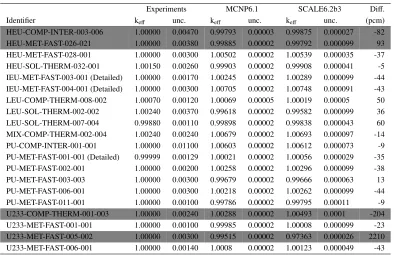
Results are presented in Table 3, marked in grey those cases where SCALE and MCNP keffvalues
differ more than 60 pcm. The source of differences for the highlighted cases are discussed:
• HEU-COMP-INTER-003-006 (82 pcm) whose difference comes partially from197Au, due to
dif-ferences in reconstruction of197Au cross sections in URR. However, not including197Au in
calcu-lations yields a difference between MCNP and SCALE of 154 pcm, so the equivalence of MCNP and SCALE models shall be checked.
• HEU-MET-FAST-026-021 (93 pcm) has differences between in MCNP and SCALE models, such as the amount of paraffin. Once equaled, the difference increases up to 343 pcm. Model representations in both cases shall be reviewed.
• U233-COMP-THERM-001-003 (204 pcm) has90Zr in its composition, for which large
discrepan-cies have been observed in transmission tests. It has a large impact in keff as seen from sensitivity
analysis, so when it is not included in calculations, differences are reduced to 23 pcm.
• U233-MET-FAST-005-002 (2210 pcm) is a233U sphere reflected by9Be which involves fast neutron
spectrum. As seen in transmission cases, large differences will be encountered using 9Be due to
issues in handling MT875+reaction channels with AMPX.
Therefore, despite HEU-COMP-INTER-003-006 and HEU-MET-FAST-026-021 cases where equivalence between MCNP and SCALE models shall be reviewed, a good agreement is achieved between MCNP and SCALE processing the JEFF-3.2 neutron cross section libraries with AMPX and NJOY.
Table 3.Results for keffin criticality benchmarks using SCALE6.2b3 and MCNP6.1, marked in grey are those
with differences between MCNP and SCALE larger than 60 pcm.
Experiments MCNP6.1 SCALE6.2b3 Diff.
Identifier keff unc. keff unc. keff unc. (pcm)
5 Conclusions
The JEFF-3.2 neutron cross section library has been processed with the AMPX version released in SCALE6.2b4. A continuous energy library for neutrons is generated for its use with SCALE transport calculations tools: KENO for criticality and MAVRIC-MONACO for shielding.
This work has identified different issues to address during the processing of JEFF-3.2 data with AMPX, which concern 17 isotopes (see Sec. 2.3). Those issues which are more relevant due to their impact in benchmarking are due to22Na and90Zr. Therefore, for these 17 isotopes, processing and
evaluations shall be reviewed.
The verification of processed files is carried out by performing criticality calculations in infinite dilution cases and transmission tests. These tests show the need to implement the definition of some isotopes in SCALE:152mEu,180mTa and131mTe, as well as those marked in Table 1 for transmission
tests. When comparing SCALE and MCNP results in transmissions tests, large differences were found for 150 isotopes (Table 1), due to a different treatment of the URR in processing and its usage in transport codes. The number of discrepant isotopes sharply decreases when probability tables are not used, where important differences are only found for 12 isotopes, with their likely issues being described in Table 2.
Finally, the generated CE library from JEFF-3.2 is used in a selection of benchmarks from the criticality validation suite for MCNP6. A comparison of SCALE and MCNP results is given. In general, a good agreement is obtained, within 60 pcm differences except for 4 cases. For 3 of these 4 cases, isotopes with large differences found in transmission tests are involved, such as197Au,9Be
and90Zr. The differences found are however not completely explained, and would require the further
review of both the MCNP and SCALE input models used.
Once the missing isotopes have been implemented in SCALE libraries, further study on trans-mission tests should be carried out with a wider selection of benchmarks in order to expand the application cases. Although, this latter work depends also in availability of inputs, for which checks on equivalence shall carried out.
This work has focused on processing the entire JEFF-3.2 neutron data library with the AMPX version released in SCALE6.2b4. Although most of the evaluations are processed successfully, the goal of releasing the thoroughly processed CE library from JEFF-3.2 library for SCALE would still need some necessary actions and decisions to be taken and which concern the issues mentioned. Nevertheless, this work has set the first milestones and established a successful collaboration for the future usage of JEFF libraries within SCALE.
References
[1] CSEWG, Tech. Rep. BNL-90365-2009 Rev.2, BNL (2012)
[2] X-5 Monte Carlo Team, Tech. Rep. LA-CP-03-0245, LANL (2003), Version 5
[3] OECD/NEA Data Bank,JEFF-3.2 Evaluated Data Library - Neutron data(2014),http://www. oecd-nea.org/dbforms/data/eva/evatapes/jeff_32/
[4] ORNL,SCALE: A comprehensive modeling and simulation suite for nuclear safety analysis and
design(2011), ORNL/TM-2005/39, Version 6.1
[5] R.D. Mosteller, Tech. Rep. LA-UR-02-0878, LANL (2002)
[6] R.E. MacFarlane, D.W. Muir, R.M. Boicourt, A.C. Kahler, Tech. Rep. LA-UR-12-27079, LANL (2015)
[7] T. Goorley, M. James, T. Booth, F. Brown, J. Bull, L. Cox, J. Durkee, J. Elson, M. Fensin, R. Forster et al., Nuclear Technology180, 298 (2012)