IJEDR1402193
International Journal of Engineering Development and Research (www.ijedr.org)2506
Optimization of Casting Process Parameters using
Taguchi Method
1
Ganesh G. Patil,
2Dr. K. H. Inamdar
1M. Tech Student, 2Professor 1Department of Mechanical Engineering, 1Walchand College of Engineering, Sangli, India
1[email protected], 2[email protected]
________________________________________________________________________________________________________ Abstract - Casting process is the most widely used process in manufacturing industries especially in automobile products. Systematic analysis and identification of sources of product defects are essential for successful manufacturing. Foundry industry suffers from the poor quality and productivity due the large number of process parameter. Since the quality of casting parts is mostly influenced by process condition, how to determine the optimum process condition becomes the key to improving part quality. Improvement in casting quality is the process of finding the root cause of occurrence of defects such as sand drop, blow hole, leakage and bad mould in the rejection of casting and taking necessary steps to reduce the defects and hence rejection of casting. In this paper, green sand casting process was optimized by using Taguchi method. An attempt has been made to obtain optimal settings of the casting process parameters in order to yield the optimum quality characteristics of the silicon molybdenum (SiMo) SG iron flange bak castings. Good quality of casting can be achieved by optimization of controllable process parameters such as mould hardness, moisture content, permeability and green compression strength. The effects of these parameters on casting defects and subsequent setting of parameters with the levels have been accomplished by Taguchi’s parameter design approach. Taguchi based L18 orthogonal array have been used for the experimentation and result has been carried out using Minitab 16 software for analysis of variance. A statistical analysis of variance (ANOVA) has been performed for which process parameters are significantly affecting the casting rejection percentage. Identify the optimum value of the selected process parameters and verification experiment has been performed.
Index Terms - Optimization, Casting process, Casting defects and Taguchi method
_______________________________________________________________________________________________________
I.INTRODUCTION
Metal casting has been a primary manufacturing process for several centuries during BC and is so even today in the 21st century. Today, its applications include automotive components, spacecraft components and many industrial and domestic components. The principle of manufacturing a casting involves creating a hollow shape of the metallic component to be made inside a sand mould and then pouring the liquid metal directly into the sand-shaped mould. Casting is a very versatile process capable of being used in mass production items in very large shaped pieces, with intricate designs and having properties unobtainable by any other methods. The major activities involved in making a casting are moulding, melting, pouring, solidification, fettling, cleaning, inspection and elimination of defective castings [1].
Metal casting is one of the direct methods of manufacturing the desired geometry of component. More than 60% of the automotive components out of the total are manufactured by metal casting process. Foundry industry suffers from poor quality and productivity due to the large number of the process parameters. Out of different casting methods, green sand casting is the commonly used method for producing automotive components.
Major applications in both ferrous and non ferrous casting material such as, casting engine block, valves, pump, aerospace and so on. Moulding, melting followed by pouring, fettling, inspection and elimination were the major steps followed in casting process. Control during each stage in casting process plays a vital role else it may lead to casting defects like rat-tails, scabs, cracks, blow holes, misrun, shrinkage, porosity, cold shut, scar, hot tears, cracks and so on. In past few decades neural networks were used to tackle production related problems, controlling the process by reducing casting defects, lead times, scrap rate, production cost and to avoid trial and error method, expert dependent advices in optimizing the process [2].
II.LITERATURE REVIEW
The majority of the published articles on the optimization of casting process parameters based on the Taguchi’s method are reviewed below.
Haq et al. [3] have optimized the process parameters of CO2 casting process such as weight of CO2 gas, mould hardness, sand particle size, and percentage of sodium silicate, sand mixing time, pouring time, pouring height, pouring temperature and cooling time of poured metal using design of experiments method such as Taguchi method.
IJEDR1402193
International Journal of Engineering Development and Research (www.ijedr.org)2507
analysis named defect diagnostic study approach and they have analyzed mould crush defect in selected S.G. Iron casting. Kumar et al. [5] have applied design of experiments method such as Taguchi method for optimization of the process parameters of green sand casting method such as moisture content, pouring temperature, green compression strength, mould hardness vertical and horizontal. Oktem et al. [6] have studied the Taguchi optimization method for surface roughness in finish milling of mold surfaces in which they have used L18 orthogonal array. Syrcos G.P. [7] have applied Taguchi method for the process parameters optimization of the die casting method, the process parameters optimized are: die temperature, metal pressure, and cooling time of die. Bagci and Aykut [8] studied the Taguchi optimization method for identifying the optimum surface roughness in CNC face milling of cobalt based alloy (satellite) in which they had used L18 orthogonal array. Der and Fong [9] have applied Taguchi method for optimization of electron-beam surface hardening of cast iron for high wear resistance. Wen et al. [10] have optimized the die casting conditions for wear properties of alloy AZ91D components using the Taguchi method and design of experiments analysis in this research they have used L9 orthogonal array.III.PROCESS PARAMETERS OF FLANGE-BAK
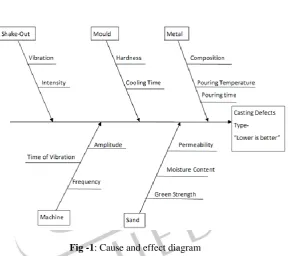
An Ishikawa diagram (cause and effect diagram) is constructed as shown in Fig. 1 to identify the casting process parameters that may influence green sand casting defects. The process parameters can be listed in five categories as follows:
a. Mould-machine related parameters b. Cast-metal related parameters c. Green-sand-related parameters d. Mould-related parameters e. Shake-out-related parameters
Fig -1: Cause and effect diagram
From the cause and effect diagram of green sand casting method (refer fig. 1) between the different process parameters of green sand casting the sand related and mould related parameters are selected because, they have major impact on occurrence of selected casting defects. The selected flange bak casting process parameters, along with their ranges, are presented in Table 1.
Table 1Process parameters level and ranges
Parameter designation Process parameters Range Level 1 Level 2 Level 3
A Mould hardness 80 to 90 80 90 -
B Moisture Content (%) 4.75 to 5.3 4.75 5.00 5.30
C Permeability No. 105 to 135 105 120 135
D Green Compression Strength (gm/cm2) 1200 to 1300 1200 1300 1400 IV.EXPERIMENTAL WORK AND ANALYSIS
The experimental region has been decided as per Taguchi design approach. The number of levels for eachcontrollable process parameter has been defined by table 1. Awide experimental region has been covered so that sensitivityto noise factors does not alter with small changes in these factors settings and to obtain optimum regions for the process parameters. Therefore, each parameter was analyzed atdifferent levels of the process parameters [11].
IJEDR1402193
International Journal of Engineering Development and Research (www.ijedr.org)2508
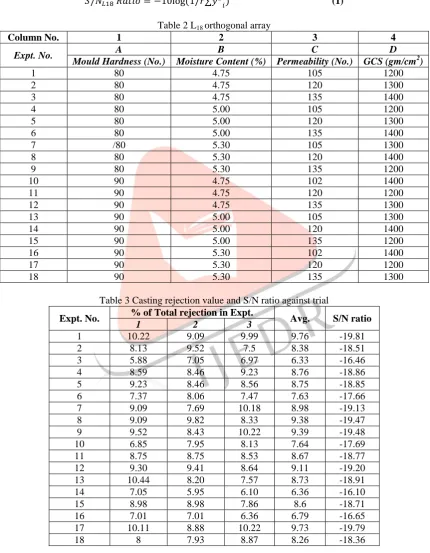
single-repetition randomization technique [12]. The casting defects rejections that occur in each trial conditions were measured. In this work, the percentage of casting rejection for each repetition was calculated by using the given formula, and then the average of the casting rejection were determined for each trial condition and it was recorded in Table 3:Percentage of Rejection =
X 100
The casting defects are the “lower the better” type of quality characteristics. Lower the better S/N ratios are computed by using equation 1 for each of the 18 experiments and the values are recorded in table 3 [11].
(1)
Table 2L18 orthogonal array
Column No. 1 2 3 4
Expt. No. A B C D
Mould Hardness (No.) Moisture Content (%) Permeability (No.) GCS (gm/cm2)
1 80 4.75 105 1200
2 80 4.75 120 1300
3 80 4.75 135 1400
4 80 5.00 105 1200
5 80 5.00 120 1300
6 80 5.00 135 1400
7 /80 5.30 105 1300
8 80 5.30 120 1400
9 80 5.30 135 1200
10 90 4.75 102 1400
11 90 4.75 120 1200
12 90 4.75 135 1300
13 90 5.00 105 1300
14 90 5.00 120 1400
15 90 5.00 135 1200
16 90 5.30 102 1400
17 90 5.30 120 1200
18 90 5.30 135 1300
Table 3 Casting rejection value and S/N ratio against trial
Expt. No. % of Total rejection in Expt. Avg. S/N ratio
1 2 3
1 10.22 9.09 9.99 9.76 -19.81
2 8.13 9.52 7.5 8.38 -18.51
3 5.88 7.05 6.97 6.33 -16.46
4 8.59 8.46 9.23 8.76 -18.86
5 9.23 8.46 8.56 8.75 -18.85
6 7.37 8.06 7.47 7.63 -17.66
7 9.09 7.69 10.18 8.98 -19.13
8 9.09 9.82 8.33 9.38 -19.47
9 9.52 8.43 10.22 9.39 -19.48
10 6.85 7.95 8.13 7.64 -17.69
11 8.75 8.75 8.53 8.67 -18.77
12 9.30 9.41 8.64 9.11 -19.20
13 10.44 8.20 7.57 8.73 -18.91
14 7.05 5.95 6.10 6.36 -16.10
15 8.98 8.98 7.86 8.6 -18.71
16 7.01 7.01 6.36 6.79 -16.65
17 10.11 8.88 10.22 9.73 -19.79
18 8 7.93 8.87 8.26 -18.36
IJEDR1402193
International Journal of Engineering Development and Research (www.ijedr.org)2509
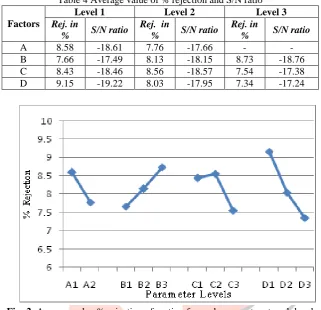
Analysis of Experimental ResultsThe mean response refers to the average value of the performance characteristic for each parameter at different levels. The average values of the casting rejection and S/N ratios for each parameter at different levels are calculated and are given in Table 4. The average values of casting rejection and S/N ratios for each parameter at different levels are plotted in Figs. 2 and 3, respectively.
Table 4 Average value of % rejection and S/N ratio Factors
Level 1 Level 2 Level 3
Rej. in
% S/N ratio
Rej. in
% S/N ratio
Rej. in
% S/N ratio
A 8.58 -18.61 7.76 -17.66 - -
B 7.66 -17.49 8.13 -18.15 8.73 -18.76
C 8.43 -18.46 8.56 -18.57 7.54 -17.38
D 9.15 -19.22 8.03 -17.95 7.34 -17.24
Fig -2: Average value % rejection of casting for each parameter at each level
It is clear from Figs. 2and 3that the casting rejection are minimum at the second level of parameter A (A2), the first level of parameter B (B1), the third level of parameter C (C3) and the third level of parameter D (D3). The S/N ratio is also maximum at the same levels of the parameters (A1, B3, C1, D2) as the best values for getting minimum casting rejection of the green sand castings of the flange bak casting.
Fig -3: Average value S/N ratio for each parameter at each level
IJEDR1402193
International Journal of Engineering Development and Research (www.ijedr.org)2510
Table 5 Average value of % rejection and S/N ratioSource Degree of freedom
Sum of
square Variance F ratio P % C
A 1 3.025 3.026 3.57 0.088 10.55
B 2 3.460 1.730 2.04 0.181 12.06
C 2 3.683 1.842 2.17 0.165 12.84
D 2 10.03 5.016 5.92 0.020 34.80
Error 10 8.478 0.848 - - -
Total 17 28.62 - - - -
- S = 0.9207 R-Sq = 70.44% R-Sq(adj) = 49.75% Confirmation Experiment
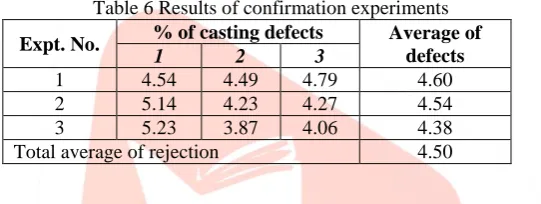
The confirming experiments are used to verify that the factors and levels chosen from an experiment cause a product or process to behave in a certain fashion. The confirming experiment is highly recommended to verify the experimental conclusions and is interpreted in this manner. If the average of the results of the confirmation is within the limits of the confidence limits, then the significant factors as well as the appropriate levels for obtaining the desired results are properly chosen. If the average of the results of the confirmation experiment is outside the limit of the CI, then the parameters selected and/or levels to control the results for a desired value are wrong or have excessive measurements, necessitating further experimentation [12].
Three confirmation experiments are conducted at the optimum settings of the process parameters recommended by the investigation. Therefore, the selected parameters as well as their appropriate levels are significant enough to obtain the desired result. Rejection due to sand related defects for pipe turbocharger was 10% which is reduced to maximum up to 4.50 %.
Table 6 Results of confirmation experiments Expt. No. % of casting defects Average of
defects
1 2 3
1 4.54 4.49 4.79 4.60
2 5.14 4.23 4.27 4.54
3 5.23 3.87 4.06 4.38
Total average of rejection 4.50
V.CONCLUSIONS
Experiments have been performed at different combination of process parameters as suggested by L18 orthogonal array by Taguchi methodology for the flange bak. Contribution of process parameters for minimization of rejection in the components and the consistency of the experiments have been estimated using statistical techniques.
From the analysis, it is proved that, by improving the quality by Taguchi’s method of parameter design at the lowest possible cost, it is possible to identify the optimum levels of signal factors at which the noise factors’ effect on the response parameters is less. The outcome of this paper is the optimized process parameters of the green sand castings process which leads to minimum casting rejection. The optimized parameter levels are mould hardness number–90, moisture content–4.75%, green strength–1400 gm/cm2, and permeability number–135. Also, the experiments give a clear picture of every factor’s contribution to the variation in the green sand casting process, and the quality can be improved without additional investment.
REFERENCES
[1] D. Benny Karunakar and G. L. Datta, “Prevention of Defects in Castings using Back Propagation Neural Networks,” International Journal of Advance Manufacturing Technology, 2008, vol. 39, pp. 1111-1124.
[2] Manjunath Patel G C and Prasad Krishna, “A Review on Application of Artificial Neural Networks for Injection Moulding and Casting Processes,” International Journal of Advances in Engineering Sciences, January 2010, Vol. 3, Issue 1, pp. 1-12.
[3] S. Guharaja, A. Noorul Haq and K. M. Karuppannan, “Parameter optimization of CO2 casting process by using Taguchi method”,International Journal of Advanced Manufacturing Technology (2009) 3, pp 41-50.
[4] B. Chokkalingam and S.S. Mohamed Nazirudeen, “Analysis of Casting Defect through Defect Diagnostic Study Approach”, Journal of Engineering Annals of Faculty of Engineering Hunedoara, Vol. 2, 2009, pp. 209-212.
[5] Sushil Kumar, Satsangi and Prajapati, “Optimization of green sand casting process parameters of a foundry by using Taguchi’s method”, The International Journal of Advanced Manufacturing Technology (2011) 55, pp. 23-34.
[6] Hasan Oktem,Tuncay Erzurumlu and Mustafa Col, “A study of the Taguchi optimization method for surface in finishing milling of mold”,The International Journal of Advanced Manufacturing Technology (2006),48, pp. 694-700.
[7] Syrcos G.P., “Die casting process parameters optimization using Taguchi method of design of experiment”, Journal of Master Process Technology (2002) 135, pp. 68-74.
IJEDR1402193
International Journal of Engineering Development and Research (www.ijedr.org)2511
[9] Jean Ming-der and Fong, “Optimization of electron beam surface hardening of cast iron for high wear resistance usingTaguchi method”, International Journal of Advanced Manufacturing Technology (2004) 24, pp. 190-198.
[10]Jeiong-Lian Wen, Yung-Kuang Yang and Ming-Chang Jeng, “Optimization of die casting conditions for wear properties of alloy AZ91D components using the Taguchi method of design of experiments”, The International Journal of Advanced Manufacturing Technology (2009) 41, pp. 430-439.
[11]Satish Kumar, Arun Kumar Gupta and Pankaj Chandna, “Optimization of Process Parameters of Pressure Die Casting using Taguchi Methodology,” World Academy of Science, Engineering and Technology, 2012, vol. 68, pp. 590-594. [12]S. Guharaja. A. Noorul Haq. and K. M. Karuppannan, “Optimization of green sand casting process parameters by using