
Flavor tagging TeV jets for physics beyond the Standard Model
Zack Sullivan1,aand Keith Pedersen1
1Department of Physics, Illinois Institute of Technology, Chicago, Illinois 60616-3793, USA
Abstract. We present a new scheme for tagging boosted heavy flavor jets called “μx tagging.” At the LHC, the primary method to tagb-jets relies on tracking their charged constituents. However, when highly boosted, track-basedb-tags lose efficiency, and the probability to mistag light jets rises dramatically. Using muons from Bhadron decay and defining a particular combination “x” of angular information and boost estimation, we find fairly flat efficiencies to tagb-jets,c-jets, light-quark jets, and light-heavy jets (containingBhadrons from gluon splitting) ofb =14%,c=6.5%,light−light =0.1%,
andlight−heavy =0.5%, respectively. We demonstrate the usefulness of this new scheme
by showing the reach for discovery of a leptophobicZ→bb¯in the dijet channel.
1 Introduction
As searches forWandZbosons at the CERN Large Hadron Collider (LHC) shift to TeV-scale energies, observation of their decay products becomes challenging. Observation of dijet resonances above QCD background is hampered by fallingb-tagging efficiencies (28–15% around 1–2 TeV) and large light-jet fake rates of 1–2% [1]. In addition to the low purity (fake/b ∼ 1/10), large uncertainties in the tagging efficiencies affect the mass limits; e.g., the ATLASb-tag uncertainty is 35% for pT > 500 GeV [2]. In order to discover multi-TeV physics beyond the Standard Model (BSM), we need a betterbtag with good efficiency and purity.
At this conference, we presented a new method for flavor tagging at TeV-scale energies called “μx boosted-bottom-jet tagging” [3]. This method is derived from kinematic first principles, and provides both a well-determined 14% efficiency forb-tagging, and a factor of 10 improvement in fake rejection over existing tags (fake/b∼1/100). In Sec. 2 we summarize the algorithm and cuts for the
μxtag, show why it works, and plot its transverse momentum pT- and pseudorapidity η-dependent efficiencies. In Sec. 3 we briefly describe the application ofμxboosted-btagging to an analysis for discovery of a leptophobicZ→bb¯. We summarize our results in Sec. 4.
2
μ
xboosted-
b
tag
Consider a jet containing a semi-muonic decay of aBhadron. In the center-of-momentum (CM) frame, the muon is emitted with a speedβμ,cmand at an angleθcmwith respect to the beam axis (see
ae-mail: [email protected]
, DOI: 10.1051/
ISMD 2015
Fig. 1). In the lab frame, the boostγB of theBhadron compresses its decay products into a narrow subjet at high energy. We define a lab frame observable
x≡γBtanθlab=
sinθcm
κ+cosθcm
, (1)
whereκ≡βB/βμ,cm.
Lab
CM
Figure 1.Nomenclature for the center-of-momentum frame and boosted lab frame.
Whileκ is unobservable, for sufficiently boosted B hadrons (γB γμ,cm ≥ 3) the lab frame
distribution of the muon countNvs.xis effectively independent ofκ,
dN
dx ≈
2x
(x2+1)2. (2)
This leads to a universal shape inxfor highly boosted jets containingBhadrons. Using this shape we define theμxboosted-btag as a cut on two variables: We capture 90% of muons fromBdecay by demandingx<3. To further isolatebdecays, we note the hard fragmentation function forbquarks leads to theBhadron subjet carrying a large fraction fsubjetof the total jet momentum. Hence, we
demand
fsubjet≡ pTsubjet
pTjet ≥
0.5. (3)
There are two challenges in applying theμxtag to real events: we must identify the correct decay remnant of theBhadron to reconstruct its four-vectorpsubjet, and we must deal with the missing muon
neutrino. Most of the neutrino energy in the lab frame comes from the boost, so we use the measured four-vector of the muon as a proxy pν = pμ > 10 GeV. In order to find the non-leptonic remnant “core” of the subjet, we need a more sophisticated algorithm.
In order to reconstruct the boosted subjet we first cluster the jet using the anti-kT algorithm with a R=0.4. We then search for the core (generally the charm hadron remnant) by reclustering the muon and calorimeter towers with total jet energy fraction fmin
tower >0.05 using a smallerRcore =0.04. We
assumemcore=2 GeV (a typical charm hadron mass), and identify the “correct” core as the one which
comes closest to
p2
subjet=5.3 GeV. Since mismeasurements smear out the reconstructed energy of
the subjet, ifmsubjet >12 GeV we constrain the subjet mass to be 12 GeV. The parameters of theμx tag are summarized in Table 1.
Table 1.A summary of parameters chosen forμxboosted bottom jet tagging.
R 0.4 mcore 2 GeV pminTμ 10 GeV
Rcore 0.04 mB 5.3 GeV xmax 3 (x90%)
fmin
tower0.05 mmaxsubjet 12 GeV fminsubjet 0.5
In spite of its non-trivial reconstruction, x is effectively a dynamic angular cut on the muon. Definingξ, the lab frame angle between the muon and the core, it is possible to calculateξmax, the
, DOI: 10.1051/
ISMD 2015
maximumμ-to-core angle which producesx≤3. For “soft” muons (EμEcore/18), this angular cut
is relatively tight
ξsoft max≈3
mcore
Ecore
. (4)
Once the muons become “hard” (Eμ≥Ecore/18), the cut loosens significantly
ξhard max ≈3
mmax
subjet
Ecore
. (5)
While the transition between these limits depends explicitly on the muon’s pT, this dependence is small until just below the hard threshold. Thus, not only isxasmartangular cut — scaling with the energy of the core — it is adualangular cut; tight for soft muons, looser for hard muons, and sensitive to thepT resolution of the muon system only within the narrow transition region.
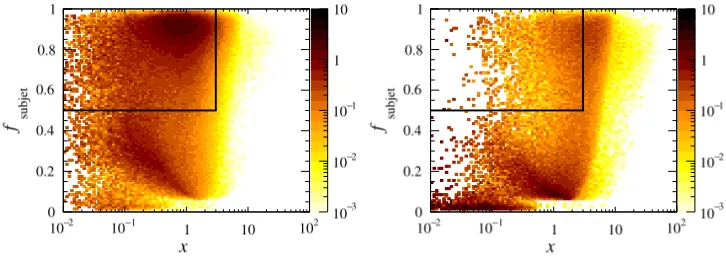
The separation of reconstructedbjets from light-quark-initiated jets can be seen in Fig. 2. Bottom jets (b-quarks hadronized asBhadrons) above 500 GeV produce large fsubjetandx∼0.8. Light jets
(mostlyπandK) produce either incompatible values ofx>3, or random subjet recombinations that lead to smallfsubjet. A small fraction ofbjets is not well-reconstructed (represented by the low-fsubjet
tail), but it has little effect on the total efficiency.
3 − 10 2 − 10 1 − 10 1 10 x 2 −
10 10−1 1 10 102
subjet f 0 0.2 0.4 0.6 0.8 1 3 − 10 2 − 10 1 − 10 1 10 x 2 −
10 10−1 1 10 102
subjet f 0 0.2 0.4 0.6 0.8 1
Figure 2.Density of reconstructed candidate tags withμ=40 pileup events as a function of fsubjetvs.xfor (left)
bottom and (right) light-quark-initiated jets.
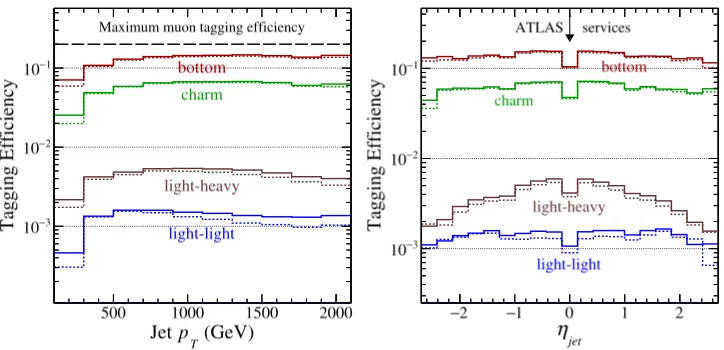
We extract the standaloneμxtagging efficiencies using PYTHIA 8.210 [4, 5] fed into an ATLAS-like version of DELPHES 3.2 [1], and a customμxtagging moduleMuXboostedBTagging(available on GitHub [6]). In Fig. 3 we show separate efficiencies as a function ofpTandηfor bottom jets, charm jets, light-light jets (where the muon came from a light-flavor hadron), and light-heavy jets (where a gluon split tobb¯/cc¯— producing heavy-flavor hadrons in the final state). The kinematic nature of the tagging variables leads to fairly flat efficiencies in pseudorapidity, and when pT > 500 GeV. The exception is theηdistribution forBhadrons from gluon splitting. This leads to the intriguing possibility that theg → bb¯ contribution to jets in the Monte Carlo could be calibrated using the rapidity dependence of these highly-boosted jets.
3 A search for leptophobic
Z
→
b
b
¯
Very massiveZbosons are expected to exist in many BSM models. We test theμxboosted-bottom tag by examining the reach at a 13 TeV LHC for a leptophobicZdecaying tobb¯orcc¯. For this study
, DOI: 10.1051/
ISMD 2015
(GeV) T
p
Jet
500 1000 1500 2000
Tagging Efficiency 10−3 2
− 10
1
− 10
Maximum muon tagging efficiency
bottom
charm
light-heavy
light-light
jet η 2
− −1 0 1 2
Tagging Efficiency
3
− 10
2
− 10
1
− 10
ATLAS services
bottom
charm
light-heavy
light-light
Figure 3. μxtagging efficiency vs. (left) jetpT and (right)ηjet. Solid (dashed) lines includeμ =0 (40) pileup
events.
we choose aU(1)BLagrange density
L = gB 6 Z
Bμq¯γμq, (6)
with a flavor-independent coupling to quarks [7, 8].
We simulate the signal and backgrounds using a MLM-matched MadEvent sample [9] and CT14llo PDFs [10] fed through PYTHIA into DELPHES. In addition to demanding one or twoμx tags (as defined in Sec. 2), we require|ηj|<2.7, andΔηj j <1.5. We reconstruct a dijet mass out of the two leading-pT jets, and look for a resonance in the mass window [0.85,1.25]×MZB.
The results for 5σdiscovery of this leptophobicZare shown in Fig. 4 for a two-tag, and one-tag inclusive sample, compared to current exclusion limits from Ref. [7]. In 100 fb−1 of integrated
luminosity at 13 TeV, a twob-tag analysis could discover aZ of 3 TeV if the universal coupling
gB ∼ 2.5. For this particular model, the single-tag inclusive search would be more effective — allowing for discovery up to nearly 1 TeV above current mass limits. Should a discovery not be made, the two-tag search (not shown) would set a 95% C.L. exclusion comparable to the one-tag discovery reach; while the one-tag search would set a 95% C.L. exclusion that can accessgBcouplings a factor of 2 smaller than current limits, and masses up to 2 TeV higher.
4 Conclusions
In this paper we discuss the newμx boosted-bottom-jet tag. Combining angular information x fromBhadron decay with jet substructure fsubjet in TeV-scale jets allows for tagging efficiencies of
b=14%,c=6.5%,light−light=0.1%, andlight−heavy=0.5%, respectively. The results here focused
on ATLAS because their standalone non-isolated muon tagging efficiency is publicly available. We expect that if CMS has similar non-isolated muon tagging capability this tag will be just as effective, since it is kinematically driven and not sensitive to fine details of the detector.
When applying theμxtag to a search for leptophobicZbosons, we find that the reach for dis-covery at a 13 TeV LHC is about 1 TeV higher than current limits. If aZis not found, 95% C.L.
, DOI: 10.1051/
ISMD 2015
0 500 1000 1500 2000 2500 0.0
0.5 1.0 1.5 2.0 2.5
MZ'B (GeV)
g
BUA2
CDF Run I
CDF 1.1 fb-1
CMS
0.13 fb-1
ATLAS 1 fb-1
CMS 4 fb-1
CMS 5 fb-1
CMS 20 fb-1
ATLAS 13 fb -1
Excluded
3000
100 fb
-1 2-tag (5
)
100 fb
-1 1-tag (5
)
3500
100 fb
-1 1-tag (95% C.L.)
Figure 4.5σdiscovery reach for a leptophobicZwith universal coupling in the with one or two boosted-btags at a 13 TeV LHC compared to exclusion limits from Ref. [7]. Also shown is the 95% C.L. exclusion reach of the one-tag analysis.
exclusion limits can be set up to 2 TeV higher, or forgBcouplings a factor of 2 smaller, than the cur-rent limits. In addition toZ →bb¯, theμxtag should be of immediate use in the search forW→tb¯ in the boosted-top and boosted-bottom channel [11] conducted by the ATLAS Collaboration [2].
Acknowledgments
Z.S. would like to thank the ISMD organizers for an exceptional symposium and environment for lively discussions. This work was supported by the U.S. Department of Energy under award No. DE-SC0008347.
References
[1] J. de Favereau et al. (DELPHES 3 Collaboration), J. High Energy Phys. 02, 057 (2014) [arXiv:1307.6346 [hep-ex]].
[2] G. Aadet al.(ATLAS Collaboration), Phys. Lett. B743, 235 (2015) [arXiv:1410.4103 [hep-ex]]. [3] K. Pedersen and Z. Sullivan, arXiv:1511.05990 [hep-ph].
[4] T. Sjostrand, S. Mrenna, and P.Z. Skands, J. High Energy Phys. 05, 026 (2006) [hep-ph/0603175].
[5] T. Sjostrand, S. Mrenna, and P.Z. Skands, Comput. Phys. Commun. 178, 852 (2008) [arXiv:0710.3820 [hep-ph]].
[6] K. Pedersen, [https://github.com/keith-pedersen/delphes/tree/MuXboostedBTagging].
[7] B.A. Dobrescu and F. Yu, Phys. Rev. D88, 035021 (2013); Erratum: Phys. Rev. D90, 079901 (2014) [arXiv:1306.2629 [hep-ph]].
, DOI: 10.1051/
ISMD 2015
[8] B.A. Dobrescu, arXiv:1506.04435 [hep-ph].
[9] J. Alwallet al., J. High Energy Phys.07, 079 (2014) [arXiv:1405.0301 [hep-ph]]. [10] S. Dulatet al., arXiv:1506.07443 [hep-ph].
[11] D. Duffty and Z. Sullivan, Phys. Rev. D90, 015031 (2014) [arXiv:1307.1820 [hep-ph]].
, DOI: 10.1051/
ISMD 2015
![Figure 4. 5at a 13 TeV LHC compared to exclusion limits from Ref. [7]. Also shown is the 95% C.L](https://thumb-us.123doks.com/thumbv2/123dok_us/8158710.1361068/5.482.62.431.86.289/figure-tev-lhc-compared-exclusion-limits-ref-shown.webp)
