International Journal of COPD 2017:12 27–33
International Journal of COPD
Dove
press
submit your manuscript | www.dovepress.com 27
O r I g I n a l r e s e a r C h
open access to scientific and medical research
Open access Full Text article
Trend of cost and utilization of COPD medication
in Korea
Jongmin lee1
Jae ha lee1
Jee-ae Kim2
Chin Kook rhee1
1Division of Pulmonary, allergy and
Critical Care Medicine, Department of Internal Medicine, seoul st Mary’s hospital, College of Medicine, The Catholic University of Korea, seoul,
2Pharmaceutical Policy evaluation
research Team, research Institution, health Insurance review and assessment service, Wonju-si, republic of Korea
Background: There are only a few longitudinal studies regarding medical utilization and costs for patients with COPD. The purpose of this study was to analyze the trend of medical utilization and costs on a long-term basis.
Methods: Using the Korean Health Insurance Review and Assessment Service (HIRA) data from 2008 to 2013, COPD patients were identified. The trend of medical utilization and costs was also analyzed.
Results: The number of COPD patients increased by 13.9% from 2008 to 2013. During the same period, the cost of COPD medication increased by 78.2%. Methylxanthine and systemic beta ago-nists were most widely prescribed between 2008 and 2013. However, inhaled medications such as long-acting beta-2 agonist (LABA), long-acting muscarinic agonist, and inhaled corticosteroid plus LABA were dispensed to a relatively low proportion of patients with COPD. The number of patients who were prescribed inhaled medications increased gradually from 2008 to 2013, while the number of patients prescribed systemic beta agonist and methylxanthine has decreased since 2010.
Conclusion: This study shows that there is a large gap between the COPD guidelines and clinical practice in Korea. Training programs for primary care physicians on diagnosis and guideline-based treatment are needed to improve the management of COPD.
Keywords: pulmonary disease, chronic obstructive, drug prescriptions, medical utilization, medical cost
Introduction
COPD is characterized by an airflow limitation with a forced expiratory volume in 1 second/forced vital capacity ratio of 70%, which is not fully reversible. The world-wide prevalence of COPD is increasing, and the Global Burden of Disease Study has estimated that it will be the fourth leading cause of death in 2030.1 With increasing
prevalence, the economic burden of COPD is also increasing. In 2010, the estimated cost of COPD in the USA was $50 billion, which included $20 billion of indirect costs and $30 billion of direct health care expenditures.2 Although more studies have recently
investigated the economic burden of COPD, existing data show remarkable variations due to differences in survey methods, diagnostic criteria, and analytic approaches.3
Though simple, inexpensive spirometers are now available for clinical practices, under-recognition and underdiagnosis of COPD affect the accuracy of data.4
Although some studies have reported the cost and utilization of medication for COPD,5 not many have reviewed these factors for an entire country. Moreover, only
few longitudinal studies have followed the cases on a long-term basis.
Korea has a compulsory universal health insurance system that includes medical reimbursement records for the entire Korean population. The Korean Health Insurance Review and Assessment Service (HIRA) database has detailed information about Correspondence: Jee-ae Kim
Pharmaceutical Policy evaluation research Team, research Institution, health Insurance review and assessment service, 60 hyeoksin-ro, Wonju-si 26465, gangwon-do, republic of Korea email [email protected]
Chin Kook rhee
Division of Pulmonary, allergy and Critical Care Medicine, Department of Internal Medicine, seoul st Mary’s hospital, College of Medicine, The Catholic University of Korea, 222 Banpodaero, seochogu, seoul 06591, republic of Korea
Tel +82 2 2258 6067 Fax +82 2 599 3589
email [email protected]
Journal name: International Journal of COPD Article Designation: Original Research Year: 2017
Volume: 12
Running head verso: Lee et al
Running head recto: Analysis of the trend of COPD medical cost and utilization DOI: http://dx.doi.org/10.2147/COPD.S121687
International Journal of Chronic Obstructive Pulmonary Disease downloaded from https://www.dovepress.com/ by 118.70.13.36 on 22-Aug-2020
For personal use only.
Number of times this article has been viewed
This article was published in the following Dove Press journal: International Journal of COPD
Dovepress lee et al
diagnosis, health care use, and medication, and is thus a reli-able source for nationwide epidemiological evaluations.6 The
objective of this article is to analyze the cost and utilization of COPD medication in Korea using the HIRA database.
Methods
Data sources
We used the HIRA data from 2008 to 2013 to analyze trends in cost and utilization of COPD medication. All hospitals, clinics, public health centers, and pharmacies are registered with the Korean National Health Insurance (NHI). The health care service providers first file a claim with the NHI, after which the HIRA assesses the claim based on diagnostic codes and medical records.
Patient selection
An operational definition was used for extracting COPD patients from the HIRA database.7–10 We searched for
subjects with diagnosis of COPD based on the Interna-tional Classification of Disease − Tenth Revision (ICD-10) codes and medications prescribed. COPD patients were defined as subjects who met all of the following criteria: 1) age 40 years; 2) ICD-10 codes for COPD or emphysema (J43.0x–J44.x, with the exception of J43.0 as primary or secondary [within fourth position] diagnosis); and 3) the use of more than one of the following COPD medications at least twice per year: long-acting muscarinic antagonist (LAMA), long-acting beta-2 agonist (LABA), inhaled corticosteroid (ICS) + LABA, short-acting muscarinic antagonist (SAMA), short-acting beta-2 agonist (SABA), SAMA + SABA, phos-phodiesterase-4 (PDE-4) inhibitor, systemic beta agonist, or methylxanthine.
analysis
The cost and utilization of COPD medication were ana-lyzed from 2008 to 2013. Only COPD-related medications (ICS, ICS + LABA, LABA, LAMA, leukotriene receptor antagonist [LTRA], oral corticosteroid [OCS], PDE-4 inhibi-tor, SABA, SAMA, SABA + SAMA, methylxanthine, and systemic beta agonist) were included in the analysis. All costs
are presented in US dollars (one US dollar =1,144 Korean won, as of 12 April 2016). The Ethics Committee of Seoul St Mary’s Hospital approved the present study and waived the requirement for informed patient consent due to the retrospective nature of the study.
Results
Changes in overall medical use during the
past 6 years
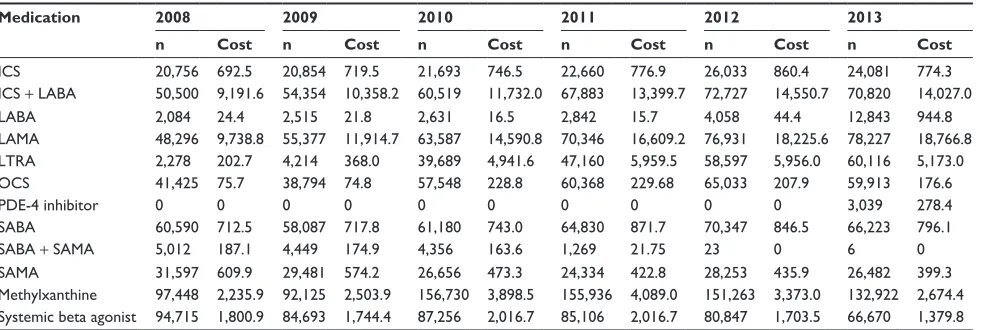
In Korea, the number of COPD patients increased by 13.9% from 184,059 to 209,579 since 2008 until 2013. The average number of prescribed medications for COPD also increased from 10.1 to 12.0 (Table 1). The total cost of COPD-related medication increased by 78.2% ($20,787,780). The cost of COPD medication per person increased from $138.4 in 2008 to $216.6, a 56.5% increase over 6 years. Table 2 shows the cost of medication pre-scribed for COPD per patient and its change. Table 3 shows the changes in the pattern of medication prescriptions for COPD from 2008 to 2013.
long-acting bronchodilators (laBa
and laMa)
Indacaterol was approved for use in Korea in 2010. Before then, LABA was rarely prescribed. In 2008, LABA inhalers were dispensed to only 1.1% (2,084) of the COPD patients. In 2013, 6.1% (12,843) of the Korean COPD patients were prescribed LABA, an 83.8% increase over 6 years (Figure 1). Prescriptions for LAMA increased gradually as well. In 2008, LAMA inhalers were dispensed to 26.2% (48,296) of COPD patients in Korea, and this increased to 37.3% (78,227) in 2013 (Figure 2). The cost of LAMA accounted for the larg-est proportion of the cost of COPD medication over 6 years. The total cost of LAMA increased from $9,738,800 in 2008 to $18,766,800 in 2013, a 92.3% increase over the 6 years (Table 3).
ICs
In 2008, ICS-only inhalers were dispensed to 11.3% (20,756) of patients, and this increased gradually, but decreased after
Table 1 number of COPD patients and prescriptions of each medication from 2008 to 2013
2008 2009 2010 2011 2012 2013
number of patients 184,059 180,334 211,148 217,624 224,889 209,579
number of prescriptions per patient each yeara
71.2 71.6 70.6 69.7 74.1 73.8
number of prescriptions for COPD per patient each yearb
10.1 10.0 11.6 11.5 11.9 12.0
Notes:aaverage number of all medications prescribed to a patient with COPD per year. baverage number of COPD medications prescribed to a patient with COPD per year.
International Journal of Chronic Obstructive Pulmonary Disease downloaded from https://www.dovepress.com/ by 118.70.13.36 on 22-Aug-2020
Dovepress analysis of the trend of COPD medical cost and utilization
2012 (Figure 3). In parallel, the total cost of ICS-only inhalers increased from $692,500 in 2009 to $860,400 in 2012, but decreased to $774,300 in 2013.
ICs plus laBa
In 2008, 27.4% (50,500) of patients with COPD were dis-pensed ICS + LABA, and this increased to 32.3% (72,727) in 2012, but decreased from 2012 to 2013 (Figure 4). The total cost of ICS + LABA gradually increased from 2008 to 2012, but decreased from $14,550,700 in 2012 to $14,027,000 in 2013 (Table 3).
PDe-4 inhibitor
Roflumilast is the only PDE-4 inhibitor approved in Korea. In 2013, it was approved for reimbursement in Korea as an add-on therapy for COPD. In 2013, 1.5% (3,309) of the
patients with COPD were prescribed roflumilast at a total cost of $278,400 (Table 3 and Figure 5).
lTra
LTRA is a well-known medication for asthma. Although LTRA is not recommended for patients with COPD in guideline, it is widely used for patients with asthma−COPD overlap syndrome.10,11 In 2013, 26.7% (60,116) of patients
with COPD were dispensed LTRA, an increase from 1.2% (2,278) in 2008 (Figure 6).
OCs
Among the people who were given any medications indi-cated for the treatment of COPD in 2013, 28.6% had been dispensed OCS, an increase from 22.5% in 2008 (Figure 7). As shown in Table 3, the total cost of OCS increased gradu-ally from $75,700 in 2008 to $229,680 in 2011, but decreased after 2011 to $176,600.
short-acting bronchodilators
In 2008, 32.9% of the Korean COPD patients were prescribed SABA, and the proportion of COPD patients using SABA has remained steady since 2008 (Figure 8). The total cost of SABA increased gradually from $712,500 in 2008 to $871,700 in 2011, but has decreased slightly since 2012 (Table 3). In 2012, 12.6% of patients with COPD were prescribed an SAMA, a gradual decrease from 17.2% in 2008 (Figure 9). The total cost of SAMA also decreased from $609,900 in 2008 to $399,300 in 2013. In 2008, combined SABA + SAMA was prescribed to 27% of the patients with COPD in Korea; however, the number of SABA + SAMA prescriptions decreased markedly from 2011 to 2013 as the manufacture of SABA + SAMA was discontinued in Korea since 2011 (Figure 10).
Table 2 Changes in the cost of prescribed medication for COPD per patient over the 6 years (all costs are in Us dollars)
Medication 2008 2009 2010 2011 2012 2013
ICs 33.5 34.7 34.6 34.4 33.2 32.3
ICs + laBa 182.9 191.5 194.8 198.3 201 199
laBa 11.7 8.7 6.2 5.7 11 73.9
laMa 202.6 216.2 230.5 237.2 238 241
lTra 89.2 87.7 125.1 127 102.1 86.5
OCs 1.8 1.9 4 3.8 3.2 3
PDe-4 inhibitor 0 0 0 0 0 92.1
saBa 11.8 12.4 12.2 13.5 12.1 12.1
saBa + saMa 37.6 39.5 37.7 17.2 9.2 10.1
saMa 19.4 19.6 17.9 17.5 15.5 15.1
Methylxanthine 23.1 27.3 25 26.3 22.4 20.2
systemic beta agonist 19.1 20.7 23.2 23.8 21.2 20.8
Abbreviations: ICs, inhaled corticosteroid; laBa, long-acting beta-2 agonist; laMa, long-acting muscarinic antagonist; lTra, leukotriene receptor antagonist; OCs, oral corticosteroid; PDe-4, phosphodiesterase-4; saBa, short-acting beta-2 agonist; saMa, short-acting muscarinic antagonist.
Table 3 Change in the number of prescriptions and cost over the 6 years (all costs are in Us$1,000)
Medication 2008 2009 2010 2011 2012 2013
n Cost n Cost n Cost n Cost n Cost n Cost
ICs 20,756 692.5 20,854 719.5 21,693 746.5 22,660 776.9 26,033 860.4 24,081 774.3
ICs + laBa 50,500 9,191.6 54,354 10,358.2 60,519 11,732.0 67,883 13,399.7 72,727 14,550.7 70,820 14,027.0
laBa 2,084 24.4 2,515 21.8 2,631 16.5 2,842 15.7 4,058 44.4 12,843 944.8
laMa 48,296 9,738.8 55,377 11,914.7 63,587 14,590.8 70,346 16,609.2 76,931 18,225.6 78,227 18,766.8
lTra 2,278 202.7 4,214 368.0 39,689 4,941.6 47,160 5,959.5 58,597 5,956.0 60,116 5,173.0
OCs 41,425 75.7 38,794 74.8 57,548 228.8 60,368 229.68 65,033 207.9 59,913 176.6
PDe-4 inhibitor 0 0 0 0 0 0 0 0 0 0 3,039 278.4
saBa 60,590 712.5 58,087 717.8 61,180 743.0 64,830 871.7 70,347 846.5 66,223 796.1
saBa + saMa 5,012 187.1 4,449 174.9 4,356 163.6 1,269 21.75 23 0 6 0
saMa 31,597 609.9 29,481 574.2 26,656 473.3 24,334 422.8 28,253 435.9 26,482 399.3
Methylxanthine 97,448 2,235.9 92,125 2,503.9 156,730 3,898.5 155,936 4,089.0 151,263 3,373.0 132,922 2,674.4 systemic beta agonist 94,715 1,800.9 84,693 1,744.4 87,256 2,016.7 85,106 2,016.7 80,847 1,703.5 66,670 1,379.8
Abbreviations: ICs, inhaled corticosteroid; laBa, long-acting beta-2 agonist; laMa, long-acting muscarinic antagonist; lTra, leukotriene receptor antagonist; OCs, oral corticosteroid; PDe-4, phosphodiesterase-4; saBa, short-acting beta-2 agonist; saMa, short-acting muscarinic antagonist.
International Journal of Chronic Obstructive Pulmonary Disease downloaded from https://www.dovepress.com/ by 118.70.13.36 on 22-Aug-2020
Dovepress lee et al
<HDU 3DWLHQWV
Figure 1 Change in the number of laBa prescriptions over the 6 years.
Abbreviation: laBa, long-acting beta-2 agonist.
<HDU 3DWLHQW V
Figure 2 Change in the number of laMa prescriptions over the 6 years.
Abbreviation: laMa, long-acting muscarinic antagonist.
<HDU 3DWLHQW V
Figure 3 Change in the number of ICs prescriptions over the 6 years.
Abbreviation: ICs, inhaled corticosteroid.
<HDU 3DWLHQWV
Figure 6 Change in the number of lTra prescriptions over the 6 years.
Abbreviation: lTra, leukotriene receptor antagonist.
<HDU 3DWLHQWV
Figure 4 Change in the number of ICs + laBa prescriptions over the 6 years.
Abbreviations: ICs, inhaled corticosteroid; laBa, long-acting beta-2 agonist.
<HDU 3DWLHQW V
Figure 5 Change in the number of PDe-4 inhibitor prescriptions over the 6 years.
Abbreviation: PDe-4, phosphodiesterase-4.
<HDU 3DWLHQWV
Figure 7 Change in the number of OCs prescriptions over the 6 years.
Abbreviation: OCs, oral corticosteroid.
<HDU 3DWLHQWV
Figure 8 Change in the number of saBa prescriptions over the 6 years.
Abbreviation: saBa, short-acting beta-2 agonist.
International Journal of Chronic Obstructive Pulmonary Disease downloaded from https://www.dovepress.com/ by 118.70.13.36 on 22-Aug-2020
Dovepress analysis of the trend of COPD medical cost and utilization
<HDU
3DWLHQWV
Figure 9 Change in the number of saMa prescriptions over the 6 years.
Abbreviation: saMa, short-acting muscarinic antagonist.
<HDU
3DWLHQWV
Figure 10 Change in the number of saBa + saMa prescriptions over the 6 years.
Abbreviations: saBa, short-acting beta-2 agonist; saMa, short-acting muscarinic antagonist.
Methylxanthine
Methylxanthine has been the most widely prescribed medica-tion for the management of COPD in Korea between 2008 and 2013. A total of 52.9% of patients with COPD were pre-scribed methylxanthine in 2008, and the proportion increased to 74.2% in 2010. In 2013, methylxanthine was dispensed to 63.4% of patients with COPD in Korea (Figure 11). The total cost of methylxanthine increased from $2,235,900 in 2008 to $4,089,000 in 2011 and then decreased to $2,674,400 in 2013 (Table 3).
systemic beta agonist
Although systemic beta agonist is not recommended for the treatment of COPD, it was prescribed to 51.5% of patients with COPD in 2008. As shown in Figure 12, the proportion of patients who were prescribed systemic beta agonist decreased to 31.8% in 2013. The total cost of systemic beta agonist also decreased from $1,800,900 in 2008 to $1,379,800 in 2013 (Table 3).
Discussion
In this nationwide study, we used Korean HIRA data to analyze cost and utilization of COPD medication in Korea.
<HDU
3DWLHQWV
Figure 11 Change in the number of methylxanthine prescriptions over the 6 years.
<HDU
3DWLHQWV
Figure 12 Change in the number of systemic beta agonist prescriptions over the 6 years.
The number of COPD patients increased by 22.2% from 2008 to 2012. This increase is partly related to an increase in the elderly population in Korea.12 Improved physician
under-standing of COPD may have contributed to the increase in the number of COPD patients until 2012. During the study period, the cost of COPD medication increased by 78.2%, mainly due to increase in prescription rates for LAMA and ICS + LABA, which are more expensive than other COPD medications.
This study found that oral medications such as methylx-anthine and systemic beta agonist were widely prescribed, while inhaled medications such as LABA, LAMA, and ICS + LABA were dispensed to a relatively low proportion of patients with COPD. Although the use of methylxanthine is recommended when the symptom of breathlessness remains despite the use of inhaled bronchodilators,13 it is
not a major medication in the treatment of COPD. However, methylxanthine was the most commonly prescribed COPD medication over 6 years in Korea. This reflects the poor compliance to current treatment guidelines for COPD in real clinical practice. There are several possible explanations for this discrepancy between the COPD guideline and real practice. One study reported that primary care physicians (PCPs) in Korea preferred oral to inhaled medication for
International Journal of Chronic Obstructive Pulmonary Disease downloaded from https://www.dovepress.com/ by 118.70.13.36 on 22-Aug-2020
Dovepress lee et al
both stable COPD and acutely exacerbated COPD.14 It
is mainly because the reimbursement criteria for inhaler medication for COPD are based on the spirometry results. Therefore, without spirometry results, it is difficult to prescribe inhalers to COPD patients in Korea. Although a diagnosis of COPD by spirometry is essential for prescrib-ing inhaled medication in Korea, the use of spirometry by PCPs was low.14 It is also possible that PCPs felt constrained
by the amount of time it would take to teach correct use of inhaled medications in a primary care setting, although education is necessary to ensure the effectiveness of inhaled medications.
Nevertheless, the results show that there has been a steady improvement in this discrepancy. The number of patients who were prescribed inhalers increased between 2008 and 2013, while the number of patients prescribed systemic beta agonist and methylxanthine has decreased since 2010.
There are some limitations to this study. First, no pul-monary function test results were available. Therefore, the enrolled patients did not have proven diagnoses of COPD, and the severity of COPD could not be assessed based on spirometry. Second, since the data analyzed were based on the pharmacy records of dispensed prescriptions, adher-ence to the prescribed medication was not measured in this study. Non-adherence to COPD therapy is widespread and a significant risk factor for morbidity and mortality.15
Underuse of medications is common, with reports that up to 49.4% of COPD patients are not taking their medications as prescribed.16–18 A further study with more focus on adherence
is therefore recommended. Third, data on smoking history and environmental or occupational exposure were not avail-able, so the cause of the COPD is unknown in the patients enrolled in this study.
Conclusion
Analysis of the Korean NHI database shows that there is a large gap between the COPD guidelines and clinical prac-tice in Korea. The problems we have highlighted include evidence of substantial over- and underuse of certain classes of medications when compared with the COPD guidelines for the appropriate use of these medications. These findings are important in terms of both the missed opportunities for improved disease control and the additional cost burden and risk of adverse effects imposed by the incorrect use of medications. Although there might be various reasons for the deviation between the guidelines and the clinical practice, they could not be analyzed in this study due to
the limitation of nature of claim data. Further investiga-tion into the factors that could affect this discrepancy will be needed.
Acknowledgment
This study was conducted as a part of the project “The trend of medication utilization and adherence to medication among patients with chronic conditions − case of COPD” by HIRA.
Disclosure
CKR received consulting/lecture fees from MSD, Astra-Zeneca, Novartis, GSK, Takeda, Mundipharma, Sandoz, Boehringer-Ingelheim, and Teva-Handok. The other authors report no conflicts of interest in this work.
References
1. Mathers CD, Loncar D. Projections of global mortality and burden of
disease from 2002 to 2030. PLoS Med. 2006;3(11):e442.
2. Guarascio AJ, Ray SM, Finch CK, Self TH. The clinical and economic
burden of chronic obstructive pulmonary disease in the USA.
Clinico-econ Outcomes Res. 2013;5:235−245.
3. Halbert RJ, Natoli JL, Gano A, Badamgarav E, Buist AS, Mannino DM.
Global burden of COPD: systematic review and meta-analysis. Eur
Respir J. 2006;28(3):523−532.
4. Pena VS, Miravitlles M, Gabriel R, et al. Geographic variations in prevalence and underdiagnosis of COPD: results of the IBERPOC
multicentre epidemiological study. Chest. 2000;118(4):981−989.
5. Pauwels RA, Rabe KF. Burden and clinical features of chronic
obstruc-tive pulmonary disease (COPD). Lancet. 2004;364(9434):613−620.
6. Lee YH, Yoon SJ, Kim EJ, Kim YA, Seo HY, Oh IH. Economic burden
of asthma in Korea. Allergy Asthma Proc. 2011;32(6):35−40.
7. Kim C, Yoo KH, Rhee CK, et al. Health care use and economic burden of patients with diagnosed chronic obstructive pulmonary disease in
Korea. Int J Tuberc Lung Dis. 2014;18(6):737−743.
8. Kim J, Lee JH, Kim Y, et al. Association between chronic obstructive pulmonary disease and gastroesophageal reflux disease: a national
cross-sectional cohort study. BMC Pulm Med. 2013;13:51.
9. Kim J, Rhee CK, Yoo KH, et al. The health care burden of high grade chronic obstructive pulmonary disease in Korea: analysis of the Korean
Health Insurance Review and Assessment Service data. Int J Chron
Obstruct Pulmon Dis. 2013;8:561−568.
10. Rhee CK, Yoon HK, Yoo KH, et al. Medical utilization and cost in patients with overlap syndrome of chronic obstructive pulmonary
disease and asthma. COPD. 2014;11(2):163−170.
11. Rhee CK. Phenotype of asthma-chronic obstructive pulmonary disease
overlap syndrome. Korean J Intern Med. 2015;30(4):443−449.
12. South Korea: Age structure between 2004 and 2014. Available from: https://www.statista.com/statistics/242558/age-distribution-in-south-korea/. Accessed October 31, 2016.
13. Vestbo J, Hurd SS, Agusti AG, et al. Global strategy for the diagnosis, management, and prevention of chronic obstructive pulmonary
dis-ease: GOLD executive summary. Am J Respir Crit Care Med. 2013;
187(4):347−365.
14. Park MJ, Choi CW, Kim SJ, et al. Survey of COPD management
among the primary care physicians in Korea. Tuberc Respir Dis. 2008;
64(2):109−124.
15. Cochrane GM. Therapeutic compliance in asthma; its magnitude and
implications. Eur Respir J. 1992;5(1):122−124.
International Journal of Chronic Obstructive Pulmonary Disease downloaded from https://www.dovepress.com/ by 118.70.13.36 on 22-Aug-2020
International Journal of COPD
Publish your work in this journal
Submit your manuscript here: http://www.dovepress.com/international-journal-of-chronic-obstructive-pulmonary-disease-journal The International Journal of COPD is an international, peer-reviewed
journal of therapeutics and pharmacology focusing on concise rapid reporting of clinical studies and reviews in COPD. Special focus is given to the pathophysiological processes underlying the disease, intervention programs, patient focused education, and self management protocols.
This journal is indexed on PubMed Central, MedLine and CAS. The manuscript management system is completely online and includes a very quick and fair peer-review system, which is all easy to use. Visit http://www.dovepress.com/testimonials.php to read real quotes from published authors.
Dovepress
Dove
press
analysis of the trend of COPD medical cost and utilization
18. Turner J, Wright E, Mendella L, Anthonisen N. Predictors of patient adherence to long-term home nebulizer therapy for COPD. The IPPB
Study Group. Intermittent Positive Pressure Breathing. Chest. 1995;
108(2):394−400. 16. James PN, Anderson JB, Prior JG, White JP, Henry JA, Cochrane GM.
Patterns of drug taking in patients with chronic airflow obstruction.
Postgrad Med J. 1985;61(711):7−10.
17. Corden ZM, Bosley CM, Rees PJ, Cochrane GM. Home nebulized therapy for patients with COPD: patient compliance with treatment
and its relation to quality of life. Chest. 1997;112(5):1278−1282.
International Journal of Chronic Obstructive Pulmonary Disease downloaded from https://www.dovepress.com/ by 118.70.13.36 on 22-Aug-2020