Developing a National Qualifications
Framework in Qatar
Research Report 1 (V.2)
Paul Grainger, Ann Hodgson, Tina Isaacs and Ken Spours
Institute of Education, University of London
Section A. Introduction
1. This research paper is intended to assist with the development of a National Qualifications Framework (NQF) for Qatar. The paper does this by summarising the main contextual factors in Qatar that might influence the development of an NQF; surveying international developments in relation to more than a 100 NQFs that have emerged or are the process of being created, and the main lessons to be learned, focusing in particular the NQF architecture of three small states - Bahrain, United Arab Emirates and Malta - two of which are situated in the Gulf Region. The paper concludes with a summary of the
implications of the international research to the conditions of Qatar and the policy goals the Qatar Government have established in this area and key questions for upcoming in-country research and consultation.
2. This report builds on the work of the Qualification Framework Group, of SECs
Vocational Education and Training Consultative Committee that undertook initial research on an NQF to meet Qatar’s economic and societal needs (SEC, 2010). The main findings and implications of this scoping work and the direction of travel it envisages for an NQF for Qatar is analysed in Section E.
3. At this stage, this initial IOE/Pearson research paper, while acknowledging the broad thinking of the Qualification Framework Group, does not go as far as suggesting concrete options for development of a Qatari NQF. Instead, it focuses on a set of key questions for research and consultation with Qatari stakeholders. However, heeding lessons from international research, the paper does exercise a preference for a balance of ‘process and architecture’. By this we are referring to a recognition that the successful establishment of an NQF is not simply the result of adopting the most appropriate technical design, but crucially requires the creation of a design and implementation strategy that relates to national conditions; is reinforced by other reforms; identifies early areas of joint action to improve the education, training and employment system and engages with all stakeholders, involving them in the actual development of an NQF.
Section B. The Qatar context
1. Historical and political backgroundof Justice. Arabic is the official language, English a common second language. Much of the land is barren, only two per cent given to agriculture, 96 per cent of the population is urban, concentrated in the capital city Doha. The traditional economy was based on fishing, pearls and trade. Oil and gas reserves revolutionised the economy from the 1920s, and in
particular from 1950 onwards. Qatar now has the highest per capita income (except maybe Liechtenstein) but distribution is uneven. At present levels of production of oil will last for 50 years. Gas reserves are larger, 13 per cent of the world total. Other industries include refining, ammonia, fertilizers, petro-chemicals, steel, ship repair, cement and
communications. Exports go largely to Asia, but imports are high from the US and Europe (CIA 2012). It is planned that the 2022 World Cup will lead to further infrastructural
development (NDS, 2011).
1.2 Qatar could be described as a ‘small state, with a population estimated at two millions. However, fewer than 300,000 are Qatari citizens, 20 per cent of the potential workforce. Migrant labour includes Arab 40 per cent, Indian 18 per cent, Pakistani 18 per cent and Iranian 10 per cent. Migrant workers require a sponsor, who has power over income and movement. The Government has concluded that this is sometimes abused (QNV, 2008). The population is growing at nearly five per cent annually largely through immigration. The median age is 32 and 22 per cent of the population is under 14 (CIA, 2012).
1.3 The Head of State since 1995 is Emir Hamad bin Khalifa Al Thani. Men and women have the vote from 18. There is no conscription. The Emir has authority in all matters, advised by the 45-seat Majlis al-Shura (30 members elected, elections are scheduled for 2013). A new constitution came into force in 2005 and in May 2011 there were nationwide elections for the Central Municipal Council (CMC), which has limited authority to improve municipal services. There are no political parties (CIA, 2012).
1.4 Although governed by various powers over time, Qatar has a history of pro-actively preserving independence through judicious alliances. It was a British protectorate until independence in 1971, considering, but choosing not to join the United Arab Emirates. Qatar supported the US in the Gulf War, the invasion of Iraq, and the NATO-led intervention in Libya. Its present stance on the Arab Spring continues this tradition of seeking balanced relations with influential powers, but the present conflict in Syria has caused difficulty reconciling the interests of the US and nearby Iran (Steinberg, 2012).
democratisation and democratic institutions. Qatar is sympathetic to reform and has established universal suffrage. The opportunity for a leading role within the Arab League has been taken: its recent presidency being seen by some commentators as decisive leadership (Christian Science Monitor, 2012; Steinberg, 2012). Ownership of Al Jazeera puts Qatar at the centre of Islam-orientated communications, reflecting its regional and global geo-political ambitions.
1.6 Qatar’s educational record is mixed. Enrolment in primary education is 100 per cent, but only 68 per cent for secondary. Completion rates are 90 per cent for males and 87 per cent for females. The literacy rate for 15-24 year olds is 98 per cent (Reiss et al. 2011). Recent research, however, has suggested that the education system for kindergarten to grade 12 (K–12), does not adequately prepare Qataris for work or post-secondary study (Stasz et al., 2007). Most Qataris in employment work for the government and receive high levels of welfare support. Women generally have higher educational achievement, but employment opportunities are more restricted. Employers in the private sector have been compelled to look to migrant workers to fill the high-skill jobs that drive the economy.
1.7 Developing education is, understandably, a high national priority and Qatar has recently developed an Education City to seek to promote higher levels of achievement for Qatari citizens (Stasz et al., 2007). It could be argued, therefore, that the current
performance of the education and training system, and the relationship between it and the labour market fails to match the economic and geo-political ambitions of the country both regionally and globally. Nor does it appear currently to contribute sufficiently to the path of long-term economic sustainability.
2.
Strategic aims and objectives in education
2.1 In 2008 the General Secretariat for Development Planning issued the Qatar National Vision (QNV) seeking to create an advanced, self-sustaining country by 2030. Within the context of its present oil wealth it sees five challenges:
modernization and preservation of tradition
the needs of this generation and the needs of future generations managing growth and uncontrolled expansion
the size and quality of the expatriate labour force
2.2 The Qatar Government recognizes that the present hydrocarbon wealth is
unsustainable. The challenge of modernisation versus heritage is confronted, particularly with regard to the role of women playing a full role in society. There is an insistence on religion, culture, family and the recognition of leading dynasties. The presence of a two-thirds and rapidly expanding majority of migrant workers with limited freedoms and economic security is potentially destabilising. The future role of citizens and the role of migrant groups are discussed in key policy documents. Moreover, the QNV also recognises a legacy of poor educational performance. Pisa returns of 2008 show Qatar trailing behind other OECD countries. In this context, the 21 key outcomes of the NDS are specific, focused, and chart a way forward.
2.3 The subsequent vision rests on four pillars - human development; social development; economic development and environmental development. The QNV
recognises that post oil, the economy must be knowledge-based and that education, health and extending the rights and safety of expatriate labour are fundamental. It calls for:
a curriculum responding to labour market needs, individual aspirations, and access to lifelong learning
a network of programmes that foster Qatari ethical and moral values and heritage, a sense of citizenship, innovation, culture and sport
self managing, accountable institutions
research including an international role in science and cultural activity.
2.4 It states that participation of Qataris in the workforce will involve investment in training for all citizens, incentives for Qataris to enter professional and management roles in both the private as well as public sectors, increased opportunities and vocational support for Qatari women, recruitment of the right mix of expatriate labour, protecting rights and security and retaining those with outstanding skills. The report also emphasises the second pillar, social development, which calls for effective institutions, tolerance, a social and economic role for women within the context of a strong family structure, and preservation of the role of leading Qatari families.
2.5 The first stage of the QNV is the National Development Strategy (NDS) 2011–2016, which identifies five challenges for education and training:
under-achievement in maths, science and English language poor administration and poor preparation of teachers
low standards in some private schools
inadequate pathways beyond secondary level.
2.7 In response, five programmes have been established:
core and cross-cutting education and training improving K–12 general education
improving higher education
strengthening technical and vocational education and training enhancing scientific research.
2.8 These have been further split into 21 key outcomes. Of relevance to this project, Outcome 8 calls for an NQF; an oversight body for occupational standards and the creation of new pathways in tertiary education. Outcome 9 discusses institutional capacity to improve quality. Outcome 18 calls for an organisational model to support TVET and Outcome 19 for the alignment of education to labour market and societal needs. Each of these has a detailed strategic plan for implementation and monitoring 2012–2016.
2.9 The Qatar Government, through its Supreme Education Council (SEC), sees the proposed NQF as aligning (tertiary) education and training with labour market needs, enabling alternative pathways to tertiary education and the labour market to be developed and implemented, together with the establishment of occupational standards for relevant professions in Qatar (SEC, 2012). Central to this will be the creation of a National Qualifications Authority to oversee the national framework.
2.10 As part of this work, it is anticipated that an NQF will enable stakeholders, educators, employers and individuals to compare the levels of qualifications from different countries and different parts of the education and training system in Qatar and also to provide a basis for the development of Qatari vocational qualifications.
2.12 It is envisaged that the work to establish the NQF will proceed through a number of stages:
a. a review of best international practices including those from GCC states
b. consultation with stakeholders around the findings and discussion of options for reform
c. agreement of an NQF structure, including the locus of a National Qualifications Authority
d. drawing up a ‘complete’ NQF for Qatar.
This paper relates to stage (a) and will form the basis for fieldwork in September and October 2012.
Section C. The experience of National Qualifications Frameworks (NQFs) over
the past 25 Years – an international review
1. Introduction
1.1 This section of the report provides a review of the major international literature on the development of NQFs over the last 25 years. It draws in particular on the work
commissioned by the OECD, the International Labour Organisation (ILO) and CEDEFOP (The European Centre for the Development of Vocational Training), but also uses a number of academic journal articles. The review begins with a brief historical analysis, which is followed by a summary of the aims of NQFs and expectations governments have of them. Key common technical features of NQFs are identified and some important conceptual distinctions are drawn. These, together with the main lessons emerging from the
international research, inform potential approaches to the development of an NQF and some initial questions for establishing a baseline for research, design and implementation in Qatar.
2. History and phases of development of NQFs
2.1 The intellectual roots of NQFs lie in the competence-based approach to vocational education and training (Jessup 1991), which drew on American behaviourist psychology. This informed the development of NQFs, in particular in the five ‘early starter’ countries - England, Scotland, NZ, South Africa and Australia. Because these are the only long-standing examples of NQFs, it is these that have been primarily referred to in the
(2009a) characterize as a neoliberal approach towards education and training in which NQFs encompassed increased central control, promotion of the role of markets in education, developing outcomes-based qualifications, reducing the role of institutions in defining
qualifications and, with a rhetoric of giving learners and employers more power. Tuck (2007: 64) defines ‘outcomes-based’ qualifications as those that ‘are based on clear statements of what the learner must know or be able to do’. Often in vocational education and training these are related to occupational standards.
2.2 There are now over 100 NQFs at various stages of development (e.g.
long-established, newly long-established, those in the process of construction and those that are under consideration). Globally, NQFs are seen as a common solution in very different countries with varying economic, social and cultural conditions. In an increasingly globalised world, they appear to be a logical development because they respond to the need for portability of qualifications and the growing internationalization of higher education and the labour market. Moreover, in many countries they have been linked with the popular goal of promoting lifelong learning (OECD 2007). As Drowley and Marshall (2010: 2) argued the discourse around NQFs, therefore, appeals to ‘common sense’ and it is difficult to criticize their
laudable aims, such as providing information about qualifications to all stakeholders; parity of esteem for different types of learners; widening participation; flexibility and portability of learning opportunities and qualifications. Recognising these potentially progressive
functions of NQFs, Young (2007: 446) stated, ‘There will continue to be support for national, regional and increasingly international qualifications frameworks as a response to the
increasingly global character of labour markets and systems of higher education’. As part of this, greater momentum has been achieved in the development of NQFs in recent years due to the emergence of cross-national or regional meta-systems (e.g. the European
Qualifications Framework).
2.3 Underpinning all of these developments there has been a ‘shift to outcomes’ in terms of how qualifications are conceptualised (Cedefop, 2008) with qualifications being seen as major drivers of education and training reform (Allais et al., 2009b). But the approach to NQFs in the later models, such as those in some European countries, is more likely to be concerned with inputs as well as outcomes.
2.4 International evaluation studies have tended to focus on the mechanics and
to be learnt. As we will see, a consideration of the national context of implementation and an agreement between all social partners about the specific problems an NQF is designed to tackle are the two fundamental issues that emerge from the literature to date.
3. System purposes and objectives
3.1. Governments have multiple aspirations and motivations for wanting NQFs. The more critical literatures have noted that NQFs are often seen as a panacea or as ‘utopias’. Allais’s (2010) review of 16 systems identified no fewer than 21 major policy aims for NQFs of which she listed a leading nine, including promoting progression and lifelong learning, labour market flexibility and mobility, system building and developing a ‘common language’ between different stakeholders. Bjornavold and Pervec-Grm (2012) and Raffe (in Allais et al., 2009a) also identified nine objectives of particular importance, transparency being the main one, while Young (2007) distilled these down to three - ‘transparency, progression and portability’.
3.2 Often NQFs function as ‘instruments of reform’ (Allais et al., 2009a). In particular national cases, they are conceived as marking a key political transition (e.g. the ending of Apartheid in South Africa). In others, arguably the more successful ones, NQFs constitute a further step in an evolving process of education system reform (Young 2007).
3.3 In discussing the purposes of NQFs and the role of national context, Raffe (2009) makes an important point about the dangers of ‘policy borrowing’ – that is where a development in one country is uncritically adopted wholesale by another. Allais (2010) suggests that there is substantial evidence of policy borrowing without considering differences in contexts and how a particular NQF has been developed. This has led to a tendency towards policy borrowing of the ‘written model’ of the framework rather than ‘policy learning’ that recognizes the importance of the surrounding conditions (Raffe, 2009).
3.4 In terms of a policy learning approach, national contextual factors are seen as equally important as issues of design. Raffe (2011b), cited in Bjornavold and Pervec-Grm (2012), suggested six major contextual factors that have influenced the development of NQFs in different countries:
a. Size
b. Diversity of education system c. Governance
e. Structure of the labour market f. Culture of policy-making.
4. Key technical or architectural features of NQFs
4.1 Tuck makes a helpful distinction between qualifications frameworks and systems, in which the former is a component of the latter because the second includes ‘all of the
activities that result in the recognition of learning (e.g. policy, institutional arrangements and quality assurance and awarding processes)’ (2007: v). He thus defines an NQF as:
‘an instrument for the development, classification and recognition of skills, knowledge and competencies along a continuum of agreed levels. It is a way of structuring existing and new qualifications, which are defined by learning outcomes, i.e. clear statements of what the learner must know or be able to do whether learned in a classroom, on-the-job, or less formally. The Qualifications Framework indicates the comparability of different qualifications and how one can progress from one level to another, within and across occupations or industrial sectors (and even across
vocational and academic fields if the NQF is designed to include both vocational and academic qualifications in a single framework’ (Tuck 2007: v).
4.2 The NQFs developed thus far appear to comprise most if not all of the key architectural or governance features listed below:
a. Purposes – they are underpinned by a set of aims and purposes which, as we have seen, are often wide-ranging and even unrealistic.
b. Scope – NQFs can be comprehensive (i.e. they aim to contain all types of learning in all settings) or partial (e.g. focused on vocational education). Most NQFs emerging since 2005 have attempted to include all levels and all types of learning - vocational education and training, general/academic education, private training, adult and informal learning and international qualifications. Comprehensive frameworks can also contain ‘sub frameworks’ related to specific sectors (e.g. higher education or VET). Large countries may decide to focus on one sector first (normally VET), but small countries are more likely to be able to create a universal system (Tuck 2007). c. A single system of qualifications levels – NQFs comprise a number of levels
(normally between eight and 10), which are intended to be used as a system for grouping qualifications that are broadly equivalent.
level. Level descriptors can be used to describe and systematize existing qualifications and to inform criteria for the development of new ones.
e. Outcomes and a common approach to describing qualifications – the development of outcomes or competencies are seen as central to NQFs and have been a
fundamental part of their historical development and of developing a common approach to describing qualifications. However, they can be defined more narrowly or more broadly (e.g. occupational standards are normally defined more narrowly than competency standards). Nevertheless, they all refer to similar things, but competency is normally linked to the relationship between educational inputs and outcomes, whereas occupational standards are linked to current labour market practices.
f. Types of competences – outcome are generally classified under three broad headings – knowledge and understanding; skills; wider personal and professional competences. Across NQFs there has been a tendency in the later models to use ‘the third column’ of broader competences (these will be differently defined in
different systems) to incorporate notions of personal autonomy and responsibility and to capture how knowledge and skill are integrated in human actions.
g. Modular/unitised qualifications and a national system of credit accumulation and transfer - early NQFs featured modular/unitised qualifications in order to facilitate learner progression, to prevent repeating of learning and to meet specific employer training needs. These NQFs tend to work with units and to describe the volume of learning in terms of ‘notional learning hours’, which are then expressed as
quantifiable credit. The overall aim is often to develop a national system of credit accumulation and transfer to meet the needs of different social partners.
h. A national governance and co-ordination agency – NQFs tend to be governed by an independent authority accountable to national government (Allais 2010). These organisations differ in their operation, size and capacity, although they invariably have a quality assurance function. While national qualifications authorities are seen as essential for co-ordinating and quality assuring an NQF, they can come into conflict with existing forms of governance. The implementation of an NQF can thus be hindered by poor relationships between ministries and other agencies.
5. Important conceptual distinctions
for change in education and training and the introduction of an NQF is not an event but a lengthy process. Due to their dynamic and multi-dimensional nature (e.g. architecture and process), international literatures highlight a number of conceptual distinctions in the purposes and design of NQFs, which can help inform options and strategies for development.
5.2 Tight and loose - Raffe (in Allais et al., 2009a: 25) makes a distinction between tight and loose designs based on the stringency of the conditions a qualification must meet to be included in the framework. Tight frameworks would, for example, insist on all qualifications being based on outcomes. A number of problems can arise from this approach, for example higher education is more likely to be resistant because of its traditional role in devising and providing its own qualifications and vocational skills specified in this way tend to reflect current occupational standards rather than future ones. On the other hand, an NQF can play a looser organizing role in relation to ordering existing qualifications as well as creating qualifications from scratch. Young (2007: 451) has suggested that ‘A qualifications framework can have a positive role in policy development if it is designed as a guide to be used by stakeholders, and not as an instrument to regulate them’. Raffe has observed (2011) that tight frameworks have become looser over time and analysts increasingly recommend that NQFs should start at the looser end if possible, because tighter frameworks have faced the greatest problems of implementation. Tuck (2007: vi), in commenting on different national approaches has stated ‘small countries may prefer a unified-loose solution with a simpler national governance and management structure. The important point is to use a model that allows for sector differences within the single framework in a way, which suits the national circumstances’.
5.3 Top-down and bottom-up – Young (2007) has made a distinction between ‘top-down and bottom-up’ in terms of implementation. Scotland is regarded as bottom-up because it put building blocks in place and brought them together over time in the development of its NQF, whereas England, New Zealand and South Africa employed a top-down approach driven by a National Qualifications Authority as part of a wider strategy of the transformation of the public and privates sectors and wider society. Young suggested that there is an argument for a mixture of both in developing countries.
of provider-defined qualifications towards ones influenced by a broader group of users (government, learners and employers) in which providers are seen not as ‘definers’ of qualifications but ‘sellers’ of programmes that lead to qualifications (Raffe 2011: 9). In this scenario, Raffe (2011: 32) has argued that a tension can arise between the intrinsic logic of NQF criteria and principles and the ‘institutional logics’ of education and training providers.
5.5 Regulation and trust - linked to tight/loose, top-down/bottom-up and
institutional/outcomes models is the issue of trust both between stakeholders and between regulators and education professionals. Reflections on the development of NQFs have led to a recognition of the importance of ‘communities of practice’ (Cedefop, 2008) or
‘communities of trust’ (Coles, 2007). However, as Keating (2003) has noted, there is a contradiction in the way that many NQFs have been developed because they have aimed to give governments greater control over educational provision and, at the same time, to persuade learners and institutions that they will have greater control and choice.
5.6 Framework design and framework strategy - Young (2007) has argued that it is important to distinguish between ‘framework design’ and ‘framework strategy’. There has been a tendency for policy-makers to focus on framework design and the technical aspects of NQFs at the expense of ‘framework strategy’; that is the process of implementation and how the NQF can be effective in producing positive change at all its phases of development. A focus on framework strategy will tend to prioritise stakeholder involvement in order to create a new dialogue and dynamic, recognizing the importance of everyone being ‘on side’ so as to avoid the framework not being used across the whole education and training system.
5.7 Isolated and comprehensive policy approaches - there has been a tendency to see NQFs as an isolated powerful solution to a range of problems rather than as an important component of a wider approach to education and labour market reform. Framework strategies, mentioned above, on the other hand, tend to be comprehensive, comprising a range of policies (e.g. institutional, governance, labour market) that are integral to effective education system building and longer-term reform.
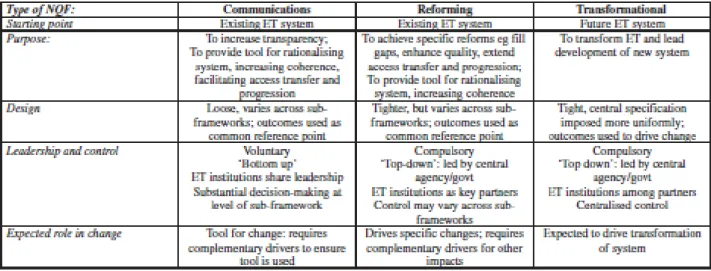
In this respect, ‘an NQF provides a new national language of learning, to be spoken by users and stakeholders as well as providers’ (Raffe, 2009: 32). The defining features of ‘reforming NQFs’ is that they are designed to address a particular problem or problems (e.g. extending access to adult learners) which need to be complemented by other policy drivers to achieve their goal. Transformational systems, as their name suggests, are designed to drive multiple changes across a system as a whole.
Figure 1. A typology of NQFs (Raffe 2011: 285)
6. Lessons from international research – conditions for success
Nine key messages emerge from the international literature on the development of NQFs, most of which are related to implementation rather than to design.
6.1 Understanding the national context and its significance – it is clear that the starting point for the development of an NQF is an analysis of the existing circumstances in that country, what it currently offers in terms of education and training, how this system might be improved and what new opportunities might be opened up by an NQF. In particular, there is a need to understand the differences between the reform requirements of established and of under-developed systems.
6.3 Engaging in policy learning rather than policy borrowing – an excessive emphasis on the technical aspects of NQFs can lead to policy borrowing. Policy learning, on the other hand, is more associated with an analysis of how more successful NQFs have emerged through an iterative process of implementation. Policy learning is associated, therefore, with the equality of design and process. There are now greater possibilities for policy learning and sharing than in the past because there are so many systems in diverse contexts and doing things differently. In particular, the literature suggests, it is important to take into consideration the experiences of those countries that have developed their NQFs more recently because they have had the benefit of learning lessons from the ‘early starters’ and may have achieved a better balance between different design elements and between the NQF and their national context.
6.4 Understanding that establishing an NQF is a technical, social and political act – Raffe (2009: 34) has argued that, ‘Once we recognize that the introduction of an NQF has social and political as well as technical dimensions, it becomes clear why it needs to be seen as a dynamic process and not as a simple matter of correct specification, design and installation’. He asserted that it is unwise to ignore the fact that NQFs have a political dimension in that by their very nature they regulate the education and training system and redistribute power. In the light of this, he has suggested that implementation has at least three dimensions – technical; socio-economic and political - and that these may be in tension with one another. Young (2005: 17) has noted how important it is to involve all the departments or ministries with oversight of education, labour, industry and trade because otherwise inter-departmental tensions can develop.
2012).
6.6 The centrality of quality assurance – Burke et al. (2009: 24) have asserted that quality assurance ‘is possibly the most central part of NQFs’. Tuck (2007) has elaborated on this by suggesting that there is a need to consider three aspects of quality assurance – validation of qualifications and/or standards; accreditation and audit of education and training institutions; and quality assurance of assessment leading to the award of qualifications. This suggests the importance of establishing a dedicated national qualifications authority with highly skilled officials and the need for capacity building across the education system more broadly.
6.7 Paying attention to the quality of institutions, capacity-building and inputs – because NQFs are only one strategy for improving national education and training systems and the relationship between education and the labour market, it is important to introduce
complementary strategies for strengthening the education and training providers, supporting the professional development of trainers and teachers and the building of
employer/education partnerships to establish high levels of trust. The most successful countries thus far have treated the development of their NQF as complementary to
improving institutional capability rather than separate from it. They have also attempted to balance a focus on outcomes with a concern for the quality of inputs (e.g. Young, 2007).
He has also warned against a tokenistic approach to building trust, ‘The development of such trust cannot be achieved simply by stating government policy and expecting
compliance. It means listening to stakeholders, seeking genuine consensus and – where necessary –accepting compromise’ (26). Working with stakeholders has also been
highlighted by Drowley and Marshall (2010), who have argued that developing the capacity of institutions is key to improving the communicative capacities of an NQF. Learning from the mistakes of the early starters, late starters in Europe (e.g. France and Germany) have emphasized deeper understanding and relationship between social partners.
6.9 Developing a pragmatic, incremental and iterative approach to policy and the implementation process – effectively developing an NQF is, therefore, a long and complex process. Allais (2010) has pointed to the tendency for governments to think ‘job done’ when they have developed a technical model of the NQF and an overseeing authority.
International evidence so far, however, has suggested that those governments that are pragmatic rather than ideological and take a longer-term view of development are more likely to successfully establish an NQF and to gain some of the benefits claimed for such
mechanisms.
7. Approaches to implementation
7.1 Creating a balance between the technical design of an NQF and its implementation process has been a central feature of the work of international experts who have been advising on the development of these frameworks. At this point and prior to the main fieldwork and consultation with stakeholders in Qatar, we identify three useful tools to provide a broad guide to design and implementation.
Figure 2. From purposes to implementation (Tuck 2007: 8)
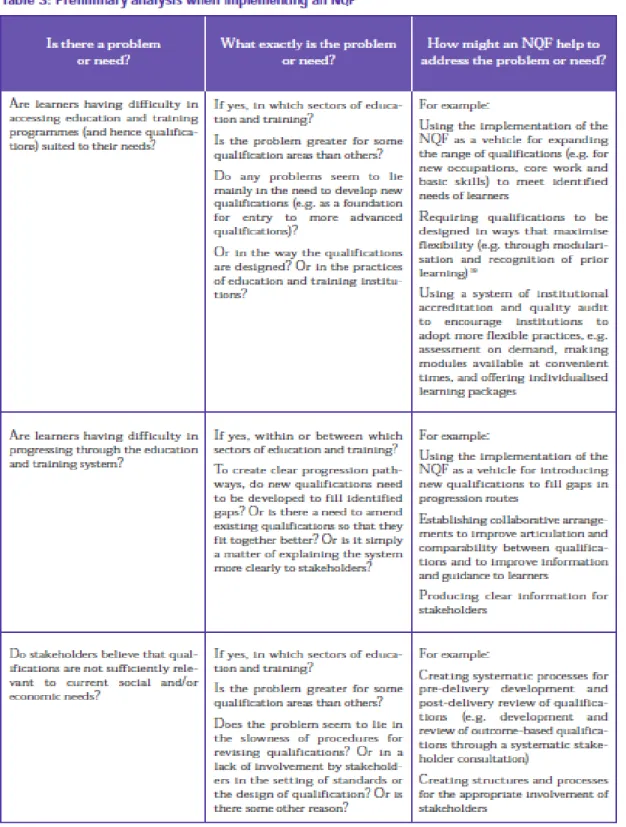
6.3 He also suggests a way of undertaking a preliminary analysis of needs when
Figure 3. Preliminary analysis when implementing an NQF
a. Long timescales
b. Stakeholder involvement and partnership c. Effective mechanisms for co-ordination d. A loose but variable design
e. Articulation of labour market demands
f. Iterative alignment – educational programmes and outcomes
g. A balance between sub-framework development and framework-wide development h. Policy breadth (alignment with wider policy development).
Section D. Creating NQFs in small states and across the Gulf Region: a review
of recent developments in Bahrain, the United Arab Emirates and Malta
1. Introduction
1.1 This section describes NQFs systems in three small states, one outside the region (Malta) and two within (Bahrain and the United Arab Emirates (UAE). In many ways the frameworks mirror each other, which is not surprising, since most NQF developers borrow policies, aims and structures from each other. They share the general purpose of providing information about qualifications in an easily accessible fashion to promote equality of
opportunity and widening participation – often using the language of parity of esteem across different types of learning – to reinforce underlying economic concepts, to support portability, mobility, transparency and flexibility and to enable comparison of qualifications across other countries and frameworks. All of them are learning outcomes based and expressed in levels of achievement (Drowley and Marshall, 2011).
2. Stated aims of the NQFs
All three frameworks are comprehensive and attempt to integrate vocational education and training, general education and higher education.
Malta
2.1 The goal of the qualifications framework in Malta is to promote life-long learning access and progression and to ensure that other countries recognise Malta’s professional and vocational certificates. The framework includes standards of knowledge, skills, competences and attitudes for each development sector and is based on the principle that the appropriate metric is not what a person has been taught, but what he or she is capable of doing. It therefore uses a learning outcomes approach. The Malta Qualifications
Bahrain
2.2 In 2009 the Scottish Qualifications Authority was commissioned by the Education Reform Board and Tamkeen (Bahrain’s economic development agency) to develop a Bahrain Qualifications Framework (BQF), the goal of which is to help people compare and understand qualifications within Bahrain. It was to be completed by the end of 2011. It is to provide access, mobility and progression into and between the education and training sectors, underpinned by a quality assurance system to ensure that qualifications are fit for purpose. Its vision is to lend credibility and recognise all learning, both locally and
internationally (Tamkeen and SQA, 2010c).
2.3 It is based on learning outcomes, with recognised progression pathways and aims to provide improved economic and social benefits and to promote transparency, equity and recognition of prior learning, thus reducing the barriers to learning and employment. The framework will be linked to other international frameworks. It will support accreditation of prior learning and is supposed to bridge the gap between academic and vocational qualifications (Tamkeen and SQA, 2010b).
UAE
2.4 The UAE qualifications framework (QFEmirates) aims to bring together qualifications across education providers and awarding bodies from many countries, including both
general and vocational education. The UAE hopes that the QFEmirates will help identify and address skills shortages and gaps and increase labour market opportunities in the context of educational and training policies that improve economic competitiveness (Akbakeri 2009).
2.5 The framework aims to enhance access to learning, to create new learning
pathways, to facilitate lifelong learning, to improve mobility and to recognise prior attainment, both informal and non-formal. Its aims and objectives include: developing a unified national qualifications strategy; establishing and maintaining standards and regulations for academic, professional and vocational qualifications (including HE); obtaining national and international accreditation; developing systems to assess learning outcomes; developing access and transfer arrangements; and developing national occupational standards that comply with the NQF (Akbakeri, 2009).
3. Approaches to qualifications and NQF development
certification. Malta and Bahrain include more general information on their websites, but it is possible to glean information about the approaches to qualifications development of all three countries.
Malta
3.2 The MQF takes existing academic, vocational and occupational qualifications and ascribes them to one of eight levels. In regards to vocational qualifications, the Malta Qualifications Council is the accreditation authority, and accredits programmes of study as well as institutions based on level descriptors, quality assurance mechanisms and pathways for further training and education. Occupational standards underpin vocational
qualifications. Formal, informal and non-formal learning can be validated; if a formal
education or training programme is validated, a certificate or diploma can be issued and the certification placed within the MQF. Assessment of prior learning can form part of the programme (Malta Qualifications Council, 2012c).
3.3 Malta defines qualifications as packages of learning that are worthy of formal
certificated recognition by a competent authority or awarding body. The size is not mandated and can be small – a single unit or module – or large – the outcome of a full-time, three-year course, so the definition is flexible and inclusive (Malta Qualifications Council, 2012d).
3.4 One of the underpinning theories of the framework is parity of esteem. The framework equates the full school leaving certificate (level 1) with a Vocational Education and Training (VET) Level 1 Certificate. The Malta Qualifications Council (MQC) recommends that a VET Level 2 Certificate should be considered equal to four Secondary Education Certificate (SEC) subjects at grade 6 or 7 and that Level 3 VET certificates equal six SEC subjects at grades 1 to 5 (Malta Qualifications Council, 2012b).
3.5 The qualifications system in Malta includes credit accumulation and transfer. Each qualification has a number of credits associated with it. The Malta Credit Transfer System for VET defines one credit as study that is equivalent to the learning outcomes a learner would achieve through a period of 25 hours of learning – regardless of the learning context (direct teaching, work experience, tutorials, study time) (Malta Qualifications Council, 2012d).
and a reference stating where the specific learning outcomes associated with the qualification can be found (Malta Qualifications Council, 2012c).
3.7 Quality assurance of VET MQF qualifications aims to ensure accountability and improvement of vocational education and training are part of the management of training institutions; that there are internal and external evaluation procedures for training institutions (which can be self-regulated); that the MQC and other external bodies are themselves subject to quality assurance; and that quality assurance includes content, sectoral skills, key competences, management, assessment, certification structures and all learning outcomes (Calleja, 2007).
3.8 For Higher Education, the Framework complies with the European framework, which means that Malta’s system for accrediting, quality assuring and licensing all higher education institutions in Malta can be transferred to other member states of the EU and beyond
(European Commission, 2012).
Bahrain
3.9 In Bahrain, SQA and Tamkeet jointly designed and delivered the draft framework and learning outcomes first and proposed that Bahrain then develop an authority to manage and maintain all aspects of the BQF. All Bahraini courses that want to be on the BQF need to undergo a validation process against pre-established criteria and only those that fulfil the requirements of the national criteria will be allowed on the framework. This takes place on three levels: licensing; accreditation; and validation, all of which fall under the auspices of the qualifications authority (Tamkeen, 2010b).
Licensing: institutions are licensed using criteria that relate to management procedures that support qualification implementation and assessment.
Accreditation: criteria for accrediting qualification concentrate on the institutional resources for qualification implementation and assessment for specific qualifications. Validation: criteria for validation concern individual qualifications’ fitness for purpose,
which must be ascertained befo
re they can be placed on the framework
(
Tamkeen and SQA, 2010a). Any learning provider is free to develop qualifications; all existing and new
Each qualification incorporates descriptors that provide details about its level and the number of credits (notional learning time). Credit points include formal and informal learning, projects, study and assessment time. Recognition of informal prior learning (RPL) can be credited if it meets quality assurance criteria (Tamkeen and SQA, 2010a).
Quality assurance resides in a system of internal and external verification.
Assessors are to be trained to ensure qualifications’ fitness for purpose and fairness. Internal verifiers ensure consistency, fairness and transparency within an institution; external verifiers ensure that assessment processes have been implemented correctly (Tamkeen, 2010c).
UAE
3.10 The UAE has created a unified qualifications framework that covers higher education, vocational education and training (VET) and general education. Its classification system for qualifications and awards is geared toward international standards, which are industry-driven in the case of vocational standards. Existing UAE qualifications and awards, both local and international, are to be recognised in a systematic fashion through the framework and a qualifications register and information system will record education and training activities. An overarching independent body is responsible for policy setting and for coordinating implementation across HE, VET and general education bodies (National Qualifications Authority 2012).
3.11 The UAE’s qualifications structure sets out the classification (type), title and profile for each accredited qualification. There are three classifications for formally recognised
qualifications and awards: principal qualifications, which are large
qualifications/programmes that comprehensively cover all five strands of learning outcomes; composite awards that recognise cohesive learning outcomes covering five strands of learning outcomes, but not the full combination required for a principal qualification; and component awards, which are small elements of cohesive learning outcomes that may relate to all or only some of the five strands (National Qualifications Authority, 2012).
3.12 There is a set titling structure that consists of the generic title of the qualifications for each level and the specific title (encompassing the sector activity, discipline, field of learning/ work, or subject matter/topic area). It is the latter that supplies the required learning
3.13 The qualifications are credit-based, with the value of one credit related to 15 notional learning hours (with additional study time hours); this system has been adopted to align with the US system of credit hours (among others). There is credit accumulation and transfer and vocational qualifications are coded into 12 industry sectors (National Qualifications Authority 2012).
3.14 Quality assurance systems underpin licensure, audit, accreditation, assessment and learning procedures. The National Qualifications Authority (NQA) has the overall
responsibility to set policy and quality assurance processes. Additionally there are three accreditation/awarding bodies that are responsible for qualifications approval, standards, accreditation, assessment and quality assurance. They are responsible for placing the qualifications within their remit onto the QFE. They are: the Commission of Academic Accreditation (CAA) for higher education qualifications and programmes; the General Education Commission for Secondary Education (GEC); and the Vocational Education and Training Awards Commission (VETAC). Although the qualifications framework is integrated, each commission sets out the requirements of its sector, including quality assurance
arrangements (National Qualifications Authority, 2012).
4. Developing National Qualifications Authorities
4.1 The factor that probably most sets apart the national qualifications authorities in the three countries is not their responsibilities, although there are differences, but the timing of their formation. For Malta and the UEA the relevant authorities were put in place at the start of the process of developing an NQF; in Bahrain, the SQA recommended that the authority be put in place once the framework’s policies were developed.
Malta
4.2 The Malta Qualifications Council (MQC) was set up in 2005 to oversee the MQF developments and the training and certification that leads to qualifications being put onto the framework that education entities or degree-awarding bodies did not already provide. MQC defines the levels of qualifications and competences within the MQF and establishes
4.3 The MQC assists qualifications design, assessment and certification so that
qualifications fit the levels in the MQF. It also accredits formal learning in vocational training and validates informal and non-formal skills within the framework (Malta Qualifications Council, 2012c).
Bahrain
4.4 SQA aims to separate the agency that administers regulations in relation to
education and training providers from the agency that manages the BQF. This is in order for the BQF to have international credibility, transparent procedures and freedom from external factors or influence. Therefore it has proposed that the BQF is governed by an independent authority once the BQF has been put into place. In 2011 Bahrain’s Quality Assurance Authority for Education & Training (QAAET) transferred the BQF from Tamkeen to QAAET. QAAET, Tamkeen and SQA signed a trilateral agreement in 2012 to launch the second phase of development of the BQF. A BQF unit was established within QAAET in March 2012 and is expected to commence operations by 2014 (AME Info 2012).
UAE
4.5 In 2010 the UAE government established an independent National Qualifications Authority (NQA), the role of which is to work with other established bodies to set up and implement an internationally recognised qualifications system, including the creation of a national qualifications framework. The three accreditation/awarding bodies with which it is associated are the:
• Commission for Academic Accreditation (CAA)
• General Education Commission for Secondary Education (GEC) • Vocational Education and Training Awards Commission (VETAC). (National Qualifications Authority, 2012).
5. Summary of features of NQFs in small states
Malta
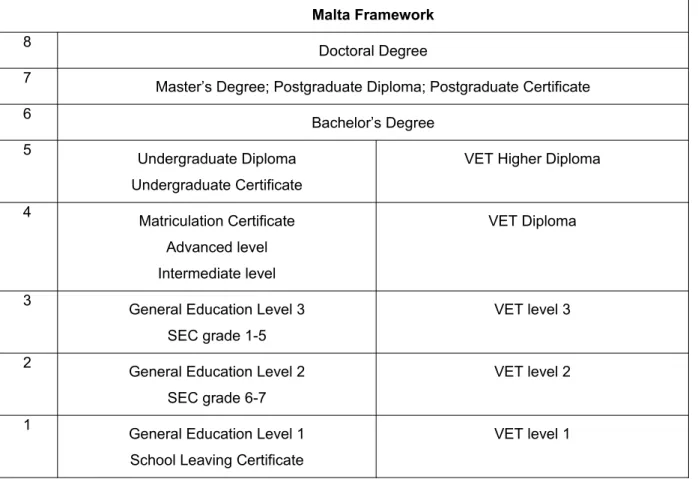
5.2 Malta’s framework expresses national standards in terms of knowledge, skills, competences and attitudes. It consists of an eight level framework, with academic and vocational examples expressed separately. The level descriptors elaborate knowledge, skills, competences and learning outcomes (knowledge and understanding; applying knowledge and understanding; communication skills; judgemental skills; learning skills; and autonomy and responsibility) for each of the levels.As a common denominator across all qualifications, the framework includes the following key competences for lifelong learning:
Communication in Mother Tongue Communication in another Language
Basic competences in Mathematics, Science and Technology Digital competence
Learning To Learn
Interpersonal and Civic Competences Entrepreneurship
Cultural expression (Malta Qualifications Council, 2012a).
Figure 4. The Malta National Qualifications Framework (Malta Qualifications Council, 2012b)
Malta Framework
8 Doctoral Degree
7 Master’s Degree; Postgraduate Diploma; Postgraduate Certificate
6 Bachelor’s Degree
5 Undergraduate Diploma
Undergraduate Certificate
VET Higher Diploma
4 Matriculation Certificate
Advanced level Intermediate level
VET Diploma
3 General Education Level 3
SEC grade 1-5
VET level 3
2 General Education Level 2
SEC grade 6-7
VET level 2
1 General Education Level 1
School Leaving Certificate
Bahrain
5.3 Bahrain expresses its national standards in terms of knowledge, skills and
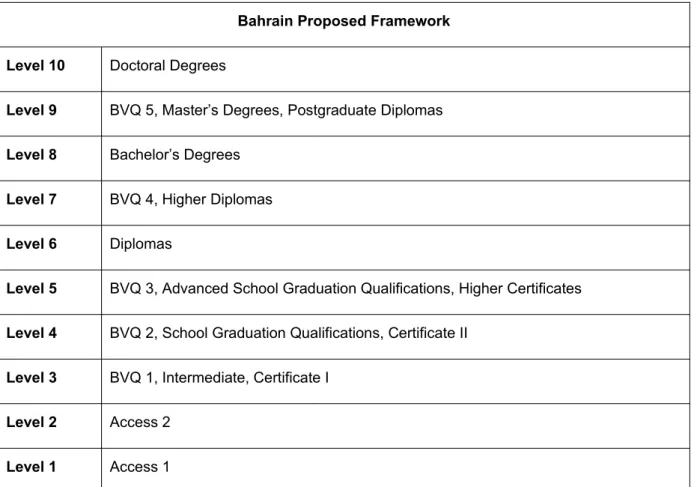
competence. The level descriptors set out knowledge in terms of theoretical understanding and practical applications; skills in terms of generic cognitive skills, communication, ICT and numeracy skills; and competence in terms of context, autonomy and responsibility, learning to learn and insight. The framework incorporates 10 levels, with vocational and academic qualifications expressed together (Tamkeen, 2010a).
Figure 5. Proposed Bahrain National Qualifications Framework (Tamkeen, 2010c)
Bahrain Proposed Framework Level 10 Doctoral Degrees
Level 9 BVQ 5, Master’s Degrees, Postgraduate Diplomas
Level 8 Bachelor’s Degrees
Level 7 BVQ 4, Higher Diplomas
Level 6 Diplomas
Level 5 BVQ 3, Advanced School Graduation Qualifications, Higher Certificates
Level 4 BVQ 2, School Graduation Qualifications, Certificate II
Level 3 BVQ 1, Intermediate, Certificate I
Level 2 Access 2
Level 1 Access 1
UAE
5.4 The UAE framework is a single organising structure for existing and new
information skills communication skills organising skills working with others numeracy skills problem-solving skills technology literacy
societal skills (National Qualifications Authority 2012).
Figure 6. The UAE National Qualifications Framework (Albakeri, 2009)
UAE Framework
Level 10 Degree PhD and equivalent qualifications
Level 9 Degree MA, Post graduate certificate/diploma
Level 8 Degree Bachelors/ graduate certificate/diploma
Level 7 Diploma Higher Diploma and equivalent qualifications
Level 6 Diploma Diploma/associate’s degree and equivalent qualifications
Level 5 Diploma Enjaaz/associate diploma and equivalent qualifications
Level 4 Certificate High school/vocational/adult education/advanced certification
Level 3 Certificate Vocational/adult education/intermediate certification
Level 2 Certificate Vocational/adult education/foundation certification
Section E. Conclusions and key questions for developing an NQF for Qatar
Initial conclusions from international research and existing Qatari thinking on an NQF
1.1 The main lessons from international research are of two major types - technical and process-based. In technical terms NQFs, both established and new, share several common framework features (e.g. levels, level descriptors, outcomes; competences; credit
accumulation and transfer possibilities and regulation through an over-arching authority). The examples from small states, including those in the Gulf have very similar features. In this sense, the establishment of an NQF in Qatar will inevitably involve a degree of ‘policy borrowing’, even though there is a clear aim of developing an NQF that explicitly meets national needs.
1.2 Despite the existence of a relatively common architecture across different NQFs, the international literature highlights significantly different approaches to the process of
development and implementation of an NQF. This is where the national character of an NQF is essentially experienced and where ‘policy learning’ is very important.
1.3 Options include whether to develop a ‘tight’ or ‘loose’ framework; how far to specify competences; which areas to prioritise in relation to technical development; how to involve social partners; where the main areas of practical project development will be located; and how much emphasis is placed on strengthening the institutions involved with the NQF through a process of capacity building. These latter points can be characterised as attempting to achieve a ‘balance of inputs and outputs’.
1.4 It is within this broad set of experiences and challenges that existing thinking about an NQF in Qatar can be understood. The work of the Qatar Qualification Framework Group (SEC, 2010) sees the creation of an NQF as a ‘subsequent’ development in the education reform process. Moreover, the Group viewed it as important that Qatar develop its own distinctive approach - ‘it is objectionable that for Qatar who is spearheading education reform across the Middle East, to either adopt or adapt a framework for purpose of expedience’ (4).
1.5 The Group observed that currently within Qatar there is a lack of clarity about progression routes; some qualifications are unregulated and vocational bodies not directly accountable. It is in this climate that different organisations have developed their own systems to meet needs. There is no sense, therefore, of a national framework or approach.
increase articulation between different parts of the qualification system and also link vocational, applied and academic learning. The Group also describes the main technical features of NQFs and credit transfer systems and their potential benefit to Qatar. In these ways, the aims of the Qatar Qualification Framework Group reflect the findings from the international literatures, particularly those of early starter nations, referred to in this report.
1.7 They also state that an early priority will be to map the diversity of qualifications being used in Qatar, including those from Australia and Scotland, according to level and category, In meeting the needs of Qatar, the Group observed that an emerging framework would have to initially focus on the area of vocational competence. Moreover, they asserted that Qatar developments had to cross-reference these to one or more international frameworks for validity and transferability, notably the European Qualifications Framework (5). Another priority will be the establishment of a national qualifications authority, which is independent and not attached to a particular ministry.
1.8 With regards to the development process and an interim phase, it is suggested in the Group’s report that a useful starting point would be to create a forum for communication between stakeholders regarding the connections between existing qualifications and to harness existing experience. Very importantly in the light of the international findings related to the critical role of a support process, they also suggest other developments such as the creation of ‘bridging qualifications’ between different sectors and the development of new types of partnerships.
Questions for research
1. Questions arising from the wider Qatari context
1.1 The QNV presents a clear agenda for change. How far is this agenda owned by existing institutions and wider society?
1.2 How do the various elements of Qatari society relate to the QNV, and what will be the role and participation of migrant workers?
1.3 How are future economic and labour market needs to be identified and fed into the planning of educational curricula and structures? What is to be the balance between locally generated and bought in skills?
1.4 What is the role of educational reform in this modernising agenda and what contribution can a National Qualifications Framework make?
1.5 How far has the work of the National Qualifications Framework Group been shared and understood?
1.6 How much has been put in place as a result of its work and what are the strengths and weaknesses of current developments?
2. Purposes and scope of the NQF
2.1 What are the main problems that have been identified to which the NQF is seen as a solution?
2.2 To what extent are these problems perceived and understood by the key stakeholders?
2.3 How have the main purposes for the NQF been articulated?
2.5 How far is there a consensus on these?
2.6 Is there agreement about the scope of the NQF (i.e. is it intended to cover VET, the school sector, and HE; all ages; to cover both public and private sectors; International as well as national qualifications and existing qualifications or new qualifications?)
2.7 Should there be one or more sub-frameworks? How far has this been discussed?
3. Governance and policy
3.2 A body to oversee the NQF has been proposed – what is the main thinking behind this and its status?
3.3 Who will drive the policy forward, who are the key contacts and how au fait are they with this development?
3.4 Who is currently responsible for quality assurance in relation to education and training and qualifications in particular?
3.5 Are there any thoughts about how centrally driven and ‘tight’ the NQF will be?
3.6 Are there any thoughts about timescales and if so, what are these, how fixed are they and how were they arrived at?
3.7 How does this policy relate to other educational policies? Which ones? How is co-ordination going to take place and by whom?
4. Stakeholders, capacity and implementation
4.1 Who are the key stakeholders?
4.2 Have they been consulted on the ideas about the NQF and if so how and when?
4.3 Is there a process for taking this forward?
4.4 To what extent are they in agreement with the approach so far?
4.5 How much capacity is there in relation to quality assurance, assessment and accreditation and who has this expertise?
4.6 Are there already fora where major stakeholders meet together and which we could use to work on the design and implementation of the NQF (e.g. partnerships between employers and the education system; between education providers; between different education sectors?)
4.7 What are the current arrangements for teacher education and continuing professional development and how might these need to change as part of the NQF reform?
5. Technical issues
5.1 Has there been an audit of all the qualifications that are offered in Qatar?
5.3 Is there any kind of qualifications framework currently in operation or any ideas about equivalences and/or how progression routes between qualifications operate?
5.4 To what extent are Qatari qualifications recognised by other countries, which ones and how? To what extent do Qatari education providers and employers recognise
international qualifications, which ones and how?
References
Christian Science Monitor (www.csmonitor.com) Accessed 22 Aug 2012.
Drowley, M. and Marshall, H. 2011. Quality National Qualifications frameworks: Mapping the terrain and planning the journey.
(http://www.anqahe.org/files/abu_dhabi_2011/FullPapers/Melinda_Drowley__Helen_M arshall.pdf)
Albakeri, F. (2009) Development of an Integrated Qualifications System in the United Arab Emirates www.qualifications.ae (Accessed 22 August 2012).
Allais, S. (2010) The impact and implementation of NQFs: Report of a study in 16 countries (Geneva: ILO).
Allais, S., Raffe, D. and Young, M. (2009a) Researching NQFs: Some conceptual issues Employment Working Paper 44 (Geneva: ILO).
Allais, S., Raffe, D., Strathdee, R., Wheelahan, L. and Young, M. (2009b) Learning from the first qualifications frameworks (Geneva: ILO)
AME Info (2012) Second phase of Bahrain Qualifications Framework launched. AME Info March 27. http://www.ameinfo.com/294824.html
Bjørnåvold, J. and Pervec-Grm, S. (2012) Development of national qualifications frameworks in Europe (Luxembourg: Cedefop)
Burke, G., Mckenzie, P., Shah, C., Keating, J., Vickers, A., Fearnside, R. and Andrea Bateman (2009) Mapping Qualifications Frameworks across APEC Economies (http:// works.bepress.com/phil_mckenzie/140)
Calleja, J. (2007) Valuing All Learning - Volume 3 - Quality Assurance Policy for VET. (Malta: Malta Qualifications Council).
Cedefop (2008) The shift to learning outcomes: conceptual, political and practical
developments in Europe (Luxembourg: Office for Official Publications of the European Communities)
European Commission (2012) Referencing the National Qualifications Framework to the Qualifications Frameworks at European level: Malta.
http://www.kslll.net/PoliciesAndAchievements/ExampleDetails.cfm?id=157#
Evans-Klock, C. (2009) Foreword in Allais, S., Raffe, D. and Young, M. (2009) Researching NQFs: Some conceptual issues Employment Working Paper 44 (Geneva: ILO).
Finegold, D. (1999) ‘Creating self-sustaining, high-skill ecosystems’, Oxford Review of Economic Policy, 15, 1, 60-81.
Hodgson, A. and Spours, K. (2012) Towards a universal upper secondary education system in England: a unified and ecosystem vision. An inaugural professorial lecture. (London: IOE Publications).
Jessup, G. (1991) Outcomes: NVQs and the emerging model of education and training (London: Falmer).
Keating, J. (2003) Qualifications frameworks in Australia Journal of Education and Work, 16 (2) 271-288.
Malta Qualifications Council. (2012c) The Malta Qualifications Council. https://www.education.gov.mt/Page.aspx?pid=225&depid=2&pageid=97
Malta Qualifications Council. (2012a) Descriptors of Key Competences on the Malta Qualifications Framework. http://www.mqc.gov.mt/malta-qualifications-framework
Malta Qualifications Council. (2012b) The Level Descriptors for the Malta Qualifications Framework (MQF). http://www.mqc.gov.mt/malta-qualifications-framework
Malta Qualifications Council (2012d) The Malta Qualifications Framework. http://www.mqc.gov.mt/malta-qualifications-framework
National Qualifications Authority (2012) Qualifications Framework Emirates Handbook. http:// nqa.gov.ae/Qualifications_Framework.
Organisation for Economic and Cooperation and Development (OECD) (2007) ‘Qualifications and lifelong learning’ Policy Brief April (Paris: OECD)
Organisation for Economic and Cooperation and Development (OECD). (www.oecd.org) Accessed 22 August 2012.
Raffe, D. (2009) ‘Towards a dynamic model of national qualifications frameworks’ in S. Allais, D. Raffe and M. Young, (2009) Researching NQFs: Some conceptual issues Employment Working Paper 44 (Geneva: ILO).
Raffe, D. (2011) Are communications frameworks more successful? Policy learning from the Scottish Credit and Qualifications Framework, Journal of Education and Work, 24 (3-4), 283-302.
Reiss, M., Pratt, D., Isaacs, T. (2011) Qatari Curriculum Standards Review. An unpublished paper written for the Qatari Government, Institute of Education, University of London.
Stasz, C., Eide, E. and Martorell, P. (2007) Post-Secondary Education in Qatar, Employer Demand, Student Choice, and Options for Policy. RAND Corporation.
Steinberg, G, (2012) Qatar and the Arab Spring. Foundation for European Studies. www.swp-berlin.org.
Supreme Education Council of Qatar (SEC) (2010) Qualification Framework Group Project Report SEC: Doha (June).
SEC (2012) Education and Training Sector Strategic Plan 2011-2016: Outcome 8 (Doha: SEC).
Tamkeen and SQA (2010a) Bahrain Qualifications Framework Frequently asked Questions. http://bqf.tamkeenpartners.net/Downloads/BQF-FAQs.pdf
Tamkeen and SQA (2010b) Bahrain Qualifications Framework Project Leaflet. http://bqf.tamkeenpartners.net/Downloads/Project-Leaflet.pdf
Tamkeen and SQA (2010c) Draft vision, mission, goals.
http://bqf.tamkeenpartners.net/Downloads/draft-framework.pdf
Tamkeen (2010a) Draft Level Descriptors. http://bqf.tamkeenpartners.net/Downloads/draft-framework.pdf
Tamkeen (2010b) A National Qualifications Framework for the Kingdom of Bahrain http://www.bqf.tamkeenpartners.net/Downloads/A-National-Qualifications-Framework.pdf
Tamkeen (2010c) Proposed Bahrain Qualifications Framework. http://bqf.tamkeenpartners.net/Downloads/draft-framework.pdf
and Practical Issues for Policy Makers (Geneva: ILO)
Wolf, A. (1995) ‘Competence-based assessment’ in H. Torrance (ed) Evaluating authentic assessment (Buckingham: Open University Press)
Young, M. (2005) National qualifications frameworks: Their feasibility for effective implementation in developing countries (Geneva: ILO)