Disk Chemistry
Wing-Fai Thi
1MPE, Garching, Germany
Abstract.The chemical species in protoplanetary disks react with each other. The chemi-cal species control part of the thermal balance in those disks. How the chemistry proceeds in the varied conditions encountered in disks relies on detailed microscopic understand-ing of the reactions through experiments or theoretical studies. This chapter strives to summarize and explain in simple terms the different types of chemical reactions that can lead to complex species. The first part of the chapter deals with gas-phase chemistry and the second part introduces chemical reactions occurring on grain surfaces. Several terms pertaining to astrochemistry are introduced.
1 The role of chemistry in disk and planet-formation processes
Chemistry are not only processes that trace the physical conditions in disks but they also plays im-portant roles in controlling the dynamics of disks or aspects of planet formation and provide the primordial composition of planets.
The most promising explanation to drive mass accretion in disks and explain the disk evolution is turbulence driven by magneto-rotational instability because molecular viscosity is inefficient on large scales. Magneto-rotational instability is a ideal-MHD phenomenon that occurs only if the gas is sufficiently ionized to couple dynamically to the magnetic fields. The strength of gas turbulence is characterized by the factorαso that the large scale turbulence can be written asν=αcsh(withcsthe
sound speed andhthe gas scale height of the disk). Many non-ideal MHD resistivities can restrict the development of MRI turbulence. The resistivities (Ohmic and Ambipolar diffusion) depend on the abundances of the charge carriers among other factors. Therefore the detailed knowledge of the disk ionization state is central to understand disk dynamical evolution.
In planet formation, chemistry defines the disk region where water can be frozen onto grains, the so-called ice zone where grains can coagulate more easily. The ice zone is paramount to permit the formation of giant planets via the core-accretion model. The unusual C/O abundance ratios seen in exoplanets raise the question of chemical filtering in disks (Helling et al. 2014; Öberg et al. 2011).
2 The path to complexity
Chemistry is also central to questions related to the origin of life. One major question is whether complex organic molecules (COMs) were originally produced in the young Earth and/or had an extra-terrestrial origin. The original composition of Earth’s atmosphere (and of extra-terrestrial extrasolar planets)
11thLecture of the Summer School “Protoplanetary Disks: Theory and Modelling Meet Observations”
DOI: 10.1051/ C
Owned by the authors, published by EDP Sciences, 2015 /201
epjconf 51020 0 1 20
influenced the conditions for the emergence of life but remains a major subject of debate (Chyba & Sagan 1992; Ehrenfreund & Charnley 2000) . The molecules in the primordial atmosphere and oceans are the building blocks for the prebiotic molecules. It is believed that a combination of comets and other extraterrestrial bodies such as meteorites and interplanetary dust particles may have supplied the primordial soup with extraterrestrial complex organic molecules.
In the following sections, we will detail few ideas needed to understand the different types of chemical reactions that can occur in protoplanetary disks. Many good textbooks deal with the chem-istry in the interstellar medium and we refer the reader to those references (Dyson & Williams 1997; Lequeux 2005; Tielens 2010).
3 Chemical reactions
A chemical reaction can be split into steps: the collision between the reactants, the destruction of existing chemical bonds followed by the formation of new bonds, and the removal of the excess energy for exothermic reactions. The first and last steps limit the efficiency of chemical reactions in the low density space environments. In the following sections, those steps will be discussed in details.
3.1 Collision frequency and chemical equilibrium
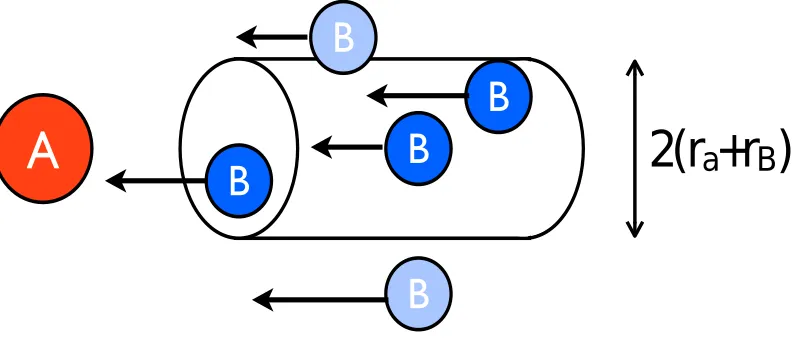
Figure 1.Hard sphere collisions.
Like all physical phenomena, any chemical reaction needs to conserve the energy and the angular momentum. The simplest possible description of a chemical reaction is the so-called "hard-sphere" or "billiard ball" approximation where a species is considered as a perfect sphere with a constant radiusr(Fig. 1). Another simplification is that there is no short- or long-range electromagnetic inter-action, which can decrease or enhance significantly the reaction rates. The "hard-sphere" collisional frequency between two species A and B within a unit volume each second is given by
zAB=σABvnAnB=σAB
8kT
πμAB
1/2
nAnB, (1)
T is the gas temperature andkthe Boltzmann constant. The typical radius of an atom is∼1.5×10⁻⁸ cm (1.5 Å), giving a cross-section of∼3×10⁻¹⁵cm2. The reduced mass is∼1×10⁻²⁴ g. At 10 K, the mean velocity assuming a Maxwellian distribution is∼60 000 cm s−1. An abundant species has an abundance of 10−6−3×10⁻⁴compared to hydrogen nuclei. This results from the elemental abundance
of the constituents. Thus for a gas number density ofnH of 106 cm−3, nAnB ∼1−100 cm−3.
The maximum collisional frequency between two abundant species is 1.5×10⁻⁶ s−1 or∼0.8 days.
For a density of 1012 cm−3, the frequency is increased by a factor 1012. Interestingly, if no reaction
proceeds upon the encounter, the collision is elastic and its collision cross section has the same order of magnitude as collision de-excitation rates by molecular hydrogen (∼10−10cm3s−1).
For three-body collisions, the frequency is much less amenable to a simple understanding. The hard sphere radius is given by the symmetric formular0=(rABrBCrCA)1/3, and the cross-section in the
6-dimensional hypersphere isσABC=(8π2/15)r50. The collisional frequency is
zABC=σABC
15π 8
kT
2πμABC
1/2
nAnBnC, (2)
where the three-body reduced-mass is
μABC=
mAmBmC
mA+mB+mC
1/2
(3)
Let us consider the three-body reaction H2+CH+M→CH3 +M, where the collision partner M
is H2. The different values are: rAB=rBC9.2×10−9 cm, rCA5.7×10−9 cm, mA=2 amu,
mB=13 amu, andmC=2 amu, where the atomic mass unit amu=1.66×10⁻²⁴ g. For a hydrogen
density of 106cm−3, with hydrogen being fully molecular, and a CH abundance of 10−6, the collisional frequency is∼2×10⁻²⁴ s−1. At 1012 cm−3 the frequency is increased by a factor (106)3 = 1018. Therefore except for the very dense inner disk region, most reactions occurring in protoplanetary disks will involve one or two species. Chemical reactions occur at the same time than other processes such as dynamics and diffusion or elastic collisions. The different chemical timescales should be compared to dynamical and heating/cooling timescales.
3.2 The "hard collision" approximation
A major shortcomings of the "hard-sphere" theory is that molecules are neither spheres nor sym-metric. The orientation of the collisions determine whether a reaction can occur. In addition atoms and molecules interact via long- and short-range electromagnetic interactions. Chemical reactions are theoretically studied by solving conservation equations quantum mechanically. However, many insights can be provided by a classical approximation called the "hard collision" approximation. A hard collision is considered to be a classical collision in which for a given incident relative energy the impact parameterbis small enough such that the particles can surmount the angular moment bar-rier. The hard collision approximation provides not only valuable insight in the physics of reactive reactions, it gives values that can be close to the actual ones, either computed by quantum theories or measured experimentally. For instance, ion-molecule reactions occur close to the "hard collision" rate and neutral-neutral reactions without activation energy barrier often proceed at every collision.
3.3 Chemical bonds and thermochemistry
A typical chemical reaction can be written in the form
where we assumed that the reaction is exothermic to the right (ΔE>0), and M is a third body, which is mainly one of the three major species H, H2, or He. For densities below 1012cm−3, only one-body
or two-body reactions occur.
The thermochemistry of a reaction can be evaluated from the enthalpy (H) difference between products (C and D) and reactants (A and B)
ΔH(reaction)=H(products)−H(reactants), (5)
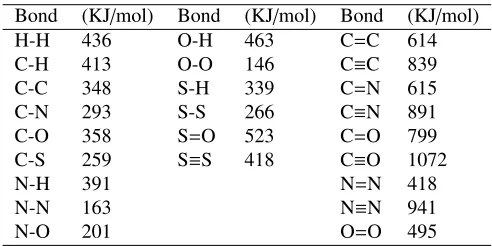
where a negative enthalpy corresponds to release of energy by a reaction (ΔE=−ΔH). Enthalpies depend on the temperature, the phase of the species, and the stoichiometry of the reaction. Table 1 summarizes the bond energies, i.e. the energies required to break certain bonds. For a stable species, the heat of formation is generally negative (i.e. the reaction is exothermic).
Table 1.Average bond enthalpies (1 KJ/mol=120 K=0.01 eV)
Bond (KJ/mol) Bond (KJ/mol) Bond (KJ/mol) H-H 436 O-H 463 C=C 614 C-H 413 O-O 146 C≡C 839 C-C 348 S-H 339 C=N 615 C-N 293 S-S 266 C≡N 891 C-O 358 S=O 523 C=O 799 C-S 259 S≡S 418 C≡O 1072 N-H 391 N=N 418 N-N 163 N≡N 941 N-O 201 O=O 495
4 Formation of bonds
The first category of reactions involves the formation of new bonds between two reactants A and B (A+B→AB∗→A+B ). The main difficulty with these reactions is to stabilize the newly formed complex (AB∗) either thorough the emission of a photon, the collision with a third partner, or the emission of an electron for gas-phase reactions. A complex is a long-lived intermediate molecule with a total internal energy above its dissociation limit. Interestingly, for surface reactions, the surface or the breaking of the adsorption bond to the surface can act as a heat sink. Therefore certain highly exothermic reactions can proceed on grain surfaces but not in a low-density gas.
An association reaction (A++B→AB+, with ratekass) occurs via the formation of an activated
complex (excited (AB+)∗), which has to be stabilized through the emission of a photon or though collision with a third body. Otherwise the complex will revert back to the initial parent species. The reaction can be decomposed into elementary steps (Klippenstein et al. 1996). The first elementary step is the formation of the complex A+B→(AB+)∗with ratekf. The complex can re-dissociate into the initial species ((AB+)∗→A++B, with ratekb), or can be stabilized by collision with a third body ((AB+)∗+M→AB with ratekc). The stabilization can also be achieved by the emission of a photon ((AB+)∗→AB++hν, with ratekr). The effective rate is
kass=keff=
kf(kr+kcnM)
kb+kr+kcnM
In the low-density regime, the rate can be expanded in a Taylor series
keff
kfkr
kb+kr +
kfkbkc (kb+kr)2nM
. (7)
At very low densities, like in most regions in space, the rate simplifies further
keff
kfkr
kb+kr
. (8)
In the high-density (i.e. high-pressure) regime, or in the so-called high-efficiency regime whenkr kb, the rate becomes
keffkf (9)
On the other hand unimolecular redissociation (AB∗→A+B) occurs much faster than emission of a photon ifkb kr. This is the so-called low-efficiency limit.
keffkfkr
kb
. (10)
4.1 Radiative association
The high-efficiency regime corresponds to radiative association. The radiative ratekr can be written within the harmonic approximation as (Klippenstein et al. 1996)
kr(s−1)= Nm
i=1
∞
n=0
1.25×10⁻⁷nPi(n)Ii(km/mol)ν2i(cm−1), (11)
whereNmis the number of vibrational modes,Pi(n) is the probability of vibrational modeibeing in leveln,Iiis the infrared absorption intensity for thev=0 andv=1 transition of modei, andνiis the
i-th vibrational frequency. The population probability can be approximated by
Pi(n,T)=exp
−hνin
kT 1−exp
−hνi
kT
. (12)
Since the energy of the excited complex is spread over all available degrees of freedom, the larger the complex, the larger the rates can be. Methanol has for example 12 vibrational modes. The vibrational transition time-scales are of the order of 10−3−10−2s, while the reaction collision time-scale is of the
order of 10−13s. Electronic allowed transitions are faster with a time-scale of the order of 10−8−10−7s.
We are well within the low-efficiency regime and only one complex out of (kr/kb)−1∼106would result in a stable product. In the interstellar medium and in disks, the main reactions of this type involve an ion and a neutral species (A++B→(AB+)∗→AB+). A complex formation rate between an ion and a neutral species follows the Langevin encounter ratekf∼10−10−10−9s−1, thus association reactions rates would be of the order of 10−16−10−17s−1.
4.2 T(h)ermolecular reactions (3-body reactions)
Three body reactions (A+B +M→ AB+M) have rates of the order of 10−32 cm6 s−1 and are thus efficient for densities higher than 1012 cm−3. The third-body carries the excess energy of the
4.3 Associative detachment
The reaction between an anion to a neutral species results in a neutral product that is stabilized through the release of an electron (A+B−→AB+e). The most important associative detachment reaction is H+H−→H2+e, with a rate of 1.3×10⁻⁹cm3s−1. In the absence of dust grains in the Early Universe,
this reaction is the only way to form molecular hydrogen.
4.4 Radiative recombination
Radiative recombinations involve cations and are the inverse reactions of photoionizations AB++e
→AB∗ →AB+hν. Therefore radiative recombination rates can be estimated by detailed balance between the two processes
n(e)n(Xi)αT =n(X0)
∞
0
σ(ν)B(ν)dν, (13)
whereB(ν) is the blackbody photon flux. The ?namical equilibrium is given by the Saha equation. Since a typical value for the photoionization cross-section is10−17 cm2, the rate coefficients for radiative recombinations are10−12cm3s−1.
The lack of efficient relaxation processes or the need to create first an anion makes the direct formation of new bonds very slow in general except for special circumstances (i.e. high gas densities).
5 Rearrangement of bonds
Reaction between two species A and B can result in exchanging part of each species to form species C and D. For these reactions the excess energy is mostly converted into kinetic energy for the products. In general, bond rearrangements favor the most strongly bound pair of atoms.
5.1 Ion-neutral reactions
The first type of rearrangement reactions involve one charged species and a neutral partner. Reactions between an ion A+and a neutral species B (A+ +B→ C++D) occur rapidly because the strong long-range polarization-induced interaction potential (charge/quadrupole-induced interaction∝1/r4)
can be used to overcome any activation barrier involved. The long range potential is
V(r)=−αe
2
2r4, (14)
whereαis the polarizability of neutral species(∼10−24cm3),ethe electron charge, andrthe distance
from the nucleus. The total energy of the system is
E=1
2μABr
2+
Eb
2
r2 +V(r), (15)
whereμABis the reduced mass andbthe impact parameter. The maximum impact parameterbmfor
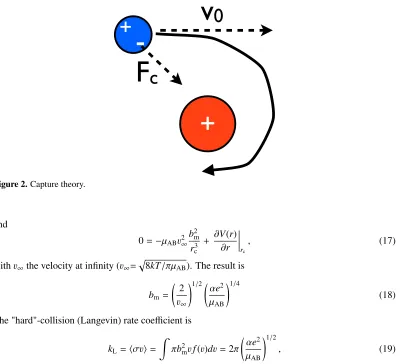
which the particles will spiral inward is a value just smaller than the impact parameter that leads to orbiting one around one another (Fig. 2). The orbiting requirement is that at the radius of closest approachrc, the effective potential is flat. Thus
1 2μABv
2
∞= 1 2μv
2
∞b
2 m
r2 c
Figure 2.Capture theory.
and
0=−μABv2∞b 2 m
r3 c
+ ∂V∂(r)
r
rc, (17)
withv∞the velocity at infinity (v∞= 8kT/πμAB). The result is
bm=
2
v∞
1/2α
e2 μAB
1/4
(18)
The "hard"-collision (Langevin) rate coefficient is
kL =σv=
πb2mvf(v)dv=2π
α
e2 μAB
1/2
, (19)
wheref(v) the Maxwellian velocity distribution.kLis of the order of 10−9s−1and is not
temperature-sensitive. If the neutral species has a permanent dipole momentμD, the enhanced rate is given by the
average dipole orientation theory (Bass et al. 1975)
kdip=2π
⎛ ⎜⎜⎜⎜⎜ ⎝
α
μAB
1/2
+μD
2
πμABkT
1/2⎞
⎟⎟⎟⎟⎟
⎠. (20)
The enhancement is particularly strong at low temperatures. At low temperatures, the ion-neutral reactions, combined with the dissociation recombination reactions are the most efficient to form sim-ple molecules. Ion-neutral reactions are driven by ionization (by cosmic-rays, X-rays, or radioactive decay).
5.2 Kinetic rate temperature-dependence as function o the shape of the long-range interaction
attractive intermolecular interaction potential
k(T)∝T−2n+12, (21)
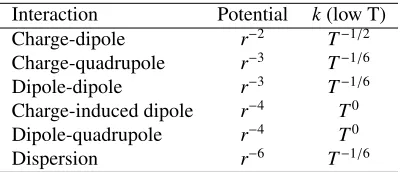
for a potential of the formr−nwhenT→0. Table 2 lists a number of interactions with their temperature dependence at low temperatures. Ion-neutral reactions are the fastest reactions at low temperatures. Since one of the products is also a cation, further ion-neutral reactions can proceed rapidly leading to molecular cations that can in turn recombine with an electron.
Table 2.Temperature-dependance of the rate coefficients at low temperatures.
Interaction Potential k(low T) Charge-dipole r−2 T−1/2
Charge-quadrupole r−3 T−1/6
Dipole-dipole r−3 T−1/6
Charge-induced dipole r−4 T0
Dipole-quadrupole r−4 T0
Dispersion r−6 T−1/6
5.3 Charge-transfer reactions
Charge transfer reactions involving an atom are key to the ionization balance. When a molecule is involved, rates can be as high as 10−9cm3s−1in the exothermic direction if there is an energy level in the product that is resonant (i.e. close within 0.1 eV) with the recombination energy and the Franck-Condon factor connecting the upper and lower states is large. In general molecules have more states available than atoms (A++B→A+B+).
5.4 Neutral-neutral reactions
A detailed review on recent works on neutral-neutral reactions is given by Smith (2008). The discus-sion here is kept at an elementary level. The attractive interaction in neutral-neutral reactions is due to van der Waals forces that are efficient at short distances only (the potential is∝1/r6). The simplest
representation of the interaction between neutral species is the Lennard-Jones potential
V(r)=
r
m
r
12
−2
r
m
r
6
, (22)
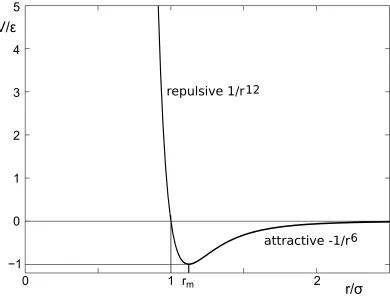
whereris the distance between the particles (Fig. 3).is the depth (i.e. the minimum) of the potential well andr=rmis the distance at which the minimum is reached. At large distances, the attractive
second term in the potential dominates
V(r) −α1α2
r6 I, (23)
whereα1 andα2 are the polarizabilities of the two particles (∼10−24 cm3) and Iis a characteristic
energy related to the ionization energies (I ∼1 Rydberg, or 13.6 eV). The "hard" collision impact parameter for neutral-neutral reactions is
b2
m=(3/2)2/3
6α1α2I
μABv∞
1/3
Figure 3.Lennard-Jones interaction potential.
The approximate rate coefficient is
knnπ(3/2)2/3
6α1α2I
μAB
1/3
v1/3 4×10⁻¹¹(
T/100)1/6 cm3s−1, (25)
withμAB=2 amu. Neutral-neutral reactions involving atoms or radicals with an unpaired electron
(e.g. OH, CN) have low or no activation barriers. The rate coefficients are in the form
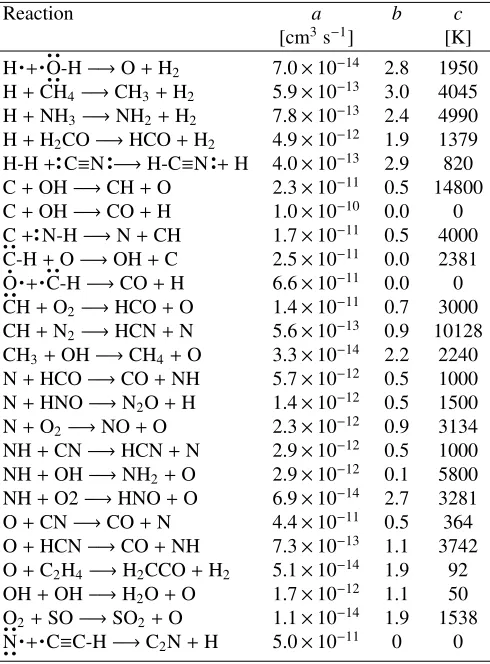
knn =a(T/300)b=A(T). (26)
transition state complexes: O...C-H (→HCO∗→CO+H) and C-H...O (→C+OH). CH is a radical. A radical is an atomic or molecular species having an unpaired or odd electron. Some radicals such as nitric oxide (NO) are relatively stable, but most are reactive. CH is the simplest example of a group of molecules called carbyne. Carbyne molecules are generally found to be in electronic doublet states: the nonbonding electrons on carbon are arranged as one radical (unpaired electron) and one electron pair, leaving a vacant atomic orbital, rather than being a triradical (the quartet state). More precisely, the CH radical has an electron configuration 1σ22σ2 3σ2 1π( C-H). The formation of the O...C-H
complex does not involve the breaking of a bond (O bonds with the unpaired electron) while the for-mation of the C-H...O requires the weakening of the strong C-H bond. In general the breaking of the C-H, O-H, or N-H bonds require substantial energies.
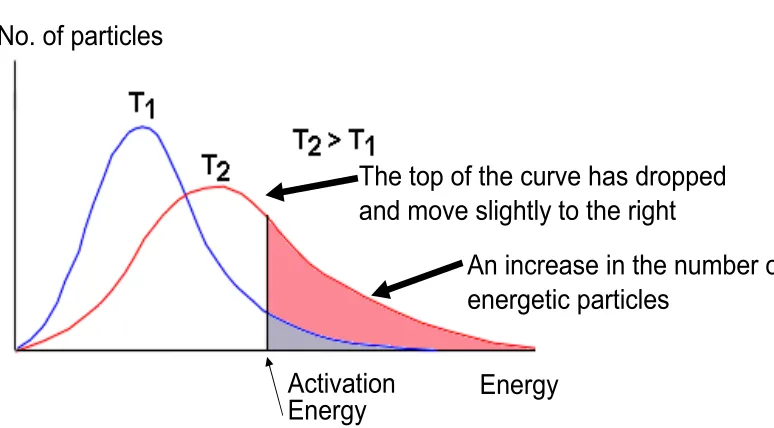
Figure 4.Maxwellian energy distribution and activation energy.
The velocity of the gas at temperatureT follows a Maxwellian distribution (Fig. 4). The reaction rate for a Maxwellian gas is
knn=
8
πμAB(kT)3
1/2 ∞
0 S
ABEe− E
kT dE. (27)
The cross-sectionSABhas to accommodate the activation barrier. The main assumption is that only the
relative speed between the two reactants.
SAB(E) = 0 forE≤Ea, = πσAB
E−E
a
E
forE>Ea. (28)
Using the modified cross-section, the rate becomes
knn=πσAB
8
πμAB(kT)3
1/2 ∞
Ea
(E−Ea) e− E
kTdE=πσAB
8kT
πμAB
1/2
e−Ea/kT. (29)
The probability for a Maxwellian gas at temperature T to overcome a barrier of energy Ea is
exp(−Ea/kT), hence an extra term in the rate coefficients. Higher activation energy implies that the
reactants need more energy to start than a reaction with a lower activation energy. Assuming standard values forσABandμAB, the rate in the hard-sphere model is
knn∼9×10⁻¹⁰(T/300)1/2e−Ea/kT. (30)
Using theσAB=b2m, another estimate of neutral-neutral reaction rates is possible
knn ∼4.8×10⁻¹¹(T/300)1/6e−Ea/kT. (31)
In summary, reaction rate coefficients of neutral-neutral reactions often follow the Arrhenius form
k=a(T/300)be−c/T, (32)
whereais of the order of 10−12−10−10,b of the order of unity and should have a value of 0.5 for a perfect gas, andcis the activation energy. A neutral-neutral reaction can be globally exothermic (ΔE>0) but still has a barrier. For an endothermic reaction, the activation energy should be at least the energy needed to form the products (c>−ΔE). Table 3 provides a few examples of neutral-neutral reactions.
Most rates are measured at ambient temperature (300 K) or higher and extrapolation to lower temperatures is questionable. Indeed quantum mechanical effects can enhance chemical rates. Slow reaction channels with no activation barrier are possible at low temperature, especially when hydrogen tunneling can play a role. Also at 300 K, low-lying excited state can be populated, which can enhance the speed of the reaction. The forwardkf and backwardkbreaction rate coefficients are related by the
equilibrium constantK,
K= kf kb
e(ΔE/kT). (33)
The constantKcan be derived from thermodynamics. Besides in protoplanetary disks, neutral-neutral reactions also contribute significantly to the chemistry of planetary atmospheres.
6 Destruction of bonds and ionization
Table 3.Parametersa,bandcfor a few examples of neutral-neutral reactions taken from the UMIST 2006 database;bis dimensionless.
Reaction a b c
[cm3s−1] [K]
H + O-H−→O+H2 7.0×10⁻¹⁴ 2.8 1950
H+CH4−→CH3+H2 5.9×10⁻¹³ 3.0 4045
H+NH3−→NH2+H2 7.8×10⁻¹³ 2.4 4990
H+H2CO−→HCO+H2 4.9×10⁻¹² 1.9 1379
H-H+C≡N −→H-C≡N +H 4.0×10⁻¹³ 2.9 820 C+OH−→CH+O 2.3×10⁻¹¹ 0.5 14800
C+OH−→CO+H 1.0×10⁻¹⁰ 0.0 0
C+ N-H−→N+CH 1.7×10⁻¹¹ 0.5 4000
C-H+O−→OH+C 2.5×10⁻¹¹ 0.0 2381
O + C-H−→CO+H 6.6×10⁻¹¹ 0.0 0
CH+O2−→HCO+O 1.4×10⁻¹¹ 0.7 3000
CH+N2−→HCN+N 5.6×10⁻¹³ 0.9 10128
CH3+OH−→CH4+O 3.3×10⁻¹⁴ 2.2 2240
N+HCO−→CO+NH 5.7×10⁻¹² 0.5 1000
N+HNO−→N2O+H 1.4×10⁻¹² 0.5 1500
N+O2−→NO+O 2.3×10⁻¹² 0.9 3134
NH+CN−→HCN+N 2.9×10⁻¹² 0.5 1000 NH+OH−→NH2+O 2.9×10⁻¹² 0.1 5800
NH+O2−→HNO+O 6.9×10⁻¹⁴ 2.7 3281 O+CN−→CO+N 4.4×10⁻¹¹ 0.5 364 O+HCN−→CO+NH 7.3×10⁻¹³ 1.1 3742
O+C2H4−→H2CCO+H2 5.1×10⁻¹⁴ 1.9 92
OH+OH−→H2O+O 1.7×10⁻¹² 1.1 50
O2+SO−→SO2+O 1.1×10⁻¹⁴ 1.9 1538
N + C≡C-H−→C2N+H 5.0×10⁻¹¹ 0 0
6.1 Photo-ionization and photo-dissociation
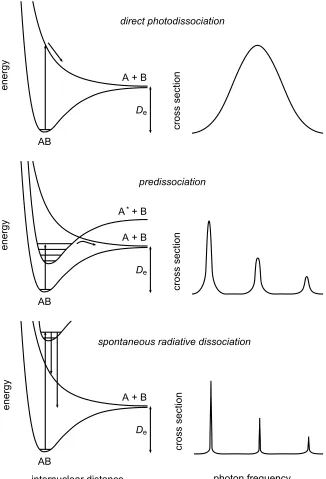
Bond energies of molecules are of the order of 5−10 eV corresponding to wavelengths of3000 Å and shorter (the far-UV regime, FUV). The theory of photodissociation is well discussed in van Dishoeck et al. (2006). Here only a brief overview is provided. Photodissociation reactions can occur different ways (see Fig. 5).
Direct photodissociation(e.g. H+2, CH+, NH, H2O): The dissociation occurs through a transition to
Predissociation(e.g. CO): The dissociation occurs by discrete (line) absorptions into bound elec-tronic states followed by radiation-less coupling with the continuum of a dissociative state of different symmetry. The cross-section is a composition of line absorption profiles.
Photodissociation through coupled states (e.g. CH, OH): The dissociation starts with the ab-sorption of a photon to a discrete electronic state followed by a radiation-less coupling with the continuum of a final repulsive state of the same symmetry, which does not cross the bound state. This process can play an important role when Rydberg-valence interactions forbid excited states to cross. The cross-section is composed of a series of resonances superposed on a continuum absorption.
Spontaneous radiative dissociation(H2): The bound excited state can decay by spontaneous
emis-sion into lower-lying continuum states. The cross section shows narrow discrete absorption Lorentzian profiles with widths determined by the natural radiative lifetimes of the electronic levels. Since the lifetime of electronic levels are short, their natural width is correspondingly relatively large.
Molecular hydrogen photodissociation proceeds via this path. The ground electronic state con-tains 14 vibrational levels, plus a continuum of levels withE>ΔEdiss=4.48 eV, the molecules binding
energy. Hydrogen molecules absorb UV photons in the range 912−1100 Å into the bound Lyman (B1 andX1 states) and Werner (C1 andX1 states) systems (Fig. 6). Fluorescence to the vibrational
continuum of the ground electronic state occurs 10 to 15% of the time (i.e. the molecule is dissoci-ated). In order to dissociate, the molecule must decay from an excited electronic state to a vibrational continuum level lying above thev=14 level in the ground state. The rest of the time H2 relaxes to
a bound vibrationally-excited ground electronic state H2(v >1). Because the absorption occurs by
line absorptions, the optical-depths increase with increasing column of H2and the photodissociation
efficiency decreases. The phenomenon is called H2 photodissociation self-shielding. When the
ab-sorption line gaussian core is saturated, further abab-sorption can still occur in the extended Lorentzian wings. At high optical depths, the line wings start to overlap with each other resulting in pseudo-band absorptions. Interestingly, H2an CO UV absorption line frequencies can be realtively close such that
the H2absorption can also shield CO. This phenomenon is called mutual shielding.
The rate of photodissociationkpdof a molecule by absorption from a lower level into a continuous
upper channeluis
kcont
pd =
λd
λH
σ(λ)I(λ)dλ s−1 (34)
whereσis the cross section for photodissociation in cm2andIis the mean intensity of the radiation
in photons cm−2s−1Å−1as a function of wavelengthλin Å. The integration runs from the hydrogen
photo-ionization limit (νH) (higher energy photons are completely absorbed by atomic hydrogen) to
the dissociation limit (νd) (the photon has to be energetic enough to break the chemical bonding). For
the indirect processes of predissociation and spontaneous radiative dissociation, the rate of dissocia-tion by absorpdissocia-tion into a specific level of a bound upper stateufrom lower level is
kpdline= πe2
mc2λ 2
u fu ηux I(λu ) s−1, (35)
,-,. !
/$
"# $ $
% $ $
&'(
) &* '(
)
+"
Figure 6.H2energy curves (S. Cazaux).
Interstellar UV radiation fields are often normalized to the standard local average value corresponding to the so-called Draine or Habing field (IUV,ISM ∼108 FUV photons cm−2 s−1 sr−1, Fig. 7). This
translates to photodissociation rates for a standard FUV field IUV,ISM of 10−9−10−10 s−1. At the
surface of protoplanetary disks at 1 AU, the UV field can reach up toχ=106−107I UV,ISM.
6.2 Dissociative recombination reactions
Dissociative recombination (DR) reactions involve the capture of an electron by a molecular ion to form a neutral species in an electronic doubly excited, usually strongly repulsive, state located above the first ionization potential, which subsequently dissociates (AB++e→AB∗∗→A+B). The rates are large (10−7s−1) because of the long-range electrostatic potential between a cation and an electron and of the low mass of the electron. The rates vary in the range ofT−1/3toT−1. Dissociative electron
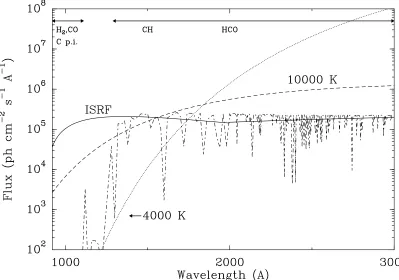
Figure 7.Comparison of the general interstellar radiation field of Draine extended forλ >2000 Å with various black body radiation fields. Reproduced from van Dishoeck et al. (2006) with permission of The Royal Society of Chemistry.
the formation of water starting with H+3: O+H+3 →OH++H2
OH++H2→H2O++H
H2O++H2→H3O++H
H3O++e−→H3O∗∗→H2O+H
The three first steps are ion-neutral reactions, which compete themselves with dissociative recombi-nation reactions (e.g. H2O+ +e−→O+H+H). Table 4 gives a sample of important dissociative
recombination reactions. One can notice for example that the branching ratio in the recombination reaction of H3O+favors OH as product instead of H2O. Dissociative recombination reactions are also
key intermediate reactions leading to abundant species such as CO:
C+H+3 →CH++H2
CH++H2→CH+2 +H
CH+2 +e−→CH+H CH+O→CO+H
electrons are locked onto grain surfaces, the recombination reactions are much slower because charges on grains move much more slowly. Although the rate coefficients are known accurately, the product branching ratios can be highly uncertain. However, products with strong bonds are usually preferred.
Table 4.Parameters for a few examples of dissociative electron recombination reactions.
Reaction a b
[cm3s−1]
H+2 +e−−→H+H 1.6×10⁻⁸ -0.43
H2O++e−−→O+H+H 3.1×10⁻⁷ -0.5
H2O++e−−→OH+H 8.6×10⁻⁸ -0.5
H3O++e−−→OH+H2 6.0×10⁻⁸ -0.5
H3O++e−−→O+H+H2 5.6×10⁻⁹ -0.5
H3O++e−−→OH+H+H 2.58×10⁻⁷ -0.5
H3O++e−−→H2O+H 1.08×10⁻⁷ -0.5
H+3 +e−−→H2+H 2.3×10⁻⁸ -0.52
HCN++e−−→CN+H 2.0×10⁻⁷ -0.5
HCO++e−−→CO+H 2.4×10⁻⁷ -0.69
HNO++e−−→NO+H 3.0×10⁻⁷ -0.69
C+2 +e−−→C+C 3.0×10⁻⁷ -0.5
CH++e−−→C+H 1.5×10⁻⁷ -0.42
CH+2 +e−−→CH+H 1.4×10⁻⁷ -0.55
CH+2 +e−−→C+H+H 4.0×10⁻⁷ -0.6
CH+3 +e−−→CH+H+H 2.0×10⁻⁷ -0.4
CH+3 +e−−→CH+H2 2.0×10⁻⁷ -0.5
CH++e−−→C+H 1.5×10⁻⁷ -0.42
CN++e−−→C+N 1.8×10⁻⁷ -0.5 NH+4 +e−−→NH2+H2 1.5×10⁻⁷ -0.47
NO+2 +e−−→NO+O 3.0×10⁻⁷ -0.5 OH++e−−→O+H 3.8×10⁻⁸ -0.5
OCS++e−−→CS+O 4.9×10⁻⁸ -0.62
6.3 Collisional dissociation
Molecules are destroyed by collisions whose energy is higher than the bond energy. Such a pro-cess is especially efficient in high temperature environments (several thousands of Kelvin), where the colliding partners have sufficient kinetic energy to excite vibrational levels that are higher than the dissociation continuum of the molecule. Main contributors to collisional dissociations are H, He and H2, i.e. the most abundant species.
6.4 Non-LTE effects on reaction rates
levels of H2 can be larger than many activation barriers. It is however not clear how much of the
internal energy can be used to overcome the barriers (Agúndez et al. 2010). The interaction of atoms such as O, C, or Si with neutral radicals is due to long-range atomic quadrupole forces, which can overcome the barriers in the potential energy surfaces that result from chemical interactions at inter-mediate separations. The reactivity is determined by the quadrupole moment of the lowest spin-orbit states and is therefore sensitive to the population of the fine-structure levels. The rate coefficients can then be enhanced by an order of magnitude at low temperature if the atoms are electronically excited upon the absorption of a UV photon for example. The last category of non-LTE effects are differences in rate coefficients due to different hydrogen spin (ortho or para, Hugo et al. 2009).
7 Grain surface reactions
Dust grains increase at the same time the probability of encounters between adsorbed species and act as a "third" body to receive most of the heat generated by exothermic reactions. Part of the excess energy can be imparted to break the bond between the newly formed species and the surface leading to the escape of the species to the gas-phase, and part can be used by the species to diffuse rapidly on the surface. The exact fractions of the energy given to each process are still under study by experimental and theoretical chemists.
Grain-surface processes are paramount to the formation of some common molecules, including H2 along with that of more complex molecules. Grain surface chemistry is governed by the
accre-tion/desorption rates as well as the surface migration rates. Those rates will depend on the nature and geometry of the dust grains. Fig. 8 provides an overview of the chemical coupling between gas and surfaces and the various types of processing occurring on grains. The discussion of grain surface chemistry is heavily based on the textbook by Tielens (2010).
7.1 Freeze-out and desorption processes
Dust grains are much heavier than atoms and molecules and we can assume that the barycenter of the system is located at the center of the grain. The adsorption rate is
kads=ndσdvSθ=0(T,Td) s−1, (36)
wherendis the number density of dust grains,σdis the geometric cross-section for a compact grain of
radiusa(σd=πa2),vthe velocity of the gas,σdvthe velocity-averaged cross-section. Upon arrival
at the surface, the particle has to dissipate its excess energy (Ei=1/2kT for an atom orEi=3/2kT for a molecule) before it can stick. Hollenbach & Salpeter (1970) defined the sticking coefficient for zero-coverage as
Sθ=0=
∞
0
e−γP()d ∞
0
e−γd, (37)
whereP() is the adsorption probability for a particle afternh hops wherenh is the number of hops
needed for the particle to give all its excess energy to the surface (nh∼Ei/ΔEs, whereΔEs is the amount of energy transfer at each hop and would be defined later),T is the gas temperature, and
γ≡Ec/kT. The variableis defined as=Ei/Ec,Ec= Ω(EadsΔEs)1/2. Ωis between 1 (Lambert’s law) to 2 (isotropic scattering). The formula can be approximated whenkTdEadsby
Sθ=0(γ2+0.8γ3)(1+2.4γ+γ2+0.8γ3). (38)
Adapted from P. Ehrenfreund
Figure 8.Gas-grain chemical processes (after P. Ehrenfreund).
andMsurfis the mass of the species at the surface). Another possibility is the expression proposed by
Hollenbach & Salpeter (1970)ΔEs =μ(Ei+Eads). The expressions are strictly valid up toμ=1. For
an atomic hydrogen atom hitting a water surface, we can estimateμ=1/16 andΔEs(Baule)0.22Ei= 0.11kT. Alternatively,ΔEs(HS)=(1/16)(0.5kT +(3/4)Eads). Assuming an adsorption energyEads
of 600 K andΩ =2, the formula recovers recent model-results by Veeraghattam et al. (2014). In the particular case of H sticking on silicate or amorphous ice surfaces, many experimental and theoretical studies have been performed. For example, Chaabouni et al. (2012) propose a parametric formula that fits experimental and theoretical values
Sθ=0(T)=S0(1+βT/T0)/(1+T/T0)β, (39)
whereβ=2.5 (isotropic gas flux),S0=1 andT0=25 and 50 for an adsorption of atomic hydrogen on
silicate and amorphous ice surface respectively (although a value of 104 instead of 50 would fit better the most recent simulations).
Before sticking, a particle will hop a few times between adsorption sites. Therefore the stick-ing coefficient is intimately related to the thermal accommodation coefficientαT. The site hopping
competes with desorption back to the gas and not all particles will stick to the grain at the end. The process is captured in the sticking coefficient Sθ=0(T,Td), which is the probability for a particle to
thermally equilibrate with the surface, becoming finally adsorbed at the surface after a few hops be-tween adsorption sites. It is defined as the ratio bebe-tween the rate of adsorption on the surface to the impinging rate. The sticking coefficient depends on the nature of the accreting species, the gas kinetic temperatureT, the dust temperatureTd, the excitation of the phonon spectrum of the grain, and the
theoreti-cal and experimental considerations into account. Unfortunately there exists no data on grain surface temperature dependence, because the surface in most studies was kept at 10 K. However, the surface temperature is an important parameter controlling the sticking, especially for disk chemical modeling where a large range of gas and dust temperature are possible. The analytical formula
Sθ=0(T,Td)=
1+4×10⁻²(T +Td)1/2+2×10−3T +8×10⁻⁶T2
−1
, (40)
which has been used by Hollenbach & McKee (1979), is based on the seminal work by Burke & Hol-lenbach (1983) which takes the effects of warm grain surfaces into account. The sticking coefficient formula is for zero-coverage (θ=0). At non-zero coverage, the number of available sites for hopping decreases and a correction term to the sticking coefficient has to be applied. The general form for the sticking coefficient becomes
S(T,Td)=Sθ=0
1− θ
θsat
n
, (41)
whereθsatandnare fitting parameters to experimental data. Theoreticallynis 1 for physisorption, but
many experiments show that the value is greater than one in many cases. For simplicity, we assume from now thatS(T,Td)=S0(1−θ) with (S0=Sθ=0). Interestingly, the excess energy carried by the
impinging particle can also be used to overcome reaction activation barriers but no detailed study has quantified this effect yet.
The binding (adsorption) of a particle to a surface is considered either as chemisorption or as physisorption depending on the energy of the bonds (Fig. 9). The nature and strength of chemisorption bonds are similar to the bonding of atoms in molecules (adsorption energy Eads>0.5 eV/particle,
1 eV5802 K). Physisorption involves only van der Waals interaction (polarization) between the surface and the particle. A simple estimate of the adsorption energies can be obtained by summing independently the van der Waals interactions between the particle and the atoms at the grain surface. Physisorption well depths have energies between 0.01 and 0.2 eV. The geometry of the surface is important. A perfectly flat crytalline surface or a rough irregular surface will bind differently to particles. The adsorption energy can also be influenced by the presence of adsorbates on the surface that can strengthen or weaken the surface bond. The adsorption to a chemisorption site involves hopping over a few physisorption sites (Kisliuk’s model of chemical adsorption).
The presence of a permanent dipole moment of the gas particle can increase the adsorption energy because physisorptions are mostly due to van der Waals interactions. The coverage of the surface by a layer of water ice will prevent further chemisorptions and only adsorptions on physisorbed sites will be possible. Once covered by a water ice layer, atomic and molecular hydrogen will constantly adsorb and desorb from the surface, because as H2 coverage increases, the number of available adsorption
sites (water ice dangling H and O sites) decreases. Not all adsorption energies for all species on all type and nature of surfaces are known. The residence time of a species on a grain surface is the time required by the species to gain sufficient energy by thermal fluctuation to overcome the adsorption energy and is given by
τdes=ν−01exp (Eads/kTd), (42)
whereν0is the vibrational frequency of the adsorbed species. Consider a species of massmadsorbed
with an energyEadson a surface with a number density of surface sitesNs(1.5×1015cm−2). For a
symmetric harmonic potential, the frequency of an atomic adsorbed species in the surface site is
νz=
2NsEads
π2m
1/2
Figure 9.Surface binding energy curve (S. Cazaux).
An adsorbed species has replaced one degree of translational freedom by a vibrational degree of freedom of the bond with the surface. For a monoatomic gas that is completely mobile on the surface,
ν0= α
1−αθ
kT h f
−1
z S =
kT h
1−e−hνz/kTS
0, (44)
wherefzis the vibrational partition function of the adsorbate in the mode perpendicular to the surface. We have assumed thatα, the number of species per adsorption site, is one. When this mode is fully excited (e.g. high temperatures,hνzkT),ν0νzS0. At low temperatures, when the surface bonding
mode is not excited at all, fz=1 andν0iskT/h=2×1011(T/10 K) s−1, with a sticking coefficient of
one. When the species is not mobile on the surface,ν0has to be modified to
ν0=kT
h
1
fxfyfz 2πmkT
Nsh2 S0
(45)
Energy barrier
Figure 10.Surface chemistry processes
the adsorption energy of atomic and molecular hydrogen depend on the surface coverage by H2. The
atomic hydrogen evaporation rate and the accretion rate of molecular hydrogen are coupled. For sur-face temperatures below 19 K, the evaporation/desorption timescale for atomic H is independent of the temperature and is given by
τdes=3×10² nH
104cm−3 s. (46)
Species can also desorb by photodesorption in which the absorption of an energetic photon can provide sufficient energy for a species to overcome the energy of the adsorption well. Photodesorption yields are estimated to be around 10−3.
7.2 Mobility on grain surfaces
Once on grain surfaces, the particles can either desorb or move between adsorption sites. Three different kinds of motion on the surface can be considered: (a) a transition between a physisorbed site and a chemisorbed site, (b) a transition from a chemisorbed site to another chemisorbed site, and (c) a transition from a physisorbed site to another physisorbed site. Heavy elements can hop from sites to adjacent sites with a time scale given by
τdiff =ν−di1ffexp (Ediff/kTd), (47)
migration is to first order a random walk process in the two dimensional surface. A surface species will visitNlnNsites inNsteps. Thus the number of sitesNtvisited by a species before evaporation
isNtlnNtτdiff=τev.
The lightest surface particles (H and D) can also migrate through quantum mechanical tunneling, although even for more massive species, tunneling can proceed faster than thermal diffusion at low grain temperature. The shape of the barrier is not known and for simplicity rectangular barriers are assumed. The tunneling time through a rectangular barrier with heightEdiff and widthais
τt=ν−01exp
2at
(2mEdiff)1/2
, (48)
whereν0(νdiff) is the vibrational frequency of the species in the well andmthe mass of the species.
The actual shape of the barrier should be used in detailed calculations. For example the barrier for H on an H2O surface partially covered by H2is unknown. An estimate forEdiff is that it should be less
than 350 K. Withν0=2×10¹³s−1andat=1 Å the migration timescale by tunneling is estimated to
be 1.5×10⁻¹⁰s for H. It should be noted that the timescale to moveNsites away is proportional toN
and notN2as for thermal hopping. We can equate the thermal diffusion with the tunneling diffusion
timescale to find the temperature below which tunneling diffusion starts to dominate
Tdiff,t=24.5
E
diff
100 K
1/21 Å
at
−1/2
N−atoms1/2 K, (49)
whereNatomsis the number of atoms of the species on the surface. For an hydrogen atom, tunneling
diffusion dominates at temperatures below 24 K. For molecular hydrogen (Ediff=0.3×430 K), it is
19 K, for an oxygen atom (Ediff=0.3×800,Natoms=16), the tunneling temperature is 9.5 K. In general,
an accreted H atom may be able to pick from among many possible co-reactants. The probability for reaction of atomic H with speciesiis then given by
Φi=
θip0(i)
jθjp0(j)
(50)
where the summation is over all possible coreactant species. The activation barriers involved have been taken from gas phase studies and their applicability to low temperature grain-surface chemistry is unclear. At low temperatures, grain surfaces have a significant molecular hydrogen coverage (0.2). Reactions with H2, which have large activation barriers, would also occur via tunneling. The reaction
probability is the probability that a species will react with H2before another migrating radical arrives
pr=τarθ(H2)p0 (51)
The most relevant surface reaction involving H2is the formation of water by the reaction OH+H2.
8 The rate equation treatment of surface reactions
The simplest way to model surface reactions is to include those reactions into a gas-phase chemistry network. The surface reaction rate between a surface speciesiand a surface species jis (Hasegawa et al. 1992)
ki j=κi j(Rdiff,i+Rdiff,k)/ndcm−3s−1, (52) whereκi jis the probability for the reaction to occur each time the species arrive at a new adsorption site andndis the dust particle density. The probabilityκi jis one when no reaction barrier exists and otherwise takes the form
withEabeing the activation barrier, andEthermthe exothermiticity of the reaction.Rdiff,iandRdiff,jare the surface diffusion rates of speciesiandj, defined as
Rdiff,i=(τ−di1ff,i+τ−t,i1)/Nsite (54)
withNsite=Ns4σdthe number of adsorption sites per grain. Both species can either diffuse thermally
or by quantum tunneling. Likewise, species can tunnel through the activation barrier (Fig. 10). R.P. Bell developed the quantum tunneling factorQthat modifies the Arrhenius treatment of reaction with an activation barrier
Q= e
α
β−α
βe−α−αe−β, (55)
whereα=Ea/kTd andβ=(2a/) 2μmEact withμm=mimj/(mi+mj). The advantage of the rate equation approach is that the coupling with gas-phase chemistry is straightforward. The main draw-back lies in its limitation to large surface coverages. Other diffusion processes have been invoked like diffusion when a grain is heated after being hit by a cosmic ray. Surface reactions are exothermic and the energy released by the reaction can be used by the nascent species to desorb back into the gas-phase. The Rice-Ramsperger-Kassel theory provides for this process the probability
P=(1−Eads/Eread)3Natoms−6, (56)
whereNatoms is the number of atoms in the product molecule. In the form of rate reactions, the
branching ratio for desorption products is f =cP(1+cP) wherec=ν/νs =0.01, the ratio of the surface–molecule bond-frequency to the frequency at which energy is transferred to the grain surface. (Garrod et al. 2007). The value forcis debated and ranges from 0.01 to 0.1 and is related to the mass ratio between the surface molecules and the surface constituents. Photoreactions also occur for grain surface species. Most of the rates are scaled from the gas-phase rates, which is a rough approximation. We can make an order-of-magnitude estimate of the rate coefficients. We assume no barrier to the reaction and that the diffusion is dominated by tunneling by the hydrogen atom atT=Td=10 K. The
rate coefficient simplifies to
ki jRdiff,H/nd=(4πa2Nsτt,Hnd)−1=1.37×106(aμm/τt,HnH)=9.13×1015(aμm/nH), (57)
where the average number of dust grains in the disk is
nd =
2.2 amunH
(4/3)πρda3gd
≈2.9×10⁻¹⁵nH
μ
m3
a3
100
gd
, (58)
wheregdis the gas-to-dust mass ratio assumed to be 100. We have assumed a silicate mass density of 3.0 g cm−3. Garrod & Pauly (2011) have recently suggested that theκ
i jterm should be modified to take the competition with diffusion into account because the rate equation treatment includes the processes of adsorption, desorptions, and reactions explicitly, but not the diffusionκi j= freacκi j, where
freac= Q
ν0exp(−Eact/kTd)
Qν0exp(−Eact/kTd)+τdi−1ff,i+τ−di1ff,j
. (59)
Applying the formula to our example (μm=mimj/(mi+mj)mH) leads to
freac =
1
1+exp(−2a/√2mHEdiff)
In case of no energy barrier, the correction is minor. If there is a barrier of energyEact=1000−2500 K
(>Ediff=100 K) for the surface reaction CO(s)+H(s)→HCO(s) and if H-tunneling dominates both
the reaction efficiency and diffusion, we obtain
freac
e−2a/√2mHEact
e−2a/√2mHEact+e−2a/
√
2mHEdiff =
1
1+e−2a/√2mH(√Ediff−√Eact) ∼
1.5×10⁻⁴−8.3×10⁻⁸. (61)
The rate coefficient is decreased because it is more probable for the hydrogen atom to tunnel to an adjacent site than to tunnel through the reaction barrier. The rate is extremely sensitive to the value of the energy barrier, which is rarely known from experimental studies.
8.1 Types of surface reactions
Reactions involving species with unpaired electrons can be expected to occur upon collision on the surface. Of course, this presumes that one of the reactants is mobile on the surface. Thus, specifically, this includes reactions involving H, C, N, or O atoms with themselves or with radicals such as OH, CH, etc. This list is not complete, as longer and longer carbon backbones can be made through the sequential addition of carbon atoms. Also, D-isotopic reactions can be included analogously to those of H atoms.
The unique advantage of grain surface chemistry is the possibility for reactions with activation barrier involving an hydrogen atom to proceed even at low grain surface temperature. The hydrogen atom can quantum mechanically tunnel through energy barriers and as the frequency of encounters of an atomic hydrogen with a surface species is much higher than in the gas phase, there is a non-zero probability that a reaction will proceed by H-atom tunneling. An hydrogen atom located in a surface site can migrate to a neighboring site if it is not occupied or react with the species in this site. The mechanism is called the Langmuir-Hinshelwood mechanism (Fig. 10). If the reaction has an activation barrierEa, the reaction probability is
p= p0 p0+pdiff
, (62)
where
p0=ν0exp
−2a(2mEa)1/2
(63)
for a rectangular barrier andpdiffis the diffusion probability. The reaction probability competes with
the migration probability. If the other reactant has a surface coverageθr, then an hydrogen atom will
havenr=τev/τdiffθrtries to react through tunnelling. The probability for a reaction to occur thek-th
time ispk=(1−p)k−1p. The overall probability for a reaction to occur before evaporation is, then
pr =
nr
k=1
pk=1−(1−pk)nr nrp=τevθrp0, (64)
Table 5.Examples of grain surface reactions with activation barriers involving H atoms.
Reactants Products Eact
[K] H+CO −→ HCO 1000 to 2500 H+O2 −→ HO2 1200
H+H2O2 −→ H2O+OH 1400
H+O3 −→ O2+OH 450
H+C2H2 −→ C2H3 1250
H+C2H4 −→ C2H5 1100
H+H2S −→ SH+H2 860
H+N2H2 −→ N2H+H2 650
H+N2H4 −→ N2H3+H2 650
Table 6.Examples of radical-radical surface reactions.
Reactants Products H+O −→ OH H+OH −→ H2O
H+C −→ CH H+CH −→ CH2
H+CH2 −→ CH3
H+CH3 −→ CH4
H+N −→ NH
with activation barrier become possible on grain surfaces. A sample of surface reactions with their activation barrier (expressed in K) are listed in Table 5.
Another type of surface reactions describes the case that one of the coreactants is adsorbed on the grain surface while the second one arrives from the gas phase and collides with the adsorbed species. These reactions were proposed by Eley-Rideal (Fig. 10). Surface chemistry involves many assumptions in the rates and the treatment of the rates (rate equations or stochastic or Monte-Carlo simulations) as well in the rates themselves. Nevertheless its importance is paramount since many important molecules from molecular hydrogen to perhaps amino-acids via methanol are most likely efficiently formed on grain surfaces. Formation of molecular hydrogen on grain surfaces is an active field of research by itself. For example, Cazaux & Tielens (2004) developed a very comprehensive model for H2 formation, where the Langmuir-Hinshelwood mechanism is considered for grain at
temperatures below 100 K and the Eley-Rideal mechanism is considered for warm grains on which only chemisorbed atomic hydrogen can be present.
8.2 Example: Formation of water on grain surfaces
gas phase like DCO+, HDCO, etc.. The formation of solid H2O proceeds via two exothermic reactions
of Langmuir-Hinshelwood type. The first reaction is the formation of the hydroxyl radical OH from the addition of H to O. This reaction is fast (σ=5 Å2). The reaction of OH with H has two competing results: either H abstracts a hydrogen from OH and leaves the surface in the form of H2, or a water
molecule is synthesized. Since the former path is endothermic and has a large barrier, the latter highly exothermic path is favored in interstellar conditions. It should be noted that the formation of H2O releases enough energy for a significant fraction of water molecules to overcome the adsorption
barrier and enrich the gas phase in water molecules. Most of the time, the grain surface acts as a heat sink, allowing the molecules to thermalize rapidly with the surface, therefore building up the icy mantle.
8.3 Grain charging and surface charge chemistry
Grains are predominantly negatively-charged in low-UV gas because the collision of a grain with an electron is much faster than the collision with a cation. The electron attachment rate onto a neutral grains is
ke,n=neSe
8kTe
πme
σdust, (65)
whereTeis the electron temperature assumed equal to the gas kinetic temperature,Seis the sticking
coefficient for electron attachment, assumed to be 0.5,σdustis the geometrical cross-section of a grain
of radiusa, andmeis the mass of an electron. For positively-charged grains (Zd >0) the electron
recombination rate is enhanced by Coulomb attraction
ke,+=ke,n
1+Wc
kT
, (66)
whereWcis an extra work function that depends on the grain charge (Weingartner & Draine 2001). A
simple extra work function is
Wc= Zde 2
a . (67)
On the contrary, the recombination rate is lower if the grain is negatively charged (Zd<0)
ke,−=ke,nexp
W
c
kT
. (68)
If a grain is positively charged, the Coulomb attraction between the grain and an electron effectively increases the photoelectric work functionWeff=W0+Wc. The recombination of positively charged ions
and molecules have rates that are included explicitly. We consider that endothermic recombinations have energy barriers equal to the endothermicity of the reaction. The charge-exchange rates between a dust grain of chargeZdand a cation can be derived from the rates with electrons.
Thermionic emission is the emission of an electron due to the transfer of momentum from an excited phonon to an electron. The rate follows from the Richardson-Dushman theory
kRD=
4πmek2
h3 T 2
d exp
Weff kTd
σdust, (69)
whereTdis the dust temperature. The grain chargeZdis determined by balancing the photoemission
An atomic hydrogen or molecular hydrogen impinging onto the grain can either transfer momen-tum or energy to the grain surface such that an electron is ejected (collisional electron detachment) with a rate
kd cd=σdust
8kT
πmn
exp
−Weff
kT
. (70)
Gas-phase cations can recombine with a negatively-charged grain without dissociation because the excess energy is used to overcome the adsorption of the neutral species and the rest of the energy is transferred to surface phonons.
9 PAH chemistry
The exact reactions leading to the formation of Polycyclic Aromatic Hydrocarbons (PAHs) are not known. PAHs are most likely formed in the envelope of carbon-rich AGB stars and not in protoplan-etary disks. The main process likely to lead to the formation of PAHs is the condensation of short carbon chains. Condensation is the name given to chemical processes leading to the formation of new C–C bondings in organic compounds. In the case of the formation of aromatic compounds, this process consists in the ion-molecule or in the radical-molecule addition of short unsaturated aliphatic molecules such as alcenes, allenes and alcynes.
On the other hand PAHs can be destroyed in disks. PAH destruction is governed by the loss of carbon fragments upon absorption of one or more UV photons. C–C bonds are a few eV stronger than C–H bonds, thus carbon is lost only from completely dehydrogenated PAHs. However, PAHs are extremely stable against UV photodissociation because PAHs can relax through cascades in their vibrational states. The probability of photodissociation can be expressed by the relation
pd(E)= k (E)
k(E)+kIR(E)
, (71)
wherek(E) andkIR(E) are respectively the rate coefficients for the dissociation and for the infrared
radiative relaxation channels.
PAHs can become the main charge carriers in disks because of their abundances and electron affinity. In protoplanetary disks, their abundances are lower by a factorfPAH=10−1−10−3compared to
their interstellar abundance of 3×10⁻⁷. We can use the circumcoronene (C
54H18) as typical PAHs that
are large enough to escape photodissociation in disks around HerbigAe stars. The circumcoronene can be once negatively-charged (PAH−) and three times positively charged by absorbing a UV with energy below 13.6 eV or by charge exchange reactions (PAH+, PAH2+, PAH3+). PAHs are not formed
or destroyed in many chemical networks and only exchange charges with other positively-charged species (for example H+, He+, Mg+, Fe+, Si+, S+, HCO+). Chemical reaction rates involving PAHs are highly uncertain. Most of the rates are extrapolations from a few existing laboratory or theoretical rates and are discussed in the following sections.
9.1 Photoionization and photodetachment by stellar or interstellar photons
Stellar and interstellar ultraviolet photons ionize neutral and ionized PAHs in disk surfaces
UV field obtained by solving the continuum dust radiative transfer and a yield computed according to the prescription of (Jochims et al. 1996). PAH self-shielding is taken into account. PAH−can loose its electron by absorbing a stellar or interstellar UV photon (photodetachment)
PAH−+hν→PAH+e−. (73)
The rates are computed the same way as for the photonionization.
9.2 Energetic particles induced photoionization and photodetachment
If H2 is collisionally excited to Rydberg states by fast ’secondary’ electrons generated by energetic
particles (cosmic ray X-ray, or radioactive decay), the ionization of hydrogen fluoresce in the ultravi-olet. The fluorescence photons have enough energies to ionize a PAH
PAH+MUV→PAH++e, (74) or detach an electron from a PAH anion
PAH−+MUV→PAH+e−, (75)
where MUV stands for UV generated by gas interaction with MeV particles. The number of fluo-rescence photons with energies between 7.1 and 14.6 eV is fRydζnH, where fRydis the fraction of the
secondary electrons that excite the H2,ζis the total rate (s−1) of hydrogen ionization (cosmic ray,
X-ray, and radioactive decay). We adopt a value of 0.15 forfRyd. The rate coefficient for photoionization
triggered by energetic events is
kpi,MeV =0.15ζnHgPAHypicm−3s−1, (76)
wheregPAHis the fraction of the photons absorbed by the neutral or positive PAHs compared to the
total opacity andypiis the yield of photoionization. Likewise, the rate coefficient for photodetachment
is
kpd,CR=0.15ζnHgPAH−ypdcm−3s−1, (77)
wheregPAH− is the fraction of the photons absorbed by the negative PAHs andypd is the yield of
photodetachment. Thes reactions may be important in the UV-shielded regions of disks.
9.3 Electron recombination
The electron recombination rates with singly-ionized PAHs
PAH++e−→PAH (78) are calculated following a classical formalism by assuming that PAH-cations and electrons interact via a Coulomb potential
ker=4.1×10⁻⁵φPAH f(a)
N
c
50
1/2100 K
T
1/2
cm3s−1, (79)
below). The recombination is essentially not dissociative for the large PAHs present in disks. For multiply-ionized PAHs, the recombination rate is enhanced
ker=ker×
1+ W0
kTe
, (80)
whereW0is calculated according to Weingartner & Draine (2001). For PAHs with less than 20 carbon
atoms, an additional correction factor has to be applied to match the experimental data
f(a)=(1−exp (−12×a/le))/(1.0+exp (12−NC)), (81)
whereais the PAH radius in cm andle=10−7cm. Alternatively, Flower & Pineau des Forêts (2003)
a size-independent rate
ker=3.3×10⁻⁶
300 K
T
1/2
cm3s−1. (82)
Both rates can be reconciled if we takeφPAH 0.2. For PAHs with 10 carbon atoms or less, the
recombinations are dissociative.
9.4 Electron attachment
Electrons can attach on neutral PAHs. Experiments have shown that the electron attachment cross section is a strong function of the electron affinity, which changes the electron sticking coefficient
SPAH(e). The electron attachment rates can be written as
kea=SPAH(e)kf, (83)
wherekf is the electron capture rate. We adopt the sticking coefficient analytical formula
SPAH(e)=
1−e−a/le
1+e(20−Nc), (84)
whereais the radius of the PAH in cm andleis the electron escape length equal to 10−7 cm. The
capture rate follows a Langevin law and thus does not depend on the temperature
kf =8.5×10⁻⁷φPAH Nc. (85)
Large PAHs (Nc>20) have electron affinity large enough (∼1 eV) such that the electron sticking
coefficient on PAHs,SPAH(e), is close to unity. The electron attachment rates are approximated by
kea =8.5×10⁻⁷SPAH(e)φPAH
N
c
50
1/2
cm3s−1. (86)
The rates are high compared to atomic electronic attachment rate coefficients, whose values are 10−16−10−14cm3s−1. The formula is consistent with the measured value of 10−9 cm3 s−1 for