Low-Waste Recycling of CuO-ZnO-Al
2O
3Spent Catalysts
Stanisław Małecki, Krzysztof Gargul*
AGH University of Science and Technology, Faculty of Non-ferrous Metals, al. Mickiewicza 30, 30-059 Krakow
*Correspondence: [email protected]; Tel.: +48 12 617 2646
Abstract: CuO-ZnO-Al2O3 catalysts are designed for the low-temperature conversion in the
process of hydrogen and ammonia synthesis gas production. The paper presents the results of research on recovery of copper and zinc from spent catalysts using pyrometallurgical and hydrometallurgical methods. Under reducing conditions, at high temperature, having appropriately selected the composition of the slag, more than 66% of copper in metallic form and about 70% of zinc in the form of ZnO can be extracted from this material. Hydrometallurgical processing of the catalysts was carried out using two leaching solutions: alkaline and acidic. Almost 62% of the zinc contained in the catalysts has been leached to the alkaline solution and about 98% of copper has been leached to the acidic solution. After the hydrometallurgical treatment of the catalysts, insoluble residue was also obtained in the form of pure ZnAl2O4. This compound can be reused to produce catalysts, or it can be processed
under reducing conditions at high temperature to recover zinc. The recovery of zinc and copper from such a material is consistent with the policy of sustainable development and helps to reduce the environmental load of stored wastes.
Keywords: sustainable development, recycling, spent catalysts, zinc, copper
1. Introduction
Spent CuO-ZnO-Al2O3 catalysts are very important secondary resources for metal
recovery and could be highly usable for copper and zinc recycling [1]. This type of catalysts is used in low-temperature processes of carbon monoxide conversion with steam and to obtain hydrogen as well as a synthesis gas to produce ammonia or methanol [2-5]. Manufacturers of catalysts define the content of the basic components in new products as follows: CuO–min. 50%, ZnO–min. 25%. Multiple variations of them are available on the market. They are different in terms of contents of Cu, Zn and Al oxides. The copper to zinc mass ratio in industrial catalysts manufactured using the co-precipitation method is usually 7:3 [6]. The presence of spinel structures is a feature specific to catalysts that are analyzed in the paper. In the literature, CuAl2O4 spinels on the surface of the catalysts and the ZnAl2O4
stoichiometry spinel structures in all their volume are most frequently reported [7-8]. X-ray diffraction studies in the literature [9] indicate that the ZnAl2O4 compound is present at a
1100oC temperature. Therefore, processing of spent catalyst with infusible spinel structures
present in them, and complete recovery of zinc from this type of materials can be difficult using the pyrometallurgical method. Due to the content of heavy metals, these materials can be considered as polluting the natural environment. In Poland, the amount of CuO-ZnO-Al2O3 waste catalysts is estimated at around 2,000 Mg per year. The current method of their
recycling consists in pyrometallurgical processing together with other waste containing zinc and/or copper. In the literature you can find quite scarce information about the processing of this type of catalysts. They are limited to the patents [10-12] describing hydrometallurgical processing of spent CuO-ZnO-Al2O3 catalysts. They consist in leaching spent catalysts in a
solution of nitric acid after high-temperature roasting or leaching in ammonia solutions. From the resulting solutions, copper and zinc compounds can be precipitated selectively and then recycled for the production of catalysts. In this work, it was decided to analyze the use of
2
pyro and hydrometallurgical methods for the processing of catalysts in terms of maximum recovery of metals and minimization of waste.
2. Properties of examined material
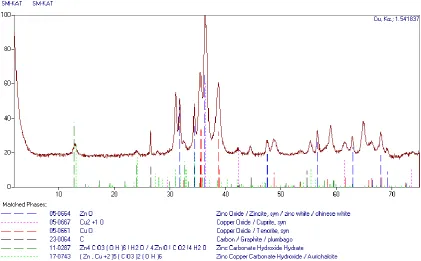
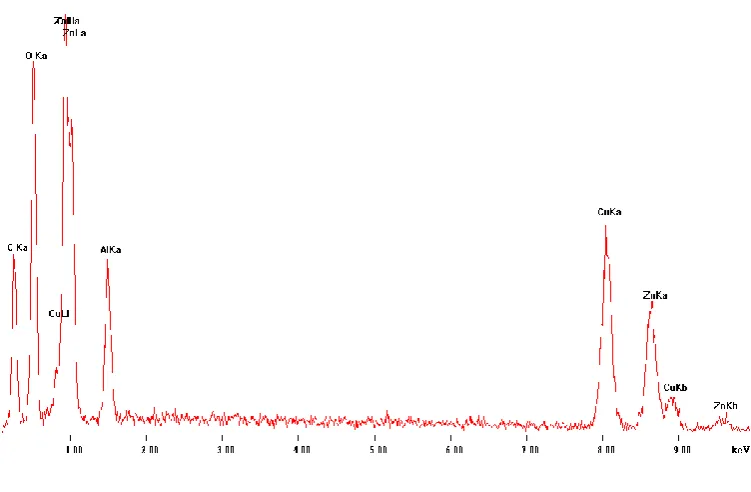
The material tested in this work is spent CuO-ZnO-Al2O3 catalysts available on the Polish market. They occur in the form of identical rolls with a diameter of 4.5 mm and height of 3.5 mm. The chemical analysis (AAS) of the examined samples of spent catalysts indicates different content of copper and zinc in the materials analysed. With the detailed chemical analysis of the catalyst sample selected to be examined, the following results were obtained: 35.1% of Cu, 29.9% of Zn and 9.2% of Al. A sample of the material was also examined using X-ray diffraction (XRD) and scanning electron microscope observation combined with qualitative energy dispersion chemical analysis (EDS). Results of the phase analysis are shown in Fig. 1. CuO and ZnO oxides are the main phase components. Additionally small quantities of Cu2O and hydroxy-carbonate complexes of zinc and copper are present.
Figure 1. XRD pattern of grounded catalysts sample.
3
Figure 2. The microscopic image of sample of the fragmented catalysts material.
Figure 3. EDS analysis of the area of the sample seen on Fig. 2.
3. Pyrometallurgical processing of spent catalysts
With information about the contents of the most valuable components in the material processed, it was decided to perform the test melting in order to extract copper and zinc in the form of zinc oxide from spent catalysts and to optimise the process for maximum yields of Cu and ZnO as mentioned above. Having in mind the oxidic nature of catalysts, in order to lower the melting point (softening point) of the slag created and, if possible, to decrease its viscosity, it was decided to carry out the recovery process under reducing conditions and to apply slag-forming additives (e.g. CaO, SiO2, Na2O). Therefore, in order to determine the
4
ternary systems were analysed. In the case of a binary ZnO-SiO2 system, the liquid phase
occurs at a temperature of 1432oC, with the content of about 52% ZnO by weight [13], while in the Na2O-SiO2 system, the liquid phase occurs in a wide range of concentrations and
temperatures close to 1000oC [14]. Therefore, it can be assumed that in the Na2O-ZnO-SiO2
ternary system, compositions, for which the melting point of the respective ternary phase will be low enough to melt the catalysts processed, are likely. The above hypothesis is confirmed by reports in the literature [15], which indicate that once the concentration level of (weight percent) 21.5% Na2O, 12.0% ZnO, 66.5% SiO2 in this system is reached, the minimum
melting point is 680oC. On the base of available information about the CaO-ZnO-SiO 2 and
CaO-ZnO-Al2O3-SiO2 systems [16-17], it was assumed that the lowest melting points can be
obtained at similar concentration levels of the relevant components.
3.1. Experimental procedure of pyrometallurgical processing
The catalysts were processed in an induction furnace, operable at a temperature range between 1100–1300oC. This temperature was to ensure maximum stripping of zinc and
obtaining liquid copper by reducing its oxide. The amount of coal for the reduction of CuO and ZnO was determined assuming the formation of CO and CO2. As a result, the amount of
reductant added varies between 6-12 wt%. For further studies, the mean value was taken increased by 10% due to the ash content in coal. Carried out initial testing allowed to determine that at 10% of added reductant degree of stripping the zinc is at a level of approx. 65%. Remaining part of zinc goes into the slag and metal phase. It should be noted that tests were carried out in a graphite crucible, which additionally improved the reduction conditions. Based on these results it was possible to determine the test plan to optimize the amount of slag-forming additives.
Four variants of laboratory tests were performed. The tests were different from each other in terms of quantity of slag-forming components added. The optimal process parameters were sought in order to obtain the lowest melting points of slag, thereby, to minimise the loss of metals extracted from the catalysts to slag. 100 g of uncrushed catalysts were used for each of the tests. The weights of copper and zinc contained in them were 35.1 g and 29.9 g, respectively. Reducing conditions of the process were secured by adding 10 grams of coal and by the fact that the melting was carried out in the graphite crucible. Once the melting was completed, the liquid products contained in the crucible were cooled, separated, weighed and chemical analyses of the materials obtained were performed.
3.2. Results and discussion of performed pyrometallurgical tests
Test No. 1
100 g of catalysts were mixed with 10 g of carbon, 50 g of SiO2 and 15 g of CaO. The whole
feed was placed in a graphite crucible and heated until a temperature of 1300oC was reached. At the beginning, intensive reduction of ZnO to Zn was observed and the metal was lifted in the gas phase and re-oxidised. After about 45 minutes, this process has been definitely halted (no emission of ZnO white films), and hence the decision was taken to terminate the test after this time. After cooling the crucible, its contents were separated into three fractions, and 26 g of metal, 62 g of glassy slag and about 17.5 g of unmelted fine fraction were yielded. This phase is, most likely, unreacted slag-forming components and unmelted ZnAl2O4 spinel
5
Test No. 2
100 g of catalysts, 10 g of carbon, 60 g of SiO2 and 20 g of NaOH were the feed for smelting.
Temperature of the process was 1300oC, duration-50 minutes. Like in the previous test,
during the first 45 minutes of the process, stripping of zinc in the form of ZnO was very intense. Upon its completion, products cooling and separation, 25 grams of metal, 95 g of glassy slag and 7.5 g of free-flowing phase (slag-forming components and spinels) were found. Also, in this test, metallic copper inclusions were seen in the slag.
Test No. 3
100 g of catalysts, 10 g of carbon, 31 g of Na2CO3 and 55.4 g of SiO2 were the feed for the
process. The feed was melted at a temperature 1250oC, and the melting time was 90 minutes. After this period, stripping of zinc drastically decreased and hence the decision to terminate the smelting was taken. 25 g of metal and 107 g of glassy slag with minor copper inclusions were yielded.
Test No. 4
100 g of catalysts, 10 g of carbon, 16 g of Na2CO3 and 28 g of SiO2 were melted. The melting
time was 90 minutes and the process temperature was 1250oC. 20 g of metal and 61 g of glassy slag with a certain amount of copper drops were yielded.
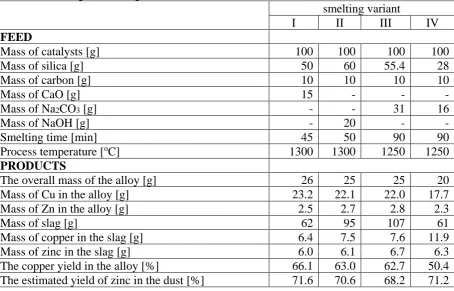
The smelting products, namely slag and metallic alloy were subjects of chemical analysis for the content of copper and zinc. Summary of test results in Tab. 1 takes into account the fact that the unbalanced portion of zinc is transferred to the dust phase.
Table 1. List of parameters of processing the spent catalysts conducted on a laboratory scale according to smelting variants.
smelting variant
I II III IV
FEED
Mass of catalysts [g] 100 100 100 100
Mass of silica [g] 50 60 55.4 28
Mass of carbon [g] 10 10 10 10
Mass of CaO [g] 15 - - -
Mass of Na2CO3 [g] - - 31 16
Mass of NaOH [g] - 20 - -
Smelting time [min] 45 50 90 90
Process temperature [oC] 1300 1300 1250 1250
PRODUCTS
The overall mass of the alloy [g] 26 25 25 20
Mass of Cu in the alloy [g] 23.2 22.1 22.0 17.7
Mass of Zn in the alloy [g] 2.5 2.7 2.8 2.3
Mass of slag [g] 62 95 107 61
Mass of copper in the slag [g] 6.4 7.5 7.6 11.9
Mass of zinc in the slag [g] 6.0 6.1 6.7 6.3
The copper yield in the alloy [%] 66.1 63.0 62.7 50.4
The estimated yield of zinc in the dust [%] 71.6 70.6 68.2 71.2
6
additives (variants II and III) results in similar effects with a much larger quantity of waste slag produced. In the last variant of the remelting (IV), a small addition of Na2CO2 was used
and an unsatisfactory degree of copper extraction to the metallic alloy was obtained. However, results of the pyrometallurgical test of catalysts recycling do not give grounds for optimism. Too low yield of copper may cause that the processing will be less cost-effective. This is due to the problem of obtaining a low viscosity slag. Probably, the presence of zinc aluminate causes high viscosity of slags. Correction of the slag composition results in the formation of large amount of slag, and even at a lower copper content in it, total losses are significant.
4. Processing of catalysts using the hydrometallurgical method
4.1. Procedure of hydrometallurgical tests
The results of using the described pyrometallurgical method to recycle the spent catalysts are not fully satisfactory. Therefore, to process them, the decision to use a hydrometallurgical method was taken for their processing. With knowledge about the structure of catalysts, their chemical composition and their phase composition, as well as being familiar with how they are produced [6], an innovative method to process them was developed. Zinc aluminate (ZnAl2O4), that is present in catalysts, is a compound highly
resistant to both acids and alkalines [18]. Therefore, it has been recognised that after leaching copper oxides and zinc oxides, will be left as insoluble residue. First, catalysts in form of pellets were fragmented to reach the size of less than 90 m. In order to separate zinc and copper, zinc oxide and copper oxide leaching process was carried out selectively and consisted of two stages:
• Leaching in NaOH solution (temperature 75oC, process duration 120 min., NaOH concentration = 200 g/dm3, l/s = 10),
• Leaching in H2SO4 solution (temperature 60oC, process duration 120 min., H2SO4
concentration = 180 g/dm3, l/s = 10).
The process conditions were adjusted based on previous experience in alkaline leaching [19], and pilot tests. After each leaching process, the slurry was filtered (filter Munktel & Filtrak, type 392) to separate the deposit. The filtration process is difficult because the deposit consist of very fine grains. During the leaching using NaOH, just zinc was transferred to the solution. In fact, after the acidic leaching, the solution contained just copper. The amount of zinc in the solution was 100 to 150 times less than the amount of copper. Additionally, in order to facilitate transferring copper to the solution, as acidic leaching was conducted, small amounts of hydrogen peroxide solution were added. A small quantity of it may in fact be present in metallic form.
4.2. Results and discussion of hydrometallurgical tests
Above described procedure allowed to obtain the following products from 100 g of catalysts recycled:
• Zn solution – 0.8 dm3 (Zn-23 g/dm3),
• Cu solution – 0.8 dm3 (Cu-43 g/dm3),
7
After leaching, the solutions still contain highly concentrated leaching agent, and should be returned to the initial leaching of subsequent batches. In order to recover as much metals as possible, the final leaching must be carried out using highly concentrated leaching agent. The zinc aluminate deposit was of dark gray colour, since it contained a certain amount of carbon. An attempt carried out to burn it out (600oC, air atmosphere) resulted in weight reduction by about 10% and the colour was changed into light gray. The sample obtained this way was analysed using the X-ray phase analysis. The results are presented in Fig. 4.
Figure 4. XRD pattern of zinc aluminate obtained from recycling catalysts.
Results of the phase analysis indicate just the presence of zinc aluminate and carbon. The presence of carbon results from the fact that during leaching coal does not pass into the solution and accumulates in the residue.
The balance of the processing performed is as follows (100 g of catalysts):
• Amount of zinc in alkaline solution – 18.5 g
• Amount of copper in acidic solution – 34.5 g
• Zinc aluminate – 30 g
• Carbon – 3 g
Material balance and analysis of the solutions allowed to determine the yield of copper in solution at the level of 98%. The yield of zinc to the alkaline solution is 61.9%. Because the residue after leaching is actually pure ZnAl2O4, it can be treated as a product of the process.
8
5. Conclusions
Laboratory tests carried out indicate that pyrometallurgical method can be used to recover copper and zinc contained in the spent catalysts processed. However, after the tests conducted, some amounts of the alloy in the slag in the form of small inclusions were noted. This may be a result of high viscosity of the slag and a result of difficult sedimentation conditions under the test conditions. The process should be carried out at temperatures above 1200°C and a reductant should be used in the form of coal in an amount of about 10% by weight of catalysts. Liquid copper and ZnO in the form of dust are products of the process. Silica and CaO or NaOH or Na2CO3 are an indispensable technological additive in processing
catalysts for slag adjustment. This allows to obtain a glassy slag and minimise copper losses in the process. Laboratory tests conditions made it possible to carry out the process of copper recovery with a yield of up to 66%. The Zn yield for dust was estimated based on the amounts of zinc contained in the alloy obtained and in slag. It can be assumed that under proper process conditions (reducing atmosphere, ~1300°C, enough time for Zn stripping) transferring to dust more than 70% of zinc contained in the spent catalysts is very possible.
Hydrometallurgical processing, based on the selective leaching allows to accurately separate the components of spent catalysts. More than 96% degree of metal recovery is reached. In the case of zinc and aluminum, this value is relative to the overall yield. It also includes the content of these metals in the leach residue. This residue may be the product of the process because it contains actually pure ZnAl2O4. Solutions obtained as a result of
applying acidic and alkaline leaching allow to perform the selective extraction of Cu and Zn they contain. These metals can be recovered from solutions in the form of compounds by precipitation or in a metallic form by electrolysis. The residue (mainly ZnAl2O4) that is left
after leaching may be returned to produce new catalysts or may be thermally processed to recover zinc it contains.
Taking into account the ecological side of the proposed processes, it should be noted that during the pyrometallurgical processing a waste slag is formed with a relatively high content of zinc and copper. It is not necessarily a waste neutral for the natural environment. Hydrometallurgical conversion of catalysts leads to their waste-free management and thus is completely environmentally friendly. The optimization of the leaching process parameters is the way of developing the proposed method.
Acknowledgments: This paper is supported by the Ministry of Science and Higher Education (Grant No. 11.11.180.726).
References
1. Sun, Z.; Xiao, Y.; Agterhuis, H.; Sietsma, J.; Yang, Y. Recycling of metals from urban mines - a strategic evaluation. Journal of Cleaner Production 2016, 112, 2977-2987.
9
3. Agarwal, V.; Patel S.; Pant K. K. H2 production by steam reforming of methanol over
Cu/ZnO/Al2O3 catalysts: transient deactivation kinetics modelling. Appl. Catal. A 2005,
279, 155-164.
4. Waugh, K. C. Methanol Synthesis. Catalysis Letters 2012, 142, 1153–1166.
5. Riaz, A.; Zahedi, G.; Klemes, J. J. A review of cleaner production methods for the manufacture of methanol. Journal of Cleaner Production 2013, 57, 19-37.
6. Behrens, M.; Studt, F.; Kasatkin, I.; Kühl1, S.; Hävecker, M.; Abild-Pedersen, F.; Zander, S.; Girgsdies, F.; Kurr, P.; Kniep, B. L.; Tovar, M.; Fischer, R. W.; Nørskov, J. K.; Schlögl, R. The Active Site of Methanol Synthesis over Cu/ZnO/Al2O3 Industrial
Catalysts. Science 2012, 336, 893–897.
7. Barroso, M. N.; Gomez, M. F.; Gamboa J. A.; Arrua, L. A.; Abello, M. C. Preparation and characterization of CuZnAl catalysts by citrate gel process. J. Phys. Chem. Solids 2006, 67, 1583-1589.
8. Turco, M.; Bagnasco, G.; Costantino, U.; Marmottini, F.; Montanari, T.; Ramis, G.; Busca, G. Production of hydrogen from oxidative steam reforming of methanol: II. Catalytic activity and reaction mechanism on Cu/ZnO/Al2O3 hydrotalcite-derived catalysts. J. Catal.
2004, 228, 56-65.
9. Walerczyk, W.; Zawadzki, M.; Grabowska, H. Glycothermal synthesis and catalytic properties of nanosized Zn1−xCoxAl2O4 (x = 0, 0.5, 1.0) spinels in phenol methylation.
Catal Lett. 2011, 141, 592–601.
10. Patent CN103495426A, 2014.
11. Patent CN1258752A, 1998.
12. Patent CN102125851A, 2011.
13. Bunting, E. N. Phase equilibria in the system SiO2–ZnO. Journal of the American
Ceramic Society 1930, 13, issue 1, 5–10.
14. Kracek, F. C. The system sodium oxide-silica. J. Phys. Chem. 1930, 34, 1583–98.
15. Holland, A. E.; Segnit, E. R. The ternary system Na2O-ZnO-SiO2. Australian Journal of
Chemistry 1966, 19, 905–913.
16. Segnit, E. R. The System CaO‐ZnO‐SiO2. Journal of the American Ceramic Society 1954,
37, 273-277.
17. Segnit, E. R. Three planes in the quaternary system CaO‐ZnO‐Al2O3‐SiO2. Journal of the
American Ceramic Society 1962, 45, 600-607.
18. Tang, Y.; Shih, K.; Wang, Y.; Chong, T. Zinc stabilization efficiency of aluminate spinel structure and its leaching behaviour. Environmental Science and Technology 2011, 45, 10544-10550.