DYNAMICS OF DROP DEFORMATION AND BREAKUP IN TIME-DEPENDENT FLOWS AT LOW REYNOLDS NUMBERS
Thesis by
Howard Alvin Stone
In Partial Fulfillment of the Requirements
for the Degree of
Doctor of Philosophy
California Institute of Technology
Pasadena, California
1988
ACKNOWLEDGEMENTS
There are many people who have contributed knowingly, or unknowingly,
to the completion of thesis. First of all, I would like to take this opportunity to
thank my advisor, Professor Gary Leal, for his support, advice, the confidence he
has shown in me and, most of all, his friendship. I have benefitted personally very
much from my interaction with Gary. In addition, I am indebted to Professor John Brady for his patient explanation of many basic principles and for taking
the time to share his many ideas. Barry Bentley not only showed great patience
with me as I was beginning my research, but also he built a unique experiment
that survived my graduate years and he (and the apparatus) taught me much
about experimental work.
The Caltech community has been very supportive during my graduate years.
I feel very fortunate to have had the opportunity to be a part of Caltech. It is a very special learning and research environment with many avenues for scientific
enlightenment. My financial support has come from a variety of sources, includ-
ing Shell Oil Company, IBM and the Chemical Engineering Department. This
research was supported by NSF. To all of these organizations I say thank you.
My friends have always been very supportive and understanding. To my
housemates over these past few years: Tom DiChristina, Chris Chow, Keith
Bentley, Mike Chobotov and Tina Morris
-
I feel very fortunate to have sharedtime with you. Each of you constantly amazed me with your unique and well-
rounded personalities and talents. I am lucky indeed if some of it has rubbed
off.
The members of the Leal, Herbolzheimer and Brady groups have taught
me more fluid mechanics than I ever dreamed of knowing. They have shared
their time and thoughts with me and have improved my ability to analyze and
solve problems. Other members of the Chemical Engineering Department and
from around Caltech have been good friends and never missed an opportunity to
special mention: Jim Stoos and his wife Ruth, Roger Bonnecaze, Lou Durlofsky,
Dave Dandy and Sonia Kreidenweis-Dandy, Ed Ascoli, Ardith El Kareh, In Seok
Kang, Seung Man Yang, Ron Lagnado and Enrique Geffroy-Aguilar. Buddie
Mullins was always available for discussions and continually sought to broaden
my thinking and John Doyle allowed me access to his computer.
In addition, I must acknowledge the contributions from my friends outside Caltech, especially those who have stayed in touch over the years. They have
helped me to grow in so many ways and constantly reminded that there is
more to life than science. Special thanks to Tom and Kelly Williams for their
companionship, to Deama Mah for her many words of encouragement over the
years and to Lila Basilgo for her special friendship.
Along the way to graduate school I have been very lucky to have had many outstanding texhers. UC Davis deserves special recognition for creating an
environment that
I
found very attractive for learning. Foremost among myteachers there, I must mention Stephen Whitaker for his special concern and approach to education. He demonstrates that outstanding teachers do indeed
make a difference.
Finally,
I
wish to thank my family, especially my parents, for their con-tinual support. Although they couldn't always appreciate the highs and lows
of graduate school, their support was constant and they never questioned my
ABSTRACT
This thesis is concerned with time-dependent free-boundary problems at
low Reynolds numbers. The primary objective is to use a combined experi-
mental and numerical investigation to examine the deformation and breakup
characteristics of a single phase Newtonian liquid drop suspended in a second
immiscible Newtonian fluid undergoing a prescribed linear flow. Two related
studies grew naturally out of this work and are also discussed here: (1) an ana-
lytic and numerical examination of the behaviour of concentric double emulsion
droplets in linear flows, and (2) an introduction to the effect surfactants have
on drop deformation in extensional flows.
Specifically, the breakup of a Newtonian liquid drop is studied under well-
defined flow conditions. Experiments are performed in a computer-controlled
four-roll mill and a detailed numerical investigation using the boundary inte-
gral method is presented. Particular attention is given to the dynamics of drop
breakup and many experimental and numerical examples are shown of the ac-
tual fragmentation process. Transient effects associated both with nonspherical
initial shapes and time-dependent velocity gradients are studied. Although the
time-dependent velocity fields are limited to step changes in flow conditions,
these investigations provide valuable insight into the breakup phenomenon and
are a necessary first step toward understanding more complicated flow situa-
tions. The effects of viscosity ratio, flow-type and capillary number are dis-
cussed thoroughly. Overall, these studies of drop breakup provide a nice illus-
tration of the influence of an interfacial-tension-driven flow that arises because of
curvature variations along the fluid-fluid interface (the interfacial tension is con-
st ant). The interaction of this interfacial-tension-driven flow with the prescribed
time-dependent velocity field produces very interesting breakup processes, often
without large scale stretching of the drop. Also, for highly elongated drops,
finite-amplitude capillary waves are observed experimentally and numerically.
tion of other systems involving deformable miscrostructures. Double emulsion
droplets, which arise in applications involving liquid membranes, are frequently
treated by drawing analogies with the known behaviour of single phase droplets.
We present a fundamental investigation of concentric double emulsion drops
in extensional flows. The analytic results allow calculation of the first effects
of flow-induced deformation and the effective viscosity of a dilute emulsion of
these particles. The analysis suggests interesting deformation and interact ion of
the two drop surfaces so a numerical investigation of the finite deformation of
these particles is described. The critical capillary number for breakup is deter-
mined, the dependence on physical and flow parameters is outlined and possible
mechanisms for breakup are discussed that differ from the single phase droplet
results. Finally, the effect of different flow-types, i.e., uniaxial or biaxial exten-
sional flows, is shown in some instances to suggest breakup of the inner droplet
even though the outer droplet maintains a steady shape.
The thesis closes with an introduction to the effect surface-ac tive agents
have on drop deformation. Because the distribution of surfactant along the
fluid-fluid interface produces interfacial tension variations, the calculation of
the drop shape as a function of time is intimately coupled with the convection
and diffusion of surfactant along the drop surface. We present an approximate
numerical procedure to study finite deformations and surfactant transport. The
results are not extensive but suggest several interesting aspects of the deforma-
. vii .
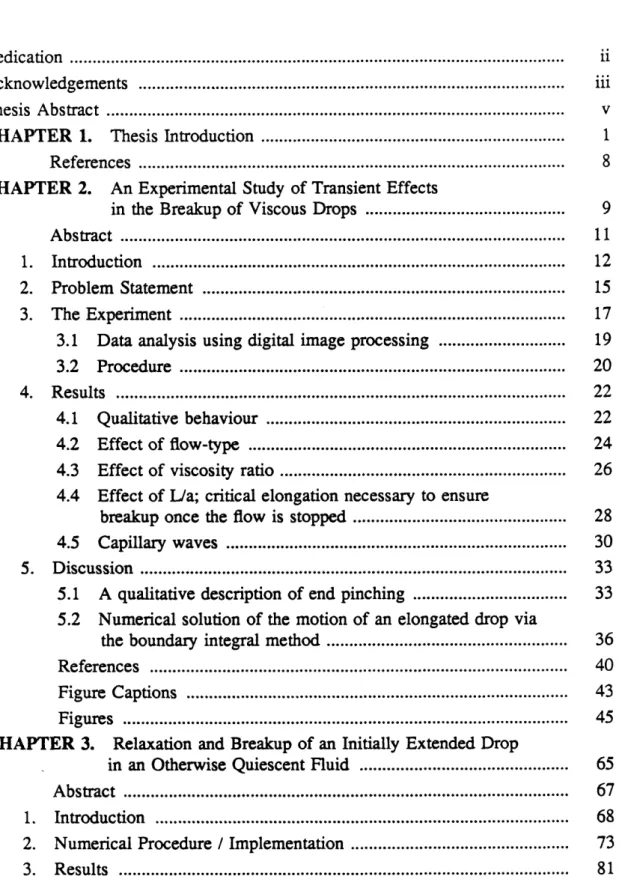
Table of Contents
Dedication
...
Acknowledgements...
Thesis Abstract...
CHAPTER 1.
Thesis Introduction...
References...
CHAPTER 2.
An Experimental Study of Transient Effectsin the Breakup of Viscous Drops
...
Abstract...
1.
Introduction...
2.
Problem Statement...
3.
The Experiment...
3.1 Data analysis using digital image processing
...
3.2 Procedure...
4.
Results...
4.1 Qualitative behaviour
...
4.2 Effect of flow-type...
4.3 Effect of viscosity ratio...
4.4 Effect of Ua; critical elongation necessary to ensurebreakup once the flow is stopped
...
4.5 Capillary waves...
5.
Discussion...
5.1 A qualitative description of end pinching...
5.2 Numerical solution of the motion of an elongated drop viathe boundary integral method
...
References...
Figure Captions...
Figures...
CHAPTER 3.
Relaxation and Breakup of an Initially Extended Dropin an Otherwise Quiescent Fluid
...
Abstract...
1.
Introduction...
2.
Numerical Procedure / Implementation...
3.
Results...
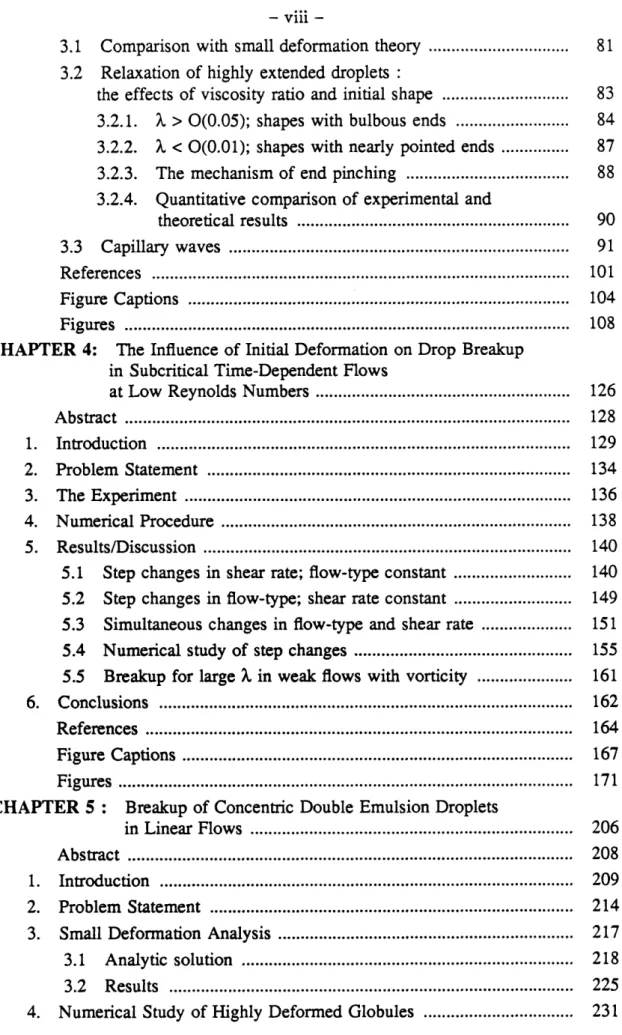
. viii .
3.1 Comparison with small deformation theory
...
3.2 Relaxation of highly extended droplets :...
the effects of viscosity ratio and initial shape3.2.1. h > O(0.05). shapes with bulbous ends
...
3.2.2. h < O(0.01). shapes with nearly pointed ends...
3.2.3. The mechanism of end pinching...
3.2.4. Quantitative comparison of experimental andtheore tical results
...
3.3 Capillary waves...
...
ReferencesFigure Captions
Figures
...
CHAPTER 4: The Influence of Initial Deformation on Drop Breakupin Su bcritical Time-Dependent Flows
...
at Low Reynolds Numbers...
AbstractIntroduction
2
.
Problem Statement...
3.
The Experiment...
Numerical Procedure
5
.
Results/Discussion...
5.1 Step changes in shear rate; flow-type constant...
5.2 Step changes in flow-type; shear rate constant...
5.3 Simultaneous changes in flow-type and shear rate...
5.4 Numerical study of step changes...
5.5 Breakup for largeh
in weak flows with vorticity...
6.
Conclusions...
References
...
Figure Captions...
Figures...
CHAPTER
5 : Breakup of Concentric Double Emulsion Droplets...
in Linear Flows...
Abstract1
.
Introduction...
2.
Problem Statement...
3.
Small Deformation Analysis...
4.1 Numerical scheme . application of the boundary integral
method
...
.'...
...
...
4.2 Results of the numerical investigationAppendix A
...
Appendix B...
...
ReferencesFigure Captions
...
...
FiguresCHAPTER
6 : A Numerical Study of the Effect of Surfactants on...
Drop Deformation and Breakup...
Abstract1
.
Introduction...
2.
Problem Statement...
.
...
3 Numerical Method I Implementation3.1 Calculation of the interfacial velocity using the
boundary integral method
...
3.2 Calculation of the surfactant distribution using theconvective-diffusion equation
...
3.3 Approximate numerical procedure to solve the...
coupled system of equations4
.
Results...
4.1 Convergence of the numerical method...
...
4.2 Initial observations4.3 The effect of Pes
...
5
.
Conclusions...
References...
...
Figure Captions
...
Figures
CHAPTER 7
: Thesis Summary...
APPENDIX
1 : Drop Deformation in Biaxial Flows...
...
1.
Introduction2
.
Numerical Procedure...
3.
Results / Discussion...
...
3.1 S teady-state calculations...
3.2 Transient effects...
4.
Conclusions...
References- X -
APPENDIX
2 : Implementing the Boundary Integral Method...
348...
.
1 Governing Equations 349
...
2.
Simplification for Axis ymrnetric Problems 352...
.
CHAPTER 1
In this thesis we are interested in the deformation and breakup of Newtonian
liquid droplets at low Reynolds numbers. Our focus will be on the dynamics
of the breakup process. Both experimental and numerical investigations will
be used to detail and understand qualitative and quantitative features of this
problem. We also include two extensions of these ideas to related topics: (1)
deformation and breakup of concentric double emulsion droplets and (2) an
introduction to the effects surface-active agents have on drop deformation in
extensional flows.
There exist many industrial processes that use studies of drop deformation
as a prototype. For example, the classical motivation for this research includes
applications to the mixing of immiscible liquids, the blending of polymers, the
dispersion of agglomerates of small particles in fluids, and the desire to obtain
a better understanding of the complex rheology of fluids with a deformable
microstructure.
In addition to many of the practical concerns outlined above, the study
of drop deformation remains a classical example of a free-boundary problem
in fluid mechanics. The deformable nature of the fluid-fluid interface implies
that the interface location is a priori unknown. Therefore, instead of being
given the boundary location as part of the problem statement, the boundary
location must be found as part of the problem solution. Perturbation methods
have been in use for many years to describe shapes that depart only a little
from a known equilibrium shape (e.g., a sphere, cylinder or plane), but it has
only been in recent years that efficient numerical methods capable of describing
finite deformation have been developed. In this thesis we will use the boundary
integral method to study time-dependent, finite deformation and breakup of
droplets in extensional flows.
Basic research concerning the fluid dynamics of drop deformation began
with two classic papers by G.I. Taylor in the 1930s. Taylor, who was interested
down to the meaningful and relatively straightforward analysis of a single droplet
suspended in a second immiscible fluid undergoing a prescribed linear flow. The
observations and results of Taylor's investigations serve as the starting point for
more than 50 years of drop deformation research reported in the fluid mechanics
literature, in addition to remaining among the most important and relevant
results in the field. An early overview of drop breakup phenomena is given by
Hinze (1955). Experimental, numerical and theoretical studies describing much of the recent work have been summarized in two excellent review articles by
Acrivos (1983) and Rallison (1984). A related work that makes a more direct connection with actual applications, particularly polymer blending processes,
has been written by Han (1981).
Physically, the problem of drop deformation would appear to be straight-
forward. A droplet immersed in a nonuniform velocity field will deform because
of viscous stresses exerted on the fluid-fluid surface. The deformation is re-
sisted by interfacial tension. If the velocity gradient is sufficiently large, in most instances the drop cannot maintain a steady shape, but rather begins to con-
b
tinually stretch in the flow. In the literature, this nonexistence of a steady drop shape is generally called "drop burst" or "drop breakup." Since the stretching
process produces shapes that are roughly cylindrical near the middle of the drop,
a common approach used to predict drop size distributions is to study the capil-
lary instability of an infinite fluid cylinder. However, it should be stated clearly
that there exist in the literature very few direct observations of the drop breakup
process for finitely deformed drops. Furthermore, there are two aspects related
to transient drop deformation that have received very little attention in the lit-
erature and deserve further investigation; namely, the effect of time-dependent
velocity gradients and the effect of nonspherical initial shapes, which drive mo- tion even in the absence of any external flow. Han (1981) makes this point very clear when discussing how the prototypical steady-state drop deformation
Therefore, the goal of the research reported in this thesis is to obtain a
better understanding of drop breakup with particular attention given to the ef-
fect of simple time-dependent flows and to a description of the mechanism of
drop breakup. Although only step changes in flow conditions will be examined,
such experiments are a necessary first step toward understanding more compli-
cated transient flows. Overall, these studies will include both experiment a1 and
numerical investigations of drop breakup in well-defined flow conditions.
The experiments are performed in a computer-controlled four-roll mill, de-
signed and constructed by Barry Bentley as part of his PhD research. A detailed
description of the design and operation of this device can be found in Bentley's
PhD thesis (1985). The four-roll mill is ideal for studying particle deformation
and breakup in linear flows where the magnitude of strain rate exceeds that of
the vorticity (so-called "strongn flows). The computer-controlled apparatus al-
lows these studies to be performed in well-controlled steady-state and transient
flow fields.
One modification to the experiment that we have introduced in this thesis
is the development of a technique to store and analyze digital images of the de-
formed drop. Previously, drop deformation as a function of time was monitored
using 35 mm photographs. For the large number of experiments it is necessary
to perform in this study of time-dependent effects, the use of digital image anal-
ysis is an important step in monitoring the rapid changes that occur during the
deformation and breakup of the drop
.
The implementation of this procedure isdiscussed in more detail in Chapter 2.
In order to understand the details of the experimental observations, a com-
plementary numerical investigation based on the boundary integral method is
described. The boundary integral method is a powerful method for solving time-
dependent free-boundary problems. This technique provides a clear picture of
the evolution of the interface during the breakup process, even for the highly
and external to the droplet are illustrated in order to better understand the
mechanism of breakup.
The net result of the studies described in Chapters 2-4 is a much improved
understanding of drop breakup, including a description of effects associated with
(simple) time-dependent flows. The experimental and numerical investigations
allow for a complete study of the effects of nonspherical initial shapes, the vis-
cosity ratio of the two fluids, the flow-type of the external flow, and the capillary
number. The role of capillary waves is examined also.
The final two chapters of this thesis describe how the methodologies used in
the course of this research and the understanding that developed as a result of
this research, can be extended to two other interesting free-boundary problems.
In Chapter 5 we examine the deformation and breakup of concentric double emulsion droplets. An analytic solution is developed t o study nearly spherical
compound drops and a complete numerical solution, again applying the bound-
ary integral method, is described to account for finite deformation and possible
mechanisms of breakup. In Chapter 6 we provide an introduction to the effect surfactants have on drop deformation in extensional flows. This is a very difficult
problem and, although the numerical procedure used is approximate, it provides
valuable insight concerning the behaviour of finitely deformed drops that have
interfacial tension variations produced by the distribution of surfact ant along
the fluid-fluid interface.
For the most part, each chapter is selfcontained with its own abstract,
introduction, description of experimental and numerical methods, and results
section. In Appendix 1 of this thesis the little studied problem of drop breakup in bian'al flows is discussed and in Appendix 2 a complete description of the
boundary integral method is provided to bridge the gap between the discussion
in the text and actual numerical implementation.
Rat her remarkably, the fundamental studies mentioned above, are finding
developed from the basic research involving drop deformation are currently be-
ing used, and may prove to be potentially useful, in such varied disciplines as
material science, biology and geology. In all of these fields, there will often be a
complex deformable microstructure whose response must be understood in order
to predict system behaviour, characterize bulk properties, etc.
For example, Stookey & Araujo (1968) have studied the deformation of
silver particles imbedded in a glass matrix and Seward (1974) has studied phase
separated glass materials (a glass matrix with very small second phase glass
particles imbedded in it). When the matrix is elongated, the discrete phase is
also elongated, sometimes being stretched into a long thread-like shape. Under
the conditions of the experiment both phases behave like Newtonian fluids. Upon
removal of the applied force, small droplets of the second phase glass are formed
by the disintegration of the narrow thread. In almost all cases, this breakup process did not occur uniformly along the thread, but rather was confined to
the end of the thread (Seward 1974). These observations are very similar to
experimental and numerical observations of the breakup of elongated droplets
that we discuss in Chapters 2 and 3.
From a biological view point, some aspects of the behaviour and deformation
of cells, especially red blood cells, can be usefully studied with the understanding
and methods developed in fundamental studies of drop deformation. A general
discussion of some of these ideas is given by Goldsmith & Skalak (1975) and a
recent mechanical model of a cell as a drop with an elastic membrane is discussed
by Bart hes-Biesel (1980). Additional discussion of the deformat ion of cells and
the role it plays in transport processes in the microcirculation is provided by
Caro, Pedley, Schroter & Seed (1978). Although no direct reference to the fluid
mechanics literature is given by Caro et al., it would appear that techniques
developed to examine deformation of a liquid drop may prove useful in this
context also.
cerning the information that can be extracted by accounting for the deformation
of droplets during studies of the flow of immiscible liquidst.
It is our hope that some of the ideas introduced in this thesis may prove to
be useful in related problems areas as well.
- 8 -
REFERENCES
Acrivos, A. 1983 The breakup of small drops and bubbles in shear flows. 4th
Int Conf. on Ph ysicochemical Hydrodynamics, Ann. N. Y. Acad. Sci. 404,
1-11.
Barthes-Biesel, D. 1980 Motion of a spherical microcapsule freely suspended in
a linear shear flow. J. Fluid Mech. 100, 831-853.
Bentley, B.J. 1985 Drop deformation and burst i n two-dimensional flows. PhD.
Dissertation. California Institute of Technology.
Caro, C.G., Pedley, T.J., Schroter,
R.C.
and Seed, W.A. 1978 The Mechanicsof the Circulation. Oxford University Press.
Goldsmith,
H.L.
& Skalak, R. 1975 Hemodynamics. Ann. Rev. Fluid Mech. 7 ,213-247.
Han, C.D. 1981 Multiphase Flow i n Polymer Processing. Academic Press.
Hinze,
J.O.
1955 Fundamentals of the hydrodynamic mechanism of splitting indispersion processes. A IChE J. 1, 289-295.
Rallison, J.M. 1984 The deformation of small viscous drops and bubbles in shear
flows. Ann. Rev. Fluid Mech. 16, 45-66.
Seward 111,
T.P.
1974 Elongation and spheroidization of phase-separated parti-cles in glass.
J.
Non-Crystalline Solids 15, 487-504.Stookey, S.D. & Araujo, R.J. 1968 Selective polarization of light due to adsorp- tion by small elongated silver particles in glass. Applied Optics 7, 777-779.
Taylor,
G.I.
1932The
viscosity of a fluid containing small drops of another fluid.Proc. R. Soc. Lond. A138, 41-48.
Taylor, G.I. 1934 The formation of emulsions in definable fields of flow. Proc.
CHAPTER 2
AN EXPERIMENTAL STUDY OF TRANSIENT EFFECTS IN THE BREAKUP OF VISCOUS DROPS
The basic text of Chapter 2 consists of an article which appeared in the G.I.
Taylor Centenary Symposium of the Journal of Fluid Mechanics, Volume 173,
An experimental study of transient effects in the breakup of viscous drops
H.
A. Stone, B. J. Bentleyt and L. G. LealDepartment of Chemical Engineering
California Institute of Technology
Pasadena, California 91 125
March 1986
ABSTRACT
A computer-controlled four-roll mill is used to examine two transient modes of deformation of a liquid drop: elongation in a steady flow and interfacial-
tension-driven motion which occurs after the flow is stopped abruptly. For
modest extensions, drop breakup does not occur with the flow on, but may occur
following cessation of the flow as a result of deterministic flows associated with
internal pressure gradients established by capillary forces. These relaxation and
breakup phenomena depend on the initial drop shape and the relative viscosities
of the two fluids. Capillary wave instabilities at the fluid-fluid interface are
observed only for highly elongated drops. This study is a natural extension
- 12 -
1. INTRODUCTION
Basic research on the deformation and breakup of a liquid drop due to the
motion of an immiscible, viscous suspending fluid dates back to the pioneer-
ing work of G. I. Taylor (1932, 1934, 1964). The problem is of considerable fundamental interest in fluid mechanics as an example of a time-dependent free-
boundary problem and as a prototype for flow-induced deformation of a variety
of flexible bodies such as red-blood cells, macromolecules, flocs, elastic particles,
etc. It is also closely related to dispersion processes in commercial blenders and
mechanic a1 emulsifiers. As a consequence, many investigations have appeared
since Taylor's original papers. Two excellent reviews by Acrivos (1983) and
Rallison (1984) provide a comprehensive description of this more recent work.
The remarkable feature of Taylor's early investigations is that he actually
discovered most of the interesting phenomena that are characteristic of drop
deformation and breakup in steady flows. However, to stop at this point in a de-
scription of Taylor's contribution to the drop deformation and breakup problem
does not do justice to the importance of his work. To experimentally simulate
a planar extensional flow, Taylor invented the four-roll mill, which has subse-
quently been used in many laboratories for studies of drop breakup, extension
of macromolecules, floc stability, and many related topics. To provide a theoret-
ical description of small deformations of the drop, Taylor used the asymptotic
method of domain perturbations. Later, to describe the motion of the highly
elongated shapes characteristic of low viscosity drops, Taylor pioneered slender-
body theory for low Reynolds number flow.
Taylor's (1934) experimental observations in steady simple shear and planar
extensional flows show clearly that drops at first deform under the combined
action of viscous and pressure forces through a series of steady shapes as the
shear rate is increased, until finally a point of maximum steady deformation
is reached beyond which further increases in the shear rate usually lead to a
first to note, however, there is a fundamental difference between simple shear
flow and two-dimensional extensional flow. In particular, a drop with a viscosity
that exceeds the suspending fluid viscosity by more than approximately a factor
of 4 does not become stretched in simple shear flow, but rather achieves a steady,
slightly deformed shape for all large shear rates. Thus, at low Reynolds number,
it is impossible to break a sufficiently viscous drop in steady, simple shear flow
regardless how large the shear rate becomes. In two-dimensional extensional
flow, on the other hand, drops of any viscosity ratio extend continuously so long
as the strain rate exceeds a certain critical value. This fundamental distinction,
first discovered by Taylor, between simple shear flow and planar extensional flow
is of considerable practical importance despite the restriction to low Reynolds
numbers, simply because the drops that we attempt to break in blending devices
are frequently very small, and are thus characterized by low Reynolds numbers.
In spite of the major accomplishments of Taylor and subsequent researchers
over the intervening 50 years, however, many important qualitative questions
remain to be answered:
(a) What is the role of flow-type in the deformation and breakup processes? In
particular, what is the nature of the transition between simple shear and
two-dimensional extensional flows?
(b) What are the mechanisms for breakup and how do they depend on the
parameters of the system, including the degree of deformation of the drop?
(c) What is the role of flow transients in the deformation and breakup proc-
esses?
(d) What is the role of rheology if one or both fluids are non-Newtonian?
The research reported here and in two earlier publications from our labo-
ratory (Bentley & Leal, 1986a,b) represent the first steps in a series of experi-
mental (and theoretical) studies that are designed to address these and related
questions. These experiments are based upon a computer-controlled version of
the flow, with minimal disturbance, for either steady or unsteady flows. The
complete spectrum of linear, twedimensional flows can be generated from pure
rotation to two-dimensional straining flow (the latter being the only motion
studied by Taylor with the four-roll mill). A complete description of this device
was published by us in our earlier paper, Bentley & Leal (1986a).
In our initial investigation, Bentley & Leal (1986b), we studied the steady
state shape and orientation for drops in five different types of steady two-
dimensional flows, from pure extension ('hyperbolic flow') to a flow with only
slightly more strain than vorticity and for drops with viscosity ranging from
to
lo2
that of the suspending fluid. Critical conditions for breakup were also de-termined for all these cases, the critical condition being identified as the capillary
number (dimensionless shear rate) beyond which the drop undergoes continuous
extension. The Bentley-Leal study of drop deformation in steady flows was a
natural outgrowth of preceding research in the field and concentrated mainly
on the measurement and prediction of steady shapes and of conditions where
steady shapes could not be achieved in steady flows.
The present paper represents a first step toward generalization of preceding
studies to investigate transient effects on the deformation and breakup of a liquid
drop. In particular, we examine the continuous elongation of a liquid drop for steady two-dimensional flows at capillary numbers (shear rates) that are equal to
or slightly above the critical value for 'breakup', and, the subsequent interfacial-
tension-driven relaxation of the extended drop when the flow is stopped abruptly.
Relatively few previous studies have examined any aspect of time-dependent
behaviour in the deformation and breakup process. Capillary wave instability
on infinite, stationary fluid cylinders has been considered by Tomotika (1935),
Rumscheidt & Mason (1962), Lee & Flumerfelt (1981) and Lee, Yu & Flumerfelt (1981), while Tomotika (1936) and Mikami, Cox & Mason (1975) have studied
capillary wave growth on extending fluid threads of infinite length. Of course,
closed at their ends, and thus do not represent a possible equilibrium state. We
shall see that the final drop length plays a critical role in both the extension of the
drop and its relaxation when the flow is removed, with the result that capillary
wave instability plays a role only if the droplets are extremely elongated. The
closest experimental study to that reported here is due to Grace (1971), who
reports data on the elongation necessary to achieve rupture in the relaxation
process, the resulting drop-size distribution, and some interesting effects due
to abrupt changes in shear-rate for simple shear and planar extensional flows.
Torza, Cox & Mason (1972) also investigated experimentally some effects of the
time-history of the flow field. From a theoretical point of view, three types
of analyses have been used to study transient phenomena. Hinch & Acrivos
(1980) and Hinch (1980) used slender-body theory to investigate the behaviour
of low-viscosity drops, and found that the equilibrium shapes corresponding to
subcritical shear rates were accessible only if the shear rate was increased slowly.
It was also shown that the existence of a waist in the initial shape always led
to breakup. Nearly spherical drops of arbitrary viscosity ratio were studied via
domain perturbation techniques by Cox (1969) and Rallison (1980), and shown
to attain steady shapes in an oscillatory manner in flows with vorticity. Finally,
Rallison & Acrivos (1978) and Rallison (1981) have used the boundary integral
method to investigate some aspects of the time evolution of the drop shape and
observed that the critical shear rate and mode of drop burst depended on the
history of the flow.
2. PROBLEM STATEMENT
We consider a Newtonian liquid droplet, with undeformed radius a, density
3,
and viscosityfi,
suspended in a second immiscible Newtonian fluid of densityp and viscosity p , which is undergoing a linear, two-dimensional flow at infinity.
with a being a 'flow-type' parameter and G the fluid shear rate. An approx-
imation to this flow field is generated near the center of a four-roll mill. The
flow-type parameter a provides a measure of the ratio of the rate of strain rel-
ative to the vorticity in the undisturbed flow and varies between a = +LO, a
hyperbolic (or extensional) flow, and a = -1.0, a purely rotational flow. Simple
shear flow corresponds to a = 0.0. We will be interested in flows with a
>
0,the so-called 'strong' flows, as they are capable of producing the greatest de-
formation for a given value of G. The streamlines for several of these flows are
illustrated in figure 1. The fluid-fluid interface is characterized by a constant
interfacial tension a.
Provided the Reynolds number is sufficiently small, the behaviour
of a neutrally buoyant drop in a steady flow can be characterized by three
dimensionless parameters: the viscosity ratio X = the capillary number
P '
C
= Q (which provides a measure of viscous forces causing deformationrelative to interfacial tension forces which resist deformation), and the flow-
type parameter a. The orientation of the drop relative to the principal axis of
strain (in our device, this is the x-axis for all flow types) is denoted by B and
is sketched in figure 2. Two scalar deformation measures have been used in
drop deformation studies and are also shown in figure 2. These are: D =
w ,
where L and B are the half-length and half-breadth of the drop, respectively,which is appropriate for mildly deformed drops; and L/a, the elongation ratio,
which is appropriate for highly extended drops. As discussed by Bentley &
Leal (1986b), the orientation angle is important because the effectiveness of a
particular flow in deforming the drop depends on the orientation of the drop
relative to the principal axis of strain of
I
'
.
This same concept will arise laterwhen we consider the transient elongation of drops in steady flows characterized
- 17 -
For sufficiently small values of the capillary number
C
a steady drop shapeexists in a steady two-dimensional flow for all a and A. Indeed, for each flow type
a
#
1, there exists a viscosity ratio above which the drop attains a steady shape for any value of the capillary number (provided, of course, that the Reynoldsnumber remains small). In such cases, drop b u n t is impossible. In the majority
of cases, though, there exists a critical capillary number above which a steady
drop shape no longer exists and viscous forces cause the drop to continually
elongate. This transient deformation is examined in the present study. If at
some time during this elongation process the flow is stopped, the problem be-
comes that of an extended liquid drop suspended in a fluid that is otherwise
quiescent. Because the extended drop is not an equilibrium shape, an evolution-
ary, interfacial-tension-driven flow occurs and the drop rapidly changes shape,
either returning to a sphere or breaking into smaller drops via a complicated,
t ime-dependent mot ion. The entire dynamics of this interfacial-tension-driven
flow are characterized by the viscosity ratio and the initial drop shape, and this
includes the determination of whether the drop breaks or returns to its native
spherical shape. Interfacial tension determines the velocity scale for the drop's
motion, and hence the time scale of the relaxation or breakup process, but has
no role in determining the qualitative characteristics of the phenomena. In the present study we examine this evolution of extended drops as a function of both
viscosity ratio and initial elongation ratio L/a at the time flow is stopped. One
objective is to determine the elongation ratio that is necessary if the drop is to
break, including any dependence of this critical condition on the viscosity ratio
or the flow-type during the elongation process (the latter presumably affecting
the initial elongated shape).
3. THE EXPERIMENT
The experiments reported in this paper were performed using the computer-
controlled four-roll mill described previously (Bentley & Leal, 1986a). Here, we
The drop position in the device is sensed using a digital television camera.
A minicomputer uses the digital representation of the drop to determine the
location of its center of mass. A control scheme which models the response of
the flow to changes in roller speed and the drop's response to changes in the
flow field then regulates the speeds of the rollers in order to maintain the drop
at the center of the device, under the constraint that the shear rate G and flow
type a remain constant. Typically, about five control cycles occur each second.
Since the drop position is controlled via small but finite modifications of
the flow several times per second, an obvious question is whether these changes
introduce any discernible change in the shape of the drop. A qualitative indi-
cation of the success of the control scheme is illustrated by the sharp fluid-fluid
interfaces shown in the time-exposure photographs of figure 3. Photo 3a is an
eight-second exposure (approximately 40 control cycles) of a drop at G = 0.11
sec-', a = 1.0, while photo 3 b is an eight-second exposure with G = 0.165
sec-', a = 0.2. The different light intensity at the center is due the lens effect
of the drop. Previous four-roll mills, including Taylor's original device, could be
controlled only by manual manipulation of the roller speeds. This resulted in
strong, time-dependent changes in the flow, and restricted the studies to steady,
hyperbolic flow, a = 1.0, only. The present apparatus dramatically increases the
reliability and utility of the four-roll mill by reducing the flow disturbances to a
minimal level and by allowing the full range of both steady and time-dependent
two-dimensional flows to be performed.
In our previous studies, the deformation and deformation history of the drop
was followed via 35 mm photographs. However, this procedure is demanding of the operator's time and is limited in the range of time-dependent motions that
can be followed (the minimum time increment between successive photographs
for a Canon A-1 motor-driven camera is approximately 0.8 sec). Furthermore,
it is expensive with regard to film and developing costs. Thus, one change
analysis of the existing digital image of the drop to determine the degree of drop
deformat ion.
3.1 Data analysis using digital image processing
Digital image processing techniques have found a wide variety of uses in
experimental fluid mechanics. However, so far as we are aware, the only uti-
lization similar to that described below is due to Girault, Schiffrin and Smith
(1982, 1984) who used a video digitizing technique to determine the shapes of
stationary pendant drops for the measurement of interfacial tension.
In our experiment, the sensor of the digital television camera effectively consists of a 224x112 grid of discrete picture elements (pixels), the light inten-
sity at each pixel being represented by an eight-bit digital signal. This gray
level information is thresholded by hardware to a one-bit (or two-st ate) signal,
effectively replacing the entire gray level image by a black drop in a white back-
ground. The thresholded information is sent via direct memory access to the
computer's memory and used in the control scheme to rapidly determine the
position of the center of mass of the drop. In our previous studies, this was the sole use of the threshold image. In the present work, however, the thresholded digital image is saved in a data file at the command of the operator, and then
analyzed, following completion of the experiment, to determine the character-
istic scalar measure of the degree of drop deformation; i.e. D or L/a. During
rapid deformation, many images could be saved, if desired.
The resolution of the digital television camera is 110.2 pixels/cm in the x-
direction and 72.5 pixels/cm in the y-direction (directions are shown in figures
1 and 2). The undeformed radius of the drop was typically 0.1 cm, but during
the elongation and breakup experiments the drops often attained half-lengths of
approximately 1 cm with very narrow waists, approximately 0.02 cm in diameter.
The narrow cylindrical waist was often very difficult for the digital camera to
resolve.
corresponding still photographs. These images are typical of the transient de-
formation that was the topic of interest of this paper. The basic features of the
shape are captured by the digital image. Following determination of the center
of mass, we calculated L/a by determining the distance separating the farthest
edge bit from the center of mass. Edge bits were located by scanning the image,
from the outside toward the inside, until we found the first bit on each scanning
line such that two out of three successive bits were 'dark'. Such a screening
process was necessary to be sure that extraneous dark bits due to 'noise' in the
digital image were not inadvertently identified as edge bits. A representative comparison of data from 35 mm still photographs with the results of analyzing
the digital image in this manner is shown in figure 5. Results are presented
for three different viscosity ratios and two different flow types for a series of
experiments on the transient elongation of a liquid droplet, described in further
detail in Section 3.2. Agreement is typically to within five percent.t With this
level of accuracy, the digital image analysis procedure was adopted and used
extensively for determination of the degree of drop deformation in the present
investigation of transient effects.
3.2 Procedure
The experiments reported here are a straightforward extension of the drop
deformation studies described by Bentley & Leal (1986b). With a drop main-
tained at the center of the four-roll mill, the shear rate is increased by small
increments of about 0.01 sec-' until a steady drop shape no longer exists. The
corresponding shear rate is termed the critical shear rate G c , or, in dimension-
less terms, the critical capillary number
C,.
At this point the drop elongatescontinuously in the local flow field. When a certain elongation ratio L/a is
reached, the flow is stopped. Depending on the viscosity ratio and the degree of
elongation, the drop then either breaks up into a series of 'daughter' drops or
else relaxes back to a spherical shape through a rather complex motion.
The objective of the experiments in which the flow is stopped is to approx-
imate an abrupt step change in the suspending fluid from a steady motion to a
state of rest. In order to achieve this, a necessary condition is that the character- istic time scale for the viscous response of the velocity field in the four-roll mill
to changes in roller speed is small compared with any time scale of drop defor-
mation. The present study was performed using Pale-4 Oil (an oxidized castor
oil available from
Cas
Chem, Inc., Bayonne, N.J.) as the suspending fluid, with viscosity of approximately 50 poise. The characteristic viscous response time for2
changes in the four-roll mill flow,
b,
is thus 0.3 sec (here, I , is the characteristicapparatus length scale, and v is the kinematic viscosity of the suspending fluid). On the other hand, the characteristic time scale for interfacial-tension-driven
a l + X
changes in drop shape is and this is usually large compared with the
viscous response time for the flow. In general, then, when the rollers are stopped,
drop motion is driven strictly by interfacial tension and is a consequence of the
nonequilibrium shape of the extended drop in an otherwise quiescent fluid.
All of the experiments were recorded on video tape for qualitative viewing
and the results were quantified by analyzing digital images of the deformed drop
or by occasionally taking 35 mm still photographs. Experiments were performed for ten viscosity ratios between 0.01 and 12 and for five flow types, a = 1 .O, 0.8,
0.6,0.4 and 0.2. The drop fluids were a series of Dow Corning Silicone oils. The
properties of these fluid systems were tabulated by Bentley & Leal (198613). The
undeformed drop radius varied between 0.05 cm and 0.1 cm and, in all cases,
was small enough that the elongated drop remained in the central region of the
device where the flow field is given approximately by (1). The Reynolds number
@ was about for these experiments.
4. RESULTS
In this section we present the results of our experimental study of the elon-
gation of liquid drops in twedimensional strong flows, and the subsequent re-
laxation and/or breakup of the drops after the flow is stopped. First, we report
qualitative observations of drop deformation and breakup, including the effects
of varying both flow type and viscosity ratio. Second, we present quantitative
results for the drop elongation ratio L/a as a function of time, as well as the
critical elongation ratio necessary to ensure breakup for this special flow his-
tory. Our results will be compared with two existing theoretical analyses: (1)
an extending, infinite fluid cylinder in an axisymrnetric extensional flow and (2)
capillary wave growth on an infinite, stationary liquid cylinder in a quiescent
fluid. In the final section, we present a qualitative explanation for the dynamics
of the observed relaxation and breakup phenomena and we describe briefly a new
solution for the motion of an elongated drop in a quiescent fluid generated using
the boundary integral technique which supports this qualitative explanation.
4.1 Qualitative behaviour
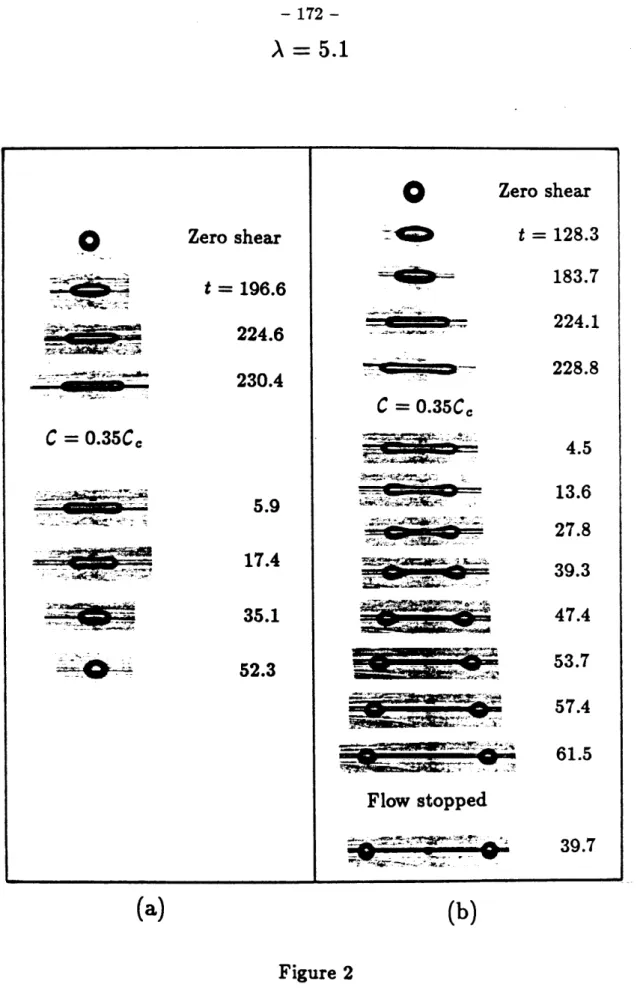
We begin by describing the elongation and subsequent interfacial-tension-
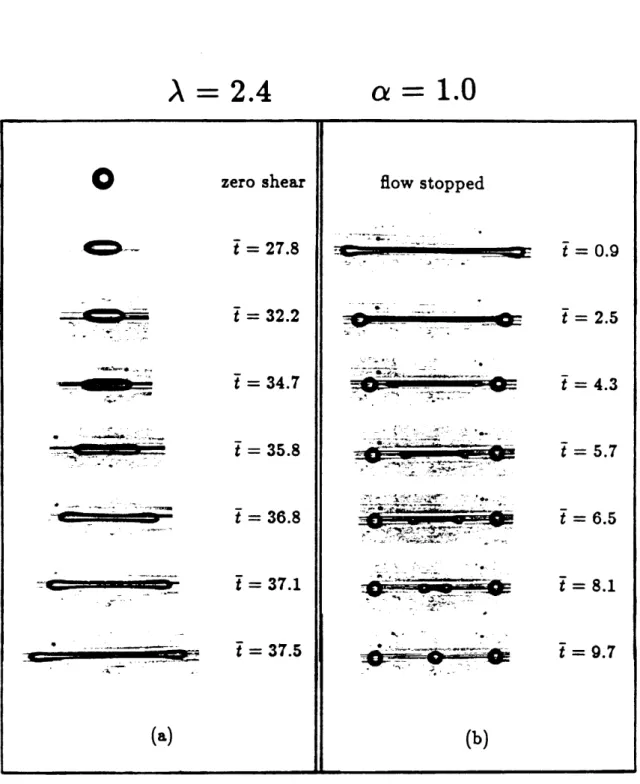
driven breakup in qualitative terms, using the results for the case X = 2.4, a =
1.0, shown in figure 6a, b to illustrate the phenomena. The first photograph in
figure 6a is the undeformed drop, and the remaining photos exhibit the transient
deformation of the drop while the flow is maintained at the critical capillary
number, Cc = 0.117. The times listed to the right of the photographs (and all
other photographs shown in this paper) are nondimensionalized with respect
to GC&
(f
= GC&t) and it is clear from the values listed that the initialelongation process is very slow. This is, in fact, true for all viscosity ratios,
though the rate of elongation in this initial stage of transient deformation is
observed to decrease as the viscosity ratio increases. During this slow initial elongation process, the sides of the drop are gradually flattened until the drop
increases, as seen in the last three photos in figure 6a, eventually approaching
the rate of elongation of a fluid line element in the linear flow. During this
period, the central section of the drop decreases rapidly in radius. Meanwhile,
the ends retain their bulbous shape and appear to translate with only a small
change in volume. While the flow is on, there is no evidence of capillary waves
on the central cylindrical section. This was true for all the systems examined
and will be discussed more fully in Section 4.5. Furthermore, we found no case
where the extending drop in a steady flow fractures at the middle while the flow
was on, though it should be noted that the total elongation in our experiments
was limited by the finite dimensions of the four-roll mill.
The sequence of photos, figure 6b, shows the drop behaviour after the flow
is stopped. The times shown are measured relative to the instant that the flow
is turned off and, for consistency, have also been nondimensionalized with re-
spect to
G&.
The most interesting and important observation is that thebreakup process, illustrated by the series of photos, is entirely different from the
capillary wave instability mechanism that is the basis for all existing theories of
drop breakup! The motion leading to breakup is obviously driven by the finite
interfacial tension of the interface. However, this motion is clearly a consequence
of capillary pressure variations near the ends of the drop rather than the insta-
bility of infinitesimal disturbances in the drop shape. We first notice that the
ends immediately become almost spherical after stopping the flow, forming a
dumbbell-like shape, while the overall length decreases. The ends then proceed
to pinch off, leaving a cylindrical thread of fluid which relaxes rapidly while the
newly formed ends bulb up. However, in this particular case, the ends do not
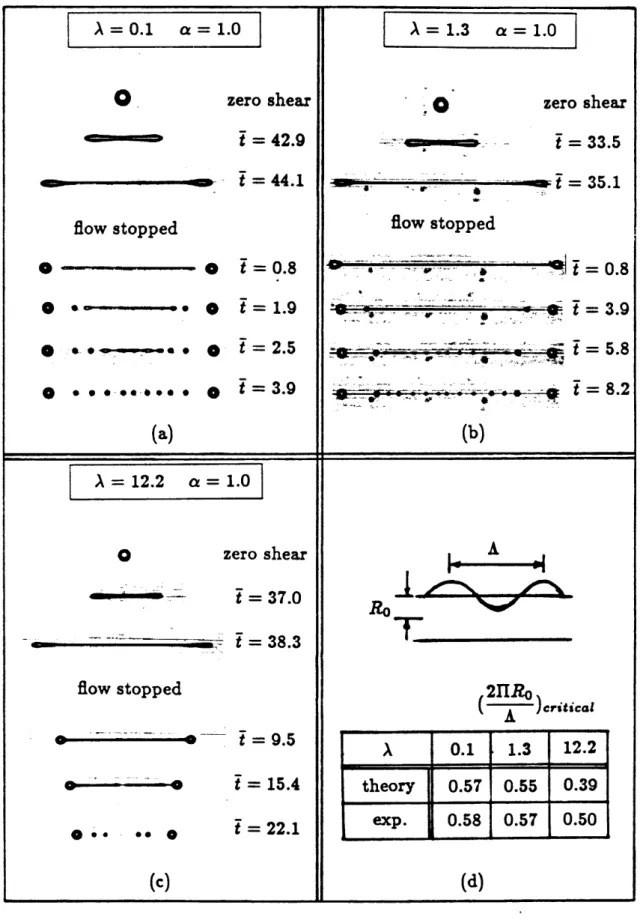
pinch off and the central thread relaxes to form a single spherical drop. Just barely visible between each pair of drops is a tiny satellite drop. During the
relaxation and breakup process exhibited in figure 6b, capillary waves are never
visible on the central, cylindrical section. Although this is not true in general,
for the most elongated drops that could be achieved in our four-roll mill while
still maintaining the drop within the central region of homogeneous flow.
Qualitatively, the behaviour observed in figure 6 b is typical of all fluid sys-
tems studied. We call the new breakup mechanism 'end pinching'. It appears
that the final drop size distribution obtained via the 'end pinching' mechanism
is determined by the rate at which the ends bulb up and contract toward the
drop center, relative to the rate at which the ends pinch off. Evidently, the
interfacial-tension-induced flow responsible for 'end pinching' occurs on a much
shorter time scale than the growth of capillary waves, at least for the particular
case shown in figure 6. Theories of drop breakup and resulting predictions of
drop size distributions based upon a capillary wave instability mechanism will
clearly not suffice in such circumstances.
4.2 Effect of flow type
Before considering the effect of varying the viscosity ratio on the dynamics
of the elongation and 'end pinching' processes, it is worthwhile to examine the
effect of flow type. Bentley & Leal (1986b) have shown that a drop that passes
through a series of quasi-steady states becomes oriented with its long axis along
the exit streamline of the flow (figure 1) as the critical capillary number is
approached. At this orientation, the effective strain rate of the fluid on the drop
(i.e. the strain-rate along its axis) is Gc&.
Now, figure 7 illustrates the elongation and breakup process for X = 0.09
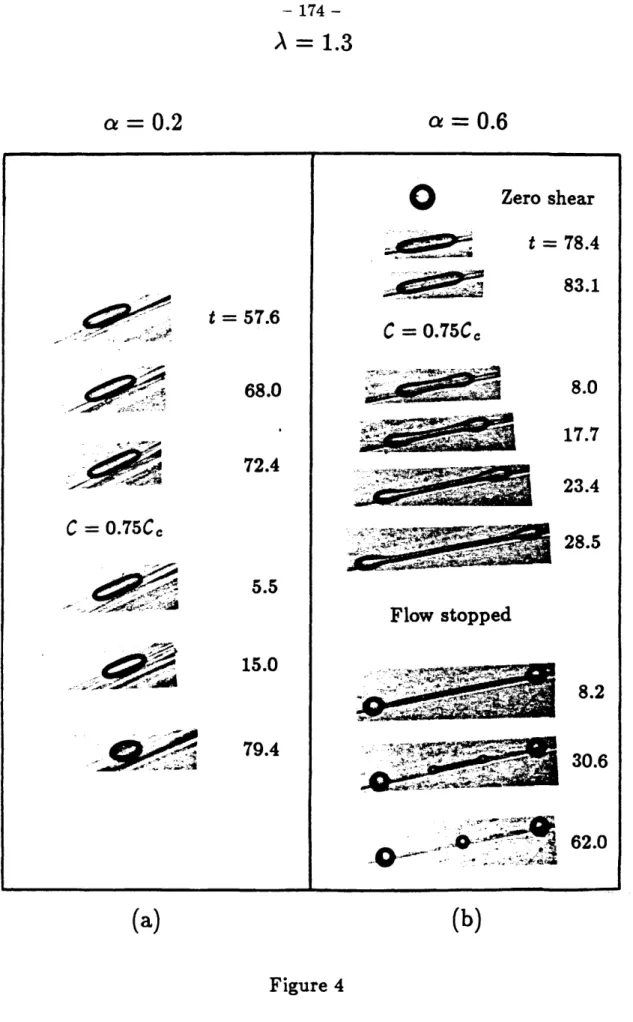
and two different flows, a = 0.6 and a = 0.2, respectively. The main difference,
other than flow type, is that the critical shear rate G c is approximately 1.5 times larger for the a = 0.2 flow. Otherwise, the similarities are rather remarkable.
As before, the drop undergoes a very slow initial elongation followed by a period
of rapid extension prior to stopping the flow. Notice that the a = 0.6 drop was
allowed to stretch further before the flow was stopped, which leads to more drop
fragments being formed. The dynamics of the breakup process, though, are
are somewhat different. This suggests that drop breakup in a quiescent fluid
depends primarily on the global geometry (rather than on any local feature of
the shape) and the basic shape of the elongated drops generated by these flows
is very similar. The 'end pinching' mechanism is observed and, in these cases,
the process repeats itself on the middle thread. Since the shape of this thread,
immediately after its formation, is different from the shape of the originally
stretched drop, we again see that it is the overall elongated shape and not
local details that denominates and is responsible for the 'end pinching' breakup
process.
Figure 8 illustrates the rate at which the elongation ratio L/a varies with
dimensionless time G&t for the drops shown in figure 7. Additional data are
also presented for the same X but different a. Here we focus attention on the
rate of elongation as a function of flow type, for constant A. Hence, the data for
each experiment end when the flow is stopped. Because G c f i is the effective
extension rate along the exit streamline where the elongated drops align, it is a
reasonable choice for scaling the time while the flow is on, and this is indicated
by the agreement in the data of figure 8 for the various values of a.
It should be noted that the very slow elongation process that characterizes
the initial stage of transient deformation means that a small error in experimen-
tally determining the critical capillary number makes a large difference in the
origin of the time axis for each experiment. Consequently, all the plots of L/a
versus time in this paper have been adjusted so that the steeply sloping portions
of the curves overlap. This adjustment affects the relative position of the curves,
but has no effect on their shape. From figure 8 it is clear that the effect of flow
type a is only to modify the time scale for elongation of the drop, at least for the
particular flow history that we examine in this paper. Hence, the photographs
in figure 7 and the rate of elongation data presented in figure 8 demonstrate that
the qualitative nature of the transient deformation and relaxation processes are
4.3 Effect of viscosity ratio
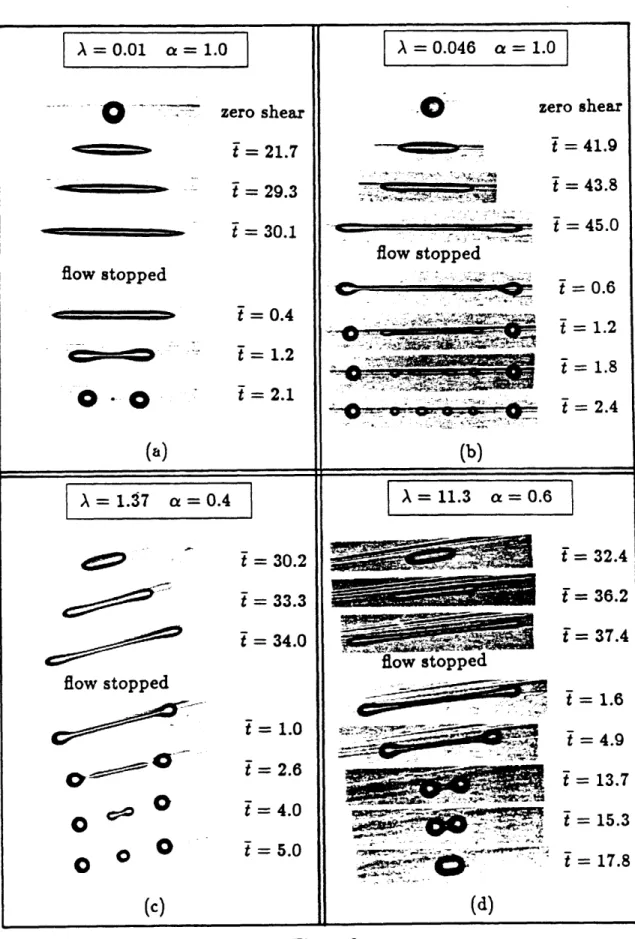
Figure 9 illustrates the elongation and breakup process for the entire range
of viscosity ratios that we studied. Although the flow type is different for the
various cases shown in figure 9, we have already demonstrated that a has no
effect other than determining the critical shear rate and hence the time scale for
elongation. The differences apparent among the experiments shown in figure 9
are a consequence of changes in the viscosity ratio A.
Figure 90 shows a sequence of photographs illustrating the transient be-
haviour of a drop with viscosity ratio 0.01. In low viscosity ratio experiments such as this one, the drop attains highly elongated steady shapes prior to achiev-
ing the critical shear rate where continuous elongation occurs, and the ends of
the drop are much more pointed than we saw in either figures 6 or 7. During
elongation with the flow on, the shape of the drop does not change dramati-
cally. Except for a small region near the ends which remains almost pointed,
the width of the elongating drop is nearly constant over its entire length at any
instant. When the flow is stopped, however, the ends rapidly become rounded,
the overall length is reduced significantly, fluid drains from the center and the
drop breaks. Two daughter droplets are formed in the case illustrated here with
a barely visible satellite drop between them.
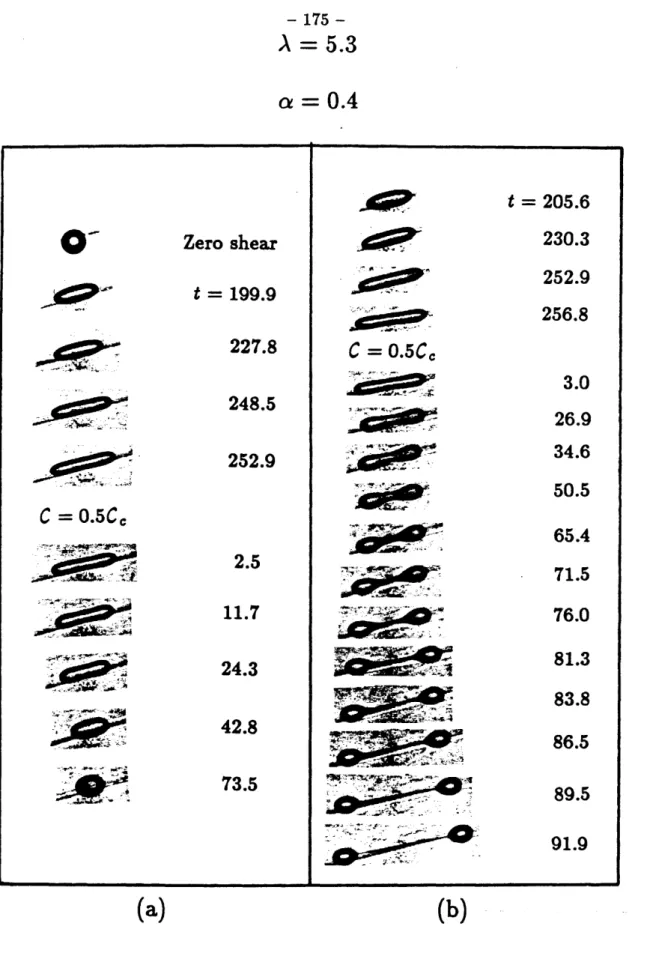
Two intermediate viscosity ratio cases X = 0.046 and X = 1.37 are shown in
figure 96,c respectively, and the qualitative behaviour is very similar to the cases
X = 1.4 and X = 0.09 examined in figures 6 and 7, respectively. In the present
figures, the initial onset of stretching of the drop occurs at moderate deforma-
tions. In other words, the maximum steady deformation is relatively small in
these cases, as already shown by Bentley & Leal (1986b). For both experiments,
breakup is evidently a consequence of the 'end pinching' mechanism.
Figure 9d illustrates the drop behaviour for the highest viscosity ratio exam-
ined in this study, X = 11.3. The new qualitative, dynamical feature we observe
though it is highly elongated and the ends bulb up to produce a dumbbell-like
shape. No pinching off of the ends occurs. Instead, the ends are pulled toward
the drop center and engulf the cylindrical protion of the drop as they move. It
is interesting that the diameter of the central portion of the drop remains es-
sentially constant until the separation between the drop ends is approximately
equal to the end diameter. Again, capillary waves are not observed.
Examination of the photographs in figure 9b-d illustrates that, despite the
300-fold difference in viscosity ratio, the shapes of the intermediate and high
viscosity ratio drops are remarkably similar while the drop is elongating in a
steady flow at the critical capillary number. Furthermore, the rates of stretching
of these different viscosity drops, following the slow initial deformation, are
also remarkably similar. This is clearly evident in figure 10 which presents
the elongation ratio L/a as a function of dimensionless time GC&t for the
experiments shown in figure 9b-d. Data are only presented for the period while
the flow is on, the results having been adjusted so that the steeply sloping
portions of the c w e s overlap. As is evident in the photographs, however, the
similarities in behaviour ended after the flow is stopped. Not only does the high
viscosity ratio drop not fragment in spite of having a comparable initial L/a and
shape as the intermediate viscosity ratio drops, but, as is to be expected, the
time period over which relaxation occurs is much longer the larger the viscosity
ratio (when examining the relaxation process it is necessary to remember that
the time has been scaled with respect to Gc@ and, for X s 1 0 , Gc decreases with increasing A). Because the degree of elongation in the three cases is similar,
the differences observed for the high X case are evidently due to the effects of
viscosity ratio.
With reference to the lowest viscosity ratio, X = 0.01, if the drop is allowed
to stretch further than shown in figure 9a, we find that it also stretches at the same rate as the higher viscosity ratio drops shown in figure 10. However,
the intermediate and high X experiments due both to the lower viscosity ratio
and the initial, pointed shape (which, of course, is also a consequence of the
lower viscosity ratio). A qualitative explanation for the effect of viscosity ratio
on the elongationJbreakup process, as exhibited by these photographs, will be
presented in the discussion section.
4.4 Effect of L/a; critical elongation necessary to ensure breakup once the flow is stopped
We have yet to address specifically the question of how the initial degree of
elongat ion affects the relaxation and breakup dynamics. First, we must reiterate
that in no case did we observe breakup while the flow was on. Drop breakup,
and, consequently, the final drop size distribution for a given viscosity ratio,
were dependent on the elongation ratio L/a prior to stopping the flow.
It should not be surprising, in the light of the photographs presented in
this paper, that drops that were extended only a little past their steady shape
relaxed back to a sphere without fragmenting over the entire range of viscosity
ratios studied. In addition, in all cases there existed a critical elongation ratio
above which the drop fragmented when the flow ceased.
For each of the viscosity ratios studied, several experiments were performed
to determine the critical elongation ratio for drop breakup. One way to il-
lustrate the results of varying the elongation ratio is to examine data for L/a
as a function of dimensionless time. Such data are shown in figure lla-f for
X = 0.018,0.036,0.20,0.47,2.2 and X = 5.7, respectively, and for a range of final elongation ratios at the point when the flow is stopped. These plots are very
similar to figures 8 and 10. Here, however, we systematically vary L/a, holding
X constant, and observe the effect on the relaxation/breakup process and sub-
sequent drop size distribution. For each experiment, we mark by a horizontal
arrow, the point where the flow is stopped. Measurements of L/a then are con-
tinued until the first fragment separates from the main drop. The value of L/a at
is driven by interfacial tension after the flow is stopped so that a more appro-
a l + X
priate time scale is
u,
for convenience, the time-scale was not changedin this portion of the plot. In each figure, data that return to L/a = 1 indicate
that the drop relaxes back to a sphere without fragmenting. When breakup
does occur, we also include a photograph of the final dispersed state of the drop
after breakup and indicate the fractional increase in interfacial area, denoted by
A/Ao, that is generated by the fragmentation process (the bottom photograph in figure l l c shows the drop shortly before it fragments into two equally sized droplets). These figures reiterate some features that were exposed earlier by the
photographs, namely that provided L/a is not too large, a considerable short-
ening of drop length occurs prior to fragmentation, and the relaxation is slower
for higher viscosity ratios. Finally, the solid, almost vertical line in each figure
illustrates the expected slope if the drop were to stretch at the same rate as a
fluid element in the linear flow. It is clear that as the drop becomes increasingly elongated this asymptotic behaviour is approached.
These figures illustrate that for small enough L/a the drop relaxes back
to a sphere. However, above a critical elongation ratio the drop breaks and the
number of drop fragments ( and hence interfacial area
)
increases with increasingL/a beyond this critical value.
For all viscosity ratios, the critical elongation ratio necessary to guarantee
drop breakup for the flow history that we examined is summarized in figure
12. The squares denote the largest elongation ratio for which the drop relaxed
back to a sphere and the triangles denote the smallest elongation ratio for which
breakup was observed upon cessation of the flow. The cross-hatched region
therefore denotes the uncertainty in the magnitude of the critical elongation ra-
tio. The dotted line in this figure represents L/a for the most deformed steady
shapes that were observed experimentally by Bentley & Leal (1986b). Exami-
12 illustrate, as found by Grace (1971), that the critical elongation necessary to ensure breakup is large compared with the maximum stable shape.
Figure 12 also clearly illustrates a difficulty in breaking drops with either a high or low viscosity ratio. As shown by the photographs in figure 9, high X
drops are able to relax back to a spherical shape before either capillary wave
instabilities on the central cylindrical portion or the dynamics of