Architectural Principles for Large Scale Web sites:
a Case Study
Tristan Linnenbank
Thesis for a Master of Science degree in Computer Science from the University of Twente, Enschede, The Netherlands.
Date December 6, 2006 Assignment Organization Hyves
Herengracht 252, 1016 BV, Amsterdam, The Netherlands Graduation Organization University of Twente
Faculty of Electric Engineering, Mathematics and Computer Science Department of Computer Science
Architecture and Services of Network Applications Chair Drienerlolaan 5, 7522 NB, Enschede, The Netherlands Graduation Committee dr. L. Ferreira Pires (University of Twente)
dr.ir. D. A. C. Quartel (University of Twente) dr.ir. R. van de Meent (University of Twente) ir. K. Kam (Hyves)
Abstract
Nowadays, almost everyone has access to the Internet. On the Internet, a large amount of Web sites exists. In practice, most Web sites start as small Web sites with a small scale architecture and might experience an enormous unexpected and/or unanticipated growth in users, page views and features. Because of this growth, the Web site’s architecture of today has limited applicability for tomorrow’s growth. This increased use and adoption of the Web site’s services causes a demand for a higher level of scalability and redundancy, when compared to the original requirements of the current architecture. Google, MySpace and MSN are examples of such large Web sites that probably had to handle with these problems. We do not know for sure, since except for Google, little is known about the architectures of these Web sites.
In this Master thesis, we gain insight into the architectures of large scale dynamic Web sites like Google and Myspace by using the Web site of the Hyves service as a case study. The Hyves Web site currently experiences an enormous growth in users and page views and the current architecture is expected not to be scalable for this growth. Within the case study, we identified architectural principles for designing and implementing such large scale Web sites. The results from a case study are not necessarily applicable for designing and implementing any large scale Web site, therefore the identified principles are not general applicable.
We restricted our research to the media service part of the architecture of the Hyves Web site, and divided the research up to three smaller researches that identified architectural principles for the resource manage-ment layer, the application logic layer and the presentation layer. Part of the architectural principles were identified by studying and analyzing the current architecture first. Secondly, we analyzed the current expe-rienced problems with the Hyves Web site. The analyzed problems and the solutions we designed to solve these problems were used to identify the other part of the architectural principles.
By analyzing the current architecture we identified the following architectural principles:
• Supporting services within the large scale Web site should be prevented from being single points of failures. During our research we experienced that supporting services that were not regarded as critical were implemented as single points of failures. During the growth of the large scale Web site, these services became more critical and the design decision to implement these services as single points of failures became invalid. Redundancy, improved performance and portability are mentioned as possible solutions;
• One should prevent tight coupling as much as possible. This concerns hard coding parameters in the application and using limited resources like storage for more than one part of the service. During our research we experienced that both concerns limited the growth of the case study’s Web site;
• Implement application-level monitoring from the start when designing a part of a large scale Web site. System-level monitoring the applications and machines that are used to implement the service is not sufficient. The performance and functioning of in-house written applications should also be monitored and also the aggregate performance and functioning of the applications and machines that are used to the implement the service.
have seen that current performance problems can be solved when introducing such a scheme.
• Every design should incorporate that current available resources such as processing capacity and storage capacity are not sufficient when used as a stand-alone solution. This principle overcomes the problem of a growth of a large scale Web site that outperforms the growth of the capacity of available resources. As a solution, the use of pools and/or clusters of resources are mentioned.
• The use of pools and/or clusters of resources also create redundancy and scalability. The current problems in our case study showed that some parts were not scalable, since it was not possible to add additional capacity to increase the performance of that part of the service. The same problems also showed that in case of failure, that part of the service was stopped because there was no redundancy to overcome a failure.
Preface
This Master’s Thesis is the final product of my Computer Science education at the department of Computer Science, at the Faculty of Electrical Engineering, Mathematics and Computer Science of the University of Twente, The Netherlands.
I would like to thank a number of people who have given me the opportunity to complete this thesis:
From the University of Twente, I would like to thank Lu´ıs Ferreira Pires and Remco van de Meent for their valuable input while discussing my progress and approach. Lu´ıs and Remco, thank you for keeping me on track and for the guidance during this research.
From Hyves, I would like to thank Koen Kam for the opportunity to do my research at such a large scale Web site and Ramon van Alteren for being a nice co-worker and discussing several implementation details. I also would like to thank Reinoud Elhorst for philosophizing about certain problems and solutions on the media service during my research. I would also like to thank the rest of my co-workers at Hyves for the pleasant time at Hyves Headquarters.
Finally, I would like to thank Cynthia, my girlfriend, for her support, for her patience, for reading the several versions of the thesis and hearing me talking way too much about my graduation project,.
Lelystad & Amsterdam, The Netherlands, December 6, 2006.
Table of Contents
1 Introduction 1
1.1 Motivation . . . 1
1.2 Case Study . . . 2
1.3 Problem and Challenges . . . 4
1.3.1 Media Growth Storage Challenges . . . 4
1.3.2 Media Growth Processing Challenges . . . 6
1.3.3 Media Growth Serving Challenges . . . 7
1.4 Objectives . . . 7
1.5 Approach . . . 7
1.6 Restrictions . . . 8
1.7 Structure of this Document . . . 9
2 Architecture 11 2.1 Initial Architecture . . . 11
2.1.1 Resource Tier . . . 11
2.1.2 Application Logic Tier . . . 12
2.1.3 Presentation Tier . . . 12
2.2 Implementation . . . 13
2.2.1 Resource Tier . . . 13
2.2.2 Application Logic Tier . . . 14
2.2.3 Presentation Tier . . . 14
2.2.4 Vertical Sub-systems . . . 15
2.3 Media Service . . . 16
2.3.1 Media Uploading and Rendering . . . 17
2.3.2 Media Storage . . . 19
2.3.3 Media Serving . . . 21
2.4 Architectural Principles . . . 21
2.4.1 Prevent Single points of Failures . . . 21
2.4.2 Loose Coupling . . . 22
2.4.3 Application-level Monitoring . . . 22
3 Media Service 25 3.1 Introduction . . . 25
3.2 Interactions . . . 25
3.2.1 Request Media Interaction . . . 26
3.2.2 Response Media Interaction . . . 26
3.2.3 Upload Media Interaction . . . 27
3.3 Hyves Media Service . . . 27
3.3.1 Rendered Media Web server Interval . . . 27
3.3.2 Storage . . . 27
3.3.3 Autorender Daemon . . . 29
3.3.5 Web site PHP code . . . 30
3.3.6 Web site Web server . . . 30
3.3.7 Remarks . . . 30
3.4 Restrictions . . . 31
4 Media Serving and Storage 33 4.1 Introduction . . . 33
4.2 Performance decrease . . . 34
4.2.1 Problem description . . . 34
4.2.2 Analysis . . . 34
4.2.3 Requirements . . . 35
4.2.4 Solutions . . . 36
4.2.5 Implementation . . . 37
4.2.6 Evaluation . . . 38
4.3 Unbalance in the number of requests . . . 39
4.3.1 Problem description . . . 39
4.3.2 Analysis . . . 40
4.3.3 Requirements . . . 43
4.3.4 Solutions . . . 43
4.4 Caching . . . 43
4.4.1 Problem description . . . 43
4.4.2 Analysis . . . 44
4.4.3 Requirements . . . 46
4.4.4 Solutions . . . 46
4.4.5 Implementation . . . 47
4.4.6 Evaluation . . . 48
4.5 Optimizing caching . . . 50
4.5.1 Problem description . . . 50
4.5.2 Analysis . . . 50
4.5.3 Requirements . . . 51
4.5.4 Solutions . . . 51
4.5.5 Implementation . . . 53
4.5.6 Evaluation . . . 53
4.6 Storage . . . 55
4.6.1 Problem description . . . 55
4.6.2 Analysis . . . 55
4.6.3 Requirements . . . 55
4.6.4 Solutions . . . 56
4.6.5 Implementation . . . 57
4.7 Storage and Serving Review . . . 64
4.8 Conclusion . . . 64
5 Media processing 67 5.1 Introduction . . . 67
5.2 Coldmaxmediaid set-back . . . 68
5.2.1 Problem description . . . 68
5.2.2 Analysis . . . 68
5.2.3 Requirements . . . 70
5.2.4 Solutions . . . 70
5.2.5 Implementation . . . 71
5.3 CPU usage . . . 71
5.3.1 Problem description . . . 71
5.3.2 Analysis . . . 71
TABLE OF CONTENTS TABLE OF CONTENTS
5.3.4 Solutions . . . 74
5.3.5 Implementation . . . 75
5.4 NFS . . . 75
5.4.1 Problem description . . . 75
5.4.2 Analysis . . . 76
5.4.3 Requirements . . . 76
5.4.4 Solutions . . . 76
5.4.5 Implementation . . . 76
5.5 Render Software . . . 76
5.5.1 Problem description . . . 76
5.5.2 Analysis . . . 77
5.5.3 Requirements . . . 77
5.5.4 Solution . . . 77
5.5.5 Implementation . . . 77
5.5.6 Evaluation . . . 77
5.6 Design . . . 78
5.6.1 Problem description . . . 78
5.6.2 Analysis . . . 78
5.6.3 Requirements . . . 78
5.6.4 Solutions . . . 78
5.6.5 Implementation . . . 79
5.6.6 Evaluation . . . 80
5.7 Conclusion . . . 81
6 Conclusions and Recommendations 83 6.1 Architectural Principles . . . 83
6.1.1 Architectural Principles for Storage Architectures . . . 83
6.1.2 Architectural Principles for Static Content Serving Architectures . . . 85
6.1.3 Architectural Principles for Processing Architectures . . . 85
6.1.4 General Architectural Principles . . . 85
6.2 Conclusions . . . 86
6.3 Recommendations . . . 86
6.4 Future work . . . 87
Index 89
References 90
Web References 95
List of Figures
1.1 A Hyves profile . . . 3
1.2 Hyves Web site . . . 3
1.3 Number of members . . . 5
1.4 OneStat page view statistics for the Hyves Web sites . . . 5
1.5 Number of uploads . . . 6
1.6 Different levels to apply scalability and redundancy . . . 9
2.1 Three-tier architecture of the Hyves service . . . 12
2.2 Current storage capacity expansion . . . 14
2.3 Load balancer setup . . . 15
2.4 Media Service in the architectural view . . . 16
2.5 Media service flow . . . 17
2.6 Sequence diagram of the scenario in which a media item is uploaded . . . 17
2.7 Sequence diagram request hot and not rendered . . . 18
2.8 Hot and Cold rendered media repository structure . . . 18
2.9 Sequence diagram request cold . . . 18
2.10 Sequence diagram request hot and rendered . . . 19
2.11 Summary and URL generation scheme . . . 19
2.12 Sequence diagram of the Autorender daemon . . . 20
3.1 Global View Information Flow . . . 25
3.2 Request . . . 26
3.3 Hyves Media Service internal components . . . 28
3.4 Flow Diagram of a Rendered Media Web server. . . 28
3.5 Flow diagram of a local storage. . . 29
3.6 Flow diagram of the render daemon. . . 29
3.7 Flow diagram of the Member Database. . . 30
3.8 Flow diagram of the Web site PHP code. . . 31
4.1 Flow of researches . . . 33
4.2 Structure of each discussed research . . . 34
4.3 Number of requests on one day, per interval . . . 35
4.4 Possible improvements . . . 36
4.5 Moving media items from interval 1 to interval 0 . . . 39
4.6 Media growth visualized . . . 40
4.7 User requests, grouped by Media id . . . 42
4.8 Total requests divided per distinct requests per partition . . . 45
4.9 Number of user-requests per resolutions . . . 45
4.10 Accelerating a Web server by use of a Reverse Proxy . . . 47
4.11 Back-end requests per media-id . . . 48
4.12 Reduction of the number of requests as a result of the use of a caching reverse proxy . . . . 49
4.14 Requests per id with the modulo approach . . . 54
4.15 Consistent Hashing . . . 58
4.16 Example of Modulo Operation . . . 59
4.17 Example of MD5 operation . . . 60
4.18 Using a redirector . . . 60
4.19 Reconfiguration procedure . . . 61
4.20 Phase shift explanation . . . 62
4.21 Logical Presentation Layer Design . . . 64
4.22 ACLs . . . 64
5.1 Structure of each discussed research . . . 67
5.2 “Hot and cold” setup analysis . . . 68
5.3 Visualization of the queue length of the Autorender Daemon . . . 69
5.4 Autorender Daemon Queue and Processor Usage . . . 71
5.5 Queuing Theory Definition and Analogy . . . 72
5.6 Pseudo code of the Autorender Daemon . . . 73
5.7 Autorender Daemon Log file . . . 74
5.8 Autorender Daemon Log file . . . 75
5.9 New Autorender Design . . . 80
List of Tables
2.1 Load balanced clusters . . . 15
2.2 Render formats per uploaded file type . . . 20
4.1 Calculation of the number of items to move - initial situation . . . 38
4.2 Calculation of the number of items to move - desired situation. . . 38
4.3 User requested resolutions on August 1st, 2006. . . 46
Chapter 1
Introduction
This chapter provides an overall introduction to the work reported in this Master’s thesis. It first presents the motivation behind the reported work, followed by the objectives to be achieved. Subsequently, this chapter illustrates the approach applied in accomplishing these objectives. This chapter ends with a global overview of the structure of this report.
1.1
Motivation
Nowadays, almost everyone has access to the Internet. On the Internet, a large amount of Web sites1exists. Web sites are either static or dynamic. In the first case, the content consists of a set of HTML-pages which are placed on a Web server by an administrator. The contents of the Web site only changes when a different set of HTML-pages is placed on the Web server. In the second case, the content of a Web site is generated either periodically (e.g., every three hours), or instantaneously (e.g., on every request). The context of a generation (e.g., the user, the time of the day, the location of a user, the information in a database) can influence the generated contents at some time and in the future.
The more Web sites are used, the more requests they receive. When a single Web server cannot cope with the number of requests, for example, when the maximum number of requests per server is CPU-bounded, multiple load-balanced servers using content replication techniques can be used to increase the service’s performance. Content-replication is a technique that uses redundant resources. In the case of dynamic Web sites, the content is often stored in a database. Content-replication of databases is called database replication. In such a setup, multiple databases are used (replication slaves) that requests for updates from a single database (replication master).
For our example, a solution like content replication is theoretically sufficient to increase the service’s per-formance, but in practice, when the number of slave requests increases and/or the number of information changes increases above a certain threshold, the replication master is not fast enough to serve all its slaves. Furthermore, it is not designed to have many large content repositories and to keep them synchronized. This issue on content replication is a typical example of the use of a standard technique for increasing perfor-mance that appears to be insufficient in practice when applied at large scale dynamic Web sites.
Within this thesis, we define large scale dynamic Web sites as Web sites that demand for non-standard techniques for improving performance in order to enable a higher level of scalability and redundancy for storing, processing or serving (or any combination of these three options) large amounts of requests. A higher level of scalability reduces overhead and/or extends the maximum number of requests that a system stores, processes or serves. The non-standard techniques are embodied in scalable architectures for large scale Web sites. A higher level of redundancy increases the maximum number of failures that have to occur to disable the entire service.
1
In practice, most Web sites start as small scale Web sites with a small scale architecture and might expe-rience an enormous unexpected and/or unanticipated growth in users, page views and features. Because of this growth, the Web site’s architecture of today has limited applicability for tomorrow’s growth. This in-creased use and adoption of the Web site’s service causes a demand for a higher level of scalability and redundancy, when compared to the original requirement of the current architecture. The increased use and adoption of the service also limits the possibilities of migrating to an improved scalable architecture because of two reasons. First of all, it is not possible to shut down the Web site’s service for a long period of time and replace it with an improved one, because the down-time leads to the loss of page views, orders, advertise-ments, users and eventually, money. Secondly, user data (e.g., photos, entered information, etc.) in the old architecture should be accessible in the new architecture because we do not want users to experience data loss caused by a migration.
Google [GOOGLE], MySpace [MYSPACE] and MSN [MSN] are examples of such large Web sites that probably had to handle with these problems. We do not know for sure, since except for Google [GLABS], little is known about the architectures of these Web sites. Probably the companies behind those Web sites are not willing to share their intellectual properties. However, Web sites like those mentioned, are the proof that it is possible to create and maintain such large and complex dynamic Web sites and to overcome the standard performance problems that arise from such scales.
In this Master thesis, we gain insight into the architectures of large scale dynamic Web sites like Google and MySpace and we identify principles for creating architectures for such large scale dynamic Web sites. By taking into account these principles when creating a Web site, from the start a more scalable and redundant architecture is created and problems caused by poor scalability can be prevented. These principles can also be applied on existing large scale Web sites when developing a new architecture to enable a higher level of scalability and redundancy.
We use the Web site of Hyves [HYVES], a Dutch online community, as a case study of a large scale dynamic Web site. The Hyves Web site currently experiences an enormous growth in users and page views and the current architecture is expected not to be scalable for this growth.
In the next sections we provide an overview of our case study and its problems and challenges.
1.2
Case Study
Hyves is an online community, which is a group of people communicating and interacting with each other by means of information technologies, typically the Internet, rather than face to face [WIKIOC]. “Hyves” is derived from the English word “hives”, which, according to [AHD00] is “a place swarming with activity” or “to live with many others in close association”.
Hyves’s members can create or extend their own hyves of friends by inviting and adding each other to their hyves. For its members, the Web site offers sophisticated user profiles (see Figure 1.1) and photo albums. In addition to hyves based on friendships, one can also join hyves based on locations, events or interests.
The service of Hyves is based on in-house written software in PHP [PHP] and it offered via a Web site
(http://www.hyves.nl) using tools like MySQL [MYSQL], Apache [APACHE], Squid [SQUID], Nagios
[NAGIOS], IPVS [IPVS] and Gentoo Linux [GENTOO] running on about 200 servers.
The Hyves service consists of these services:
• the Web site (user profiles, Web blogs, user messages);
• a chat service;
CHAPTER 1. INTRODUCTION 1.2. CASE STUDY
Figure 1.1: A Hyves profile
Examples of scalability problems with the Hyves service at the start of this research were:
• Database scaling: 32-bits MySQL can address 2GB of RAM-memory, but the indexes in the database eventually will be larger than 2GB. Performance decreases dramatically in case the indexes cannot be stored entirely in RAM because of disk access caused by paging.
• Chat: how to offer a chat service to more than two million users?
• Media growth: Currently more and more photos and other media are uploaded. A good storage and serving architecture is necessary to offer millions of media items to millions of users. It is expected that the current architecture does not scale out well. How can we change the current architecture to a more scalable solution?
• Maintenance: how to maintain, configure, backup or install 200 or even more servers?
Because of the complexity and size of the Hyves service, we had to select one specific problem to address in this thesis. We have chosen the media growth problem to be addressed in this thesis. The main argument for choosing the media growth problem is that the media service includes all layers of a typical distributed application [ALONSO] and, therefore, when analyzing it, we might identify architectural principles for all the three layers.
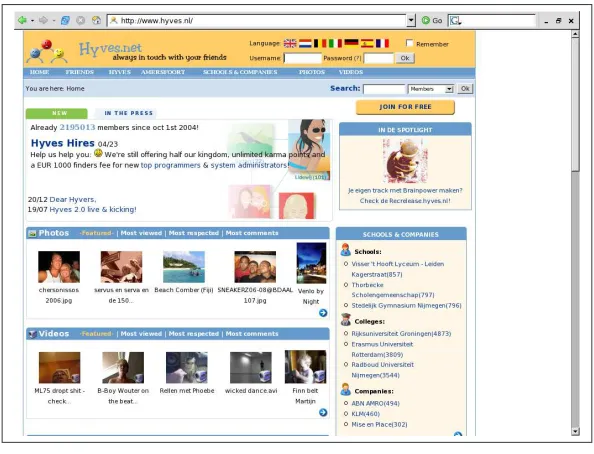
What Hyves distinguishes from other so called “online communities” is that Hyves does not limit its members by some sort of quota on the number of photos that can be uploaded or on the aggregate disk usage as a result of these uploads. Not limiting its members with respect to the photo uploading is a strategic choice. This makes Hyves a popular place to share photo’s (see in Figure 1.2 the “Photos” and “Video” sections) as can be derived from the number of photo downloads.
In addition to photo sharing, Hyves recently released video sharing in which Hyves continues its strategy to allow its members to share unlimited amounts of videos. Currently just small videos are supported (i.e., from a mobile phone camera) but future use might allow larger and longer videos. Hyves is considering offering file sharing in the nearby future (i.e., Powerpoint presentations, Word reports). All these items that can be uploaded are referenced with the term media.
Within the Hyves media service, three functions exists:
• Media items are stored;
• Media items are processed;
• Media items are served.
These functions are affected by the increasing number of page views and members.
1.3
Problem and Challenges
The number of Hyves members and sub sites (e.g., Classifieds, Hyvertising, Photo’s, etc.) is still growing. Next to the growing number of members (see Figure 1.3), the number of page views per day is also growing (see Figure 1.4). This implies that more server capacity is needed to service all users and sub sites.
1.3.1
Media Growth Storage Challenges
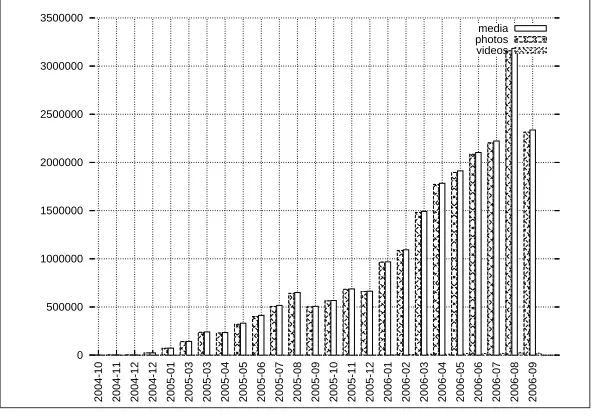
The Hyves service experiences a large number of file uploads by its users (see Figure 1.5). The number of uploaded items is expected to increase because of the following reasons:
CHAPTER 1. INTRODUCTION 1.3. PROBLEM AND CHALLENGES
0 500000 1000000 1500000 2000000 2500000
September-2006
August-2006
July-2006
June-2006
May-2006
April-2006
March-2006
February-2006
January-2006
December-2005
November-2005
October-2005
September-2005
August-2005
July-2005
June-2005
May-2005
April-2005
March-2005
Februari-2005
January-2005
December-2004
November-2004
October-2004
September-2004
number of members
Figure 1.3: Graph of the number of members as known on the first of each month, displaying the period of October 2004 - September 2006.
0 500000 1000000 1500000 2000000 2500000 3000000 3500000
2006-09
2006-08
2006-07
2006-06
2006-05
2006-04
2006-03
2006-02
2006-01
2005-12
2005-11
2005-10
2005-09
2005-08
2005-07
2005-06
2005-05
2005-04
2005-03
2005-03
2005-01
2004-12
2004-12
2004-11
2004-10
media photos videos
Figure 1.5: Number of uploads measured approx. per month as measured on the 15th of September 2006. Media: total number of uploads (video and photos). Video: number of video uploads. Photos: number of photo uploads. Note that the results for the last month are not definite, because September had not ended yet at the creation of this graph.
• the number of users increases and therefore the number of potential uploads increases too;
• the number of media types is expected to increase, therefore increasing the likelihood that a user may upload even more items.
Each uploaded and stored media item takes space in the storage of the Hyves media service. Items are also processed. The processed media items are also stored in the storage of the Hyves media service.
The increase of the number of uploads demands for a scalable storage architecture. A first version of such a storage architecture is currently in use, but it is not expected to be scalable enough.
1.3.2
Media Growth Processing Challenges
In the Hyves service, every media item is processed. For example:
• photos are rendered to different geometries into the JPEG-format to fit in nicely into the layout of the Web site;
• videos are downsized and rendered to the FLV-format so that they are accessible in the Web site. Also a JPEG-thumbnail is rendered from the video for the Web site.
Processing the uploads takes time and processing capacity. At the beginning of this research, items not yet processed (those are queued to a render daemon), they were rendered instantly on a Web server. The rendering process takes time, so the user experienced a delay between the request and the result. The rendering process also takes CPU-power of a Web server, that otherwise could process more requests. To improve user experience, the time between the upload of the item and the availability on the Web site should be as low as possible.
CHAPTER 1. INTRODUCTION 1.4. OBJECTIVES
1.3.3
Media Growth Serving Challenges
Visitors of the Web site (members and non-members) can download media items. Each newly uploaded item has the potential of being downloaded multiple times. Because of the increase of the number of uploads the number of downloads is also likely to increase. To handle the increased number of downloads, the capacity has to be extended. This demands for a scalable download service.
1.4
Objectives
We formulate our overall research question based on the motivation and the context of this thesis as follows:
Which architectural principles should be applied in the design of a large scale Web site?
In practice, large scale Web sites’ architectures conforms to the architecture of a typical distributed informa-tion system [ALONSO], which consists of three layers: a resource management layer, an applicainforma-tion logic layer and a presentation layer. Furthermore, the challenges in Section 1.3.1, 1.3.2 and 1.3.3 fit into this division. Therefore to answer our research question, first the following sub-questions need to be answered:
What architectural principles should be applied in the design of a scalable and redundant stor-age architecture for a large scale Web site?
What architectural principles should be applied in the design of a scalable and redundant pro-cessing architecture for a large scale Web site?
What architectural principles should be applied in the design of a scalable and redundant static content serving architecture for a large scale Web site?
To answer these sub-questions, we set ourselves the following objectives:
1. Make the high-level architecture of Hyves service explicit in terms of functions and components. Give a more in-depth view of the Hyves media service that reflects the initial situation at the beginning of our research and which allows analysis and evaluations;
2. Identify the architectural principles and decisions that have been applied in the design of the large scale Web site of our case study;
3. Identify current and future bottlenecks of the Hyves media service;
4. Design an improved Hyves media service architecture;
5. Identify the architectural principles and decisions that have been applied in the improved design of the media service architecture.
1.5
Approach
The first and the second objective are achieved by studying the initial architecture and implementation as found at the beginning of our research. In this study, we perform these two steps:
• Define the Hyves service architecture in terms of its parts and their relations;
• Identify the architectural principles that were applied at the design and the implementation of the current architecture and its implementation.
The third objective is achieved by gathering log data from the machines and by processing this data using utilities specially written for this purpose. We also wrote utilities to generate graphs from this data. Subtasks of the third objective are:
• Identify the information flow in the Hyves media service;
• Identify current performance problems by using measurements;
• Identify future performance problems using measurements.
The fourth objective is achieved by researching alternatives for the current architecture and to provide a design ready to implement. Subtasks of this objective therefore are:
• Analyze the characteristics of the identified performance problems;
• Create requirements for the possible solutions, using the characteristics of the performance problem;
• Propose possible solutions and select the best one or design a solution;
• Describe how the solution should be implemented;
• Implement the solution;
• Evaluate the solution with respect to the problem.
The fifth objective is performed by studying the identified problems and the designed solutions for these problems. Subtask of this objective therefore are:
• Identify the architectural principles by using the identified performance problems found in the current Media service architecture and its implementation;
• Identify the architectural principles that have been applied in the design of the solutions for the identi-fied performance problems.
1.6
Restrictions
Before starting the research, we would like to identify six restrictions which should be taken into account while reading this thesis.
While using a case study we gain deep insights in large scale Web sites. However, case studies in general have some restrictions, therefore the identified architectural principles in this report may not hold for a generic large scale Web site but at least for the Hyves Web site. We encourage readers to implement the architectural principles gained in this thesis according to their own situation.
Our case study research has to take place in a dynamic environment: the current architecture of our case study is still work in progress. Any architectural improvement done by us should be done with respect to a minimum of downtime and a minimum of impact for the other parts of the service. This might influence possible measurements.
CHAPTER 1. INTRODUCTION 1.7. STRUCTURE OF THIS DOCUMENT
expect this, because the current work flow (storing, processing, serving) for videos is comparable to the work flow for images. Further, at the moment the videos are rather small and the file sizes are comparable to some of the images, therefore storing and serving the videos is somewhat similar to serving and storing images. Of course this has to be reconsidered when larger videos are allowed.
Further, because of the performance issues, any identified and solved bottleneck during our research are implemented as soon as possible to allow a further growth and adoption of the service. As a consequence, we will do our research in an incremental way.
Our design of an improved architecture should reflect the architectural principles found in our research.
Kernel Kernel Kernel
Network OS services
Network OS Network OS
services services
Machine A Machine B Machine C
network
Distributed Applications
Figure 1.6: Different levels to apply scalability and redundancy. We focus on the distributed application. This image was taken from [DSYS].
In the introduction, we defined scalability and redundancy. In our research questions, we state that we want to identify principles for the design of a scalable and redundant architecture. Scalability and redundancy are widely used understandings and both can be applied extremely and at different levels (kernel, network, application, see Figure 1.6). We focus on the distributed application the large scale Web site provides and assume that supporting subsystems like the network and the operating system are a solid base for the distributed application.
1.7
Structure of this Document
This thesis is further structured as follows:
Chapter 2 gives an overview of the Hyves service architecture and its implementation. In this chapter we provide a high-level overview of the Hyves architecture explicit in terms of functions and components. Fur-thermore, we provide an in-depth view of the Hyves media architecture that allows analysis and evaluation to identify the architectural principles and decisions that have been applied in the design of the Hyves Web site.
In chapter 3 we present the implementation details for the Media Service architecture. Furthermore, we present the interactions with the service, the internals of the service and the implementation details of the service. These service implementation details are the starting point for our analysis.
We conclude our thesis by answering our research questions and presenting an overview of all the archi-tectural principles identified during our research in Chapter 6. Further we present some recommendations that can be useful for Hyves.
Chapter 2
Architecture
In this chapter we provide a high-level overview of the Hyves architecture explicit in terms of functions and components. Furthermore, we provide an in-depth view of the Hyves media architecture that allows analysis and evaluation to identify the architectural principles and decisions that have been applied in the design of the Hyves Web site. Therefore this chapter discusses the situation as found at the beginning of our research.
We start the high-level overview of the Hyves service by decomposing the architecture in layers and discuss each of them. Thereafter, we give an overview of the implementation of the Hyves service. After this, we provide a more in-depth overview in terms of functions and components of the Hyves media service. This chapter concludes with the architectural principles that were applied when the discussed architecture was designed and implemented.
2.1
Initial Architecture
Like typical distributed information systems, our case study’s architecture conforms to a three-tier architec-ture [ALONSO] with a resource management tier that provides access to resources like storage, databases and interfaces to other systems, an application logic tier that combines the resources, and a presentation tier that enables interaction between the users and the application. Figure 2.1 displays this layered architecture of the Hyves service. In the following sub sections we present the parts of each tier.
2.1.1
Resource Tier
In the resource management tier, several resources can be found (see Figure 2.1). These resources are:
• The management database resource that holds configuration data for multiple parts of the application;
• The rendered media resource, which is a repository of files containing the rendered media items;
• The media resource, which is a repository of files containing the original media items;
• The member database that holds all data for the members of Hyves. For example, the information put into user’s profile is stored in this database;
• The contact database that holds the address books of the Hyves members (imported from Hotmail, Gmail, etc.);
• The friend invitation database that holds all unconfirmed Hyves invitations to possible new members of the Hyves service;
autorender tools
management
media
member search
resource management tier database
presentation tier
database contact
database database database
Web site code parsemail
daemon daemon
search daemon daemon
invitations
rendered
media invitation
application logic tier Web server
Web server
client program (web browser)
client
Hyves Service
static content cache
Web site Web server
client program (mail client)
mail server ads
rendered media
Figure 2.1: Three-tier architecture of the Hyves service
2.1.2
Application Logic Tier
The application logic tier contains all application logic. It uses the resource management tier, and serves the presentation tier (see Figure 2.1). The components in the application logic tier are:
• Tools, which is a collection of scripts and programs that are used to maintain the application;
• Autorender daemon, which is a process that renders all uploaded media items. It uses the media resource and stores the rendered images on the rendered media resource. It uses the member database resource to obtain data on the uploaded media items;
• Parse-mail daemon, which is a process that parses all the e-mails sent to the Web site. Users can send e-mails to the Web site for (mobile) blogging. The daemon reads the mails and insert the blogs into the database. If attachments are included, they are stored at the media resource;
• Web site code is a collection of mostly PHP-scripts that renders the Web site. These scripts use all databases and interact via Web servers with the members of the service;
• Invitation daemon, which is a process that sends an invitation message to a possible new member;
• Search daemon, which is a process that updates the Search databases periodically so the Search databases contains actual information. It uses the member database.
2.1.3
Presentation Tier
The presentation tier contains all services that interact with the client programs like Web browsers and e-mail clients. (see Figure 2.1). On the server side of the presentation tier, the following parts exists:
CHAPTER 2. ARCHITECTURE 2.2. IMPLEMENTATION
• Static content Web cache server, which serves all static content to the members. Examples are static images such as Smiley’s and Java-Script sources;
• Advertisements Web server, which serves all the advertisements to the members;
• Web site Web server, which serves all dynamic content to the members. Examples are the Web site’s home page but also the pages containing the member profiles;
• Mail server, which handles e-mail interaction. For example, mobile blogging and member invitations use e-mail as a transport medium.
For the client side of the presentation tier, Hyves assumes that users use Web browsers and e-mail clients to access the service. The Web browsers must allow the use of cookies [COOKIE], JavaScript [WIKIJS] and Flash [FLASH].
2.2
Implementation
This section discusses the implementation of the components that we presented in the previous section. First, we discuss the implementation of the components of the three tiers, and then additional implementa-tion details.
2.2.1
Resource Tier
The Management database uses MySQL [MYSQL] and runs on one host.
The rendered images usually have a smaller file size than the original images, so the storage capacity of the Rendered Media repository is smaller than the storage capacity of the Media repository. The Ren-dered Media repository is stored on two volumes. The first volume contains all renRen-dered media items with
0 ≤ id ≤ intervalboundary, whereidis a unique number assigned by the application. This first vol-ume is called “interval 0” or “first interval”. The second volvol-ume contains all rendered media items with
intervalboundary<id. This volume is called “interval 1” or “second interval”. Both volumes are redun-dantly stored on two disks and each disk is placed in one server each, for performance and redundancy. These volumes are not exported, because the applications serving the media items are located on the same servers. When there is demand for more storage, either another interval is introduced to store more media items or the volumes are moved to disks with a larger capacity.
For the Media repository, network attached storage (NAS) [WIKINAS] is currently used. The NAS exports its file system to all Web servers in the cluster. Previously, when more storage capacity was needed, the NAS was replaced by another NAS with a larger capacity. Currently, when more storage capacity is needed, media items with a low mediaidare moved to disks on other machines. The moved media items remain accessible via the NAS by means of NFS [WIKINFS] shares and symbolic links. This process of expanding the storage capacity is displayed in Figure 2.2. Figure 2.2 (a) displays the initial single NAS. This NAS is replaced with one with a larger capacity (see Figure 2.2 (b)). Figure 2.2 (c) displays the results of moving media items to an external disk. These media items remain accessible via the NAS using a NFS link between the NAS and the server with the external disk. Figure 2.2 (d) displays the next iteration of moving of media items.
a
nfs
b
nfs
d
NAS
NAS
NAS
NAS
nfs
nfs
c
capacity
capacity
capacity
nfs
capacity
nfs
nfs
disk
+
disk
disk
server
server
server
+
+
Figure 2.2: Current storage capacity expansion: (a) original NAS; (b) larger NAS; (c) and (d) NAS and disk(s) with moved media items.
2.2.2
Application Logic Tier
The “Tools” collection of scripts is written in Perl [PERL], Bash [BASH] and Awk [AWK]. They are executed either periodically (using Cron [CRON], e.g., cleaning up log files, making back-ups) or instantaneously (at the command line, e.g., when deploying the code).
The Autorender daemon [DAEMON] is written in PHP [PHP] and runs on one of the Rendered Media Web servers. It peeks into the Member Database to discover newly uploaded media items. These items are then rendered using theconvertcommand from the ImageMagick software suite [IMGMGK]. Newly rendered media items are then stored in the Rendered Media repository.
The Parse-mail daemon is written in PHP [PHP] and runs on a machine dedicated to daemon processes. It receives e-mails from Hyves members, parses them, and converts them into content, and stores the content in the Member Database. If the parsed e-mail contains attachments, then these are stored in the Media repository and the Member Database is altered so the Autorender daemon can render these items.
The Web site code is written in PHP [PHP] and runs on Web site Web servers. It uses all the databases to generate the dynamic content for the Web site.
The Invitations Daemon, which is written in PHP, runs on the machine dedicated to daemon processes. From the information stored in the Invitation Databases, it generates messages to (non-) Hyves members. The messages are forwarded to the Mail server.
The Search daemon uses the Member database to generate information for the Search databases. There-fore it disconnects one Search database server from the Web site, fills it with new search information and connects it again with the Web site. Every three hours one Search database server is updated.
2.2.3
Presentation Tier
The Web server for the rendered media is implemented using Apache [APACHE]. This Web server runs on 4 redundant hosts (two per interval). When there is a demand for more performance, the number of Web servers per interval is increased.
CHAPTER 2. ARCHITECTURE 2.2. IMPLEMENTATION
The Web server for the advertisements is implemented using Apache [APACHE]. This Web server runs on a single host. When there is a demand for more performance, the number of Web servers is increased.
The Web server for the Web site’s dynamic content is implemented using Apache [APACHE]. This Web server also serves static content to the Static content cache. This Web server runs on about 40 redundant hosts. The number of hosts is regularly increased to increase the maximum number of requests.
The Mail server is implemented using Postfix [POSTFIX]. This runs on a single host. Currently, there is no perspective on how to scale this service when more performance and/or storage capacity is needed.
2.2.4
Vertical Sub-systems
The overview of the architecture parts of Figure 2.1 given so far, is not complete, because additional tech-niques are used to implement the architecture. These additional techtech-niques are presented in this section.
Rendered Media Web site
client
loadbalancer primary loadbalancer request
response
request
secondary
Web server Web server 1
2
3
4 5
Figure 2.3: Load balancer setup. (1) client sends a request to a Web server cluster. (2) load balancer intercepts the requests, determines cluster from request and chooses a cluster node. (3) requests is forwarded to chosen cluster node. (4). Cluster node Web server handles requests. (5) the response is send directly to the client.
All the Web servers are load balanced using IPVS [IPVS]. The load balancer software runs on two hosts: a primary and a secondary load balancer. The secondary load balancer takes over when the primary load balancer fails. These load balancers direct requests designated at different clusters to the correct pool of servers. The response returns directly to the client. The load balancer maintains a list of connections be-tween clients and Web servers. When a client makes consecutive requests and the time intervals bebe-tween any consecutive requests are not larger than a certain period of time, these consecutive requests are for-warded to the same Web server. If the time interval between two consecutive requests exceeds a certain period of time, the load balancer again elects a server to forward the request to. This is displayed in Figure 2.3. The clusters currently defined and load-balanced are summarized in Table 2.1.
cluster’s DNS entry cluster function load balanced IP address
*.hyves.nl dynamic Web site 213.193.242.126
interval0.rendered.startpda.net rendered media interval 0 Web servers 213.193.242.128 interval1.rendered.startpda.net rendered media interval 1 Web servers 213.193.242.130
cache.hyves.nl static content Web cache 213.193.242.123
clarice.startpda.net advertisements Web server 213.193.242.127
Table 2.1: Load balanced clusters
The NAS is not only used for storing the media items, but also for the database backups and the code (Web site as well as Tools).
System-level monitoring is available to determine statistics (e.g., disk utilization, database on host A is running, Web server on host B is running, etc.). System-level monitoring currently runs on one host. On the same host, also application-level monitoring is running to gather statistics about running processes like MySQL, Apache and Squid.
2.3
Media Service
The Media Service part of the Hyves architecture consists of Web servers that serve the rendered media items, file servers that store the rendered and the original media items and the Autorender daemon that processes media items. These components are depicted in Figure 2.4.
member database media
rendered media
website code rendered
media web server
web server website client program (web browser)
client
Hyves Service
tier application logic tier
presentation tier
resource management autorender
daemon
Figure 2.4: Media Service in the architectural view
The media service performs the following functions:
• uploading of media items (Web site code, Member database);
• storing of media items in the Media repository (Media repository);
• processing of media items into rendered media items (Autorender, Member database);
• storing of rendered media items in the Rendered Media repository (Rendered Media repository);
• serving the rendered media item requests (Rendered Media repository, Rendered Media Web servers, Web site code, Member database).
The flow of the functions of the Media service is depicted in Figure 2.5.
CHAPTER 2. ARCHITECTURE 2.3. MEDIA SERVICE
uploading media item
storing
media item
processing media item into
media items rendered
storing
media items rendered
serving rendered media items
Figure 2.5: Media Service flow. A media item is uploaded. The media item is stored in the media repository. The Autorender Daemon renders the media item into the rendered media items. These are stored in the Rendered Media repository, and thereafter, they can be served to clients.
2.3.1
Media Uploading and Rendering
Uploading of media items can happen on each Web server in the cluster. If the uploaded items file type is recognized and accepted, the media item is assigned a mediaid(which is stored in a database) and the item is copied to the Media Repository using the mediaidas file name. Because of the interaction the Web site offers the uploader of the file, the file is directly rendered into 75x75 format. This is achieved by pushing the Web browser of the uploader to refresh its page for one in which the result of the upload is showed, using this rendered image. A sequence diagram of this scenario is given in Figure 2.6.
user media
upload item
process item
create db entry
store item
rendered media member
database Web site code
Web server
Web site web server
rendered media
response
to rendered media item page with reference
Figure 2.6: Sequence diagram of the scenario in which a media item is uploaded
The Web browser therefore requests a Web server to serve the media item. If the media item is not yet rendered (if its mediaidis above thecoldmaxmediaid idand if it cannot be found in the Rendered Media Repository) the Web server renders the image only for the requested resolution. Therefore it loads the media item from the Media Repository, renders the item, stores the item in the Rendered Media Repository and serves the item to the requester. This process is displayed in the sequence diagram in Figure 2.7.
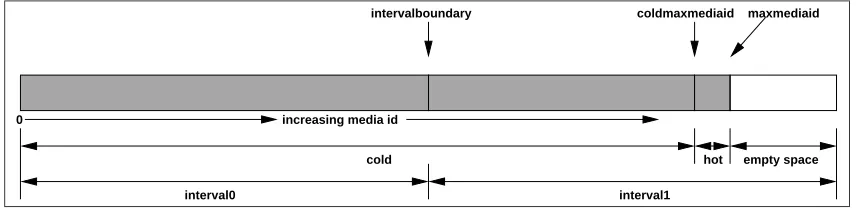
When a media item is uploaded, is it appended to the “hot” part of the Rendered Media repository. The “hot” part is defined as the part of the repository that the Autorender daemon is to process. The “cold” part is defined as the part of the repository that the Autorender daemon has processed already.
Figure 2.8 displays this “hot and cold” setup.
If a media item was processed by the render daemon, its mediaid(a by the application assigned unique number) it is below thecoldmaxmediaid pointer. When a user requests such a media item, the following process occurs. The Web site’s code checks if the media id is below thecoldmaxmediaid. If so, then the Web site’s code generates the URL for the media item. For this, it first checks the media id of the requested media item. If the media id is below the interval boundary, it generates an URL for the media item designated at the first interval. If the mediaidis above the interval boundary, an URL for the media item designated at the second interval is generated. We display this process in the sequence diagram of Figure 2.9.
If a media item is not processed by the render daemon, but already by the site, the following process occurs. The user requests a Web page. The Web site’s code checks the mediaidof the media item. If the mediaid
user media
request
process
check coldmaxmediaid
negative
check globalmediarendered
get file from media storage
return file
render file and store
return rendered file
return page
request image
return image
Web server Web site
Website code member
database media
rendered Web server rendered media
Figure 2.7: Sequence diagram of the scenario when a request is made for a media item that is in the hot part of the Rendered Media Repository and is not rendered yet.
0
interval0 interval1
hot empty space cold
coldmaxmediaid maxmediaid intervalboundary
increasing media id
Figure 2.8: Hot and Cold rendered media repository structure
user media
request
process request
check coldmaxmediaid
return url
return page
request url get file
return file
return response
rendered media member
database Web site code
Web site Web server
Web server rendered media
CHAPTER 2. ARCHITECTURE 2.3. MEDIA SERVICE
user media
request
process
check coldmaxmediaid
check global mediarendered
rendered media member
Web site code Web site
Web server database
Web server rendered media
found
response
Figure 2.10: Sequence diagram of the scenario when a request is made for a media item that is in the hot part of the Rendered Media Repository and is already rendered.
All these scenarios are summarized in Figure 2.11
mediaid > coldmaxmediaid
rendered yet? mediaid > intervalboundary
request second interval
request web site and render request first interval
request web site yes
no
http://interval1.rendered.startpda.net/1−50000/1.jpeg
http://interval0.rendered.startpda.net/1−500000/1.jpeg
http://www.hyves.nl/showimage/1
http://www.hyves.nl/showimage/1
yes no yes
no
Figure 2.11: Summary and URL generation scheme.
Simultaneously the auto-render daemon is running. This daemon checks for newly uploaded images by comparing the value ofcoldmaxmediaidandmaxmediaidand renders them into certain formats depend-ing on their file type. This process is displayed in the sequence diagram of Figure 2.12. An overview of the file types is given in Table 2.2. After rendering, the rendered media items are stored in the cold part of the Rendered Media Repository and the so called cold pointer (coldmaxmediaid) is increased. The auto-render daemon renders the next image. The rendering process is done sequentially by mediaid.
2.3.2
Media Storage
In Section 2.2 we argued that there are two repositories for media, namely a Rendered Media repository and a repository for the original media items.
The original media repository is stored on a NAS and exported via NFS [WIKINFS]. Media items are sequentially stored in directories per 50.000 mediaid’s. In the case of Rendered Media, this implies that about 300.000 media items are stored per directory; in the case of the Media repository, 50.000 media items are stored per directory.
The interval boundary is always defined per directory of 50.000 items.
The rendered media repository is stored (as stated) on two volumes, and those volumes are stored on two machines per volume.
media
get media item
return media item render item
get media item return media item
get media item
return media item store rendered items
adjust coldmaxmediaid render item
render item ...500x
maxmediaid get maxmediaid
coldmaxmediaid get coldmaxmediaid daemon
autorender
database member
media rendered
Figure 2.12: Sequence diagram of the Autorender daemon.
file type render format
image JPEG 50x50
JPEG 70x70 pixels JPEG 120x120 pixels JPEG 200x200 pixels JPEG 500x500 pixels JPEG 700x700 pixels
video FLASH movie
JPEG 50x50 pixels
PDF JPEG 50x50 pixels
CHAPTER 2. ARCHITECTURE 2.4. ARCHITECTURAL PRINCIPLES
2.3.3
Media Serving
Because of the amount of requests and media items, media serving is done by two clusters of two Apache Web servers, load-balanced by using IPVS.
The first cluster of Web servers serves the domaininterval0.rendered.startpda.net. This cluster serves only the media items that are located in the first interval. The second cluster of Web servers serves the domaininterval1.rendered.startpda.netand serves only the media items that are located in the second interval.
Each Web server has its own copy of the media items of the interval it serves. The media items are served with an HTTP expiration date of one year after the request to allow the users Web browser to cache the media items.
The Web site PHP code generates the URLs (see Figure 2.11) for the media items. If a media item’sidis above thecoldmaxmediaid, the media item is requested from a dynamic content Web server because the media item is in the hot part of the Rendered Media Repository. This Web server checks if the media item is already rendered. If not, the Web server renders the media item, stores the media item in the Rendered Media Repository and serves the request to the client (Figure 2.7). If perhaps another Web server has already rendered the media item, the media item is server by the Web server (Figure 2.10).
If a media item’sidis above below thecoldmaxmediaid, the generated URL provides that the Web browser requests the media item via the media-rendered Web servers (Figure 2.9).
2.4
Architectural Principles
This section presents our observations of the Hyves Web site architecture and based on these observations, the architectural principles for large scale Web sites are defined.
2.4.1
Prevent Single points of Failures
We have observed several single points of failures in the Hyves Web site. Examples are the NAS, the Mail Server, the advertisement Web server and a single daemon server. If the NAS fails, there is no access to backups, the original media items and the Tools repository for maintaining the Web site. If the Mail server fails, the Hyves Web site is unable to receive e-mails from clients or to send e-mails to clients. If the advertisements Web server fails, no advertisements can be showed. If the daemon server fails, several processes such as the Friendinvitation daemon stall.
Because not all these services that are provided by these parts have to be accessible at every moment in time, these services are not considered as critical. A single point of failure is only critical if the service is essential for the large scale Web site.
At the beginning of our research, the Autorender Daemon was a single point of failure, but not very critical. The Autorender Daemon was capable of processing a backlog caused by downtime within half a day and at the beginning of our research, there were lesser page views and therefore the impact of the Web site rendering media items on demand was less when compared to nowadays. When the number of users, the number of page views and the number of uploads increased, the impact of the Web site rendering media items was increased and the Autorender daemon was no longer able to process a backlog within half a day. The Autorender Daemon service became critical.
The Mail server, the advertisements Web server and the daemon server are not very critical at the moment. It is expected that these services become critical as well, when performance demands increase because of a growth in users or page views, because all these services provide a sort of processing service, similar to the Autorender Daemon.
Increasing the performance also reduces the chance of the service becoming a bottleneck. Note that this solution only minimizes the effects of a failure and not prevents the service for failure.
The second option is to require that for each service, there are at least two instances, running on different machines. In case of a failure on one machine, the instance on the other machine continues to run the ser-vice. This prevents or reduces the length of a possible backlog. As a consequence, the service should allow multiple instances simultaneously and thus adds complexity to the design to prevent concurrency problems. Another benefit from this option is that the performance of the service is the aggregate performance of the multiple instances. If there is demand for more capacity, more instances can be started. Note that it is possible to run multiple instances from different services on one machine.
A third option is to design the service more portable. In case of failure, the service can be installed/started on another machine and the service remains accessible.
As an architectural principle for designing large scale Web sites, we conclude that supporting services within the large scale Web site should be prevented from being single points of failures, even when these services are not critical at the moment. Three possible solutions were discussed: increasing performance to minimize
effects of a failure, design redundant instances for the service and design the service with portability in mind.
2.4.2
Loose Coupling
Although the Hyves Web site can be placed into the typical three-tier architecture, some parts are tightly-coupled in the implementation.
The interval-boundary that determines which mediaids are in the first and second interval is hard coded programmed in the application. This implicates that when the value of the intervalboundary has to be adapted (e.g., because rendered media items should be moved from the second to the first interval), the source code of the Web site’s code has to be adapted and redeployed to all Web servers.
Another example is the NAS. It serves as the storage for original media items, but also as a storage for database back-ups and as a file server for the Tools repository. We have experienced that backup-scripts need to be adapted to store their data on other hosts, because the Media repository contained so many me-dia items, that there was no space for storing back-ups. We also experienced that back-ups were removed to create space for the Media Repository.
We think that dependencies between different sub-parts of the Hyves Web site need to be removed. The value of the interval-boundary should be editable without redeploying the code afterward and back-up files should not interfere with storing media items.
Small Web sites often start with one server that performs all the services. the requests are served with a web server which also runs a database for the dynamic content and that stores static content. Backups are made on the same machine etc.. When the Web site evolves in a large Scale Web site, dependencies between parts of the Web site need to be removed as soon as possible.
We consider loose coupling as an architectural principle for large scale Web sites. The examples of tight
coupling discussed above limits the growth of parts of the large Scale Web site and therefore should not be implemented.
2.4.3
Application-level Monitoring
CHAPTER 2. ARCHITECTURE 2.4. ARCHITECTURAL PRINCIPLES
at application-level are MySQL, Apache and Squid. Examples of applications that were written by Hyves but are not monitored at application-level are the daemons (Autorender, Parsemail) and Web site statistics (total number of media items, total number of members). Within the existing application-level monitoring, there are no aggregate views (e.g., the total number of processed queries by all MySQL servers). We can conclude that only parts of the service are monitored, but not the service as a whole.
A current problem is that at some times, more media items are uploaded per period of time than the Au-torender Daemon can render during that period of time. Because of the growth of the number of users, one also expects a growth in the number of uploaded media items. Thus, when introducing a processing service like the Autorender Daemon, one could expect that at a certain moment in time, the number of media items uploaded per period of time overtakes the number of media items processed per period of time.
The problem discussed in the text above illustrates the desire of application level monitoring of applications written by Hyves. If the number of uploaded media items per period of time was monitored, and the number of rendered media items per period of time also, then with these data one is enabled to determine the moment that the maximum capacity of the Autorender daemon will be reached. If this moment could be determined in advance (e.g., when extrapolating the results from the monitoring), one could anticipate and improve the Autorender daemon before the expected problem starts to take effect. This enables proactive maintenance.
Because of a continuous growth of users and sub sites of the Hyves service, one should expect a growth in page views and an increasing demand of capacity. In the above text we have argued that currently there exists no monitoring for the self-written applications used in the Hyves Web site and we have given an example of a problem that could be dealt with pro-actively, if such monitoring had existed. We also argued that because of the growth of the number of users and sub sites, this issue might occur again in the future.
Another recent problem illustrates the desire for monitoring the application as a whole. Earlier in this chapter we mentioned that the rendered media is stored on two intervals. We also mentioned that these intervals are two volumes. With system-level monitoring only, we receive warnings about the disk usage (volume). As a response to these warnings, we moved data from the second interval to the first interval. The second interval disk usage is decreased and we can continue the service a little bit longer. This process is repeated every now and then when the second interval reaches 100% disk usage. Because of the number of uploads doubling every month (which we did not know at that time), the movement of media items followed each other each time sooner. Suddenly it appeared that the first interval was also filling up. If the first interval is full, and the second one also, we cannot move media items from the second to the first interval.
If application monitoring had existed, that monitored the aggregate disk usage for the rendered media and we also used extrapolation, the moment we would reach 100% disk usage could be calculated in advance.
Next to enable detection of future problems, application-level monitoring also allows verification of the ap-plied measures. For example, suppose that as a measure the capacity of a certain part of the architecture is expanded, does it really enable more requests of might there be another problem?
From this, we conclude that a good architectural principle would be to implement application-level monitoring
from the start for every storing, processing and serving part of the service when designing a large scale Web site.
Note that monitoring the application by a monitoring service is not sufficient. The monitored values should be looked at periodically and the values should be interpreted correctly. Monitoring only takes into account the values of the current moment and in the past, prediction and extrapolation are necessary to increase the value of monitoring.
Chapter 3
Media Service
3.1
Introduction
In this chapter we present the implementation details for the Media Service architecture. Furthermore, we present the interactions with the service, the internals of the service and the implementation details of the service. These service implementation details are the starting point for our analysis, which is presented in Chapter 4 and 5.
Hyves Media Service Client
interactions
Figure 3.1: Global View Information Flow
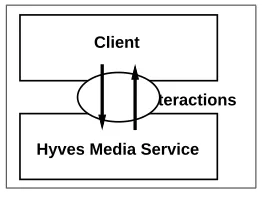
The service provisioning is constituted by three parts (see Figure 3.1):
• The client that interacts with the service. The client is a Web browser that interacts with the service using the HTTP protocol or the client is a e-mail program that interacts with the service using the SMTP protocol. We do not discuss the client in this chapter;
• The interactions between client and service, which are encapsulated in HTTP requests and re-sponses. We discuss the interactions in Section 3.2;
• The service which replies the interactions from the client using a HTTP Web server. We discuss the service in Section 3.3.
3.2
Interactions
By analyzing the Hyves Web site architecture and its implementation details, we identified the working and the purpose of the system:
• The service has to process uploaded media items. After processing, the processed media items are made available for requests and responses.
From these two functions we can derive three interactions between the client and the service:
• Media Requests (requests for the media items);
• Media Responses (responses to the request, the media items);
• Media Uploads (to transfer user media items to the service).
These three interactions are discussed hereafter.
3.2.1
![Figure 1.4: Page view statistics for the last 24 months (generated at 9th of August 2006), as measured by One-Stat [ONESTAT]](https://thumb-us.123doks.com/thumbv2/123dok_us/1164705.1146612/19.612.153.451.102.309/figure-page-statistics-months-generated-august-measured-onestat.webp)