R E S E A R C H
Open Access
Sparse correlation matching-based spectrum
sensing for open spectrum communications
Eva Lagunas
1*and Montse Nájar
1,2Abstract
To deal with the current spectrum scarcity problem and exploiting the fact that exclusive access through tightly regulated licensing leads to idle spectrum, cognitive radio has been proposed as a way to reuse this underutilized spectrum in an opportunistic manner, i.e., allowing the use of temporarily unused licensed spectrum to secondary users who have no spectrum licenses. To protect the licensed users from the cognitive users’interference, the opportunistic user requires knowledge of the original license holder activity. In this article, a feature-based approach for spectrum sensing based on periodic non-uniform sampling is addressed. In particular, we face the compressed-sampling version of detecting predetermined spectral shapes in sparse wideband regimes by means of a correlation-matching procedure.
Keywords:cognitive radio, compressed sensing, spectrum sensing, correlation matching
1 Introduction
Current spectrum division among users in wireless com-munication systems is assigned by regulatory and licensing
bodies like the Federal Communication Commissiona
(FCC) in the US or the European Telecommunications Standard Instituteb(ETSI) in Europe. In the usual spec-trum management approach, the radio specspec-trum is divided into fixed and non-overlapping blocks, which are assigned to different services and wireless technologies. The recent proliferation of wireless communications services together with the inflexible spectrum regulations have resulted in a crowded radio frequency (RF) spectrum. This spectrum congestion becomes a bottleneck for the increasing demand of new transmission bands, which can rarely be satisfied using permanent allocation.
The scarcity of electromagnetic spectrum is obvious, but the real problem is not a dearth of radio spectrum; it’s the way that spectrum is used. The radio spectrum is actually poorly utilized in many bands in the sense that large portion of the assigned bands are not used most of the time [1]. A solution to this inefficiency is to allow opportunistic unlicensed access to the poorly uti-lized frequency bands that have been already allocated.
This more flexible allocation approach is known as cog-nitive radio (CR) [2].
In CR, radios opportunistically look for holes (non-used spectrum gaps) in the licensed spectrum, which can subse-quently be exploited for setting up a communication link. However, the approach described previously requires knowledge of the primary (licensed) user spectrum activity in order to avoid causing interference. Protecting the non-cognitive users is mandatory, since they have the priority of service. The task of accurately detecting the presence of licensed user is encompassed in spectrum sensing. The signal-processing fundamentals specific to spectrum sen-sing implementation have been investigated in [3]. Among the implementation challenges mentioned in [3], the most critical design problem is the need to process very wide bandwidth (regardless of operating frequency range) and reliably detect presence of primary users. Identifying unoc-cupied frequencies is a complicated problem which involves sampling many points on the radio spectrum. Moreover, with the current analog-to-digital converters (ADC) technology, wideband RF signal digitising is a quite demanding task. Consequently, each CR node can only sense a relatively narrow band.
Sampling at the Nyquist rate is shown to be inefficient when the signals of interest contain only a small number of significant frequencies relative to the bandlimit [4]. To alleviate the sampling bottleneck, a promising
* Correspondence: [email protected]
1
Department of Signal Theory and Communications, Technical University of Catalonia (UPC), c/Jordi Girona 1-3, 08034, Barcelona, Spain
Full list of author information is available at the end of the article
alternative for this type of sparse signals is the use of sub-Nyquist sampling techniques.
1.1 Background and prominent related work
This article blends two topics: Spectrum sensing and sub-Nyquist sampling. The goal of this section is to pre-sent a review of the most prominent published works related to spectrum sensing and sub-Nyquist sampling techniques.
1.1.1 Beyond Nyquist sampling rate
Signal acquisition is a main topic in signal processing. Sampling theorems provide the bridge between the con-tinuous and the discrete-time worlds. The most famous theorem is often attributed to Shannon [5,6] (but usually called Nyquist rate) and says that the sampling rate must be twice the maximum frequency present in the signal in order to perfectly recover the signal. However, sampling at twice as high as the upper frequency of the signal spectra might be problematic when the band limit of the signal is large. The usual method of sampling at equally spaced instants of time permits unambiguous reconstruction of the original signal if and only if the spectra of the signal is known in advance to lie in the Nyquist band.
Shapiro and Silverman [7] were the first who noticed these problems back in 1960. In order to avoid aliasing they proposed unequally spaced instants of sampling time. In fact, they showed that random sampling schemes succeed in eliminating aliasing, while others do not. One example proposed in [7] was to take the sam-pling time the occurrence times of the events of some Poisson process.
Later in the 1970s, Beutler [8] generalized the formu-lation of the alias-free sampling problem and studied special cases depending on the spectral distribution of the signals. In this context, Masry [9] studied the ran-dom sampling in a more general framework. In the 1990s, Bilinskis [10] presented his breakthrough study in digital alias-free signal processing (DASP) which was summarized in 2005 in a book with the same name [11]. As the term suggests, DASP is focussed on the problem of aliasing prevention, as well as all the pre-vious mentioned methods.
All these researchers realized that the restrictions defined by Shannon-Nyquist do not have to be always satisfied. Of course, the obvious way (and the simplest way) to avoid aliasing when there is no extra informa-tion available is to require two times the maximum fre-quency present in the signal. This approach is very conservative but ensures perfect recovery of the signal. The strong requirements of the ADCs can be reduced by exploiting prior knowledge on the signal model. Due to the low occupancy of many communication systems, whose frequency support is much smaller than the band
limit, the spectrum can be considered sparse and the uniform sampling becomes very redundant.
Following this vision, a clever way of sampling the sig-nal is the periodic non-uniform sampling. This method, called multi-coset sampler and originally proposed by Feng and Bresler [12], shares many aspects with the recent compressed sensing (CS) theory. CS [13,14] pro-vides a robust framework for reducing the number of measurements required to summarize sparse signals allowing to compress the data while is sampled. Although multi-coset sampling can be casted into a CS framework, its implementation becomes simpler: while usually CS considers an analog to Information converter (AIC), in the multi-coset approach only a limited num-ber of parallel ADCs operating at low sampling rate are needed. In this context, Mishali and Eldar [15] proposed a sub-Nyquist analog-to-digital converter of wideband inputs, the first reported wideband hardware for sub-Nyquist conversion based on the multi-coset technique (as the authors claim).
1.1.2 Spectrum sensing
A CR monitors the available spectrum bands, captures their information, and then detects the spectrum holes where is possible to transmit in an opportunistic man-ner in order to avoid possible interferences with the pri-mary or licensed users.
The identification procedure of available spectrum is quite a difficult task due to the strict requirements imposed to guarantee no harmful interference to the licensed users. In general, the minimum signal-to-noise ratio (SNR) at which the primary signal may still be accurately detected required by the sensing procedure is very low. Thus, low SNR levels must be sensed which translates into a high detection sensitivity.
A second constraint is the required detection time [16]. The longer the time that we sense, the better the signal processing gain. However, the spectrum behaves dynamically, changing all the time, and cognitive users need to be aware of these fast changes. Another desir-able feature is that the primary user detector has to pro-vide an accurate power level for the primary user. The estimated power level can be used to obtain information about the distance at which the primary user is located providing the level of interference that unlicensed users represent.
hand, the most famous feature-based method is the matched filter. If the full structure of the primary signal is known (together with time and carrier synchroniza-tion), the optimal detector is the matched filter detector. Unfortunately, the complete knowledge of the primary signal is not usually available. If only some features of the primary signal are known, feature-based detectors such cyclostationary detector [18] are more suitable. In fea-ture-based approaches, the secondary users are consid-ered as interference. A survey of the most common spectrum sensing techniques, both non-feature and fea-ture-based detectors, has been published in [19].
As it was mentioned before, the design of the analog front-end is critical in the case of CR. The worst problem is the high sampling rate required to process very wide bandwidth. The present literature for sparse spectrum sensing is still in its early stages of development. The tra-ditional way for detecting holes in a wide-band spectrum is channel-by-channel scanning. In order to implement this, an RF front-end with a bank of tunable and narrow bandpass filters is needed. Some alternative methods have been proposed in the literature to facilitate the wide-band sensing process [16,20,21]. In [16], a compres-sive sensing approach is used to reconstruct the spectrum of a wide-band signal using time samples, which studies for special signals whose Fourier transform is real. In [20], the received analog signal is sampled at the informa-tion rate of the signal using an AIC. An estimate of the original signal spectrum is then made based on CS recon-struction using a wavelet edge detector. Wang et al. [21] proposed a two-step compressed spectrum sensing method which first quickly estimates the actual sparsity order of the wide spectrum of interest, and adjusts the total number of samples collected according to the esti-mated signal sparsity order.
1.2 Outline and contributions
Many research studies such as Viberg [22] or Lexa [23] use the sub-Nyquist methods to obtain information of the unknown power spectrum from the compressed sam-ples avoiding the signal reconstruction. In particular, in [23], the estimator does not require signal reconstruction and can be directly obtained from a straightforward application of nonnegative least squares. In [22], the esti-mation of the signal spectrum is skipped, and the occu-pied channels are directly detected from the sampled data in the time domain. Others such as Giannakis [16] or Leus [20] look for an estimate of the original signal spectrum based on CS reconstruction using a wavelet edge detector. Here, a more particular problem is stu-died. In this article, the problem of detecting predeter-mined spectral shapes present in the spectrum of the wide-band signal received at the CR detector is addressed. The final goal of this proposal is to determine
the spectrum occupancy of the licensed system. Taking advantage of the sparsity of the signals sent out over the spectrum, a sub-Nyquist periodic non-uniform sampling is used to reduce the amount of data needed to find the white space and still maintain a high degree of accuracy.
The procedure is developed following a correlation matching framework, changing the traditional single fre-quency scan to a spectral scan with a particular shape. The spectrum sensing scheme considered here was first presented in [24] without solving the sampling bottle-neck. In [24], the data autocorrelation matrix was esti-mated from the Nyquist samples of the analog received signal due to the traditional assumption that the sam-pling state needs to acquire the data at the Nyquist rate, corresponding to twice the signal bandwidth. There are two drawbacks in [24]: (1) due to the timing require-ments for rapid sensing, only a limited number of mea-surements can be acquired from the received signal; and (2) the implementation quickly becomes untenable for wideband spectrum sensing. Here, we take advantage of the sparsity of the spectrum to alleviate the sampling burden. Sensing and compressing in a single stage allows fast spectrum sensing while simplifying the implementa-tion. In this article, the estimate of the data autocorrela-tion matrix is directly obtained from the compressed samples. Three procedures are derived depending on the criteria used to compare the estimated matrix with the predetermined one. We evaluate the resulting detector with particular examples, we derive simulated ROCs and the performance is evaluated with the RMSE and com-pared with classical filter-bank approaches as well as with the non-compressed version of the procedure.
This article is organized as follows. The following sec-tion states the signal model and problem formulasec-tion introducing the periodic sub-Nyquist sampling notation. Then, the following section introduces the spectrum sensing method paying special attention to the data autocorrelation matrix estimation. Finally, the last sec-tion shows the simulasec-tion results and the performance evaluation. The concluding remarks of this article are given in the very last section.
2 Signal model, definitions and problem statement
We consider a wideband signalx(t) which may represent the superposition of different primary services in a CR network. This signal is assumed to be multi-band signal, i.e, a bandlimited, continuous-time, squared integrable signal that has all of its energy concentrated in one or more disjoint frequency bands.
F= N
i=1
[ai,bi) (1)
A sparse multiband signal is thus a multiband signal whose spectral support has Lebesgue measure that is small relative to the overall signal bandwidth [25]. To this end, the spectral occupancyΩis defined as,
= λ(F)
fmax
0≤≤1 (2)
wherel(F) is the Lebesgue measure of the frequency
set F which, in this particular case, is equal to
N
i=1(bi−ai). For the set of sparse multiband signals
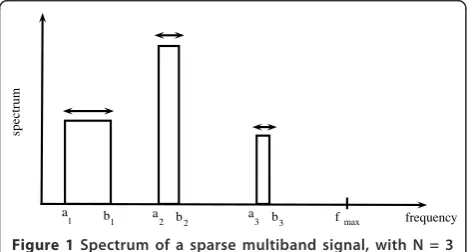
Ωranges from 0 to 0.5 (see Figure 1). In the spectrum
sensing framework, the spectral supportF is unknown
but the total bandwidth under study is assumed to be sparse.
The goal of this article is to obtain the frequency loca-tions and the power levels of the primary users using a correlation matching spectrum sensing strategy based on the compressed samples obtained with a periodic non-uniform sub-Nyquist sampling. The diagram of the cognitive receiver is sketched in Figure 2. First, taking advantage of the sparsity of the received signal spec-trum, a multi-coset sampling is used to overcome the problem of high sampling rate. Then, the compressed samples are processed in the autocorrelation estimation stage and finally, the correlation-matching based trum sensing is performed using a predetermined spec-tral shape, which has to be known a priori.
3 Sparse-based sample acquisition
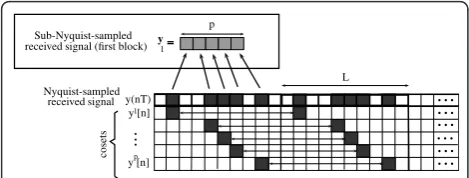
In multi-coset sampling, we first pick a suitable sam-pling period T. The inverse of this period (1/T) will determine the base frequency of the system, being 1/T at least equal to the Nyquist rate so that sampling at 1/ Tensures no aliasing. Given the received multiband sig-naly(t), the periodic nonuniform samples are obtained at the time instants,
ti(n) = (nL+ci)T (3)
whereL> 0 is a suitable integer,i =1, 2,...,pand nÎ ℤ. The set {ci} containspdistinct integers chosen from {0,1,...,L- 1}. The reader can notice that the multi-coset sampling process can be viewed as a classical Nyquist
sampling followed by a block that discards all but p
samples in every block of L samples periodically. The samples which are not thrown away are specified by the set {ci}.
Thus, a sequence (or coset, hence the name of the method) of equally-spaced samples is obtained for each ci. The period of each one of these sequences is equal to LT. Therefore, one possible implementation consists of
p parallel ADCs, each working uniformly with period
LT. Another widely-used notation for the multi-coset sampling is to express eachith sampling scheme as fol-lows,
yi[n] =
y(nT),n=mL+ci, m∈Z
0, Otherwise (4)
wherey(t) denotes the received signal, which contains the multiband signal x(t), plus an interferencei(t), plus
a double-side complex zero-mean AWGN w(t) with
spectral densityN0/2,
y(t) =x(t) +i(t) +w(t) (5)
The interference is assumed independent of the noise and desired signal, and its spectral shape is different from that of the desired.
The set {ci} is referred to as an (L,p) sampling pattern and the integer Las the period of the pattern. Figure 3 shows a scheme of how thepcosets are obtained.
The complete observation consists of a data record of Mblocks ofpnonuniform samples notated asym. Thus, the notation can be compacted inY as follows,
Y=y1. . .yM (6)
The sub-Nyquist data matrixYhas dimensionp×M.
3.1 Relation between multi-coset sampling and CS theory To translate the multi-coset sampling notation into a CS
notation, let us consider zm as the mth block of L
spect
ru
m
frequency a
1 b1 a2 b2 a3 b3 fmax
Figure 1Spectrum of a sparse multiband signal, with N = 3 and spectral occupancyΩlower than 0.5.
multi-coset sampling
correlation estimator
correlation matching
x(t)=s(t)+w(t) - frequency location
- power
y(n) R
RCM
uniform Nyquist samples ofy(t),
zm=
y(tm1). . .y(tLm)T (7)
where tnm= (mL+n)T. As we know, this signal is sparse if it is expressed in the frequency domain. The implication of sparsity in the novel CS theory is that one can discard the part of the coefficients without much perceptual loss. Let us now consider the classical linear measurement model for the above block,
ym=mzm (8)
The problem in CS consist of designing a convenient
measurement matrixFmsuch that salient information
in any compressible signal is not damaged by the dimensionality reduction. A low value of coherence
between Fm and the basis where the signal becomes
sparse (Fourier in our case) is desirable in order to ensure mutually independent matrices and therefore better compressive sampling. The incoherence is defined as the maximum value amongst inner product of the orthonormal basis where the signal becomes sparse, and the orthonormal measurement matrixFm. In our exam-ple, the maximal incoherence associated to the Fourier basis is given by the canonical or spike basisk(t)=δ(t
– k). Thus,Fm must be a matrix that randomly selects psamples of zm, where p<L. This matrix Fm is given by randomly selectingprows of the identity matrixIL.
If matrixFmis obtained from the identity matrix and it remains the same whatever themth block is
consid-ered, then the signal ym is the same than the one
obtained using the multi-coset sampling. As the matrix notation is much more clear, we will proceed following this notation,
Y=y1. . .yM=[z1. . . zM] (9)
Following the notation of (8), the correlation matrix ˆ
Ry∈Cp×p can be obtained as,
ˆ Ry=
1
M M
m=1 ymyH
m=
1
M M
m=1 zmzHm
H=Rˆ
xH+R˜i+R˜w (10)
where Rˆx∈CL×L indicates the estimated
autocorrela-tion matrix of the primary user that we want to detect, and R˜i∈Cp×p and R˜w∈Cp×p denotes the sub-Nyquist
interference and the sub-Nyquist noise estimated auto-correlation matrix, respectively. AsF comes from the identity matrix, R˜w is expected to bes
2 I
p. This nota-tion simplifies the notanota-tion presented in [22], where the coset samples are fractional shifted and used to compute the correlation matrix of the signal.
4 Sparse correlation matching-based spectrum sensing
The proposed procedure consists of detecting the pre-sence of a licensed user whose power spectral shape (called candidate spectral shape henceforth) is the only prior knowledge we have. Based on a feature-based detector perspective, a correlation matching approach is used with the candidate spectral shape as a reference.
The baseband candidate autocorrelation matrix Rb,
which depends only on the basic pulse used by the modulation transport, can be easily obtained from the candidate spectrum shape.
Therefore, in order to obtain the frequency location of each primary user, the candidate autocorrelation Rbis modulated by a rank-one matrix formed by the steering frequency vector at the sensed frequencywas follows,
Rcm= [RbssH] (11)
where ⊙ denotes the elementwise product of two
matrices, s= 1ejw. . .ej(L−1)w
T
. Note that in (11) the
dependency onwhas been removed to clarify notation. According to (11) and assuming one active primary user, the corresponding model for the data autocorrela-tion matrix defined in (10) is given by,
Ry=γ(ws)RcmH+Rn (12)
whereRnis the randomly sampled AWGN plus
inter-ference autocorrelation matrix and g(ws) is the power level at frequency ws, which denotes the tentative fre-quency of the active primary user.
Summarizing, the problem to solve consists in finding the frequency that the compressed candidate correlation has to be modulated to best fit the data autocorrelation matrix Rˆy and to find the contribution of this
modu-lated candidate autocorrelation contained in Rˆy. Thus,
the procedure not only provides the frequency location of the desired user but also an estimation of its trans-mitted power.
Based on these assumptions, an estimate of the power levelgcan be formulated as,
L
y(nT) y [n]1
y [n]p y
1 p
cos
ets
Nyquist-sampled received signal Sub-Nyquist-sampled received signal (first block)
min
γ
ˆ
Ry,γ RcmH
(13)
where Ψ(⋅, ⋅) is an error function between the two matrices. Note that the solution to (13) will be clearly a function of the steering frequency.
The different estimates result from the proper choice of the aforementioned error function can be divided in two groups: (1) error functions based on the distance between the two matrices and (2) error functions based on the positive definite character of the difference (Rˆy−γ RcmH).
4.1 Derivation of different methods depending on the choice ofΨ(•,•)
Three different candidate methods were defined in [24] for the non-compressed case. Here comes a brief review of the three procedures adapted to the sparse signal acquisition case.
The first one is a detector based on the traditional Euclidean metric (Frobe-nius norm of the difference between matrices) and is denoted as CANDIDATE-F. Thus, our problem can be written as,
min
γ
Rˆy−γ RcmH
F (14)
and the solution to (14) is given by,
γF =
TraceRcmHRˆy
Trace(RcmH)2
(15)
However, this estimate does not preserve the positive definite property of the difference.
The second alternative is a detector based on the geo-desic distance (CANDIDATE-G) that best suits the space generated by hermitian matrices. The set of auto-correlation matrices is a convex cone because they are hermitian and positive semidefinite matrices. Therefore, a more proper distance for the space generated by the semidefinite positive matrices is the geodesic distance. The geodesic distance betweenR1 andR2is given by,
d2geo(R2,R1) =
Q
q=1
(Ln(λq))2 (16)
where
R−11R2eq=λqeq for q= 1,. . .,Q (17)
IdentifyingR1 =gFRcmFHand R2=Rˆy and
minimiz-ing (16), the power level estimate and the resultminimiz-ing minimum geodesic distance can be derived (18).
γG=
⎛ ⎝Q
q=1
λq
⎞ ⎠
1
Q
(18a)
d2geo, min= Q
q=1
ln(lq)2= Q
q=1
ln(λq/γG)2 (18b)
where lq (q = 1,..., Q) denotes the Q generalized eigenvalues of the pair (Rˆy,RcmH). That is,
ˆ
Ryeq=λqRcmHeq for q= 1,. . .,Q (19a)
1
γ(RcmH)−1Rˆyeq=lqeq for q= 1,. . .,Q (19b)
In interesting, the power level estimate gG does not depend on the frequencywof the candidate. Thus, the
power level estimate gG does not require frequency
scanning. The frequency location is obtained detecting the maximum of the inverse of the minimum geodesic distance (18b) versus frequency.
Finally, a third power level estimate can be derived by forcing a positive definite difference between the data autocorrelation matrix and the candidate matrix, as it was done in [24]. Here, we propose a different way to get to the same result following a minimum mean square error between the received signal and the candi-date signal.
The received signal model can be simplified as,
y=√γx+n (20)
where x denotes here the candidate signal, √γ its
amplitude andnthe noise plus interference.
Let us define a filter A, which is applied to the
received signalyin order to obtain an approximation of the desired signalx. The resulting erroreis defined as,
e=x−Ay (21)
The covariance matrix of the aforementioned error,
ξ =E{eeH}=Rxx−RxyAH−ARyx+ARyyAH (22)
Given that Rxy=Ryx=√γRxx and
∇AHξ =ARyy−ARxy, the optimal filter and the
mini-mum error are given by,
Aop=√γRxxR−yy1 (23)
Matrixξ is positive semi-definite by definition. If so,
I−γR−yy1Rxx must be too.
Thus, using the Eigen-Decomposition of R−yy1Rxx
defined byUΛUH,
I−γR−1
yyRxx0⇒I−γUUH0⇒I−γ 0⇒ −1−γI0 (25)
where Λ-1 is a diagonal matrix whose diagonal ele-ments are the corresponding eigenvalues of the matrix (R−xx1Ryy). In the worst case we assume that the
mini-mum eigenvalue of (Λ-1-gI) is equal to zero,
λmin(R−xx1Ryy)−γ = 0 (26)
Therefore, another possible estimator of g can be
obtained as,
γM=λmin(R−xx1Ryy) =λmin((RcmH)−1Rˆy) (27)
The last procedure is denoted as CANDIDATE-M because it looks for the minimum eigenvalue of (RcmH)−1Rˆy).
5 Numerical results
This section is divided in two parts. The first part con-centrates on the general performance of the candidate spectrum sensing method proposed in the previous sec-tion. In the first section, scenarios with high SNR are used for the sake of figure clarity. The second part gives the ROC results for low SNR scenarios.
5.1 High SNR scenario
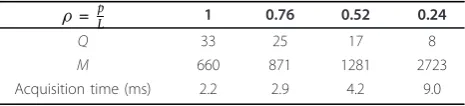
To test the ability of the proposed sparse correlation matching-based spectrum sensing techniques to prop-erly label a desired user, we first consider a scenario with one desired user in the presence of noise. The desired user is assumed to be a binary phase shift keying (BPSK) signal with a rectangular pulse shape, and 4 samples per symbol. The SNR of the desired user is 10dB and the normalized carrier frequency isw0 = 0.2. The size of the observation xmin L =33 samples. The sampling rates of ym and xm are related through the compression rate ρ=Lp. To strictly focus on the perfor-mance behavior due to compression and remove the effect of insufficient data records, the size of the com-pressed observations is forced to be the same for any compression rate. Therefore, we setM = 2Lr-1 where is a constant (in the following results= 10). Thus, for a high compression rate, the estimator takes samples for a larger period of time. The spectral occupancy Ω for this particular example is 0.25. The simulation para-meters are summarized in Table 1.
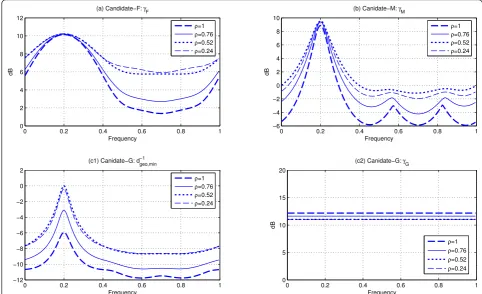
Figure 4 shows the performance of the three Candi-date methods for different compression rates. The gF
estimate, which is shown in Figure 4a, presents lower
resolution and higher leakage compared with gMand
d−geo1, min, which are plotted in Figures 4b and 4c1,
respectively. From Figure 4 it can be concluded that the best power estimate in terms of resolution is given by gM. Moreover, the range of d−geo1, min is smaller than the range ofgM, which is longer than 15 dB when there is no compression and decreases when the compression rate increases. This robustness makes us think that CANDIDATE-M may still work in scenarios with low SNR, where CANDIDATE-G probably fails (it is con-firmed in the following section). On the other hand, the independence ofgGwith respect to the carrier frequency may be observed in Figure 4c2.
Figure 5 depicts the same as Figure 4 but with two BPSK desired signals: one located at normalized fre-quency 0.2 and one located at normalized frefre-quency 0.7 with the same SNR level equal to 10dB. While all three methods successfully detect the two candidates, gG is not able to provide two power level estimates because of the non-dependency on the frequency of the parameter
gG.
Figure 6 depicts the same as Figure 4 but with the presence of a narrow band interference (pure tone) with
SNR = 10 dB at normalized frequency 0.7. While gM
remains practically unfazed, CANDIDATE-G’s
perfor-mance has suffered a slight degradation. CANDIDATE-F clearly works as a ED. This sensitivity to interference suggests to discard CANDIDATE-F in favor of the two other candidate methods. Although both figures (Figures 4 and 6) make evident the degradation of the correla-tion-matching based spectrum sensing techniques in terms of detection capability due to the effect of the compression, it is interesting to note that the frequency and power level estimation do not suffer from the compression.
For the evaluation of the frequency and power estima-tion accuracy, an scenario with one active primary user with binary phase shift keying (BPSK) using a rectangu-lar pulse shape (with 4 samples per symbol) and AWGN is considered. The normalized carrier frequency is again w0 =0.2 and the size of the observationxm in L = 33 samples. Figures 7 and 8 show the normalized root mean squared error (RMSE) of the estimated power level (this is the RMSE divided by the SNR) and the normalized RMSE of the estimated frequency location
Table 1 Simulation parameters
ρ= pL 1 0.76 0.52 0.24
Q 33 25 17 8
M 660 871 1281 2723
0 0.2 0.4 0.6 0.8 1 0
2 4 6 8 10 12
Frequency
dB
(a) Candidate−F: γF
ρ=1 ρ=0.76 ρ=0.52 ρ=0.24
0 0.2 0.4 0.6 0.8 1
−6 −4 −2 0 2 4 6 8 10
Frequency
dB
(b) Canidate−M: γM
ρ=1 ρ=0.76 ρ=0.52 ρ=0.24
0 0.2 0.4 0.6 0.8 1
−12 −10 −8 −6 −4 −2 0 2
Frequency (c1) Canidate−G: d−1geo,min
ρ=1 ρ=0.76 ρ=0.52 ρ=0.24
0 0.2 0.4 0.6 0.8 1
0 5 10 15 20
Frequency
dB
(c2) Canidate−G: γG
ρ=1 ρ=0.76 ρ=0.52 ρ=0.24
Figure 4Performance of the sparse correlation-matching based spectrum sensing. The candidate has the following parameters: BPSK signal with 4 samples per symbol, and SNR = 10dB at frequency 0.2.
0 0.2 0.4 0.6 0.8 1
6 7 8 9 10 11 12
Frequency
dB
(a) Candidate−F: γF
ρ=1 ρ=0.76 ρ=0.52 ρ=0.24
0 0.1 0.2 0.3 0.4 0.5 0.6 0.7 0.8 0.9
−10 −5 0 5 10
Frequency
dB
(b) Canidate−M: γM
ρ=1 ρ=0.76 ρ=0.52 ρ=0.24
0 0.1 0.2 0.3 0.4 0.5 0.6 0.7 0.8 0.9
−13 −12 −11 −10 −9 −8 −7 −6
Frequency (c1) Canidate−G: d−1
geo,min
ρ=1 ρ=0.76 ρ=0.52 ρ=0.24
0 0.2 0.4 0.6 0.8 1
0 5 10 15 20
Frequency
dB
(c2) Canidate−G: γG
ρ=1 ρ=0.76 ρ=0.52 ρ=0.24
(this is the RMSE divided by w0) of the desired user, respectively, for different compression rates. From Fig-ures 7 and 8 it can be conclude that both the power level estimation accuracy and the frequency estimation
accuracy remain almost constant whatever the compres-sion rate we consider.
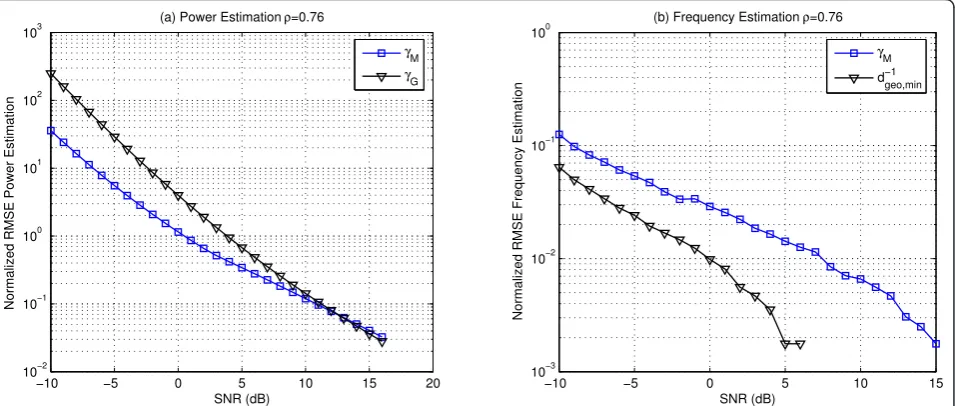
On the other hand, Figure 9 shows the comparison between CANDIDATE-M and CANDIDATE-G for a
0 0.2 0.4 0.6 0.8 1
2 4 6 8 10 12 14
Frequency
dB
(a) Candidate−F: γF
ρ=1 ρ=0.76 ρ=0.52 ρ=0.24
0 0.2 0.4 0.6 0.8 1
−6 −4 −2 0 2 4 6 8 10
Frequency
dB
(b) Canidate−M: γM
ρ=1 ρ=0.76 ρ=0.52 ρ=0.24
0 0.2 0.4 0.6 0.8 1
−12 −11 −10 −9 −8 −7 −6
Frequency (c1) Canidate−G: d−1geo,min
ρ=1 ρ=0.76 ρ=0.52 ρ=0.24
0 0.2 0.4 0.6 0.8 1
0 5 10 15 20
Frequency
dB
(c2) Canidate−G: γG
ρ=1 ρ=0.76 ρ=0.52 ρ=0.24
Figure 6Performance of the sparse correlation-matching based spectrum sensing with interference. The candidate has the following parameters: BPSK signal with 4 samples per symbol, and SNR = 10dB at frequency 0.2. The interference is a pure sinusoid located at frequency 0.7 and with SNR = 10dB.
−10 −5 0 5 10 15 20
10−2 10−1 100 101 102
SNR (dB)
Normalized RMSE Power Estimation
(a) Candidate−M: γM
ρ=1
ρ=0.76
ρ=0.52
ρ=0.24
−10 −5 0 5 10 15 20
10−2 10−1 100 101 102 103
SNR (dB)
Normalized RMSE Power Estimation
(b) Candidate−G: γG
ρ=1
ρ=0.76
ρ=0.52
ρ=0.24
particular compression rate in terms of RMSE. Figure 9a reflects that CANDIDATE-M presents higher resolution in the power estimation than CANDIDATE-G. How-ever,gGdoes not depend on the frequency and therefore it only works properly when only one desired user is present. Moreover, Figure 9b makes evident that CAN-DIDATE-G provides better results for the frequency location estimation. In conclusion, CANDIDATE-M seems to be the most complete technique of the three proposed methods because it provides good frequency and power estimations and it works in scenarios where more than one desired user is present.
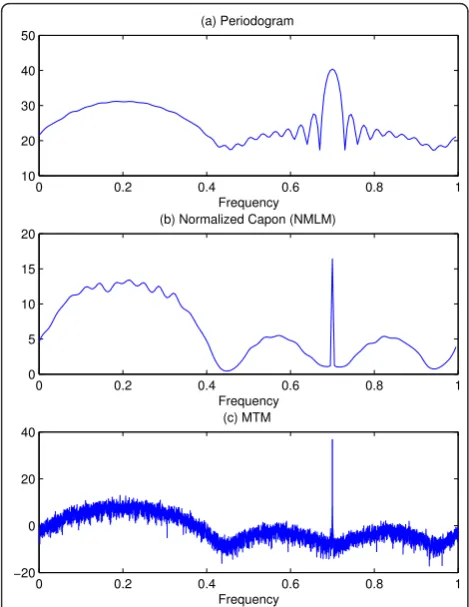
The results obtained in Figure 6 can be compared with the performance of the current most prominent spectral estimation procedures applied in the scenario under consideration. To this end, Figure 10 shows two major filter-bank spectral estimates (periodogram and normalized capon) and Thompson’s mul-titaper method (MTM) [26] for the scenario with interference in 0.7. Besides presenting low resolution, note also that they are not robust to the strong interference. In contrast, the candidate methods provide a clear frequency and power estimation and make the interference disappear because of their feature-based nature.
−10 −5 0 5 10 15 20
10−3 10−2 10−1 100
SNR (dB)
Normalized RMSE Frequency Estimation
(a) Candidate−M: γM
ρ=1 ρ=0.76 ρ=0.52 ρ=0.24
−10 −8 −6 −4 −2 0 2 4 6 8
10−3 10−2 10−1 100
SNR (dB)
Normalized RMSE Frequency Estimation
(b) Candidate−G: d−1
geo,min
ρ=1 ρ=0.76 ρ=0.52 ρ=0.24
Figure 8RMSE of the estimated frequency location in a scenario with one desired user (BPSK) in the presence of noise. (a) CANDIDATE-M, (b) CANDIDATE-G
−10 −5 0 5 10 15 20
10−2 10−1 100 101 102 103
SNR (dB)
Normalized RMSE Power Estimation
(a) Power Estimation ρ=0.76
γM
γG
−10 −5 0 5 10 15
10−3 10−2 10−1 100
SNR (dB)
Normalized RMSE Frequency Estimation
(b) Frequency Estimation ρ=0.76
γM
d−1geo,min
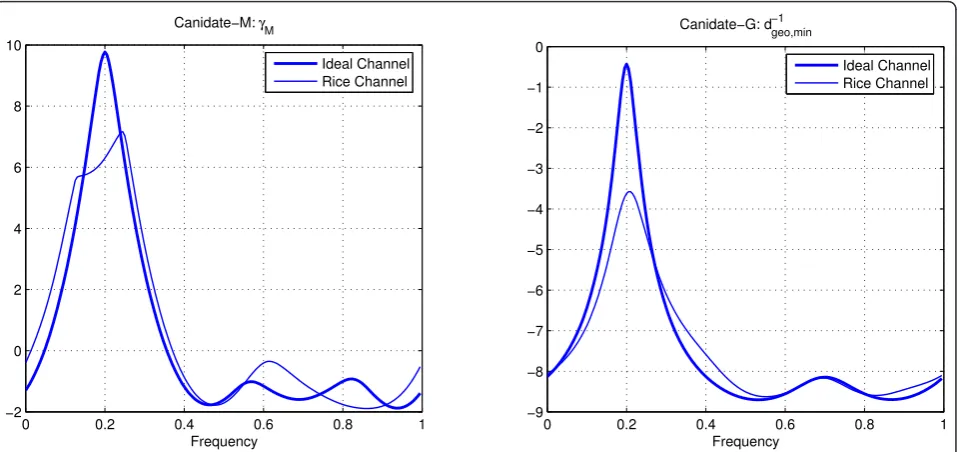
Because the method proposed here is a correlation matching-based method, a question regarding its robust-ness in front of a frequency selective channel, instead of flat fading, arises. We consider here the same scenario as in Figure 6 but with a 13-tap Rice channel (a channel with a LOS and some random late arrivals). The LOS presents a gain of one, and the late random arrivals alto-gether also have energy equal to one. A particular
per-formance is shown in Figure 11 for r = 0.76 and in
Figure 12 for r= 0.52. It can be observed that the mul-tipath causes significant losses regarding detection cap-abilities and also a deterioration in the frequency estimation due to the appearance of a bias into the fre-quency location. In any case, if these losses imply ser-ious problem, it is reasonable to assume channel equalization at the sensing station.
5.2 Low SNR scenario-ROC curves
This section evaluates the performance in low SNR sce-narios by means of the ROC curves (receiver operating characteristic) in order to illustrate the proposed candi-date spectrum sensing method robustness against noise.
To evaluate the probability of false alarm versus the probability of detection we have run 200 simulations, each in the presence of the primary user (Hypothesis H1), and 200 records of the same length without the primary user (Hypothesis H0).
ˆ
Ry=
Rn H0
γ(ws)RcmH+RwH1
(28)
0 0.2 0.4 0.6 0.8 1
10 20 30 40 50
(a) Periodogram
Frequency
0 0.2 0.4 0.6 0.8 1
0 5 10 15 20
(b) Normalized Capon (NMLM)
Frequency
0 0.2 0.4 0.6 0.8 1
−20 0 20 40
(c) MTM
Frequency
Figure 10Performance of Periodogram, Normalized Capon (NMLM) and Thompson’s multitaper method (MTM). Compression is not considered. There is a desired signal: BPSK signal with 4 samples per symbol, and SNR = 10dB at frequency 0.2. The interference is a pure sinusoid located at frequency 0.7 and with SNR = 10dB.
0 0.2 0.4 0.6 0.8 1
−5 0 5 10
Frequency Canidate−M: γM
Ideal Channel Rice Channel
0 0.2 0.4 0.6 0.8 1
−11 −10 −9 −8 −7 −6 −5 −4 −3
Frequency Canidate−G: d−1geo,min
Ideal Channel Rice Channel
The primary user is located at normalized frequency 0.2. The primary user is a BPSK and its SNR is indicated in each plot. The detection methods under study will be CANDIDATE-M and CANDIDATE-G.
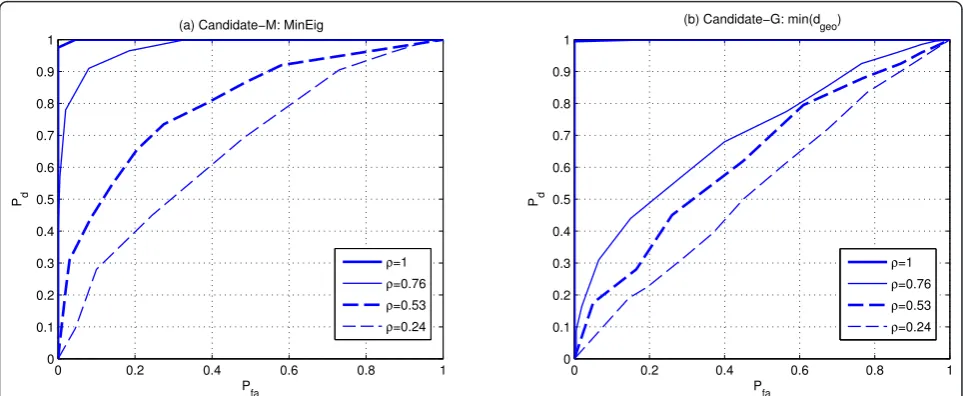
Figure 13a shows the ROC of CANDIDATE-M and Figure 13b the ROC of CANDIDATE-G for SNR = -10 dB obtained with Monte Carlo runs and for different compression rates. Figure 14 shows the same but with SNR = -14 dB. As it was expected, the general perfor-mance of both detectors is deteriorated as the
compression rate decreases. One possible explanation of why we are losing detection capabilities when the com-pression rate decreases can be found in [27], where the noise folding phenomenon is described. Basically, [27] stated that for the acquisition of a noisy signal of fixed sparsity, the SNR of the CS measurements decreases by 3 dB for every octave increase in the subsampling factor. Both Figures 13 and 14 make evident that the CAN-DIDATE-M performance is much better than that of CANDIDATE-G.
0 0.2 0.4 0.6 0.8 1
−2 0 2 4 6 8 10
Frequency Canidate−M: γM
Ideal Channel Rice Channel
0 0.2 0.4 0.6 0.8 1
−9 −8 −7 −6 −5 −4 −3 −2 −1 0
Frequency Canidate−G: d−1geo,min
Ideal Channel Rice Channel
Figure 12Performance of CANDIDATE-M and CANDIDATE-G in a rice channel (r= 0.52). The candidate is a BPSK, with 4 samples per symbol, and SNR = 10dB at frequency 0.2. The interference is a pure tone located at 0.3 with SNR = 10dB. A 13-length rice channel is
considered.
0 0.2 0.4 0.6 0.8 1
0 0.1 0.2 0.3 0.4 0.5 0.6 0.7 0.8 0.9 1
Pfa Pd
(a) Candidate−M: MinEig
ρ=1 ρ=0.76 ρ=0.53 ρ=0.24
0 0.2 0.4 0.6 0.8 1
0 0.1 0.2 0.3 0.4 0.5 0.6 0.7 0.8 0.9 1
Pfa Pd
(b) Candidate−G: min(dgeo)
ρ=1 ρ=0.76 ρ=0.53 ρ=0.24
6 Summary and conclusions
A feature-based approach for spectrum sensing based on periodic non-uniform sampling is addressed. In par-ticular, the compressed-sampling version of detecting predetermined spectral shapes in sparse wideband regimes is faced by means of a correlation-matching procedure. The main contribution of the new sub-Nyquist sampling approach is that it allows to alleviate the amount of data needed in the spectrum sensing process. Once the sampling bottleneck is solved, the data autocorrelation matrix is obtained from sub-Nyquist samples. Following the correlation matching concept, the method is able to provide an estimate of the frequency location and a power level estimation of the desired user. Three different methods are proposed: The first one, which is based on the Euclidean distance, is discarded because of its low rejection to interference. The second one, which is based on the geodesic dis-tance, works well in terms of interference rejection but the power level estimate that this method provides does not depend on the frequency parameter and therefore, it is not indicated when detecting more than one desired user. The third method, which is based on the positive semidefinite difference between matrices, is the one which works the better, both in terms of accuracy of the estimated parameters and in terms of robustness against noise. As it was expected, simulation results have shown that the compression affects the detection capabilities of all the correlation-matching methods. However, we have also shown that the accuracy of the frequency estimation and the accuracy of the power level estimation is not affected by the undersampling technique.
Acknowledgements
This study was partially supported by the Catalan Gov-ernment under grant 2009 SGR 891, by the Spanish Government under project TEC2008-06327-C03 (MULTI-ADAPTIVE), by the European Cooperation in Science and Technology under project COST Action IC0902. Eva Lagunas is supported by the Catalan Gov-ernment under grant FI-DGR 2011.
Endnotes a
http://www.fcc.gov/. b
http://www.etsi.org/.
Author details
1Department of Signal Theory and Communications, Technical University of
Catalonia (UPC), c/Jordi Girona 1-3, 08034, Barcelona, Spain2Centre
Tecnologic de Telecomunicacions de Catalunya (CTTC), Av. Canal Olímpic SN, 08860, Castelldefels, Spain
Competing interests
The authors declare that they have no competing interests.
Received: 15 September 2011 Accepted: 15 February 2012 Published: 15 February 2012
References
1. Federal Communications Commission, Tech. Report TR 02-155 (November 2002)
2. J Mitola III, GQ Maguire Jr, Cognitive radio: making software radios more personal. IEEE Personal Commun.6(4), 13–18 (1999). doi:10.1109/98.788210 3. D Cabric, SM Mishra, RW Brodersen, Implementation issues in spectrum
sensing for cognitive radios. Asilomar Conf Signals Syst Comput.1, 772–776 (2004)
4. JA Tropp, JN Laska, MF Duarte, JK Romberg, RG Baraniuk, Beyond Nyquist: efficient sampling of sparse bandlimited signals. IEEE Trans Inf Theory56(1), 520–544 (2010)
5. CE Shannon, Communication in the presence of noise. Proc Inst Radio Eng.
37(1), 10–21 (1949)
0 0.2 0.4 0.6 0.8 1
0 0.1 0.2 0.3 0.4 0.5 0.6 0.7 0.8 0.9 1
Pfa Pd
(a) Candidate−M: MinEig
ρ=1 ρ=0.76 ρ=0.53 ρ=0.24
0 0.2 0.4 0.6 0.8 1
0 0.1 0.2 0.3 0.4 0.5 0.6 0.7 0.8 0.9 1
Pfa Pd
(b) Candidate−G: min(dgeo)
ρ=1 ρ=0.76 ρ=0.53 ρ=0.24
6. H Nyquist, Certain topics in telegraph transmission theory. Trans AIEE.47, 617–644 (1928)
7. HS Shapiro, RA Silverman, Alias-free Sampling of random noise. J Soc Indust Appl Math.8, 225–248 (1960). doi:10.1137/0108013
8. FJ Beutler, Alias-free randomly timed sampling of Stochastic processes. IEEE Trans Inf Theory16, 147–152 (1970). doi:10.1109/TIT.1970.1054435 9. E Masry, Alias-free sampling: an alternative conceptualization and its
applications. IEEE Trans Inf Theory.24(3), 317–324 (1978). doi:10.1109/ TIT.1978.1055889
10. I Bilinskis, AK Mikelsons,Randomized Signal Processing, (Prentice Hall, London, 1992)
11. I Bilinskis,Digital Alias-free Signal Processing, (Wiley, Chichester, UK, 2007) 12. P Feng, Y Bresler, Spectrum-blind minimum-rate sampling and
reconstruction of multiband signals, Inter Conf Acoustics Speech Signal Process,3Atlanta, GA, 1688–1691 (1996)
13. DL Donoho, Compressed sensing. IEEE Trans Inf Theory52(4), 1289–1306 (2006)
14. EJ Candes, MB Wakin, An introduction to compressed sampling. IEEE Signal Process Mag.25(2), 21–30 (2008)
15. M Mishali, Y Eldar, O Dounaevsky, E Shoshan, Xampling: analog to digital at sub-Nyquist rates. IET J Circ Dev Syst.5(1), 8–20 (2011). doi:10.1049/iet-cds.2010.0147
16. Z Tian, GB Giannakis, Compressed sensing for wideband cognitive radios, International Conference on Acoustics, Speech and Signal Processing (ICASSP),4Las Vegas, NV, 1357–1360 (2008)
17. H Urkowitz, Energy detection of unknown deterministic signals. IEEE Proc.
55, 523–531 (1967)
18. W Gardner, Signal interception: a unifying theoretical framework for feature detection. IEEE Trans Commun.36, 897–906 (1988). doi:10.1109/26.3769 19. T Yucek, H Arslan, A survey of spectrum sensing algorithms for cognitive
radio applications. IEEE Commun Surv Tutorials.11(1), 116–130 (2009) 20. YL Polo, Y Wang, A Pandharipande, G Leus, Compressive wide-band
spectrum sensing, inInternational Conference on Acoustics, Speech and Signal Processing (ICASSP), Taipei, 2337–2340 (2009)
21. Y Wang, Z Tian, C Feng, A two-step compressed spectrum sensing scheme for wideband cognitive radios, inIEEE Global Telecommunications Conference (GLOBECOM), Miami, FL, 1–5 (2010)
22. M Rashidi, K Haghighi, A Owrang, M Viberg, A wideband spectrum sensing method for cognitive radio using sub-Nyquist sampling, inIEEE Signal Processing Society 14th DSP Workshop, 6th SPE Workshop, Arizona, USA, 30–35 (2010)
23. MA Lexa, ME Davies, JS Thompson, J Nikolic, Compressive power spectral density estimation, inInternational Conference on Acoustics, Speech and Signal Processing (ICASSP), Prague, 3884–3887 (2011)
24. AI Pérez-Neira, MA Lagunas, MA Rojas, P Stoica, Correlation matching approach for spectrum sensing in open spectrum communications. IEEE Trans Signal Process.57(12), 4823–4836 (2009)
25. P Feng, Universal minimum-rate sampling and spectrum-blind reconstruction for multiband signals, PhD, (University of Illinois at Urbana-Champaign, USA, 1997)
26. PD Welch, The use of FFT for the estimation of power spectra: A method based on time averaging over short modified periodograms. IEEE Trans Audio Elec-troacustic.AU-15(2), 70–73 (1967)
27. J Treichler, M Davenport, R Baraniuk, Application of compressive sensing to the design of wideband signal acquisition receivers, inProc 6th US and Australia Joint Workshop on Defense Applications of Signal Processing (DASP), (Hawaii, 2009)
doi:10.1186/1687-6180-2012-31
Cite this article as:Lagunas and Nájar:Sparse correlation matching-based spectrum sensing for open spectrum communications.EURASIP Journal on Advances in Signal Processing20122012:31.
Submit your manuscript to a
journal and benefi t from:
7Convenient online submission 7Rigorous peer review
7Immediate publication on acceptance 7Open access: articles freely available online 7High visibility within the fi eld
7Retaining the copyright to your article