Scalable Algorithms in the Cloud III
Microsoft Summer School
Doing Research in the Cloud
Moscow State University
August 5 2014
Geoffrey Fox
[email protected]
http://www.infomall.org
School of Informatics and Computing
Digital Science Center
A REMINDER
HPC-ABDS
Integrating High Performance Computing with
Apache Big Data Stack
•
HPC-ABDS
•
~120 Capabilities
•
>40 Apache
•
Green layers have strong HPC Integration opportunities
•
Goal
Kaleidoscope of (Apache) Big Data Stack (ABDS) and HPC Technologies
Cross-Cutting
Functionalities
Message Protocols:
Thrift, Protobuf
Distributed
Coordination:
Zookeeper, JGroups
Security &
Privacy:
InCommon,
OpenStack
Keystone, LDAP
Monitoring:
Ambari, Ganglia,
Nagios, Inca
Workflow-Orchestration:
Oozie, ODE, Airavata, OODT (Tools), Pegasus,
Kepler, Swift, Taverna, Trident, ActiveBPEL, BioKepler, Galaxy, IPython
Application and Analytics:
Mahout , MLlib , MLbase, CompLearn, R,
Bioconductor, ImageJ, Scalapack, PetSc
High level Programming:
Hive, HCatalog, Pig, Shark, MRQL, Impala, Sawzall,
Drill
Basic Programming model and runtime
,
SPMD, Streaming, MapReduce,
MPI:
Hadoop, Spark, Twister, Stratosphere, Tez, Hama, Storm, S4, Samza,
Giraph, Pregel, Pegasus
Inter process communication Collectives, point-to-point, publish-subscribe:
Hadoop, Spark, Harp, MPI, Netty, ZeroMQ, ActiveMQ, QPid, Kafka, Kestrel
In-memory databases/caches:
GORA (general object from NoSQL),
Memcached, Redis (key value), Hazelcast, Ehcache
Object-relational mapping:
Hibernate, OpenJPA and JDBC Standard
Extraction Tools:
UIMA, Tika
SQL:
Oracle, MySQL, Phoenix, SciDB
NoSQL:
HBase, Accumulo, Cassandra, Solandra, MongoDB, CouchDB, Lucene,
Solr, Berkeley DB, Azure Table, Dynamo, Riak, Voldemort. Neo4J, Yarcdata,
Jena, Sesame, AllegroGraph, RYA
File management:
iRODS
Data Transport:
BitTorrent, HTTP, FTP, SSH, Globus Online (GridFTP)
Cluster Resource Management
: Mesos, Yarn, Helix, Llama, Condor, SGE,
OpenPBS, Moab, Slurm, Torque
File systems:
Swift, Cinder, Ceph, FUSE, Gluster, Lustre, GPFS, GFFS
Interoperability:
Whirr, JClouds, OCCI, CDMI
DevOps:
Docker, Puppet, Chef, Ansible, Boto, Libcloud, Cobbler, CloudMesh
IaaS Management from HPC to hypervisors:
OpenStack, OpenNebula,
Eucalyptus, CloudStack, vCloud, Amazon, Azure, Google
Maybe a Big Data Initiative would include
•
IaaS:
Amazon, Azure,
OpenStack, Libcloud
•
Slurm
•
Yarn
•
Hbase, MongoDB
•
MySQL
•
iRods
•
Memcached
•
Kafka, RabbitMQ
•
Harp
•
Hadoop, Giraph, Spark
•
Storm
•
Hive
•
Pig
•
Mahout
– lots of different
analytics
•
R -
– lots of different
analytics
•
Kepler, Pegasus
•
Zookeeper
•
Ganglia, Nagios, Inca
HPC ABDS SYSTEM (Middleware)
120 Software Projects
System Abstraction/Standards
Data Format and Storage
HPC Yarn for Resource management
Horizontally scalable parallel
programming model
Collective and Point to Point Communication
Support for iteration (in memory processing)
Application Abstractions/Standards
Graphs, Networks, Images, Geospatial ..
Scalable Parallel Interoperable Data Analytics Library
(SPIDAL)
High performance Mahout, R, Matlab …..
High Performance Applications
SPIDAL (Scalable Parallel Interoperable Data Analytics Library)
Getting High Performance on Data Analytics
•
On the systems side, we have two principles:
–
The Apache Big Data Stack with ~120 projects has important broad
functionality with a vital large support organization
–
HPC including MPI has striking success in delivering high performance,
however with a fragile sustainability model
•
There are
key systems abstractions
which are levels in HPC-ABDS software stack
where Apache approach needs careful integration with HPC
–
Resource management
–
Storage
–
Programming model -- horizontal scaling parallelism
–
Collective and Point-to-Point communication
–
Support of iteration
•
Data interface (not just key-value) but system also supports other important
application abstractions
–
Graphs/network
–
Geospatial
–
Genes
Lets discuss
Using Lots of Services
•
To enable Big data processing, we need to support those processing data,
those developing new tools and those managing big data infrastructure
•
Need Software, CPU’s, Storage, Networks delivered as
Software-Defined
Distributed System as a Service
or
SDDSaaS
–
SDDSaaS
integrates
component services
from lower levels of
Kaleidoscope
up to
different Mahout or R components and the workflow services that integrate them
•
Given richness and rapid evolution of field, we need to enable easy use of
the Kaleidoscope (and other) software.
•
Make a list of basic software services needed
•
Then define them as
Puppet/Chef Puppies/recipes
•
Compose them with SDDSL Language (later)
•
Specify
infrastructures
•
Administrators, developers run Cloudmesh to deploy on demand
•
Application users directly access Data Analytics as Software as a Service
Infra
structure
IaaS
Software Defined
Computing (virtual Clusters)
Hypervisor, Bare Metal
Operating System
Platform
PaaS
Cloud e.g. MapReduce
HPC e.g. PETSc, SAGA
Computer Science e.g.
Compiler tools, Sensor
nets, Monitors
Software-Defined Distributed
System (SDDS) as a Service includes
Network
NaaS
Software Defined
Networks
OpenFlow GENI
Software
(Application
Or Usage)
SaaS
CS Research Use e.g.
test new compiler or
storage model
Class Usages e.g. run
GPU & multicore
Applications
FutureGrid uses
SDDS-aaS Tools
Provisioning
Image Management
IaaS Interoperability
NaaS, IaaS tools
Expt management
Dynamic IaaS NaaS
DevOps
FutureGrid uses
SDDS-aaS Tools
Provisioning
Image Management
IaaS Interoperability
NaaS, IaaS tools
Expt management
Dynamic IaaS NaaS
DevOps
CloudMesh
is a
SDDSaaS tool
that
uses
Dynamic Provisioning and
Image Management to
provide custom
environments for general
target systems
Involves (1) creating,
(2) deploying, and
(3) provisioning
of one or more images in
a set of machines on
demand
CloudMesh Architecture
•
Cloudmesh is a
SDDSaaS
toolkit to support
–
A software-defined distributed system encompassing
virtualized and bare-metal
infrastructure, networks, application, systems and platform software with a unifying
goal of providing Computing as a Service.
–
The creation of a tightly integrated mesh of services targeting
multiple IaaS
frameworks
–
The ability to
federate
a number of
resources
from academia and industry. This
includes existing FutureGrid infrastructure, Amazon Web Services, Azure, HP Cloud,
Karlsruhe using several IaaS frameworks
–
The creation of an environment in which it becomes easier to experiment with
platforms and software services while
assisting with their deployment.
–
The exposure of information to guide the efficient utilization of resources.
(Monitoring)
–
Support
reproducible computing environments
–
IPython-based
workflow
as an interoperable
onramp
•
Cloudmesh exposes both hypervisor-based and bare-metal provisioning to
users and administrators
Cloudmesh Architecture
•
Cloudmesh
Management
Framework
for
monitoring and
operations, user and
project management,
experiment planning
and deployment of
services needed by an
experiment
•
Provisioning and
execution
environments to be
deployed on resources
to (or interfaced with)
enable experiment
management.
•
Resources
.
Building Blocks of Cloudmesh
•
Uses internally
Libcloud and Cobbler
•
Celery Task/Query manager (AMQP - RabbitMQ)
•
MongoDB
•
Accesses via abstractions
external systems/standards
•
OpenPBS, Chef
•
OpenStack (including tools like Heat), AWS EC2, Eucalyptus,
Azure
•
Xsede user management (Amie) via Futuregrid
•
Implementing
Docker, Slurm, OCCI, Ansible, Puppet
Cloudmesh Components I
•
Cobbler:
Python based provisioning of bare-metal or hypervisor-based systems
•
Apache Libcloud:
Python library for interacting with many of the
popular cloud service providers using a unified API. (One Interface To
Rule Them All)
•
Celery
is an asynchronous task queue/job queue environment
based on RabbitMQ or equivalent and written in Python
•
OpenStack Heat
is a Python orchestration engine for common
cloud environments managing the entire lifecycle of infrastructure
and applications.
•
Docker
(written in Go) is a tool to package an application and its
dependencies in a virtual Linux container
•
OCCI
is an Open Grid Forum cloud instance standard
•
Slurm
is an open source C based job scheduler from HPC community
Cloudmesh Components II
•
Chef
Ansible Puppet Salt
are system
configuration managers. Scripts are used to define system
•
Razor
cloud bare metal provisioning from EMC/puppet
•
Juju
from Ubuntu orchestrates services and their
provisioning defined by charms across multiple clouds
•
Xcat
(Originally we used this) is a rather specialized (IBM)
dynamic provisioning system
•
Foreman
written in Ruby/Javascript is an open source
project that helps system administrators manage servers
throughout their lifecycle, from provisioning and
Cloudmesh User Interface
Cloudmesh Shell & bash & IPython
SDDS Software Defined Distributed Systems
•
Cloudmesh
builds infrastructure as SDDS consisting of one or more virtual clusters or slices
with extensive built-in monitoring
•
These slices are instantiated on infrastructures with various owners
•
Controlled by roles/rules of Project, User, infrastructure
Python or REST
API
User in
Project
User in
Project
CMPlan
CMPlan
CMProv
CMProv
CMMon
CMMon
Infrastructure
(Cluster,
Storage,
Network, CPS)
Infrastructure
(Cluster,
Storage,
Network, CPS)
Instance Type
Current State
Management
Structure
Provisioning
Rules
Usage Rules
(depends on
user roles)
Results
Results
CMExec
CMExec
User
Roles
User
Roles
User role and infrastructure
rule dependent security
checks
User role and infrastructure
rule dependent security
checks
Request
Execution
in Project
Request
SDDS
Select
Plan
Requested SDDS as
federated Virtual
Infrastructures
Requested SDDS as
What is SDDSL?
•
There is an OASIS standard activity TOSCA (Topology
and Orchestration Specification for Cloud Applications)
•
But this is similar to mash-ups or workflow (Taverna,
Kepler, Pegasus, Swift ..) and we know that workflow
itself is very successful but workflow standards are not
–
OASIS WS-BPEL (Business Process Execution Language) didn’t
catch on
•
As basic tools (Cloudmesh) use Python and Python is a
popular scripting language for workflow, we suggest
that
Python is SDDSL
Cloudmesh as an On-Ramp
•
As an On-Ramp, CloudMesh deploys recipes on
multiple platforms so you can test in one place and do
production on others
•
Its multi-host support implies it is effective at
distributed systems
•
It will support traditional workflow functions such as
–
Specification of an execution dataflow
–
Customization of Recipe
–
Specification of program parameters
•
Workflow quite well explored in Python
https://
wiki.openstack.org/wiki/NovaOrchestration/Workflo
wEngines
CloudMesh Administrative View of SDDS aaS
•
CM-BMPaaS
(Bare Metal Provisioning aaS) is a systems view and allows
Cloudmesh to dynamically generate anything and assign it as permitted by user
role and resource policy
–
FutureGrid machines India, Bravo, Delta, Sierra, Foxtrot are like this
–
Note this
only implies user level bare metal access
if given user is authorized and this is
done on a per machine basis
–
It
does imply dynamic retargeting of nodes
to typically safe modes of operation
(approved machine images) such as switching back and forth between OpenStack,
OpenNebula, HPC on Bare metal, Hadoop etc.
•
CM-HPaaS
(Hypervisor based Provisioning aaS) allows Cloudmesh to generate
"anything" on the hypervisor allowed for a particular user
–
Platform determined by images available to user
–
Amazon, Azure, HPCloud, Google Compute Engine
•
CM-PaaS
(Platform as a Service) makes available an essentially fixed Platform
with configuration differences
–
XSEDE with MPI HPC nodes could be like this as is Google App Engine and Amazon HPC
Cluster. Echo at IU (ScaleMP) is like this
–
In such a case a system administrator can statically change base system but the
CloudMesh User View of SDDS aaS
•
Note we always consider virtual clusters or slices with nodes
that may or may not have hypervisors
•
Well defined user and project management assigning roles
•
BM-IaaS
: Bare Metal (root access) Infrastructure as a service
with variants e.g. can change firmware or not
•
H-IaaS:
Hypervisor based Infrastructure (Machine) as a Service.
User provided a collection of hypervisors to build system on.
–
Classic Commercial cloud view
•
PSaaS
Physical or Platformed System as a Service where user
provided a configured image on either Bare Metal or a
Hypervisor
–
User could request a deployment of Apache Storm and Kafka to
Cloudmesh Infrastructure Types
•
Nucleus Infrastructure
:
–
Persistent Cloudmesh Infrastructure with defined provisioning rules and
characteristics and managed by CloudMesh
•
Federated Infrastructure
:
–
Outside infrastructure that can be used by special arrangement such as
commercial clouds or XSEDE
–
Typically persistent and often batch scheduled
–
CloudMesh can use within prescribed provisioning rules and users restricted to
those with permitted access; interoperable templates allow common images to
nucleus
•
Contributed Infrastructure
–
Outside contributions to a particular Cloudmesh project managed by
Cloudmesh in this project
–
Typically strong user role restrictions – users must belong to a particular
project
–
Can implement a Planetlab like environment by contributing hardware that can
A Project Management Framework for Cloud and HPC Resource Providers
Jefferson Ridgeway
2, Ifeanyi Rowland Onyenweaku
3, Gregor von Laszewski
1*, Fugang Wang
11*
Indiana University, Bloomington, IN 47408, U.S.A., [email protected], [email protected]
2Elizabeth City State University, [email protected]
3Mississippi Valley State University, [email protected]
Abstract
Introduction
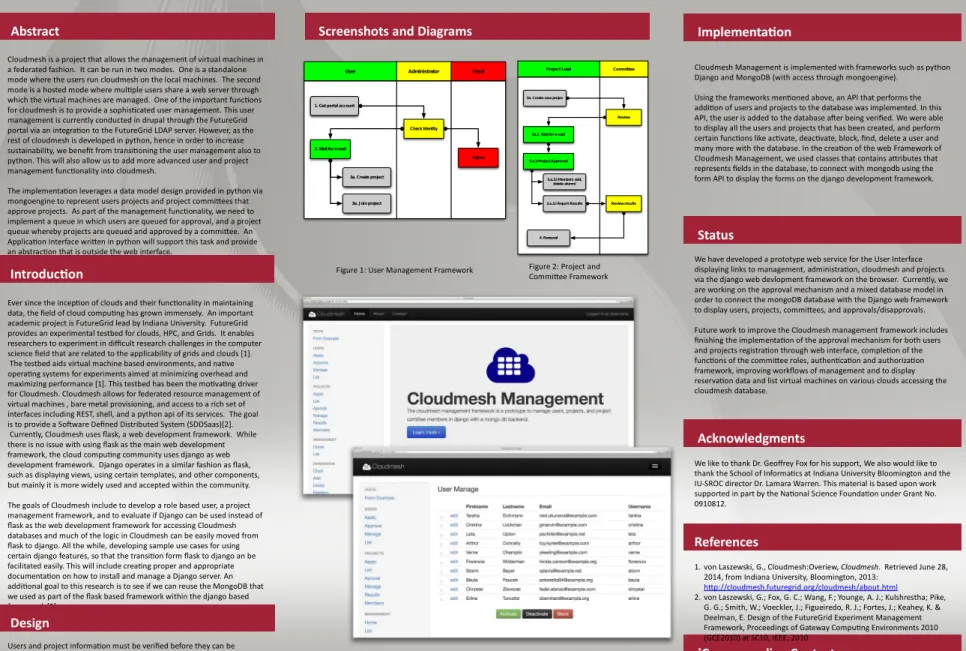
Ever since the inception of clouds and their functionality in maintaining data, the field of cloud computing has grown immensely. An important academic project is FutureGrid lead by Indiana University. FutureGrid provides an experimental testbed for clouds, HPC, and Grids. It enables researchers to experiment in difficult research challenges in the computer science field that are related to the applicability of grids and clouds [1]. The testbed aids virtual machine based environments, and native operating systems for experiments aimed at minimizing overhead and maximizing performance [1]. This testbed has been the motivating driver for Cloudmesh. Cloudmesh allows for federated resource management of virtual machines , bare metal provisioning, and access to a rich set of interfaces including REST, shell, and a python api of its services. The goal is to provide a Software Defined Distributed System (SDDSaas)[2]. Currently, Cloudmesh uses flask, a web development framework. While there is no issue with using flask as the main web development framework, the cloud computing community uses django as web development framework. Django operates in a similar fashion as flask, such as displaying views, using certain templates, and other components, but mainly it is more widely used and accepted within the community. The goals of Cloudmesh include to develop a role based user, a project management framework, and to evaluate if Django can be used instead of flask as the web development framework for accessing Cloudmesh databases and much of the logic in Cloudmesh can be easily moved from flask to django. All the while, developing sample use cases for using certain django features, so that the transition form flask to django an be facilitated easily. This will include creating proper and appropriate documentation on how to install and manage a Django server. An additional goal to this research is to see if we can reuse the MongoDB that we used as part of the flask based framework within the django based framework [3]. Cloudmesh Management is implemented with frameworks such as python Django and MongoDB (with access through mongoengine). Using the frameworks mentioned above, an API that performs the addition of users and projects to the database was implemented. In this API, the user is added to the database after being verified. We were able to display all the users and projects that has been created, and perform certain functions like activate, deactivate, block, find, delete a user and many more with the database. In the creation of the web Framework of Cloudmesh Management, we used classes that contains attributes that represents fields in the database, to connect with mongodb using the form API to display the forms on the django development framework.Screenshots and Diagrams
Figure 3: Web interface for the Cloudmesh Management
Implementation
Status
We have developed a prototype web service for the User Interface displaying links to management, administration, cloudmesh and projects via the django web devlopment framework on the browser. Currently, we are working on the approval mechanism and a mixed database model in order to connect the mongoDB database with the Django web framework to display users, projects, committees, and approvals/disapprovals. Future work to improve the Cloudmesh management framework includes finishing the implementation of the approval mechanism for both users and projects registration through web interface, completion of the functions of the committee roles, authentication and authorization framework, improving workflows of management and to display reservation data and list virtual machines on various clouds accessing the cloudmesh database.
Acknowledgments
We like to thank Dr. Geoffrey Fox for his support, We also would like to thank the School of Informatics at Indiana University Bloomington and the IU-SROC director Dr. Lamara Warren. This material is based upon work supported in part by the National Science Foundation under Grant No. 0910812.References
*
Corresponding Contact
Gregor von Laszewski, Indiana University, [email protected] Cloudmesh is a project that allows the management of virtual machines in a federated fashion. It can be run in two modes. One is a standalone mode where the users run cloudmesh on the local machines. The second mode is a hosted mode where multiple users share a web server through which the virtual machines are managed. One of the important functions for cloudmesh is to provide a sophisticated user management. This user management is currently conducted in drupal through the FutureGrid portal via an integration to the FutureGrid LDAP server. However, as the rest of cloudmesh is developed in python, hence in order to increase sustainability, we benefit from transitioning the user management also to python. This will also allow us to add more advanced user and project management functionality into cloudmesh. The implementation leverages a data model design provided in python via mongoengine to represent users projects and project committees that approve projects. As part of the management functionality, we need to implement a queue in which users are queued for approval, and a project queue whereby projects are queued and approved by a committee. An Application Interface written in python will support this task and provide an abstraction that is outside the web interface. Figure 1: User Management Framework 1. Get portal account
3a. Create project 3. Wait for e-mail
3a. J oin project
Check Identity Reject Trash Administrator User
1. von Laszewski, G., Cloudmesh:Overiew, Cloudmesh. Retrieved June 28, 2014, from Indiana University, Bloomington, 2013: http://cloudmesh.futuregrid.org/cloudmesh/about.html 2. von Laszewski, G.; Fox, G. C.; Wang, F.; Younge, A. J.; Kulshrestha; Pike, G. G.; Smith, W.; Voeckler, J.; Figueiredo, R. J.; Fortes, J.; Keahey, K. & Deelman, E. Design of the FutureGrid Experiment Management Framework, Proceedings of Gateway Computing Environments 2010 (GCE2010) at SC10, IEEE, 2010 Figure 2: Project and Committee Framework
3a. Create new projec
3.a.3.I Members add, delete alumni 3a.1. Wait for e-mail
3.a.3.I Report Results Review
Committee Project Lead
Review results 3.a.2 Project Approved
4. Renewal
Design
Useful Set of Analytics Architectures
•
Pleasingly Parallel:
including
local machine learning
as in parallel
over images and apply image processing to each image
- Hadoop could be used but many other HTC, Many task tools
•
Search:
including collaborative filtering and motif finding
implemented using
classic MapReduce
(Hadoop); Alignment
•
Map-Collective
or Iterative MapReduce
using Collective
Communication (clustering) – Hadoop with Harp, Spark …..
•
Map-Communication
or Iterative Giraph:
(MapReduce) with point-to-point communication (most graph algorithms such as maximum
clique, connected component, finding diameter, community
detection)
–
Vary in difficulty of finding partitioning (classic parallel load balancing)
•
Large and Shared memory:
thread-based
(event driven) graph
4 Forms of MapReduce
(1) Map Only
(1) Map Only
(
4) Point to Point or
Map-Communication
(
4) Point to Point or
Map-Communication
(3) Iterative Map Reduce
or Map-Collective
(3) Iterative Map Reduce
or Map-Collective
(2) Classic
MapReduce
(2) Classic
MapReduce
Input
Input
map
map
reduce
reduce
Input
Input
map
map
reduce
reduce
Iterations
Iterations
Input
Input
Output
Output
map
map
Local
Graph
BLAST Analysis
Local Machine
Learning
Pleasingly Parallel
High Energy Physics
(HEP) Histograms
Distributed search
Recommender Engines
Expectation maximization
Clustering e.g. K-means
Linear Algebra,
PageRank
Classic MPI
PDE Solvers and
Particle Dynamics
Graph Problems
MapReduce and Iterative Extensions (Spark, Twister)
MPI, Giraph
Integrated Systems such as Hadoop + Harp with
Compute and Communication model separated
Comparison of Data Analytics with Simulation I
•
Pleasingly parallel
often important in both
•
Both are often
SPMD
and
BSP
•
Streaming event
style important in Big Data; only see in
simulations for “parameter sweep” simulations
•
Non-iterative MapReduce
is major big data paradigm
–
not a common simulation paradigm except where “Reduce” summarizes
pleasingly parallel execution
•
Big Data often has
large collective communication
–
Classic simulation has a lot of smallish point-to-point messages
•
Simulation dominantly
sparse
(nearest neighbor) data structures
–
“Bag of words (users, rankings, images..)” algorithms are
sparse, as is PageRank
Comparison of Data Analytics with Simulation II
•
There are similarities between some
graph problems and particle
simulations
with a
strange cutoff force.
–
Both
Map-Communication
•
Note many big data problems are “
long range force
” as all points are
linked.
–
Easiest to parallelize. Often full matrix algorithms
–
e.g. in DNA sequence studies, distance
(
i
,
j
) defined by BLAST, Smith-Waterman, etc., between all sequences
i
,
j.
–
Opportunity for “fast multipole” ideas in big data.
•
In image-based
deep learning
, neural network weights are block sparse
(corresponding to links to pixel blocks) but can be formulated as full matrix
operations on GPUs and MPI in blocks.
•
In HPC benchmarking, Linpack being challenged by a new sparse conjugate
gradient benchmark HPCG, while I am diligently using
non- sparse
“Force Diagrams” for
Iterative MapReduce
Implementing HPC-ABDS
Using Optimal “Collective” Operations
•
Twister4Azure Iterative MapReduce with enhanced collectives
–
Map-AllReduce primitive and MapReduce-MergeBroadcast
Kmeans and (Iterative) MapReduce
•
Shaded areas are computing only where Hadoop on HPC cluster is
fastest
•
Areas above shading are overheads where T4A smallest and T4A with
AllReduce collective have lowest overhead
•
Note even on Azure Java (Orange) faster than T4A C# for compute
37
32 x 32 M
64 x 64 M
128 x 128 M
256 x 256 M
0
200
400
600
800
1000
1200
1400
Hadoop AllReduce
Hadoop MapReduce
Twister4Azure AllReduce
Twister4Azure Broadcast
Twister4Azure
HDInsight (AzureHadoop)
Num. Cores X Num. Data Points
Ti
m
e
(
Collectives improve traditional MapReduce
•
Poly-algorithms choose the best collective implementation for machine and
collective at hand
•
This is K-means running within basic Hadoop but with optimal AllReduce collective
operations
Harp Design
Parallelism Model
Architecture
Shuffle
Shuffle
M
M
M
M
Optimal Communication
Optimal Communication
M
M
M
M
R
R
Collective or
Map-Communication Model
MapReduce Model
YARN
MapReduce V2
Harp
MapReduce
Applications
Map-Collective
or Map-Communication
Applications
Application
Framework
Features of Harp Hadoop Plugin
•
Hadoop Plugin (on Hadoop 1.2.1 and Hadoop
2.2.0)
•
Hierarchical data abstraction on arrays, key-values
and graphs for easy programming expressiveness.
•
Collective communication model to support
various communication operations on the data
abstractions (will extend to Point to Point)
•
Caching with buffer management for memory
allocation required from computation and
communication
•
BSP style parallelism
WDA SMACOF MDS (Multidimensional Scaling) using Harp on IU Big Red 2
Parallel Efficiency: on 100-300K sequences
Conjugate Gradient (dominant time) and Matrix Multiplication
0
20
40
60
80
100
120
140
0.00
0.20
0.40
0.60
0.80
1.00
1.20
100K points
200K points
300K points
Number of Nodes
P
ar
al
le
l E
ff
ic
ie
nc
y
Best available
MDS (much
better than
that in R)
Java
Harp (Hadoop
plugin)
Increasing Communication
Identical Computation
Mahout and Hadoop MR
– Slow due to MapReduce
Python
slow as Scripting;
MPI
fastest
Spark
Iterative MapReduce, non optimal communication
Harp
Hadoop plug in with ~MPI collectives
1000000 points
50000 centroids
10000000 points
5000 centroids
100000000 points
500 centroids
● ● ● ● ● ● ● ● ● ● ● ● ● ● ● ● ● ● ● ● ● ● ● ● ● ● ● ● ● ● ● ● ● ● ● ● ● ● ● ● ● ● ● ● ● ● ● ● ● ● ● ● ● ●