Theory and legitimacy in professional education: A Practitioner Review of Reflective Processes within Programmes for New Academic Staff
Peter Kahna, Richard Youngb, Sue Gracec, Ruth Pilkingtond, Linda Rushe, Bland
Tomkinsonf and Ian Willisa
aThe University of Liverpool, UK; bNewcastle University, UK; cThe University of York, UK; dUniversity of Central Lancashire, UK; eEdge Hill University, UK; fThe University of Manchester
International Journal for Academic Development, 13(3),161-73
Abstract
We review research literature on coherent theoretically-based approaches to the use of reflective processes within programmes of initial professional education for new academic staff. Employing a novel methodology that incorporates practitioner perspectives, we establish a framework that highlights the role of personal and social factors, and also pedagogic and theoretical considerations, in shaping reflective processes. The included studies identified participants who had engaged in certain categories of reflection. Certain fundamental outcomes, however, such as changes in professional commitment, were never seen across an entire cohort. We thus discuss the intended learning outcomes that programmes might legitimately seek to meet.
Introduction
The notions of ‘reflective practice’ and ‘reflective learning’ are now widely employed across higher education, Dewey (1933, p9), for instance, takes reflective practice to mean the extended consideration of aspects of practice in light of its supporting grounds and the further conclusions to which it tends. Schön (1983), meanwhile, applied this notion of reflective practice to professional education, and in recent years we have seen the wider use of reflective processes to support student learning more generally, as with Boud and Walker (1990) and Moon (2000). The initial professional education that new members of academic staff receive in relation to the application of reflective processes to their own learning and practice is thus influential in shaping student learning across higher education.
Existing reviews on the use of reflective processes in programmes for new academic staff have reported inconclusive results. The review by Prebble et al (2004, p9) found no evidence that university teaching staff who had taken a programme that incorporated training in reflective practice were able to make decisions on the basis of reflection as opposed to convention, even if some programmes resulted in promising outcomes. Gilbert and Gibbs (1998) concluded similarly, noting that the conceptual frameworks in accounts of these programmes were usually implicit. Studies have also identified issues with the role that reflective practice plays within these programmes. Fanghanel (2004) identified a range of dissonances within three specific programmes, related to practice,
Centre for Lifelong Learning, University of Liverpool, 128 Mount Pleasant, Liverpool L69 3GW.
epistemology, structure and ideology, with reflection essentially used as a metaphor for problematising professional practice. Clegg et al (2002) argues that the language of reflective practice has been employed as a strategic approach for accreditation, while Edwards and Nicoll (2006) point out that the rhetoric of reflective practice may serve to mobilize professional identity and to motivate participants towards particular forms of professional development.
One key issue in these various studies concerns the underlying notion of reflection, which Kreber (2004) identifies as one that is poorly conceptualized. Indeed, it is evident that theorists typically see the need to qualify the usage of the term with further distinctions as Moon (2000, pp18-19) observes. It is thus not surprising that previous studies have found inconclusive evidence as to the effectiveness of programmes for new academic staff that promote ‘reflective practice’. We highlight this point by looking at the study by Ho (2000), which focuses on conceptual change. It can be argued that the intervention reported in this study required participants on the programme to engage in intensive reflection in relation to the supporting grounds for their practice, but typically conceptual change is located under a different category to ‘reflective practice’, as with Gilbert and Gibbs (1998). Kreber emphasizes that it is essential to both identify the definition of reflection underpinning a study and to consider how the respective findings can be linked, when seeking to judge the contribution of a body of studies in this area. Scope thus remains to gain insight into the use of reflective processes within programmes for new academic staff, allowing us to shape practice in an informed fashion. We report here on a review of the research literature on the characteristics of coherent theoretically-based approaches to the use of reflective processes on programmes of initial professional development for new members of academic staff (for the full review report see Kahn et al, 2006). The review was one of a series of literature reviews commissioned by the Higher Education Academy to take place between October 2005 and May 2006, with those acting as reviewers recruited by the Project Director from amongst colleagues within a network of programme leaders based in both pre-1992 and post-1992 universities in the north of England.
An Interpretive-practitioner Methodology
The use of practitioners in undertaking a review of research literature provides a clear context for the methodology, locating it within the tradition of practitioner research. It is evident, however, that this tradition has yet significantly to engage with reviews of research. The user review (see Burton, 2004) remains a notable exception, although user reviews are not themselves seen as research. Rather, they are based on an earlier academic review of the literature, as evident in Rickinson et al (2004). Many established review methodologies, meanwhile, adopt objective stances towards research literature that may sit uneasily with practitioners (as for instance with systematic reviews, Cooper and Hedges, 1994, and realist reviews, Pawson, 2002), favouring as they do transparent and technical approaches.
commentary, analysis of the data (including the creation of a theoretical sub-sample of studies on which to base the main conclusions) and finally the narrative report.
The review incorporated a study on the current state of practice within programmes within England. This involved a review of grey literature, covering programme handbooks and other documentation from a sample of 15 English higher education institutions. This further permits us to highlight within the synthesis issues relevant to external validity. The institutions covered included a number from the network of programme leaders from which the review team was drawn. While such a documentary analysis provides a relatively limited view of any one programme, and cannot be taken as representative of the population of programmes, it does allow us to focus directly on the language employed within the programme.
Given the novelty of this methodology, considerations of internal and external validity are important, as more fully analysed in Kahn et al (2007), but the validity of our methodology will also be seen by the extent to which the review itself is useful to practitioners and researchers. In overall terms this approach fits well with our central research question, which concerns ascertaining the characteristics of coherent theoretically-informed approaches to the use of reflective processes within programmes for new academic staff, with the perspectives of practitioner researchers shaping the way that this question is to be answered.
The initial phase of identifying relevant literature was designed to allow freedom for the practitioner reviewers to select studies that they considered of relevance to their own practice, a freedom tempered by the need for construct validity in relation to the central notion of a reflective process applied to professional practice and learning. Five members of the review team each took a specific area of the published literature to review: purposes and outcomes for reflection; reflective processes that involve personal reflection; reflective processes that involve a social dimension; assessment; the pedagogy of reflective processes. This ensured that the overarching concept of reflective process was approached at a detailed level, so that studies operating with an implicit understanding of reflective practice were less likely to be included within the review. These areas provided the basis for the key words used to search standard databases such as the British Education Index. Relevant studies were also located through recommendations from colleagues, hand searching relevant journals, and studies identified within earlier reviews. The areas themselves were established through exchanges with a consultant, and left scope also for the inclusion of relevant studies from related professional domains. Such wider inclusion of literature was important given the limited number of studies of direct relevance to programmes for new academic staff.
We thus present in this paper a narrative that articulates this framework and analyses the theoretical basis and the reported outcomes of the sub-sample of studies. Quality of study is thus assessed in theoretical terms, rather than through such factors as robustness of methodology or effect size (as for Slavin, 1986); although we are more cautious here than in the main report (Kahn et al, 2006) about the extent to which conclusions can be drawn in relation to the effectiveness of the interventions reported. The approach taken in this paper sits more naturally with an interpretive practitioner review, focusing as it does on the development of understanding, while also allowing connections to be made with practice.
Characteristics of Approaches to Reflective Processes
Sixty-eight studies were formally included within the review, with 12 focusing specifically on programmes for new academic staff, 18 covering the development of academics more widely, 20 within initial teacher training, ten within medical or health related practice and eight from other contexts. The studies came from 25 journals, with Reflective Practice contributing 18 and International Journal for Academic Development nine; and they were carried out within a range of countries, with the UK, Australia and the US contributing the greatest numbers.
This sample as a whole served two main purposes: to generate a framework for understanding and to allow for the creation of a sub-sample of directly relevant studies. While we will explore the framework in greater detail in a subsequent paper, it is important here to provide an outline given its centrality to the review methodology. The method of constant comparison yielded 6 major categories with which to code the data as indicated in Table 1, with some 123 nested sub-categories articulated in total, leading to 634 identifications against these categories across the proforma data. These categories cover analysis of the interventions as well as actual descriptions of programmes.
Major category Description
Core reflective process (task and focus)
Task – an extended activity or set of activities (e.g. peer observation; portfolio development; action research; projects; action learning; co-observation; with specific features (e.g. a cycle of activities; progression evident in the level of challenge).
Focus – The aspect of, or foundations for, practice investigated during the task, typically viewed through one or more theories (e.g. individual practice; collaborative practice; specific bases for practice; the reflective process itself).
Social basis The social interactions between participants, facilitators and others, which may help sustain the core reflective process (e.g. dialogue, including such aspects as challenges, prompts, crossing of boundaries, insights from literature, specialist language and feedback; roles; atmosphere).
Personal basis Factors influencing how an individual engages in a reflective process (e.g. experience; ownership; personal and professional identity; roles).
Wider context Factors concerning the context within which the reflective process unfolds (e.g. programme; workplace setting; discipline; institution).
Theoretical basis The theoretical foundations for the reflective process (e.g. theories of practice; theories of reflection; theories of professional learning)
development of expertise; ability to engage in reflective processes).
Table 1: The elements of a directed reflective process as applied to practice, along with examples of sub-categories (and, where relevant,
sub-sub-categories)
It is evident from Table 1 that the framework, while focusing on the reflective process, also addresses issues from professional learning. The social basis for a reflective process, where the participant is drawn to consider new perspectives on their practice, is equally an integral aspect of pedagogy in relation to the process. Indeed, this emerged as the sub-category most frequently identified within the studies. A similar emphasis on the role of discourse in reflective learning is also evident within Brockbank and McGill (2007). The personal basis, meanwhile, plays a significant role in enabling a process to unfold suitably, as with the willingness to engage, but also more directly in the contribution that experience makes to providing material on which to focus the process. While the wider context may be regarded as more remote from the actual process, it does still shape both learning and the reflective process, given for instance the actual scope within the workplace to make changes in practice during or following a reflective process. A clear link is further evident between the intended learning outcomes and the focus of the reflective process. The theoretical basis for the process is also relevant, as we will consider in further detail with reference to the sub-sample. These major categories may all be linked in a relatively open way through what we term the ‘directed reflective process’. The term ‘reflective process’ itself highlights the range of possible approaches to and the need to select from within this range; while the word ‘directed’, which we interpret to allow for the possibility of self-direction, emphasises the way in which the process must both be targeted and sustained, where possible through ensuring alignment across the different elements of the framework, enabling it to be pursued to the necessary depth, and yielding the intended or emergent outcomes. Alternatively we can think of these different elements of the framework as conditions to be met if specific forms of reflection or outcomes are to occur.
The sweep of issues covered by the framework is indeed large; theories of learning may be said typically to focus on one or two of these aspects, as with the social construction or the cognitive construction of learning, peer learning in the workplace or theories of reflection themselves. While we present the idea of alignment between these elements as important, it is also evident that the interplay between the different elements will be complex, potentially making it difficult to effect alignment, particularly where there is limited control over some elements of the framework. While both detailed consideration of the studies themselves and observations in relation to practice will help us to offer an initial synthesis of the different elements of the framework, more sophisticated analysis (which we will address in the further paper) would benefit from a broader theoretical perspective, such as that provided by social realism (see for instance Archer, 2000) which considers the interplay between social structure and human agency.
sub-sample that focus more generally on the professional development of academic staff: Lyons (2006); and MacKinnon (2001). Level of experience is certainly one factor that affects how a reflective process unfolds, but these studies nonetheless address a range of relevant issues. We provide in Table 2 a summary description of the match with the framework, citing examples of overlap with the major categories. The match itself was made on the basis of a finer level of detail, with Bell (2001), for instance, contributing on 18 occasions to sub-categories, including: tasks such as ‘Peer observation’ and ‘Action-research’; a social basis that incorporated the sub-categories ‘Feedback’, ‘Questioning’ and ‘Respect amongst peers’; and outcomes such as ‘Capacity for reflection on practice’ and ‘Capacity for practice’.
It is helpful also in reaching a synthesis to consider in Table 2 the theoretical basis for each study within sub-sample. We see the inclusion of theories on the nature of reflection within these studies, although the notion of reflective practice from Schön is still dominant. Bell (2001), for instance, while drawing on Schön, qualifies this with further reference to the internal reflective and external technical dimensions of practice from Brookfield (1986). But a significant contribution comes from theories of professional learning. Mackinnon (2001) draws on Boud’s theories of professional learning (see for instance Boud, 1999) in recognizing that it is sites for academic practice that primarily influence academic identity. Action research similarly places the professional context at the heart of the learning process. Recognition of the value of a socialization linked directly to the professional context is also evident, in helping to foster possibilities for new insights, challenge, and ultimately, changes in practice and identity.
Study Theoretical basis for programme Overlaps with framework
Bell (2001) Reflective practitioner (Schön); action research (Lewin); critical thinking (Brookfield); lifelong learning (Brookfield, Candy and Mezirow); learning in practice contexts (Boud) and others.
Action research provides a focus for social interaction to support the reflective process, while incorporating personal engagement in relation to levels of experience and the work context.
Booth and Anderberg (2005)
Practice-Experience-Theory model; nature of knowledge (Ryle);
phenomenography and variation theory (Marton); knowledge capabilities (Bowden); reflective problematisation.
Developing insights into personal teaching stances, and action research. Use of discussion and collaborative writing, with consideration given to language and the practice setting.
Ho (2000) Conceptions of teaching (Trigwell and Prosser); theories of action (Argyris & Schön); conceptual change (Posner); social change (Lewin) and others.
Seven-stage process involving reflection on espoused conceptions of teaching and actual practice, involving challenges, insights from the literature, and planning subsequent practice. Addresses the work environment and professional experience.
Staniforth and Harland (2003)
Collaborative action research (Carr and Kemmis)
Action research supported online, with a supportive and critical community. Covers tensions between research and teaching, and professional identity.
Lyons (2006) Reflective inquiry (Dewey); reflective practitioner (Schön); scholarship of teaching (Boyer).
(2001) (Bordin); learning in practice contexts
(Boud). structured process of reflection; involving a partnership with a consultant, observational tools and taking account of the context for practice.
Table 2: Theoretical basis for the programmes reported within the sub-sample studies
In addition there are theories of knowledge and of professional action. The use of action research, for instance, cuts across these different areas, in viewing the practitioner as central to process, both in engaging in and investigating an aspect of practice. Epistemology plays a key role in ensuring a process addresses supporting grounds for practice, and thus in helping to frame further conclusions. Stenhouse et al (1979), indeed, points out that a focus on the fundamental structures of knowledge in any discipline is a critical part of any educational endeavour. Ho (2000) shows how a programme can involve a reflective process in relation to the fundamental structures of knowledge within a professional field. Theories of reflection, practice, knowledge and learning in professional contexts may thus all serve to provide direction for, or shape to, the reflective process. The reflective processes involved in the sub-sample studies are designed around such considerations, helping to ensure a consistent approach across the elements of the framework.
The Outcomes of Reflective Processes Employed on Programmes
This above analysis is important for understanding the characteristics of reflective processes employed in contexts of initial professional education, but it also enables us to explore the outcomes associated with the use of reflective processes on programmes for new academic staff.
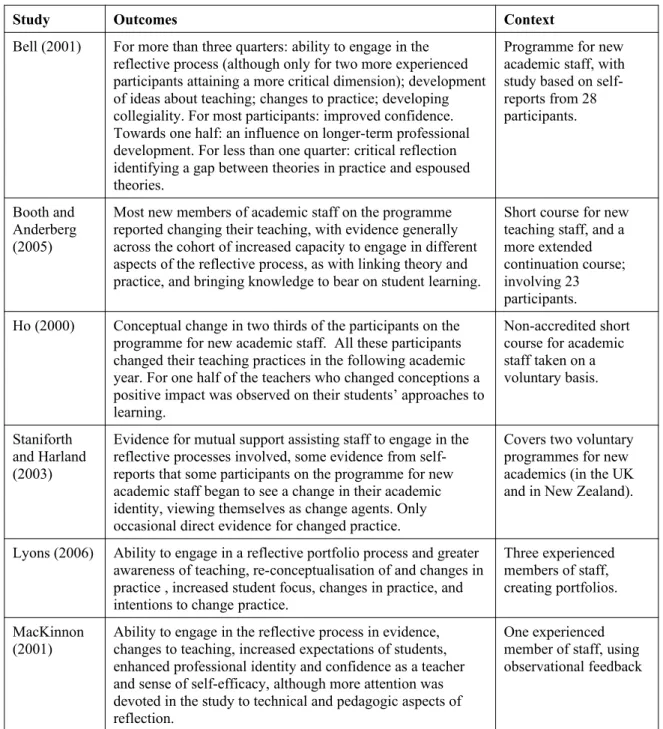
Table 3 provides an overview of the outcomes claimed within the sub-sample studies. The reported outcomes primarily concern enhanced capacity for practice, ability to engage in specific accessible reflective processes (although the extent to which an increase in ability could be directly attributed to a programme was typically less clear) and to engage in, become aware of, or understand aspects of practice; with these specific outcomes affecting the majority of subjects involved. For instance, Lyons (2006) argues that the creation of a reflective teaching portfolio enabled the university teachers to redirect their practice in line with their new insights, establishing a link in this case between capacity to engage in a specific reflective process and enhanced capacity for practice. While changes may be been evident in practice, it is further clear that when entire cohorts are considered there is significant variation for individual members of staff, ranging from little to extensive change in practice.
It seems likely that change of this order involves factors beyond the control of a programme. A research culture within an institution, for instance, is a well known factor in over-riding professional commitment to teaching (see, for instance, Prosser et al, 2006). Moreover, the programmes involved are usually part-time and modest in scale, typically covering at most 600 notional hours of learning at masters-level. One might also consider the way in which dominant ideologies affect the attainment of the more demanding outcomes. Studies from the related field of action research are helpful here: thus Carr and Kemmis (2005) refer to difficulties evident in practitioners realising a specific vision of criticality. They argue that technical means-end approaches reflect the ideology sustaining the culture of modernity, an ideology at odds with their approach.
Study Outcomes Context
Bell (2001) For more than three quarters: ability to engage in the reflective process (although only for two more experienced participants attaining a more critical dimension); development of ideas about teaching; changes to practice; developing collegiality. For most participants: improved confidence. Towards one half: an influence on longer-term professional development. For less than one quarter: critical reflection identifying a gap between theories in practice and espoused theories.
Programme for new academic staff, with study based on self-reports from 28 participants.
Booth and Anderberg (2005)
Most new members of academic staff on the programme reported changing their teaching, with evidence generally across the cohort of increased capacity to engage in different aspects of the reflective process, as with linking theory and practice, and bringing knowledge to bear on student learning.
Short course for new teaching staff, and a more extended continuation course; involving 23 participants. Ho (2000) Conceptual change in two thirds of the participants on the
programme for new academic staff. All these participants changed their teaching practices in the following academic year. For one half of the teachers who changed conceptions a positive impact was observed on their students’ approaches to learning.
Non-accredited short course for academic staff taken on a voluntary basis.
Staniforth and Harland (2003)
Evidence for mutual support assisting staff to engage in the reflective processes involved, some evidence from self-reports that some participants on the programme for new academic staff began to see a change in their academic identity, viewing themselves as change agents. Only occasional direct evidence for changed practice.
Covers two voluntary programmes for new academics (in the UK and in New Zealand).
Lyons (2006) Ability to engage in a reflective portfolio process and greater awareness of teaching, re-conceptualisation of and changes in practice , increased student focus, changes in practice, and intentions to change practice.
Three experienced members of staff, creating portfolios.
MacKinnon
(2001) Ability to engage in the reflective process in evidence, changes to teaching, increased expectations of students, enhanced professional identity and confidence as a teacher and sense of self-efficacy, although more attention was devoted in the study to technical and pedagogic aspects of reflection.
One experienced member of staff, using observational feedback
Rhetoric and Legitimacy
It is instructive to compare these findings with observations from our integral study on the state of practice on programmes for new academic staff. It was evident in the state of practice study that the notion ‘reflection’ was central to the headline purpose of all the programmes covered: whether to develop a ‘reflective approach to the practice of teaching and the support of learning in higher education’ or involving the ‘Use of reflection as a tool for critical thought on the teaching and learning process’. Terms such as ‘reflection’ or ‘reflective practice’ were, however, only rarely unpacked within the documentation. While exploration of their meaning might well occur during a programme, it was clear in the documentation that the ability to engage in a reflective process was not simply an end in itself. Other intended outcomes flowing from the application of reflective processes included the ability to innovate, the willingness to take risks, a framework for career long development and so on. A direct link was made in each programme between reflective processes and professional development, with the use of reflection to support self-improvement and adaptation of practice prevalent to varying extents, as with one programme which sought to promote ‘a framework for … career-long development based on reflective practice’. This was typically set within a context of change within higher education.
Our above findings, however, indicated that evidence for the attainment of many such wider outcomes was not seen across an entire cohort. Programmes that claim that their participants attain outcomes that apply to the longer term or that concern identity or demanding forms of reflection may find it difficult to substantiate their position; raising the possibility that the claims may serve other purposes than simply to represent the actual outcomes for participants. Programme documentation, indeed, is employed for accreditation purposes; the programmes concerned were accredited by the Higher Education Academy, and in some cases also the Staff and Educational Development Association. At the time of the review, both of these bodies required programmes to promote reflection on practice.
Edwards and Nicoll (2006) also argue that the language of reflective practice forms part of the discourse of professional development, set within a context of change (p118). Edwards and Nicoll suggest that there is a certain attractiveness to the language of reflective practice, advocating as it does open-mindedness and a readiness to question on the part of the audience. They contend that such language is employed in part to legitimize the need for professional development: ‘The rhetoric of reflective practice may be powerful, not in the sense of whether it is literally true, but in the ways in which it is persuasive and the work it attempts to do.’ (p123)
It is also clear, though, that this discourse of reflective practice, or indeed professional development, is not always accepted within the workplace setting of the participants. Fanghanel (2004) argues that reflective practice generally underpins the environment for teaching and learning present on programmes for new academic staff. She highlights dissonance between this environment and the environment in operation within the workplace settings of the programme participants, whether in relation to practice, structure, ideology or epistemology. Trowler and Cooper (2002) similarly show incongruities between self-theories, exercise of power, discourses within disciplines, and underlying assumptions operating within these two settings.
environments of professional education and professional practice. Indeed, we can posit a cycle in which dissonances result in a weaker attainment of outcomes linked to reflection on practice, leading to a widening of the gap between the language employed on a programme and the outcomes that are actually realized. Care is thus needed in designing reflective processes for use on a programme for new academic staff, to ensure that the nature of practice within the workplace settings of the participants is taken fully into account; and even for reflective processes to be applied to consider this gap between the practice and training environments.
Conclusions
This review has sought to enhance our understanding of reflective processes employed within programmes for new academic staff, developing a framework that synthesises insights from across the literature. This framework provides a means to understand ways in which reflective processes may be based on theories from a range of domains, whether in relation to practice, knowledge or pedagogy; rather than simply relying on theorization in relation to reflection itself.
We were further able to explore a potential gap between rhetoric and reality on programmes for new academic staff. Claims for a wide set of intended learning outcomes, including those that concerned professional identity or more demanding categories of reflection, were never seen in the literature included within the review to be achieved for an entire cohort. Programmes are thus particularly advised when shaping or supporting reflective processes to consider the relevance of professional context, given the tensions exposed within this study. Professional learning is a complex area, one in which care is needed when matching intended learning outcomes with what participants on a programme can realistically achieve.
We recognize here that further research to assess the methodological adequacy of the studies included within the sub-sample would assist in judging of effectiveness more directly. It would, for instance, be possible for professional researchers to support a practitioner review in the way that action research is often supported by researchers. However, we have seen various insights stemming from our synthesis and from the associated descriptions of coherent theoretically-informed approaches. Elliot (2001), indeed, argues that generalization in relation to the effectiveness of a given educational practice remains of relatively limited use in comparison to knowledge that is more directly actionable by practitioners.
In looking to adapt practice on programmes for new academic staff, or indeed in relation to the pedagogy of reflective learning and practice more widely, the experience of the reviewers themselves is instructive, in that insights into the application of the literature to practice stemmed both from the ongoing dialogue within the review team, as much as from reading specific studies, as explored in the associated study of the methodology for the review (Kahn et al, 2007). Practitioners seeking to learn from this report might thus find it helpful both to engage with the sub-sample of studies, in dialogue with colleagues. A shared understanding of reflection is clearly an important first step in moving practice forward.
pedagogy of reflective processes, when associated theories of professional practice and knowledge are also considered.
This paper has not sought to provide a blueprint for the use of reflective processes within programmes for new academic staff, or indeed to seek straightforwardly to claim that the use of such processes are effective. Rather we have aimed to develop understanding of the ways in which a theoretical basis in notions of reflection, pedagogy, knowledge and practice may contribute to making legitimate claims for the place of reflective processes in the professional education of new academics, and to shaping practice in an informed fashion.
Acknowledgements
We are grateful to the Higher Education Academy for funding this research, and to Jenny Moon, Terry Wareham and Liz Evans for their roles in the project.
Notes on contributors
Peter Kahn is an Educational Developer at the University of Liverpool. His books include Developing your Teaching (Kahn and Walsh, 2006, Routledge) and A Guide to Staff and Educational Development (Kahn and Baume, 2003, Kogan Page).
Richard Young works in Academic Staff Development at the University of Newcastle, leading the Postgraduate Certificate in Academic Practice.
Sue Grace is Programme Director of the Postgraduate Certificate in Academic Practice at the University of York
Ruth Pilkington is Course Leader of the MEd (Professional Practice in Higher Education) and the Postgraduate Certificate in Learning and Teaching in Higher Education at University of Central Lancashire.
Linda Rush is Senior Lecturer in Teaching and Learning Development at Edge Hill University. She leads the university’s Postgraduate Certificate in Teaching and Learning Support in Higher Education.
Bland Tomkinson is the University Adviser on Pedagogic Development at the University of Manchester and Programme Director for the Academic Staff Programme.
Ian Willis is Programme Director for the Postgraduate Certificate in Learning and Teaching in Higher Education at the University of Liverpool.
References
Bell, M. (2001). ‘Supported Reflective Practice: a Programme of Peer Observation and Feedback for Academic Teaching Development.’ International Journal for Academic Development 6(1): pp.29-39.
Booth, S. and Anderberg, E. (2005). Academic Development for Knowledge Capabilities: Learning, Reflecting and Developing. Higher Education Research and Development, 24, 373-386.
Boud, D. (1999). Situating Academic Development in Professional Work: Using Peer Learning. International Journal for Academic Development 4, 3-13.
Boud, D. and Walker, D. (1990). Making the most of experience, Studies in Continuing Education. 12, 2, 61-80.
Brockbank, A. and McGill, I. (2007). Facilitating reflective learning in higher education. Maidenhead: Open University Press.
Brookfield, S. (1986). Understanding and facilitating adult learning. San Francisco: Jossey-Bass.
Burton, L. (2004). A new venture–bridging the gap between educational research and policy and practice. British Educational Research Journal, 30, 3-7.
Carr, W. and Kemmis, S. (2005). Staying critical. Educational Action Research, 13, 347-328.
Clegg, S., Tan, J., Saeidi, S. (2002). Reflecting or Acting? Reflective Practice and Continuing Professional Development Programmes in Higher Education. Reflective Practice 3,131 – 146.
Cooper, H. and Hedges, L. (Eds) (1994). The handbook of research synthesis. New York: Russell Sage Foundation.
Dewey, J. (1933). How we think: a restatement of the relation of reflective thinking to the educative process. Boston: D C Heath.
Edwards, R. and Nicoll, K. (2006). Expertise, Competence and Reflection in the Rhetoric of Professional Development. British Educational Research Journal, 32, 115-131.
Elliott, J. (2001). Making evidence-based practice educational. British Educational Research Journal, 27, 555-574.
Fanghanel, J. (2004). ‘Capturing Dissonance in University Teacher Education’. Studies in Higher Education, 29, 575-590.
Gilbert A and Gibbs G (1998). A Proposal for an international collaborative research programme to identify the impact of initial training on university teachers. Research and Development in Higher Education Series, 21, Higher Education Research and Development Society of Australasia, Wellington: NZ,131-43.
Glaser, B. (1998). Doing grounded theory: issues and discussions. Mill Valley, CA: Sociology Press.
Ho, A.S.P. (2000). A Conceptual Change Approach to Staff Development: A Model for Curriculum Design. International Journal for Academic Development, 5, 30-41. Kreber, C. (2004). An Analysis of Two Models of Reflection and their Implications for
Educational Development. International Journal for Academic Development, 9, 29-49.
Kahn, P.E., Young, R., Grace, S., Pilkington, R., Rush, L., Tomkinson, C. B. and Willis, I. (2006). The role and effectiveness of reflective practices in programmes for new academic staff: a grounded practitioner review of the research literature. York: Higher Education Academy.
Lyons, N. (2006). Reflective Engagement as Professional Development in the Lives of University Teachers. Teachers and Teaching: Theory and Practice, 12, 151-168. MacKinnon, M.M. (2001). Using Observational Feedback to Promote Academic
Development. International Journal for Academic Development, 6, 21-28.
Moon, J.A. (2000). Reflection in learning and professional development. London: Kogan Page.
Pawson, R. (2002). Evidence-based policy: the promise of ‘realist synthesis’. Evaluation, 8, 340–358.
Prebble, T. et al (2004). Impact of Student Support Services and Academic Development Programmes on Student Outcomes in Undergraduate Tertiary Study, Massey University College of Education, New Zealand (Online, accessed 25 April 2005), http://www.minedu.govt.nz/web/downloadable/dl10247_v1/ugradstudentoutcomes.p df.
Prosser, M., Richardson, M., Bence, V., Hanbury, A. and Kulej, M. (2006). Formative evaluation of accredited programmes. York: Higher Education Academy.
Rickinson, M., Clark, A., Dawson, L., McLeod, S., Poulton, P., Sargent, J. (2004). What on earth has research got to do with me? Teacher Development, 8, 201-220.
Schön, D.A. (1983). The Reflective Practitioner: how professionals think in action. New York: Basic Books.
Slavin, R.E. (1986). Best evidence synthesis: an alternative to meta-analytic and traditional reviews. Educational Researcher, 15, 5-11.
Staniforth, D. and Harland, T. (2003). Reflection on Practice: Collaborative Action Research for New Academics. Educational Action Research, 11, 79-92.
Stenhouse, L., Verma, G., Wild, R. and Nixon, J. (1979). Problems and effects of teaching about race relations. London: Ward Lock.
Trowler, P. and Cooper, A. (2002). Teaching and learning regimes: implicit theories and recurrent practices in the enhancement of teaching and learning through educational development programmes. Higher Education Research and Development, 21, 221-240.