doi:10.1155/2009/928974
Research Article
A Joint Time-Frequency and Matrix Decomposition Feature
Extraction Methodology for Pathological Voice Classification
Behnaz Ghoraani and Sridhar Krishnan
Signal Analysis Research Lab, Department of Electrical and Computer Engineering, Ryerson University, Toronto, ON, Canada M5B 2K3
Correspondence should be addressed to Sridhar Krishnan,[email protected]
Received 1 November 2008; Revised 28 April 2009; Accepted 21 July 2009
Recommended by Juan I. Godino-Llorente
The number of people affected by speech problems is increasing as the modern world places increasing demands on the human voice via mobile telephones, voice recognition software, and interpersonal verbal communications. In this paper, we propose a novel methodology for automatic pattern classification of pathological voices. The main contribution of this paper is extraction of meaningful and unique features using Adaptive time-frequency distribution (TFD) and nonnegative matrix factorization (NMF). We construct Adaptive TFD as an effective signal analysis domain to dynamically track the nonstationarity in the speech and utilize NMF as a matrix decomposition (MD) technique to quantify the constructed TFD. The proposed method extracts meaningful and unique features from the joint TFD of the speech, and automatically identifies and measures the abnormality of the signal. Depending on the abnormality measure of each signal, we classify the signal into normal or pathological. The proposed method is applied on the Massachusetts Eye and Ear Infirmary (MEEI) voice disorders database which consists of 161 pathological and 51 normal speakers, and an overall classification accuracy of 98.6% was achieved.
Copyright © 2009 B. Ghoraani and S. Krishnan. This is an open access article distributed under the Creative Commons Attribution License, which permits unrestricted use, distribution, and reproduction in any medium, provided the original work is properly cited.
1. Introduction
Dysphonia or pathological voice refers to speech problems resulting from damage to or malformation of the speech organs. Dysphonia is more common in people who use their voice professionally, for example, teachers, lawyers, salespeople, actors, and singers [1,2], and it dramatically effects these professional groups’s lives both financially and psychosocially [2]. In the past 20 years, a significant attention has been paid to the science of voice pathology diagnostic and monitoring. The purpose of this work is to help patients with pathological problems for monitoring their progress over the course of voice therapy. Currently, patients are required to routinely visit a specialist to follow up their progress. Moreover, the traditional ways to diagnose voice pathology are subjective, and depending on the experience of the specialist, different evaluations can be resulted. Developing an automated technique saves time for both the patients and the specialist and can improve the accuracy of the assessments.
coefficients (LPCCs) [7] have been used as pathological voice features. Gelzinis et al. [8] and S´aenz-Lech ´on et al. [9] provide a comprehensive review of the current pathological feature extraction methods and their outcomes. We mention only few of the techniques which reported a high accuracy; for example, Parsa and Jamieson in [10] achieves 96.5% classification using four fundamental frequency dependent features and two independent features based on the linear prediction (LP) modeling of vowel samples. In [7], Godino-Llorente et al. feed MFCC coefficients of the vowel /ah/
from both normal and pathological speakers into a neural-network classifier, and achieve 96% classification rate. In [11], Umapathy et al. present a new feature extraction methodology. In this paper, the authors propose a segment free approach to extract features such as octave max and mean, energy ratio and length, and frequency ratio from the speech signals. This method was applied on continuous speech samples, and it resulted in 93.4% classification accuracy.
In this paper, we study feature extraction for pathological voice classification and propose a novel set of meaningful features which are interpretable in terms of spectral and temporal characteristics of the normal and pathological signals. InSection 2, we explain the proposed methodology.
Section 3provides an overview of the desired characteristics of the selected signal analysis domain and chooses a signal representation which satisfies the criteria.Section 4describes nonnegative matrix factorization (NMF) as a part-based matrix decomposition (MD). In Section 5, we propose a novel temporal and spectral feature set and apply a simple classifier to train the pattern classifier. Results are given in
Section 6, and conclusion is described inSection 7.
2. Methodology
In this paper, we propose a novel approach for automatic pathological voice feature extraction and classification. The majority of the current methods apply a short time spectrum analysis to the signal frames, and extract the spectral and temporal features from each frame. In other words, these methods assume the stationarity of the pathological speech over 10–30 milliseconds intervals and represent each frame with one feature vector; however, to our knowledge, the stationarity of the pathological speech over 10–30 millisec-onds has not been confirmed yet, and as a matter of fact, our observation from the TFD of abnormal speech evident that there are more transients in the abnormal signals, and the formants in pathological speech are more spread and are less structured. Another shortcoming of the current approaches is that they require to segment the signal into short intervals. Using an appropriate signal segmentation has always been a controversial topic in windowed TF approaches. Since the real world signals have nonstationary dynamics, segmentation at nonstationarity parts of the signal could loose the useful information of the signal. To overcome these limitations, we propose a novel approach to extract the TF features from the speech in a way that it captures the dynamic changes of the pathological speech.
Figure 1 is a schematic of the proposed pathological speech classification approach. As shown in this figure, a joint TF representation of the pathological and normal signals is estimated. It has been shown that TF analysis is effective for revealing non-stationary aspects of signals such as trends, discontinuities, and repeated patterns where other signal processing approaches fail or are not as effective. However, most of the TF analyses have been utilized for visu-alization purpose, and quantification and parametrization of TFD for feature extraction and automatic classification have not been explicitly studied so far. In this paper, we explore TF feature extraction for pathological signal classification. As we mention inSection 3, not every TF signal analysis is suitable for our purpose. InSection 3, we explain the criteria for a suitable TFD and propose Adaptive TFD as a method which successfully captures the temporal and spectral localization of the signals components.
Once the signal is transformed to the TF plane, we interpret the TFD as a matrix VM×N and apply a matrix
decomposition (MD) technique to the TF matrix as given below
VM×N=WM×rHr×N = r
i=1
wihi (1)
where N is the length of the signal, M is the frequency resolution of the constructed TFD, and r is the order of MD. Applying an MD on the TF matrixV, we derive the TF matricesWandH, which are defined as follows:
WM×r=[w1w2· · ·wr],
Hr×N = ⎡ ⎢ ⎢ ⎢ ⎢ ⎢ ⎢ ⎢ ⎣
h1 h2
.. .
hr ⎤ ⎥ ⎥ ⎥ ⎥ ⎥ ⎥ ⎥ ⎦ .
(2)
In (1), MD reduces the TF matrix (V) to the base and coefficient vectors ({wi}i=1,...,rand{hi}i=1,...,r, resp.) in a way
that the former represents the bases components in the TF signal structure, and the latter indicates the location of the corresponding base vectors in time. The estimated base and coefficient vectors are used in Section 5 to extract novel joint time and frequency features. Despite the window-based feature extraction approaches, the proposed method does not take any assumption about the stationarity of the signal, and MD automatically decides at which interval the signal is stationarity. In this paper, we choose nonnegative matrix factorization (NMF) as the MD technique. NMF and the optimization method are explained inSection 4.
Finally, the extracted features are used to train a classifier. The classification and the evaluation are explained in
Section 5.3.
3. Signal Representation Domain
Normal speech
Pathological speech
Test speech TFD
TFD
TFD
VM×N
VM×N
VM×N
MD
MD
MD
WM×r
Hr×N
WM×r
Hr×N
WM×r
Hr×N
Feature extraction
Feature extraction
Feature extraction
{fNi}
{fPi}
K-means clustering
Nearest cluster
{Ck}
Train
Abnormality clusters
{Cabn
k }
Classification Test
Figure1: The schematic of the proposed pathological feature extraction and classification methodology.
the signal. As shown in [12], the TFD that preserves the time and frequency localized components has the following properties:
(1) There are nonnegative values.
V t,f≥0. (3)
In order to produce meaningful features, the value of the TFD should be positive at each point; otherwise the extracted features may not be interpretable, for example, Wigner-Ville distribution (WVD) always gives the derivative of the phase for the instantaneous frequency which is always positive, but it also gives that the expectation value of the square of the frequency, for a fixed time, can become negative which does not make sense [13]. Moreover, it is very difficult to explain negative probabilities.
(2) There are correct time and frequency marginals.
+∞
−∞V t,f
df = |x(t)|2, (4)
+∞
−∞V t,f
dt=X(f)2, (5)
where V(t,f) is the TFD of signal x(t) with Fourier transform of X(f). The TFD which satisfies the above criteria is called positive TFD [13]. A positive TFD with correct marginals estimates a cross-term free distribution of the true joint TF distribution of the signal. Such a TFD provides a high TF localization of the signal energy, and it is therefore a suitable TF representations for feature extraction from non-stationary signals. In this study, we use a TFD that satisfies the criteria in (5) and (3). This TFD is called Adaptive TFD as it is constructed according to the properties of the signal being analyzed. Adaptive TFD has been used for instantaneous feature extraction from Vibroarthrographic (VAG) signals in knee joint problems to classify the pathological conditions of the articular cartilage [14].
3.1. Adaptive TFD. Adaptive TFD method [14] uses the matching pursuit TFD (MP-TFD) as an initial TFD estimate
to construct a positive, high resolution, and cross-term free TFD. As explained inAppendix A, MP-TFD decomposes the signal into Gabor atoms with a wide variety of modulated frequency and phase, time shift and duration, and adds up the Wigner distribution of each component. MP-TFD eliminates the cross-term problem with bilinear TFDs and provides a better representation for multicomponent signals. However, the shortcoming of MP-TFD is that it does not necessarily satisfy the marginal properties.
As described by Krishnan et al. [14], we apply a cross-entropy minimization to the matching pursuit TFD (MP-TFD) denoted by V(t,f), as a prior estimate of the true TFD, and construct an optimal estimate of TFD, denoted by
V(t,f) in a way that the estimated TFD satisfies the time and frequency marginals,m0(t) andm0(f), respectively.
The Adaptive TFD is iteratively estimated from the MP-TFD as given below.
(1) The time marginal is satisfied by multiplying and then dividing the TFD by the desired and the current time marginal:
V(0) t,f=V t,fm0(t)
p(t) , (6)
where p(t) is the time marginal of V(t,f). At this stage,V(0)(t,f) has the correct time marginal.
(2) The frequency marginal is satisfied by multiplying and then dividing the TFD by the desired and the current frequency marginal:
V(1) t,f=V(0) t,fm0 f
p(0) f, (7)
wherep(0)(f) is the frequency marginal ofV(0)(t,f).
At this stage V(1)(t,f) satisfies the frequency
marginal condition, but the time marginal could be disrupted.
4. Matrix Decomposition
We consider the TFD,V(t,f), as a matrix,VM×N, whereNis
the number of samples, andMis the frequency resolution of the constructed TFD, for example, given an 81.92 ms frame with sampling frequency of 25 kHz,Nis 2048 and the highest possible frequency resolution,M, is 1024, which is half of the frame length. Next, we apply an MD technique to decompose the TF matrix to the components, WM×r and Hr×N, in a
way thatV ≈WH.WandH matrices are called basis and encoding, matrices respectively, andr < Nis the number of the decomposition.
Depending on the utilized matrix decomposition tech-nique, the estimated components satisfy different criteria and offer variant properties. The MD techniques that is suitable for TF quantification has to estimate the encoding and base components with a high TF localization. Three well-known MD techniques are Principal Component Analysis (PCA), Independent Component Analysis (ICA), and Nonnegative Matrix Factorization (NMF). PCA finds a set of orthogonal components that minimizes the mean squared error of the reconstructed data. The PCA algorithm decomposes the data into a set of eigenvectors W corresponding to the first r largest eigenvalues of the covariance matrix of the data, and H, the projection of the data on this space. ICA is a statistical technique for decomposing a complex dataset into components that are as independent as possible. If r independent components w1· · ·wr compose r linear
mixturesv1· · ·vnasV=WH, the goal of ICA is estimating H, while our observation is only the random matrixV. Once the matrixHis estimated, the independent components can be obtained as W = V H−1. NMF technique is applied
to a nonnegative matrix and constraints the matrix factors
W and H to be nonnegative. In a previous study [15], we demonstrated that NMF decomposed factors promise a higher TF representation and localization compared to ICA and PCA factors. In addition, as it was mentioned in
Section 3, the negative TF distributions do not result in interpretable features, and they are not suitable for feature extraction. Therefore, in this paper, we use NMF for TF matrix decomposition.
NMF algorithm starts with an initial estimate forWand
H and performs an iterative optimization to minimize a given cost function. In [16], Lee and Seung introduce two updating algorithms using the least square error and the Kullback-Leibler (KL) divergence as the cost functions:
Least square error
W←−W· V HT
WHHT, H←−H·
WTV WTWH,
KL divergence
W←−W·(V/WH)HT
1·H , H←−H·
WT(V/WH)
W·1 .
(8)
In these equations, A · B and A/B are term by term multiplication and division of the matricesAandB.
Various alternative minimization strategies have been proposed [17]. In this work, we use a projected gradient bound-constrained optimization method which is proposed by Lin [18]. The optimization method is performed on function f =V−WHand is consisted of three steps.
(1) Updating the Matrix. W In this stage, the optimization of fH(W) is solved with respect toW, where fH(W) is the function f =V−WH, in which matrixHis assumed to be constant. In every iteration, matrixWis updated as
Wt+1=max Wt−αt∇fH Wt, 0, (9)
where t is the iteration order, ∇fH(W) is the projected gradient of the function f, while H is constant, and αt is
the step size to update the matrix. The step size is found as
αt =βKt. Whereβ1,β2,β3,. . .are the possible step sizes, and
Ktis the first nonnegative integer for which
f Wt+1−f Wt≤σ∇fH Wt,Wt+1−Wt, (10)
where the operator·,· is the inner product between two matrices as defined
A,B =
i
j
ai jbi j. (11)
In [18], values ofσ andβare suggested to be 0.01 and 0.1, respectively. Once the step size,αt, is found, the stationarity
condition of function fH(W) at the updated matrix is checked as
∇PfH Wt+1≤∇fH W1, (12)
where ∇fH(W1) is the the projected gradient of the
function fH(W) at first iteration (t = 1), is a very small tolerance, and∇PfH(W) is the projected gradient defined as
∇PfH(W)= ⎧ ⎨ ⎩
∇fH(W), wmr>0,
min 0,∇fH(W), wmr=0. (13)
If the stationary condition is met, the procedure stops, if not, the optimization is repeated until the pointWt+1becomes a
stationary point of fH.
(2) Updating the Matrix. H: This stage solves the optimiza-tion problem respect toHassumingWis constant. A similar procedure to what we did in stage 1 is repeated in here. The only difference is that in the previous stage,H is constant, but hereWis constant.
(3) The Convergence Test. Once the above sub-optimum problems are solved, we check for the stationarity of theW
andHsolutions together:
∇fH Wt+∇fW Ht
Base vectors
wi
LF energy ≥ HF energy
Yes
No
wLF i
wHF i
Feature extraction
Feature extraction
fLF:
[Shi,Dhi,MOwi(1),MO(2)wi,MO(3)wi]
fHF:
[Shi,Dhi,Swi,SHwi]
Figure2: Block diagram of the proposed feature extraction technique.
The optimization is complete if the global convergence rule (14) is satisfied; otherwise, the steps 1 and 2 are iteratively repeated until the optimization is complete.
The gradient-based NMF is computationally competitive and offers better convergence properties than the standard approach, and it is, therefore, used in the present study.
5. Feature Extraction and Classification
In this section, we extract a novel feature set from the decomposed TF base and coefficient vectors (W and H). Our observations evident that the abnormal speech behaves differently for voiced (vowel) and unvoiced (constant) components. Therefore, prior to feature extraction, we divide the base vectors into two groups: (a)Low Frequency(LF): the bases with dominant energy in the frequencies lower than 4 kHz, and (b)High Frequency(HF): the bases with major energy concentration in the higher frequencies.
Next, as depicted in Figure 2, we extract four features from each LF base and five features from each HF base while only two of these two feature sets are the same. In order to derive the discriminative features of normal and abnormal signals, we investigate the TFD difference of the two groups. To do so, we choose one normal and one pathological speech and construct the Adaptive TFD of each 80 ms frame of the signals. The sum of the TF matrices for each speech is shown inFigure 3. We observed two major differences between the pathological and the normal speech: (1) the pathological signal has more transient components compared to the normal signal, and (2) the pathological voice presents weaker formants compared to the normal signal.
Base on the above observations, we extract the following features from the coefficient and base vectors.
5.1. Coefficient Vectors. It is observed that the pathological voice can be characterized by its noisy structure. The more transients and discontinuities are present in the signal, the more abnormality is observed in the speech. Two features are proposed to represent this characteristic of the pathological speech.
5.1.1. Sparsity. Sparsity of the coefficient vector distinguishes the nonfrequent transient components of the abnormal signals from the natural frequent components. Several
sparseness measures have been proposed in the literature. In this paper, we use the function defined as
Shi= √
N−N
n=1hi(n)
/Nn=1h2i
√
N−1 .
(15)
The above function is unity if and only if hi contains a single nonzero component and is zero if and only if all the components are equal. The sparsity measure in (15) has been used for applications such as NMF matrix decomposition with more part-based properties [19]; however, it has never been used for feature extraction application.
The next proposed feature differentiates the discontinu-ity characteristics of the pathological speech from the normal signal.
5.1.2. Sum of Derivative. We have
Dhi=
N−1
n=1
hi(n)2, (16)
where
hi(n)=hi(n+ 1)−hi(n), n=1,. . .,N−1. (17) Dhi captures the discontinuities and abrupt changes, which
are typical in pathological voice samples.
5.2. Base Vectors. The base vectors represent the frequency components present in the signal. The dynamics of the voice abnormality varies between HF and LF-bases groups. Hence, we extracted different frequency features for each group.
5.2.1. Moments. Our observation showed that in the patho-logical speech, the HF bases tend to have bases with energy concentration at higher frequencies compared to the normal signals. To discriminate this abnormality property, we extract the first three moments of the base vectors as the features:
MO(o)wi=
M
m=1
fowi(m), o=1, 2, 3 (18)
where MO1, MO2, and MO3 are the three moments, and
0.05 0.1 0.15 0.2 0.25 0.3 0.35 0.4 0.45 0.5
N
o
rmaliz
ed
fr
eq
ue
ncy
10 20 30 40 50 60 70 80
Time (ms)
(a) TF distribution of a normal voice with a male speaker
0.05 0.1 0.15 0.2 0.25 0.3 0.35 0.4 0.45 0.5
N
o
rmaliz
ed
fr
eq
ue
ncy
10 20 30 40 50 60 70 80
Time (ms)
(b) TF distribution of a pathological voice with a male speaker
Figure3: TFD of a normal (a) and an abnormal signal (b) is constructed using adaptive TFD with Gabor atoms, 100 MP iterations and 5 MCE iterations. As evident in theses figures, the pathological signal has more transient components specially at high frequencies. In addition, the TF of the pathological signal presents weak formants, while the normal signal has more periodicity in low frequencies, and introduces stronger formants.
the HF components, there are not useful for representing the abnormalities of the LF bases. The reason is that the major frequency changes in the LF components is dominated by the difference in pitch frequency of speech from one speaker to another speaker, and it does not provide any discrimination between normality or abnormality of the speech. Two features are proposed for LF bases.
5.2.2. Sparsity. As is known in literature, it is expected to observe periodic structures in the low frequency components of the normal speech. Therefore, when a large amount of scattered energy is observed in the low frequency compo-nents, we conclude that a level of abnormality is present in the signal. To measure this property, we propose the sparsity of the base vectors{wi}i=1,...,Mas given below:
Swi= √
M−M
m=1wi(m)
/Mm=1wi2
√
M−1 .
(19)
For normal signals we expect to have higher sparsity fea-tures, while pathological speech signals have lower sparsity values.
5.2.3. Sharpness. Swimeasures the spread of the components
in low frequencies. In addition, we need another feature to provide an information on the energy distribution in frequency. Comparing the LF bases of the normal and the pathological signals, we notice that normal signals have strong formants; however, the pathological signals have weak and less structured formants.
For each base vector, first we calculate the Fourier transform as given
Wi(ν)=
M
f=1
e−j(2πmν/M)wi(m)
. (20)
whereMis length of the base vector, andWi(ν) is the Fourier transform of the base vectorwi. Next, we perform a second Fourier transform on the base vector, and obtainWi(κ) as follows:
Wi(κ)=
M/2
ν=1
e−j(2πνκ/(M/2))Wi(ν)
. (21)
Finally, we sum up all the values of|W(κ)|forκmore than
m0, wherem0is a small number:
SHwi =
M/4
κ=m0
|Wi(κ)|. (22)
In Appendix B, we demonstrate thatSHwi is a large value
for bases representing strong formants, such as in normal speech, but is a small value for distorted formants, such as in pathological speech.
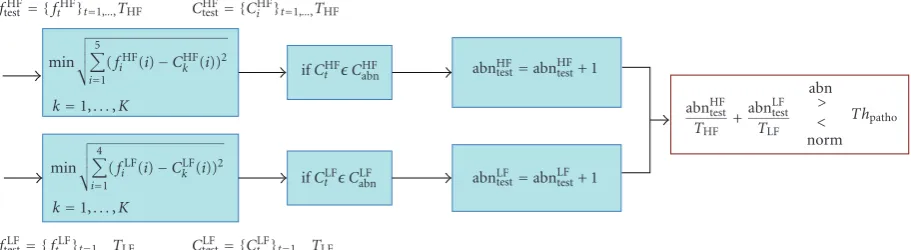
5.3. Classification. As it is shown in Figure 1, once the features are extracted, we feed them into a pattern classifier, which consists of a training and a testing stage.
fHF
test = {ftHF}t=1,...,THF CHFtest= {CHFi }t=1,...,THF
ifCHFt CHFabn
ifCLF t CLFabn
min 5
i=1
(fiHF(i)−CkHF(i))2
min 4
i=1
(fiLF(i)−CLFk (i))2 k=1,. . .,K
k=1,. . .,K fLF
test= {ftLF}t=1,...,TLF CLFtest= {CLFt }t=1,...,TLF
abnHF
test=abnHFtest+ 1
abnLF
test=abnLFtest+ 1
abnHFtest
THF +
abnLFtest
TLF
abn
> <
norm
Thpatho
Figure4: The block diagram of the test stage.
K-means clustering is one of the simplest unsupervised learning algorithms. The method starts with an initial random centroids, and it iteratively classifies a given data set into a certain number of clusters (K) by minimizing the squared Euclidean distance of the samples in each cluster to the centroid of that cluster. For each cluster, the centroid is the mean of the points in that clusterCi.
Since separate features are extracted for LF and HF components, we have to train a separate classifier for each group:CLFandCHFfor LF and HF components, respectively.
Once the clusters are estimated, we count the number of abnormality feature vectors in each cluster, and the cluster with a majority of abnormal points is labeled as abnormal clusters; otherwise, the cluster is labeled as normal
Ck∈
⎧ ⎪ ⎨ ⎪ ⎩
Abnormality, if fCk
abn> α
fCk
n ,
Normality, if fCk
abn< α
fCk
n ,
(23)
wherefCk
abnand
fCk
n are the total number of abnormality
and normality features in the cluster Ck, respectively. We found the value ofαequal to 1.2 to be a proper choice for this threshold.
In (23), we choose the classes that represent the abnor-mality in the speech. The equation distinguishes a cluster as abnormal if the number of the features estimated from the pathological voice is more than features derived from the normal speech. The abnormality clusters are denoted asCLFabn
andCHFabnfor LF and HF groups, respectively.
5.3.2. Testing Stage. In this stage, we test the trained classifier. For a voice sample, we find the nearest cluster to each of its feature vectors using Euclidean distance criterion. If the number of the feature vectors that belong to the abnormality clusters is dominant, the voice sample is classified as a pathological voice; otherwise, it is classified as a normal speech.
Figure 4 demonstrates the testing stage. fLF
Test and fTestHF
feature vectors are derived from the base and coefficient vectors in LF and HF groups, respectively. For each feature vector, we find the closest cluster,Ck0, as given in
fLF
t ∈CkLF0 ifk0=k=min1,...,K
4
i=1
fLF
t (i)−CkLF(i)
2
,
t=1,. . .,TLF,
fHF
t ∈CHFk0 ifk0=k=min1,...,K
5
i=1
fHF
t (i)−CHFk (i)
2
,
t=1,. . .,THF,
(24)
whereftLFandftHFare the input feature vectors, andTHFand TLFare the total numbers of test feature vectors for HF and
LF components, respectively.
Next, the number of all the features that belong to abnormal and normal clusters is calculated
if CLF
k0 ∈C
LF
abn=⇒abnLFtest=abnLFtest+ 1,
if CHF
k0 ∈C
HF
abn=⇒abnHFtest=abnHFtest+ 1,
(25)
where abnLF
test and abnHFtest are the numbers of all the feature
vectors of LF and HF groups that belong to an abnormal cluster. The signal is classified as normal if
Labnormality< Thpatho, (26)
whereThpathois the abnormality threshold, andLabnormalityis
the number of the abnormality features in the voice sample:
Labnormality=
abnLF test TLF
+abn
HF test THF
. (27)
5 10 15
NP
E
50 100 150 200
Iteration (a)
5 10 15
NP
E
50 100 150 200
Iteration (b)
Figure5: The normalized projected energy (NPE) at each iteration is plotted for one normal (a) and one pathological signal (b). As it can be observed in this figure, most of the coherent structure of the signal is projected before 100 iterations, and the remaining energy is negligible.
6. Results
The proposed methodology was applied to the Massachusetts Eye and Ear Infirmary (MEEI) voice disorders database, dis-tributed by Kay Elemetrics Corporation [20]. The database consists of 51 normal and 161 pathological speakers whose disorders spanned a variety of organic, neurological, trau-matic, and psychogenic factors. The speech signal is sampled at 25 kHz and quantized at a resolution of 16 bits/sample. In this paper, 25 abnormal and 25 normal signals were used to train the classifier.
MP-TFD with Gabor atoms is estimated for each 80 ms of the signal. Gabor atoms provide optimal TF resolution in the TF plane and have been commonly used in MP-TFD. To acquire the required iterations (I) in the MP decomposition, we calculate the energy of the projected signal at each iteration,Rix,gγ
i in (A.2).Figure 5illustrates
the mean of the projected energy per iteration for one normal and one pathological signal. As evident in this figure, most of the coherent structure of the signal is projected before 100 iterations. Therefore, in this paper, MP-TFD is constructed using the first 100 iterations and the remaining energy is ignored. As explained inSection 3.1, the Adaptive TFD is constructed by performing MCE iterations to the estimated MP-TFD. It can be shown that after 5 iterations, the constructed TFD satisfies the marginal criteria in (5).
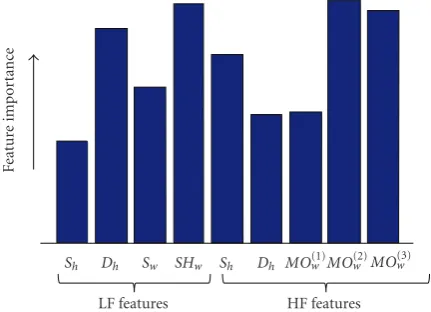
Next, we apply NMF-MD with base number ofr = 15 to each TF matrix and estimate the base and coefficient matrices,W andH, respectively. Each base vector is catego-rized into either LF or HF group a base vector is grouped as LF component if its energy is concentrated more in the frequency range of 4 kHz or less; otherwise, it is grouped as HF component. We extract 4 features (Sh,Dh,Sw,SHw) from each LF base vectorwand its coefficient vectorh, and 5 features (Sh,Dh,MO(1)w ,MO(2)w ,MO(3)w ) from each HF base
Sh Dh Sw SHw Sh Dh MO(1)w MO(2)w MO(3)w
LF features HF features
Fe
at
u
re
im
p
o
rt
an
ce
Figure6: The relative height of each feature represents the relative importance of the feature compared to the other features.
vector and its coefficient vector. In order to obtain the role of each feature in the classification accuracy, we calculate the
P-value of each feature using the Student’st-test. The feature with the smallestP-value plays the most important role in the classification accuracy.Figure 6demonstrates the relative importance of each 9 features. As shown in this figure, Dh
andSHw from LF features, andSh,MO(2)w andMO(3)w from
HF features play the most significant role in the classification accuracy.
Finally, we apply the K-means clustering to the logarithm of the derived feature vectors, and define the abnormality clusters. Figures7illustrates the application of the proposed methodology for a pathological voice sample which is shown inFigure 7(a). As explained inSection 5.3, the test procedure determines the feature vectors that belong to the abnor-mality clusters. We use the base and coefficient matrices,
Wabn andHabn, corresponding to the abnormality feature
vectors to reconstruct the abnormality TF matrix,Vabn, as Vabn = WabnHabn.Figure 7(b)depicts the reconstructed TF
matrix. As it is expected, the proposed method successfully distinguishes transients, high frequency components, and week formants as abnormality.
In the test stage, the trained classifier is used to calculate the measure of abnormality (Labnormality in (27)) for each
voice sample.Figure 8 shows the abnormality measure for 51 normal and 161 pathological speech signals in MEEI database. As evident in this figure, the pathological samples have higher abnormality measure compared to the normal samples. Each signal is classified as normal if its abnormality measure is smaller than a threshold (Thpatho in (26));
otherwise it is classified as pathological. In order to find the abnormality threshold, receiver operating curves (ROCs) of Labnormality are computed with the area under the curve
indicating relative abnormality detection (Figure 9). Based on the ROC, the cut point of 0.59 is chosen as the abnormality threshold (Thpatho =0.59). Table 1 shows the
0.05 0.1 0.15 0.2 0.25 0.3 0.35 0.4 0.45 0.5
N
o
rmaliz
ed
fr
eq
ue
ncy
10 20 30 40 50 60 70 80
Time (ms) (a) TFD of a pathological speech
0.05 0.1 0.15 0.2 0.25 0.3 0.35 0.4 0.45 0.5
N
o
rmaliz
ed
fr
eq
ue
ncy
0.01 0.02 0.03 0.04 0.05 0.06 0.07 0.08 Time (ms)
(b) TFD of the estimated abnormality
Figure7: The classifier ofFigure 4is applied to the TF matrix of a pathological speech shown in (a), and the estimated abnormality TF matrix is shown in (b) . As evident in this figure, the abnormality components are mainly transients, high frequency components, and week formants.
as pathological and only 2 were misclassified as normal. The total classification accuracy is 98.6%. As it can be concluded from the result, the extracted features successfully discriminate the abnormality region in the speech.
InFigure 9andTable 1, we utilized MD with decomposi-tion order (r) of 15. We repeated the proposed method using different decomposition orders. Our experiment showed that the decomposition order of 5 and higher is suitable for our application. Table 2 shows the P-values of three decomposition orders obtained with the Student’st-test.
As explained inSection 2, our proposed feature extrac-tion methodology performs a longer term modeling com-pared to the current methods. The pathological speech classification is conventionally performed on 10–30 ms of signal. At sampling frequency of 8 kHz, the number of sample is 80–240 samples per segment. In this paper, we
0 2 4 6 8
A
b
nor
m
alit
y
m
easur
e
50 100 150
Voice sample Pathological
Normal
Figure 8: For each voice sample, the number of the feature vectors that belong to an abnormality cluster is calculated, and the abnormality measure is calculated as the ratio of the total number of the abnormal feature vectors to the total number of feature vectors in the voice sample.
0 0.2 0.4 0.6 0.8 1
Se
nsti
vi
ty
0 0.2 0.4 0.6 0.8 1 1-Specificity
ROC curve
Figure9: Receiver operating curve for the pathological voice classi-fication is plotted. In this analysis, pathological speech is considered negative, and normal is considered positive. The area under the ROC is 0.999, and the maximum sensitivity for pathological speech detection while preserving 100% specificity is 98.1%.
Table1: Classification result.
Classes Normal Abnormal Total
Normal 50 1 51
Pathological 2 159 161
Normal 98.0% 2.0% 100%
Pathological 1.2% 98.8% 100%
Table 2:P-value of the classifiers obtained with three different
decomposition orders.
Decomposition order (r) 5 10 15
P-value 3×10⁻¹⁰ 1×10⁻¹¹ 1×10⁻¹³
remaining part represents the random noise presented in the signal. Hence, we perform an automatically denoising on the signal which allows the technique to be practical in the low SNR speech signals. (2) In this method, we reconstruct the TF matrix of the abnormality part of the signal, and we estimate the amount of abnormality in the speech signal. The reconstructed TF matrix and the abnormality measure have potential to be used as a patients’ progress measure over the course of voice therapy. (3) In this work, we use a very simple classifier rather than a complex classifier, such as hidden Markov models or neural networks.
7. Conclusion
TF analysis are effective for revealing non-stationary aspects of signals such as trends, discontinuities, and repeated patterns where other signal processing approaches fail or are not as effective; however, most of the TF analysis are restricted to visualization of TFDs and do not focus on quantification or parametrization that are essential for feature analysis and pattern classification.
In this paper, we presented a joint TF and MD feature extraction approach for pathological voice classification. The proposed methodology extracts meaningful speech features that are difficult to be captured by other means. TF features are extracted from a positive TFD that satisfies the marginal conditions and can be considered as a true joint distribution of time and frequency. The utilized TFD is a segment free TF approach, and it provides a high-resolution and cross-term free TFD.
The TF matrix was decomposed into its base (spectral) and coefficient (temporal) vectors using nonnegative matrix factorization (NMF) method. Four features were extracted from the components with low frequency structure, and five features were derived from the bases with high frequency composition. The features were extracted from the decom-posed vectors based on the spectral and temporal character-istics of the normal and pathological signals. In this study, we performed K-means clustering to the proposed feature vectors, and we achieved an accuracy rate of 98.6% for the MEEI voice disorders database, including 161 pathological and 51 normal speakers.
Appendices
A. Matching Pursuit TFD
Matching pursuit (MP) was proposed by Mallat and Zhang [21] in 1993 to decompose a signal into Gabor atoms,gγi,
with a wide variety of modulated frequency (fi) and phase (φi), time shift (pi) and duration (si) as shown in
gγi(t)=
1
√sig t−pi si
!
exp"j 2 π fit+φi#, (A.1)
whereγi represents the set of parameters (si,pi,fi,φi). The MP dictionary is consisted of Gabor atoms with durations (si) varying from 2 samples toN(length of the signalx(t)), and it therefore is a very flexible technique for non-stationary signal representation. At each iteration, the MP algorithm chooses the Gabor atom that best fits to the input signal. Therefore, after I iterations, MP procedure chooses the Gabor atoms that best fit to the signal structure without any preassumption about the signal’s stationarity. Components with long stationarity properties will be represented by long Gabor atoms, and transients will be characterized by short Gabor atoms.
At each iteration, MP projects the signal into a set of TF atoms as follows:
x(t)=
I−1
i=0
$ Rix,gγi
%
gγi(t) +R
I
x, (A.2)
where Ri
x,gγi is the expansion coefficient on atom gγi(t),
andRI
xis the decomposition residue afterIdecomposition.
At this stage, the selected components represent coherent structures and the residue represents incoherent structures in the signal. The residue may be assumed to be due to random noise, since it does not show any TF localization. Therefore, the decomposition residue in (A.2) is ignored, and the Wigner-Ville distribution (WVD) of eachIcomponents is added in the following:
V t,f=
I−1
i=0
$Rix,gγi
%2
Wgγi t,f
, (A.3)
where Wgγi(t,f) is the WVD of the Gabor atom gγi(t),
B. Analysis of sharpness feature
In order to demonstrate the behavior of feature SHw, we assume that the base vector, wi, has two components at frequencies samples m1 and m2 with energies of α andβ,
respectively
wi(m)=αδ(m−m1) +βδ(m−m2), (B.1)
|W(ν)|(21) is calculated as
|W(ν)| =α2+β2+ 2αβcos (2π(m1−m2)ν). (B.2)
|W(ν)|is independent to the parameterνonly whenm1 ≈ m2, or when the energy ratio of the components in (B.1) is
too small (eitherβ/α≈0 orα/β≈0). In this case, when we calculate the Fourier transform of|W(ν)|as shown in (21),
|W(κ)|is non-zero only at small values of κ(sayκ < m0,
wherem0is a small number). Hence,SHwias it is calculated
in (22) results in a small feature. From the other side,|W(ν)|
is dependent on the parameterνwhen both the components in (B.1) are strong (β/α≈R,R /=0). In this case, the Fourier transform of|W(ν)|is not negligible atκ > m0, andSHwi
results in lager values.
From the above explanation, we conclude that the small values ofSHwirepresent pathological formants, in which the
components’ energies are very small compared to the energy of the main frequency (β/α≈ 0 orα/β ≈0), and the large values ofSHwi show the strong formants in speech (β/α ≈
R,R /=0).
References
[1] R. T. Sataloff,Professional Voice: The Science and Art of Clinical Care, Raven Press, New York, NY, USA, 1991.
[2] P. Carding and A. Wade, “Managing dysphonia caused by misuse and abuse,”British Medical Journal, vol. 321, pp. 1544– 1545, 2000.
[3] E. J. Wallen and J. H. L. Hansen, “A screening test for speech pathology assessment using objective quality measures,” in
Proceedings of International Conference on Spoken Language Processing (ICSLP ’96), vol. 2, pp. 776–779, Philadelphia, Pa, USA, October 1996.
[4] R. J. Moran, R. B. Reilly, P. de Chazal, and P. D. Lacy, “Telephony-based voice pathology assessment using auto-mated speech analysis,” IEEE Transactions on Biomedical Engineering, vol. 53, no. 3, pp. 468–477, 2006.
[5] T. Ananthakrishna, K. Shama, and U. C. Niranjan, “k-means nearest neighbor classifier for voice pathology,” inProceedings of the IEEE India Conference INDICON, pp. 352–354, Indian Institute of Technology, Kharagpur, India, 2004.
[6] A. A. Dibazar, S. Narayanan, and T. W. Berger, “Feature analysis for automatic detection of pathological speech,” in
Proceedings of Annual International Conference of the IEEE Engineering in Medicine and Biology (EMBS ’02), vol. 1, pp. 182–183, Houston, Tex, USA, 2002.
[7] J. I. Godino-Llorente and P. G ´omez-Vilda, “Automatic detec-tion of voice impairments by means of short-term cepstral parameters and neural network based detectors,”IEEE Trans-actions on Biomedical Engineering, vol. 51, no. 2, pp. 380–384, 2004.
[8] A. Gelzinis, A. Verikas, and M. Bacauskiene, “Automated speech analysis applied to laryngeal disease categorization,”
Computer Methods and Programs in Biomedicine, vol. 91, no. 1, pp. 36–47, 2008.
[9] N. S´aenz-Lech ´on, J. I. Godino-Llorente, V. Osma-Ruiz, and P. G ´omez-Vilda, “Methodological issues in the development of automatic systems for voice pathology detection,”Biomedical Signal Processing and Control, vol. 1, no. 2, pp. 120–128, 2006. [10] V. Parsa and D. G. Jamieson, “Identification of pathological voices using glottal noise measures,”Journal of Speech, Lan-guage, and Hearing Research, vol. 43, no. 2, pp. 469–485, 2000. [11] K. Umapathy, S. Krishnan, V. Parsa, and D. G. Jamieson, “Discrimination of pathological voices using a time-frequency approach,”IEEE Transactions on Biomedical Engineering, vol. 52, no. 3, pp. 421–430, 2005.
[12] F. Auger and P. Flandrin, “Improving the readability of time-frequency and time-scale representations by the reassignment method,”IEEE Transactions on Signal Processing, vol. 43, no. 5, pp. 1068–1089, 1995.
[13] L. Cohen and T. E. Posch, “Positive time-frequency distribu-tion funcdistribu-tions,”IEEE Transactions on Acoustics, Speech, and Signal Processing, vol. 33, no. 1, pp. 31–38, 1985.
[14] S. Krishnan, R. M. Rangayyan, G. D. Bell, and C. B. Frank, “Adaptive time-frequency analysis of knee joint vibroarthro-graphic signals for noninvasive screening of articular cartilage pathology,”IEEE Transactions on Biomedical Engineering, vol. 47, no. 6, pp. 773–783, 2000.
[15] B. Ghoraani and S. Krishnan, “Quantification and localiza-tion of features in time-frequency plane,” inProceedings of Canadian Conference on Electrical and Computer Engineering (CCECE ’08), pp. 1207–1210, May 2008.
[16] D. D. Lee and H. S. Seung, “Algorithms for non-negative matrix factorization,” in Proceedings of the Conference on Advances in Neural Information Processing Systems (NIPS ’01), pp. 556–562, 2001.
[17] M. W. Berry, M. Browne, A. N. Langville, V. P. Pauca, and R. J. Plemmons, “Algorithms and applications for approximate nonnegative matrix factorization,” Computational Statistics and Data Analysis, vol. 52, no. 1, pp. 155–173, 2007.
[18] C.-J. Lin, “Projected gradient methods for nonnegative matrix factorization,”Neural Computation, vol. 19, no. 10, pp. 2756– 2779, 2007.
[19] P. O. Hoyer, “Non-negative matrix factorization with sparse-ness constraints,”Journal of Machine Learning Research, vol. 5, pp. 1457–1469, 2004.
[20] M. Eye and E. Infirmary, Voice Disorders Database, Version 1.03, Kay Elemetrics Corporation, Lincoln Park, NJ, USA, 1994.