Volume 2007, Article ID 84956,11pages doi:10.1155/2007/84956
Research Article
Analysis of Adaptive Interference Cancellation Using
Common-Mode Information in Wireline Communications
Thomas Magesacher, Per ¨Odling, and Per Ola B ¨orjesson
Department of Information Technology, Lund University, P.O. Box 118, 22100 Lund, Sweden
Received 4 September 2006; Accepted 1 June 2007
Recommended by Ricardo Merched
Joint processing of common-mode (CM) and differential-mode (DM) signals in wireline transmission can yield significant im-provements in terms of throughput compared to using only the DM signal. Recent work proposed the employment of an adap-tive CM-reference-based interference canceller and reported performance improvements based on simulation results. This paper presents a thorough investigation of the cancellation approach. A subchannel model of the CM-aided wireline channel is presented and the Wiener solutions for different adaptation strategies are derived. It is shown that a canceller, whose coefficients are adapted while the far-end transmitter is silent, yields a signal-to-noise power ratio (SNR) that is higher than the SNR at the DM channel output for a large class of practically relevant cases. Adaptation while the useful far-end signal is present yields a front-end whose output SNR is considerably lower compared to the SNR of the DM channel output. The results are illustrated by simulations based on channel measurement data.
Copyright © 2007 Thomas Magesacher et al. This is an open access article distributed under the Creative Commons Attribution License, which permits unrestricted use, distribution, and reproduction in any medium, provided the original work is properly cited.
1. INTRODUCTION
Transmission of information over copper cables is conven-tionally carried out by differential signalling. On physical-layer level, this corresponds to the application of a voltage between the two wires of a pair. The signal at the receive side is derived from the voltage measured between the two wires. Differential-mode (DM) signalling over twisted-wire pairs, originally patented by Bell more than hundred years ago [1], exhibits a high degree of immunity against ingress of un-wanted interference, caused, for example, by radio transmit-ters (radio frequency interference) or by data transmission in neighboring pairs (crosstalk) [2]. The inherent immunity of a cable against ingress decays with frequency. In fact, the performance of almost all high data-rate (and thus also high-bandwidth consuming) digital subscriber line (DSL) systems is limited by crosstalk.
The number of strong crosstalk sources is often very low—one, two or three dominant crosstalkers significantly raise the crosstalk level and thus reduce the performance on the pair under consideration. In such cases, it is beneficial to exploit the common-mode (CM) signal, which is the sig-nal corresponding to the arithmetic mean of the two voltages measured between each wire and earth, at the receive side
[3–5]. The CM signal and the DM signal of a twisted-wire pair are strongly correlated. Exploiting the CM signal in ad-dition to the DM signal yields a new channel whose capacity can be, depending on the scenario, up to about three times higher than the conventional DM-only channel capacity [3]. The large benefit is achieved for exactly those scenarios that are challenged by strong interference. The additional receive signal yields an additional degree of freedom, which can be exploited to mitigate interference.
This paper investigates the receiver front-end for CM-aided wireline transmission. Independent work proposed the use of an interference canceller consisting of a linear adap-tive filter fed by the CM signal [6,7]. Adaptive processing of correlated receive signals bears the potential danger of can-celling the useful component. Despite the performance im-provements reported in [6,7], it is a priori not clear whether this kind of adaptive interference cancellation is beneficial or counterproductive.
In Section 4, the maximum likelihood (ML) estimator of the transmit signal is derived. The ML estimator suggests a receiver front-end which has the structure of a linear inter-ference canceller with coefficients adjusted so that the signal-to-noise power ratio (SNR) at the canceller output is max-imised. The performance of adaptive cancellation is analysed by means of Wiener filter solutions.Section 5illustrates the results through performance simulations based on channel measurements.Section 6concludes the work.
2. SYSTEM MODEL
The wireline channel can be modelled as a linear stationary Gaussian channel with memory and coloured interference (correlated in time). In general, interference originates from an arbitrary number S of sources, which typically model far-end crosstalk (FEXT) and near-end crosstalk (NEXT) in a multipair cable [2]. We choose to model the channel in frequency domain for two reasons. First, frequency-domain modelling yields valuable insights and supports a simple analysis based on subchannels. Second, a frequency-domain model is the natural choice considering that most modern wireline systems are based on multicarrier modulation. The application of the suggested subchannel interference can-celler in multicarrier systems is thus straightforward.
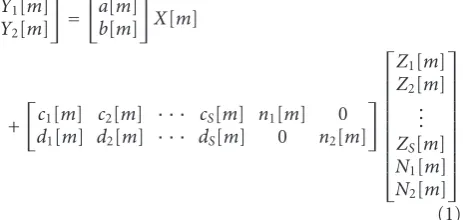
The DM outputY1[m] and the CM outputY2[m] of a
twisted-wire pair at themth subchannel can be written as
Y1[m]
Y2[m]
=
a[m]
b[m]
X[m]
+
c1[m] c2[m] · · · cS[m] n1[m] 0
d1[m] d2[m] · · · dS[m] 0 n2[m]
⎡ ⎢ ⎢ ⎢ ⎢ ⎢ ⎢ ⎢ ⎢ ⎢ ⎣
Z1[m]
Z2[m]
.. .
ZS[m]
N1[m]
N2[m]
⎤ ⎥ ⎥ ⎥ ⎥ ⎥ ⎥ ⎥ ⎥ ⎥ ⎦
(1) for 0≤m≤M−1, whereMis the number of subchannels. The choice ofMmay be influenced by the parameters of the wireline system the interference canceller is applied to. An obvious choice forMis the system’s number of tones. Here-inafter, we omit the subchannel indexmwherever possible for the sake of simple notation.X,N1,N2, andZi, 1≤i≤S,
are mutually independent, zero-mean, unit-variance, com-plex, circularly symmetric Gaussian random variables.X is the far-end transmit signal. N1 andN2 model background
noise present at the wire-pair’s output ports of DM and CM, respectively. TheSinterference sources are modelled byZi,
1≤i≤S.
The complex coefficientsa ∈ Candb ∈ Cmodel the coupling from the far-end DM port to the DM port and to the CM port, respectively. The coefficientsci∈Canddi∈C
model the coupling from theith interference source to the DM port and to the CM port, respectively. The coefficients
n1 ∈ Candn2 ∈Cscale and colour the background noise
present at the DM port and at the CM port, respectively. Figure 1depicts a block diagram of this frequency-domain
N1 N2
n1 n2
X a + Y1 + Y(k)
b + Y2 k
c1 c2 · · ·cS d1 d2 · · ·dS · · · .
. . · · · · · ·
Z1 Z2 ZS Subchannel Canceller Figure1: Model of the subchannel (1) and the corresponding scalar linear interference canceller (8).
model, which allows us to continue the analysis on subchan-nel level.
3. CHANNEL PROPERTIES
Based on cable models [2,8] and on experience from mea-surements [4,9], we observe that a large number of prac-tically relevant scenarios obey the following conditions (|·| denotes absolute value):
Assumption 1. |a|( |α) ci|
(β)
≈ |b|(≈ |γ) dj|
(δ) |n2|
()
≈ |n1|, i,j ∈ {1,. . .,S}.
For FEXT, (α) always holds since the model for the FEXT coupling function includes scaling by the insertion loss of the line. For NEXT, in systems with overlapping frequency bands for upstream and downstream, (α) does not necessarily hold for long loops and/or high frequencies since, at least accord-ing to the ETSI model [8], the NEXT couplaccord-ing function is not scaled by the insertion loss and is thus independent of the loop length. Consequently, the level of the receive signal power spectral density (PSD) on long loops may be lower than the NEXT PSD level. Most high-bandwidth consuming DSLs, however, employ frequency division duplexing and are thus only vulnerable to alien NEXT, that is, NEXT from sys-tems of different types, and “out-of-band self-NEXT,” that is, NEXT caused by the out-of-band transmit signals of sys-tems of the same type. Alien NEXT is often taken care of by spectral management. Self-NEXT is usually negligible due to out-of-band spectral masks. The CM-related assumptions (β) and (γ) are mainly based on measurement experience [4,9]. While (δ) always holds for NEXT, it may not be true for FEXT on long loops, where the FEXT PSD level may lie below the PSD level of the background noise due to the loop attenuation. Assumption () states that the CM background noise level is of the same order of magnitude as the DM back-ground noise level.
0 −10 −20 −30 −40 −50 −60 −70 −80 −90
M
ag
nitude
(dB)
5 10 15 20 25
Frequency (MHz) |a|
|b| |c|
|d| |n1| = |n2|
Figure 2: Channel propertiesa, b,c, dobtained from measure-ments. The y-axis denotes relative magnitude in dB (the raw re-sults are normalised by the magnitude of the largesta-value). As-suming a VDSL transmit PSD of−60 dBm/Hz results in a level of −80 dB forn1andn2in order to obtain a background-noise PSD of −140 dBm/Hz, which is the level suggested in standardisation doc-uments [8,10].
pairs are extremely short, the crosstalk PSD levels are very low and consequently (β) does not hold. In case the pairs are extremely long, both the crosstalk PSD levels and the re-ceive signal PSD levels are very low, which may lead to nei-ther (α) nor (β) being true. Cases with extreme lengths (short or long) are of little practical interest, since extremely short loops are not found in the field and extremely long loops are out of scope for high-bandwidth consuming DSL techniques. Care should be taken with near/far scenarios for which (α) does not necessarily hold since the useful signal is severely attenuated while the crosstalk is strong.
Figure 2shows exemplary channel transfer and coupling functions based on measurements [4]. The magnitude val-ues are normalised by the magnitude of the largest mea-surement result for the transfer function. Assuming a VDSL transmit PSD of−60 dBm/Hz and a background-noise PSD of−140 dBm/Hz, which is the level suggested in standardi-sation documents [8,10], results in a level of−80 dB forn1
andn2.Assumption 1holds over nearly the whole frequency
range for the channel measurements depicted inFigure 2.
4. ANALYSIS
4.1. Maximum likelihood (ML) estimator
The linear Gaussian model (1) of a subchannel can be written as
Y1
Y2
=Y
=
a b
=H
X+V, (2)
where the vectorVcontains both noise and interference. The covariance matrixCvofVis given by
Cv=E
VVH=H
vHHv, Hv=
c1 c2 · · · cS n1 0
d1 d2 · · · dS 0 n2
, (3) where E(·) and·Hdenote expectation and Hermitian
trans-pose, respectively. Note thata,b,c,d,n1, andn2are
complex-valued. The ML estimator ofXis defined as [11]
X=arg max
X f(Y|X), (4)
where f(Y|X) denotes the likelihood ofX(probability den-sity function ofY givenX). For the linear Gaussian model (2), the ML estimator can be written as [11]
X=HHC−1 v H
−1
HHC−1
v Y. (5)
Inserting (2) and (3) into (5) followed by mostly straightfor-ward calculus yields
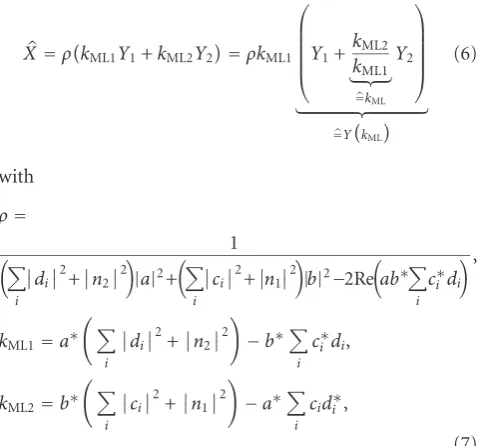
X=ρkML1Y1+kML2Y2
=ρkML1
⎛ ⎜ ⎜ ⎜ ⎜
⎝Y1+
kML2
kML1
=kML
Y2
⎞ ⎟ ⎟ ⎟ ⎟ ⎠
=YkML
(6)
with
ρ=
1
i
di2
+n2 2
|a|2+
i
ci2
+n1 2
|b|2−2Re
ab∗
i
c∗idi
,
kML1=a∗
i
di2
+n22
−b∗
i
c∗idi,
kML2=b∗
i
ci2
+n12
−a∗
i
cid∗i ,
(7) where Re(·) and·∗denote real part and complex conjugate, respectively.
The ML solution (6) suggests a linear combination ofY1
andY2as estimator, which essentially corresponds to linear
interference cancellation depicted inFigure 1and described by
Y(k)=Y1+kY2. (8)
Choosing k = kML = kML2/kML1 and applying the scaling
factorρkML1to the output of the canceller realises the ML
solution. The mutual information betweenX and canceller outputY(k), when the subchannel canceller is adjusted to the coefficientk, can be written as [12]
where the subchannel SNR at the canceller output is given by
SNR(k)= |a+bk|2 ici+dik
2
+n1 2
+n2k
2. (10)
Note that kML is the interference canceller coefficient for
which the mutual information I(X;Y(kML)) is maximised.
Furthermore, I(X;Y(kML)) is equal to the mutual
informa-tion I(X;Y1,Y2) of the transmit signalXand the receive
sig-nal pair (Y1,Y2). In other words, the ML-based canceller
pre-serves all the information contained in the two channel out-put signals.
4.2. Steady-state performance of adaptive cancellation
CM-aided reception can be applied in autonomous receivers and does not require cooperation with receivers of adjacent lines. Thus, CM-aided reception can be used to complement or enhance level-2 or level-3 dynamic spectrum management proposals [13], which rely on colocated receivers. Unlike in many other applications, the ML receiver is not too complex for implementation; however, it requires perfect knowledge of the channel and of the statistics of noise and interference. Since this knowledge is often not available, receiver struc-tures that operate without any kind of side information are of great practical importance. In the following, the suitability of adaptive cancellation schemes based on a squared error cri-terion is investigated. Popular examples of such schemes are the least-mean square (LMS) and the recursive least squares (RLS) algorithm. In a stationary environment, these algo-rithms can be parametrised in such a way that they converge towards the Wiener filter solution [14].
In general, the Wiener filter minimises the cost func-tion defined as the mean of the squared error. In our setup, this corresponds to minimising the energy of the interference canceller’s output signalY(k) given by (8) with respect tok. The Wiener filter solutionkWis defined by [14]
kW=arg min
k E
Y(k)2
. (11)
For our interference canceller model (8), the Wiener filter can be expressed as (cf.Appendix A)
kW= −
EY1Y2∗
EY2Y2∗
. (12)
In the following, we distinguish between the Wiener filter so-lutionkW1obtained forX=0 and the Wiener filter solution
kW2obtained forX =0. Inserting (2) and (3) into (12), we
obtain
kW1= −
EY1Y2∗)
EY2Y2∗
= − ab∗+
icid∗i |b|2+
idi
2
+n2
2, (13)
which is the solution a properly parameterised algorithm converges to when the coefficients are adapted while the use-ful transmit signal is present. ForX=0, we obtain
kW2=arg min
k E
Y(k)2
X=0
= −E
Y1Y2∗
EY2Y2∗
X=0
= −
icidi∗
idi2+n22
,
(14)
which is the solution a properly parameterised algorithm converges to when the coefficients are adapted while there is no useful transmit signal.
As a reference when assessing the performance of adap-tive algorithms, we will use the mutual information between
XandY1, which can be written as
IX;Y1
=log1 + SNRDM
, (15)
where the DM-subchannel SNR is given by
SNRDM= |a| 2
ici
2
+n1
2. (16)
4.3. Implications ofAssumption 1on the steady-state performance of adaptive cancellation
UnderAssumption 1, it can be shown that the following two propositions hold. Instead of proofs, which are merely tech-nical (cf.Appendix B), we provide here motivations for the propositions, which are more insightful and simple to follow.
Proposition 1. Under the conditions defined inAssumption 1, the following inequality holds:
IX[m];YkW1[m]
≤IX[m];Y1[m]
, 0≤m≤M−1.
(17) In other words, in each subchannel, the SNR of the output
Y(kW1)of a linear interference canceller with tap settingkW1
given by(13)is lower than the SNR ofY1.
Motivation
Since the strongest component inY1stems fromX, there is
a mechanism driving the canceller coefficient towards−a/b, which is the coefficient that eliminatesX(note that|a/b|
1). Since increasing|k|increases the residual ofZ inY(k), there is a counter mechanism working against large values of
|k|. These two mechanisms reach an equilibrium for the so-lution given by (13). As a net result, the power ofXinY(kW1)
is reduced (compared to Y1), which implies |kW1| 1.
However, the larger |kW1|, the higher the power of theZ
-component inY(kW1). More precisely, for anykW1that
ful-fils|kW1| > 2, the power of theZ-component inY(kW1) is
higher than inY1. To summarise, while the power of theX
-component is lower inY(kW1) than inY1, the power of the
Z-component is higher inY(kW1) than inY1, which confirms
Remark 1. In case there is no dominant interferenceZ, which corresponds in our setting toc = d = 0, adaptation while
X=0 yieldskW1≈ −a/b, which essentially eliminatesX. Proposition 2. Under the conditions defined inAssumption 1, the following inequality holds:
IX[m];YkW2[m]
≥IX[m];Y1[m]
, 0≤m≤M−1.
(18) In other words, in each subchannel, the SNR of the output
Y(kW2)of a linear interference canceller with tap settingkW2
given by(14)is higher than the SNR ofY1.
Motivation
When the far-end transmitter is silent (X=0), the strongest component inY1stems fromZ. Then, the Wiener filter
so-lution is close to−c/d(the exact solution is given by (14)), which essentially eliminatesZ. Since|kW2| ≈ |c/d| ≈1, the
power of theN2-component inY(kW2) remains negligible. A
lower and an upper bound on the signal energy (i.e., energy ofX) contained in Y(kW2) are|a|2− |b|2 and|a|2+|b|2,
respectively. Consequently, the front-end causes a negligible reduction of signal power (|b| |a|) while essentially elimi-nating the interference. Thus, its performance is close to that of the ML estimator. The proof ofProposition 2is given in Appendix B.
Remark 2. In case there is no dominant interferenceZ(c=
d=0), adaptation withX=0 yieldskW2=0, which is close
to the ML solutionb∗|n1|2/a∗|n2|2.
The conclusion drawn from Propositions 1 and 2 for a typical wireline scenario (typical in the sense that Assumption 1is valid) with one dominant crosstalker is the following: a canceller set to the Wiener filter solution kW2
(i.e., when adaptation is performed while the transmitter is silent) exhibits a higher SNR at the output compared to the DM channel output. Moreover, the performance is close to the ML estimator’s performance. A canceller set to the Wiener filter solutionkW1(i.e., when adaptation is
per-formed while the transmitter is active) exhibits a lower SNR at the canceller output compared to the DM channel output. Note that Propositions1and2hold for the interference-canceller front-end (8) set to the corresponding Wiener-filter solution. The results might not be valid for more advanced receivers that, for example, jointly decode and estimate the channel.
4.4. Impact of coefficient mismatch on steady-state performance
The design of adaptive algorithms that converge to the Wiener filter solution involves a tradeoff between conver-gence time and mismatch. In general, the faster an adap-tive algorithm reaches a steady solution, the larger the de-viation from the desired Wiener filter solution becomes [14]. Hereinafter, we focus on the mismatch of a canceller adapted while X = 0, that is, its mismatch with respect tokW2. In
order to assess the sensitivity of the achieved SNR with re-spect to the mismatch, we quantify this mismatch in terms of the relative deviation of the coefficient’s absolute value. A mismatch of up to 10%, for example, is expressed as
|(k−kW2)/kW2| ≤0.1. We denote the set of coefficients with
a mismatch of up toμas Kμ=
k:k−kW2
/kW2| ≤μ
(19) and the corresponding set of SNR values as SNR(Kμ). The
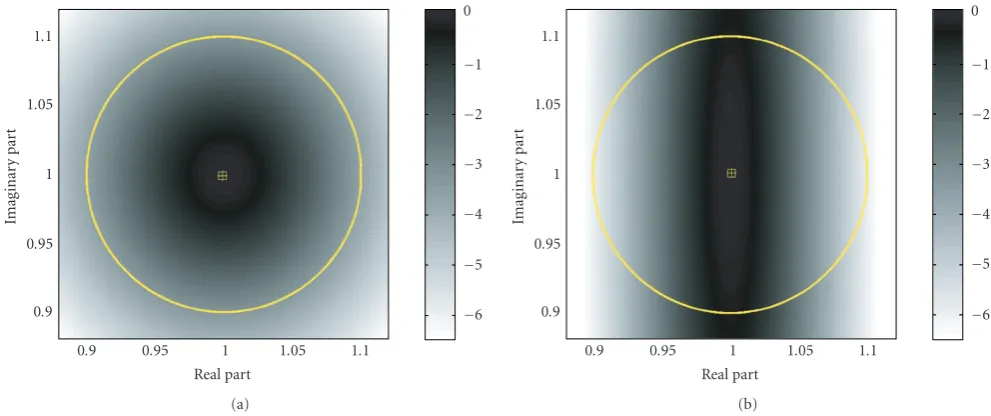
SNR is not necessarily a rotationally symmetric function of real part and imaginary part of k around the peak corre-sponding tokML. The sensitivity of the SNR with respect to
kdepends on the channel coefficients.Figure 3depicts two examples: while the SNR decay is in the same order of mag-nitude for all directions inFigure 3(a), the sensitivity of the SNR along the direction corresponding to the imaginary part is negligible inFigure 3(b). The coefficients in the setKμlie
inside or on the marked circle{k : |(k−kW2)/kW2| = μ}.
The worst-case SNR is obtained for one or more coefficients on the circle. In the examples presented in the following sec-tion, the sensitivity of the performance with respect to the coefficient’s mismatch is quantified in terms of SNR(Kμ).
5. SIMULATION RESULTS
In order to illustrate the implications of the propositions pre-sented in the previous section, we evaluate the performance of adaptive cancellation in terms of the SNR at the canceller output given by (10). For comparison, the SNR of DM-only processing, given by (16), and the SNR of the ML estimator are computed. We considerM=8192 subchannels in the fre-quency range from 3 kHz to 30 MHz. The coupling functions are obtained from cable measurements [4] using the length-adaptation methods suggested in [3].
5.1. Example 1: equal-length FEXT
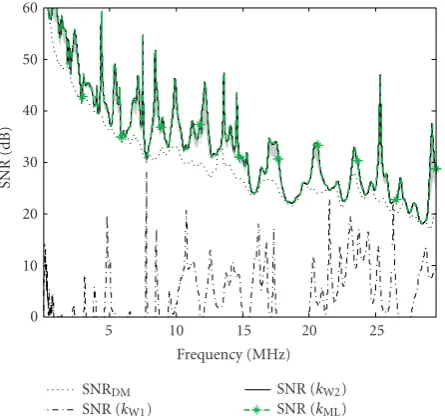
We begin with a transmission scenario over a loop of length 300 m. We assume a flat transmit PSD of−60 dBm/Hz and flat noise PSDs of−140 dBm/Hz at both the CM port and the DM port of the receiver. Furthermore, there is one crosstalk source (S=1) located at the same distance and transmitting with the same PSD as the transmitter. The results for this scenario, depicted in Figure 4, agree with the propositions presented in the previous section. Adaptation in the absence of the far-end signal yields a signal-to-noise ratio SNR(kW2)
that exceeds the signal-to-noise ratio SNRDM achieved by
DM-only processing for virtually the whole frequency range. Moreover, SNR(kW2) is virtually the same as the upper limit
given by SNR(kML). Adaptive interference cancellation
elim-inates the crosstalk almost completely. The resulting SNR is merely limited by the background noise. Consequently, the performance is sensitive to a mismatch of the canceller co-efficients. A mismatch of 10% can result in a performance degradation of up to 8 dB for sensitive subchannels. Adapta-tion in the presence of the far-end signal, on the other hand, yields a signal-to-noise ratio SNR(kW1) that is much lower
1.1
1.05
1
0.95
0.9
Im
ag
inar
y
par
t
0.9 0.95 1 1.05 1.1 Real part
0 −1 −2 −3 −4 −5 −6
(a)
1.1
1.05
1
0.95
0.9
Im
ag
inar
y
par
t
0.9 0.95 1 1.05 1.1 Real part
0 −1 −2 −3 −4 −5 −6
(b)
Figure3: Normalised SNR 10 log10(SNR (k)/SNR (kW2)) in dB as a function of real part and imaginary part ofk/kW2for two different choices of channel coefficientsa,b,c,d,n1,n2. While the SNR decay is in the same order of magnitude for all directions for case (a), the sensitivity of the SNR along the direction corresponding to the imaginary part is negligible for case (b). Coefficients with a mismatch of up to 10%, denoted by the setK0.1, lie inside or on the marked circle. The plus-marker indicateskW2and the square-marker indicateskML.
60 50 40 30 20 10 0
SNR
(dB)
5 10 15 20 25
Frequency (MHz) SNRDM
SNR (kW1)
SNR (kW2) SNR (kML)
Figure4: SNRs of adaptive cancellation compared to processing only the DM signal for a transmission over a loop of 300 m length with one FEXT source (S = 1) located at the same distance and transmitting with the same PSD of −60 dBm/Hz as the far-end transmitter. The background-noise level on both DM port and CM port is−140 dBm/Hz. The grey-shaded area indicates SNR values for coefficient mismatch of up to 10% (SNR(K0.1)).
Figure 5shows the results for a scenario with the same parameters but withS=2 crosstalkers located at a distance of 300 m from our receiver. Both crosstalk sources transmit with the same PSD as the transmitter. On most subchannels, SNR(kW2) exceeds SNRDM. Since the canceller tries to
elim-inate two interference sources with one coefficient, the re-sulting SNR is smaller compared to the case ofS=1. Thus, also the sensitivity of the performance with respect to coeffi -cient mismatch is considerably lower. Adaptation of the can-celler coefficients in the presence of the far-end signal yields SNR (kW1) SNRDM.
Figure 6shows the results forS = 5 FEXT sources. Al-though the improvement of SNR(kW2) compared to SNRDM
is marginal on most subchannels, SNR(kW2) is strictly larger
than SNRDM over the whole frequency range. Due to the
lack of degrees of freedom, the residual interference of the 5 sources is large, which also explains the insensitivity with respect to coefficient mismatch. Adaptation of the canceller coefficients in the presence of the far-end signal is counter-productive, as in the previous two setups.
To conclude, adapting the canceller coefficients in the absence of the far-end signal yields large improvements in terms of SNR. Moreover, operating a canceller with kW2
does not yield a lower SNR than available at the DM out-put. Adaptation in the presence of the far-end signal, on the other hand, yields SNR(kW1) SNRDMand should thus be
avoided.
Typically, the benefit achieved by a canceller set tokW1is
60 50 40 30 20 10 0
SNR
(dB)
5 10 15 20 25
Frequency (MHz) SNRDM
SNR (kW1)
SNR (kW2) SNR (kML)
Figure5: SNRs of adaptive cancellation compared to processing of DM signal only for a transmission over a loop of 300 m length with two FEXT sources (S=2) located at the same distance and trans-mitting with the same PSD of−60 dBm/Hz as the far-end transmit-ter. The background-noise level on both DM port and CM port is −140 dBm/Hz. The grey-shaded area indicates SNR values for coef-ficient mismatch of up to 50% (SNR(K0.5)).
5.2. Example 2: near-far scenario
Another scenario of practical relevance is depicted in Figure 7. We investigate the upstream transmission of cus-tomer A, who is located at a distance of 750 m from the central office. The upstream transmission of customer A is mainly disturbed by strong FEXT caused by the upstream transmission of customer B, who is located at a distance of only 250 m. This scenario represents a near-far problem of-ten encountered in practice. Typically, there are only few cus-tomers located at a very short distance from the central of-fice. The number of customers located at a medium distance is larger. Thus, we introduce customers C and D located at a distance of 750 m from the central office. All transmitters use a transmit PSD of−60 dBm/Hz. A trivial solution to the near-far problem is to reduce the transmit power of customer B—an approach that is referred to as power backoff[15]. While power backoff, applied at the transmitter of customer B, reduces the interference for customer A, it also limits the achievable rate of customer B.
Figure 8depicts the resulting SNRs for the near-far sce-nario. The SNR improvement due to joint DM-CM process-ing is marginal for subchannels below 1 MHz since there is interference of equal strength from several sources, which the canceller cannot eliminate. However, the gain in SNR for subchannels above 1 MHz is large since the interference caused by customer B is dominant. The improvement in this frequency range is valuable since the range overlaps with both the lower (3–5 MHz) and the upper (7–12 MHz) up-stream band of the bandplan referred to as “997-plan,” which
60 50 40 30 20 10 0
SNR
(dB)
5 10 15 20 25
Frequency (MHz) SNRDM
SNR (kW1)
SNR (kW2) SNR (kML)
Figure6: SNRs of adaptive cancellation compared to processing of DM signal only for a transmission over a loop of 300 m length with five FEXT sources (S =5) located at the same distance and trans-mitting with the same PSD of−60 dBm/Hz as the far-end transmit-ter. The background-noise level on both DM port and CM port is −140 dBm/Hz. The grey-shaded area indicates SNR values for coef-ficient mismatch of up to 100% (SNR(K1)).
is widely used for VDSL systems [8]. For subchannels above 7 MHz, adaptive interference cancellation enables SNR val-ues that make transmission practically feasible, which is not the case with DM-only processing. Adaptation of the coeffi-cients in the presence of the far-end signal yields good results for subchannels above 9 MHz since the interference caused by customer B is significantly stronger than the far-end signal at these frequencies.Assumption 1 does not hold for these subchannels. Consequently, the observed behaviour is not contradictory toProposition 2.
6. CONCLUSIONS
Adaptive cancellation is a viable way to exploit common-mode information in practical wireline systems since it does not require channel knowledge. A thorough performance analysis of adaptive cancellation has been presented. It was shown that adaptation of the canceller coefficients in the absence of the useful far-end signal yields an improvement in terms of throughput for a large class of practical sce-narios. More importantly, adaptation in the presence of the far-end signal decreases the throughput and should thus be avoided.
Customer A
X
C Z2
D Z
3
Customer B
Z1
Central office
Y1
Y2
250 m 750 m
Figure7: Near-far scenario: the upstream transmission of customer A is disturbed by strong FEXT from customer B, who is located closely to the central office, and by weaker FEXT from customers C and D. All FEXT sources transmit with the same PSD of−60 dBm/Hz as the far-end transmitter of customer A. The background-noise level on both DM port and CM port is−140 dBm/Hz.
60 50 40 30 20
10 0
SNR
(dB)
1 3 5 7 9 11 13 15
Frequency (MHz) SNRDM
SNR (kW1)
SNR (kW2) SNR (kML)
Figure8: SNRs for near-far scenario. The improvement in terms of SNR for subchannels above 1 MHz is significant. For frequencies above 7 MHz, adaptive interference cancellation yields SNR values that make transmission on these subchannel sensible, which would not be possible by processing the DM signal only. The grey-shaded area indicates SNR values for coefficient mismatch of up to 10% (SNR(K0.1)).
APPENDICES
A. WIENER FILTER SOLUTION(12)FOR THE MODEL(8)
Inserting (8) into (11) yields
kW=arg min
k E
Y(k)2
=arg min
k
kEY1∗Y2
+k∗EY1Y2∗
+|k|2EY 2Y2∗
.
(A.1)
In order to find the extremum, we set the first derivative with respect tokto zero:
d dkW
kWE
Y1∗Y2
+k∗WE
Y1Y2∗
+kW2E
Y2Y2∗
!
=0.
(A.2) Keeping in mind that (d/dk)k∗=0 and (d/dk)|k|2=k∗, we obtain
EY1∗Y2
+k∗WE
Y2Y2∗
=0, (A.3)
which yields expression (12) for the Wiener filter solution in the model (8).
B. PROOF OF PROPOSITIONS1AND2
Since validity ofAssumption 1is a prerequisite for Proposi-tions1and2, we begin with formalising the relationsand
≈. We consider that|v| |w|holds if
|v|
|w|≥η (B.1)
for a given “large”η. A sensible choice may beη=10, which corresponds to a magnitude ratio of 20 dB.
We consider that|v| ≈ |w|holds if 1
χ ≤
|v|
|w| ≤χ (B.2)
for a given “small” χ ≥ 1. A sensible choice may be χ =
2, which corresponds to magnitude ratios in the range of
±6 dB. Hereinafter, we require that
1≤χ <
√
η
2 , (B.3)
which implies thatη >4 and holds for all sensible choices ofχ
andη. Note that it is sufficient to prove the relations between
presented in the sequel, it is assumed thatS=1. The exten-sion forS > 1, which is straightforward but cumbersome, does not yield any additional insight and it is thus omitted. Proof ofProposition 1.We need to prove that SNR(kW1) ≤
SNRDM, that is,
a+bkW12
c+dkW12
+n12+n2kW12
≤ |a|2
|c|2+n 12
. (B.4)
The proof is laid out in three steps. First, we show that the sig-nal power with interference cancellation usingkW1, given by |a+bkW1|2(cf. (10)), is smaller than the signal power with
DM-only reception, given by|a|2(cf. (16)), that is,
a+bkW1<|a|. (B.5)
Second, we show that the resulting interference power of an interference canceller withkW1, given by|c+dkW1|2, is larger
than the interference power with DM-only reception, given by|c|2, that is,
c+dkW1>|c|. (B.6)
Third, we note that|n1|2+|n2kW1|2 ≥ |n1|2, that is, that
the resulting noise power with interference cancellation us-ingkW1is larger than with DM-only reception.
Step 1. We start from the inequality
χ≤ η, (B.7)
which follows directly from (B.3). UsingAssumption 1and definitions (B.1) and (B.2), inequality (B.7) yields
|c| |b|
|d|
|b| ≤χ2≤η≤ |a| |b|,
bcd∗
|b|3 ≤ |a||b|2
|b|3 ,
bcd∗≤ |a||b|2,
a
|d|2+n 2
2
+bcd∗
|b|2+|d|2+n 22
≤ |a|.
(B.8)
The left-hand side of (B.8) can be lower bounded by
a
|d|2+n
22+bcd∗ |b|2+|d|2+n
2
2 ≥
a
|d|2+n 22
−bcd∗
|b|2+|d|2+n 2
2
=a+bkW1,
(B.9) where inequality and equality follow from the triangular in-equality and (13), respectively. Combining (B.8) and (B.9) yields (B.5).
Step 2. It is straightforward to show that when (B.3) holds, the following inequality also holds:
1≥ 2
ηχ2
1 + 1
η2
+ 1
χ4η. (B.10)
UsingAssumption 1and definitions (B.1) and (B.2), inequal-ity (B.10) yields
|a||d| |b|2 ≥ηχ≥
2
χ
1 + 1
η2
+ 1
χ3
≥2|c|
|b|
1 +n2
2
|b|2
+|c|
|b| |d|2 |b|2, |a||d|
|b|2 ≥
2|c||b|2+n 2
2
|b|3 +
|c||d|2 |b|3 , |a||b||d| − |c||b|2+
n22
≥ |c||b|2+|
d|2+
n22
,
|a||b||d| − |c||b|2+n 22
|b|2+|d|2+n22 ≥ |c|.
(B.11) The left-hand side of (B.11) can be upper-bounded by
|a||b||d| − |c||b|2+n 2
2
|b|2+|d|2+n 22
≤c
|b|2+n 2
2
−ab∗d
|b|2+|d|2+n 22 =c+dkW1,
(B.12) where inequality and equality follow from the triangular in-equality and (13), respectively. Combining (B.11) and (B.12) yields (B.6), which concludes the proof.
Proof ofProposition 2.We need to prove that SNR(kW2) ≥
SNRDM, that is,
a+bkW22
c+dkW22
+n12+n2kW22
≥ |a|2
|c|2+n 12
. (B.13)
An upper bound for|kW2|, which follows directly from (B.2),
is given by
kW2= |c||d|
|d|2+n 22
<|c|||d|
d|2 ≤χ. (B.14)
It is straightforward to show that when (B.3) holds, the fol-lowing inequality also holds:
η2
1−2χ
η−
1
1 +η22
−2χ
η−χ
4≤0. (B.15)
UsingAssumption 1and (B.1), we obtain from (B.15)
|c|2
n12
1−2χ
η−
1
1 +η22
−2χ
η−χ
4≤0,
|c|2
1−2χ
η
+n12
1−2χ
η
≤ |c|2
1 +η22 +n1 2
1 +χ4, |a|21−2(χ/η)
|c|2/1 +η22+n 1
2
1 +χ4 ≤
|a|2 |c|2+n
1 2.
The left-hand side of (B.16) can be upper-bounded by
|a|21−2(χ/η) |c|2/1 +η22+n121 +χ4
≤ |a|2
1−2|b|kW2/|a|
|c|21+|d|2/n 22
−2
+n12
1+n22kW22/n12)
≤ a+bkW2
2
|c|21+|d|2/n
22)−2+n12
1+n22kW22/n12)
= a+bkW2
2
c+dkW22
+n12+n2kW22
.
(B.17) The first inequality follows from the bound (B.14), Assumption 1, and definitions (B.1) and (B.2). The second inequality follows from the triangular inequality and the equality follows from (14). Combining (B.16) and (B.17) yields (B.13), which concludes the proof.
ACKNOWLEDGMENTS
This work was supported by the European Commission and by the Swedish Agency for Innovation Systems, VIN-NOVA, through the IST-MUSE and the Eureka-Celtic BAN-ITS projects, respectively.
REFERENCES
[1] A. G. Bell, “Improvement in telegraphy,” Letters Patent no. 174,465, dated March, application filed February,1876. [2] W. Y. Chen,DSL: Simulation Techniques and Standards
Devel-opment for Digital Subscriber Line Systems, Macmillan Techni-cal, Indianapolis, Ind, USA, 1998.
[3] T. Magesacher, P. ¨Odling, P. O. B¨orjesson, and S. Shamai, “In-formation rate bounds in common-mode aided wireline com-munications,”European Transactions on Telecommunications, vol. 17, no. 5, pp. 533–545, 2006.
[4] T. Magesacher, P. ¨Odling, P. O. B¨orjesson, et al., “On the ca-pacity of the copper cable channel using the common mode,” inProceedings of IEEE Global Telecommunications Conference (GLOBECOM ’02), vol. 2, pp. 1269–1273, Taipei, Taiwan, November 2002.
[5] T. Magesacher, P. ¨Odling, and P. O. B¨orjesson, “Adaptive in-terference cancellation using common-mode information in DSL,” in Proceedings of the 13th European Signal Processing Conference (EUSIPCO ’05), Antalya, Turkey, September 2005. [6] T. H. Yeap, D. K. Fenton, and P. D. Lefebvre, “A novel
common-mode noise cancellation technique for VDSL appli-cations,”IEEE Transactions on Instrumentation and Measure-ment, vol. 52, no. 4, pp. 1325–1334, 2003.
[7] A. H. Kamkar-Parsi, M. Bouchard, G. Bessens, and T. H. Yeap, “A wideband crosstalk canceller for xDSL using common-mode information,” IEEE Transactions on Communications, vol. 53, no. 2, pp. 238–242, 2005.
[8] ETSI TM6, “Transmission and multiplexing (TM); access transmission systems on metallic access cables; very high speed digital subscriber line (VDSL)—Part 1: functional require-ments,”TS 101 270-1, Version 1.1.6, August 1999.
[9] T. Magesacher, W. Henkel, G. Taub¨ock, and T. Nordstr¨om, “Cable measurements supporting xDSL technologies,”Journal
e&i Elektrotechnik und Informationstechnik, vol. 199, no. 2, pp. 37–43, 2002.
[10] ANSI T1E1.4, “Very-high-bit-rate digital subscriber line (VDSL) metallic interface—part 1: functional requirement and common specification,” T1E1.4/2000-009R3, February 2001.
[11] S. M. Kay,Fundamentals of Statistical Signal Processing: Esti-mation Theory, Prentice-Hall, Upper Saddle River, NJ, USA, 1993.
[12] T. M. Cover and J. A. Thomas,Elements of Information Theory, John Wiley & Sons, New York, NY, USA, 1991.
[13] K. B. Song, S. T. Chung, G. Ginis, and J. M. Cioffi, “Dy-namic spectrum management for next-generation DSL sys-tems,”IEEE Communications Magazine, vol. 40, no. 10, pp. 101–109, 2002.
[14] S. Haykin,Adaptive Filter Theory, Prentice-Hall, Upper Saddle River, NJ, USA, 3rd edition, 1996.
[15] S. Schelstraete, “Defining upstream power backofffor VDSL,”
IEEE Journal on Selected Areas in Communications, vol. 20, no. 5, pp. 1064–1074, 2002.
Thomas Magesacherreceived the Dipl.-Ing. and Ph.D. degrees in electrical engineering from Graz University of Technology, Austria, in 1998 and Lund University, Sweden, in 2006, respectively. From 1997–2003, he was with Infineon Technologies (former Siemens Semiconductor) and with the Telecommunications Research Cen-ter Vienna (FTW), Austria, working on circuit design and concept engineering for communication systems. Since February 2003, he has been with Lund University, Sweden. His responsibilities include the management of national and European research projects and research cooperations with industry as well as undergraduate ed-ucation. In 2006, he received a grant from the Swedish Research Council for a postdoctoral fellowship at the Department of Electri-cal Engineering, Stanford University, USA. His research interests include adaptive and mixed-signal processing, communications, and applied information theory.
Per ¨Odlingwas born in 1966 in ¨Ornsk¨oldsvik, Sweden. He received an M.S.E.E. degree in 1989, a Licentiate of Engineering degree 1993, and a Ph.D. degree in signal processing 1995, all from Lule˚a Uni-versity of Technology, Sweden. In 2000, he was awarded the Do-cent degree from Lund Institute of Technology, and in 2003 he was appointed Professor there. From 1995, he was an Assistant Pro-fessor at Lule˚a University of Technology, serving as Vice Head of the Division of Signal Processing. In parallel, he consulted for Telia AB and ST-Microelectronics, developing an OFDM-based proposal for the standardisation of UMTS/IMT-2000 and VDSL for stan-dardisation in ITU, ETSI, and ANSI. Accepting a position as Key Researcher at the Telecommunications Research Center Vienna in 1999, he left the arctic north for historic Vienna. There, he spent three years advising graduate students and industry. He also con-sulted for the Austrian Telecommunications Regulatory Authority on the unbundling of the local loop. He is, since 2003, a Professor at Lund Institute of Technology, stationed at Ericsson AB, Stock-holm. He also serves as an Associate Editor for the IEEE Transac-tions on Vehicular Technology. He has published more than forty journal and conference papers, thirty-five standardisation contri-butions, and a dozen patents.