Effective Research Communication
Jennifer Hill and Helen WalkingtonSynopsis
This chapter begins by outlining the nature of research, identifying the key steps that both comprise the research process and help you to plan the presentation of your research. It highlights the advantages that can be gained as a geography student if you complete the research process right through to communication of your findings. The chapter makes explicit the principles of effective research communication in a variety of oral, visual and written formats, including checklists that you might use to help you prepare for and feel confident in presenting your research in specific settings. The increasing number of venues in which you can make your research public are identified, moving beyond your department and institution to a variety of public audiences. Delivering verbal presentations, defending posters, writing papers for publication and authoring web pages and blogs are examples of the diverse ways in which you can communicate your research. When dissemination is aimed at external multi-disciplinary audiences, you will develop a broad range of intellectual, organizational and inter-personal skills that can help you to gain relevant employment after graduation.
The chapter is organised into the following sections:
1. What is research and why engage in research as a geography student? 2. What are the elements of the research process?
3. Who are the possible audiences for student research?
4. Communicating your research effectively to different audiences 5. What are the outcomes of effective research communication? 6. Conclusions
1. What is research and why engage in research as a geography student? As a student of geography you are inherently a researcher. Research may be defined simplistically as finding the answer to a question that you don’t yet know the answer to. Adopting this basic definition, you undertake research in order to produce a written answer to a particular essay question set by your tutor. But you go beyond this when preparing
knowledge of a theory, topic, etc., by careful consideration, observation, or study of a subject’. Answering a question set by your tutor with recourse to literature advances your knowledge, whilst answering your own questions with reference to primary data or via original application of secondary data moves towards the ultimate prize of research: the creation of new knowledge.
There are two very different motivations for undertaking research as a student geographer (Plotnik & Kouyoumdjian, 2011). Extrinsic motivations are forces external to you that encourage or reward you to undertake a task. The greatest extrinsic motivating force in university is assessment. You might carry out your research to the best of your abilities in order to receive the highest grade you can from your tutor. Intrinsic motivations, by contrast, are your internal self-driven desires to want to perform well, to know that your research is accurate and reliable and might inform others. With intrinsic motivation, you undertake research because you find it personally rewarding to develop your own understanding and that of others. Intrinsic motivation encourages you to undertake true research, moving beyond scholarship (Table 1). True research is really only achieved if you communicate the knowledge and understanding you have acquired to a larger audience in order to subject it to public scrutiny. This is reiterated by the Boyer Commission (1998: 24), which states:
‘Every university graduate should understand that no idea is fully formed until it can be communicated, and that the organisation required for writing and speaking is part of the thought process that enables one to understand material fully. Dissemination of results is an
essential and integral part of the research process’.
In contrast to the experience of academic staff, who habitually communicate their research findings through conferences and journal articles, the student experience of the research process (or research cycle) often remains incomplete. Research written up for a dissertation or capstone project, for example, is usually submitted late in the final year and receives feedback only from the supervisor and markers. As such, the research produced is rarely disseminated. This is something that Walkington (2008) has referred to as a ‘gap’ in the research cycle, leaving the research process unfinished and disconnected from the skills associated with effective communication. Ideally, you will learn more by consciously considering and putting into practice the skills necessary to effectively communicate your research – in other words you should complete the research process through to the dissemination phase.
competitive higher education environment around the world, driven by the desire of governments to produce employable graduates who possess the skills and knowledge to play pivotal roles in national economies (Li et al., 2007; Hennemann & Liefner, 2010; Castree, 2011; Arrowsmith et al., 2011; Whalley et al., 2011; Erickson, 2012). As a result, moving beyond research assessed within the curriculum by your tutor and/or your peers, you can increasingly expand the exposure of your research findings to communicate your work to external audiences (Spronken-Smith et al., 2013) (see section 3). With this in mind you need to need be able to identify and action the principles of effective research communication in a variety of oral, visual and written formats and this chapter will provide you with the
information you need to work through this process (section 4). Whilst internal dissemination of research builds your confidence, deepens your understanding of the discipline and develops certain inter-personal skills, external presentation of research develops additional skills only acquired by entering these more professional learning spaces (section 5).
2. What are the elements of the research process?
Research is essentially a problem-solving activity that can be presented in an idealised model as a sequence of steps (Figure 1). The starting point in the process is to define the research problem, to establish the overall aim or intent of your research (Brause, 2000). You should essentially spell out what you are researching, clarifying the rationale for undertaking your study. Once you have defined your broad area of interest you will be able to consider the theoretical and conceptual context to your research problem. You achieve this by reading and critically evaluating the literature associated with your topic area, elucidating what is known and not known about the topic. Your literature review should make sense of the literature in terms of your research aim. If the literature review is well structured and appropriately critical then, following its completion, you will be able to define and justify hypotheses or assumptions that you will use to guide your investigations.
In order to answer your research questions or test your hypotheses you will need to design a sampling framework and select appropriate methods to collect empirical evidence. Data can be collected from primary sources accessed in the field, or from secondary published
sources. These data can be collected and analysed using quantitative techniques: finding variables for concepts, measuring them and applying statistical techniques to understand geographical phenomena; and/or qualitative techniques: interpreting the subjective
experience of individuals via methods such as ethnography, participant observation, in-depth interviews, focus groups, and visual and documentary analyses (Grix, 2010). Some
It is important that you can justify and defend your choice of research method. When utilising quantitative methods, often collecting extensive empirical data and generalizing results from a sample to a population, you must consider issues of sampling validity (strictness of
sampling relative to the question set), rigour (precision of your overall sampling frame), representativeness (capturing variability in the population as closely as possible), error (inaccuracies inherent in counting any variable) and significance (confidence that the samples represent the population) (Creswell, 2014). Qualitative methods are often used to offer a case study approach and gather in-depth understanding of human behaviour and the reasons that govern such behaviour (Creswell, 2014). As such, the results of qualitative research may be descriptive rather than predictive, but the methods must still be applied with careful reasoning, just as with quantitative techniques. The most appropriate method for you to adopt for your research will depend on the questions you want to ask.
After data collection is complete you must analyse your data, using appropriate descriptive or inferential techniques, in order to tease out and present your key findings. You will then interpret your data in the light of your research questions or hypotheses, referring back to the literature. Directed interpretation allows you to draw conclusions from your research,
progressing beyond a summary of key findings to present a considered synthesis. You might also highlight limitations of the research, summarise its implications and make
recommendations for future research. At this point of the process, you are ready to complete the research cycle by communicating your findings to others.
In reality, the research process is more usefully, and indeed more truthfully, thought of as a way of communicating research rather than as a way of carrying it out (Philips & Pugh, 2010). The process you pass through ‘on the ground’ is usually non-linear and iterative - you re-visit a number of the steps depicted in Figure 1 over the course of your research. As such, you do not communicate the reflexivity of the research process in your dissertation, or in any verbal presentation, poster or published article. Instead, you present a methodical and clear account of your main route through the process. Equally, the dissemination phase does not have to come at the end of your research, when you are communicating a finished product. Your research can be communicated ‘in progress’ through certain outlets, to gain feedback from others and to refine particular steps of the process as you pass through them.
3. Who are the possible audiences for student research?
There has been growing encouragement in higher education for students to become
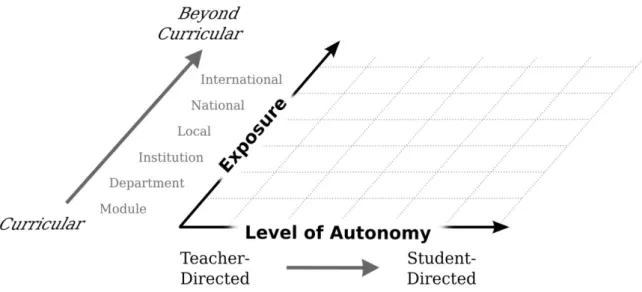
2011; Healey et al., 2014). This trend has broadened the scope for students to engage with and to communicate their research to external audiences. Spronken-Smith et al. (2013) have created a framework for the dissemination of student research (Figure 2) and this allows you to consider and ‘map’ the level of exposure that your research achieves as you progress through your geography degree. You might start by sharing your research in courses and modules, through to departmental research conferences, institutional research poster events and exhibitions, and on to national multi-disciplinary events hosted, for example, through the British Conference of Undergraduate Research (BCUR) or the North American National Conferences on Undergraduate Research (NCUR), and perhaps even through international journals and meetings within geography. Your research in geography, even at undergraduate level, can therefore be disseminated to a variety of audiences in a range of physical settings within the university or beyond (Table 2).
External communication in a multi-disciplinary context is generally perceived as requiring higher order skills in order to deliver a more polished public product when compared with presentation to tutors and peers within university (Willison & O’Regan, 2008). This is partly related to the language we use as geographers. When talking to people within our discipline we can expect a level of understanding of geographical terminology, whereas if we are speaking to physicists, medics, artists and psychologists, for example, we will need to use lay language to describe our research. Many of the questions that geographers engage with are shared with people from other disciplines, so communicating clearly is essential because people will have a range of perspectives that they can bring to geographical problems. Clear communication without recourse to jargon is an important skill to develop as global problems will increasingly require large multi-disciplinary teams. Employers appreciate that
geographers, with their ability to understand both scientific and social science methodologies and discourses, are well placed to work on and communicate team-based research.
3.1 Internal audiences for student research
Small scale exposure of student research can be achieved within institutions by writing essays, reports or dissertations, presenting posters, or delivering verbal presentations to tutors and peers in class or even in the field (Marvell, 2008; Marvell et al., 2013). Posters or verbal papers can also be presented at extra-curricular departmental or institutional
conferences. The audience for this research communication includes your peers, tutors and other staff and students in the university. Increasing the exposure of your research
(Walkington, 2014; 2015), to include podcasts or videos of research results, makes it
might even write a paper for your institutional journal if one exists (Walkington & Jenkins, 2008; Walkington, 2012; Walkington et al., 2012).
3.2 External audiences for student research
Formats designed to maximize exposure of student research beyond institutions include: blogs, video logs and podcasts; client presentations and consultancy reports; papers or chapters within journals and books; exhibitions, displays and shows; web pages, public wikis and Wikipedia pages; and poster and paper presentations at online (virtual) or face-to-face conferences (e.g. departmental/ national /international). Two online journals dedicated to the publication of undergraduate research papers in geography are GEOverse (in the UK) and Geoview (in Australia) (see Table 2). Postgraduate researchers should target standard academic journals. Going public in these ways can be done individually or collaboratively with other students or with academic staff. Co-authoring an article with an academic staff member in a published journal is a good way to start. If you are writing up your research as an article you will want to make sure that the research findings have been fully analysed and the research is completed, but for some less formal formats such as blogs, an ongoing update on your research findings as you analyse them might be acceptable, so long as you are not still collecting data (which could be biased by your blog posts).
Robertson & Walkington (2009) co-authored an article based on an undergraduate dissertation in geography about recycling and waste minimisation behaviour. There were significant unexpected implications for local authorities, so it was important to share the research results with an audience beyond academia. Co-authoring with academic supervisors who are familiar with the journal reviewing process can provide support with writing for a wider audience, although it often involves an investment in time beyond the university course for both people. Other examples of the co-production of geographical research include co-presenting at an academic conference such as the Royal Geographical Society annual conference (Hill et al., 2010; 2013). It is essential that ownership of material is clearly agreed when you are co-authoring and co-presenting with peers and academics. Acknowledgement of different levels of input is usually done through the order of authorship. Acknowledgements sections can also be added to papers and presentations to thank those who are not authors but who have helped, for example, with the drawing of figures, field assistance and commenting on drafts.
research findings with a global audience. When communicating your research online the requirements for a scholarly style over and above a more popular style will need to be carefully tailored to the outlet and audience. It is important to remember that the audience for web-based resources is international, potentially non-academic and could include future generations. It is consequently a very powerful way to share your research and contribute to knowledge, but it comes with a significant responsibility in terms of accurate reporting and making realistic claims.
Finally, it is important to understand that research is a commodity. The copyright of research is sometimes signed away in the publication process. There is a growing commitment to the open sharing of research and creative commons licenses allow you to share your work under different standardised licencing conditions. It is important to understand that you must have the agreement of people whose material you use whether this is their data (via ethics procedures), or figures and maps that they have produced (copyright agreements). Just as with your university work, you must be careful to avoid plagiarism and to make sure that your own work is protected and attributed to yourself in turn.
4. Communicating your research effectively to different audiences
This section highlights the principles of effective research communication that are applicable to different oral and written/visual formats delivered in a variety of contexts. We aim to make you conscious of how you might connect appropriately to different audiences, 'pitching' your work to their likely knowledge and experience. Within each context, considering the elements of the research process (Figure 1) will help you to structure your work logically and
coherently and you will see these steps referred to repeatedly in the sub-sections that follow.
4.1 Principles of effective oral presentation
An effective oral presentation communicates a clear message in a logical manner. It considers the needs of the audience in order to capture their interest and develop their understanding. As you prepare to verbally communicate your research you should consider prior rehearsal and the context, content and delivery of your final presentation.
Rehearsal
confident and relaxed as you stand up to present (Kneale, 2011). You can also brainstorm and practice answers to the questions that you are likely to be asked at the close of your talk.
Context
You should consider the layout of the room in which you are presenting and the technology available to you. Arrive early enough to check that all equipment is functioning correctly (Cryer, 2006). Run your slides through in advance to ensure they display properly with the equipment and software available to you and check that internet links are working. You will need to establish whether the audience members are likely to be disciplinary specialists or range across a number of disciplines. You can then match the style, language and technical content of your talk to their anticipated interests and levels of knowledge (Kneale, 2011). Excite the interest of the audience by making connections to their experiences where you can. Explain technical terms that may not be widely understood but avoid oversimplifying and using colloquial language.
Content
Your presentation must be organised carefully as many internal and external presentations are only 15 minutes long, including time for questions from the audience. It is rare that you will have the time to say all that you want to about your research and, as such, it is just as important to consider what to omit from your talk as it is to decide what to include (Young, 2003). The most difficult part of any oral presentation is the introduction, when you must capture the attention of audience members, establish your credibility and make the audience receptive to hearing what you have to say. Begin with an opening slide that presents a clear research title and states your name. For external audiences you should also include your affiliation and email address. It is a good idea to follow this slide with an outline of your talk, setting out its content to provide a handrail through the information. Try to ‘hook’ in the audience early in your talk by asking a compelling question that clarifies the purpose of your research and sets this question in context personally (why is it of interest to you and why should it be to others?). You should also set the question in perspective theoretically and/or conceptually with reference to appropriate literature, and geographically by establishing the key characteristics of the ‘field’ location(s). Outline and justify briefly the methods you
adopted and communicate your key results clearly and succinctly. Interpret your key findings (referring back to your selected literature) and draw to a clear conclusion about your
presentation. Overall, keep in mind that you are trying to develop a clear structure in order to deliver an authoritative argument.
Delivery
A presentation is essentially a visual performance (Kneale, 2011), so your style of delivery is an important aspect of effective communication. Consider the appearance of both your slides and yourself as you prepare to deliver your presentation. The text and visuals on your slides should be readable from the back of the room (24 point font or larger is acceptable and images should be simple). You should not crowd slides with text but use them to
communicate key issues and to highlight relevant visuals. Use a consistent background colour, font and graphic style throughout your presentation. Leave slides projected long enough for the audience to take in their content, take the time to explain complex issues and graphics, and do not be afraid to emphasize key points. Remember to lead your visuals rather than let them lead you. You can incorporate technology into your presentation, such as slide animation and embedded audio and video materials, but do not use technology simply as a gimmick (Cryer, 2006). It needs to clarify your message for the audience.
Speak with suitable pacing and varied intonation, loud enough to be heard by everyone. At the beginning of your talk you can ask if the audience can hear you and during your
presentation you can check that sound levels for audio-visual clips are satisfactory. Do not allow your nerves to compel you to read from a prepared script. Instead, learn your material well enough to speak confidently and freely, perhaps referring to one or two pre-prepared cue cards. Speaking unscripted will enable you to maintain eye contact with the audience and to help them feel involved. It will also allow you to gauge whether audience members look confused, bored or are nodding attentively and taking notes (Kneale, 2011). It is a good idea to shift your focus around the room to involve as many people as possible in your talk. You can also acknowledge your audience by making verbal contact with them. During your presentation you can use inclusive language to draw your audience into your talk by noting, for example, that ‘this graph shows us’ an important fact. Feel free to move away from a lectern to projected slides in order to point out key aspects of text, graphs or tables. When you do this, ensure that your gestures are controlled so that you do not appear nervous. Remember that your presentation should express your personality and communicate your ‘story’ with an enthusiasm that captures the interest of the audience. You must be confident that the audience wants to listen and that you have something interesting to tell them.
keep to time. If you find you are running out of time then you need to have the confidence to cut out an aspect of your talk or to skim quickly over a slide indicating only the fundamental issues (Young, 2003). Do not just stop mid-way through a slide if you are cut off by a tutor or session convenor. Ensure you reach your concluding slide, clearly coming to the end of your argument.
Do not worry if you make a mistake during your presentation. Calmly start the sentence or explanation again with a smile. If you recognise there is an error with text on a slide just point this out and indicate what it should say. It is always best to be honest if you notice a mistake in your written or verbal communication. Even research experts are fallible when they
present and they do make mistakes. They do not know everything and they are often presenting their research to find out where the weaknesses in their arguments lie. Your presentation will be no different. If you do not know the answer to an audience question, be honest and perhaps invite responses from the audience (Cryer, 2006). Never try to ‘make up’ an answer to appear clever as you will inevitably be found out. Offering the question back to the room is a good way to draw everyone into debate to try and solve the problem. Finally, you should aim to look and act like a professional by wearing smart clothes and adopting a confident but relaxed posture (Young, 2003).
It is important to study the guidelines directing your presentation and to relate your work to them. These guidelines indicate what is expected of your work. When you present your research internally for assessment your tutor should provide you with assessment criteria at the outset. You should be aware of the main criteria as, if you use them as extrinsic
motivators to think critically about your work, they will enable you to plan and deliver a better presentation. Table 3 offers a generic checklist of criteria based on presentation content and delivery. Usually, a selection of these criteria will be used to compose a full grading scheme against which your final presentation will be assessed.
4.2 Principles of effective poster presentation
detailed personal discussions with people who are genuinely interested in your research and whose knowledge may range from expert to novice in relation to your subject matter. The dialogue that emerges from ‘defending’ your poster to a diversity of audience members, particularly non-specialists, offers you an important method of enhancing your graduate competencies (see section 5.2 of this chapter).
Posters are a highly visual medium, usually presented in large format (A0 or A1) and designed to be eye-catching but also informative. They allow you to practice both your research and creative skills (Vujakovic, 1995). Many of the criteria for effective oral presentations apply equally to effective poster presentation (Table 4). The fundamental challenge remains of how to reduce the complexity of your research into a small number of words that convey your key messages in a self-contained format that does not necessarily require further explanation. Posters usually contain only 300-500 words of text and within this limit your aim is to make it easy for a person unfamiliar with your research to understand it and to want to find out more about it (Hay & Thomas, 1999). Decisions on content will depend on whether the audience is likely to be comprised of disciplinary specialists, who may require detailed information, or non-specialists, who may be looking for an accessible summary. As with oral presentations, set aside plenty of time for preparation and review the guidelines for poster production.
main text should be large enough to be read at a distance of two metres away from your poster. Good fonts to use on posters are Arial or Helvetica as they are simple and lack fine decoration. Whichever font you choose, use italics, bold and underlined text sparingly. You should also consider line spacing and text alignment. Apart from poster titles, a line spacing of 1.5 is ideal. You can then decide whether left or full justification suits your blocks of text.
The layout of your poster should be comprised of coherent blocks of text that are readily distinguishable and logically ordered so that the viewer’s eye naturally follows the flow of information in your display. Scientific posters usually comprise the six primary components of title, introduction, methods, results, conclusions and references (Hay & Thomas, 1999). These components should be balanced with images and white space to create visual stability (Figure 3). You should aim to use two or three colours only on your poster, ensuring you use black or dark blue for your smallest text, contrasted sufficiently with the background. Avoid textured backgrounds that make the text difficult to read and, if you use a photographic background, adjust the transparency so it does not dominate. It is a good idea to blend your colours with those in your images. Using shades of the same colour is visually appealing, as is the use of complementary colours. The images you include should have a resolution of 300 pixels per square inch, and figures and tables should be simple and clear. Remember that any images you include in your poster should be relevant to your argument, labelled and, if they are not your own, should be appropriately referenced. You should have
permission to use them or they should have been obtained under an open commons licence.
You will usually present your poster in a busy room, with many other posters and presenters (Figure 4). Your poster will need to be eye-catching to draw in viewers from an initial glance and you must be prepared to discuss your research amidst the distractions of noise and a constant flow of people moving past you. It is a good idea to practice a 30 second ‘elevator pitch’ about your research to convey your key messages and to draw audience members into your poster. Consider the types of questions that may be asked about your research by those who come to look at your poster and rehearse you answers. Remember the audience for your poster can ask you about any aspect of the underlying research. The sequence in which you discuss your material might differ each time, so practice with peers to become accustomed to answering unexpected questions.
4.3 Principles of writing for publication in academic journals
understand that publication in this format may require a lengthy review process and several attempts before your work is accepted.
When writing for journals the most common mistake that student authors make is to submit essays and dissertations in the format of a piece of university work. A minority of student journals accept work in this style but they are institution-specific and aim to facilitate publication of their own students’ work (Walkington et al., 2013). There are only a small number of universities and colleges that host journals for students and, even here, most require reformatting in a journal style. Rewriting is essential if you want your work to be taken seriously by an external peer reviewed academic journal. You need to invest time to get it right, but this is the best way to publish your work successfully beyond your own institution.
Most academic journals have teams of reviewers who provide anonymous reviews of your work against the journal’s criteria. This is the peer review process. These reviewers do not see each other’s comments, adding to the rigour and impartiality of reviewing. The journal editor makes a final decision and provides feedback to you on your submission, frequently with conditions that you need to fulfil in terms of additional information, analysis, explanation or reference to further literature. Submitting work after you have received feedback from within your university or college will increase your chances of publication as you can revise your work in the light of comments. In rare cases your article will be accepted as it is, in others you will be given time to make minor or major changes. Unfortunately, most journals receive many more articles than they can publish, so some articles will be rejected. Coping with rejection is part of academic life and does not necessarily mean an article will never be published. You might try to get your work published in a different journal, but it is essential that you only submit your article for consideration to one journal at a time. This can mean waiting for a significant period of time while your paper is being reviewed.
There are generally two types of research article accepted by journals: full papers, perhaps with limits of 5,000-8,000 words; and rapid communication style articles, sometimes called 'work in progress' (more typically up to 2,000 words).
Full papers
the right kind of material. Author guidelines are specific to each journal and are rigidly enforced. Read them carefully. Your submission will be rejected if you do not conform to the word limits, referencing style, formatting for figures and tables and aims and scope of the journal. The research process, outlined in section 2, highlights the main elements that your article will cover, beginning with an introduction to the study and perhaps the study location, the methods you have chosen, results obtained and then a discussion of your findings before you conclude in relation to the impact your study has more broadly on the field of geography. Box 1 outlines in more depth the principles of writing a clearly communicated geography journal article.
Short articles
Rapid communication style articles are not accepted by every journal so if your results are significant and it is important to share them quickly then search for journals that cater for this kind of short publication style. Alternatively, you may want to share your findings through social media (see section 4.4 of this chapter).
Writing for publication in academic journals hinges ultimately on having a set of novel research findings that you wish to communicate and that other people will want to read about. Not every piece of independent research that you carry out at university will be suitable, so think carefully about the big picture and what has already been published in your topic area before considering submission to a journal. If you are unsure, write to the journal editor to pitch your idea and ask their advice on whether your research is something the journal would be interested in. Journal editors will know what papers have proved popular with their readers, so they are a valuable source of advice prior to submitting an article.
4.4 Effective communication in informal arenas online
Advances in technology have allowed many groups of people to become authors, particularly of online content, and this has opened up issues of authority, liability and privacy (Flanagin & Metzger, 2008). Geography students can take on a role in research and research
are able to disseminate research findings (either your own research or a collation of published research) communicated as a story.
Involving the wider public in your research can be fruitful if you want feedback on your interpretations and blogging is a good way to test out ideas and receive feedback. Tweeting your results is also a way to create followers who are interested in your research area, people who may eventually become collaborators or participants in future research. Box 2 outlines some of the media you might use and considers the style you can adopt when writing for online audiences.
The impact indicators of web media are different to journals. With formal journals the impact factor is a significant metric to consider, whereas with online publishing the number of times that articles are shared is seen as a means of calculating impact. If you are not wishing to publish your research through a journal article and writing is not your favoured medium, then presenting your research direct to camera for a short video might suit you. There is an international competition for PhD (doctoral) students called the 'Three Minute Thesis'™ developed by the University of Queensland and You Tube houses a wealth of examples of winning presentations. Vodcasts provide an excellent model of how to communicate your research findings to a wide audience, beyond geographers, effectively and clearly. You may want to have a go at this and add your own short video clip on You Tube as a link on your CV or Linked In page. Done well this is also a great way of promoting your presentation skills to prospective employers.
5. What are the outcomes of effective research communication? 5.1 Research communication within your institution
Communication skills are an important component in the education of geography students because the many jobs that geography graduates find themselves in often require the use of such skills. Graduate students from Oxford Brookes University, for example, have noted:
‘All the fundamental skills I have needed for my career I learnt as an undergraduate researcher. Communication is a huge part of my working life. I have to do a substantial amount of presentations. I had solid foundations through the numerous presentations I had
to do at University, including the Geography undergraduate research conference’
In my opinion presenting with personality, conviction and presence can do more for your career than anything else ... My geography degree focussed on getting this right. Now I’m
Employers across the globe highlight verbal, written and visual communication skills as of central importance to their decision-making when recruiting graduates (Solem et al., 2008; Arrowsmith et al., 2011; Whalley et al., 2011). Collectively, it is the sum of geographical knowledge, technical competencies and personal attributes, assembled in appropriate ways, which define your employment capability. As a result, you are currently provided with
opportunities across all levels of your degree programme to practice, and have assessed, your skills in oral, visual and written presentation of geographical research material.
You should embrace the opportunities to engage in research and research communication that are offered throughout your student journey. These should be scaffolded from research-led experiences (learning about current research in the discipline) to research-based
experiences (undertaking research and inquiry) inside and outside curricula (Healey, 2005). Undertaking research and dissemination that is extrinsically motivated and assessed gains you marks and develops the skills summarised in Tables 3 and 4. Undertaking research and dissemination within your institution but beyond curricula and grades, intrinsically motivated, allows you to build a portfolio of graduate skills that include confidence, understanding of disciplinary content, oral communication skills, visual creativity, information literacy, critical thinking, reflective judgement, self-evaluation, and offering and accepting critique.
5.2 Research communication beyond your institution
It is worthwhile disseminating your research as a student beyond your university and in diverse arenas because ‘post-degree activities will be in spaces that are quite different from the college lecture theatre, Virtual Learning Environment and formal examination settings’ (Whalley et al., 2011: 389). Preparing and delivering your verbal presentation, defending your poster to audiences external to your institution, writing a paper for publication, or communicating through social media, especially when these contexts embrace a multi-disciplinary audience, develops a broad range of intellectual, organizational and inter-personal skills.
Students who have delivered oral and poster presentations at the British Conference of Undergraduate Research (BCUR) have made their research public, completing the research cycle (Walkington, 2008). The participating students embraced this opportunity
enthusiastically, perceiving it to afford their work meaning in academia and perhaps in wider society. They gained in confidence and sense of achievement, feeling validated as
through conference presentation. They referred to the importance of preparation, practice and repurposing of their work (see Box 3) (Hill & Walkington, in print). Additionally, students who presented posters that had to be defended highlighted the importance of dialogue in developing their communication and wider skills. As the students shared alternative
interpretations of their research they re-evaluated it, recognising that it assumed a different appearance from diverse viewpoints. Such transactional communication made explicit the tacit understanding of these students by offering them the chance to clarify and develop their ideas interactively. Overall, the students who presented their research at BCUR evidenced progress towards self-authorship (Baxter Magolda, 2004), consciously balancing the
contextual nature of their disciplinary knowledge with intra-personally grounded goals, beliefs and values. The ‘public’ presentation of their research motivated them in ways that other ‘assessment’ had not. BCUR thereby offered the students an opportunity to begin to
construct their professional identities during their studies, potentially helping them to navigate into their working and wider social lives.
For those students who have published articles in the journal GEOverse, there have been many positive impacts. In terms of gaining places on Masters courses and doctoral research places, several students have gone on to develop their academic career and to publish further work. Students benefited from the feedback that they were given by the journal reviewers:
‘It was my first experience of publishing and I got lots of useful but critical feedback. Because it was online and anonymous, the reviewers were free to say exactly what they liked. It was a longer and more complicated process than I thought it would be at the outset but I was really
proud when it was accepted’
Successfully published student authors from GEOverse described the experience as an iterative learning process. They trusted the written advice of others, receiving detailed comments that helped them to improve their articles. The publication itself gave them recognition as a researcher. However, student authors disliked the impersonal nature of the feedback (via email) and the lack of face-to-face dialogue with reviewers (Walkington, 2008; 2012).
in geography or informing society at large is empowering and students who are initially successful with research dissemination tend to begin a journey of continuing impact. These kinds of goals are both intrinsic and extrinsic. For some students recognition is a key factor, whereas for others the subject is a source of passion. In both instances, however, the sense of purpose students have to share their research findings can lead naturally into further study or into employment where these skills are valued.
6. Conclusions
To master the communication of your research you need to practice and take on board feedback. Grasp the opportunities available to you as a geography student to undertake research, to consider staff and peer critique, and to disseminate your findings. Operating alongside the formal curriculum, disseminating research externally can provide a means for you to see how your research has value beyond the modules and assignments that form your degree programme. Passing through the entire research cycle essentially offers you a signature learning experience (Spronken-Smith, 2013), developing a suite of graduate attributes (Barrie, 2004) and promoting self-authorship (Baxter Magolda, 2004). The skills learnt in ‘going public’ with your research will help you to move beyond the confines of your discipline to apply yourself productively to whatever you encounter in the dynamic, uncertain and insecure world beyond education (Barnett, 2000).
Summary
As a student of geography you are inherently a researcher. If you seize the
opportunities that currently exist in higher education to communicate your research findings to a range of audiences you will develop your disciplinary knowledge and generic skills and abilities.
Delivering effective oral and poster presentations requires practice, however
confident you are. Know your audience, rehearse, and tailor your language, content and delivery appropriately.
Develop your writing style for journal articles and online destinations according to your audience – be punchy and concise for web based media, and scholarly and in-depth for journal articles.
Think creatively about audiences for your research and have a go at creating an audience through sharing your work via social media.
7. Further reading
Two HEA commissioned resources by Waller & Schultz (2013; 2015), examining how to succeed at university in Geography and related disciplines, will support you with independent research.
Hay (2012) is an up-to-date textbook offering a practical guide for geography and environmental science students on how to communicate clearly and effectively in an academic setting. Now in its fourth edition, the text covers a wealth of written, graphic and spoken forms of communication.
The University of Leicester Student Learning Development website offers a suite of open access resources that support the delivery of effective oral and poster presentations: http://www2.le.ac.uk/offices/ld/resources/presentations. From this web address you can access user-friendly printable study guides and online tutorials. Equally, a detailed document from the University of Oxford that describes the process of creating an academic poster can be found at:
https://weblearn.ox.ac.uk/access/content/group/e05e05d2-f4ce-4a24-a008-031832bd1509/ LearningRes_Open/Course_Book_Ppt_TIUD_Conference_Posters10.pdf
The third edition (2015) of Publishing and getting read: a guide for researchers in Geography is now accessible online at:
http://www.rgs.org/OurWork/Research+and+Higher+Education/Journals+books+and+guides/ Publishing+and+getting+read.htm. This free guide, published by the RGS-IBG, provides clear practical advice about how to publish research in a wide range of forms, and how to maximise the reach of your research.
The British Conference of Undergraduate Research website offers useful material and further electronic links concerning how to publish student research in geography and other
disciplines: http://www.bcur.org/.
The Reinvention website offers advice on writing your first journal article: http://www2.warwick.ac.uk/fac/cross_fac/iatl/reinvention/.
8. References
Ashwin, P. & Trigwell, K. (2004) Investigating Staff and Educational Development. In D. Baume and P. Kahn (Eds.) Enhancing Staff and Educational Development. London: Kogan Page, pp 117-131.
Barnett, R. (2004) Learning for an unknown future. Higher Education Research and Development, 23, 247-260.
Barrie, S.C. (2004) A research-based approach to generic graduate attributes policy. Higher Education Research & Development, 23, 261-275.
Baxter Magolda, M.B. (2004) Preface. In M.B. Baxter Magolda & P.M. King. (eds.) Learning Partnerships: Theory and models of practice to educate for self-authorship. Sterling, VA: Stylus Publishing, pp. xvii-xxvi.
Boyer Commission on Educating Undergraduates in the Research University (1998) Reinventing Undergraduate Education: A Blueprint for America’s Research Universities. Stony Brook: State University of New York at Stony Brook.
Brause, R.S. (2000) Writing Your Doctoral Dissertation.
Castree, N. (2011). The future of geography in English universities. The Geographical Journal, 177, 294-299.
Cresswell, J.W. (2014) Research Design: Qualitative, Quantitative and Mixed Methods Approaches. Fourth edition. Sage, London.
Cryer, P. (2006) Giving presentations on your work. In The Research Student’s Guide to Success. Third edition. Buckingham: Open University Press, pp. 177-186.
Day, A. & Peters, J. (1994) Quality Indicators in Academic Publishing. Library Review, 43, 4-72.
Flanagin, A.J. & Metzger, M.J. (2008) The credibility of volunteered geographic information. GeoJournal, 72, 137-148.
Grix, J. (2010) The Foundations of Research. Second edition. Palgrave Macmillan, Basingstoke.
Hay, I. (2012) Communicating in Geography and the Environmental Sciences. Fourth edition. Oxford: Oxford University Press.
Hay, I. & Thomas, S.M. (1999) Making sense with posters in biological science education. Journal of Biological Education, 33, 209-214.
Healey, M. (2005) Linking research and teaching exploring disciplinary spaces and the role of inquiry-based learning. In: Barnett, R. (ed.) Reshaping the university: new relationships between research, scholarship and teaching. Maidenhead: McGraw-Hill/Open University Press, 30-42.
Healey, M., Flint, A. & Harrington, K. (2014) Developing Students as Partners in Learning and Teaching in Higher Education. York: Higher Education Academy.
Hennemann, S. & Liefner, I. (2010) Employability of German geography graduates: the mismatch between knowledge acquired and competencies required. Journal of Geography in Higher Education, 34, 215-230.
Hill, J. & Walkington, H. (2015) Developing graduate attributes through participation in undergraduate research conferences. Journal of Geography in Higher Education (in print).
Hill, J., Nelson, M., Blackler, V., Chellew, R., Ha, L. and Lendrum S. (2010) Evaluating the flexible spaces of learning created through exotic video podcasts. RGS-IBG Annual Conference, Kensington Gore, London, 1-3 September.
Hill, J., Blackler, V., Chellew, R., Ha, L. & Lendrum, S. (2013) From Researched to Researcher: Student Experiences of becoming Co-Producers and Co-Disseminators of Knowledge. Planet, 27, 35-41.
Li, X., Kong, Y. & Peng, B. (2007) Development of geography in higher education in China since 1980. Journal of Geography in Higher Education, 31, 19-37.
Little, S. (ed.) (2011) Staff-Student Partnerships in Higher Education. London: Continuum.
Marvell, A. (2008) Student-led presentations in situ: the challenges to presenting on the edge of a volcano. Journal of Geography in Higher Education, 32, 321-335.
Marvell, A., Simm, D., Schaaf, R. & Harper, R. (2013) Students as scholars: evaluating student-led learning and teaching during fieldwork. Journal of Geography in Higher Education, 37, 547-566.
Neary, M. & Winn, J. (2009) The student as producer: reinventing the student experience in higher education. In: L. Bell, H. Stevenson and M. Neary(eds.) The Future of Higher
Education: Policy, Pedagogy and the Student Experience. London: Continuum, pp. 192-210.
Philips, E.M. & Pugh, D.S. (2010) How to get a PhD: A Handbook for Students and their Supervisors. Fifth Edition. Open University Press, Buckingham.
Plotnik, R. & Kouyoumdjian. H. (2011) Introduction to Psychology. 10th edition. Belmont, CA: Wadsworth.
Robertson, S. & Walkington, H. (2009) Recycling and waste minimisation behaviours of the transient student population in Oxford: results of an online survey. Local Environment: The International Journal of Justice and Sustainability 14, 285-296.
Solem, M., Cheung, I. & Schlemper, B. (2008) Skills in professional geography: An
assessment of workforce needs and expectations. The Professional Geographer, 60, 1-18.
Spronken- Smith, R., Brodeur, J.J., Kajaks, T., Luck, M., Myatt, P., Verburgh, A., Walkington, H. & Wuetherick, B. (2013) Completing the research cycle: a framework for promoting dissemination of undergraduate research and inquiry. Teaching and Learning Inquiry, 1, 105-118.
Vujakovic, P. (1995) Making posters. Journal of Geography in Higher Education, 19, 251-256.
Walkington, H. (2008) Geoverse: Piloting a national journal of undergraduate research in Geography. Planet, 20, 41-46. [Online] Available at: http://journals.heacademy.ac.uk/doi/pdf/ 10.11120/plan.2008.00200041.
Walkington, H. (2012) Developing Dialogic Learning Space: The Case of Online
Undergraduate Research Journals. Journal of Geography in Higher Education, 36, 547-562.
Walkington, H. (2014) Get Published! Keynote lecture to the British Conference of Undergraduate Research, University of Nottingham, UK.
Walkington, H. (2015) Students as Researchers: Supporting undergraduate research in the disciplines in Higher Education. York: Higher Education Academy.
Walkington, H. & Jenkins, A. (2008) Embedding undergraduate research publication in the student learning experience: Ten suggested strategies. Brookes eJournal of Learning and Teaching, 2. Available at: http://bejlt.brookes.ac.uk/article/embedding.
Walkington, H., Edwards-Jones, A. & Gresty, K. (2013) Strategies for Widening Students’ Engagement with Undergraduate Research Journals. Council on Undergraduate Research Quarterly, 34, 24-30.
Waller, R. & Schultz, D.M. (2015) How to succeed at University in GEES disciplines: Enhancing students' information literacy skills. York: HEA [online]. Available at: https://www.heacademy.ac.uk/node/10230.
Waller, R & Schultz, D.M. (2013) How to succeed at University in GEES disciplines: Using online data for independent research. York: HEA [online]. Available at:
Whalley, W.B., Saunders, A., Lewis, R.A., Buenemann, M. & Sutton, P.C. (2011) Curriculum Development: Producing Geographers for the 21st Century. Journal of Geography in Higher Education, 35, 379-383.
Willison, J. & O'Regan, K. (2008) The Researcher Skill Development Framework. Available at http://www.adelaide.edu.au/rsd/framework/rsd7/.
Table 1 Relationship between research and other forms of investigation (Modified from Ashwin & Trigwell, 2004: 122)
Level of investigation
Purpose of investigation
Verification of investigative process
Result of investigation
Scholarly To inform oneself Verified by self Personal
knowledge Scholarship To inform a group
within a shared context
Verified by those within the same context
Local knowledge
Research To inform a wider audience
Verified by those outside of that context
Table 2 Opportunities for undergraduate research dissemination within and beyond university Research dissemination inside your
institution Research dissemination beyond your institution
Module
- Essay read by peers and tutors
- In class verbal presentations and posters - Research podcasts/videos
- Research report/project read by peers and tutors
- Student-led field research presentations - Presentations to clients within consultancy
based modules
Department/Faculty
- Departmental or Faculty undergraduate research conferences (posters, verbal papers, podcasts)
- Research posters displayed within department corridors and teaching spaces - Research showcases on department or
faculty web pages
- Student led research blogs and
e-magazines (e.g. blog posts by geography students at Leicester:
http://studentblogs.le.ac.uk/geography/ and
https://environmentalgeographies.wordpre ss.com/)
Institution
- Institutional multi-disciplinary research showcases including conferences (posters, verbal papers, podcasts) and journals (e.g. The Plymouth Student Scientist
https://studentjournals.plymouth.ac.uk/ind ex.php/pss, Diffusion
http://www.uclan.ac.uk/research/explore/p rojects/diffusion_the_uclan_journal_of_un dergraduate_research.php
Local
- Employer presentations/exhibitions (client presentations for consultancy projects) - General public presentations/exhibitions - Writing a book review for a public blog
National
- Undergraduate research conferences (e.g. British Conference of Undergraduate Research
http://www.bcur.org/ and North American National Conferences on Undergraduate Research
http://www.cur.org/conferences_and_events/student_e vents/ncur/)
- National exhibitions (e.g. Posters in Parliament http://www.bcur.org/about/posters-in-parliment/ and Posters on the Hill
http://www.cur.org/conferences_and_events/student_e vents/posters_on_the_hill/)
- Writing for a national undergraduate research journal in geography (e.g. GEOverse in the UK
http://geoverse.brookes.ac.uk/, Geoview in Australia https://www.iag.org.au/publications/geoview/)
International
- Writing for an international multi-disciplinary undergraduate research journal (e.g. Reinvention http://www2.warwick.ac.uk/fac/cross_fac/iatl/ejournal/) - Co-authoring a paper with an academic staff member
for an academic or professional journal - Co-presenting a verbal paper at a
national/international geography conference (e.g. Royal Geographical Society, Association of American Geographers)
- Producing web based podcasts - Authoring Wikipedia pages
Table 3 Checklist for oral presentations based on common assessment criteria Self-assessment checklist for oral presentations
Presentation content
Clear indication of aim/intent Organisation of material Relevance of content
Breadth and depth of knowledge Clarity and depth of argument
Level and currency of supporting evidence Effectively drawn conclusions
Quality of referencing
Directed appropriately to audience
Presentation delivery
Pacing, audibility and intonation of speaker
Fluency of delivery and appropriate use of language Enthusiasm and confidence of speaker, including eye contact
Appearance and demeanour of speaker
Effective use of visual aids (clarity of slides/handouts) Audience engagement
Well managed timing Quality of question handling
Table 4 Checklist for poster presentations based on common assessment criteria Self-assessment checklist for poster presentations
Poster content Clarity of the title Clarity of aim/intent
Logical and coherent organisation/layout Relevance of content
Focus and depth of argument
Level and currency of supporting evidence (including references) Clarity of conclusions
Grammar, spelling and use of language Quality of presentation - text and images Visual appeal
Directed appropriately to audience
Poster delivery
Quality of verbal summary/defence
Ability to adapt language and terminology to the viewers Appearance and demeanour of presenter
Ability to handle questions at a range of levels
Establish the research aim
Establish the theoretical/conceptual underpinnings
Read the literature
Formulate research questions / hypotheses
Decide on sample design and research methods
Gather empirical evidence (data)
Summarise and reflect on findings (in light of literature)
Draw conclusions and recommendations
Communicate results to others
Box 1: Principles of a clearly communicated geography journal article
In Walkington (2008) students comment on writing a geography article for publication:
‘The experience of writing up research in the format of a paper, using a project that I had devised, with data that I had collected and analysed was an important experience as it was the most realistic encounter I had had with research. It was this experience that encouraged me to approach the module
convenor about the possibility of a PhD.’
‘Being able to see the whole ‘journey’ from start to finish was extremely worthwhile.’
‘I feel that I’ve accomplished something! It was difficult but I’m proud of it!’
A journal article is not the same as an essay, thesis or project report. You need to be committed to rewriting your work in a new format. The first step is to read articles from your target journal to become familiar with the layout and style. All journals have a style guide dictating, for example, word limits, figure requirements and referencing conventions.
Academic journals publish work that addresses a gap in the existing research literature or a contribution to knowledge. GEOverse is a journal that publishes the very best of original undergraduate research and scholarship in physical and human geography. As a potential author, you must be very clear about how your article contributes to the literature, why it is of interest to readers and how it differs from research published previously.
Titles, key words and abstracts are crucial for making your research work discoverable through online searches. Use yourtitle to convey concisely what your research is about. Theabstract, usually about 200 words,should present a clear summary of your paper – what you did, why you did it, how you did it, what your results were and where your research is going from here. Key wordsare like search terms, they need to be informative and clear.
Here is an example of a title, abstract and key words from an article published in GEOverse:
Locavoracious: What are the impacts and feasibility of satisfying food demand with local production?
Katie O'Sullivan, McGill University, Montreal, Canada. May 2012
assessing the impacts and feasibility of local food systems. I demonstrate that knowledge of environmental impacts is well-developed in comparison to economic and social elements, while feasibility analysis over-simplifies networks of food production and consumption as geographical alignment of supply and demand. As policymakers strive to improve food security at multiple scales, there is inadequate consideration of external market forces and infrastructure that are crucial in determining local food distribution and availability.
Key Words: Local, Food systems, Systematic review, Impacts, Feasibility
The title uses a colon to capture the imagination, but also to say clearly what the article is about. The key words include methods (systematic review) as well as content. The addition of ‘policy’ as a key word would increase the hit rate of the article in searches.
You need to convey complex ideas in a clear and concise manner in a journal article. Day & Peters (1994) suggest that a research article should address the following prompts:
What are your research questions and why are they important?
What did you do and why is your method valid?
What do your results mean and what has your analysis shown? What impact might this have on geography as a discipline?
Have your discoveries opened up further questions for research?
Box 2: Using social media for effective research communication
Increasing the reach and exposure of your research through engaging in blog posts, tweets and other forms of social media is a good complement to more traditional forms of research dissemination. Social media can help with your research at all stages of the process, from the initial planning through to publicising the results, from exploring ideas for collaborative research projects to engaging
participants. The following are just a few examples of the ways in which you might want to engage with social media for research purposes:
Follow a conference remotely via twitter
Promote your research on You Tube
Use a wiki for collaborative writing with others
Use Facebook to involve the public in your research
Receive literature alerts using RSS feeds
Post your articles on Linked In, Academia.edu or your own blog or web page
Writing for digital media is different to writing essays or formal journal articles. Your writing needs to be up-to-date, contain lots of links, be informal and engaging and very inclusive (people from all over the world will be able to access your work, from a range of backgrounds and ages, so be very careful about the words you use). Some guidelines for sharing your research through social media are:
i. Make sure your writing serves a clear purpose, know who your audience is and what you want to achieve;
ii. Bite-sized is best so keep your writing concise, adopt a consistent style and use the house style if you contribute to established blogs;
iii. Be user-friendly for your readers. Adopt their language, avoid jargon, use terms that will help people to find your work;
iv. Use headings, short paragraphs and break up the text. Reading online is harder than in print. Readers can easily click away from your site if they are distracted so keep them on track by getting straight to the point;
v. Provide evidence for your claims and never make up statements to hook readers;
vi. Ensure there are no mistakes as this will provide confidence in your readers that your writing is authoritative.
Box 3: Student experiences of research communication at a national undergraduate research conference
We have examined the experiences of geography, earth and environmental science students who have presented their research at a national undergraduate research conference (the British Conference of Undergraduate Research or BCUR). The students were very aware of honing their communication skills, including specific aspects of oral delivery such as pacing, fluency and audience engagement. They thought critically about their research content, re-purposing it for a multi-disciplinary external context. Notably, they prioritised material that would convey their core messages in a comprehensible manner:
‘After doing a dissertation, condensing 16,000 words onto a side of A1 was quite challenging, but also I think it really makes you own your research, because you can't abbreviate that much without really having
a firm understanding of what you're talking about’
Students planned the structure of their presentations carefully, wanting to develop an accessible narrative for the many disciplines represented at the conference. They referred to the spatial layout of posters and the temporal sequencing of slides. They were particularly sensitive to language, translating technical terms:
‘In the geography department, because we’re all doing the same discipline, you can talk in the same way and they understand, but it’s quite difficult to speak to say a medical student ... because they don’t
understand the specific terminologies’
Participating in BCUR legitimised the students as having undertaken research that mattered - to their audiences, to their disciplines and to the field of science:
‘Coming here and presenting is a lot better than ... writing your dissertation and it being put in a cupboard for how many years. Making it public is worthwhile ... you feel like oh well it’s being heard by other people,
not just you and your supervisor’
The majority of students self-regulated their preparations. They rehearsed in front of peers, sought feedback, and subsequently improved their poster and paper presentations. This process continued for many to benchmarking themselves against peers during the conference:
‘I learnt things by going to the other presentations ... you see people's mistakes so you think well if I am going to do a presentation I'm not going to do that’
The students who presented posters learnt to negotiate and verbally organize their thoughts in real time, engaging in ‘deeper’ critical thinking:
‘You can be asked a question and it can put you off kilter and then you have to think on your feet which is quite a good experience. There's a difference between that and being in a classroom because it's more of
The students welcomed the opportunity to present their work unconstrained from formal grading, being judged instead by peers who were ‘genuinely interested’ in their work:
‘It’s quite good that it’s not assessed because that does take some of the pressure off, it gives you that real feel ... there was no-one constantly writing down what you’ve been doing and to give you a mark on it.
It lets you focus on what you’re doing ... am I ticking the right boxes to engage the audience rather than am I ticking the right boxes to get a first class grade’
BCUR enables an authentic form of research communication as presentations are not delivered to others who already know the answers and are simply assessing to award a grade; they are for the benefit of others who do not know the answers and who are genuinely interested in learning from the presenters.
To conclude, students recognised the employability skills that they were practicing and improving through presenting their research at BCUR. They made links from academic skills, knowledge and values to the world beyond their campuses: