Adjusted risk difference estimation: an assessment of convergence problems with application to malaria efficacy studies
Mukaka Mavuto2,4,5*, White Sarah A3 , Mwapasa Victor2, Kalilani-Phiri Linda2, Terlouw Dianne
J1,2,3 Faragher E Brian3
1Malawi-Liverpool-Wellcome Trust Clinical Research Programme, College of Medicine, University of Malawi, Box 30096, Blantyre 3, Malawi;
2Department of Public Health, College of Medicine, University of Malawi, P/Bag 360, Blantyre 3, Malawi;
3Liverpool School of Tropical Medicine, Pembroke Place, L3 5QA, Liverpool, UK.
4Mahidol-Oxford Tropical Medicine Research Unit, Mahidol University,60th Anniversary Chalermprakiat Building, 3rd Floor, 420/6 Ratchawithi Rd, Bangkok,10400, Thailand
5Oxford Centre for Tropical Medicine and Global Health, Nuffield Department of Medicine Research Building, University of Oxford, Old Road Campus, Roosevelt Drive, Oxford OX3 7FZ, UK
*Correspondence to Dr. Mavuto Mukaka, Head of Statistics, Mahidol-Oxford Tropical Medicine Research Unit, Mahidol University, 60th Anniversary Chalermprakiat Building, 3rd Floor, 420/6 Ratchawithi Rd, Ratchathewi District, Bangkok,10400, Thailand.
E-mail: [email protected]; [email protected]
Abstract
A common measure of treatment effect in malaria efficacy studies is the risk difference, which
can be estimated using binomial regression models. These models can fail to provide estimates,
however, due to model failure or model convergence problems. Such failure most commonly
occurs when the rate is close to 0% or 100% (a “boundary problem”) but can also occur
occasionally even when the rate is not close to a boundary. This paper reports the findings from
simulation studies performed to evaluate the factors that may contribute to model failure when
using binomial regression to derive risk difference estimates.
Convergence rates were found to fall: i) as one or both efficacy rates moved towards a
numbers of covariates in the model increased; iii) as the levels of correlation between covariates
the covariates increased. In all circumstances, convergence was poor when the efficacy rate in
either group was 90% or more.
1. Introduction
In Randomized Controlled Trials (RCTs), treatment effect for binary outcomes is usually
measured using a risk ratio, an odds ratio or a risk difference 1. Risk differences are becoming
more widely reported in RCTs, especially in malaria efficacy studies2-4. These are now
frequently used when the objective is to compare treatment effect between treatments as
commonly used alternatives such as odds ratios and risk ratios can be difficult for general
medical researchers to interpret5. A major concern with odds ratios is that these are prone to
misinterpretation even when the efficacy of the outcome measure is common, easily leading to
invalid inferences of treatment effect6-9. Likewise, risk ratios can be difficult to understand,
especially in equivalence studies, as their interpretation depends on whether a failure or a
success is being modelled; while failure and success rates are clearly complementary, the
inference that can be drawn for each of these endpoints may differ in some cases.
Risk difference estimation is preferred by many researchers not only because it is easier to
interpret but for the arguably more important reason that it is frequently the most relevant and
biologically sensible measure to report11 and provides a clear interpretation of the scientific
question of interest. That is, it directly answers the question of whether there is a difference in
risk and/or efficacy between two groups.
The binomial regression model with an identity link function is often the standard model used to
estimate risk differences. Risk difference models, however, sometimes encounter the problem
literature suggests that this problem is most likely to occur when one or both rates are close to a
boundary (0% or 100%) and hence when risk ratios approach either infinity or zero. Experience
working with risk difference modelling using the Stata software, however, shows that these
models can sometimes fail to converge or produce output even in instances where both rates
are reasonably distant from boundary values. Furthermore, even in scenarios when one or both
rates are close to a boundary, convergence is can be achieved in some cases. These
observations suggest that factors other than boundary problems may influence
non-convergence and/or output failure.
Simulation studies were performed to evaluate the potential impact of convergence problems on
the estimation of treatment effect using risk difference modelling when adjusting for potential
confounders. This research was motivated by a malaria efficacy study that was conducted in
Malawi between 2003 and 2005; full details of the methods and findings of this study are
available in Bell DJ et al2 but to summarise briefly:
A four-group blinded randomized controlled study was performed to compare the efficacy of
three Sulfadoxine-Pyrimethamine (SP)–Based Combination therapies (SP plus chloroquine
(CQ), SP plus artesunate (ART) and SP plus amodiaquine (AQ)) plus a placebo (control) group.
This control arm comprised of SP plus placebo as SP was the standard first line treatment for
uncomplicated falciparum malaria in Malawi during the study period. The study was conducted
in response to accumulating evidence indicating that some resistance to SP was developing,
and because the WHO was recommending the use of combination therapies (especially the
Treatment effect was modeled using risk differences. Covariates, denoted as X, included in the
analyses were X= . Adjusted risk difference modelling,
however, encountered model failure problems.
Simulation studies were carried out to explore the impact of the following issues on model
convergence rates: 1) the number of covariates in the model; 2) the level of correlation between
the covariates; 3) the proximity to a boundary of one or more efficacies.
2. Methods
Datasets were simulated based on the methods and results of the randomized control trial
described in the previous section (Bell et al2). These were used to compare the efficacy rates in
two treatment groups (“active” and control) with adjustment for up to two covariates. Two
patterns of correlation between the covariates were examined; no/negligible correlations and
correlations similar to those found by Bell et al2. All simulations used a sample size 200 (100
participants randomized to each group), again as used by Bell et al2.
Five thousand (5,000) datasets were simulated for each scenario considered. Independent
(predictor) variables were generated using multivariate log-Normal distributions except for
haemoglobin level (hb) which was generated using a Normal distribution; these were used as
covariates in a binomial model using an identity link to estimate the risk difference between the
treatment and control arms.
The choice of covariates was based on expert knowledge from malaria researchers suggesting
that age, weight (wt), haemoglobin (hb) level and parasite count (para) can confound the
relationship between treatment and efficacy in malaria RCTs. Standard practice in such RCTs is
2.1 Parameter values for simulation of covariates
The matrices of parameters and values for simulating the baseline covariates were as follows:
X= ,
and
where:
Xis a vector of values for the four covariates: log(age), log(wt), log(para) and haemoglobin (hb).
μ and σ are vectors of mean and standard deviation values respectively for (in order) log(age),
hb, log(wt) and log(para).
ρ is a matrix of correlations among the four covariates.
2.2 Randomization
The simulated pre-study covariate observations were randomly allocated to two treatment
2.3 Simulation of a binary outcome variable
After randomization of the simulated observations, the outcome measure (1=success, 0=failure)
was generated for each of the two groups to achieve the required efficacy (treatment success)
rates using a Bernoulli (πi) distribution, where πi is the mean proportion of subjects with
treatment success (efficacy) in a group i (i = A, B). This resulted in a simulated binary outcome
variable with group success (efficacy) and failure rates of πi and 1-πi respectively. The
simulations were constrained to ensure that the specified rates were achieved exactly.
The risk difference model can be fitted in the Generalized Linear Model (GLM) framework. A
GLM is constructed using three statistical functions: the linear function, the link function and the
variance function12,13. The linear function may be parameterized as follows:
where is the pth covariate or factor for individual i and (β0, β1….. βp) is a vector of regression
coefficients.
The link function is specified as: , that is, the link function describes how the
expected value of the outcome variable depends on the linear predictor . Note that
can be specified either as the identity function (no transformation on the ), or
as a logit, log, log-binomial etc. along with a relevant family such as Poisson, Binomial,
Gaussian and Gamma.
Finally, the variance function is given by , where is a constant
The outcome variable Yi. follows a binomial distribution denoted by ,
where ni and are the number of participants and treatment efficacy rate respectively in group
i.
The main interest is to model the probability of a treatment success (efficacy) in the form
of a risk difference model, where:
,
So the variance function which is a function of , and the dispersion
parameter is = 1 / ni.
Estimates of the risk differences are obtained by specifying an identity link function to the
binomial regression model. The coefficients in the Binomial regression model with identity link
produce risk differences as follows:
Consider what happens when a variable X is increased by 1 unit.
, where Y=1 denote treatment success and Y=0 denote treatment failure.
.
X can be thought of as a reference group and X+1 as a treatment group of interest. Taking the
difference gives:
In the multivariable model: , the
regression coefficients βpi represent the risk difference resulting from a change (increase) of one
unit in the explanatory variable Xpi. When using the identity link, fitted probabilities outside the
probability range (0,1) are possible. Wacholder11 suggested that when fitting a binomial
regression model with identity link, the fitted probabilities should be checked for range
conditions at each iteration. If found to be outside the permitted range, then they should be reset
it to be within that range13.
Risk difference models considered in this study included subsets of between one and three of
the continuous covariates age, wt, para or hb, and a binary factor taking values of 1/0 indicating
treatment given/not given.
2.4 Correlations and number of covariates included in modelling.
In the first set of simulations, the contributions to binomial regression model convergence rates
due to the (i) the proximity of efficacy rates to boundary vales and (ii) the number of covariates
were assessed using correlation levels between the covariates reflecting those observed in the
sample dataset. The efficacy rate in one group was allowed to approach a boundary (100% in
this case) while that in the other group was held constant. For example, in one group efficacy
was set at 60% and in the other group it was varied to take values 70%, 80%, 85% or 90%, and
convergence rates were estimated in each scenario.
To assess the impact of level correlation between covariates on the ability of models to
converge, the pairwise correlations between the covariates were reduced to zero and the same
models fitted while monitoring convergence. In these simulations, for each pre-set risk
2.5 Statistical software
All simulations were performed using Stata 12.0, IC, StataCorp, 4905 Lakeway Drive, College
Station, Texas 77845 USA. Graphs were constructed using Microsoft Excel 2007.
3. Simulation Results
3.1 Effect of proximity to boundary of efficacy levels and number of covariates on convergence of a binomial regression model
When using just a single predictor variable (covariate) and with the efficacy levels set at 60%
and 70% for the two groups respectively (i.e. distant from the boundary of the parameter space),
the percentage of datasets that converged when a binomial regression model was fitted was
high (96.8% to 99.7%) (Table 1); however, while the corresponding non-convergence rates
were very low, they were not negligibly so.
Convergence rates remained high, ranging from 92.0% to 94.7%, even when the larger of the
two efficacy levels were increased to 85%. However, when the larger efficacy level was
increased to 90% (still some distance from the boundary), convergence levels dropped
Table 1 Convergence rates by efficacy rate and number of covariates in model (averaged over 5000 simulated datasets - correlated)
Covariates: Efficacy rates:
Number Names 60% vs. 70% 60% vs. 80% 60% vs. 85% 60% vs. 90%
1 age 99.7 97.9 94.6 85.5
1 hb 99.9 98.7 94.7 81.3
1 para 96.8 98.6 92.0 86.6
1 wt 99.9 98.1 94.2 82.1
2 hb, age 99.4 94.7 84.5 61.4
2 age, wt 99.3 94.1 84.7 61.0
2 age, para 96.0 91.1 82.6 66.1
2 hb, wt 99.4 95.1 84.7 59.8
2 hb, para 96.1 91.4 83.3 64.9
2 wt, para 96.4 92.0 83.0 64.6
3 age, hb, para 95.7 87.9 73.9 48.1
3 age, hb, wt 98.8 89.7 73.4 42.9
3 hb, wt, para 96.3 88.1 74.2 46.4
3 age, wt, para 95.9 87.6 74.5 47.7
Adding additional covariates exacerbated this problem. With the larger of the two efficacy levels
set at 90%, convergence was obtained in 59.8% to 66.1% of models involving two covariates,
and in only 42.9% to 48.1% of models involving three covariates. The full extent of this trend is
Figure 1 Percentage convergence by efficacy rates and correlation structure
3.2 The effect of correlations between covariates on model convergence
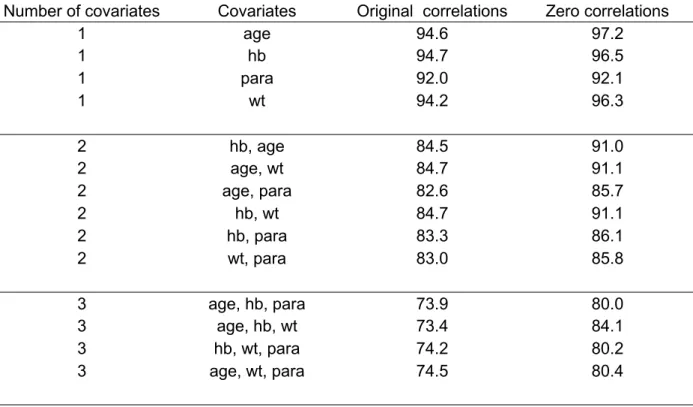
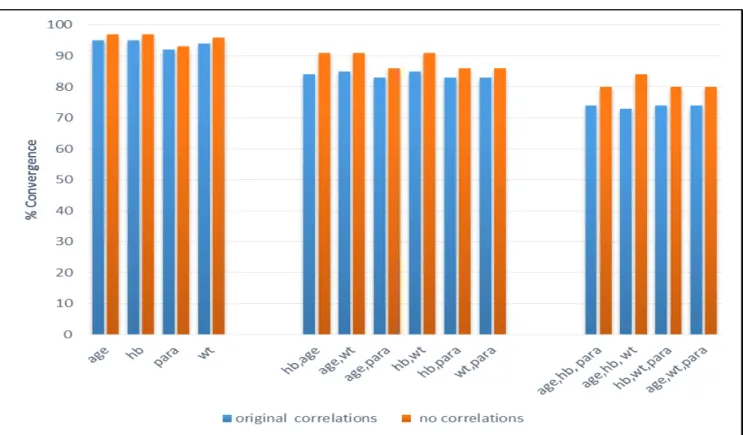
The influence of correlation levels on model convergence rates was examined for efficacy rates
of 60% and 85% in the two groups respectively (Table 2 and Figure 2). In these simulations,
the impact of setting the correlations between each pair of covariates to zero was compared to
that obtained using the correlation levels from the original RCT.
For all models considered, the convergence percentage improved when the correlations
between covariates were removed. The improvement in convergence rates increased as the
Table 2 Convergence rates in the presence and absence of correlation between covariates (averaged over 5000 simulated datasets) : efficacy rates 60% and 85%
Number of covariates Covariates Original correlations Zero correlations
1 age 94.6 97.2
1 hb 94.7 96.5
1 para 92.0 92.1
1 wt 94.2 96.3
2 hb, age 84.5 91.0
2 age, wt 84.7 91.1
2 age, para 82.6 85.7
2 hb, wt 84.7 91.1
2 hb, para 83.3 86.1
2 wt, para 83.0 85.8
3 age, hb, para 73.9 80.0
3 age, hb, wt 73.4 84.1
3 hb, wt, para 74.2 80.2
Figure 1 Effect of reducing correlation on convergence (efficacy rates: 60% and 85%)
4. Discussion and conclusion
For many researchers, risk difference is increasingly the preferred measure of treatment effect
in RCTs and in epidemiological cohort studies where the primary outcome measure is
dichotomous. Estimating risk differences adjusted for important covariates can be problematic,
however, due to the problem of the binomial regression model failing to converge. This
simulation study found that non-convergence rates tend to rise as the number of continuous
covariates included in the model increases, as correlation levels between covariates increase,
and (most severely) when efficacy rates in either treatment arms is close to a boundary (i.e. to
0% or 100%).
When using maximum likelihood estimation, as is frequently the case with binomial regression
iterative computing process (e.g. starting values not in the restricted parameter space) or
because the maximum likelihood solution occurs on the boundary of the parameter space12. The
first of these causes can be fixed easily by specifying better starting values. In the latter
situation, however, the derivative of the likelihood at its maximum may not be 0 (in which case
standard software packages that maximize the likelihood by finding the point at which the
derivative is equal to 0 (namely Newton’s method), may be unable to find a solution) or could be
a result of having a flat likelihood distribution.
In summary, binomial model non-convergence rates were found to increase as efficacy rates in
one or both treatment groups moved towards a boundary value irrespective of the number of
covariates included in the model. Indeed, it is interesting to note that the problem worsened as
the number of covariates in the model increased and as the efficacy rate in either treatment
group moved towards a boundary value. That is, models with just one covariate had less
convergence problems than models with two covariates, and in turn these had fewer
convergence problems than models with three covariates.
For all scenarios examined, convergence was poor when the efficacy rate in either group was
90% or greater. Additionally, non-converge rates increased with increasing levels of correlation
between any covariates included in the model.
5. Acknowledgements
This work was supported by the European and Developing Countries Clinical Trials Partnership
(EDCTP) grant number IP.2007.31060.03; and the Johns Hopkins University Center for AIDS
Research (Grant Number1P30AI094189) from the National Institute of Allergy And Infectious
6. References
1. Magder LS. Simple approaches to assess the possible impact of missing outcome information on estimates of risk ratios, odds ratios, and risk differences. . Control Clin Trials 2003;24:411-421. 2. Bell DJ, Nyirongo SK, Mukaka M, et al. Sulfadoxine-pyrimethamine-based combinations for
malaria: a randomised blinded trial to compare efficacy, safety and selection of resistance in Malawi. PLoS One. 2008;3(2):e1578.
3. Arinaitwe E, Sandison TG, Wanzira H, et al. Artemether-lumefantrine versus dihydroartemisinin-piperaquine for falciparum malaria: a longitudinal, randomized trial in young Ugandan children. Clin Infect Dis. Dec 1 2009;49(11):1629-1637.
4. Mukaka M, White, SA., Mwapasa, V., Kalilani-Phiri, L., Terlouw, DJ., Faragher, EB. Model choices to obtain adjusted risk difference estimates from a binomial regression model with convergence problems: An assessment of methods of adjusted risk difference estimation. Journal of Medical Statistics and Informatics. 2016;4.
5. Mukaka M, White SA, Terlouw DJ, Mwapasa V, Kalilani-Phiri L, Faragher EB. Is using multiple imputation better than complete case analysis for estimating a prevalence (risk) difference in randomized controlled trials when binary outcome observations are missing? Trials. Jul 22 2016;17:341.
6. Case LD, Kimmick G, Paskett ED, Lohman K, Tucker R. Interpreting Measures of Treatment Effect in Cancer Clinical Trials. . The Oncologist 2002;7:181-187.
7. Davies HT, Crombie IK, M. T. When can odds ratios mislead? BMJ 1998 316:989-991.
8. Page J, Attia J. Using Bayes' nomogram to help interpret odds ratios. . ACP J Club 2003;139:A11-A12.
9. McNutt LA, Wu C, Xue, X., Hafner, J.P. Estimating the relative risk in cohort studies and clinical trials of common outcomes. Am J Epidemiol. 2003;157:940-943.
10. Cheung YB. A modified least-squares regression approach to the estimation of risk difference. Am J Epidemiol. Dec 1 2007;166(11):1337-1344.
11. Walter SD. Choice of effect measure for epidemiological data. J Clin Epidemiol. Sep 2000;53(9):931-939.
12. Deddens JA, Petersen MR. Approaches for estimating prevalence ratios. . Occup Environ Med. 2008; 65::481-506.