En Partial ZuUillmenk of the Xeqaxrements For the Degree of
I w i s h &O express my
$hank@
to the s b f f members of %ha California Institute of Teeknolsgy w h o assirsled m e d u r i n g mygrad-$@ studies. In P I F ~ ~ C U E B P , 1 am indebted to my research adwirors
,
Dr. C l a r k B. kiiflikan, whose guidance and e n c ~ u r a g e - . menf have fostered the prhagres" 01: my research, I a m also an-p r e c k t l v s of the many helpgel suggestisae of
Dr
, Homer 3 . Stewart in formulating sad a a c k i n q the probfem, b r = Ghazlc-ab De Prima and D r .A.
ErdcLyi aided mes greatly in tbe mathemat-ical analysis.
R5y ~(antiaeted graduate s t u d y was made possible to s great
extent by the scholarship policies of T h e Douglas Aircraft Corn- pany and the C a l i f o r n i a Imetituta 01: Tecbaslegp
,
for which E amThe effect sfthe variable density isf tBz Standard A t n ~ o s - pkere on the dynamic stabi"Hiey ol a missile in ver.&bcak
flight
1s considerad, The analysis is restricted to small distsarbances from steady rectilinear fBigh4, The cxponewtial deerease sf den- s i t y wiBA altitude characteristic of the Standard Stratosphere is introduced into $be equationsof
=%ation and a stat~i2Sty criterion far Cfie dynamic behavior immedla26 Ey following a small distur- bance fa found. A l t e r n a t i v e l y , a hy2erbalic variation of density w i t h altitude is ~ s e d to approximate the Stadat-$ Akmaasphere *and the idedical stability c ritsrioa is obtain-.&,Fbe effect of non-linear pitching moment and lift waria- %ions' with
angle
of attack an the dynamic response to a sudden change in angle 08 attack is considered, 4n a p p r o ~ ~ ~ a t e sofution to tbe asn-linear zqiaatton bafmotisn is developed. Several numer- ical examples are c o n o ~ d e r ed,
and the r e 13~lt0 of the apprcl%imatesolution are cornpared w i t h the v e r y accurate results of mramzsi- cal i.8.a%agration as w a l l as the classical; linearized solution. The effect of a asa-linear masmen$ c u r v e on the determination of sta-
"Zffects of Lozag Period C s c i l l a t i ~ n and G r a v i t y OD the Characteristics sf tho
Short e r i d C%cil%a$~or% for a Repr~ss.1-s- eati ~e 2Lis s ila
Cot-iprieon of Lhe Vzb:uas of the ZBarameter,
q
,
w i t h the Independent Variable,,
i n the i,apanf"luent Hypergeometric Function,F; ( - I T , I , Z ) for T-ae; K e ~ r e ~ c w k t i . r e ?&is-
s ile s
introduction
3ffecL 09' ?40n-Linear 1 itching komeert and
L
i f t V a r bat i o n *-~iLb hngZe of R ttaek on %he Eie-
sponge do a Step Function Inpub i n Angle of.%,ttac k 2 9
* .
p e n
I :
Z f f e c t of Eon-Linear.
itching ..Xax%c~t L b r v e s en Bh? Zeter;mina-ri3;z.r; of Stalarlity 3erivstives f r o m
Sa ,
C
o r n p r ison of Approxima-ke 3 a n s i t y Var iatisn w th Altitude and $ha Standard Atmosphe re 3 b . C o r n p r i s o n of Approximate Density V a r iatiornw i t h A l t i t u d e an& the Staadard PLS.moap$joera 4. E f f e c t of Variable Density
on
the Response ofBisBurbed M i s s i l e in Vertical Flight, Initial Altitude
-
HG ,000 d t .5 . Effect of Variable D e n s i t y on the Zesponse of
Disturbed ::Missile ia V e r t i c s l Plight. Initial AIti%.de
=
8 0 , G00 f t.
6.
Camera1 Character of Pitching %foment v o.
Angle 08 R.eBack for EZissile * A c t9 , General Character of 2itchiag :domen% v s
.
Angle of Attack for M i s s i l e "B*?8 . General Gharacteas of LIfr trs. k a g l a of Attack for Representative lbBPQssiles
9a
Reatssiag Pii<omant and Damping Functfm vs.
Incremznt~E Angle of A t t a c k , ExampleI
5%. Dynamic iXespsnsc to S t e p Function input in ;~ngXe oP' A t t a c k , ixample
P
Hoa. ~ ~ g t c s r i n g hfoment and Damping Function v s
.
Increme&& ,ingle 0 s Attack, ZxampBe 1%lob a Gynamic Raspanse to S t e p Function Input in
Angle of At$ack, Zxamp\a Ii
i k b .
Dynamic
R e
eponse Lo 5te2 Funeciisn Input in Angls of AtLaek, Zxamyhc 111Rzstoring blomsnl ;a ad Damping *runetion v s . hcremental Angle of Attack, Exampis
IV
Dynamic Wes2oraae to $%cp Function Input in
Angle of Attack, Example IV
R ~ s t ~ r i n g bi$ame~t,$ and Damping F ~ s ~ c L ~ o z ~ vs. Sncremeas-ttal Angle 0% At%ack, Emmple V
Dyaamic Waspoomoe to Step Fttrzetiorn Input in
Angle 01 Attack, Example V
Restoriag Mamant and Damping Function vs
.
Ineremental Angle of Attack, Zxampla "%"I Dymmic Response 40 Step Function Input
in
Angle of Attack, Example VIIRestoring Moment and Damping Fwetisn vs
.
l~cremenz%al Angle of Attsek, Example VZI Dynamfe Response to Step Etltwctiosn Input in Angle of Attack, 2xompfs VIIPhase Space Diagram, Zxample II 89
Pkaods? Space C l a g ~ ~ a = , Suampbe IIf
Fnase S p e c Diagram, =%ample
IV
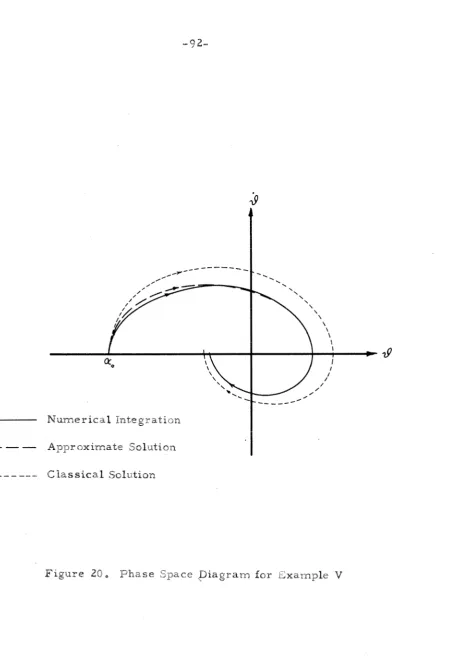
PBaoe S p c e Diagram, Exam2la V $82
F i g u r e
-
Page 24 , Trajeetoriaa Through Saddle Points for UndampedSystem C o ~ r e a p s d i n a g to Example
IHI
96
25
,
T
rajsctsr y Through Saddle Point fop & ? d a m w dSystem Correapsndzng to Example V 97 26. T r a jecCory 'Yhrsaq$h Saddle Point for Uradamped
System C o r r e iipoadiapg $0 Example V I 9 8 27. Trajectory Through Saddle Point for Gndam?ed
The sslutfans to the equations of motion of an airplane when subjected "c srr~all disturbances from steady flight have comprised a standard p a r t of the c u r r i c u l u m for students sf aeronautics during the past several y e a r e , The classical treatment of the problem i s due l a r g e l y to 6 , W , Bryan w h o applied the theory of small osci&fa- tioars p r e v i o u s l y d e v s l o p d by Routh. B r y a n assumed that the forces and m o m e d s due to a slight disturbance from a state of equilibrium depend linearly on the diahrrbancs
.
T h e solution i s than shown to depend on a number of constants called stability d e r i v a t i v e s , For many y e a r s , t h e development of a n p r i m e n t a l techniques for d a t e r - mining these derivatives haa been the yr inelpal intareat of BnvestZga- tors in the field of dynam~ic stability as applied to aeronautics, U n t i l v e r y recently there has been little or-no
change in the theory and iti.s in u s e today essentially in the form developed by B r y a n .
It should be noted that the etassical theory applies strictly only %a the c a s e
d
idiniteaimaB d i o t u r b a n c e ~ , H o w e v e r , the rasufts have been found to apply with reasonable a c c u r a c y to finite d i s t u r - bances of " t h e magnitude experienced in the f l i g h t o f conventionalsubsonic airplanes. In other w o r d s , the second order terms nagleetad in tha theory do not h a v e any a p p r e c i a b l e effect on the motion.
that the applicability of the theory is questi~aabHe. In the ease 08 euperssnaic rocket-powered mtssileni these violations are parbicu- f a r l y flagraat. Xar the first place, s u c h m i s s i l e s rarely f l y at con- stant speed; on the contrary, the u s u a l flight comprises a period d v a r y "nmigb acce1eratioa f o l l a w e d by a lens r e p i d deceleration, Secondly, %ha cssmple~e f u e l supply is often cshdasumed in a. very s h o r t time, giving rise to appreciable variations of mass and cen-
%as of gravity location, Thirdly, a portion of the flight is some- times vertical in direction, haace Lkie atmosp"9nric: density i s rapidly varying. Z a a these reasons, the aerodynamic forces and msmcBtls
-
the s t a b i l i t y e'Berfpitakivas-
a r e e%abjec$: to appreciable variation during the period of the oscillation baing studied.Eut perhaps the most se riousr deviation from the conditions of the c l a ~ s i c a l theory occurs when one attempts to extend the re- sults to the ease of finite disturbances. In most missile configura- tions, smafb aspset ratio \vings are mounted in tandem cdla propor- tionately large diameter bodies
.
T h i s exaggerates the aerodynamic interference effects and slaeh missiles exhibit markedly non-linear dependence of the aercdynamic farces and moments UP the angle ofa t t a c k Consequently, the amplitude of disturbances %or w h i c h one would e x p e c t the r=laasicai theory to be valid is esnsiderably reduced. But at ehs same time, in the normal operation of s u c h m i s s i l e s ,
-
3-Weirace it would appear that, in the case of guided
,
theexkeasion of the theory of s w ~ a l l @scillatle>ns $0 finite disturbances is vary questibnable.
The effect of variable speed o n dynamic stability has beans
investigated by
N
.
3 , Stewart (Reference 1). He con~ideted the caseaB:
%s rnaiesile in coasting flight, decelerating under the idlra-encle
d
drag.Hi@
results show that al%bsugh $be effective damping is decreased in this case, Lhe drag does not lead to inahbil'ily.The effect of variation of m a s s on the dynamic stability s f jet pro2elled miersiles has Been iavesbLigated by N . V . Barton ('4 tf-
srence 2). His analysis chows %at the diaturbamrt-e of a missile w i t h decreasing d a m p out meore rapidly khan it d a s a bsr a csnotank %-%lass m i s s i l e , indicating that variable ?-decreasing mass is more stable. A%$8 the escnillaticn ft-equaacy of the variable mass
missile inacreasas wi%h tima and is greater than the oscillation f r e e quancy of the C O P ~ S L P P ~ S ~ maas mfssiPe.
In Past BY' of the 2resent p r p r , the effect on the Po.trgiQ.kxs"niaof
dynamic stabi l i t y of the variation sf eLmoapBarie density is8 vertical
flight is conefdesed.
The
analysis is reatrietsd to the care of in- finitesimal 6iskurbances so &hat the forces and moments depend 'timarly on the angle of sttack, The stability dersivativaa are, haw- e v e r , fusaazeians of the indepndent wriable, and the problem isb y the n~ekhoda of mathematical analysis.
In Part V of the presalzt p a p e r , the e f f e c t sf non-linear variation
of
lift and pitching moment w i t h angle of attack on the dyaamic rts~onse to a s t e p function input in angle of attack l e in- vestigated, T h e missile is assr~mad to be f l y i n g at constant speed and altitude. The problem is reduced L a an ordinary ~iracond o r d e r non-linear differential equation which c a n n o t b e solved exactly by methods known d d a y.
Wewe v a r,
approximate solutions may beobtained, and by the mathod of numerical integration a ao'XutIon to any d e s i r e d degree of a c c u r a c y can be obtained,
The stability of the nen-linear sy &tam i s determinzd from considerations of the solution in the neighborhood of the crbticzl poinks of the differential equation, and the i n v e $tigation of the dy- namic response is e o d i n e d to systems w h i c h have been previously d a t e r m i n e d to be stable.
In its application to a guided missile the problem of dy- namic respans~ p r o p e r l y involves "%ha combination of the misslke
- 5 -
to :>rotride satisfactory steering sf the n2issile
.
in the present a n a l y s i s an a t t e m p u s made $0 approximate
this overshoot without resorting to the tcdTouc3 method of aumeri- cal integration. A com;arison s f this a2proximatiesn w i t h the nu- merical sofertisn and the linearized solution is presented.
R v e r y i-mpcrta.911 problem confronting the ae rodynamicist working In the field of guided missiles is ikc reduction of flight t e s t data in order l o evaluate the stability d a r f v a t i v e a , One of the
p r w e d u r e s followed is to analysc the transient re-sgonse of the missile to a. s t e p function in?& in the c o n t r ~ t surface deflection. T"as is eqrrivalerlt to a ste; fuqction input in the angle of attack.
-6-
IS.
(SBCRDP2GaTES, P;GTATBI;=:f<, SYMBCLSThe equations of motion for a missile ean be referred to a s e t of body axes which a r e fixed in the missile and move wi&e it. A n orthogonal s e t of p~incip'i body axes with artgiw in the missile canter a2 g r a v i t y , the x-axil., the lobgitudina'h centerline, the y-axis
in the rmsrmakly horizontal pHma and the z-axis in the normally ver- tical p l n e
,
2s selected. This coordinate system is shown in Fig-ure 1. The v e P o ~ i f i e s , m ~ m e n t s , angular velocities, diaplcemt?n&s and angular displacements are all defined in accordance with the right hand rule
.
A , B ,C , D , 2
,F
=
coefficients of non-linear eqwtion c ~ f mation-
defined in text4:
=
reference chord for moment coefflciente, f$%=o
=
damping constan* for claasl;ical theory cvalwted at sea Level, L'rp/secP L
""I-
=
& p v 2 s
= 1st coefficientCL.
-
-
-
aC,
ewluated a& t r i m positionK t aa
-
-
a C M evaluated at = 0 a(dc4vC ~ q
-
-
a evaluarted at: q=
O a(qc/,v\3
,
=
incomplete elliptic integral of f i r s t kind8
=
acceleration
of gravity, ft/sec2E
x =
S(r12+
zydm
s moment of inertia about x-axis ( r o l l ) . ~ . b i;eeZ/it.=
)(xz+
zqdm=
moment af inertia about y-axis (pitch).
Ib seeZ/ft=
![X'+ 'j2)dm=
moment of inertia about z-axis (yaw), Ib sea:Z/ftk
=
parameter defining variation of rafatlvs density w i t h altitude.
L/fc.k
'f,2,3
=
conotaanto clsed to define non-lin58e" l i f t c u r v eK
= cons"eands u s e d to defina non-linear morsrent c u r v e1 , 2 , 3
= aacce'terometer reading
= e
- -
a'
=
perturbation in roll rate (angular velocitya t
about x - a x i s ) rad/sec=
l r a ..d/seca t
= steady s t a b of value of P ae
-
a t
= p r t u r b a b i o n f r z p i ' t c b r a t s ( a n g u l a r v e l s c f t y about y-axis) aad/sec.
2
= $ p V
=
dynamic p r e s s u r e , lb/ft 2= E pertarbation in yaw rate (angular velocity
about z-axis) rad/sec
a @
=
9
=
-=
~ P W rats rad/sctra t
= steady state value of W
,
radfsee=
r a d i u scPt:
c u r v a h u r ~oP
flight path, ft.
= reference area lor a e r d y n a m i ~ ca~?Eficien"lt, sq, f d .
=
time, S B C= velocity ssmpseaznt in w-direction ft/sec
=
steady s t a t e value ofU
fi/oee:=
steady state value ofV
f t/
s e cv
= missile velocity & / s e ew 3 velocity perturbation in Z-direction ftlsee:
iV 1
=
s t e a d y state value of %;x , Y , z
=
coordinate a x i s , r tghd handed principal body axes (x-all.. pitcb, yaw axis respectively)X
=
force in x-direction, BbY
=
force in y-direction, Pb'Z
=
force in e-directionXU
=
dX
=
Resistance derivative, rate of change of f o r c ea
u in x-directiea w i t h velocity in x-direction, Sb-sccjft= resistance de;ivatives('f. ~ b - s e c / f t
1 Y
CL
=
angle raf attack, rad.
8
=
~ r t u r b a t i o k ~ , ihagufar displacement in pitch, rad6
=
angular displacement in pifci~ measured from horizontal, rad0,
=
steady state value of QDA
=
10g~rSthmic decrement of r e l a t i v s dens & t y variation w i t h altitudeP
=
-
=
relative density6
a;,
=
relative density at 35,000 f t in the standard atmospherea;
= relative dcrrrasity at attitude corresporildimg to xZ = time, S d C .
Wt,
=
natural undamy%d c i r c u l a r freqaeracgr,
radlses:52
=
phase angle:, rad-11-
EII.
EGUAF18NSCF
b"2GTPCNThe equatioplas of mstion a r e referred to a s e t of p r i n c i p l
body axes; bancs all momcat
of inertia
terms vranhsh. It ie assumed that %Be mti.lsilia is initially in ia atale! of steady flight, .&hat the linearanre$ angular velocities and displacements can ba raprc seatad a@ :
and that =
PI
=g,
=T=o.
It is also assumed that 6 is suffic- iently small thaO s i n e m a y be laken equal toe
and cosi 8 may be taken equal to m e ; and that u, v , w,
p , q, r are s d f i c i e n t i y small that their squares a d produets m a y be naplacled. The eqwtiswe of motion a a given fa Referaace 3 are then:-P1&-
where the second order terms are neglected. The partial deriva-
aX
t i v e s are then written in the form =
X u
and are known astr"stability d s r i m t i v e s g \ 18% the saaItysir of the effect of the density
gradient on PongitudimL dyaamie stssbili%y, this assumption is made
.
Burt in the analysis of the effect af the non-linear vorizatfsan of pitch-ing moment an6 lift with angle of a t h e k sn the dynamic b b v i o s of a missile, the seeand and third order t e r m s in d W a r e tacladed in the axprassions for h4 2 . A ~ ~ o r d f n g f i y . issateiread sf the u s u a l notation,
Mww
,
Zwvv these term@ are w t f t k nM(w)
,
Z(w)respec- tively.If the missile has a fonqitaadinat plaac eaf symmetry (which is u s ~ a 3 l y the C I B C ) .sad fP it is flyfag at zero yaw, many sf the a t r -
bility darivativeo are %era and the a@% @Pf six aimlalehaaaou~ equations
P t ia to bc ampkfsaiaed that these equations are referred to priprcipl b d y axes instaad d the more @ommonIy used '"wind"
axes sr so-called H s t ~ b i l i t y 8 i u e s , and that t&a a p p ~ ~ p r i ( ~ ~ t e exm pressions for the stability derivatives m u s t ba ansad.
Geslalnsida ring the langlturfi-l eqmtions (31, it, f s oboer ved that
if
2,
=M,c
0,
Eqtndations (3.a)
and ( 3 . 3 ) become i a d ~ p e n - dent of Squation (3 . f ) aad. tke pitch matian can "ea ddaaerlbed by a t w o degree e$: freedom s y ~ t e r m . For a misciiilhs which is symmetri- cat; w i t h respect to t b yaw plane &ad whichIS
trimmed at zero angle of attack, It is a p p r e n t that the1wiA
and momenton
the mis- s i l e are s e r o and their dcriva-stiveo with r a s p c t t o u will be small@mall angles of & t a c k tae coupl3nq of u w i t h w and 8 1s srerrra81
arig
that the s y s t e m caw be adequately treated a s a two degree of f r e t - d ~ m syb~tem. This means that the fdlaaence of the long p r f s d mo-tioa on the short period motion is negligible. Calculatiesnr for rtpr~sanLtaLiva m i s o i b s &ave been carried out and
this
is indeedfoumd to be the c a s e . The re%arslLts of these calculi9lioms a r e g r e -
seated in Table I.
It is notad that %he long p e r i o d %or a s u p r s o n f c missile i s
of the order sf 100 seconds w h e r e a s the s h o r t l.period i s of the order
of l second. Therefore it .la to be expected that the long period
-
14-it ia obvious that the short p e r i d motion Is the aolna which 5s im- portant far steering aad codrol
.
The long * r i d mation '616tauld;lappar to 'be of little practicat impop&once riace t b ~ assumptions m a d e will certainly be violated during the C Q U P S ~ ~ ~ OQ the long per-
iod.
If 10 i s
assumed Chat %he missile is stabift;ead in roll, thelateral eqtt.stf ons (4) reduce 6-0 ctsxacdly the same form as the 10x1-
gitudiml equatian~ except for the g$ravff;y t e r m s ,
Returning t s tba lorngitardiml equations, dividing 2cguation (3.21) by rn ( 3 . 3 ) by
IIy
and designating by primeair the qepann-There rernriias a botftarsome term in these sgguat,lona, mmely g sin
Q!
e.
If
$he missile i s flying at a small angle rsf climb,s i n @, 2 0 and thir term may be neg1ected. However, ak~, is
d t a a Lbe case, If the missile is flying in a nearly va~tieal dtrec-
tiaa,
It i s
not ~tsiapprel.tt that &his terms may p r o p r l y be neglected.t h e c u r v a t u r e
oih"
the flight path due to gravityT o
neglect this termwould seam t o bs r reasonable aesaamptfoar, sirace the time Interval for whieb the motion is baing studied is of the order of five t o ten
second%, dellring which t h e change in the flight patb due to gravity w i l l be @light:. Csmg~ta&ions for rep~e?se.tsbtiird cases b v e been made
and the rasufts are ohown in Table I. These raawlte Indictate that
%&ere i s no appreciable e r r o r irervolved in negbttiritg gravity.
Noting that
Z;
< CU.
andZ*
44I
,
henceZ;
andZi
can "s neglected and Equa%fesazls (Sf a r e w r i t t e a :
W.
-z1W)
-
uq
2,'
+
U Q ,
+g
cos0.
w ' +
U,Q,
+
g c o s @,4
=, Ul Utasld & I f f e r a n t i w i t h re spec* L s time :
-. I$ -.
If
it i s desired to esmputc the respsnss to a s t e p function input in control surface deflection, the forcing functions,M:
and2 :
can bo written as step functions and the response computed directly f r o m Zquatilan ( 9 ) . T h e incrementaI velocity, w,
i s m e a s - ured from the original t r i m gosi&ir=rn and Q, 8d @, correspa3nd tothe steady state values at the original %rim p ~ s i l i o n . Altero3gtively,
a lineas t r a n s f ~ r m a t i o n i%n w can be made suekt that w = O carrea- ponds to the trim position a t the n e w cetntrof ~ilrfa~ltf defleestisn, whence Q, and
8,
are r s f e r r e d ts the new t r i m position. The so- lution of: the %ramsformed B Q U ~ ~ ~ G ; P ~ is7 found subject to the initial con-d i t i o n ~ , ~ ( 0 ) = WO and
w
( 0 )-
0,
w h e r e W, eesrrerppowds ta theold trim position measured in the new c ~ ~ r d i a a t e system.
ff
thislatter viewpoint is adopted.
M:
= 0.
21
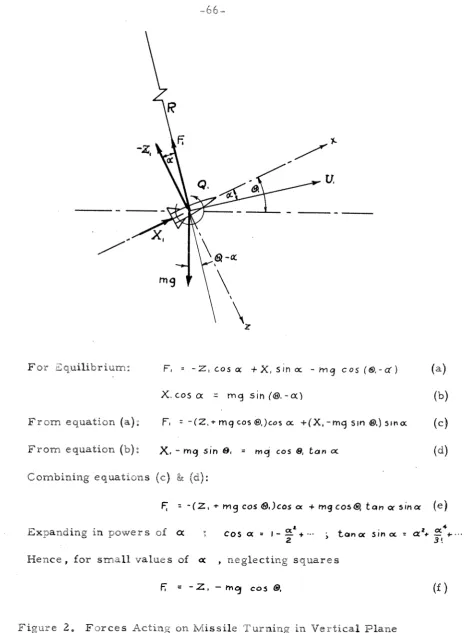
' ia the aerodynamic force in the a;-direction andQ,
6s the angular velocity for the steady state mstion in the m w trim porition. FOP the steady ~3Lah motion oi the missile in a vertical plane* e q ~ i l i b r t a m of farce@ 5m the z-di-ractiotn, negkecking squares of the angle of sttack (Reference Figure
2 ) , requires:
- Z ,
-
rnq
c o s8.
=m
R.Q:
w h e r e R, is the radius of curvature 01
the
flight p l h .Bill
U,
-
Q,R.
.
hence -2,-
rn g cor4.
= m U,O,
or-z'
- g c o r4
=uQI
and the right hand side of Z5wtlon ( 9 ) t a a e r a , The problem Is gaswTo
investigate the effect of the atmospheric density gradienton the dynamic stability aP a missile, the analysis is restricted to
fnAaitessimaP disturbances from steady flight at conatant speed.
Accordingly in Equation (10).
M?W)
and Z i w ) are written in the *usual form.
M,
w and w respectively. The a s ~ u m p t i a n of a t w o degree of freedom system is still valid andthe
effect: of gravity may still be meglaeted. The only difference from the classical theory is that the stability derivakiv6?s a r e not pure eonslants but are naw F;u'tl,ckiof"it?r of the densi&y. This dependence on density is exhibited by w r i t f a g the derivatives in the form:z,
=zL0
rMi
= ML0 a-M;
=M q e g
M
=:
;
p
,
bw h e r e Lha subecriph, o
,
refers tc s e a l e v e l conditians,
anda=
a
( X I x being the distance along the Plight path.With this nsCatiam, letting
=
d
u,
Assuming vertical %Tight
and
letting x be the vertical distance above35,000 A , the standard atmsrpherie: deasity variati~fa w i t h altfgude
- A X where is the relative
U-=
cr,
e
density at 35,000 PL. ( 14)
Now the aquation of motion becomes:
2 2 L
d2&
h
T 4-~:h'q
*
-
C,,U,XC'
"
+(-UP(,?
+ z ~ ~ M ~ ~ ' + U ~ & A O - ) Z ~
(15)do-
do-
da- = 0Making a chanpo oi var;able, z =
C"
an; dividing through byU' X
Zquation (16) become s :
$8 ometr ic f unctlot1.
Consider for a m-ament J ~ c o a t i o n (18;. P t i s noted that
Z , M ~
< <U
M;
.
ixenceZ,
M;
m a y be w l t c t e d . LettingZ,,vd
Mie
= O Zqwtioa (1'7) reduces exactly to the csr-ePfluertt hypergeometric aqua- t i a n , which writtan in standard form is:This aquation has an exact solutircsa valid for all finite I which is expressed in standard form:
The values of the parameter,
,
for two representative missilesthe series being unUsamZy aa9 absolutely casnvergegitt for z
,?
real and 0 S 2 6 X.
'TheAk
are given by the gelaerating functimSubstituting into Zquatfsn ( B O )
2 z
w h e r e (4d2- 1 2 X 4 ~ - 3
.
-.(42/2-~2r-~j2)(21tr)
=
22r
r!
z
Stabt%%itutl~ag SquatLon (23) and neglecting
-
higher powers ofu(
Z
and since i a neglected corn- pared to 1, the quantity
{,
+(hz-
irf
is to be replaced by 1 andW i t h tkase sasbetitutiesns the ooButtoa to Equation (18) is then given by:
- I
where € ( z )
=
t a n i laad C, and4,
ass constants tolca
-I
bs determimed by the Initial csnsditioas.
To get the S S C I S ~ U ~ ~ Q R in terms 0% the disOk~ll~ce along the flight
c,
% -AXpath note $ha$ Z =
-
e
wherex
is the altitude measuredV, A
from 3 5 , 0 0 0 feet. XaLrodu~b tha paew variable,
y
=x -
X , where X ,is the value of n when "be Bisturbakzca seglurrs. W i t h
QBIs
natatiom:-
M,neglecting Zke esmgaired t;s
-
A
where a; = a;e- r X I is the value of the relative density when the
ZP
=C,
exp{
%A
e-Ay]
F r o m ZquaLicaa (29) it is sboerved that as y becomes v e r y large the ompZiQude
of
the oaeilk%isrm, khough it may decreaseC 0;
initially d c p n d i n q on the value of the praizmctea
,
will even-2 U h
tually become and remain very large. This irmdieatesr thank a mie;sile which is stable in a iconstant density atmosphere will even%uaTly be-
c a m e unstable in vertieat flight through the standard atmosphere, To investigate the initial stability sf tho osci'ilalion,
e-xy
is expanded in powers of X y
.
The amplitude af the sscitlatirsm is than given by:which for s,mali9 vaEuea of Ay may be written:
From this it is aean that OBc initial character of the osi3;c:llati~sn w i l l
be stable if the p r a m e t e r
'
and unstableif
-
COG (a
The preceding analyeis is valid for Y( large c o m p a r e d to z This occurs, as is seen from Table I i , at high altitude. A different
aeymptotic e x ~ n a i e i n for the eodluant hyprgesanetrie: Pwction must be aseel for low altitude tzcaoss w h e r e r( and z arc of the same order. Rower vest, aa al%ernate procadetre cans be followed which w i l l apply equally well for .a31 a l t i r ~ ~ d e s , The fact that tP1~ asymptotic expaa-
@ion for the codliuent Es(ypergeebmstrbc: fr~~tetiors io expressed in terms of S e r a e l functions suggests that a differeat appraximatisn I s the relative density gradisat be made in O ~ d 8 1 t o reduce
LBr;
dtffercsatfal.Ht is observed that the density variation w i t h altitude
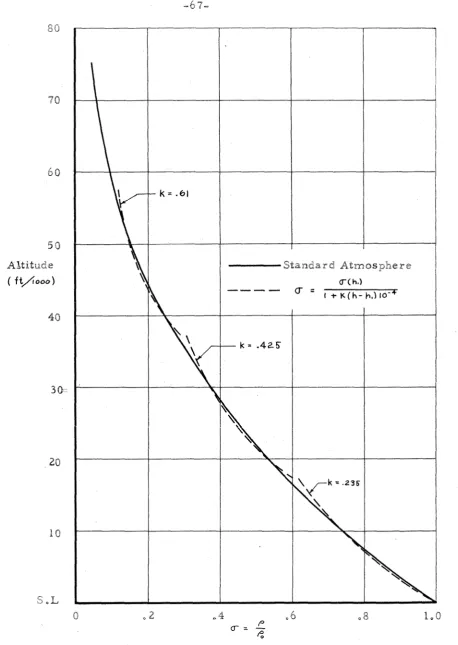
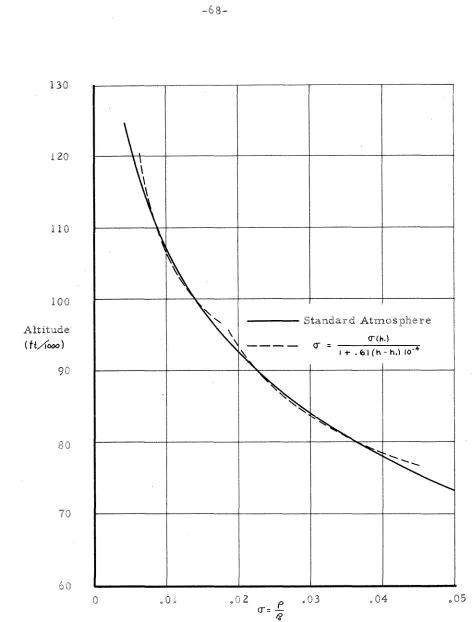
%(fir
#bestandard atmosphere can be zspgroximated fat: limited incremeate in altitude by a hyprbola of the form:
where x s alt.$ittt$a measured in f a s t from sea Level
x, s altitude where %be disturbance from steady Plight occurs
g =: the value sf u ( x ) a% x = x ,
Such an approximation w i t h
k
=(
a;-
I).
ld4is found to bea- (
r ,
+ l0,000)~eabot~able for increments of altitude sf the order of 10,000 f e a t .
Sub;igti$utin@ this axp~ession for cr(x) in Ehlazation (13) the
C,o;
.
'd 2 i 9 + z - dd
and
-
-
-
d ye i t k y dy (33)
I
Substitute + Y = Z then
d
=d
and the equation of motion is:dy d z
whieh is a form sf B e s s e l f s equation and its rgslu$ion is given in Ref- erence
6 o r :
where
2,
=
B e a s e l function or order pw h e r e
C,
and tfz a r c eonsts.glles ha be determined by the initial con-ditions
.
Now it is clear that the damping of t h e system is expressed by the exponent of a:
where
co
is $Be sea IsveP value of the ~ogarithmig: decrement as defined gar the classical theory and given by:c.
= -M;* - u . M ; ~ -zL0
Rew ritifsg the damping parameter la a form which more clearly
where 8 =
(&)(-$I
the missile eodigurstion and &Iach number only, wkf ta the second
,
csntaias the depndenee r;=a'l?i al%itudo.
F r m kheexpression ( 3 6 ) above, it l o clear that the mLasife is stable if 6 >
-
27-would mean stability. Heaca again the rstaule is obtained &bat a misigilt which .1-8 stable i i a constant density atmosphere, such a s experienced ia level flight, @ran become metable in vertical flight due Is the density variation, I t i s seen from (37.1) above t h t
,
since the damping factor C, decreases w i t h Increasing b+Aach n u m ~ b a r at auperks-onic a p e d s,
an& since 1.Saach number appears exglieitly in the d e a ~ m i m t o ~ ~ of ah@ first Pactar of,
and sincethe relative d e n s i v of the iniLio1 altitude apparks in the nl~~rnerak~r of the second factor, the tendency toward instability increases
with b&b increasing initial altitrrda aplrg speed.
It -la to bs a~~~pfrlariecd that the kayprbojtie variation of
deasrty with (1~~ltitt3CIe is a r e 8 8 6 n a b 1 ~ apprwimcsrtion only for fim- ited intarvolrs of s r l t i t d e , hence the otabifity c r i t e r i o n p r h i n r a t o
%ha initis1 stability af the oyslcism. The resbtPt i s then i n axact agreement with that gzbtained'pseviouoly ( E q u t i o a (31) ) iP k is
regtiaced by h
.
This
instability in vertical flight ean ha explained pbysi- eelly.
1l
the missile is undamped, the t o h i energy of saci12atisa remains constant and war i a s sishusoidalljr batweanz af 8 potentialenergy and aPH kinetic energy. The potential e n e r g y is istored against the t t a e r o d y n a m i ~ spring1', and if the spring becomes weakened during the taacillatioa, which i s the case in vertical
-28-
if the missile I s d a m p d and flying at constant altitude
,
some s f the energy w i l l be dissipated In w o r k done against the damping f o r c e s , and the sum sf the: potential pPas kinetic energies w i l l de-crease, hence tb@ &mptl$ude of oscillatfsn will decrease. Cam-
bitzing these t w o e f f e c t s far
&
damped missile,In
vertical flight, if the damping is light snthsugh, the increase in amplitude dm to the;: weakening spring w i l l outweigh the decrease due to damping with the ask result that, tke arnplibuda increaiss; and a e the missilespeed increases, the aerodynamic spring weakens mote rapidly and this effect becomes more pronounced.
In Figares 4 and 5 the response of a disturbed missile in
vertical flight eompaked f ram the above analysis is presePa&e$ Zgb
comparison with the constant dawoity case for high and low alti-
ttsdc. It is noted that tha affect
i
d
variable density is sregligibleV. ETFZGT
OF
M G N - L P N L ~ ~ R PITCHING ~ I C ~ ~ X E H T AND LIPr
VMlabTIBM -WITH ANGLE
OF
ATTACKOH
$= RZSPONSET O
A
S"PZP GfSMC'TliCK INPUT IN ANGLE GF ATTACKIn
order to formulate the p r o b k m 191 a manner amenable &asolution by analylfeal means, kba pitching moment and normal force
a o functisns ai the angle of attack are approximated by p1yaoomiafs.
It
ifs canve~rient ts use eubic p a l ~ a m t a l r sE the form:where ?P is the t n ~ r e m e ~ l b La a n g b of attack meatirured from the trim
W
pssriticzza. Since w is a small qusatity compared with
U,
,
29 =-
u,
negfeeting higher order terms. Subatituling there rdslationr~ in&o Equalion (10) and collecting ta rmo :
Before proceeding with &he ec~Putisn of Equation (39) iS is ciasfrerb2e to e s e b l i a h the stability af the system, T h i s is done in the usual mannar by csnilridaring the so%;utie;ts in the aeighborkood of the critical points of $he equation and ideati.P"yi.ktg the type of the
-31-
eal examples c o n ~ i d e r e d In this paper and is presented ia Ap-
pendix 1,
Aasum.Eng a stable s y ~ t e m , it fa desired t o find a solution to the equation:
srxbje e t to the initial conditions : $(o: = Q,
29Co) = 0
v;iahera in particular,
f w
=A
+ B Q
+ m 2
and w i t h o d loss of generality go is taken
<
0.
Uafartumte3ky%he exact s~fation to this equatiaa cannot be eprbrssoed in terms
4
the known filsnctianmsePE
m a t h e m t i c s (except in the cases A=
Bdegree sf acccracy can ta obtained by the methods of numerical integra2iort. This prscsdurs is tedious =hen done by hand and. is best accomplished b y of autozqatie computf$~;g machines. The latter method 1s expansive and 1"~s additional cast can net al-
ways be Janstfffed. 1% i s therefore desirable to find an approximate
-32-
An iteration ar gesrturbatian procedure would a p w a r to be i s order. Nwseven, since
g(z~)d
19 of the3 third power in f(tP)is of %he 6.saco.waS power in zP
,
the di_ffem;a~%ial equa%ions fa^^ thesecond sad higher appzh~ximati oas bsecama imraasiagly complex and the rrunncr ical appllcatl~3~~ of %he r e s u l t @ to any s p c r b l c axample
b c o r n e s even mare I;edi~as ~ % P I Z . I the numericaL integratio~"f, willPIf~ the rersulQs are? PIE?SS aceliar
a%*.
A l s o , there Ts tb~s Q E ~ @ @ % % O T ~ 02:hawmany terms mast be carried, Since the solution is e~7?sassntlslIy il Fourier expaston, and
term&
of the formt
sinat and t c o s ~ t occur, which beecaw large as % becomes large. Theag? t e r m @ do not corn- stitute ;a diverges-ace if Bha e a % $ ~ @ r s r tee I-s taken, ortinee t h ~ y are cancelad out by srtaboeqaent terms; but the? queo%toaof
bow many terms must be taken to insure this ~ a n c e l i ~ g is nat e a s i l y anrswersd.For
these reasons, this approach ha@ been absadowd.
A
r-dtp by step approximating procedure bas bean r~sal~rLei4.to. The equatim is linearized ayes a closrsd intervial of the nmglf-
tudee of 29 the lineariasation being b a e d QPB a time average of the
reepoare over the inkerval. TBs conatal-n&g used in the linearisation
are changed for each &tap.
In
%he ffollerwtng sectioa, this m e l h d is d o v e l o p d amd explained. The analysis issf
neeese1t.g~ Paeking in m&%hematfsal r tgssr and re kh h~ het'itjlPy 37a phyafcal Entenitioa amd analogy l o %Be well-known linear srcllbtor.
The eafUlf0~1: $0 kke dqaati~n:
- 3 3 -
where l( axxi
wn
are constants, subject to the initial condition&:d(0) =
a,
$('a) = 0
is w a l l known t o be:
w h e r e
and $336 firad; derivative ia given by:
w, - 2 t
2b
= . - q , ~ ,
-
e
sin
w tW
If
values of W: and q are oehcted to replace c j @ ) and f i e ) r e -r
tisn (41). the a p p r o x h a t s solution can be written
a o EqalSan which w i l l be valid for sufficiently emall values ;.g
time
.
It is noted that in the lhesr y Es% small csscillatloars,
w,Z = C and R= A
,
but this approxbatisn is unsatisfoct~sy for the mgniteacie saf va 2uaa of 29 under conside ration ha re.
Before ealecli-eng a graiue
d
,
it fo observed that in tbe fiitaearias-ed case, the damping factor, Q has P s e e a d order affect on the frequency, O.
For example,if
!.@
= 0.6. i.e. the systemI s 600/0 critically d a m ~ d , w = 0, BG
,
-i .e , the frequency is 8Oe"/ov.2
-
34-tem is 20% critically damped, w -1 0.98 d,,
,
i .e. the frequency1% apprcjrlmata8y 98'i0 sf: the undamped nolurel frequency. Pn the
capes which arise in practice, the m % s ~ l i t ~ ? is ilmsider~bly leas t b n
60%
critically d a m p e d ; in fact. it i s usually of the order of 25% or less. Since it is desired to find 29 as a function rPt: time it wcaafd seem reaeom~zbfa tto s a f a e t a values of w,, corresponding to the $re?-queney of the undamped system.
Accordingly, consider for the moment
f
(29) 2 @ r 0.
Nowj + w : &
= o
zP(0) =
aO
) ;9 ( 0 ) = 0Equation ($4) can be solved as fo?lows:
Ine9?gratixlg w i t h r e ~ p c t do
9
:It
q ( 9 ) ia a pe1ywomial in d,
G(Q,)-
G(9)
will atso be a polporn-Pal in d
,
and henee,2'
= P(d) w h e r e P ( 8 ) i~ again a polynomialand integrating:
which defines ZP as a function cf t
.
Similarly, G q u t i o n (45) can ba solved and its solution is:
Letting the inter vaB under consideration be
qqo
<
ZJ g291
wherea,
< o,
and from E ~ u ~ ~ Q P L . (30)
and the approxima& eol%l$ion t o Gqwtiesrs (44) caw be written:
from which:
9
= -GC,W, sin a t (54.1)where tbcs integral on %bet right hand side represents the sz~esgy d i g s i p l e d during the %ime ZP varies from OC, to 10
.
Letting ED,, represent this integral:Similarly for %ha Pinearised bayatem:
and
Subr%itut.ing the approxiraats solution to dqwOion (44) as given by
Equations (54) and ( S B , 1 ) into 2quations
(56)
and ( 5 8 ) :wh
= a : ~ , ,
~ ( ~ . G O S X I sinzx d x(5 92
Mow $18; the end of lime
t,
,
equating the energy d i s s i p t a d in thet w o s y e t e m s , i.e.
Eo15
= and solving Bor 4 :The apprmimate oolatioro ts EqwLlon (41) vatid in the time inkrwal
0 4
t
&t,
for whicha,
c
29 4 Z# io thea:a, e-$t
w h e r e
- 1 "9'2
= t a n
(;3)
DiP'bersntiaiinp huation
(bk),
the value s?f.rb
is forand ta ba:w,
- 3 t+
-
e
sin w tW ( b 3 )
It is abser ved from Eqhxakiaas (43) for the l i ~ e a r i a s d system that as
idarclticakfj. with Zcwtion (54.1). The quantity (a,ccl,( r a p r e s s & e
For the non-linear case with e e s o damping, the angular ve-
locity, i s given by Gqs-tisjn (48) as:
which in g e n e r s l w i l l not aqua1
.
The maximum value of4
for the uprldasnpd non-linear ays.&sm is obtained when d is e q u a l to zero in squation (48):
%,,
=.tlli7;;;;s;
For the linear system, the m a x i m m value of
2b
is:q,,,
= l c w , ~ " lHence,
if
the q u a n t i t y - ~ Y , w , in Lqudtloo ( 6 3 ) is replaced byd
m
Bbs approximate expression for4
becamas:w h i c h in the limit a%
q-w
o becomes:2b
=If=
sin G J , ~(64.1)
1"ehoetld be noted that the exprsssnsn
for
zb
given by Zquation (64) ia aol the time derivative of %he approximate solution bar z0 givem by Equation (61) but it bae &he same general characeer and gives thsproper value
d
@MA x inthe
limit as Q - c o , Baeaua~se tks ap-p ~ o x i n s t e value
~f
G ( t )
obtaiaed in this way iar not the Lime deriva- t i v eof
the approximate value sf 3 ( t ),
the fuactiomsG(t)
and d t )should be treated as unrelated functiono.
-39-
a?~eiTLtion. Z f the e y s k m is rnot eonsarvalive, i . e .
f(4)
fo
,
this amplitLuda -;t.elI change: w i t h time and af%er %islat 2
its mag-- nftuda f a givea by:The genasal procedure oattined above corn bs eon%iauad for swother intervsf
d,'
<
d
stO,
,
using the reeiiezczed value of the oscillation am-plitude to determine the value 0%
w ,
,
and modifying the procedure to izk~cs;;cum% far the d s f e r e n t initial conditions far %%a a e c c ~ d i n l ~ r v a l ,since
zb
(t,) wiLJ ia g e ~ e r a l not be e e r ~ . This soIa%ion w i l l be vatid fortz
St
t tf.
Fo13Lowiag this steep by step procraais,
the aolutisncam ba coadinzued
,
an4 by saleetiag the interval% of timad @uP"%iczialw$lyemall, the approximate. solution can pre s u r n ~ b l y be made Lo differ
from the exatk salutioa by sz3 little ass desired. Furthermore, t h e approximate atsPu~isra, fsr the u f p d a r n t ~ d ease given by Sqmtisns (61) sad
(64)
byb a i n g
Q-
o and kbe exact selra%fon in the rudrarrtpdcase given by Eqtpa&iano (48) and ($9) agree at t = o and at t = t, irreswc"rivs
of
the magnitude 08t2
This suggests, by amlogy to the d a m p d liaear ab y o t e r n , that in t"ns case of omall &;amping, the apprresximte s ~ l a t l e ~ n s sBglul& be reasonably g o d for f a i r l y-
43-choice of t,
,
the a p p r o x i ~ ~ a t s eolutian can be written:for o ~5 t, t
,
a , s ? P S oti
=
1 / m ( $ ) e - t t
sin
w t
E + ,
And w h e n
t =
t,
= 2W
t =
dEGi
(2)
c3e
(7118
For the next interval, it is cepnveniani %a eheroec
t,
such %batzb
w h e r e
5,
is the amplitude af t"ce peak sf the undamped a s c i l $ o t i ~ non the spposike side oi a@ ra f rem
a,
.
Meace G ( 6 , ) = G(a,). ;H$q ( t 9 )
8 is an add function of 29 them 6 , = 6 ,.
Lelfing 'C
= t
-tz
where t = 0 cclrrrspoads to 29 = cX,,zb:Q,"te sdeoad interval as" the oscillation ia g i v e n by:
Tbe process i~ then cr3.p"t-t;inued
LOP
a
third interval such that 'LP war- ies from ZP(t3) t~ o ; hence this i n t e r v a l is exactly aimifat. to the f i r s t . The f o u r t h ' k ~ t e r v a l is; similar to the second, s t cctrxa.
T h e procedure oatlined a k o v e can be followed for any %&a- eronabb functions f(2.0) and $9) provided the amplitude of tkc os-
cilPati~-ns considered is such that, the system is stable.
Pt,
is foundintegrals of the first kind fear &he determl~ation
of
W, &ad thesefunctisno ore bbulatad
.
U higher order pslyaomiais are used, %he integrals w i l l hawe to be csnnputsd.Saves r~gresernbtive name-sical examples hawe been worked oat by the method outlined abstre. These w a r e taken from acdraal
sC
missile ~ o d i g u r a t l ~ n b and include high and l a w elltfiude o p r a t i o n st differcotl Mach namhfegfs and aaglea
cd attack, T h t
iattial c0';9tditioz%.~w e r e ehossn t o eorreapond to step functiormr c m t r o l sarpface deflec- tion@ necessary for turns of the order of from oae t o f i m g F a . Tha
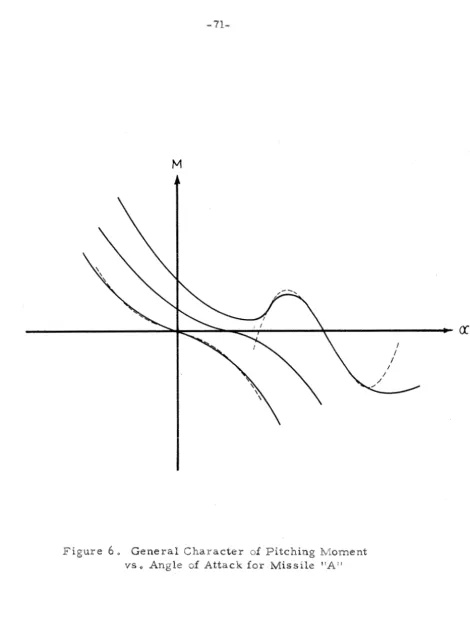
general character af the moment and lift C a r v e # vs
.
angle of attackt ~ g a t h s ~ with their mathematical tspproxim-attoas by cubic; polynom-
ials are presented in Figures
6
and 7.T b
seven examples eon be dahseribd by the vaPua8 of the cwfficfents A , B,
C
,
D, 3 , and F,
a d the initial dirpkcemant,
c~,.
These are presentedIn Table
IfE. Tha &abfi?s c3f the calcukatioas far thesre cases are praseat%;.$ la Agwndilr;:PI.
The resultsolE the
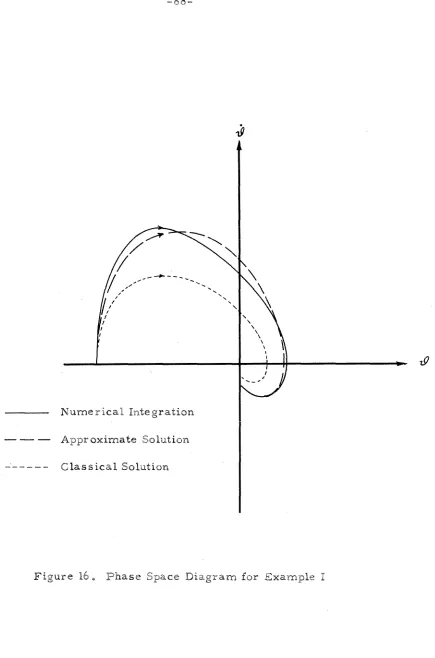
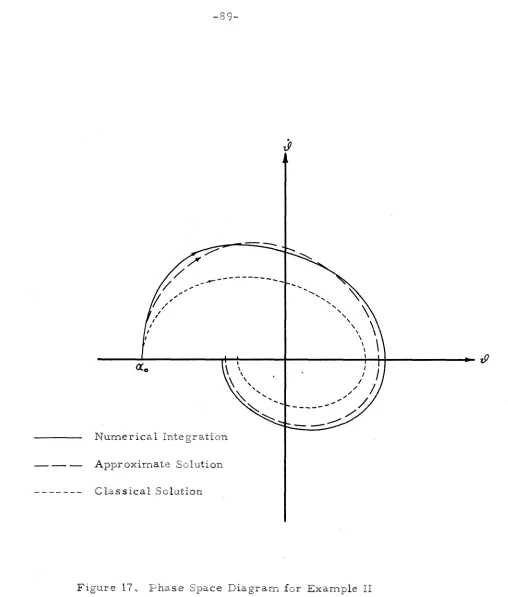
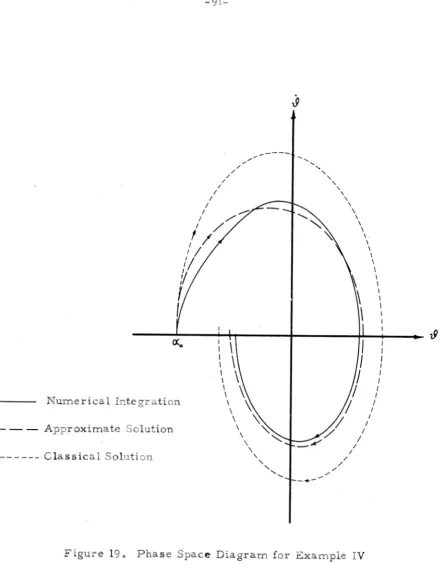
a~ralycis iw csisraprissnaw with lamerleal i&tgz~atiosno a b b t n ~ d by 1.B , M . punched card teehaiitques a d the claseical, limeariaed ro-lulisn a r ~ preaented in t w o ways. The responses in both Q and
.rb
are plotted ggsimsst t h e
a&
prseented sllarmtely with the apprap- riata plot% sf the ra storing m a m e a t ,-
91d129 and the damping func- tion,f($)
againat di&plaeeme~lt in Figures9a
ta B b . Pharaa spaceThe variable density analysis indicates that a missile w h i c h i s stable at c=oasLa.n(; speed in level flight can b e c o m e tanstable in vertical flight through $ha standard atmosphere, the tendency ts- ward instability increasing w i t h both altitude aad Wach number.
The analysis assumes conrhrrt o p e d and the result i s due entirely to the density gradient. This sffact together with S$;&awartfrr result, that the effective damping is decrsaead when a misails is deecler- aging under the influence of d r a g , would indicate that some form &rf control should be incsrpsratad fa any missile which is intended
for vertical flight a& high altitudes.
Tine: respcanlse to a sudden angle? of attack in the case a non-linear moment curve i s found 4 0 be qualiti~tively similar to
that far a linear moment curve
,
though quaHntiatlvaly, the differ- ence is very marked. This difference in the examples treated, which are con~sideaad to be representative, irmdicates that the clas--
44-APPESDEX 1 Stability Considerations
T o imatrostigate the s t a b i l i t y s f the system described by the equation:
it is convenient ta let
&=
$
and replace the equation b y the equiva- lent autonam~orrs pair of fsquasrtiono:$
=F(s,q)
=4
=
~ t a 4 )
= - ~ ( ~ P I J- f ~ ) q
The critical points of this s e t of equatisnts are deffrmrsclt by:
T h i s Q C C U ~ S t~~hee5
q = ~
and either " S = G QI-g(LPj=o
.
In the eases t o be d i s c u s s a d ,
Consider f i s e t the critical point, & = o,
$
= ofn the neighborhood 0%
zP
= o,
+
=o
,
neglecting higher orderfar which L-ka date rminanl
The matrix is reduead to canot.tica1 form oy applying es! esmplex
for which the charac"tsrfstie roots are:
If
A > O and C,(*)2,
h,
andh p
are complex w i t h negative real p r t s ; hence the origin is a atitnbb spiral point. F o r the s e v e n arn- msrical cases considered, these cbklditieha~ a r b sati?~bfad. Weneein all cases, the system i~ stable in the neighborboodl af 29= = 0 The other critical p i n t s are more conveniently di;scussed seprestely for the various examples
.
Examples 1 and
HI
For these c a @ e s b = D
=
O
hence g ( d )=
C+
F d 2Examples 1x5: and IV
For these c a s e & , g ( d ) = C
+
Dd +F$' w h e m D 7 C>
0 , F ( OH e n c e there are two critical points other than ehe origin, They are
( d , ~ )
and(a,
o)
w h e r e : I =-g
f2 2 F 2F
' C
Now --20 hence 79,
, d z
are $281 and of opposite signanad $ > - ~ P , > oF
9
= O and neglecting second and higher order t e r m s :d = g
for which %he charactaristic roots are:
Wesea A, and ,A, are real sad sf dfgferea), sign, and tksr paint c4-- t?!
,
4
=
0 is a saddle point.S i m i k r l y
,
in the neighborlaosd of zP =4
,
4
= oHence X , , h z a r e real and sf different sign and the point &=
4
,
Q 2
O
$ 5 also a saddle point.t x a m p f e e
V,
V h n d VIIFor these examples g (dl =
c
+
o ~ P and g(23).o for & =D
The characteristic roots are
Now
3ines C 7 0,
A , and X z are real and s f different sign, the point 19 =4
,
$ = is a aaddle point.The nature of the eriticak point@ is established and a &is- cusrsisn of the stability for finite initial csnditlana is pssaisible. In
Sxamplea I and $1, since the oalyrgsal critical point isii tbe origin which is
zz
stitnblc spiral point, and since tbe damping termrfl#)
=A
+
E - d Z is &lidfays > $3 for all9
,
the system is stabla for any initial coandflisras.
-43-
examples, a simpler procedure is 20s sible
.
It is noted that the a n d a m p % system, i . a . R ==
B
=
E
=
0 , ha@ the ram& critical points as the damped system, with the e x -ce$reion that; frrigia i s a center instead s f a stable spiral point.
FOP
the former, the trajectoriee through the saddle pofnks a r e easilycomputed, and the setparatrices a r e fsund. Naw if the dampirag
term does not change sign Q V ~ T the renga of zP included withiin
Application of Approximate Met&& of Solution to S p c i f i c Examples
In the application of the a g p t o x i ~ a d ~ mstbsd davelopd in Part V to actual case& it is a s s w e d &at f (291 = A + 629 + E d 2
&ad that
q
(29) =e
+
O d + F z ~ ".
Tbe; determinatisn of the effec-tive damping eoasbnt is i~traigkaorward by application of Equation
(6
9)
,
and the result is:The algebra ia the, &e(tcrmin;[email protected] sf &Jn varies ~ o m e w h a t
d e p d t n g on the viatws of C , D , a&
F.
The different eases en- courntssad in the examplaa cited in this g a p r are traated s e p r a t e l ybe bow.
Csbeer 1, (Examples I and II) O = O ; C , F > O , a o c O , hence q c + ) = C - + ~ ~ ( l I . l ) From Equation (47) :
,9
cornplate elliptic integral of the fireel kind.
From E q u a t i o ~ ( 6 8 ) :
The approximate solution for the fir s t inter vaf: o S
t
<
T,,
a,
dzP C o is given by:s i n
a O tNsw ias the valus sf
t
w b n 19 = 0,
hence:Since cj(z~)rP =
c
21+
~ 2 9 ~ which is igin odd function sf zC *the amplitude sf oa~cillslticln far the undamwd system is symmelrb- eal with r s a w c t to 20 = o
.
The aolutio~n for b b ~ second irPlborval,0 , 0 < 2 9 d a a
,
i s given ~ J P the follow-ing equations where 'C = t
-
T,sin ~ 2 :
FOP t b third interval, Th G t G T,
,
a, ), 29 2 o the aofution is gives by tkct following equations where 2 = t-
T-- t 2
e
T C O S ( W ~ O - ~ ~ )(EX.
18)the constanas being given by Equations (11.5) through (11.16) on set- tiag i
=
2 . Now Tj i s the value af t when Z P = Q,
hence:For %he fourth intervat, T3 C t
c
7,,
Z ~ ( T ~ )
1( C 0 , O > ~ B O L ~%he
a olution i9r given by the following aquatione w h e r e 2 =t
-
T33
=
n
j-)e-$'
sin ~ J , TT b a consbl.gt~, are given by Zquatiano (PP.5) tfirsugh (fE,9) on s e t - ting i
=
3 . How TI is the value of t when $ = o,
hence(IT.
26)
Tba solution for ths next four intervals i s obtained in exactly the
C a s e I I . (ZxamplesIIlandIV) C , D > O ; F , a . < o hence 9 ( n = ~ + ~ ~ + ~ @ 2
where
Factoring, P ( 4 l = (6
-
CCo)(d-/3.)(d-C)(fl- 6.1 where PO,x,&2
a r e the roots of the cubic: ~9~
+
b d 2+
c 9 +d
= 0where:
?fb
=s i n - '
k,
=(If.
34))and
3
[w,,$~]
is the incomplete eBligtic Integral sf the f i r s $ kindofamplitudecC;,
*Far tho firrst interval, o s t S T,
,
or,& 2 9 S O the scatation I s given by Equations (11.3) and (11.4); the constants are determined by Equations (11.7) through (11.10) eta eettiomg I=
0 , and Eqwtisns ( I I , 3 f ) through (11.33). T; and6'
(T. ) ass csbtaaSned h o r n EqwtSms(11.11) and (II,12) respectively, Sinec ql@)d ia not an odd Punc- tion of 29
,
tbe amplitude af oocillstiond
the ~~lpdgbrnped sjTstem ia not symnnetrSca1 with respect ts z0 =o
.
Hence for thr3 secondroots
sf the aqwtion: + b e d + c,z9 + dd, = o = (zf-j3, I)($- 6,)(29- Y , ) , l q < o < , < o < S , < v ,-
a
e-%'r.
The quaa%ltiao b,,
c ,,