WCDMA Uplink Parallel Interference
Cancellation—System Simulations
and Prototype Field Trials
Bo Hagerman
Ericsson Research, Ericsson AB, 164 80 Stockholm, Sweden Email:[email protected]
Fredrik Gunnarsson
Ericsson Research, Ericsson AB, 58117 Link¨oping, Sweden Email:[email protected]
Hideshi Murai
Nippon Ericsson K.K., Tokyo 112-0004, Japan Email:[email protected]
Mioko Tadenuma
Nippon Ericsson K.K., Tokyo 112-0004, Japan Email:[email protected]
Jonas Karlsson
Ericsson Research, Ericsson AB, 164 80 Stockholm, Sweden Email:[email protected]
Received 1 March 2004; Revised 20 September 2004
Interference cancellation (IC) is one identified key technology to enhance WCDMA uplink performance. The goal of this contri-bution is to highlight the relative uplink system capacity improvement available for WCDMA, especially in realistic typical urban radio environments when employing receiver implementations including realistic channel estimation, searcher, and so forth. The performance of the selected limited-complexity parallel IC receiver is first evaluated with link-level simulations in order to pro-vide input to system-level simulations. The system-level methodology is explained and a 40% system-level uplink capacity increase compared to utilizing the conventional RAKE receiver is found. The limited-complexity parallel IC receiver is then evaluated in a single-cell field trial. The trials show that both the mean and the variance of the outer-loop power control is reduced, which implies an overall increased capacity and an increased battery life of the terminals. Furthermore, the observed capacity gains are in accordance with system simulations.
Keywords and phrases:CDMA, field trials, interference cancellation, link-level simulations, system-level simulations.
1. INTRODUCTION
Interference canceling (IC) is regarded as one of the key technologies for enhancing CDMA uplink performance. The general interest in IC started after Verd ´u published his
This is an open access article distributed under the Creative Commons Attribution License, which permits unrestricted use, distribution, and reproduction in any medium, provided the original work is properly cited.
results on the optimal receiver for Gaussian multiple-access channels [1].
Received signal
0
0
0
0
ICU
ICU
ICU
ICU rep(1)1
rep(1)2
rep(1)3
rep(1)4
ICU
ICU
ICU
ICU rep(2)1
rep(2)2
rep(2)3
rep(2)4
ICU
ICU
ICU
ICU
Symbol
Symbol
Symbol
Symbol
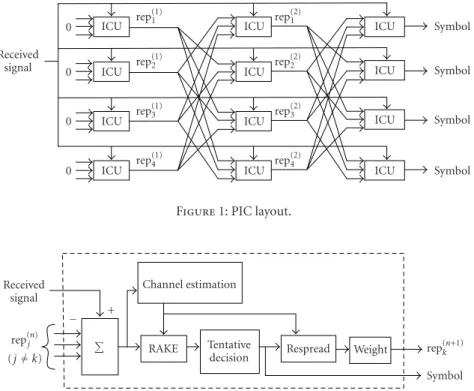
Figure1: PIC layout.
Received signal
Channel estimation
RAKE
Tentative
decision Respread Weight rep (n+1)
k
Symbol rep(jn)
(j=k)
+ −
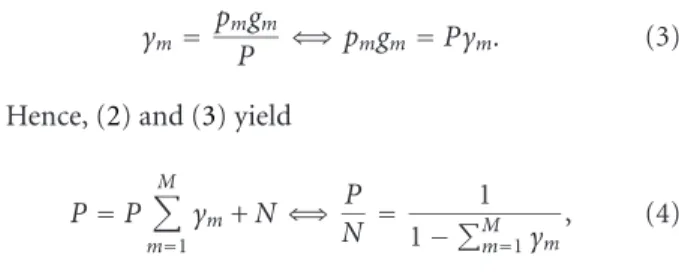
Figure2: ICU layout.
been less thoroughly covered in the literature. These types of components are important to model, analyze, and under-stand how to utilize IC in systems to ensure the UL/DL ca-pacity balance and improve the robustness of realistic system implementations.
This paper investigates system-level performance of in-terference cancellation for the WCDMA uplink [11] by means of simulations and measurements from a prototype PIC implementation. The prototype PIC test system devel-opment and the field trial were performed in collaboration between Ericsson, China Academy of Telecommunications Technology (CATT), and Datang Telecom Technology Co. Ltd. The field measurements were performed at the north-west part of urban Beijing, China.
The link-level simulator employs a realistic COST 259 channel model [10] and a complete WCDMA receiver in-cluding searcher, channel estimation, coding, and so forth in addition to IC functionality. The system-level simulator models user dynamics such as power control, mobility, soft handover, and so forth. The test system utilizes a proto-type PIC multiuser receiver implementation integrated into a commercial Ericsson RBS 3202 WCDMA radio base station. The PIC simulator model has been carefully designed to be equivalent to the prototype implementation.
This paper has been organized as follows. First an algo-rithm description segment with PIC algoalgo-rithm details and a description of IC interaction with a multicell system are presented. Then, the simulation workflow is described as an iterative procedure of link and system simulations, together with simulated capacity results. Finally, test system details
and field measurements prerequisites are presented, and the trial system performance is evaluated, followed by some con-clusive remarks.
2. PARALLEL IC ALGORITHM
A PIC consists mainly of several cascaded detection units (e.g., RAKE receivers) for each user, see Figure 1, where each detection unit after detection regenerates a replica of the signal based on the detected symbols, estimated chan-nel responses, and the user’s spreading codes. These detec-tion units, denoted byinterference cancellation units (ICUs) shown inFigure 2, receive as input all the other active users’ signal replicas from the previous stage in the cascaded chain of ICUs. As is visible inFigure 1, the original total received signal is also one input to the ICU.
Within the ICU, the replicas are subtracted from the orig-inal total received signal and a tentative symbol decision is formed using a standard RAKE receiver and channel re-sponse estimator. The channel rere-sponse estimator averages the pilot symbols from two consecutive slots of the WCDMA uplink signal in order to form an estimate. The ICU out-put consists of the tentative symbol decision together with a weighted form of the replica signal.
2
1 ×10⁻²
BLER
0.2 0.3 0.4 0.5 0.6 0.7 0.8 Weighting factor 1
(a)
2
1 ×10⁻²
BLER
0.2 0.3 0.4 0.5 0.6 0.7 0.8 Weighting factor 2
(b)
Figure3: Two slices of the 2D search for optimal weighting factors are presented. (a) shows the block error rate (BLER) as function of weighting factor 1 when weighting factor 2 is set to 0.625. (b) shows the BLER as a function of weighting factor 2 when weighting factor 1 is set to 0.375.
simulations, was done in order to find the optimal weighting factors. The optimal weighting factors for the first and sec-ond stages were found to be 0.375 and 0.625, respectively; seeFigure 3.
3. PIC INTERACTION WITH SYSTEM PERFORMANCE
All users will, dependent on their service, have a qual-ity requirement on the dedicated communication link. In WCDMA, the control mechanism to ensure the fulfillment of the quality requirement is mainlypower control (PC). The WCDMA PC is performed on two levels, the inner-loop and outer-loop PC. The inner-loop PC operates at 1500 Hz to fol-low fast channel variations. The outer-loop PC evaluates the service quality on higher layer (i.e., on a longer time scale) and sets the target for the inner-loop PC accordingly.
In a multiple-cell deployment, interference is generated both from users in surrounding cells (intercell interference) as well as from users in the own cell (intracell interference). The PIC algorithm is of course effective only towards intra-cell interference. Thus, the PIC will reduce the impact of the intracell interference compared to a conventional RAKE re-ceiver and thereby via the PC reduce the required output power of the UEs to maintain the service quality.
The typical uplink radio interface load measure is the noise rise, that is, the ratio between total received wideband power at the base stationPand the noise powerN. A popular
model is to introduce the fractional loadL[14] as
P N =
1 1−L=
1 1−M/Mp
, (1)
whereM is the number of users andMp is the pole
capac-ity—essentially the upper limit of the users the network can accommodate. In the single-cell case, it is straightforward to derive an expression forL. The received wideband power can be expressed as
P= M
m=1
pmgm+N, (2)
where mdenotes themthuser equipment (UE)in the cell, pm is the UE power, and gm the power gain from UE to
the base station. Furthermore, thecarrier-to-interference ra-tio, CIR(defined here as dedicated physical control channel (DPCCH) received signal code power relative to the received wideband power), is given by
γm= pmgm
P ⇐⇒pmgm=Pγm. (3)
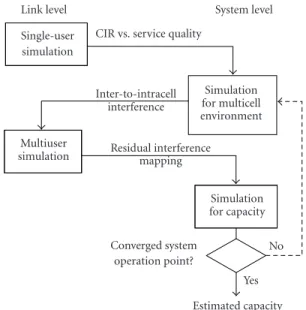
Hence, (2) and (3) yield
P=P
M
m=1
γm+N⇐⇒ P
N = 1 1−Mm=1γm
, (4)
which provides the fractional loadLin (1), see also [15]. The dedicated physical data channel (DPDCH) is transmitted at a fixed power offsetβto the DPCCH power. Therefore, both these channels contribute to the fractional load:
L= M
m=1
γm(1 +β). (5)
The interference cancellation capacity gain can be described by comparing the average fractional load for the same num-ber of UEs,M, using either RAKE or PIC. Utilizing the aver-age load for the two different receiver schemes,
LRAKE= M
MPRAKE
, LPIC= M
MPPIC
, (6)
the average pole capacity gain is related via (6) by the average load for equal number of UE’s as
MPIC P =
LRAKE
LPIC M RAKE
P . (7)
12 11 10 9 8 7 6 5 4 3 2 1 0
0 MRAKE
p MPICp
No. of users
N
o
ise
rise
(dB)
RAKE PIC
(0.75Mp, 6 dB) Capacity gain
Coverage gain
Figure4: Illustration of the relation between noise rise and number of users for conventional RAKE and PIC.
4. PARALLEL IC SIMULATION MODELING
A dynamic system simulator is used to evaluate system capac-ity for a defined outage probabilcapac-ity level. An outage occurs when a users’ average service quality requirement is not sup-ported. The outage probability is therefore estimated as the fraction of unsatisfied users relative to the total number of users in the entire simulation. The system simulator models the propagation environment, mobility, and traffic services. Radio resource control algorithms such as power control, soft handover, cell selection, and so forth are also included [16]. The PIC functionality is modeled as an intracell interference adjustment reflecting the effective received CIR as
γm,b= pm,b i=mRIFi,b·pi,b+
i,j=bpi,j+N, (8)
whereγm,b,pm,b, andNare the CIR for themth user in the
bth cell, the received power from themth user in thebth cell, and the background noise power (AWGN), respectively. The parameterresidual interference factor(RIFm,b) denotes the
ra-tio between the equivalent intracell interference for themth user in thebth cell after and before PIC execution and reflects the PIC performance. RIFm,bis defined according to
RIFm,b=
LF
l=1hm,b,l·dm,b−hm,b,l·dm,b2
LF
l=1hm,b,l·dm,b2
, (9)
wherehm,b,l,dm,b,hm,b,l,dm,b, andLFare the channel
coef-ficient of thelth path, the data symbol, the estimated chan-nel coefficient, the estimated data symbol, and the number of channel delay paths, respectively. In the sequel, these quanti-ties will be discussed generically, and the individual-user in-dicesmandbare omitted for clarity.
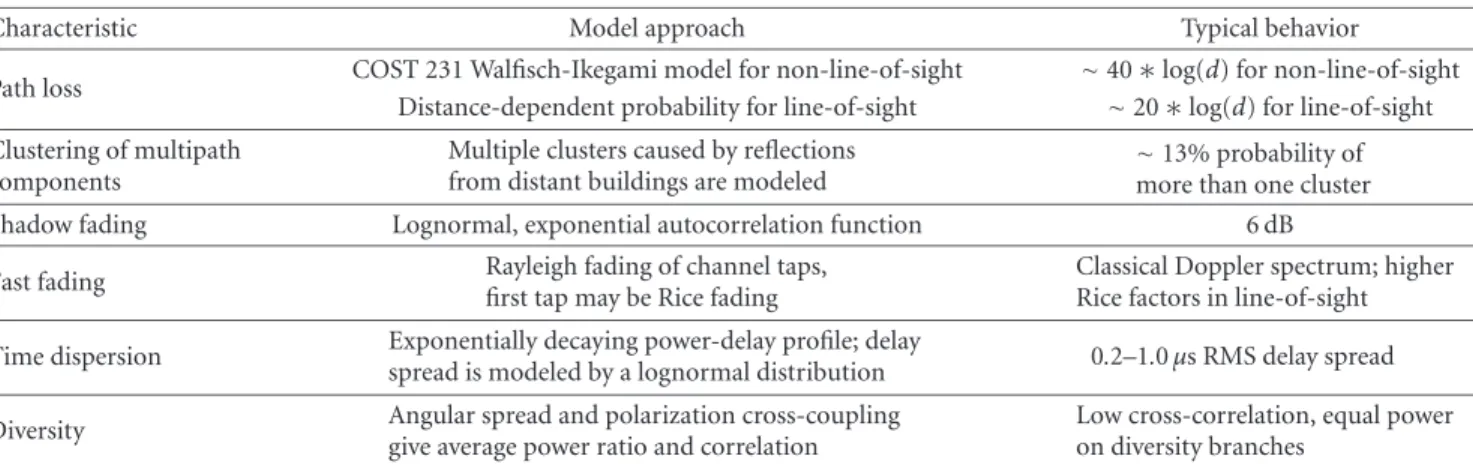
The typical system simulation workflow is to first run de-tailed link simulations to determine relations between CIR and block error rate (BLER) statistics, and then use these models in system simulations to obtain the system capacity.
Single-user simulation
Multiuser simulation
Simulation for multicell environment
Simulation for capacity
Yes No
Estimated capacity Converged system
operation point? Residual interference
mapping Inter-to-intracell
interference CIR vs. service quality
Link level System level
Figure5: Workflow for PIC system evaluation.
The division between link- and system-level simulations is the selected approach to overcome the overwhelming com-plexity to simulate all the radio communication link details within a multiuser and multicell dynamic system environ-ment, especially under realistic conditions with realistic algo-rithms. However, in this case, link simulations to obtain CIR and RIF mappings depend on the intercell interference situ-ation, which is obtained from system simulations. The sys-tem simulations in turn depend on RIF to CIR mappings. Therefore, an iterative workflow as illustrated byFigure 5is adopted, where iterated link and system simulations are per-formed to converge to the correct operation point of both the receiver performance and the impact through effective inter-ference between connections. This will secure the PIC system interaction.
4.1. Link-level simulation modeling
Table1: Key characteristics of the COST 259 channel model.
Characteristic Model approach Typical behavior
Path loss COST 231 Walfisch-Ikegami model for non-line-of-sight ∼40∗log(d) for non-line-of-sight Distance-dependent probability for line-of-sight ∼20∗log(d) for line-of-sight Clustering of multipath
components
Multiple clusters caused by reflections
from distant buildings are modeled ∼
13% probability of more than one cluster
Shadow fading Lognormal, exponential autocorrelation function 6 dB
Fast fading Rayleigh fading of channel taps,
first tap may be Rice fading
Classical Doppler spectrum; higher Rice factors in line-of-sight
Time dispersion Exponentially decaying power-delay profile; delay
spread is modeled by a lognormal distribution 0.2–1.0µs RMS delay spread
Diversity Angular spread and polarization cross-coupling give average power ratio and correlation
Low cross-correlation, equal power on diversity branches
100
10−1
10−2
10−3
10−4
BLER
−23.5 −23 −22.5 −22 −21.5 −21 −20.5 −20 Target CIR (dB)
UE=1 UE=25 UE=50
F=0.59 F=
0
Figure 6: Link-level simulations of PIC performance. Multiple users are simulated in a single cell with intercell interference mod-eled as AWGN with the powerF times the intracell interference power. Note that UE=1 corresponds to conventional RAKE per-formance in a single cell.
that are modeled using statistical distributions. Correlations between links to different base stations have been added to the model for the system simulations. Further details on the characteristics of the model can be found inTable 1.
Link-level simulations are conducted following the 3GPP specification [11] regarding physical parameters and proto-cols. The UL closed-loop power control model is CIR-based with a 1 dB step size, but including 1-slot feedback delay without feedback errors. The radio base station (RBS) re-ceiver is configured with a 2-branch antenna diversity.
The PIC simulator model has also been carefully de-signed to be equivalent to the prototype implementation (i.e., functionality like path searcher, channel estimation, and
so forth are modeled realistically). The intercell interference is emulated by additive white Gaussian noise with a power level according to theFvalue. For link-level performance ex-amples seeFigure 6and [17].
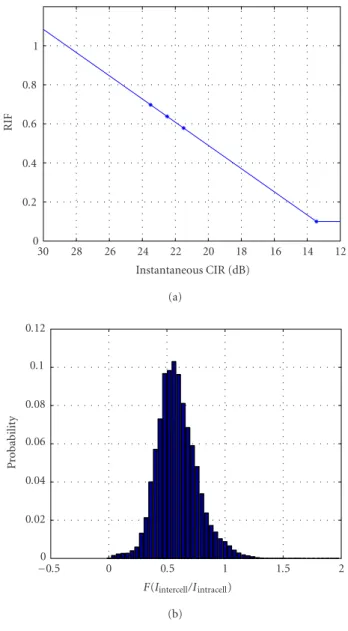
The presented link-level performance results inFigure 6 are simulated in a single-cell environment with anF-factor to model intercell interference. It represents examples of simu-lation results from both single- and multiple-user link-level simulations, which were pointed out in the simulation work-flow inFigure 5. InFigure 6, exemplified for an AMR (adap-tive multirate) speech user scenario, the BLER performance is shown as a function of the power controltarget CIR, that is, the outer-loop power control target for the fast inner-loop PC handling the channel variations. Observe that the target CIR requirement for PIC decreases when the intracell interference to background noise ratio increases, that is, in a multiple-user environment. This can be seen in Figure 6 when the number of users increases from 1 to 50 with an equivalent increasingFvalue of 0 and 0.59, respectively. Note that the single-user case with PIC is equivalent to using a conventional RAKE receiver. The output from each batch of link-level simulations is a RIF to CIR mapping, at the opera-tion points of interest, as exemplified inFigure 7a.
4.2. System-level simulation modeling
System-level simulations are performed within a cellular structure configured with 3 cell sites deployment with cell radius of 1 km. To avoid system border effects, a method of 7-site cluster wrap around technique is utilized. The simula-tions are using a single WCDMA frequency carrier, and the soft handover functionality is limited to an active set equal to 3 (i.e., connections have maximum three legs). The UE transmit power dynamics is in the region−44 to 24 dBm. A fixed number of users are connected per simulation setup, and no load control such as admission/congestion control is activated.
1 0.8 0.6 0.4 0.2 0
30 28 26 24 22 20 18 16 14 12
Instantaneous CIR (dB)
RIF
(a) 0.12
0.1 0.08 0.06 0.04 0.02 0
−0.5 0 0.5 1 1.5 2
F(Iintercell/Iintracell)
P
robabilit
y
(b)
Figure7: (a) RIF mapping and (b)Fdistribution over all cells.
transport block errors. (Note that BLEP is an error proba-bility, while BLER is the error rate of the actual realization.) Outer-loop power control acts on the block error sequences to determine an appropriate target CIR for inner-loop power control to meet the BLER requirements [11, TS 25.214]. For example, the requirement of the considered AMR speech service is BLER 1%. The main output from a batch of sys-tem simulations is anFvalue distribution as exemplified in Figure 7b. The simulation workflow iterations inFigure 5are halted when the RIF mapping and theF distribution have converged, and the system capacity can be evaluated.
5. SYSTEM PERFORMANCE EXAMPLE
The uplink system performance is studied from the perspec-tive of the capacity that one WCDMA carrier can support for each cell in the deployment. The system capacity is defined
for a certain system quality level, that is, outage probabil-ity. In the performance examples shown inFigure 8, all users utilize AMR (12.2 kbps) speech service in a typical urban (COST 259) environment and slowly move around. The mo-bility model is a random walk with a mean velocity of 3 km/h. An AMR speech user is considered unsatisfied (is in outage) when the required average service quality of maximum 10−2 BLER is not satisfied. Reasons behind outages could typically be insufficient UE power to overcome the uplink interfer-ence. An outage probability (fraction of unsatisfied users) at 5% is considered acceptable, and the corresponding number of users in the system is therefore the system capacity. The system capacity inFigure 8is normalized to the system ca-pacity when the conventional RAKE receiver with realistic channel estimates is used in the system (Figures 8aand8b leftmost curve).
Using the above described quality measures, it can be concluded from Figure 8b that PIC is supporting approxi-mately a 40% uplink system capacity increase compared to utilizing the conventional RAKE receiver in this simulated realistic multiple-cell typical urban radio environment. Note that the PIC is carefully modeled in the simulations reflecting the limited-complexity implementation of realistic searcher, channel estimation, and so forth. In an equivalent single-cell environment setup, the realistic receiver implementation shows that PIC supports an improvement of the capacity in the order of 70% as indicated byFigure 8a. The anticipated gain in capacity is expected to decrease for high-speed users [6].
As an upper bound regarded as reference of the technol-ogy limit, the outage performance of an ideal interference canceller (ideal IC) is also shown in Figure 8b (rightmost curve). An ideal IC receiver removes perfectly all intracell in-terference, equivalent to a RIF equal to zero in the CIR model in (8). For the ideal IC, the capacity increase is hence approx-imately 180% in the multiple-cell network environment with realistic channel estimates.
6. SINGLE-CELL SYSTEM EVALUATION
100 10−1 10−2 10−3
Outage
P
rob
.
0.5 1 1.5 2 2.5 3 3.5
Normalized capacity RAKE
PIC
(a)
100 10−1 10−2 10−3
Outage
P
rob
.
0.5 1 1.5 2 2.5 3 3.5
Normalized capacity RAKE
PIC
Ideal IC (b)
Figure8: Simulated system performance relative to the performance with a conventional RAKE for (a) a single-cell scenario and (b) a multiple-cell scenario.
Figure9: Modified Ericsson RBS 3202 hardware integrating mul-tiuser PIC functionality.
Figure10: Defined measurement areas within RBS cell coverage.
The radio base stations were during all parts of the tests fully integrated into the WCDMA RAN infrastructure (i.e., connected to an RNC simulator using the 3GPP NBAP, Node B Application Protocol) supporting all layers 2 and 3 func-tionality with for example system information (BCCH), pag-ing and call setup handlpag-ing, as well as the outer-loop power control. The field trial was performed in a single-cell system environment (Figure 10), which implies that no handover functionality was activated during the trial. The used pro-totype handset UEs were supporting 3GPP baseline, Release 99 December 2000, with AMR speech and 64 kbps UDI data [11].
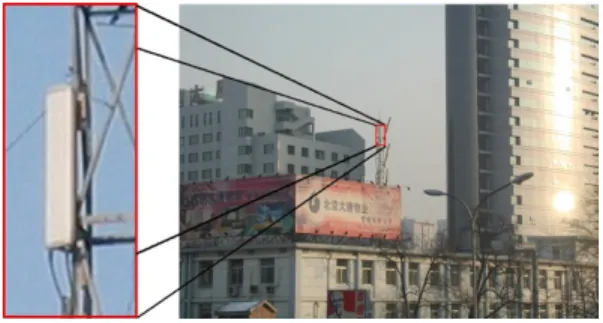
Figure11: Antenna installation northwest Beijing, China.
The field trial measurement methodology is based upon the fact that UEs move/drive around in a for each UE con-fined measurement area; seeFigure 10. The UEs will follow the normal traffic flow on a predefined route (i.e., mimic normal-user operation/behavior).
As exemplified inFigure 10, within the test system cov-erage, a set of confined measurement areas was defined with a size in the range∼50−500 m×50−500 m. In each con-fined area, a measurement route was decon-fined where the im-portant parameters are the radio environment, angular di-rection, and distance. The different confined areas and routes are in some cases overlapping, and in addition, multiple UEs can be allowed within the same area during a test.
The radio base station antenna (17 dBi gain) was in-stalled at the rooftop of a three-floor building (seeFigure 11) in northwest Beijing at approximately 25 m height. The 65-degree antenna boresight was west-north-west with a se-lected sector radii of∼3 km overlooking an urban area in-cluding open areas and houses of both equivalent height as the installation as well as very much higher buildings.
10
8
6
4
2
0
Ti
m
e
d
el
ay
(
µ
s)
0 20 40 60 80 100 120
Time (s) (a)
12 10 8 6 4 2 0
Ti
m
e
d
el
ay
(
µ
s)
0 50 100 150
Time (s) (b) −80
−85
−90
−95
−100
−105 −110 −115 −120
RSCP
(dBm)
0 20 40 60 80 100 120
Time (s) (c)
−80
−85
−90
−95
−100
−105 −110 −115 −120
RSCP
(dBm)
0 50 100 150
Time (s) (d)
Figure12: (a) and (b) Impulse responses and (c) and (d) received code power along the measurement routes in areas 2 and 3, respectively.
received code powers are presented when transmitting at a fixed UE power level (24 dBm). The impulse response for area 2 (Figure 12a) has mainly one dominating path while for area 3, multiple paths are dominating. The measured impulse responses for the selected test system coverage area show that the trial environment can be classified as typical urban from a radio propagation modeling perspective.
The network integrated single-cell system performance test scenarios were conducted with different sets of multiple-user traffic and the results indicated that the implemented prototype PIC system provides performance (service qual-ity, required UE power level, and so forth) and behavior im-provements in accordance with expectations.
To exemplify the behavior improvement, results are shown inFigure 13toFigure 16from live on-the-air test sce-narios with walking users in confined area 3. InFigure 13, a scenario with two communicating UEs was used, and in
Figure 14toFigure 16, a scenario with four communicating UEs were used. In the execution for the different scenarios, the environment and service quality requirements resulted in different quality settings (Target CIR) from the layer 3 outer-loop power control algorithm used per UE in the tests.
Each test scenario was set up and executed in an identi-cal fashion twice. Between the executions, the only difference being that the PIC prototype test system was configured for utilizing either the conventional RAKE or the PIC receiver.
−10
−12
−14 −16 −18
−20 −22
T
arget
CIR
(dB)
0 5 10 15 20 25 30 35 40
Time (s) Conventional RAKE
PIC
MS1
MS2
Figure13: RNC (layer 3) target CIR commands when either con-ventional RAKE or PIC receiver is utilized for users 1 and 2.
found. When examining and comparing the specific mea-sured scenario inFigure 13, the measurement results imply that the PIC receiver improves the control process stability compared to a system configuration utilizing the conven-tional RAKE receiver. The statistics for the two cases show a reduction in mean and standard deviation of the SIR tar-get. For UE 1, the mean values are reduced from 3.43 dB to 3.3 dB and the standard deviation from 0.938 dB to 0.601 dB when the PIC is active. For UE 2, the mean values are re-duced from 1.08 dB to 0.499 dB and the standard deviation from 0.802 dB to 0.677 dB when the PIC is active. For this measured scenario, this implies an overall increased capacity (less interference generated) and an increased battery life of the UE terminal. Since the outer-loop power control is mea-suring and controlling the service quality over all 3 layers in the radio access network (RAN) and adjusts the targets, the decrease in standard deviation indicates a stabilizing effect on the system.
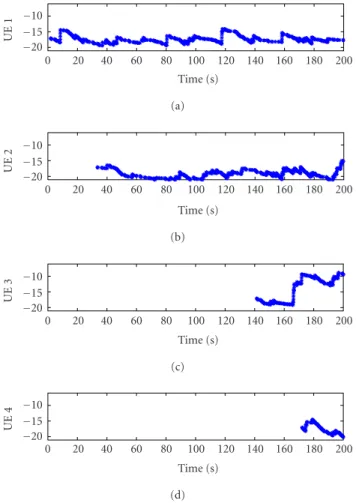
Figures14and15illustrates the outer-loop power control target CIR commands (the RNC layer 3 algorithm decisions) for the active UEs when moving along the test route during call setup with four UEs. The setup phase is selected to illus-trate the improved power control stability due to PIC. Essen-tially, the target CIR variations are related to the uplink load, and therefore, the load reduction due to PIC also improves system stability. This is evident fromFigure 16, which pro-vides cumulative distribution functions of the uplink load for RAKE and PIC, respectively, for the case of four active UEs. Clearly, PIC implies a more stable system.
Corresponding system load as defined by (1) and com-puted in (5) for single-cell networks is used to compare the resulting load in the two tests (RAKE and PIC, respectively) when all UEs are connected. Then the estimated capacity
−10 −15 −20
UE
1
0 20 40 60 80 100 120 140 160 180 200 Time (s)
(a) −10
−15 −20
UE
2
0 20 40 60 80 100 120 140 160 180 200 Time (s)
(b) −10
−15 −20
UE
3
0 20 40 60 80 100 120 140 160 180 200 Time (s)
(c) −10
−15 −20
UE
4
0 20 40 60 80 100 120 140 160 180 200 Time (s)
(d)
Figure14: RNC (layer 3) target CIR commands with conventional RAKE.
gain can be evaluated as in (7):
Capacity gain :meanL
RAKE
meanLPIC ≈1.65. (10)
This is in accordance with observations from the realistic simulations inSection 5.
7. CONCLUSION
The main conclusion that can be drawn from the extensive work that has been carried out, involving link- and system-level simulations and field trials, is that there are major up-link performance gains achievable even so for interference cancellation base station architectures of rather limited com-plexity. This is primarily due to the known nature of the in-herent intracell interference generated in WCDMA networks, which can be exploited by the IC technology to offer a large theoretical uplink gain.
−10 −15 −20
UE
1
0 20 40 60 80 100 120 140 160 180 200 Time (s)
(a) −10
−15 −20
UE
2
0 20 40 60 80 100 120 140 160 180 200 Time (s)
(b) −10
−15 −20
UE
3
0 20 40 60 80 100 120 140 160 180 200 Time (s)
(c) −10
−15 −20
UE
4
0 20 40 60 80 100 120 140 160 180 200 Time (s)
(d)
Figure15: RNC (layer 3) target CIR commands with PIC.
so forth and the on-the-air trial results indicate that the im-plemented prototype PIC system provides performance and behavior improvements in accordance with expectations.
Observations of the on-the-air trial measurement dy-namics imply that the PIC receiver stabilizes the control pro-cess via a reduction in standard deviation of the RNC outer-loop PC target CIR commands. The single-cell estimated ca-pacity gain in the order of 70% might potentially be expe-rienced in inhomogeneous deployments with isolated high-demanding hotspot cells. Moreover, the estimated capacity gain for single-cell systems is in accordance with results from realistic network simulations. This also indicates that the simulation models are relevant and representative.
ACKNOWLEDGMENTS
Needless to say, all the “background” work that has been car-ried out to design and build a prototype system, and to set up and perform the field measurements, has involved quite a lot of people. The authors would in particular like to thank the persons of all collaboration partners in Beijing, Erics-son Radio Network R&D Center Beijing, China Academy of Telecommunications Technology (CATT), and Datang Tele-com Technology Co. Ltd., for their excellent effort and the
1 0.8 0.6 0.4 0.2 0
CDF
(
L
RAKE
)
0 0.1 0.2 0.3 0.4 0.5
Uplink loadL
(a) 1
0.8 0.6 0.4 0.2 0
CDF
(
L
PI
C)
0 0.1 0.2 0.3 0.4 0.5
Uplink loadL
(b)
Figure16: CDF comparison of the uplink load for (a) RAKE and (b) PIC.
magnificent fruitful cooperation. Furthermore, we are also very grateful to all the other persons that has been involved for critical support from various organizations and places: Ericsson Research in Tokyo, Link¨oping, Jorvas, Budapest, and Kista; Ericsson R&D in Beijing, M¨olndal, Kista, and En-schede; TietoEnator in G¨oteborg, Karlstad, and Ume˚a.
REFERENCES
[1] S. Verd ´u, “Minimum probability of error for asynchronous Gaussian multiple-access channels,”IEEE Trans. Inform. The-ory, vol. 32, no. 1, pp. 85–96, 1986.
[2] R. Lupas and S. Verd ´u, “Linear multiuser detectors for synchronous code-division multiple-access channels,”IEEE Trans. Inform. Theory, vol. 35, no. 1, pp. 123–136, 1989. [3] P. Patel and J. Holtzman, “Analysis of a DS/CDMA
succes-sive interference cancellation scheme using correlations,” in Proc. IEEE Global Telecommunications Conference (GLOBE-COM ’93), pp. 76–80, Houston, Tex, USA, December 1993. [4] M. K. Varanasi and B. Aazhang, “Multistage detection in
asyn-chronous code-division multiple-access communications,” IEEE Trans. Commun., vol. 38, no. 4, pp. 509–519, 1990. [5] T. Shima, R. Esmailzadeh, J. Karlsson, and T. Yamauchi, “User
capacity of a single cell WCDMA system with different I-Q power ratios with and without interference cancellation,” inProc. IEEE CDMA International Conference and Exhibition (CIC ’99), pp. 36–39, Seoul, Korea, September 1999. [6] M. Ariyoshi, T. Shima, J. Han, J. Karlsson, and K. Urabe, “On
the effect of forward-backward filtering channel estimation in W-CDMA multi-stage parallel interference cancellation re-ceiver,”IEICE Transactions on Communications, vol. E85-B, no. 10, pp. 1898–1905, 2002.
[8] T. Suzuki, Y. Takeuchi, F. Watanabe, and S. Niida, “Implemen-tation and field test result of a base s“Implemen-tation canceling CDMA interference for the IMT-2000 air interface,” inIEEE 50th Ve-hicular Technology Conference (VTC ’99), vol. 2, pp. 1003– 1007, Amsterdam, The Netherlands, September 1999. [9] T. Futami, H. Seki, and Y. Tanaka, “Performance evaluation
of DS-CDMA multistage interference canceller in multi-cell environments,” inProc. IEEE Global Telecommunications Con-ference (GLOBECOM ’98), vol. 1, pp. 247–252, Sydney, NSW, Australia, November 1998.
[10] L. M. Correia, Ed., Wireless Flexible Personalized Communications—COST 259: European Co-operation in Mobile Radio Research, John Wiley & Sons, Chichester, England, UK, 2001.
[11] 3GPP Technical Specification Group Radio Access Network, Release 99, December 2000, available from
http://www.3gpp.org/ftp/Specs/2000-12/R1999/, specifically 23-series, 24-series and 25-series.
[12] D. Divsalar, M. K. Simon, and D. Raphaeli, “Improved parallel interference cancellation for CDMA,”IEEE Trans. Commun., vol. 46, no. 2, pp. 258–268, 1998.
[13] N. S. Correal, R. M. Buehrer, and B. D. Woerner, “A DSP-based DS-CDMA multiuser receiver employing partial paral-lel interference cancellation,”IEEE J. Select. Areas Commun., vol. 17, no. 4, pp. 613–630, 1999.
[14] H. Holma and J. Laakso, “Uplink admission control and soft capacity with MUD in CDMA,” inIEEE 50th Vehicular Tech-nology Conference (VTC ’99), vol. 1, pp. 431–435, Amsterdam, The Netherlands, September 1999.
[15] E. Geijer Lundin, F. Gunnarsson, and F. Gustafsson, “Uplink load estimation in WCDMA,” inProc. IEEE Wireless Commu-nications and Networking Conference (WCNC ’ 03), vol. 3, pp. 1669–1674, New Orleans, La, USA, March 2003.
[16] M. Karlsson, M. Almgren, S. Bruhn, K. Larsson, and M. Sun-delin, “Joint capacity and quality evaluation for AMR tele-phony speech in WCDMA systems,” inIEEE 56th Vehicular Technology Conference (VTC ’02), vol. 4, pp. 2046–2050, Van-couver, Canada, September 2002.
[17] H. Murai, B. Hagerman, M. Tadenuma, et al., “System perfor-mance for WCDMA Up-Link interference cancellation - sim-ulated results and field measurements,” inProc. IEEE Interna-tional Symposium on Wireless Personal Multimedia Communi-cations, Yokosuka, Kanagawa, Japan, October 2003.
[18] H. Olofsson, “Improved quality estimation for use in simula-tion of wireless systems,” inProc. IEEE International Confer-ence on Universal Personal Communications, San Diego, Calif, USA, October 1997.
Bo Hagerman received the M.S.E.E., Lic.
Tech. E.E., and Ph.D. degrees in radio com-munication systems from the Royal In-stitute of Technology (KTH), Stockholm, Sweden, in 1987, 1993, and 1995, respec-tively. From 1987 to 1990, he was a mem-ber of the technical staff at the Erics-son Radio Systems Research and Devel-opment Department, where he worked in the area of signal processing with
applica-tions to GSM receivers. He joined the Department for Radio Ac-cess and Antenna Systems Research at Ericsson Research, Stock-holm, in 1995, where he has been working in research on adap-tive antennas in cellular systems. In 1999, he was appointed as the Senior Specialist in the area of advanced antenna systems.
His current research interest is in the areas of statistical sig-nal and array processing for wireless communications and of radio resource management for cellular systems.
Fredrik Gunnarsson is a Senior Research
Engineer at Ericsson Research, and a Re-search Associate at Link¨oping University, Sweden. He obtained his Ph.D. degree in electrical engineering from Link¨oping Uni-versity in 2000. His research interests in-clude radio resource management and sig-nal processing for wireless communica-tions.
Hideshi Murai received the B.E. degree
and the M.S. degree from the Univer-sity of Electro-Communications, Tokyo, Japan, in 1983 and 1985, respectively. He also received the Ph.D. degree from Os-aka University, OsOs-aka, Japan, in 1988. Dur-ing 1988–2000, he worked for Mitsubishi Electric Corporation in the area of digital satellite communications, spread-spectrum communications, and radio access
tech-nologies such as PDC and CDMA. Since 2000, he has been working for Ericsson Research in radio access technologies focused on 3G and beyond. During 2000–2001, he worked in Sweden as a Visiting Researcher from Nippon Ericsson. He is a Member of IEICE and IEEE.
Mioko Tadenumawas born in Kanagawa,
Japan, on January 27, 1976. She received the B.E. and M.E. degrees in electrical en-gineering from Keio University, Japan, in 1998 and 2000. In 2000, she joined Ericsson Research in Japan. Her research interests in-clude radio access technologies and interfer-ence cancellation.
Jonas Karlssonwas born in ¨Orebro,
Swe-den, on June 30, 1969. He received the M.S. degree from Link¨oping University, Sweden, in 1993, the Licentiate degree from Royal Institute of Technology, Sweden, in 1998, and the Ph.D. degree from the University of Tokyo in 2003, all in electrical engineer-ing. From 1993 to 1998, he worked for Eric-sson Research in Sweden as a Research En-gineer. In 1998, he joined Ericsson Research