Iterative Code-Aided ML Phase Estimation
and Phase Ambiguity Resolution
Henk Wymeersch
Digital Communications Research Group, Department of Telecommunications and Information Processing, Ghent University, Sint-Pietersnieuwstraat 41, 9000 Ghent, Belgium
Email:[email protected]
Marc Moeneclaey
Digital Communications Research Group, Department of Telecommunications and Information Processing, Ghent University, Sint-Pietersnieuwstraat 41, 9000 Ghent, Belgium
Email:[email protected]
Received 29 September 2003; Revised 25 May 2004
As many coded systems operate at very low signal-to-noise ratios, synchronization becomes a very difficult task. In many cases, conventional algorithms will either require long training sequences or result in large BER degradations. By exploiting code prop-erties, these problems can be avoided. In this contribution, we present several iterative maximum-likelihood (ML) algorithms for joint carrier phase estimation and ambiguity resolution. These algorithms operate on coded signals by accepting soft information from the MAP decoder. Issues of convergence and initialization are addressed in detail. Simulation results are presented for turbo codes, and are compared to performance results of conventional algorithms. Performance comparisons are carried out in terms of BER performance and mean square estimation error (MSEE). We show that the proposed algorithm reduces the MSEE and, more importantly, the BER degradation. Additionally, phase ambiguity resolution can be performed without resorting to a pilot sequence, thus improving the spectral efficiency.
Keywords and phrases:turbo synchronization, phase estimation, phase ambiguity resolution, EM algorithm.
1. INTRODUCTION
In packet-based communications, frames arrive at the re-ceiver with an unknown carrier phase. When phase estima-tion (PE) is performed by means of a convenestima-tional non-data-aided (NDA) algorithm [1], the resulting estimate exhibits a phase ambiguity, due to the rotational symmetries of the sig-nalling constellation. Phase ambiguity resolution (PAR) can be accomplished by a data-aided (DA) algorithm that ex-ploits the presence of a known pilot sequence in the trans-mitted data stream [2]. The need for PAR can be removed by using differential encoding, which however results in a BER degradation, and requires significant changes to the decoder in case of iterative demodulation/decoding [3]. Since a phase ambiguity resolution failure gives rise to the loss of an entire packet, its probability of occurrence should be made suffi -ciently small. At the same time, the pilot sequence must not be too long as it reduces the spectral efficiency of the system. Although conventional estimation algorithms perform well for uncoded systems, a different approach needs to be taken when powerful error-correcting codes are used. These codes operate typically at low SNR, making the estimation
This paper addresses the problem ofjointphase estima-tion and phase ambiguity resoluestima-tion for a turbo-coded sys-tem [13]. Based on [9], we make use of the EM algorithm [14] to derive a maximum-likelihood (ML) method for PE and PAR. We make comparisons in terms of mean square es-timation error (MSEE) and BER with some known schemes from literature. We go on to show how convergence issues may be dealt with, without any increase in computational complexity, MSEE, and BER. Finally, we demonstrate that al-though the EM-based PE algorithm does not necessarily yield a substantial gain in terms of BER as compared to a conven-tional PE algorithm, the EM-based PAR algorithm is manda-tory if we wish to avoid long pilot sequences.
2. SYSTEM DESCRIPTION
The transmitted sequence, denoted by the row vectors, con-sists of a pilot sequence (p, lengthL) and an unknown data sequence (a, lengthN), that is,s=[p a]. The data symbols are obtained by mapping a sequence of interleaved coded bits onto a signalling constellation. The received vector is given by
r=sejθ+n, (1) wherenis a row vector consisting ofL+Ncomplex AWGN samples with real and imaginary components having vari-ance σ2 = N
0/(2Es), whereEs is the energy per transmit-ted symbol. The pilot and data symbols are taken from an M-PSK constellation1 with |p
m| = |an| = 1, for m = 0, 1,. . .,L−1 andn=0, 1,. . .,N−1. The unknown carrier phaseθis in the interval (−π,π). Detection of the data sym-bolsais based upon the rotated vectorre−jθˆ, with ˆθdenoting an estimate of the carrier phaseθ.
We introduce the integer part,kθ, and the fractional part, εθ, of the phaseθ, defined by
θ=kθ2π
M +εθ, (2)
where|εθ|< π/M andkθ ∈ {0, 1,. . .,M−1}. The PE algo-rithm involves the estimation of the continuous parameterεθ orθ, whereas PAR refers to the estimation of the discrete pa-rameterkθ. Estimation ofεθandθwill be denoted by “frac-tional phase estimation” (FPE) and “total phase estimation” (TPE), respectively, wherever it is appropriate to make such a distinction.
3. CONVENTIONAL PHASE ESTIMATION
3.1. DA total phase estimation
Considering only the observations [r0,. . .,rL−1] that
corre-spond to the pilot symbols, an ML estimate ofθmay be ob-tained as follows [15]. Defining
Cp= L−1
i=0
rip∗i, (3)
1Generalization to other constellations is straightforward.
the ML estimate becomes
ˆ
θML,p=arg max
˜
θ
Cpe−jθ˜
=argCp
.
(4)
As this phase estimate is in the interval (−π,π), no PAR is required.
3.2. NDA fractional phase estimation combined with DA PAR
Note that in (4), the observations [rL,. . .,rN+L−1] are not
ex-ploited. These observations can be used in a NDA estimator, such as a Viterbi and Viterbi (VV) estimator [1]. However, because of the rotational symmetry of the M-PSK constella-tion, the NDA estimate suffers from an M-fold phase ambi-guity, and is to be interpreted as an estimate of the fractional partεθrather than the “total” phaseθ. Hence, the VV esti-mator yields [1]
ˆ εθ= 1
Marg
N+L−1
k=0
rM
k . (5)
The NDA FPE algorithm (5) must be combined with a PAR algorithm that estimates the integer partkθ of the phase. A conventional PAR algorithm based upon the pilot sequence is [2]
ˆ
kθ=arg max
˜
k∈{0,...,M−1}
Cpe−jεˆθexp
−j2π k˜
M , (6)
where ˆεθis the NDA estimate resulting from (5).
4. CODE-AIDED PHASE ESTIMATION
4.1. ML estimation through the EM algorithm
Assume we want to estimate a (discrete or continuous) pa-rameterbfrom an observation vectorrin the presence of a so-called nuisance vectora. The ML estimate ofbmaximizes the log-likelihood function
ˆ
bML=arg max ˜
b
lnpr|b˜, (7)
where
pr|b˜= ap
r|a, ˜bpada. (8)
Often p(r|b˜) is difficult to calculate. The EM algorithm [14] is a method that iteratively solves (7). Defining the com-plete data x = [r,a], the EM algorithm breaks up in two parts: the expectation part (9) and the maximization part (10):
Qb˜, ˆb(n)=
xp
x|r, ˆb(n)lnpx|b˜dx, (9) ˆ
b(n+1)=arg max ˜
b
Qb˜, ˆb(n).
100
10−5
10−10
10−15
10−20
10−25
10−30
10−35
−4 −2 0 2 4
θ
p
(
r
|
θ
)
(a)
1
0.9
0.8
0.7
0.6
0.5
0.4
0.3
−4 −2 0 2 4
θ
Q
(
θ
,
θ
)
(b)
Figure1: Comparison of (a)p(r|θ) and (b)Q(θ,θ) (both up to a multiplicative constant) for a short random code with QPSK mapping.
The true value of the carrier phase is 0 radians.
It has been shown that ˆb(n)converges to a stationary point
of the likelihood function under fairly general conditions [14]. However, when the initial estimate ( ˆb(0)) is not suffi
-ciently close to the ML value, the EM algorithm may con-verge to a local maximum or a saddle point instead of the global maximum of the likelihood function. To avoid these convergence problems, we propose the following solution [16]. Assuming we haveKinitial estimates{bˆ1(0),. . ., ˆb
(0)
K }, we apply the EM algorithm ((9)-(10))Ktimes, each with a dif-ferent initial estimate; after convergence, this will result inK tentative estimates{bˆ1,. . ., ˆbK}. The final estimate ofbis the tentative estimate with the largest likelihood:
ˆ
b=arg max
ˆ
bk
lnpr|bˆk. (11)
As the computation of the likelihood functionp(r|b) is gen-erally intractable, we resort to the following approximation:
ˆ
b=arg max
ˆ
bk
Qbˆk, ˆbk
, (12)
whereQ( ˆbk, ˆbk) is obtained by evaluating (9) for ˜b=bˆkand ˆ
b(n)=bˆ
k.
Although using (12) instead of (11) may seem somewhat ad hoc, p(r|bˆk) and Q( ˆbk, ˆbk) turn out to have very simi-lar shapes in our situation. For the sake of illustration, we have computed these functions forb=θthrough computer simulations for some short random codes. A typical result is shown inFigure 1.
The EM algorithm can easily be extended to acquire the maximum a posteriori (MAP) estimate ofbby taking the a priori distributionp(b) into account in (9).
4.2. ML phase estimation
We now make use of the EM algorithm for estimating the carrier phaseθ. We define the complete data asx = [r,a]. Taking (1) into account, we obtain
lnpr|θ˜,a∝ − 1
2σ2r−se
jθ˜2
∝
N+L−1
i=0
ris∗ie−j
˜
θ .
(13)
In the appendix, we show that, sinceaand ˜θare independent, (9) becomes
Qθ˜, ˆθ=Ea
lnprθ˜,aθˆ,r
= Cp+Cd
ˆ
θe−jθ˜, (14)
whereCpis given by (3) and
Cd
ˆ
θ=
N−1
i=0
ri+Lµ∗i
r, ˆθ, (15)
wherein
µi
r, ˆθ=
{αl}
Pai=αl|r, ˆθ
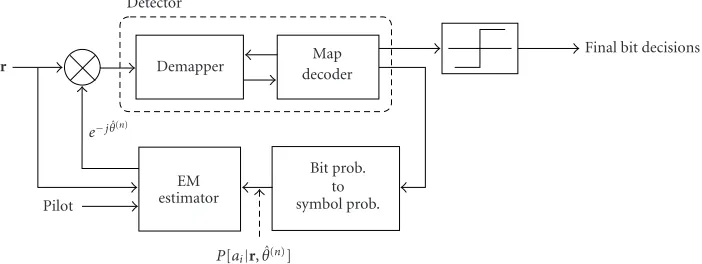
Map decoder
Bit prob. to symbol prob. Demapper
EM estimator Pilot
Final bit decisions Detector
r
e−jθˆ(n)
P[ai|r, ˆθ(n)]
Figure2: Receiver operation block diagram.
denotes the a posteriori average of the data symbolai. Here
{αl}is the set of constellation points. The quantityµi(r, ˆθ) can be interpreted as a soft symbol decision: it is a weighted average of all possible constellation points. The a posteriori probabilities in (16) can be provided by a MAP decoder. Ap-plication of (10) yields the following iterative algorithm for TPE:
ˆ
θ(n+1)=argC
p+Cd
ˆ
θ(n). (17)
The algorithm starts withn= 0 from some initial estimate ˆ
θ(0). Such an estimate can be obtained either according to
(4) or by taking ˆθ(0)=2π( ˆk
θ/M) + ˆεθwith ˆεθand ˆkθresulting from (5) and (6). This initial estimate is used to phase-correct the vectorr, which is then fed to the detector which computes the corresponding a posteriori probabilities. From that point on, we can apply the EM algorithm (17).
Generally the true a posteriori symbol probabilities are difficult to compute. For that reason, we resort to a sub-optimal scheme whereby the detector consists of a soft-in soft-out (SISO) demapper and a SISO decoder. The latter operates on coded bits, rather than on coded symbols. The decoder incorporates bit interleaving, BCJR decoding [17], and bit deinterleaving. Such an implementation of the EM estimator is shown in Figure 2. Depending on the system’s set-up, the detector may iterate between demapping and de-coding (as in a BICM-ID scheme [18]). The resulting a pos-teriori probabilities of the coded bits are then recombined to yield a posteriori probabilities of the coded symbols.
4.3. Convergence properties
In this section, we will illustrate some convergence proper-ties of the EM total phase estimation algorithm (17). We first introduce the notion of the normalized phase estimation er-rore(n)=( ˆθ(n)−θ)/2π, whereθis the true (unknown) value
of the carrier phase and ˆθ(n)the estimated value afternEM
iterations. The behavior of the EM TPE algorithm is ana-lyzed based on the evolution ofe(n) from one iteration (n)
to the next (n+ 1). We have carried out computer simula-tions for a turbo-coded system with QPSK mapping (to be described in more detail inSection 5) to obtain E[e(n+1)] and
E[Q( ˆθ(n), ˆθ(n))], where E[·] denotes averaging with respect
to the pilot sequence, the coded data symbols, the Gaus-sian noise, and the carrier phase. The results are shown in
Figure 3. Note that these results do not depend on the spe-cific value ofnand that we plot E[e(n+1)]−e(n), rather than
E[e(n+1)], as a function ofe(n).
InFigure 3a, we plot the measured values of E[e(n+1)]−
e(n) as a function of e(n). The negative and positive
zero-crossings of E[e(n+1)]−e(n)correspond to the stable and
un-stable equilibrium points of the EM algorithm. The un-stable equilibrium points are at e(n) = {−0.5,−0.25, 0, 0.25, 0.5}
whereas the unstable equilibrium points are at e(n) = {−0.375,−0.125, 0.125, 0.375}. These equilibrium points are independent of the SNR. Hence, the acquisition range of the EM algorithm for QPSK is|e(0)|< 0.125, corresponding to
a maximum allowable initial phase error magnitude ofπ/4. For larger phase errors, the EM algorithm will (on average) converge to an incorrect stable point. We have verified (re-sults not shown) that for turbo-coded BPSK, the acquisition range is|e(0)|<0.25, corresponding to a maximum allowable
initial phase error magnitude ofπ/2.
Figure 3b shows measurements of E[Q( ˆθ(n), ˆθ(n))] as a
function of e(n). We observe that the previously mentioned
stable and unstable equilibrium points correspond to local maxima and minima, respectively. In particular, the stable equilibrium point e(n) = 0 corresponds to the global
max-imum of E[Q( ˆθ(n), ˆθ(n))].
From these two figures, we draw the important conclu-sion that proper operation of the EM algorithm (17) requires an initial estimate ˆθ(0)without phase ambiguity. The DA
es-timate (4) exhibits no phase ambiguity, but a long pilot se-quence is needed to keep the variance of the estimate within acceptable limits. Instead, we propose to apply the EM algo-rithm with NDA initialization, but withKMrather than one initial estimate:
ˆ
θk(0)= 2πk
KM + ˆεθ fork∈ {0, 1,. . .,KM−1}, (18)
0.06 0.04 0.02 0 −0.02 −0.04 −0.06
−0.5 −0.4 −0.3 −0.2 −0.1 0 0.1 0.2 0.3 0.4 0.5
e(n)
E
[
e
(
n
+1)
]
−
e
(
n
)
Eb/N0= −1 dB
Eb/N0=0 dB
Eb/N0=1 dB
Eb/N0=2 dB
E[e(n+1)]=0
(a)
1
0.95
0.9
−0.5 −0.4 −0.3 −0.2−0.1 0 0.1 0.2 0.3 0.4 0.5
e(n)
E
[
Q
(
θ
+2
πe
(
n
),θ
+2
πe
(
n
))]
/
(
N
+
L
)
Eb/N0= −1 dB
Eb/N0=0 dB
Eb/N0=1 dB
Eb/N0=2 dB
(b)
Figure3: Convergence behavior for EM phase estimation.
according to (12) withb =θ. This way, we can be sure that K initial estimates yield a corresponding initial normalized errore(0)within the acquisition range of the EM algorithm.
Strictly speaking, K =1 is sufficient, but we will point out in the next section the advantage of takingK >1. In the re-mainder of this paper, we will denote the EM algorithm with KMinitial values by “EM-K.”
In the case of perfect PAR (i.e.,kθis known), this EM al-gorithm can easily be specialized into a purely FPE alal-gorithm by retaining from (18) only theKinitial estimates closest to 2πkθ/Mand applying algorithm (17). Similarly, the EM al-gorithm can be modified to a PAR alal-gorithm by fixing ˆεθand then applying (12) withb=kθ.
5. PERFORMANCE RESULTS
We evaluate the performance of the EM algorithm for PE and PAR when applied to a turbo-coded system with QPSK map-ping. The constituent convolutional codes of the turbo code are systematic and recursive with rate 1/2, generator polyno-mials (21, 37)8, and constraint length 5. The turbo code
sists of the parallel concatenation of two unpunctured con-stituent encoders, which yields an overall code rate of 1/3. We perform 10 turbo-decoding iterations per EM iteration to compute the a posteriori symbol probabilitiesP[ai=αl|r, ˆθ]. Codewords consist of 1002 bits (not including pilot bits). The EM algorithm was executed until convergence (i.e., until
|θˆ(n+1)−θˆ(n)|is sufficiently small) with a maximum of 10 EM
iterations. Through simulation, we have made a comparison with conventional schemes fromSection 3and a code-aided scheme from literature.
5.1. Computational complexity
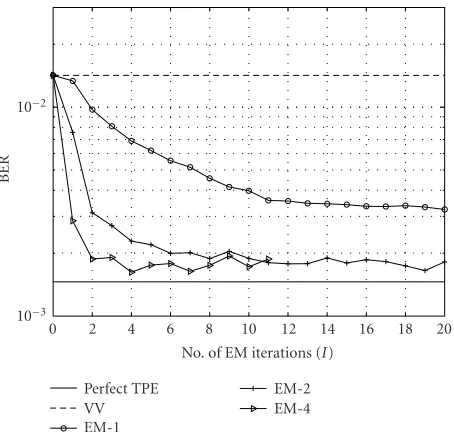
The total computational complexity of the joint estimation and decoding algorithm is proportional toKMDI, whereM is the size of the constellation, KM is the number of exe-cutions of the EM algorithm, D is the decoding time per codeword, andI is the number of EM iterations. From the shape of the curves in Figure 3, we may infer that conver-gence will occur sooner (i.e., for less EM iterations) when the initial estimate is nearer to the correct value. It may there-fore be advantageous to execute the estimation algorithm with more than M initial values but with fewer EM itera-tions.
10−2
10−3
0 2 4 6 8 10 12 14 16 18 20
No. of EM iterations (I)
BER
Perfect TPE VV EM-1
EM-2 EM-4
Figure4: Number of EM iterations versus number of initial values
tradeoff(QPSK,Eb/N0=1 dB).
5.2. Phase estimation
Figure 5a shows the mean square estimation error (MSEE) performance of the VV estimator and the EM estimators, as-suming perfect PAR (i.e.,kθis known at the receiver, so that only εθ needs to be estimated). As a reference, we include the modified Cram´er-Rao bound (MCRB) for a known se-quence of 1002 bits (=501 QPSK symbols). The MCRB is a lower bound for the MSEE of any unbiased estimator [19]. Application of the EM-1 algorithm reduces the MSEE but the MCRB is reached only for SNRs above 2 dB. The EM-2 algorithm is able to further reduce the MSEE and reaches the MCRB forEb/N0 ≥ 1.5 dB. The different MSEE
perfor-mances resulting from the EM algorithms indicate that the EM-1 algorithm occasionally converges to an incorrect value due to the (large) initial estimation error.
To see how this translates in BER performance, we refer toFigure 5b. Clearly, the VV FPE algorithm results in a high BER degradation. EM-1 is able to partly reduce this degra-dation. However, the remaining degradation at BER=10−4is
still around 0.5 dB. By applying EM-2, we are able to essen-tially remove any resulting degradation. Note that increas-ing the number of initial estimates (i.e., increasincreas-ingKto 3 or more) will further reduce the MSEE but the corresponding reduction of the BER will be barely noticeable.
5.3. Phase ambiguity resolution
We first note that the combination of any PAR algorithm with any FPE algorithm will result in degradation at least as large as the degradations of the separate algorithms. For that rea-son, we will only consider the following schemes (we remind thatLis the length of the pilot sequence, expressed in sym-bols):
(i) TPE: EM-2 + init(VV);L: the EM algorithms is exe-cuted 2Mtimes with initial estimates given by (18);
(ii) PAR: CORR + perfect FPE;L: the conventional PAR algorithm (6) under the assumption of perfect knowl-edge ofεθ;
(iii) PAR: REEN + perfect FPE;L: this algorithm is formally obtained by replacing the soft decisionsµi in (15) by the data symbols obtained by re-encoding the decoded information sequence [12]. This approach has roughly the same computational complexity as the EM-1 PAR algorithm;
(iv) PAR: EM-hard + perfect FPE;L: this algorithm is for-mally obtained by replacing the soft decisionsµifrom (15) by the nearest (hard) constellation symbol. This can be seen as a code-aided decision-directed PAR al-gorithm.
In the latter two cases,εθis assumed to be known at the re-ceiver. The estimated phase shift (2πk/M) is the one resulting in the largest correlation of the hard symbol decisions (resp., with and without re-encoding) with the rotated received vec-tor (rexp(−j2πk/M)).
Figure 6shows the BER performance for the various ap-proaches. We see that “PAR: CORR + perfect FPE” requires fairly long pilot sequences to reach acceptable BER perfor-mance, thus reducing the spectral efficiency of the system. The re-encoding rule leads to a BER degradation whenEb/N0
is below 2 dB. We now consider the EM algorithm approach. Using hard instead of soft data decisions leads to very high BER for all considered SNR, even under perfect FPE. On the other hand, application of “TPE: EM-2 + init(VV)” leads to a very good performance, even when no pilot sequence is present.
6. CONCLUSION AND REMARKS
This contribution has considered the problem of phase es-timation (PE) and phase ambiguity resolution (PAR) in (turbo-) coded systems. Starting from the ML criterion, we have pointed out how code-aided PE and PAR may be per-formed iteratively based on the EM algorithm, and how con-vergence issues may be addressed. We have compared the re-sulting algorithms with known algorithms (of which some do and some do not take code properties into account) in terms of the mean square estimation error (MSEE) and the BER. Through simulation of a turbo-coded QPSK transmis-sion system, we have shown that
(i) code-aided PAR can achieve a very small BER degra-dation, even in the absence of pilot symbols;
(ii) conventional PAR can achieve a very small BER degra-dation only at the expense of a sufficient number of pilot symbols;
(iii) code-aided PE is required to achieve a very small BER degradation.
100
10−1
10−2
10−3
10−4
−1.5 −1 −0.5 0 0.5 1 1.5 2
Eb/N0(dB)
MSEE
MCRB VV
EM-1 EM-2 (a)
100
10−1
10−2
10−3
10−4
10−5
−1.5 −1 −0.5 0 0.5 1 1.5 2
Eb/N0(dB)
BER
Perfect TPE VV
EM-1 EM-2 (b)
Figure5: Phase estimation performance in terms of (a) MSEE and (b) BER assuming perfect PAR.
100
10−1
10−2
10−3
10−4
10−5
−1.5 −1 −0.5 0 0.5 1 1.5 2
Eb/N0(dB)
BER
Perfect TPE
TPE: EM-2 + init (VV);L=0 PAR: REEN + perfect FPE;L=0 PAR: EM-hard + perfect FPE;L=0 PAR: CORR + perfect FPE;L=(1, 5, 10, 15)
Figure6: Impact of phase ambiguity resolution on BER.
Hence, in this case, it is not necessary to apply the EM PE algorithm. Regarding PAR, the conclusions pertaining to QPSK are also valid for BPSK.
While the ML phase estimation algorithm was developed for an AWGN channel with M-PSK modulation, it can easily be altered and applied to a variety of channel models (e.g., fading, multipath), codes (e.g., convolutional codes, LDPC codes), and communication systems (e.g., CDMA, MIMO, OFDM).
In this paper, we have assumed perfect symbol and frame synchronization. In practice, symbol (resp., frame) synchro-nization can be accomplished by means of non-data-aided algorithms [20,21] (resp., data-aided algorithms [20,22]). Recently, code-aided algorithms for symbol synchronization [23] and for frame synchronization [16] have been proposed. An algorithm for code-aided joint phase and delay estima-tion remains a topic for future work.
APPENDIX We start with (9):
Qb˜, ˆb(n)=
xp
x|r, ˆb(n)lnpx|b˜dx (A.1)
withx=[r,a]. Whenbandaare independent (as is the case in our problem), we may write
px|b˜=pr|a, ˜bp(a) (A.2) while
px|r, ˆb(n)=pa|r, ˆb(n). (A.3) Dropping terms that do not depend on b, and taking into account the uniform a priori distribution ofa, (A.1) becomes
Qb˜, ˆb(n)=
ap
a|r, ˆb(n)lnpr|a, ˜bda
.
=Ea
lnpr|a, ˜b|r, ˆb(n).
(A.4)
In our case, withb=θ,
lnpr|a, ˜θ∝
N+L−1
i=0
ris∗ie−j
˜
Substituting (A.5) into (A.4) leads to
Qθ˜, ˆθ(n)=
L−1
i=0
rip∗i e−j
˜
θ+N
+L−1
i=L
riEa
a∗i|r, ˆθ(n)
e−jθ˜
= Cpe−j
˜
θ+C d
ˆ
θ(n)e−jθ˜
(A.6)
withCpandCd( ˆθ) defined in (3) and (15), respectively.
ACKNOWLEDGMENT
This work has been supported by the Interuniversity Attrac-tion Poles Program P5/11, Belgian Science Policy.
REFERENCES
[1] A. J. Viterbi and A. M. Viterbi, “Nonlinear estimation of PSK-modulated carrier phase with application to burst dig-ital transmission,” IEEE Trans. Inform. Theory, vol. 29, no. 4, pp. 543–551, 1983.
[2] E. Cacciamani and C. Wolejsza Jr., “Phase-ambiguity reso-lution in a four-phase PSK communications system,” IEEE Trans. Commun., vol. 19, no. 6, pp. 1200–1210, 1971. [3] P. Hoeher and J. Lodge, ““turbo DPSK”: iterative differential
PSK demodulation and channel decoding,”IEEE Trans. Com-mun., vol. 47, no. 6, pp. 837–843, 1999.
[4] V. Lottici and M. Luise, “Carrier phase recovery for turbo-coded linear modulations,” inProc. IEEE International Con-ference on Communications (ICC ’02), vol. 3, pp. 1541–1545, New York, NY, USA, April–May 2002.
[5] L. Zhang and A. Burr, “A novel carrier phase recovery method for turbo coded QPSK systems,” inProc. European Wireless (EW ’00), Florence, Italy, February 2000.
[6] W. Oh and K. Cheun, “Joint decoding and carrier phase re-covery algorithm for turbo codes,” IEEE Commun. Lett., vol. 5, no. 9, pp. 375–377, 2001.
[7] B. Mielczarek and A. Svensson, “Phase offset estimation using enhanced turbo decoders,” inProc. IEEE International Con-ference on Communications (ICC ’02), vol. 3, pp. 1536–1540, New York, NY, USA, April–May 2002.
[8] M. J. Nissil¨a, S. Pasupathy, and A. M¨ammel¨a, “An EM ap-proach to carrier phase recovery in AWGN channel,” inProc. IEEE International Conference on Communications (ICC ’01), vol. 7, pp. 2199–2203, Helsinki, Finland, June 2001.
[9] N. Noels, C. Herzet, A. Dejonghe, et al., “Turbo synchroniza-tion: an EM algorithm interpretation,” inProc. IEEE Inter-national Conference on Communications (ICC ’03), vol. 4, pp. 2933–2937, Anchorage, Alaska, USA, May 2003.
[10] J. Dauwels and H.-A. Loeliger, “Joint decoding and phase es-timation: an exercise in factor graphs,” inProc. IEEE Inter-national Symposium on Information Theory (ISIT ’03), p. 231, Yokohama, Japan, June–July 2003.
[11] U. Mengali, A. Sandri, and A. Spalvieri, “Phase ambiguity res-olution in trellis-coded modulations,”IEEE Trans. Commun., vol. 38, no. 12, pp. 2087–2088, 1990.
[12] U. Mengali, R. Pellizzoni, and A. Spalvieri, “Soft-decision-based node synchronization for Viterbi decoders,”IEEE Trans. Commun., vol. 43, no. 9, pp. 2532–2539, 1995.
[13] C. Berrou, A. Glavieux, and P. Thitimajshima, “Near Shannon limit error-correcting coding and decoding: Turbo-codes. 1,” in Proc. IEEE International Conference on Communications (ICC ’93), vol. 2, pp. 1064–1070, Geneva, Switzerland, May 1993.
[14] A. P. Dempster, N. M. Liard, and D. B. Rubin, “Maximum liklihood from incomplete data via the EM algorithm,”J. Roy. Statist. Soc. Ser. B, vol. 39, pp. 1–38, 1977.
[15] U. Mengali and A. N. D’Andrea, Synchronization Techniques for Digital Receivers, Plenum Publishing, New York, NY, USA, 1997.
[16] H. Wymeersch and M. Moeneclaey, “Code-aided frame syn-chronizers for AWGN channels,” inProc. International Sympo-sium on Turbo Codes & Related Topics, Brest, France, Septem-ber 2003.
[17] L. R. Bahl, J. Cocke, F. Jelinek, and J. Raviv, “Optimal decoding of linear codes for minimizing symbol error rate,”IEEE Trans. Inform. Theory, vol. 20, pp. 284–287, 1974.
[18] X. Li, A. Chindapol, and J. A. Ritcey, “Bit-interleaved coded modulation with iterative decoding and 8 PSK signaling,” IEEE Trans. Commun., vol. 50, no. 8, pp. 1250–1257, 2002. [19] A. N. D’Andrea, U. Mengali, and R. Reggiannini, “The
mod-ified Cramer-Rao bound and its application to synchroniza-tion problems,” IEEE Trans. Commun., vol. 42, no. 234, pp. 1391–1399, 1994.
[20] H. Meyr, M. Moeneclaey, and S. A. Fechtel, “Synchroniza-tion, channel estima“Synchroniza-tion, and signal processing,” inDigital Communication Receivers, John Wiley & Sons, New York, NY, USA, 1997.
[21] M. Oerder and H. Meyr, “Digital filter and square timing re-covery,” IEEE Trans. Commun., vol. 36, no. 5, pp. 605–612, 1988.
[22] J. G. Proakis, Digital Communications, McGraw-Hill, New York, NY, USA, 4th edition, 2001.
[23] C. Herzet, V. Ramon, L. Vandendorpe, and M. Moeneclaey, “EM algorithm-based timing synchronization in turbo re-ceivers,” inProc. IEEE International Conference on Acoustics, Speech, and Signal Processing (ICASSP ’03), vol. 4, pp. 612– 615, Hong Kong, China, April 2003.
Henk Wymeerschreceived the Diploma of Computer Science Engineering from Ghent University, Ghent, Belgium, in 2001. He is currently working toward the Ph.D. degree in the Department of Telecommunications and Information Processing, Ghent Univer-sity. His main research interests are in syn-chronization, multirate receivers, and chan-nel coding.
Marc Moeneclaey received the Diploma and the Ph.D. degree, both in electrical en-gineering, from Ghent University, Ghent, Belgium, in 1978 and 1983, respectively. He is currently a Professor in the Depart-ment of Telecommunications and Infor-mation Processing, Ghent University. His main research interests are in statistical communication theory, carrier and symbol synchronization, bandwidth-efficient