Volume 2007, Article ID 76241,12pages doi:10.1155/2007/76241
Research Article
Locally Regularized Smoothing B-Snake
J ´er ˆome Velut, Hugues Benoit-Cattin, and Christophe Odet
CREATIS, CNRS UMR 5220, Inserm U 630, INSA, Bˆatiment Blaise Pascal, 69621 Villeurbanne, France
Received 22 July 2005; Revised 25 July 2006; Accepted 17 December 2006
Recommended by Jiri Jan
We propose a locally regularized snake based on smoothing-spline filtering. The proposed algorithm associates a regularization process with a force equilibrium scheme leading the snake’s deformation. In this algorithm, the regularization is implemented with a smoothing of the deformation forces. The regularization level is controlled through a unique parameter that can vary along the contour. It provides a locally regularized smoothing B-snake that offers a powerful framework to introduce prior knowledge. We illustrate the snake behavior on synthetic and real images, with global and local regularization.
Copyright © 2007 J´er ˆome Velut et al. This is an open access article distributed under the Creative Commons Attribution License, which permits unrestricted use, distribution, and reproduction in any medium, provided the original work is properly cited.
1. INTRODUCTION
Active contour models (or snakes) are well adapted for edge detection and segmentation. Since snakes were intro-duced by Kass et al. [1], they have been widely used in many domains and improved using different contour rep-resentations and deformation algorithms. Menet et al. [2] proposed the snakes that take advantages of the B-spline representation. A local control of the curve con-tinuity and a limited number of processed points in-crease the convergence speed and the segmentation relia-bility. At the same time, L. Cohen and I. Cohen [3] fo-cused on external forces that drive the snake toward the features of interest in the image and proposed the bal-loon force that increases considerably the attainability zone. Then, Xu and Prince [4] defined another external force called gradient vector flow (GVF) that brings a better control on the deformation directions: they proposed to diffuse the gradient over the image according to optical flow theory. Beside these works, the multiresolution frame-works were integrated within the active contours. Wang et al. [5] used a B-spline representation that allows a coarse-to-fine evolution of the snake. Brigger et al. [6, 7] ex-tended Wang’s technique with a multiscale approach in both the image and the parametric contour domain. Pre-cioso et al. [8] proposed a region-based active contour that achieves real-time computation adapted to video segmen-tation. They extended their model by applying a smooth-ing B-spline filter [9,10] on the contour. It increases con-siderably the robustness to noise without additional
compu-tation. Recently, new energies have been proposed by Jacob et al. [11] who unify the edge-based scheme with the region-based one.
Existing snakes suffer from several limitations when a lo-cal regularization is wanted. With the original snake [1], a local regularization involves a matrix inversion step at each iteration. Although B-snakes [6] avoid this inversion step by implicitizing the internal energy, the proposed solutions induce a varying sampling step when a local regulariza-tion of the snake is needed. Consequently, prior knowledge would be difficult to integrate in the varying sampling step. The smoothing B-spline filtering method of [8] does not deal with local regularization and has a strong initialization-dependent minimization process linked to the regularization algorithm proposed.
In this paper, we propose to regularize locally a snake while keeping a uniform sampling step. The presented ap-proach is based on smoothing-spline filtering that is con-trolled through a unique parameter λ. The next section reminds the snake concepts and their interaction with B-splines. Section 3 details the proposed algorithm named LRSsnake that stands for locally regularized smoothing B-snake. Section 4 presents experimental results on real and synthetic images.
2. SNAKES AND B-SPLINES
describe the smoothing B-spline filtering strategy. Finally, we analyze its usage within the smoothing-spline snake-based algorithm of Precioso et al. [8].
2.1. Snakes: active contour model
Basically, a snake is a parametric curve g(s) = (x(s),y(s)) placed on an image [1]. The final snake, that represents the segmentation result, will be the curve that minimizes the en-ergyEsnakegiven by
Esnake=
sEint
g(s)+Eextg(s)ds, (1)
where
Eint=1 2
α(s)·dg(s)
ds
2+β(s)·d
2g(s)
ds2
2, (2)
Eext= −∇I(x,y)2. (3)
Eint given by (2) is the internal energy that traduces shape constraints on the curve. Theα(s) andβ(s) functions tune the regularization. The functionβ(s) gives more or less im-portance to the curvature by weighting the second derivative of the curve. In the same way, the functionα(s) weights the elasticity through a tuning of the first derivative. In order to attract the snake to the contours of an imageI, the external energyEextis defined in (3). Such energy is the most current one. One can use any external energy expressions coherent with the image features to detect.
In [1], the authors complete the minimization of the
Esnakeenergy using the discretized version of (1):
Esnake=
k
Eintg(k)+Eextg(k), (4)
where kis the discretized version of the parameter s. This leads to a force balance
A·x+fx=0, A·y+fy=0, (5)
whereAis a pentadiagonal banded matrix built fromα(k) andβ(k) function values, where vectorsxandycontain the point coordinates of the discrete versiong(k) of the curve
g(s), and where vectorsfxandfyconstitute the external forces
computed at thekth point of the snake as follows:
f(k)=fx(k),fy(k)
=
∂Eext(k)
∂x ,
∂Eext(k)
∂y
, (6)
where (x(k),y(k))=g(k).
The equilibrium state is reached using the gradient de-scent method that ensures the convergence toward a local minimum of energy:
A·xi+fx,i−1= −γ
xi−xi−1
,
A·yi+fy,i−1= −γ
yi−yi−1
, (7)
whereγis a step-size parameter andiis the iteration index of the gradient descent evolution.
c(k)
g(k)
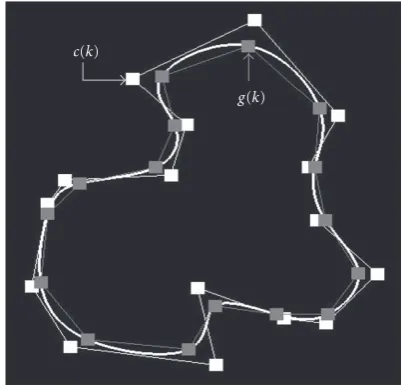
Figure1: B-spline interpolation.c(k) are the coefficients,g(k) are the B-spline points, andg(s) is the curve that interpolatesg(k).
We can then solve forxiandyiwithxi−1andyi−1:
xi=
A+γI−1γ·xi−1−fx,i−1
,
yi=
A+γI−1γ·yi−1−fy,i−1
. (8)
Solving this system iteratively leads to an equilibrium state that is the minimum of the snake energy. Local min-ima traps may be avoided with sufficient regularization, but the need to initialize the snake close to the solution remains.
2.2. B-splines for B-snakes
The B-splines are continuous functions used to build para-metric curves. The continuity is dependent on the degree of the B-spline. Cubic B-splines are often used, because this is a
C2 continuous function that provides an implicit
smooth-ness to adjacent points of the corresponding parametric curve. A cubic uniform B-spline curve g(s) = (x(s),y(s)) (Figure 1) is built from a finite set of coefficientsc(k) with
x(s)=
n−1
k=0
cx(k)Bk(s), y(s)= n−1
k=0
cy(k)Bk(s), (9)
wherenis the number of coefficients,Bk(s) is the basis
func-tion centered on thekth coefficient.
The coefficients are represented through their plane co-ordinatesc(k)=(cx(k),cy(k)).
Menet et al. [2] showed that (1) can be minimized through an iterative process that is equivalent to (8) except that the matrixAbecomesAband external forcesfbecome fb. The matrixAbintegrates theαandβcoefficients of matrix Aand the first and second derivatives of the B-spline func-tion. The new external forces fb(k) are derived from the
g(k) B−1(z) c(k) B(z) g(k)
Figure2: Block diagram of the direct and inverse B-spline filters.
g(k) are the curve points.B−1(z) is the direct B-spline filter that
computes the B-spline coefficientsc(k) fromg(k).B(z) is the inverse filter ofB−1(z) and is called indirect B-spline filter.
process is given by
cx,i=
Ab+γI−1γ·cx,i−1−fbx,i−1
cy,i=
Ab+γI−1γ·cy,i−1−fby,i−1
, (10)
wherecx,iandcy,iare vectors containing the coefficient
val-ues at iterationi. Such a snake is called B-snake in [2] and its evolution is conducted using the coefficients values. More-over, Flickner et al. [12] and Brigger et al. [6] use the built-in smoothness property of the cubic B-splines to take the inter-nal energy out of (1). The regularization is then controlled by varying the distance between adjacent coefficients. The more distant two coefficients are, the smoother the spline is. The iterative system in (10) is then simplified by settingαandβ
to 0 inA, and the iterative minimization process becomes
cx,i(k)=cx,i−1(k)−γ−1·fxb,i−1(k), cy,i(k)=cy,i−1(k)−γ−1·fyb,i−1(k).
(11)
In [6], the authors prefer to interact with the snake via real curve points instead of the coefficients. They implement a digital filterB(z) described in [13] that links the B-spline coefficientsc(k) to the curve pointsg(k) by
g(k)=b(k)∗c(k)−→z G(z)=B(z)·C(z), (12)
where G(z), B(z), andC(z) are the Z-transforms of g(k),
b(k), andc(k) and where
B(z)=z+ 4 +z
−1
6 . (13)
Using the inverse filter ofB(z) allows one to obtain the B-spline coefficients from the curve points (Figure 2). As coef-ficients and curve points are linked together, there is no need to work with B-spline coefficients in the deformation process of the snake. Then (11) can be rewritten using the snake’s pointg(k)=(x(k),y(k)):
xi(k)=xi−1(k)−γ−1· fx,i−1(k), yi(k)=yi−1(k)−γ−1·fy,i−1(k),
(14)
wherexi(k) and yi(k) are the coordinates of thekth curve
point at iterationi.
2.3. Smoothing B-splines
B-splines interpolation is a mean of building continuous curves from a finite set of coefficients. A B-spline interpolates
exactly a set of pointsg(k). However, an exact interpolation is often not a reliable method of reconstruction. Reinsch [9] illustrates this issue with a 1D signal taken from an imperfect measuring tool. He proposed to approximate the set of mea-sured points by spline functions. Given a set of pointsg(k), the smoothing spline is the one that minimizes
ε2 s= +∞ k=−∞
g(k)−g(k)2+λ +∞
−∞
∂2g(s)
∂2s 2
ds, (15)
whereg(k) is the point set,g(k) is the approximating point set ofg(k), andg(s) is the continuous function that interpo-latesg(k).
The first term of (15) represents the error between the original data setg(k) and the approximating oneg(k). The second term, weighted byλ, represents the global curvature of the curve. A largeλgives more importance to the smooth-ing aspect ofg(k) whereas a smallλimposesg(k) to be closer tog(k). It is proven [9,10] that a cubic B-spline is the solu-tion of (15).
In [10], Unser et al. apply the B-spline filtering approach to the smoothing spline formulation. They show that the co-efficients of the approximating B-spline could be computed through an IIR filterSλ. Consequently, from these
approxi-mating coefficientsc(k), one can find the approximating B-spline pointsg(k) through a B-spline filterB(Figures3and 4).
The smoothing B-spline filter transfer function is given by
SBλ(z)=Sλ(z)·B(z)= z+ 4 +z
−1
a+b·z+z−1+c·z2+z−2,
(16)
where
Sλ(z)= 6
z+ 4 +z−1+ 6·λz2−4z+ 6−4z−1+z−2,
(17)
B(z) is given in (13), anda=4+36λ,b=1−24λ, andc=6λ.
SBλ(z) represents a fourth order symmetric filter with
co-efficients depending onλ. It is a low-pass filter with a cut-off frequency controlled byλ(Figure 5). The link betweenλand the cut-offfrequencyfcwith an attenuation of−3 dB is given
by
λfc
= −cos
2π fc
+ cos2π fc √
2−2 + 2√2 12cos2π fc
2
−2 cos2π fc
+ 1 ,
fc(λ)
=arccos
−1+√2+24·λ+3−2√2−144·λ+144√2·λ/24·λ
2π .
(18)
When λ equals 0, (34) shows that SBλ(z) equals 1. It
means thatg(k) = g(k), that is, there is no approximation (Figure 3).
g(k) g(s) c(k)
(a)
g(k) g(s) c(k)
(b)
Figure3: A smoothing B-spline curve. The points to approximate are theg(k) represented by the cross symbols. Thec(k) are the coefficients of the smoothing B-spline and are represented by the dot symbols. The curveg(s) is the approximating curve according toλ. (a) Approxi-mation of a point setg(k) withλ=0. Note that in this case, we obtain a B-spline interpolation. (b) Approximation of the same point set withλ=0.1.
g(k) Sλ(z)
c(k) B
(z) g(k)
SBλ(z) λ
Figure4: Block diagram of the smoothing B-spline filterSBλ.g(k)
are the curve points.Sλ(z) is a filter that computes the smoothing
B-spline coefficientsc(k).B(z) is a filter that computes the B-spline curve points from a set of coefficients.g(k) are the approximating points ofg(k).
smoothed outputg(k):
g(k)=g(k)∗b(k)∗sλ(k)=g(k)∗sbλ(k), (19)
wheresbλ(k) is the impulse response of the approximation
filterSBλ.
The implementation of the smoothing B-spline filter is not straightforward. An efficient implementation was pro-posed by Unser et al. [13]. It implements a causal/anticausal filtering technique (see the appendix), resulting inO(n) com-plexity of the filtering process,nbeing the number of points of the input signal.
2.4. Smoothing B-splines and snakes
The smoothing-spline snake-based algorithm proposed by Precioso et al. [8] takes advantage of the smoothness con-trol allowed by a smoothing B-spline filter in the
regulariza-0 0.2 0.4 0.6 0.8 1 1.2
|
SB
λ
|
0 0.1 0.2 0.3 0.4
Normalized frequency λ=0
λ=0.1 λ=1
λ=10 λ=100
Figure5: Frequency response of the smoothing-spline filterSBλfor
different values ofλ.
tion of an active contour. The segmentation results obtained with this algorithm show a good robustness to noise forλ
varying in the range [0.1, 1]. The authors underlined that the computational cost of the contour smoothing is negli-gible compared to the statistical evaluation involved in the region-based active contour. This algorithm contains an ini-tialization step, an evolution step, and a convergence test. Let
ibe the iteration index, g(k) the sampling points,c(k) the smoothing spline coefficients.
At initialization step, we get gi=0(k) from an interface.
The smoothing spline coefficients are
ci,0(k)=sλ(k)∗gi,0(k), (20)
The snake evolution is conducted through the following steps.
(a) Computation of the smoothing spline points:
gi(k)=b(k)∗ci(k). (21)
(b) Computation of evolution forces (di(k)) according to
a region-based scheme detailed in [8]:
di(k)=ν·N(k), (22)
whereνis defined as the velocity of the contour,Nis the normal vector to the contour.
(c) Displacement ofgi(k) bydi(k) to get the next points gi+1(k):
gi+1(k)=gi(k) +di(k). (23)
(d) Computation of smoothing spline coefficients:
ci+1(k)=sλ(k)∗gi+1(k). (24)
(e) Return to step (a) until convergence.
The convergence test is based on some variation mea-sures of the contour characteristics [8]. If an equilibrium cri-terion is reached, the snake stops. We note that each iteration involves a smoothing part represented by the convolution equations (21) and (24), whereb(k) is the impulse response of the filterB(z), respectively. Introducing the iteration index
iand the deformation process through the evolution forces (ν·Ni(k)) with respect to the algorithm, we obtain, from
(21) and (23),
gi+1(k)=gi(k) +di(k)=ci(k)∗b(k) +di(k). (25)
From (25), we find
ci+1(k)=ci(k)∗sbλ(k) +di(k)∗sλ(k), (26)
wheredi(k)=ν·Ni(k).
Finally, from (26) and using theZtransform, we obtain:
Ci+1(z)=C0(z)· i+1
SBλ(z) + i
j=0
Dj(z)·Sλ(z) i−j
SBλ(z)
.
(27)
Equation (27) presents one term linked to the initial smoothing-spline coefficientsC0(z) which is multiplied by a product of theSBλ(z) approximation filter. As this filter is a
low-pass filter, the initial position of the snake tends to have less importance when the number of iterations increases. A similar behavior is observed within the second term of (26) where the oldest deformation forces tend to be canceled. The product terms involving the SBλ(z) approximation filter in
(27) explains the restricted range [0.1, 1] of theλ parame-ter values. For a given number of iparame-terations, greaparame-ter values ofλmake the snake to shrink. The reproducibility of the re-sults is hard to obtain because theSBλregularization effect is
strongly linked to the number of iterations that is itself linked to the initial position of the snake.
In this paper, we propose another approach that uses the smoothing-spline filter in an active contour scheme where
λvalues are not limited and where the regularization is not iteration-dependent and can be locally defined.
Initialization
Def
o
rm
ation
Con
ver
ge
n
ce
Initial sampling points g0(k)
Deformation forces computation di(k)
Deformation forces smoothing di(k)=sbλ∗di(k)
Moving sampling points
gi+1(k)=gi+μ·di(k)
Resampling
No i=i+ 1
Convergence test
Yes Segmentation ends
Figure6: Flow-chart of the locally regularized smoothing B-snake algorithm.
3. LOCALLY REGULARIZED SMOOTHING B-SNAKE
An overview of the proposed locally regularized Smoothing B-Snake (LRSB-snake) is given in Figure 6. From an initial contourg0(k) and the image to segment, we compute the de-formation forces (seeSection 3.1). The regularization is done by smoothing the deformation forces. We can apply a global regularization (Section 3.2) or a local one (Section 3.3). The contour is then moved by applying the regularized deforma-tion forces. To enforce a similar behavior of the smoothing process at each iteration, the contour is resampled as dis-cussed inSection 3.4. If the contour is stabilized, the iterative process is stopped.
3.1. Deformation forces computation
Laplacian vector field (6) computed from a Gaussian-blurred version of the image gives suitable deformation forces [1]. Xu and Prince proposed the gradient vector flow (GVF) [4] to diffuse the gradient over the image in order to give a greater range to the attraction forces. The balloon force [3] is an-other external force. It is a vector directed along the normal of the contour. It creates a pressure force at each point of the snake that makes it swelling.
The sum of every considered forces gives the deformation vectordi(k) at each pointk and at each iteration i. As the
basic idea of a deformation process is to move every point according to a deformation vector, we define the following deformation equation:
gi+1(k)=gi(k) +μ·di(k), (28)
whereiis the iteration index,g(k) are the snake points,di(k)
are the deformation vectors, that is, the external forces, andμ
is a step-size parameter involved in the speed of convergence. Equation (10) corresponds to (28) if we setμ = −γ−1 and d(k)= f(k). Note that (28) does not imply any regulariza-tion process.
3.2. Global regularization process through deformation forces smoothing
Regularization of the deformable model is essential to ensure a good robustness to noise of such segmentation approach. Usually, the regularization is assumed through an internal energy term in the snake energy formulation [1] or implicitly through a variation of the contour sampling [6]. Such regu-larization prevents incoherent deformation of the contour by introducing a curvature-based penalty. We choose to control the curvature of the contour with a smoothing B-spline fil-ter that minimizes the curvature optimally [9] according to a single parameterλ.
Equation (29) gives the snake regularized by theSBλ
ap-proximation filter at iterationi,
gi(k)=sbλ(k)∗gi(k). (29)
From (28) and (29), we obtain (30) that yields the defor-mation and the motion steps of the algorithm (Figure 6),
gi+1(k)=gi(k) +
μ·di(k)
∗sbλ(k). (30)
Finally, from (30) and using theZ-transform, we obtain
Gi+1(k)=G0(k) +μ· i
j=0
Dj(z)·SBλ(z). (31)
It is clear in (30) that we bring into effect the snake regu-larization by a smoothing filtering of the deformation forces (Figure 6). Consequently (31), an infinite iterative process does not lead to an infinite successive convolution of di.
Compared to [8], the regularization does not depend on the number of iterations. It allowsλto control the cut-off fre-quency of theSBλapproximation filter and thus the
regular-ization level by taking any real positive values. As the regu-larization is done by a digital recursive filter, it preserves the processing speed mentioned in [8].
In practice, the 1D smoothing B-spline filter is used to filter a parametric curve in the plane. It is applied on each parametric component of the curve as in (32).Figure 7 illus-trates the filtering of such a parametric curve,
g(k)=sbλ(k)∗g(k)=⇒
gx(k) gy(k)
=
sbλ(k)∗gx(k) sbλ(k)∗gy(k)
.
(32)
Note that a 1-D filter is usually applied on a uniformly sampled signal. As we want to keep the same filter frequency response which isλ-dependent, we enforce a uniform sam-pling of the contour in our algorithm (seeSection 3.4).
3.3. Local regularization process
From the regularization term of (30), one can write the fol-lowing equation:
Di(z)=SBλ(z)·Di(z), (33)
where
SBλ(z)=Sλ(z)·B(z)= z+ 4 +z
−1
a+b·z+z−1+c·z2+z−2
(34)
witha=4 + 36λ,b=1−24λ, andc=6λ.
In (Appendix A.2), we show that (33) conducts to two recurrence equations (A.10) and (A.11) where the filters co-efficientsa,b, andcappears. We propose to make those two equations space-varying by makingλdependent of thekth contour point. Thus,a,b, andcbecome
ak=4 + 36·λk, bk=1−24·λk, ck=6·λk
(35)
and the space-varying recurrence equations are
d1(k)=ck·d(k) +ak·d1(k−1)−bk·d1(k−2),
d2(k)=ck·d1(k) +ak·d2(k+ 1)−bk·d2(k+ 2).
(36)
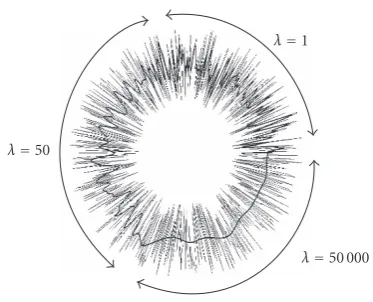
Consequently, each point of the snake has its own regu-larization rate. We are able to affect different values ofλalong the contour (Figure 8) according to several strategies like lo-cal image information (to adaptλto noise level or to perti-nent image features under the contour), or prior knowledge introduced in the initial model (to keep the contour in a con-trolled deformation range). These strategies may have diff er-ent impacts on snake evolution that are beyond the scope of this paper.
3.4. Resampling
(a) (b)
(c) (d)
Figure7: Smoothing B-spline filtering of a parametric circle with parameters. Noisy circle in (b) is described byx(s) andy(s) (a). The circle in (b) has a constant radius disturbed by a uniformly distributed additive noise.x(s) andy(s) are smoothed separately by the smoothing B-spline filter (c). (d) shows the smoothed parametric circle.
λ=50
λ=1
λ=50 000
Figure 8: Spatially variant smoothing-spline filtering. The input signal is the noisy circle. This signal is filtered through a smoothing-spline filter where the smoothing parameterλvaries along the con-tour. The resulting signal is represented in bold.
a resampling one. Starting with one existing point, each next point is set at a fixed distance from the previous one as de-scribed in the following algorithm.
Letg(s) be the original contour,g(i) the resampled con-tour, ithe new point index, sthe continuous parameter, e
the wanted constant sampling distance, andN the number of points of the original contour.N−1 represents also the total curve length.
(1) Initialization:g(0)=g(0),i=0. (2) Incrementation ofi.
(3) Findssuch that g(s)g(i−1) =e, then setg(i)=
g(s).
(4) Repeat steps (2) and (3) whiles < N−1.
As g(i) = (x(i),y(i)), we have g(i)g(i−1) =
(x(i)−x(i−1))2+ (y(i)−y(i−1))2.
The resampling impact is illustrated inFigure 9where a curve with different sampling rates is smoothed via a smoothing B-spline filter with the same λ. It appears that the greatest interpoint distance (Figure 9(d)) leads to the smoothest curve.
When λ is locally variant, the λ-values under the new points are obtained by linear interpolation between the λ -values of the previous and the next old points.
3.5. Open and closed contours
The smoothing-spline filter has an infinite impulse response. To implement the corresponding difference equation (33), Unser et al. [13] proposed to initialize the filtering process with an approximation of the impulse response. Boundary conditions have to be clearly defined in order to choose a cor-rect extrapolation of the signal.
(a) Standard curve to be smoothed. (b) 10 000-point smoothed curve.
(c) 1000-point smoothed curve. (d) 100-point smoothed curve.
Figure9: Illustration of the influence of sampling over theλvalue. Each curve is smoothed by the same smoothing B-spline filter with
λ=1000.
Figure10: Illustration of an opened contour smoothing using an antimirror with pivot point extension. A hand-drawn line and its smoothed version are given.
The open contour case is different because we need to ex-trapolate the parametric signal while keeping a suitable con-tinuity at endpoints. Several extrapolation techniques have been proposed leading to different behaviors [6, 14]. We choose to implement an antisymmetric mirror with pivot point extension [6] in order to conserve the continuity at ex-treme points. A smoothed open contour including such an extension is illustrated inFigure 10.
4. RESULTS
This section gives results obtained with the proposed LRSB-snake algorithm. First, the global regularization mode is il-lustrated using real MRI images with opened and closed con-tours. Then, the LRSB-snake is applied on synthetic image and real MRI image to illustrate the advantage of such a local regularization. All these results have been obtained with the following external forces: Laplacian vectors of a Gaussian-blurred version of the image combined with a balloon force to increase the convergence speed.
4.1. Global regularization
Figure 11(a)shows an MR image of a guinea-pig knee and
an initial opened smoothing B-snake. The feature to detect is the femoral border. With a too lowλvalue (λ=71), the final result obtained after 1280 iterations is corrupted by a local minimum (Figure 11(c)). We set a largerλvalue (λ=1000) to avoid this artifact (Figure 11(c)). The final result obtained after 630 iterations is close to the wanted femoral border.
Figure 12shows an anatomic structure in an MRI
(a) Initial snake. (b)λ=1000, 630 iterations. (c)λ=71, 1280 iterations.
Figure11: MRI image of a guinea-pig knee and an initial 67 points snake.
(a) Initial snake. (b)λ=12, 550 iterations. (c)λ=220, 480 iterations.
Figure12: Segmentation of an MRI image through a close snake. Final snakes are 150 points long.
(Figure 12(b)) with a lower value ofλ(λ=12) and 480 iter-ations.
4.2. Local regularization
To illustrate the limitation of the global regularization, we use a synthetic image obtained from a circle (Figure 13(a)). The circle contour is modulated to introduce as many ranges of curvature variation as there are different modulation fre-quencies. A Gaussian noise is then added to the image. Global regularization demonstrates its limits on Figures13(b)and 13(c). A low globalλvalue leads to an evolution of the con-tour very sensitive to noise. The snake may be stuck in local minima as inFigure 13(b). A large globalλvalue induces too much constraint on the snake curvature. The final contour could only outline a mean circle (Figure 13(c)).
OnFigure 13(d), we use the locally regularized scheme whereλ was made spatially variant. The highest frequency part (I) was attached to a lowλ(λ=1). We then increaseλ
to 10 in order to outline successfully the second part (II) of the disk. Last part (III) being perfectly circular,λwas set to 100.
We note with these tests that the LRSB-snake provides a segmentation result (Figure 13(d)) closest to the object to outline (white contour inFigure 13(a)).
Figure 14illustrates the same behavior on a real MRI im-age that presents interesting features: an unsharp gradient area (“ghost gradient”) at the top of the shape that is not an
edge to outline and a lack of gradient at middle right. On Figure 14(b), balloon forces induce a leak of the snake which is not sufficiently regularized. The ghost gradient corrupts the final result also by introducing a curve that does not ex-ist. A largerλvalue (Figure 14(c)) prevents the leak but gives too much importance to the unsharp gradient area.
The LRSB-snake is then applied on this image (Figure 14(d)). A λ map gives the λ values at each im-age position. In this example, theλmap is manually defined, with values empirically determined as follows. Positions where the contour is well visible take a smallλvalue (λ=1), and positions where the contour tends to disappear take a highλ value (λ = 300). One can observe onFigure 14(d) that such a local regularization prevents the leak, manages correctly the ghost gradient, and stops the swell at the top. A strategy to automatically defineλvariations is beyond the scope of this paper.
5. CONCLUSIONS
(a) (b)
(c)
I II
III
(d)
Figure13: Constant and locally regularized 100-points smoothing B-snake on a synthesis image. (a) Noisy object with the reference contour in white. (b) Final segmentation with global lowλ(λ=1). (c) Final segmentation with global highλ(λ=100). (d) Locally regularized smoothing B-Snake. (I :λ=1, II :λ=10, III :λ=100).
(a) (b) (c) (d)
Figure14: Constant and local regularization on an MRI image. (a) Initial snake and original MRI image. (b) Final segmentation after 310 iterations usingλ=1. (c) Final segmentation after 250 iterations usingλ=300. (d) Final segmentation after 330 iterations using localλ
This algorithm associated to pertinent localλdefinition offers a powerful tool for introducing prior knowledge and consequently makes the segmentation process more robust.
A. APPENDIX
This appendix details the smoothing B-spline filter imple-mentation which is linked to the λ value that impacts the filter pole values.
A.1. Smoothing B-spline filter pole analysis
We implement the smoothing spline-filter as discussed in [13]. The filtering system is the one presented inFigure 4. TheB(z) filter is an FIR filter and is implemented through the difference equation associated to its transfer function (13). TheS(z) filter implementation is not straightforward because of its transfer function (17). TheS(z) filter is equiv-alent to a cascade of two symmetric second-order filters:
Sλ(z)=S+λ(z)·S+λ
z−1 (A.1)
with
S+λ(z)=
1−2ρ·cos(ω) +ρ2
1−2ρ·cos(ω)·z−1+ρ2·z−2. (A.2)
In (A.2),ρandωare the magnitude and argument of the two complex conjugate roots (p1 =ρexpjω,p2 =ρexp−jω)
of theS+
λ(z) denominator, and they are linked to theλvalue
by
ρ=24λ−1−
ξ
24λ ·
48λ+ 24λ·√3 + 144λ
ξ ,
tan (ω)=
144λ−1
ξ ,
(A.3)
ξ=1−96λ+ 24λ·3 + 144λ. (A.4)
Equations (A.3) are valid forλvalue greater than 1/24. For otherλvalues several cases have to be considered.
(1) Whenλ=1/24,ρandωtake the specific values given by
ρ=
11−√120,
ω=π 2.
(A.5)
(2) Whenλvalue belongs to the interval ]1/144 : 1/24[, (A.3) are still valid but ρ value is greater than one, and consequently the associated conjugate roots are the roots of
S+
λ(z−1) instead of being those ofS+λ(z).
(3) Whenλvalue belongs to the interval ]0 : 1/144], the roots ofS+
λ(z) become real and are given by
p1=2 +x1+
4x1+x12
2 , p2=
2 +x2+
4x2+x22
2
(A.6)
withx1=(−1+√1−144λ)/12λandx2=(−1−√1−144λ)/
12λ.
Then, we can writeS+
λ(z) as follows:
S+λ(z)=
p1p2 λ
1
1−p1p2z−1+p1p2z−2. (A.7)
(4) Whenλvalue equals 0, we have
λ=0⇐⇒Sλ(z)=B−1(z)⇐⇒SBλ(z)=1. (A.8)
It means that the smoothing B-spline filter has no effect: input and output signals are equal.
A.2. Smoothing B-spline filter implementation
The filter SB(z) is implemented as a cascade of two causal/anticausal filters (A.1) followed by the filterB(z) (13),
D1(z)=D(z)·S+ λ(z),
D2(z)=D1(z)·S+ λ
z−1, D(z)=D2(z)·B(z).
(A.9)
The corresponding difference equations are given by
d1(k)=c·d(k) +a·d1(k−1)−b·d1(k−2), (A.10)
d2(k)=c·d1(k) +a·d2(k+ 1)−b·d2(k+ 2), (A.11)
d(z)=1
6 d2(k−1) + 4 +d2(k+ 1)
, (A.12)
where a,b, andc are computed fromρ and ωdepending on theλvalue as detailed in the previous appendix section. Equation (A.10) represents the causal filtering while (A.11) represents the anticausal one. This is implemented by revers-ing the signald1(k), filtering it withS+
λ and reversing the
out-put.
As the smoothing B-spline filter is an IIR filter, the com-putation of the output at instantkrequires the output knowl-edge at instantsk−1 andk−2 ((A.10) and (A.11)). Conse-quently, the filtering process has to be initialized for the two first points (in the causal recursion) and the two last ones (in the anticausal recursion). For these initializations, we use an approximation of the impulse response ofS+λ(z):
d1(0)=
n
k=0
d(k)s+λ(k), d1(1)= n
k=0
d(k)s+λ(k−1),
(A.13)
where n is the length of the approximation. Note that n
should be sufficiently high to correctly approximate the im-pulse response. Consequently,nvalue will be increased with theλvalue. The anticausal filtering is initialized equivalently. Whenλ >1/144, the impulse response is given by
s+ λ(k)=
1−2ρ·cos (ω) +ρ2ρ|k|sin
|k|+ 1ω
sin (ω) .
Whenλ <1/144, the impulse response is given by
s+ λ(k)=
p1p2
λ
1 1−p2/ p1p
|k|
1 +
1 1−p1/ p2p
|k|
2
.
(A.15)
Whenλ=1/144, the impulse response is given by
s+ λ(k)=
|k|+ 1·p|1k|. (A.16)
ACKNOWLEDGMENTS
This work is in the scope of the scientific topics of the PRC-GdR ISIS Research Group of the French National Center for Scientific Research CNRS. We would like to thank the review-ers of this paper for their comments and suggestions.
REFERENCES
[1] M. Kass, A. Witkin, and D. Terzopoulos, “Snakes: active con-tour models,” inProceedings of the 1st International Conference on Computer Vision, pp. 259–268, London, UK, June 1987. [2] S. Menet, P. Saint-Marc, and G. Medioni, “B-snakes:
imple-mentation and application to stereo,” inProceedings of Image Understanding Workshop, pp. 720–726, Pittsburgh, Pa, USA, September 1990.
[3] L. D. Cohen and I. Cohen, “Finite-element methods for ac-tive contour models and balloons for 2-D and 3-D images,” IEEE Transactions on Pattern Analysis and Machine Intelligence, vol. 15, no. 11, pp. 1131–1147, 1993.
[4] C. Xu and J. L. Prince, “Snakes, shapes, and gradient vector flow,”IEEE Transactions on Image Processing, vol. 7, no. 3, pp. 359–369, 1998.
[5] M. Wang, J. Evans, L. Hassebrook, and C. Knapp, “A multi-stage, optimal active contour model,”IEEE Transactions on Im-age Processing, vol. 5, no. 11, pp. 1586–1591, 1996.
[6] P. Brigger, J. Hoeg, and M. Unser, “B-spline snakes: a flexible tool for parametric contour detection,”IEEE Transactions on Image Processing, vol. 9, no. 9, pp. 1484–1496, 2000.
[7] P. Brigger and M. Unser, “Multi-scale B-spline snakes for gen-eral contour detection,” inWavelet Applications in Signal and Image Processing VI, vol. 3458 ofProceedings of SPIE, pp. 92– 102, San Diego, Calif, USA, July 1998.
[8] F. Precioso, M. Barlaud, T. Blu, and M. Unser, “Robust real-time segmentation of images and videos using a smooth-spline snake-based algorithm,” IEEE Transactions on Image Processing, vol. 14, no. 7, pp. 910–924, 2005.
[9] C. H. Reinsch, “Smoothing by spline functions,”Numerische Mathematik, vol. 10, no. 3, pp. 177–183, 1967.
[10] M. Unser, A. Aldroubi, and M. Eden, “B-spline signal processing—part I. Theory,”IEEE Transactions on Signal Pro-cessing, vol. 41, no. 2, pp. 821–833, 1993.
[11] M. Jacob, T. Blu, and M. Unser, “Efficient energies and al-gorithms for parametric snakes,”IEEE Transactions on Image Processing, vol. 13, no. 9, pp. 1231–1244, 2004.
[12] M. Flickner, H. Sawhney, D. Pryor, and J. Lotspiech, “Intelli-gent interactive image outlining using spline snakes,” in Pro-ceedings of the 28th Asilomar Conference on Signals, Systems and Computers, vol. 1, pp. 731–735, Pacific Grove, Calif, USA, October-November 1994.
[13] M. Unser, A. Aldroubi, and M. Eden, “B-spline signal processing—part II. Efficient design and applications,”IEEE Transactions on Signal Processing, vol. 41, no. 2, pp. 834–848, 1993.
[14] L. Weruaga, R. Verd ´u, and J. Morales, “Frequency domain formulation of active parametric deformable models,”IEEE Transactions on Pattern Analysis and Machine Intelligence, vol. 26, no. 12, pp. 1568–1578, 2004.
J´erˆome Velutgraduated in 2003 as a
Com-puting Engineer from the Universit´e de Provence (France). He then specialized in image processing at the INSA, Lyon, and re-ceived the Master degree in image and sys-tem in 2004. Since this graduation, he is a Ph.D. student at the Research and Applied Image and Signal Processing Center (CRE-ATIS) at the INSA, Lyon. His research inter-ests include image processing, deformable models, and 3D modeling.
Hugues Benoit-Cattin received in 1992
the Engineer degree (electrical engineering) and in 1995 the Ph.D. degree (wavelet im-age coding of medical imim-ages), both from INSA, Lyon, France. He is Associated Pro-fessor at INSA, Lyon, at the Telecommu-nications Department. His teaching activi-ties mainly concern information theory, sig-nal and image processing. He worked since 1992 at CREATIS Laboratory (CNRS no.
5515 INSERM U630). For six years (1992–1998), he worked on image coding including DCT, wavelet- and fractal-based coding schemes applied to medical images and spatial images. Since 1998, he is member of the Volumic Imaging Research Team of CREATIS. His main research interests include image segmentation as well as MRI image acquisition, correction, and simulation.
Christophe Odetreceived in 1979 the
Engi-neering degree (electrical engiEngi-neering) and in 1984 the Ph.D. degree (nondestructive testing), both from the National Institute for Applied Sciences of Lyon (France). He worked since 1984 at CREATIS as Assistant Professor. His primary research interests in-cluded image segmentation and classifica-tion based on texture analysis and signal and image restoration. He has been involved