Volume 2008, Article ID 428036,10pages doi:10.1155/2008/428036
Research Article
A Comparison of Detection Performance for Several
Track-before-Detect Algorithms
Samuel J. Davey, Mark G. Rutten, and Brian Cheung
Intelligence Surveillance and Reconnaissance Division, Defence Science and Technology Organisation, P.O. Box 1500, Edinburgh, SA 5111, Australia
Correspondence should be addressed to Samuel J. Davey,[email protected]
Received 30 March 2007; Revised 20 August 2007; Accepted 8 October 2007
Recommended by Yvo Boers
A typical sensor data processing sequence uses a detection algorithm prior to tracking to extract point measurements from the observed sensor data. Track before detect (TBD) is a paradigm which combines target detection and estimation by removing the detection algorithm and supplying the sensor data directly to the tracker. Various different approaches exist for tackling the TBD problem. This article compares the ability of several different approaches to detect low amplitude targets. The following algorithms are considered in this comparison: Bayesian estimation over a discrete grid, dynamic programming, particle filtering methods, and the histogram probabilistic multihypothesis tracker. Algorithms are compared on the basis of detection performance and compu-tation resource requirements.
Copyright © 2008 Samuel J. Davey et al. This is an open access article distributed under the Creative Commons Attribution License, which permits unrestricted use, distribution, and reproduction in any medium, provided the original work is properly cited.
1. INTRODUCTION
Traditional tracking algorithms are designed assuming that the sensor provides a set of point measurements at each scan. The tracking algorithm links measurements across time and estimates parameters of interest. However, a practical sensor may provide a data image, where each pixel corresponds to the received power in a particular spatial location (e.g., range bins and azimuth beams). In this case, the common approach is to apply a threshold to the data and to treat those cells that exceed the threshold as point measurements, perhaps using interpolation methods to improve accuracy. This is accept-able if the signal-to-noise ratio (SNR) is high. For low SNR targets the threshold must be low to allow sufficient proba-bility of target detection. A low threshold also gives a high rate of false detections which cause the tracker to form false tracks. An alternative approach, referred to as track-before-detect (TBD), is to supply the tracker with all of the sensor data without applying a threshold. This improves track accu-racy and allows the tracker to follow low SNR targets.
The main difficulty in the TBD problem is that the mea-surement, which is the whole sensor image, is a highly non-linear function of the target state. Typically, the target state
describes the kinematic evolution of the target, and may also include its amplitude. However, the sensor provides a map of received scatterer power, which may have a relatively high-intensity response in the location corresponding to the tar-get. One way to deal with this nonlinearity is to discretise the state space. When the state is discrete, then linearity is irrel-evant, and estimation techniques such as the hidden Markov model (Baum-Welsh) filter or smoother [1] and the Viterbi algorithm [2] can be applied. Several approaches for TBD have been developed using this method [3–7]. The problem with using a discrete-state space is that it leads to high com-putation and memory resource requirements.
Another alternative approach is the histogram proba-bilistic multihypothesis tracker, H-PMHT [14,15]. A key dif-ference between H-PMHT and the algorithms above is that it uses a parametric representation of the target pdf rather than a numerical one. This reduces the computation load of the algorithm significantly. H-PMHT assumes the superpo-sition of power from the scattering sources and probabilisti-cally associates the received power in each sensor pixel with the target and clutter models. After the association phase it can exploit the estimation algorithms for point measurement tracking. H-PMHT is naturally a multitarget algorithm.
Rather than using the whole sensor image, maximum likelihood probabilistic data association (ML-PDA) reduces the threshold to a low level and then applies a grid-based state model for estimation [16–19]. The association of the high number of measurements is handled using PDA. An al-ternative version using PMHT for data association has also been used [20]. This algorithm will not be considered in this paper, which instead focuses on algorithms that use the sen-sor image directly.
In addition to estimating the target state, the TBD algo-rithm needs to detect the presence or absence of targets. A simple method for this is to extend the state space to include a null state corresponding to the case that there is no target, for example, [6,11,21]. In this case, a target is detected when any state other than the null state has the highest probability. A closely related concept is to use a separate Markov chain for the presence or absence of a target as originally introduced for PDA in [22]. This approach has been used for the particle filter [13] and a generalised version was applied to PMHT in [23].
Although there are numerous algorithms for solving the TBD problem, there is currently no TBD benchmark, and existing comparisons between the competing algorithms are limited. The purpose of this article is to compare a num-ber of existing TBD algorithms and to investigate their per-formance in terms of detection capability, estimation error, and required computation resource. Reference [11] com-pared the RMS error of a particle-based TBD algorithm with a grid-based Baum-Welsh algorithm. However, that compar-ison used a single initial target speed (with almost constant velocity) and a single amplitude. A preliminary comparison of the particle filter and H-PMHT algorithms was presented in [24]. This article extends that comparison by including a broader set of algorithms, by using a more realistic measure-ment model ([24] used Gaussian measurement noise), and by adding diversity in the target behaviour.
This article compares the performance of four TBD algo-rithms on a radar-like simulation problem as a function of target speed and target amplitude. The target is assumed to be well approximated by a point scatterer, and its contribu-tion to the received sensor image is via a known point-spread function. Although the specific point-spread function used here is the response of Fourier transform windows, prob-lems with extended targets (where the sensor resolution is relatively high) could easily be explored by instead using an appropriate target template, such as in [11].
The algorithms compared are the optimal Bayesian es-timator for a discrete-state space, detailed in [6], a Viterbi
algorithm, much like that of [4], the particle filter of Rutten et al. [13], and the H-PMHT [14]. The first two algorithms represent maximum a posteriori and maximum likelihood estimation over a fixed grid, the particle filter is a random sampling numerical approximation, and H-PMHT is a para-metric approach.
This article is arranged as follows.Section 2defines the TBD problem, and outlines the target and measurement models used by the various algorithms.Section 3reviews the different algorithms under test. The performance of the al-gorithms is investigated via simulations of low SNR targets inSection 4andSection 5concludes.
2. PROBLEM DEFINITION
As in [10, Chapter 11], consider a sensor that collects a se-quence of two-dimensional images. When present, a target moves in the plane according to a known statistical process. The algorithms use two different kinds of target model: the Bayesian and Viterbi algorithms use a discrete-valued state space, whereas the particle and H-PMHT algorithms use a continuous valued-state space. The true target state, which is used to generate data for simulation analysis, follows the latter model.
2.1. Target model
For simplicity of notation, assume a discrete time model, with a fixed sampling period,T. The target state at timek,
xk, consists of position and velocity in the plane and the in-tensity of the returned signal, that is,
xk=
xk x˙k yk y˙k Ik
T
. (1)
The evolution of the state is modelled by the linear stochastic process
xk=Fxk−1+vk, (2) wherevkis a noise process and the transition matrix is given by
F=
⎡ ⎢ ⎣
Fs 0 0 0 Fs 0 0 0 1 ⎤ ⎥
⎦, Fs=
1 T 0 1
. (3)
The noise process is different for the discrete and continuous-valued state models.
2.1.1. Discrete-valued state
LetXdenote the set of all possible states. Assume that the states are uniformly sampled so that
xk=
Δxq Δx
T r Δys Δy
T t Ik T
, (4)
The process noise,vk, must also belong toX. To reduce the computation overhead, the probability mass function (pmf) ofvk is chosen so that p(vk) = 0 for allvk outside a tight region centred on the origin. The implementation for this article restrictsvkto a single step in any one dimension (the pmf is a 81 element matrix).
2.1.2. Continuous-valued state
In this case, the noise process is the usual Gaussian random variable with covarianceQgiven by
Q=
⎡ ⎢ ⎣
Qs 0 0 0 Qs 0 0 0 qiT
⎤ ⎥
⎦, Qs=qs
T3/3 T2/2 T2/2 T
, (5)
where qs is the power spectral density of the acceleration noise in the spatial dimensions andqiis the power spectral density of the noise in the rate of change of target return in-tensity.
2.2. Measurement model
The measurement at each time is a 2-dimensional image con-sisting of α cells in thex-dimension and βcells in the y -dimension. An example of the data used for simulation in this paper is shown inFigure 1. The measurement in each pixel of the image at timek,z(ki,j), is assumed to be the mag-nitude of a windowed complex sinusoid in Gaussian noise, as in [13]. Thus the pixel value will be Ricean distributed if there is a target present, or Rayleigh distributed if there is no target [25]. The measurement pdf is
pz(ki,j)|xk
=2z
(i,j) k
σ2 exp ⎛ ⎜ ⎝−
z(ki,j)
2
+h(i,j)x k
2
σ2
⎞ ⎟ ⎠
×I0
2zk(i,j)h(i,j)
xk
σ2
(6)
if the target is present or
pzk(i,j)= 2z
(i,j) k
σ2 exp ⎛ ⎜ ⎝−
z(ki,j)
2
σ2 ⎞ ⎟
⎠ (7)
if there is no target, whereσ2is the variance of the measure-ment noise. The termh(i,j)(x
k) is the contribution in celli,j from the target, which depends on the point spread function of the windows, the target location, and the target intensity. I0(·) is the modified Bessel function.
The complete measurement at timekis denoted byzk = {zk(i,j)|i=1,. . .,α, j=1,. . .,β}and the set of all measure-ments up to timekis denoted byZk= {zl|l=1,. . .,k}.
The target peak SNR quantifies the height of the peak of the target point spread function relative to the noise floor, and represents a measure of how easy it is to detect the target. The point spread function is assumed to be normalised such that the contribution to celli,jisIkwhen the target is located exactly on the sample point for the cell. Thus the peak SNR in dB is given by 20 log{Ik/σ2}.
2 4 6 8 10 12 14 16 18 20
Yc
el
l
2 4 6 8 10 12 14 16 18 20
X cell
Figure1: Simulated measurement data with a 12 dB target return atx=3.5 andy=3.25.
2.3. Likelihood ratio
In many cases, it is more convenient to deal with the likeli-hood ratio of the data, rather than the measurement pdf. For the measurement model described above, the likelihood ratio for cell (i,j) is
Lzk(i,j)|xk
≡ p
z(ki,j)|xk
pzk(i,j)
=exp
−h(i,j)x k
2
σ2
I0
2z(ki,j)h(i,j)
xk
σ2
.
(8)
Since the pixels are assumed to be conditionally indepen-dent, the likelihood of the whole image is simply the product over the pixels
Lzk|xk
= α
i=1
β
j=1
Lz(ki,j)|xk
. (9)
If a prior distribution is assumed for the target intensity, p(Ik), then an intensity independent marginal likelihood is given by
Lzk|xk
=
∞
0L
zk|xk
pIk
dIk. (10)
This integral can be approximated by a summation.
3. ALGORITHMS
3.1. Bayesian estimator
The posterior pdf of the target state can be recursively deter-mined using the well-known Bayesian relationship
pxk|Zk
∝pzk|xk p
The Bayesian estimator in this paper is a direct approx-imation to (11) based on a discretisation of the state space. Choose a uniformly spaced set of states,X(which is not nec-essarily related to the discrete measurement function). Equa-tion (11) can then be approximated by
pxk|Zk
≈KLzk|xk xk−1∈X
pxk|xk−1pxk−1|Zk−1, (12)
whereKis a normalising constant. The approximation is ex-act in the limit asXapproachesR4. The first term in (12) is the intensity independent marginal likelihood, defined by (10).
The discrete-state space is augmented with a null state,
∅, to indicate the possibility that there is no target. Denote the probability of targetdeathasPd, and the probability of targetbirthasPb. Then the evolution probability in (12) is given by
pxk|xk−1= ⎧ ⎪ ⎪ ⎪ ⎪ ⎪ ⎪ ⎪ ⎨ ⎪ ⎪ ⎪ ⎪ ⎪ ⎪ ⎪ ⎩
1−Pb, xk=∅,xk−1=∅, Pd, xk=∅,xk−1=∅, Pb/|X|, xk=∅,xk−1=∅,
1−Pd
xk=∅,xk−1=∅,
×pvk=xk−Fxk−1,
(13)
where|X|is the number of discrete states inX.
The parametersPbandPdcontrol the detection perfor-mance and can be tuned to optimise detection perforperfor-mance. The selection of the state space,X, is a tradeoffbetween esti-mation accuracy, which improves with finer resolution, and computation requirement, which increases with |X|. The process noise pmf also affects estimation accuracy, as well as providing some capacity to handle model mismatch between the assumed target model and the true target motion. The al-gorithm is initialised withp(x0 =∅)=1 andp(x0)=0 for allx0=∅.
Once the pdf of the state has been evaluated, a state esti-mate can be obtained by selecting the state with the highest probability. In the event that this state is the null state, then the algorithm reports that there is no target. To account for the case where the pdf has a peak that is spread over several grid cells, the implementation used in this article finds the highest probability nonnull state and accumulates the prob-ability in the adjacent cells. If the accumulated probprob-ability is higher than the null-state probability, then a detection is re-ported.
3.2. Dynamic programming
The Bayesian algorithm above is a MAP estimator. It recur-sively defines the probability of the target occupying a partic-ular location by the superposition of all of the possible paths to that position. An alternative is to use a maximum likeli-hood (ML) estimator. Rather than accumulate the probabil-ity from alternate paths, an ML estimator selects the single best path. An ML algorithm for discrete states is the Viterbi algorithm, which has been applied to TBD in [4]. The Viterbi
algorithm is a batch processor that finds the most likely se-quence of states. One advantage of this is that it always pro-duces an estimate consistent with the dynamic model: if the transition model gives probability zero to the transition from state 1 to state 3, then the Viterbi estimate will never contain a transition from 1 to 3. In contrast, a MAP estimate may contain such a transition. The next algorithm considered is the Viterbi algorithm. The main difference between the al-gorithm used here and that of Barniv is the extension of the state space to include the possibility that there is no target.
The joint posterior probability of the sequence of states
x0· · ·xkis given by
px0· · ·xk|Zk
∝px0 k
t=1
Lzt|xt
pxt|xt−1. (14)
The Viterbi algorithm is a recursive scheme for maximising the joint pdf above which has linear complexity in time (un-like the size of the joint-state space, which is |X|k+1). Let Ck(xk) denote the Viterbi cost metric, which is a normalised measure of the log-likelihood of the most likely sequence leading into statexk. As for the Bayesian algorithm,xk =∅ denotes the case that there is no target. The previous state in the most likely sequence leading into statexk is denoted
θk−1(xk). The algorithm proceeds as follows.
(1) InitialiseC0(∅) = 0 andC0(x0) = −∞ for all other states.
(2) For each scank = 1· · ·kmax, the unnormalised cost of the null state,c0
k, is given by
c0
k=maxxk−1
!
Ck−1xk−1+ logp∅|xk−1", (15)
which is used to define the normalised cost for all states
Ck
xk
=logLzt|xt
+ max xk−1
!
Ck−1xk−1+ logpxk|xk−1"−c0k. (16)
The previous state in the most likely sequence leading toxkis given by
θk−1xk
=arg max!Ck−1xk−1+ logpxk|xk−1". (17)
(3) The estimated state sequence is found by backtracking
#
xk=
$
arg maxCk
xk
, k=kmax, θk
#
xk+1
, otherwise. (18)
As for the Bayesian algorithm above, the discrete state grids,PdandPb, are tuning parameters. The span of the state space includes a null state, so the algorithm reports that no target is present if the estimated state in (18) is the null state.
3.3. Particle filter
state space is augmented with a null state to allow for auto-matic track initiation. This algorithm uses terminology simi-lar to that used for target detection with the probabilistic data association filter [22,26]. That is, a binaryexistencevariable, Ek, is defined such thatEk=1→xk=∅andEk=0→xk=∅. The algorithm makes a direct approximation of the target-state posteriorp(xk|Ek=1,Zk) and the existence probabil-ity p(Ek |Zk). Reference [27] demonstrated that this model is significantly more efficient than extending the state vector with a binary existence state.
The algorithm proceeds by constructing two sets of par-ticles. The first set, the birth particles, estimatesp(xk|Ek = 1,Ek−1=0,Zk), that is the case where the target did not exist in the data at timek−1 but does at timek. The second set, the continuing particles, estimatesp(xk|Ek =1,Ek−1=1,Zk), which is the case where the target has continued to exist in the data from timek−1 tok. Starting with a set ofNc parti-cles{xik−1|i=1· · ·Nc}describing the posterior target state at timek−1 and an estimate of the probability of existence at timek−1,P#k−1, the algorithm consists of the following steps.
(1) Create a set ofNbbirth particles by placing the parti-cles in the highest intensity cells [27]
xk(b)i∼qxk|xk−1=∅,zk
. (19)
The unnormalised birth particle weights are calculated using the likelihood ratio (9) and proposal density (19)
% wk(b)i=
Lzk|x(kb)i
px(kb)i|xk−1=∅
Nbq
xk(b)i|xk−1=∅,zk
. (20)
(2) Create a set ofNccontinuing particles using the system dynamics (2) as the proposal function, with weights
% wk(c)i=
1 NcL
zk|x(kc)i
. (21)
(3) The mixing probabilities are calculated using sums of unnormalised weights
& Mb=Pb
'
1−P#k−1(
Nb
i=1
% w(kb)i,
& Mc=
'
1−Pd( #Pk−1
Nc
i=1
% wk(c)i.
(22)
(4) The probability of existence at timekcan also be cal-culated in terms of unnormalised weights
# Pk=
& Mb+M&c
&
Mb+M&c+PdP#k−1+'1−Pb
('
1−P#k−1(
. (23)
(5) The particle weights are normalised
# w(kb)i=
Pb
'
1−P#k−1( & Mb+M&c
% w(kb)i,
# w(kc)i=
'
1−Pd( #Pk−1 & Mb+M&c
% w(kc)i.
(24)
The two sets of particles can then be combined into one large set
)
x(kt)i,w#(kt)i
|i=1,. . .,Nt,t=c,b
*
. (25)
(6) Resample fromNb+Ncdown toNcparticles.
Thus after completing the above steps the particles,{xi
k|i=
1· · ·Nc}, with uniform weights, approximate the posterior target state density at time k, andP#k is an estimate of the probability of target existence.
The algorithm declares a target detected when the exis-tence probability, that is, 1−p(xk = ∅), is above a tun-able threshold. The state estimate is then found by taking the mean of the state vectors for each particle.
3.4. Histogram PMHT
The algorithms described so far are general numerical ap-proximation techniques applied to the TBD problem. The fi-nal algorithm is an approach specifically developed for TBD. H-PMHT is derived by interpreting the sensor image as a histogram of observations of an underlying random process. The received energy in each cell is quantised, and the result-ing integer is treated as a count of the number of measure-ments that fell within that cell. The sum over all of the cells is the total number of measurements taken. The probability mass function for these discrete measurements is modelled as a multinomial distribution where the probability mass for each cell is the superposition of target and noise contribu-tions. The H-PMHT data association process probabilisti-cally assigns each individual quantum to the target and noise models. For each model, the individual quanta and their as-signment weights are combined to form a single synthetic
measurement and measurement covariance. These are then used by a point-measurement-based estimator. For the spe-cial case of linear Gaussian statistics, the synthetic measure-ment is formed using a weighted arithmetic mean and a Kalman filter can be used as the estimator. The quantisation is an artificial process, and is removed by taking the limit as the quantisation step size approaches zero.
The H-PMHT measurement model is slightly different to the model inSection 2.2. WhereasSection 2.2explicitly rep-resents the target amplitude, H-PMHT uses a relative power representation. In the H-PMHT model, the mean cell value is given by
Pk(i,j)= M
m=0
πkmP(kmi,j), (26)
Existing tracks are updated using a recursive implemen-tation of the H-PMHT algorithm. H-PMHT is an iterative al-gorithm which alternates between data association and state estimation. The state and mixing proportion estimates at the pth iteration are denoted by#x(kmp)andπ#(kmp), respectively. The algorithm is summarised as follows.
(1) Initialise estimates
#
x(0)km=F#x(k−1)m,
#
π(0)km=π#(k−1)m.
(27)
(2) Calculate cell probabilities,P(kmi,j)andP (i,j)
k .
(3) Calculate cell-centroid,z%(kmi,j)=[%xkm(i,j),y%km(i,j)]T, with
% xkm(i,j)=x#
(p−1)
km +Σ2N
+ i−1
2;#x (p−1)
km ,Σ2
,
−Σ2N +
i+1 2;x#
(p−1)
km ,Σ2
, ,
% ykm(i,j)=#y
(p−1)
km +Σ2N
+ j−1
2;#y (p−1)
km ,Σ2
,
−Σ2N +
j+1 2;#y
(p−1)
km ,Σ2
, .
(28)
(4) Determine synthetic measurements and synthetic measurement covariances (whereIis the identity ma-trix)
% z(kmp)=
-i
-j
z(ki,j)
P(kmi,j)/P
(i,j) k
% z(kmi,j)
-i
-j
z(ki,j)
Pkm(i,j)/P
(i,j) k
,
% R(kmp)=
Σ2 #
π(kmp−1)
-i
-jz
(i,j) k
P(kmi,j)/P
(i,j) k
I.
(29)
(5) Estimate mixing proportions
# π(tmp)=
# π(kmp−1)
-i
-jz
(i,j) k
Pkm(i,j)/P
(i,j) k
-M
l=0π#(
p−1) kl -i -jz
(i,j) k
Pkl(i,j)/P
(i,j) k
. (30)
(6) Estimate states using Kalman filters, the synthetic mea-surements, and covariances.
(7) Repeat 2–6 until convergence. (8) Estimate intensity
# Ikm=
# πkm -i -jz
(i,j) k
#
πk0 .
(31)
Note that the theory demands that the convergence test be based on the expectation-maximisation auxiliary function associated with the algorithm (see [14]). However, in prac-tice this function is costly to evaluate and only required for the convergence test. Instead it is more practical to test for convergence based on the estimates themselves. In the im-plementation used for this paper, convergence is tested by measuring the change in state estimates from one iteration to the next.
The H-PMHT algorithm described above updates ex-isting tracks, but does not provide a means for initiating
new tracks or terminating old tracks. A typical two-stage ap-proach based on the method in [15] is used for this func-tion. The tracker maintains two sets of tracks: established tracks, that the tracker is confident corresponding to targets, and tentative tracks, that the tracker is not confident in. The established tracks are updated first, and they vet the sensor data before it is presented to the tentative tracks. Similarly, the tentative tracks vet the data before it is passed to a new tentative track initiation stage. Established tracks are termi-nated when the estimated intensity drops below a threshold of−10 dB for two consecutive scans. Tentative tracks are ter-minated when the estimated intensity drops below 0 dB for two consecutive scans. Tentative tracks are promoted to es-tablished tracks if the estimated intensity is greater than 0 dB for more than three scans.
The tracks vet the sensor data following the method pro-posed in [15]. This is done by scaling each cell based on the tracker model
zk(i,j)=zk(i,j) 1 αβPk(i,j)
. (32)
The result of the vetting process is a sensor image that is sup-pressed in the location of the existing tracks, but unchanged in other regions. New tentative tracks are formed by find-ing peaks in the vetted data. When there are peaks within a threshold distance in two consecutive scans, a new tentative track is formed.
3.5. Algorithm tuning
Each of the algorithms has a number of different parame-ters which need to be selected to ensure good performance. It is of interest to characterise how algorithm performance varies with these parameters. However, it is impractical to investigate these characteristics in this article. For this arti-cle, each algorithm has been tuned to give approximately the same false alarm performance, and effort was made to opti-mise the algorithm code for speed. A more detailed analysis of algorithm performance as a function of various parame-ters is currently being undertaken by the authors.
4. DETECTION PERFORMANCE
The performance of the various algorithms was investigated by simulating a scenario with a single target. Since this study is concerned with detection performance, only straight line targets were considered. Various scenarios were constructed by selecting a particular target speed and intensity. Each scenario contained 20 scans.Table 1summarises the diff er-ent parameters considered. For each scenario, one hundred Monte Carlo trials were performed.
Table1: Scenario parameters.
Scenario 1 2 3 4 5 6 7 8 9 10 11 12
speed (pixels/frame) 0.25 0.5 1 2 0.25 0.5 1 2 0.25 0.5 1 2
SNR (dB) 12 12 12 12 6 6 6 6 3 3 3 3
0 5 10 15 20 25
Y
p
osition
0 5 10 15 20 25
X position
Figure2: Example scenario, target speed=1.
sampled from 0 degrees (East) to 45 degrees (North East). Figure 2shows an example of 20 Monte Carlo trials with a speed of 1.
False track performance was quantified using a single re-alisation of a scenario with no target present and 2000 scans. The long duration was chosen to test whether the particle fil-ter algorithm suffered from degeneracy.
Six metrics were used to measure performance as follows.
(1) Overall detection probability was defined as the frac-tion of Monte Carlo trials for which the target was de-tectedat any time.
(2) Instantaneous detection probabilitywas defined as the total fraction of frames for which the target was de-tected.
(3) RMS position error was averaged over those frames when the target was detected.
(4) False track countwas the number of false tracks formed in the no-target scenario.
(5) False track lengthwas the average number of frames for which these false tracks persist.
(6) Computation resource was the total CPU time re-quired to evaluate all of the scenarios. This figure was recorded both in seconds, and as a ratio compared with the fastest algorithm.
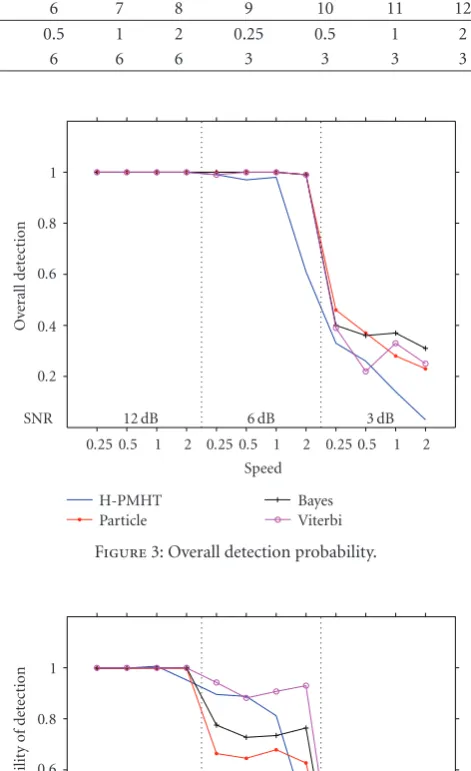
The overall detection probability is shown inFigure 3, the instantaneous detection probability inFigure 4, and the RMS position error in Figure 5. In each of the figures, the metric is plotted as a function of scenario number. The hor-izontal (scenario) axis has two labels: the target speed for the scenario is shown below the axis, and the SNR for the
sce-0.2 0.4 0.6 0.8 1
Ov
er
al
l
d
et
ec
ti
on
0.25 0.5 1 2 0.25 0.5 1 2 0.25 0.5 1 2 Speed
12 dB 6 dB 3 dB
SNR
H-PMHT Particle
Bayes Viterbi Figure3: Overall detection probability.
0.2 0.4 0.6 0.8 1
P
er
scan
p
ro
babilit
y
o
f
d
et
ection
0.25 0.5 1 2 0.25 0.5 1 2 0.25 0.5 1 2 Speed
12 dB 6 dB 3 dB
SNR
H-PMHT Particle
Bayes Viterbi
Figure4: Average instantaneous detection probability.
nario is shown above the axis. Vertical dotted lines delineate the scenarios with a particular SNR value.
0.2 0.4 0.6
RMS
er
ro
r
0.25 0.5 1 2 0.25 0.5 1 2 0.25 0.5 1 2 Speed
12 dB 6 dB 3 dB
SNR
H-PMHT Particle
Bayes Viterbi Figure5: RMS position estimation error.
a known target SNR and a detection threshold to give ninety percent probability of detection for that SNR. The false track performance at the SNR values of interest is shown inTable 2. The false track performance of the PDAF-AI is clearly unac-ceptable below 12 dB. For the 3 dB case, the rate of false tracks is lower because the false tracks persist for much longer. The other performance metrics were not considered for PDAF-AI since the false track performance was so poor.
All of the TBD algorithms were able to easily detect tar-gets at 12 dB, and they all detected every target. The H-PMHT had a small delay in detecting some of the high speed (2 pixels per frame) targets. These targets proved to be diffi -cult for the H-PMHT algorithm because of the track initial-isation method that it used. The algorithm formed tentative tracks and then rejected or accepted the tentative tracks based on the estimated power of the track. For this strategy to work, the track formation logic must reliably form tentative tracks close to the true target state. Two consecutive measurements were used to initialise the tentative tracks, and the approach gave poor speed initialisation. This degraded the H-PMHT’s ability to detect high-speed targets.
For the 6 dB targets, in the centre region of Figures3and 4, the numerical approximation techniques continued to de-tect almost all of the targets, but the H-PMHT only dede-tected about half of the high speed targets. The Viterbi algorithm gave the best instantaneous detection result because it was allowed to back-track. The H-PMHT also gave high instan-taneous detection for the lower speed cases because the ten-tative track history was included.
At 3 dB, all of the algorithms showed degraded detec-tion performance and found less than half of the targets. Again, the H-PMHT performed poorly for high speed tar-gets. It may be counterintuitive that the Viterbi algorithm performed generally worse than the other numerical approx-imations. However, the smoothing it performs does not im-prove overall detection performance. It imim-proves state
esti-mation when the target is detected and allows the estimator to back-track once the target has been detected, but it does not increase the overall number of targets that are found.
The false track performance of all of the algorithms is comparable, since this was a requirement of the al-gorithm tuning. Thus, the overall conclusion is that the numerical approximation techniques considered give sim-ilar detection performance. If batch processing is accept-able, then back-tracking can provide some improvement in the percentage of time that a target is tracked. Note that for batch processing, the Bayesian filter used here could be replaced with a Baum-Welsh such as in [11]. The H-PMHT gave worse performance than the numer-ical approaches when the target had high speed. How-ever, this may be alleviated with an improved initialisation scheme.
The RMS estimation error curves shown in Figure 5 shows an obvious trend. The error increases as the target speed increases and as the amplitude is reduced. For all cases, the H-PMHT error is significantly lower than particle filter error, which is in turn better than the grid approximations. The smoothing used in the Viterbi algorithm reduced the RMS error a little over the Bayesian filter. As may be expected, the error from the grid-based algorithms was approximately half the grid size.
The computation resource required by the different al-gorithms shows a more marked difference than the detection performance. AsTable 2shows, the H-PMHT was more than an order of magnitude faster than the particle filter, and more than two orders of magnitude faster than the grid-based al-gorithms. Significant effort was spent in optimising all of the algorithms. For the H-PMHT, there was no specific compu-tation bottleneck: both the association and filtering codes took similar resource. In contrast, the numerical approxi-mation algorithms were all limited by the likelihood calcula-tions. These incurred the vast majority of the processing cost, even though they used external library code. The H-PMHT was much faster because it does not perform likelihood com-putations.
In summary, the H-PMHT gave slightly worse detection results than the other algorithms, but at a fraction of the computation cost. Given that H-PMHT is already a multi-target algorithm, whereas the others assume only a single tar-get, the results here suggest that a robust initialisation scheme would make it the algorithm of choice.
Table2: Algorithm performance.
Algorithm False number False length cpu time (s) cpu time (ratio)
H-PMHT 0 ∗ 420 1
particle 0 ∗ 16600 39
Bayes 0 ∗ 85600 204
Viterbi 11 2.27 88000 210
PDAF-AI (12 dB) 0 ∗ ∗ ∗
PDAF-AI (6 dB) 1412 145 ∗ ∗
PDAF-AI (3 dB) 1028 185 ∗ ∗
5. CONCLUSION
The detection performance of four alternative track-before-detect algorithms has been investigated for a range of target SNR values and speeds. For most of the scenarios the diff er-ence in detection performance was minor, except for targets with high speed, which were not tracked well by H-PMHT. Both of the grid-based algorithms were very costly in terms of computation resource, whereas the particle filter was signif-icantly faster. The H-PMHT was by far the fastest, requiring two orders of magnitude less computation resource than the grid-based algorithms. The difference in computation cost is largely due to the cost of calculating the likelihood ratio of the data: H-PMHT does not use the likelihood ratio, and the particle filter calculates it over fewer points than the grid al-gorithms.
The comparison also considered the RMS position es-timation error of the algorithms, for which H-PMHT was clearly the best. The two grid-based algorithms had an RMS error approximately double that of H-PMHT, and the parti-cle filter RMS error was part-way between.
The scenarios considered used only a single target, whereas many practical situations required the detection of multiple targets. The H-PMHT is a multitarget algorithm, so is already capable of handling such a problem, but the other algorithms require extension to the multitarget problem. Fu-ture work is planned to consider multitarget detection and tracking.
REFERENCES
[1] L. Rabiner and B. Jang, “An introduction to hidden markov models,”IEEE ASSP Magazine, vol. 3, no. 1, pp. 4–16, 1986. [2] A. J. Viterbi, “Error bounds for convolutional codes and an
asymptotically optimum decoding algorithm,”IEEE Transac-tions on Information Theory, vol. 13, no. 2, pp. 260–269, 1967. [3] S. C. Pohlig, “An algorithm for detection of moving optical targets,”IEEE Transactions on Aerospace and Electronic Systems, vol. 25, no. 1, pp. 56–63, 1989.
[4] Y. Barniv, “Dynamic programming algorithm for detecting dim moving targets,” inMultitarget-Multisensor Tracking: Ad-vanced Applications, Y. Bar-Shalom, Ed., chapter 4, Artech House, Norwood, Mass, USA, 1990.
[5] S. M. Tonbsen and Y. Bar-Shalom, “Maximum likelihood track-before-detect with fluctuating target amplitude,”IEEE Transactions on Aerospace and Electronic Systems, vol. 34, no. 3, pp. 796–809, 1998.
[6] L. D. Stone, C. A. Barlow, and T. L. Corwin,Bayesian Multiple Target Tracking, Artech House, Norwood, Mass, USA, 1999. [7] M. G. S. Bruno and J. M. F. Moura, “Multiframe
detec-tor/tracker: optimal performance,”Transactions on Aerospace and Electronic Systems, vol. 37, no. 3, pp. 925–945, 2001. [8] D. J. Salmond and H. Birch, “A particle filter for
track-before-detect,” inIn Proceedings of the American Control Conference, vol. 5, pp. 3755–3760, Arlington, Va, USA, June 2001. [9] Y. Boers and J. N. Driessen, “Particle filter based detection for
tracking,” inProceedings of the American Control Conference, pp. 4393–4397, Arlington, Va, USA, June 2001.
[10] B. Ristic, S. Arulampalam, and N. J. Gordon, Beyond the Kalman Filter: Particle Filters for Tracking Applications, Artech House, 2004.
[11] M. G. S. Bruno, “Bayesian methods for multiaspect target tracking in image sequences,”IEEE Transactions on Signal Pro-cessing, vol. 52, no. 7, pp. 1848–1861, 2004.
[12] H. Driessen and Y. Boers, “An efficient particle filter for non-linear jump Markov systems,” inProceedings of the IEE Sem-inar on Target Tracking: Algorithms and Applications, Sussex, UK, March 2004.
[13] M. G. Rutten, N. J. Gordon, and S. Maskell, “Recursive track-before-detect with target amplitude fluctuations,”IEE Proceed-ings on Radar, Sonar and Navigation, vol. 152, no. 5, pp. 345– 322, 2005.
[14] R. L. Streit, “Tracking on intensity-modulated data streams,” Tech. Rep. 11221, NUWC, Newport, RI, USA, May 2000. [15] R. L. Streit, M. L. Graham, and M. J. Walsh, “Multitarget
track-ing of distributed targets ustrack-ing histogram-PMHT,”Digital Sig-nal Processing, vol. 12, no. 2-3, pp. 394–404, 2002.
[16] C. Jauffret and Y. Bar-Shalom, “Track formation with bearing and frequency measurements in clutter,”IEEE Transactions on Aerospace and Electronic Systems, vol. 26, no. 6, pp. 999–1010, 1990.
[17] T. Kirubarajan and Y. Bar-Shalom, “Low observable target motion analysis using amplitude information,”IEEE Transac-tions on Aerospace and Electronic Systems, vol. 32, no. 4, pp. 1367–1384, 1996.
[18] W. R. Blanding, P. K. Willett, and Y. Bar-Shalom, “Off-line and real-time methods for ML-PDA track validation,”IEEE Transactions on Signal Processing, vol. 55, no. 5, pp. 1994–2006, 2007.
[19] W. R. Blanding, P. K. Willett, Y. Bar-Shalom, and R. S. Lynch, “Directed subspace search ML-PDA with application to active sonar tracking,” to appear inIEEE Transactions on Aerospace and Electronic Systems.
[21] R. L. Streit and R. F. Barrett, “Frequency line tracking us-ing hidden markov models,”IEEE Transactions on Acoustics, Speach, and Signal Processing, vol. 38, no. 4, pp. 586–598, 1990. [22] S. B. Colegrove, A. W. Davis, and J. K. Ayliffe, “Track ini-tiation and nearest neighbours incorporated into probabilis-tic data association,”Journal of Electrical and Electronics Engi-neers, Australia, vol. 6, no. 3, pp. 191–198, 1986.
[23] S. J. Davey and D. A. Gray, “Integrated track maintenance for the pmht via the hysteresis model,”IEEE Transactions on Aerospace and Electronic Systems, vol. 43, no. 1, pp. 93–111, 2007.
[24] S. J. Davey and M. G. Rutten, “A comparison of three algo-rithms for tracking dim targets,” inConference Proceedings of Information, Decision, and Control (IDC ’07), pp. 342–347, Adelaide, Australia, February 2007.
[25] M. I. Skolnik, Introduction to Radar Systems, McGraw-Hill, 3rd edition, 2001.
[26] D. Muˇsicki, R. Evans, and S. Stankovic, “Integrated probabilis-tic data association,”IEEE Transactions on Automatic Control, vol. 39, no. 6, pp. 1237–1240, 1994.
[27] M. G. Rutten, B. Ristic, and N. J. Gordon, “A comparison of particle filters for recursive track-before-detect,” in Proceed-ings of the 8th International Conference on Information Fusion, vol. 1, pp. 169–175, Philadelphia, Pa, USA, July 2005. [28] D. Lerro and Y. Bar-Shalom, “Automatic track formation with
target amplitude information,” in Proceedings of the Oceans Conference Record (OCEANS ’91), vol. 3, pp. 1460–1467, Oc-tober 1991.
[29] D. Lerro and Y. Bar-Shalom, “Comparison of tracking/asso-ciation methods for low SNR targets,” in Proceedings of the Oceans Conference Record (OCEANS ’92), pp. 443–448, Octo-ber 1992.