R E S E A R C H A R T I C L E
Open Access
The highly polymorphic
CYP6M7
cytochrome
P450 gene partners with the directionally
selected
CYP6P9a
and
CYP6P9b
genes to expand
the pyrethroid resistance front in the malaria
vector
Anopheles funestus
in Africa
Jacob M Riveron
1†, Sulaiman S Ibrahim
1†, Emmanuel Chanda
2, Themba Mzilahowa
3, Nelson Cuamba
4,
Helen Irving
1, Kayla G Barnes
1, Miranda Ndula
1and Charles S Wondji
1*Abstract
Background:Pyrethroid resistance in the major malaria vectorAnopheles funestusis rapidly expanding across Southern Africa. It remains unknown whether this resistance has a unique origin with the same molecular basis or is multifactorial. Knowledge of the origin, mechanisms and evolution of resistance are crucial to designing successful resistance management strategies.
Results:Here, we established the resistance profile of a ZambianAn. funestuspopulation at the northern range of the resistance front. Similar to other Southern African populations, ZambianAn. funestusmosquitoes are resistant to pyrethroids and carbamate, but in contrast to populations in Mozambique and Malawi, these insects are also DDT resistant. Genome-wide microarray-based transcriptional profiling and qRT-PCR revealed that the cytochrome P450 geneCYP6M7is responsible for extending pyrethroid resistance northwards. Indeed,CYP6M7is more over-expressed in Zambia [fold-change (FC) 37.7; 13.2 for qRT-PCR] thanCYP6P9a(FC15.6; 8.9 for qRT-PCR) andCYP6P9b(FC11.9; 6.5 for qRT-PCR), whereasCYP6P9aandCYP6P9bare more highly over-expressed in Malawi and Mozambique. Transgenic expression ofCYP6M7inDrosophila melanogastercoupled within vitroassays using recombinant enzymes and assessments of kinetic properties demonstrated thatCYP6M7is as efficient asCYP6P9aandCYP6P9bin conferring pyrethroid resistance. Polymorphism patterns demonstrate that these genes are under contrasting selection forces: the exceptionally diverseCYP6M7likely evolves neutrally, whereasCYP6P9aandCYP6P9bare directionally selected. The higher variability ofCYP6P9aandCYP6P9bobserved in Zambia supports their lesser role in resistance in this country. Conclusion:Pyrethroid resistance in Southern Africa probably has multiple origins under different evolutionary forces, which may necessitate the design of different resistance management strategies.
Keywords:Anopheles funestus, Malaria, Pyrethroids, Insecticide resistance, Cytochrome P450,CYP6M7, Directional selection
* Correspondence:[email protected] †Equal contributors
1
Vector Biology Department, Liverpool School of Tropical Medicine, Pembroke place, Liverpool, L3 5QA, UK
Full list of author information is available at the end of the article
Background
Malaria remains the most important vector-borne disease in the world. Nearly 216 million cases are reported each year, with an estimated 655,000 deaths in 2010, 86% of which occurred in children under the age of five [1]. Malaria control relies extensively on the use of insecti-cides, either in Long Lasting Insecticide Nets (LLINs) or as Indoor Residual Sprays (IRS). Unfortunately, increasing resistance to the available insecticide classes in the major malaria vectors, such asAnopheles funestus, is threatening the effectiveness of these control tools across Africa [2]. The recent WHO Global Plan for Insecticide Resistance Management [2] highlights the growing threat posed by insecticide resistance and calls for urgent action to imple-ment suitable resistance manageimple-ment strategies against malaria vectors to ensure the continued effectiveness of control interventions. The elucidation of the molecular basis of insecticide resistance in malaria vectors is a crucial step in the design and implementation of these resistance management strategies.
Resistance to pyrethroid insecticides is of particular concern because these insecticides are the only class recommended by WHO for the impregnation of LLINs. Previous efforts to characterize the mechanisms of py-rethroid resistance in An. funestus have revealed that resistance is mainly driven by metabolic resistance with cytochrome P450 genes playing a major role while target-site resistance through knockdown resistance (kdr) was absent [3-6]. Two duplicated cytochrome P450 genes,
CYP6P9a and CYP6P9b, were recently showed to play a key role in the resistance observed in the Southern African countries of Malawi and Mozambique [4]. The similarity in the gene expression profiles and the presence of a highly predominant resistance haplotype for each gene in the two countries suggested that the resistance had a unique origin [4]. However, recent susceptibility studies have demonstrated that the pyrethroid resistance front is expanding further northward across Southern Africa [5,7,8]. The factors behind this expansion remained un-characterized, and it remains unknown if, beyond Malawi and Mozambique, the pyrethroid resistance front is still of a unique origin as previously suggested [4].
Resistance can spread from a single origin through gene flow between populations and can involve a single re-sistance mechanism. This phenomenon was responsible for the worldwide spread of DDT resistance under the control of theCYP6G1gene in the fruit fly [9]. The expan-sion of the resistance front could also originate from mul-tiple independent selection events by different selection forces, potentially leading to the involvement of multiple resistance mechanisms in the overall resistance front. This phenomenon has been observed in the other major mala-ria vector An. gambiae, in which pyrethroid/DDT resis-tance is now widespread and is associated with various
mechanisms, including two 1014 F/S knockdown resist-ance mutations [10,11] and over-transcription of various metabolic genes [12-14]. It is not known if the expansion of pyrethroid resistance in Southern African populations of An. funestus is driven by different resistance me-chanisms as inAn. gambiaeor by the same underlying re-sistance mechanism under the control of different genes. Furthermore, whether genes other than CYP6P9a and
CYP6P9b are also responsible for the expansion of the resistance front remains to be determined. This informa-tion has important operainforma-tional implicainforma-tions for the imple-mentation of resistance management strategies against
An. funestusacross this region.
In addition, because the main tool used previously was a microarray chip based on a set of 8,540 An. funestus
Expressed Sequenced Tags (ESTs) that did not cover the full transcriptome of this species [15], it is possible that other important resistance genes may contribute to the py-rethroid resistance previously characterized in Mozambique and Malawi. The availability of another RNAseq EST set with more than 15,000 ESTs [16] has enabled increased transcriptome coverage and a more comprehensive eluci-dation of the molecular basis of pyrethroid resistance in
An. funestus.
The present study aimed to answer two main questions. i) Is the pyrethroid resistance front across Southern African
An. funestuspopulations driven by same resistance mech-anisms? ii) Are genes other thanCYP6P9aandCYP6P9b
also responsible for the previously reported resistance to pyrethroids inAn. funestusin Mozambique and Malawi?
In this study, after establishing the resistance profile of a Zambian An. funestus population, we used genome-wide transcriptional and functional analyses to demonstrate that the cytochrome P450 CYP6M7 has efficiently partnered with the previously detected CYP6P9a and CYP6P9b to expand the pyrethroid resistance front northward. Fur-thermore, we demonstrate that these three genes are under constrasting selection forces; the exceptionally poly-morphic CYP6M7 evolving neutrally, whereas CYP6P9a
andCYP6P9bare both under directional selection.
Methods
Area of study and mosquito collection
field-collected female mosquitoes and randomly mixed in cages for subsequent experiments.
PCR species identification
All females used for individual oviposition were morpho-logically identified as belonging to theAn. funestusgroup according to the key of [18]. A PCR assay was performed using the protocol of [19] to confirm that all females that laid eggs wereAn. funestus s.s.
Bioassays
Insecticide susceptibility assays were performed using 2- to 5-day-old F1 adults from pooled families from
Mbinga as described previously [5,17] following the WHO protocol [20]. We tested the following insecticides: 0.75% permethrin (type I pyrethroid) and 0.05% delta-methrin (type II pyrethroid); 0.1% bendiocarb (carbamate); 5% malathion (organophosphate); and the organochlorines DDT (4%) and dieldrin (4%). The effect of the synergist PBO was assessed in combination with 0.75% permethrin, 4% DDT and 0.1% bendiocarb. For each insecticide, 100 female mosquitoes were pre-exposed to 4% PBO impreg-nated-paper for 1 h and immediately exposed to the in-secticide paper for 1 h. Final mortality was assessed after 24 h and compared to the results obtained in the absence of PBO.
Microarray
To detect the genes associated with the expansion of the pyrethroid resistance front inAn. funestus, a new 8×60 k Agilent microarray chip was designed using the eArray program (Agilent) (A-MEXP-2374) by adding the 15,527 Expressed Sequence Tags (ESTs) generated from another transcriptome sequencing of An. funestus [16] to the previous 4×44 k array used by [4]. Each array contained 60mer probes designed from 8,540 ESTs generated from
An. funestustranscriptome 454 sequencing [15] (2 probes for each EST), a set of 2850 An. funestus cDNAs from GenBank (2 probes for each EST), a set of P450 genes from the rp1 and rp2 QTL BAC sequence [21,22] (3 probes for each gene), and the 13,000 transcripts of the completeAn. gambiaegenome. In addition, all of theAn. gambiae detoxification genes previously present on the
An. gambiaedetox chip [23] were added to this chip with 3 probes for each gene to exploit possible gene sequence conservation betweenAn. gambiaeandAn. funestus.
RNA was extracted from three batches of ten 2- to 5-day-old An. funestus females alive after exposure to 0.75% permethrin (Resistant, R) and unexposed mosqui-toes of the fully susceptible laboratory strain FANG (Susceptible, S) using the Picopure RNA Isolation Kit (Arcturus). The quantity and quality of the extracted RNA were assessed using a NanoDrop ND1000 spectro-photometer (Thermo Fisher) and Bioanalyzer (Agilent,
Santa Clara, CA, USA), respectively. Complementary RNA (cRNA) was amplified from each sample using the Agilent Quick Amp Labeling Kit (two-color) following the manufacturer’s protocol. cRNAs from the resistant samples (R) were labeled with cy5 dye, and cRNAs from the susceptible strain FANG (S) were labeled with the cy3 dye. cRNA quantity and quality were assessed before labeling using the NanoDrop and Bioanalyzer. Labeled cRNAs were hybridized to the arrays for 17 h at 65°C according to the manufacturer’s protocol. Five hybridiza-tions were performed for each location by swapping the biological replicates.
Microarray data were analyzed using Genespring GX 12.0 software. To identify differentially expressed genes, a cut-off of 2-fold-change (FC) and a statistical signifi-cance of P < 0.01 with Benjamini-Hochberg correction for multiple testing and q < 0.01 with Storey with boot-strapping were applied. The predicted functions of all the transcripts and ESTs used for this microarray chip were identified by the BLAST2GO program [24,25].
Quantitative reverse transcriptase PCR
The expression patterns of some of the genes most associ-ated with resistance based on the microarray analyses were assessed by qRT-PCR using the primers listed in Additional file 1: Table S1. In the case of the new candi-date resistance gene CYP6M7, fold change was obtained from three independent primer pairs to further validate the microarray over-expression. One microgram of total RNA from each of the three biological replicates from the Resistant (R), Control (C) (mosquitoes from each location not exposed to insecticide) and FANG (S) populations for the three countries was used as the template for cDNA synthesis using Superscript III (Invitrogen) with oligo-dT20 and RNase H according to the manufacturer’s instructions. A serial dilution of cDNA was used to estab-lish standard curves for each gene to assess PCR efficiency and quantitative differences between samples. qRT-PCR amplification was performed as described previously [4,26]. The relative expression level and FC of each target gene in R and C relative to S were calculated according to the 2-ΔΔCTmethod incorporating the PCR efficiency [27] after normalization with the housekeeping genes ribo-somal protein S7 (RSP7; AGAP010592) and actin 5C (AGAP000651).
Tissue-specific expression of candidate resistance genes
used for RNA extraction. The results were analyzed as described above, with the expression level of each gene in each body part determined in relation to the FC in the whole mosquito.
Transgenic expression of candidate genes inDrosophila strains
To establish whether over-expression of the candidate gene CYP6M7 alone can confer resistance to different pyrethroids, transgenicDrosophila melanogasterflies ex-pressing this gene were generated using the GAL4/UAS system. The construction of the transgenic strain fol-lowed the protocol recently successfully used for the P450sCYP6P9aandCYP6P9b[4].
Briefly, full-length CYP6M7 was amplified from cDNA using the Phusion High-Fidelity DNA Polymerase (Thermo Scientific) and cloned into the pJET1.2/blunt cloning vector (Thermo Scientific). The primers used are listed in Additional file 1: Table S1. After sequence analysis, one clone that was predominant in the three countries was selected to construct transgenic flies and cloned into the pUASattB vector using primers containing restriction sites forEcoRI andXbaI. Using the PhiC31 system, clones were transformed into the germ line of aD. melanogasterstrain carrying the attP40 docking site on chromosome 2 [“y1w67c23; P attP40”, “1;2”] by Genetic Services (MA, USA) to generate the transgenic line UAS-CYP6M7. Ubiquitous expression of the transgeneCYP6M7in adult F1progeny (experimental group) was obtained after
cros-sing virgin females from the driver strain Act5C-GAL4 ["y [1] w[*]; P(Act5C-GAL4-w)E1/CyO","1;2"] (Bloomington Stock Center, IN, USA) with homozygote UAS-CYP6M7 males. Similarly, adult F1control progeny (control group)
with the same genetic background as the experimental group but without expression of CYP6M7were obtained by crossing virgin females from the driver strain Act5C-GAL4 and UAS recipient line males (which do not carry the pUASattb-CYP6M7 insertion).
Insecticide contact bioassays: Experimental and con-trol F1Drosophila melanogasterfemales were selected for
use in insecticide bioassays. A comparison of the mortality rates of the experimental group and control group was used to assess whetherCYP6M7 could confer resistance. Post-eclosion females that were 2 to 5 days old were used in a contact assay with the pyrethroids deltamethrin and permethrin. After assessing a range of doses to identify the best discriminating dose for flies, 2% permethrin- and 0.15% deltamethrin-impregnated filter papers were pre-pared in acetone and Dow Corning 556 Silicone Fluid (BHD/Merck, Germany) for bioassays. These discrimi-nating doses differ from that of mosquitoes due to various differences between both species notably in size and cu-ticle thickness. These papers were rolled and introduced into 45 cc plastic vials to cover the entire wall. The vials
were plugged with cotton soaked in 5% sucrose. Then, 20–25 flies were placed in each vial, and the mortality plus knockdown was scored after 1 h, 2 h, 3 h, 6 h, 12 h and 24 h of exposure to the insecticide. For all assays, at least 6 replicates were performed. Student’s t-test was used to compare the mortality plus knockdown of the experi-mental group with the control group.
Confirmation of transgene expression in transgenic flies by qRT-PCR: To confirm the expression ofCYP6M7
in the experimental group and the absence of expression in the control groups, total RNA was extracted from three pools of 5 flies. cDNA was synthesized as described above. The relative expression levels of the transgene were assessed by qRT-PCR in the experimental F1progeny as
well as in the respective controls with normalization with theRPL11housekeeping gene.
Heterologous expression of candidate genes inE. coli Cloning of CYP6M7, CYP6P9a and CYP6P9b for ex-pression inE. coli:The CYP6M7,CYP6P9aandCYP6P9b
genes were fused to a bacterial ompA + 2 leader sequence and expressed inE. coliJM109 cells using the pCW-ori + vector as previously described [28-30]. Briefly, a DNA frag-ment containing the coding sequence for the ompA signal peptide with a downstream alanine-proline linker and ap-proximately the first 20 nucleotides of each gene was first amplified using KAPA HiFi PCR (Kappa Biosystems) and 50 ng ofE. coliJM109 DNA as the template using the spe-cific primers (OMPA + 2_F and the reverse primers: OMPA + 2-CYP6M7, OMPA + 2-CYP6P9a and OMPA + 2-CYP6P9b, Additional file 1: Table S1). The KAPA HiFi PCR conditions were: 1 cycle at 95°C for 5 min; 35 cycles of 94°C for 20 s, 57°C for 30 s and elongation at 72°C for 90 s; and 1 cycle at 72°C for 5 min.
Next, the same CYP6M7clone used for the Drosophila
transgenic study, theCYP6P9aandCYP6P9b clones used previously [4], and the ompA + 2 PCR fragment were used as templates in a fusion PCR under the same conditions described above. The full-length sequence of each gene in-corporating the ompA + 2 leader was ligated into a modi-fied pCW-ori + vector plasmid, pB13 [29], via EcoRI and
XBaI sites to produce pB13::ompA + 2-CYP6PM7, pB13:: ompA + 2-CYP6P9a and pB13::ompA + 2-CYP6P9b. These constructs were sequenced to confirm the absence of PCR errors.
P450 concentration [31] and CPR activity by monitoring cytochrome c reduction [32]. The histidine-tagged An. gambiae cytochrome b5 (Cyt-b5) was generated as pre-viously described by Stevenson et al. [30] and used for the metabolism assays.
Metabolism assays: Pyrethroids were dissolved in methanol (HPLC grade, Fisher Scientific) immediately before use at a final working concentration of 0.02 mM. As previously described by Stevenson et al. [30], the reactions consisted of the following: 45 pmoles of P450, 0.2 M Tris HCl pH 7.4, 0.25 mM MgCl2, 1 mM glucose-6-phosphate,
0.1 mM NADP + (Melford), 1 unit/ml glucose-6-phosphate dehydrogenase (G6PDH), 0.8μM Cyt-b5 and 0.2 mM pyr-ethroid insecticides in a final volume of 200 ml. NADP + was excluded from the minus NADPH control. Mem-branes expressing P450 and CPR with Cyt-b5 were applied to the side of a 1.5 ml Eppendorf tube, and buffer was added to the bottom of the tube. After a 5 min pre-incubation, the reactions were initiated by vortexing and incubated at 30°C with shaking at 1000 rpm.
HPLC analysis: Reactions were stopped with 0.1 ml of cold methanol and incubated with shaking (1000 rpm) for 5 min at 30°C to dissolve all available pyrethroids. The samples were then centrifuged at 16,000 rpm for 10 min at 4°C, and 150μl of the supernatant was transferred into HPLC vials. The quantity of pyrethroid remaining in the samples was determined by reverse-phase HPLC with a monitoring absorbance wavelength of 226 nm (Agilent 1260 Infinity). A 100 μl sample was loaded into an iso-cratic mobile phase of 90% methanol and 10% water with a flow-rate of 1 ml/min, and substrate peaks were sepa-rated on a 250 mm C18 column (Acclaim™ 120, Dionex) at 23°C.
Turnover and kinetic assays: To determine the turn-over of P450s with pyrethroids, experiments with delta-methrin and perdelta-methrin were performed in which the incubation time was varied from 0 to 30 minutes. The turnover was calculated from the plot of the initial vel-ocity vs. time at zero-order phase by fitting the data to a non-linear regression using the enzyme kinetic module of GraphPad Prism 6.03 (GraphPad Software Inc., La Jolla, CA, USA). Steady-state kinetic parameters were obtained by measuring the rate of reaction under linear conditions for 10 minutes while varying the substrate concentration from 0 to 20 μM. KM and Vmax were
established from the plot of substrate concentrations against the initial velocities and fitting of the data to the Michaelis-Menten equation using GraphPad Prism. Catalytic constants and efficiencies were determined from the steady-state parameters.
Genetic variability of candidate genes
The full-length coding regions of CYP6M7 were ampli-fied from cDNA of permethrin-resistant samples from
Malawi, Mozambique and Zambia and from the suscep-tible FANG strain to assess the role of allelic variation in resistance. The amplification was performed using the same cDNA synthesized for qRT-PCR with the Phusion polymerase, which was cloned and sequenced as de-scribed above.
In addition, to assess the potential association between allelic variation and pyrethroid resistance, a genomic frag-ment spanning the full-lengthCYP6M7gene and a portion of the 5’UTR region were amplified and directly sequenced in five susceptible (dead after a 1 h exposure) and five resistant (alive after a 1 h exposure to 0.75% permethrin) mosquitoes from Zambia, Malawi and Mozambique. The primers used are listed in Additional file 1: Table S1. Simi-larly, both CYP6P9a and CYP6P9b were also amplified and sequenced from the Zambia samples for comparison with the polymorphism profiles previously obtained in Malawi and Mozambique samples [4]. Polymorphic posi-tions were detected through manual analysis of sequence traces using BioEdit and as sequence differences in mul-tiple alignments using ClustalW [33]. DnaSP 5.1 [34] was used to define the haplotype phase (through the Phase program) and to assess genetic parameters of each gene such as nucleotide diversity π and haplotype diversity. A maximum likelihood phylogenetic tree of the haplotypes for each gene was constructed using MEGA 5.2 [35], and a haplotype network was built using the TCS program [36] (95% connection limit; gaps treated as a fifth state) to assess the potential connection between haplotypes and resistance phenotypes.
Test of selection onCYP6M7: To assess the possibility of selection acting onCYP6M7in all three countries and its role in pyrethroid resistance, the departure from neu-trality was tested using the codon-based Z test of selec-tion. As implemented in MEGA5.2, this test uses the Nei and Gojobori method to compute the numbers of syno-nymous (dS) and non-synosyno-nymous (dN) substitutions per site and the numbers of potentially synonymous and potentially non-synonymous sites [37]. The dN/dS ratio was calculated, and the probability of rejecting the null hypothesis of strict neutrality (H0: dN = dS) in favor of the alternative purifying (H1: dN < dS) or positive selection hypotheses (H1: dN > dS) was estimated using the boot-strap method (1000 replicates) in MEGA5.2.
Results
Susceptibility status ofAn. funestusin Zambia
permethrin and deltamethrin) [5] but lower than that in Mozambique (no mortality after a 2 h exposure for both pyrethroid types) [17].
This Zambian population is also highly resistant to carbamates, with no mortality in females and only 5% mortality in males after a 1 h exposure to 0.1% bendiocarb. This level of carbamate resistance is much higher than that previously reported in Mozambican (70% mortality) [17] and Malawian (60% mortality) [5,8] populations. Surpri-singly, DDT resistance was also detected in the Zambian
An. funestuspopulation, with 60.6% mortality in females. This profile is significantly different from that in other Southern African populations; full susceptibility to DDT was observed in the Mozambican population, and only moderate resistance was observed in the Malawian popu-lation (93% mortality). Thus, despite their similar pyre-throid resistance profiles, the Zambian population differs from the Malawian and Mozambican populations. How-ever, full susceptibility to malathion (organophosphate) and dieldrin was observed, with 100% mortality similar to that observed in the Mozambican and Malawian populations.
A near full susceptibility to permethrin was restored in the Zambian population after exposure to the synergist piperonyl butoxide (PBO), with 100% mortality in females. This result suggests that, as observed previously in Malawi and Mozambique, cytochrome P450 genes play a major role in the pyrethroid resistance observed in Zambia. Similarly, after PBO exposure, significant recov-ery of susceptibility to the carbamate bendiocarb from 0% to 86.5% was observed, further supporting an im-portant role of P450s in the carbamate resistance ob-served in Zambia. However, the absence of a complete
recovery of susceptibility suggests the potential involve-ment of other mechanisms. Exposure to PBO only mo-derately increased DDT mortality from 60.6 to 83.8%, suggesting that the potential role of P450s in DDT resistance might not be as important as in pyrethroid or carbamate resistance.
Genome-wide microarray-based transcriptional profiling
A new genome-wide An. funestus custom Agilent micro-array chip containing 60,000 probes (60mer) was used to identify genes associated with pyrethroid resistance in a Zambian population for the first time. The same chip was also used to detect novel resistance genes in Malawian and Mozambican populations that might have been missed by the previously less comprehensive chip [4]. Labeled com-plementary RNA (cRNA) was successfully obtained from 3 biological replicates of resistant (R) (mosquitoes alive after a 1 h exposure to 0.75% permethrin) from each country and susceptible (S) (unexposed mosquitoes from the fully susceptible laboratory strain FANG) populations. The number of probes that were differentially expressed (>2-fold change, FC) between R and S mosquitoes for each country and between them is indicated in Figure 2A (P < 0.01) and Additional file 2: Figure S1A (P < 0.05). Overall, 639 probes were differentially expressed in the Mozambican population (298 over-expressed and 341 under-expressed), 3038 in the Malawian population (1327 over-expressed and 1711 under-expressed) and 2196 in the Zambian population (748 over-expressed and 1448 under-expressed). A total of 120 probes were differentially expressed in all three countries.
Genes commonly up-regulated in all three countries: An analysis of the list of probes commonly up-regulated
in mosquitoes from all three countries revealed that the two duplicated P450 genesCYP6P9aand CYP6P9bwere among the most up-regulated genes for Mozambican and Malawian mosquitoes, with FCs of 75.5 and 39.4, respec-tively, for CYP6P9a and 88.2 and 24, respectively, for
CYP6P9b(Additional file 1: Table S2). However, although these two genes were also significantly up-regulated in the Zambian sample, the FC was much lower than for the Mozambican and Malawian samples, with FCs of only 15.6 and 11.9, respectively, for CYP6P9a and CYP6P9b. This two to seven-fold decrease in the expression level of both genes from south Mozambique to Malawi and to Zambia was observed across the three distinct microarray probes used for each gene (Figure 2B). Such change in expression level suggests a variation in the roles these duplicated P450 genes play in the pyrethroid resistance observed across Southern Africa.
This hypothesis was further supported by the observa-tion that the most highly over-expressed detoxificaobserva-tion gene in the Zambian sample was another CYP6 family P450 gene, CYP6M7, which displayed an FC of 37.7, corresponding to a 2- to 3-fold greater up-regulation com-pared to CYP6P9aandCYP6P9b. This gene is located in the genomic region spanning the pyrethroid resistance
rp2QTL on chromosome 2 L detected in the FUMOZ-R pyrethroid-resistant laboratory strain [21]. CYP6M7 is the ortholog of the CYP6M3 gene in An. gambiae
(AGAP008213), which is over-expressed in resistant mos-quitoes but with a much lower FC than that described in this study [26,38].CYP6M7 was also up-regulated in the Mozambican and Malawian samples but with a lower FC than in the Zambia sample (25.7 and 12.5, respectively). This result suggests that CYP6M7 might play a more important role in the pyrethroid resistance observed in
Zambia than the duplicated CYP6P9a and CYP6P9b
genes.
Another novel gene identified using the 8x60k chip was the P450 CYP6AA1, which was also commonly up-regulated in the samples from all three countries, with two-fold over-expression in the Mozambican sample (FC = 13.2) than in the Malawian (FC = 5.2) and Zambian (FC = 5.3) samples. This gene is the ortholog ofCYP6AA3
inAn. minimus, which was recently shown to metabolize pyrethroids [39] and is located on the 2R chromosome in therp1QTL in the same P450 cluster withCYP6P9aand
CYP6P9b[22]. Other newly identified detoxification genes that were up-regulated in the samples from all three coun-tries include three other P450s,CYP6Y2 (located in rp2
QTL),CYP304B1andCYP9K1, although these genes were expressed at lower levels (FC < 4, see Additional file 1: Table S2).
Two other P450 genes, CYP9J11 (located around the
rp3 QTL) and CYP6P2 (located around rp1), were also up-regulated in the three populations (Additional file 1: Table S2). Other genes commonly up-regulated in the three countries are listed in Additional file 1: Table S2.
Probes commonly down-regulated in all three coun-tries: The most down-regulated genes in the samples from all three countries were previously reported to be down-regulated in Mozambican and Malawian samples [4] and include a cationic amino acid transporter, a monkey king protein gene, an isoform c gene and several probes for cyto-chrome c oxidase subunit 3 (Additional file 1: Table S3).
Transcriptional profiling of the Zambian population
The transcriptional profile of the Zambian population was analyzed further because it had not been previously performed with the previous 4×44 k chip. This analysis revealed that, in addition to the main genes CYP6P9a,
CYP6P9b and CYP6M7, other detoxification genes were up-regulated. The majority of these genes encode cyto-chrome P450s; nineteen P450 genes were up-regulated (P < 0.01) (Table 1). These P450s include CYP6M4
(FC = 5.1) which was also up-regulated in the Malawian sample (FC = 4.3) (Table 1) but not the Mozambican sample (Table 1), CYP315A1 (FC = 4.5) and CYP6N1
(FC = 2.9).
Two carboxylesterases were also up-regulated in Zambia. The COEAE1A gene (FC = 12), an ortholog of AGAP001722 inAn. gambiaeandCOE09916, an ortholog of AGAP010917 in An. gambiae (FC = 2.2). COEAE1A
was also over-expressed in the Malawian sample (FC = 6.1) but not the Mozambican sample, whereasCOE09916was only over-expressed in the Zambian sample.
Another important detoxification gene family that was up-regulated in the Zambian sample is the glutathione S-transferases, with 4 genes notably over-expressed (Table 1). GSTD3 was the most highly over-expressed
member of this family (FC = 7.8) whereas the three other GSTs were up-regulated at a lower level (FC < 3);GSTD1-5,
GSTe2 and GSTe1. GSTD3 is not over-expressed in the DDT-susceptible populations of Mozambique and Malawi.
Other up-regulated gene families include aldehyde oxi-dases, ABC transporters, proteases (such as trypsin and chymotrypsin 1), cuticle proteins, UDP glucosyl trans-ferases, heat shock proteins (HSP70) argininosuccinate lyase and short chain dehydrogenases (Table 1).
Validation of the microarray results by qRT-PCR
Quantitative real-time PCR (qRT-PCR) was used to validate the microarray results for fifteen of the most up-regulated detoxification genes in the samples from the three countries, including 11 P450 genes, one gluta-thione S-transferase gene (GSTe2), the argininosuccinate lyase gene, one aldehyde oxidase gene and one gene with unknown function (Combined_c3440). The qRT-PCR results confirmed the over-expression patterns observed by microarray, although with generally lower fold change values (Figure 2B). A similar expression pattern was ob-served for the control samples that were not exposed to insecticides from each of the three countries (Additional file 2: Figure S1B). Particular attention was paid to the
CYP6M7 to validate its high over-expression. The qRT-PCR results from the three independent primer pairs on
CYP6M7 confirmed that this gene is over-expressed in the three countries with FC of 21.0, 11.75 and 13.25 re-spectively in Mozambique, Malawi and Zambia when aver-aging over the three primers. In Zambia, theCYP6M7was most over-expressed (FC 13.25) than CYP6P9a (FC 8.9) andCYP6P9b(FC 6.53) although the difference is signifi-cant only against CYP6P9b. The Mozambique sample exhibited the highest over-expression for the three main pyrethroid candidate resistance gene in correlation with microarray in line with the high pyrethroid resistance observed in this population [17]. However, in Malawi, no significant difference was observed in the expression of the three genes in contrast to microarray. A notable higher over-expression was observed for the CYP6Z1 P450 gene than with microarray for all the three countries (13 < FC < 18.9 for qRT-PCR while FC < 3 for microarray). A significant correlation between the qRT-PCR and micro-array results was observed in the combined sample of the three countries (R2= 0.4;P<0.05) (Additional file 2: Figure S1C).
Table 1 The most up-regulated detoxification genes in Zambia (ZB), Malawi (ML) and Mozambique (MZ) (P < 0.01)
Systematic name Orthologs inAn. gambiae Fold change (FC) Description
ZB ML MZ
Afun007663 (CYP6M7) AGAP008213-PA 37.7 12.5 25.7 Cytochrome p450
CYP6P9a AGAP002865-PA 15.6 39.4 75.5 Cytochrome p450
CYP6P9b AGAP002865-PA 11.9 24.0 88.2 Cytochrome p450
Afun008614 (CYP6AA1) AGAP002862-PA 5.3 5.2 13.2 Cytochrome p450
Afun007346 AGAP007990-PA 2.7 3.1 3.5 Glucosyl glucuronosyl transferases
Afun007469 (CYP9J11) AGAP012296-PA 4.1 4.8 4.0 Cytochrome p450
CYP6Y2 3.9 2.9 4.4 Cytochrome p450
Afun012197 (CYP6Z1) AGAP003066-PA 2.8 2.9 3.9 Cytochrome p450
Afun009335 (CYP6AG1) AGAP003343-PA 2.4 2.7 2.6 Cytochrome p450
Afun012194 (CYP6P2) AGAP002869-PA 2.6 2.7 3.9 Cytochrome p450
Afun007769 (CYP9K1) AGAP000818-PA 3.6 2.4 2.3 Cytochrome p450
Afun000493 AGAP006225-PA 3.0 2.2 2.6 Aldehyde oxidase
Afun010360 AGAP006222-PA 2.8 2.0 2.1 Glucosyl glucuronosyl transferases
combined_c920 (GSTe2) 2.5 3.4 2.8 Glutathione-s-transferase gst
Afun009227 AGAP008141-PA 25.4 66.3 Argininosuccinate lyase
Afun010614 AGAP006380-PA 4.0 2.5 atp-binding cassette sub-family a member
Afun007482 AGAP002693-PA 3.9 2.3 atp-binding cassette sub-family f member 2
Afun011877 AGAP013384-PA 2.5 2.1 atp-binding cassette transporter
Afun002473 AGAP000553-PA 6.6 4.5 atp-binding-cassette protein
Afun009492 AGAP001722-PA 12.0 5.9 Carboxylesterase
CD577459.1 2.3 3.0 Cuticle protein
CYP6M4 5.1 5.3 Cytochrome p450
Afun009522 AGAP012292-PA 2.4 4.5 Cytochrome p450
Afun003394 (CYP315A1) AGAP000284-PA 4.5 2.4 Cytochrome p450
Afun007127 (CYP4C36) AGAP009241-PA 2.1 2.4 Cytochrome p450
Afun007499 (GSTd1-5) AGAP004164-PA 2.8 2.9 Glutathione transferase
combined_c4173 4.6 4.8 Glycoprotein 93
combined_c557 7.6 11.8 Trypsin
CD578169.1 3.0 6.0 Trypsin
Afun007646 AGAP006225-PA 2.0 3.4 Aldehyde oxidase
Afun008347 AGAP009828-PA 4.2 2.2 Chymotrypsin 1
Afun013935 AGAP010917-PA 2.2 Carboxylesterase
Afun013921 AGAP006709-PA 31.3 Chymotrypsin 1
Afun004392 AGAP008213-PA 2.3 Cytochrome p450
Afun008909 AGAP002416-PA 2.1 Cytochrome p450
Afun012666 AGAP002429-PA 2.1 Cytochrome p450
Afun008354 (GSTD3) AGAP004382-PA 7.8 Glutathione transferase
Afun013481(GSTe1) AGAP009195-PA 2.3 Glutathione-s-transferase gst
Afun011899 AGAP012514-PA 2.0 Short-chain dehydrogenase
combined_c4812 2.7 Short-chain dehydrogenase
genes is likely to be ubiquitous rather than specific to tissues involved in detoxification, such as the midgut, Malpighian tubules, or fat body [40].
Transgenic expression ofCYP6M7inDrosophilaflies
To confirm that the over-transcription ofCYP6M7alone can confer pyrethroid resistance, transgenicD. melanoga-sterindividuals expressing aCYP6M7allele (derived from permethrin resistant field mosquitoes) under the control of the ubiquitous Act5C-GAL4 driver were successfully generated. qRT-PCR analysis confirmed thatCYP6M7was expressed only in transgenic Act5C-CYP6M7 F1progeny
(2-ΔΔCT of 0.17); virtually no expression was observed in the control (same genetic background but without
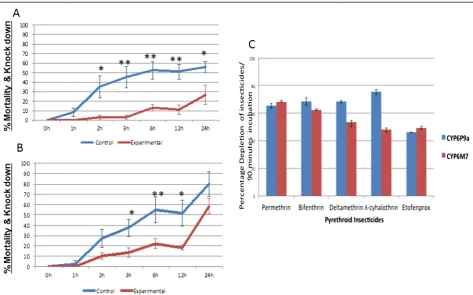
CYP6M7gene) (2-ΔΔCT of 4.8 × 10⁻⁵) (Additional file 2: Figure S1D). Contact bioassays performed with 2% per-methrin (type I pyrethroid) and 0.15% deltaper-methrin (type II) revealed that flies over-expressingCYP6M7were resis-tant to both pyrethroid types, resulting in a significantly reduced mortality/knockdown rate for both insecticides compared to that observed for control flies. For permeth-rin, significantly reduced mortality/knockdown rates were recorded at five different exposure times of transgenic
Act5C-CYP6M7 individuals when compared with the control group not expressing CYP6M7. These exposure times were 2 h (3.15 vs. 35.04%, P = 0.027), 3 h (3.15 vs. 44.92%, P = 0.0066), 6 h (13.20 vs. 52.39%, P = 0.0039), 12 h (11 vs. 50.96%, P = 0.0023) and 24 h (26.57 vs. 55.59%, P = 0.038) (Figure 3A). Similarly, a significant reduction in mortality/knockdown rates was also recorded for deltamethrin in the transgenic Act5C-CYP6M7 flies compared to the control group after 3 h (13.52 vs. 37.5%, P = 0.037), 6 h (22.10 vs. 54.71%, P = 0.041) and 12 h (18.1 vs. 51.30%, P = 0.032) (Figure 3B). These results demon-strate that CYP6M7over-transcription alone is sufficient to confer resistance to both type I and type II pyrethroids.
Heterologous expression ofCYP6M7,CYP6P9aand
CYP6P9binEscherichia coli
RecombinantCYP6M7protein was successfully expressed at 21°C and 150 rpm and harvested 48 h after induction withδ-ALA and IPTG. The co-expression of theCYP6M7
enzyme inE. coliproduced CO-difference spectrum typi-cal of a good-quality functional enzyme expressed pre-dominantly as P450 with low P420 content. Previous attempts to express the recombinant enzyme from the
CYP6P9a allele from field populations after co-transfor-mation with cytochrome P450 reductase (CPR) intoE. coli
JM109 cells had been unsuccessful [4]. Here, successful expression was achieved by allowing the starter culture to grow until the optical density at 595 nm reached 0.7-0.8 and by increasing the final concentrations of IPTG and
δ-ALA used for induction from 1 M and 0.5 M, respec-tively, to 1.25 M and 0.75 M. The expression temperature was 24°C for the first 24 h after induction and was then lowered to 18°C at 24–48 h. Optimal expression of
CYP6P9a was obtained 36–48 h post-induction, as indi-cated by a good-quality CO-difference spectrum. Details of the expression ofCYP6P9bwere previously reported [4].
Metabolism assays with CYP6M7: To confirm that
CYP6M7 can metabolize pyrethroid insecticides, the recombinant enzyme produced from this gene was assessed in in vitro metabolism assays. The metabolism assays demonstrated that recombinant CYP6M7 meta-bolized both type I and type II pyrethroid insecticides (Figure 3C). Indeed, for the type I pyrethroids, significant substrate depletion rates of 68.28% ± 0.16 (P < 0.001) and 62.19% ± 0.6 (P < 0.001) were observed for permethrin and bifenthrin (as determined by the disappearance of sub-strate (20μM) after 90 min), respectively, compared to the
controls (with no NADPH). CYP6M7could also deplete the same concentration of the type II pyrethroids delta-methrin and lambda-cyhalothrin at rates of 53.60% ± 3.5 (P < 0.001) and 48.24% ± 1.97 (P < 0.001), respectively (Figure 4A). Similarly,CYP6M7 can also metabolize the ether pyrethroid etofenprox with a significant depletion rate of 49.05% ±0.166 (P < 0.001).
Metabolism assays withCYP6P9a: Similar toCYP6P9b
[4], recombinant CYP6P9a also metabolized both type I and type II pyrethroids. A significant substrate depletion of 20μM type I permethrin and bifenthrin was observed; 65.68% ± 1.5 (P < 0.001) and 68.48% ± 2.65 (P < 0.0001) of the substrate was deleted, respectively, by 90 minutes post-incubation. Similar significant depletion levels were also observed for the type II pyrethroids deltamethrin and lambda-cyhalothrin, with substrate disappearance rates of 68.4% ± 0.83 (P < 0.001) and 75.41% ± 0.50 (P < 0.001), re-spectively (Figure 4B). This enzyme also metabolized eto-fenprox with a depletion rate of 46.04% ± 0.26 (P < 0.0014).
Turnover and kinetic profiles ofCYP6M7,CYP6P9aand
CYP6P9b
A comparative analysis of the turnover of the three enzymes during pyrethroid metabolism was performed.
CYP6P9a produced a substrate turnover of 5.77 ± 1.48 min−1and 5.91 ± 1.64 min−1for permethrin and delta-methrin, respectively. CYP6P9b produced a turnover of 6.43 ± 1.40 min−1and 7.041 ± 1.98 min−1with permethrin and deltamethrin, respectively.CYP6M7followed the same pattern, with turnovers of 5.71 ± 1.52 min−1for permethrin and 6.25 ± 1.67 min−1 for deltamethrin. These turnovers are within similar ranges, indicating that these three dif-ferent enzymes have similarin vitrometabolic profiles with type I and type II pyrethroids.
Steady-state kinetic parameters forCYP6M7,CYP6P9a
andCYP6P9b are given in Table 2 and Figure 4C and D. The KM values obtained were within normal ranges
associated with P450 metabolism (1–50 μM) in insects [28,30,39,41] and in rats and mammals [42] but lower than those observed for CYP6AA3 and CYP6P7 in An. minimuswith deltamethrin and permethrin [39].
ForCYP6P9a, the apparent KMand rate constant (Kcat)
were within the same range for deltamethrin and per-methrin, suggesting comparable affinity and metabolic profiles for type I and type II pyrethroids. CYP6M7 ex-hibited a lower KM (higher affinity) for permethrin than
deltamethrin, resulting in a higher catalytic efficiency (Kcat/KM) with permethrin.CYP6P9bhad the highest
af-finity (lower KM) and highest Kcat for both pyrethroids
compared withCYP6P9aandCYP6M7, which is reflected in its higher catalytic efficiency for deltamethrin and per-methrin. This enzyme therefore metabolizes pyrethroids, particularly deltamethrin, with higher efficiency than both
CYP6P9a and CYP6M7 and other previously charac-terized P450s [28,30,39,41]. Overall, for all three enzymes, the reactions appeared to follow Michaelis-Menten kine-tics, with Kcat values within the range recorded in the literature for the activities of some insect P450s with pyrethroids [28,30,39,41].
Genetic variability of candidate resistance genes in relation to pyrethroid resistance
Polymorphism analysis of CYP6M7: Analysis of the genetic variability ofCYP6M7full-length cDNA (1503 bp) for five clones each from Mozambique, Malawi, Zambia and the susceptible FANG strain revealed a high poly-morphism of this gene, with an average of 45 polymorphic sites observed for each sample and 22 amino acid changes observed in total. In contrast to CYP6P9aand CYP6P9b
[4], no reduced variation inCYP6M7was observed in the resistant field samples compared to the susceptible strain FANG. This is reflected by the absence of specific clades based on resistance phenotype in the maximum likelihood phylogenetic tree (Additional file 2: Figure S2), in contrast toCYP6P9aandCYP6P9b[4].
Comparative analysis of CYP6M7 polymorphism in resistant and susceptible mosquitoes: An analysis of sequence polymorphisms in a 2,148 bp genomic fragment spanning the fullCYP6M7gene (2 exons and 1 intron) and a portion of the 5’ upstream region in five permethrin-resistant and five susceptible mosquitoes from each of the three countries revealed that CYP6M7 is highly poly-morphic. This high diversity of CYP6M7 is reflected in the elevated number of substitution sites (226) and high haplotype diversity (51 haplotypes) detected across the three countries (Additional file 1: Table S4). CYP6M7
polymorphism, based on the number of substitutions (S), the nucleotide diversity (π), haplotype number and haplo-type diversity (hd), is significantly higher across the three countries than that of CYP6P9a and CYP6P9b (t-test, P < 0.05) (Additional file 2: Figure S3A, S3B and S3C). The higher polymorphism of CYP6M7 is further sup-ported by a high number of singleton haplotypes in
CYP6M7(38 of 43 haplotypes for the coding region), with the most predominant haplotype in the three countries found only at a frequency of 15.5% (Additional file 2: Figure S3A), much lower than the equivalent frequencies of 63% for CYP6P9a (Additional file 2: Figure S3B) and 62% forCYP6P9b(Additional file 2: Figure S3C). A similar pattern was observed when the protein variants of these three genes were compared (Additional file 2: Figure S4A, S4B and S4C). In addition, the haplotype network of
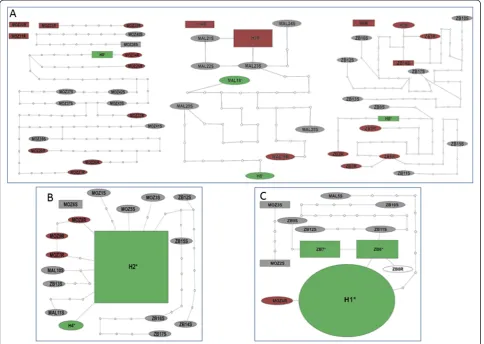
CYP6M7 indicates that, in each of the three countries (Figure 5A) and in the total sample,CYP6M7haplotypes are more diverse than those ofCYP6P9a(Figure 5B) and
CYP6P9b(Figure 5C), as evidenced by an increase in the number of mutational steps (>50) separating haplotypes.
In contrast to CYP6P9a and CYP6P9b, no apparent correlation was observed between the genetic variability ofCYP6M7and the resistance phenotype. Indeed, in the maximum likelihood phylogenetic tree of the haplotypes in each country, the haplotypes were not clustering ac-cording to their resistance phenotype (Additional file 2: Figure S5A), in contrast to the clustering observed for both
Table 2 Kinetic parameters for permethrin and deltamethrin metabolism byCYP6M7, CYP6P9aandCYP6P9b
Genes Catalytic constant (Kcat) (min−1) K
M(μM) Catalytic efficiency (Kcat/Km) (min−1μM−1)
Permethrin Deltamethrin Permethrin Deltamethrin Permethrin Deltamethrin
CYP6P9a 8.11 ± 1.24 7.469 ± 1.25 18.77 ± 13.76 18.21 ± 8.904 0.432 ± 0.09 0.410 ± 0.141
CYP6P9b 8.37 ± 1.13 7.90 ± 1.10 12.68 ± 10.08 9.9 ± 3.653 0.660 ± 0.112 0.798 ± 0.303
CYP6P9a (Additional file 2: Figure S5B) and CYP6P9b
(Additional file 2: Figure S5C). This lack of correlation be-tweenCYP6M7polymorphism and permethrin resistance is further supported by the similar levels of polymor-phisms in both resistant and susceptible mosquitoes in the 3 countries, as measured by the number of polymorphic sites or by haplotypic (hd) and genetic (π) diversities (Additional file 1: Table S4 and Additional file 2: Figure S6A), which also differs from the findings for
CYP6P9a (Additional file 2: Figure S6B) and CYP6P9b
(Additional file 2: Figure S6C). However, sliding window analysis of the genetic diversity indicates a significant difference in polymorphism levels between susceptible and resistant samples for the 696 bp non-coding region
(paired t-test, P < 0.01), with higher diversity among the total susceptible sample across the three countries compared to the resistant sample (Additional file 2: Figure S6D). Sliding window analysis for both CYP6P9a
and CYP6P9bconsistently revealed a higher diversity for susceptible mosquitoes across the entire gene (Additional file 2: Figure S6B and S6C).
Sliding window analysis of the genetic diversity of
CYP6M7 revealed that, as expected, this polymorphism is higher in the 5’ upstream non-coding region than the coding region for both the susceptible and resistant sam-ples. Analysis of the coding region to detect polymor-phism patterns associated with potential key functional regions of the gene detected three regions that exhibited
higher diversity than the rest of the gene at positions 250– 450 bp, 900–1100 bp and 1200–1350 bp (Additional file 2: Figure S6D, Additional file 1: Table S4).
CYP6M7 selection test: Patterns of selection acting on the coding region of CYP6M7 were analyzed using the codon-based Z test of selection, which is based on the dN/dS ratio, as implemented in MEGA 5.2. A significant excess of synonymous substitutions per site (dS) over non-synonymous substitutions (dN) was con-sistently observed for both the susceptible and resistant samples from all countries for the analysis averaging over all sequence pairs within each group of samples (Additional file 1: Table S5). The codon-based test per-formed between sequence pairs also revealed that most Z values (dS-dN) were positive, irrespective of the re-sistance phenotype of the samples. A very high propor-tion of Z values (dS-dN) (64 to 98.4%) were associated with significantPvalues, supporting a significant excess of synonymous substitutions per site over non-synonymous substitutions (Additional file 1: Table S5).
Polymorphisms of CYP6P9a and CYP6P9b in the
Zambian sample: Analysis of the polymorphism patterns of CYP6P9a and CYP6P9b in the Zambian sample re-vealed the same reduction of genetic diversity (number of substitutions, genetic diversity (π) and haplotype number) in resistant mosquitoes that was previously observed in the Malawian and Mozambican samples [4] (Additional file 1: Table S6 and S7). However, both genes were more variable in the Zambia sample than in the Mozambican and Malawian samples with notably more mutational steps between haplotypes. Indeed, only 1 haplotype of
CYP6P9a was more than 4 mutational steps from any other in the Malawian and Mozambican samples, whereas in the Zambia sample, all haplotypes were between 5 to 18 mutational steps apart (Additional file 2: Figure S7A, S7B and S7C). In addition, the frequencies of the predo-minant haplotypes of both genes were lower in Zambia. This difference is more evident for the CYP6P9b, for which the predominant haplotype (H1) found in the Mozambican (84.5%; Additional file 2: Figure S7D) and Malawian (95%; Additional file 2: Figure S7E) samples is not present in the Zambian sample, which, by contrast, featured two predominant haplotypes, ZB6 (40%) and ZB7 (35%) (Additional file 2: Figure S7F). These haplotypes were separated by 1 and 2 mutations, respectively, from haplotype H1 (Figure 5C). Furthermore, analysis of the maximum likelihood tree ofCYP6P9aandCYP6P9b hap-lotypes detected a cluster of haphap-lotypes only specific to Zambia (Additional file 2: Figure S5B and S5C). The differences observed in Zambia for both genes resulted in a higher and significant genetic differentiation between Zambia and the two other countries based onKSTestimates
whereas no significant differentiation is observed between Malawi and Mozambique (Additional file 1: Table S8). In
contrast, for CYP6M7 all populations were significantly differentiated from each other. These patterns are con-firmed by the phylogenetic trees based on genetic distances (Additional file 2: Figure S5D, S5E and S5F).
Discussion
Insecticide resistance among Anopheles mosquitoes is spreading throughout Africa, threatening the success of malaria control methods. In this study, after characte-rizing the insecticide resistance profile of anAn. funestus
population from Zambia, we elucidated the molecular and genetic basis of the resistance mechanisms driving the expansion of the pyrethroid resistance front across Southern Africa.
Expansion of the resistance front inAn. funestusis likely due to multiple independent selection events
The rapid spread of insecticide resistance from a single localized origin to a large geographical region due to ex-tensive gene flow between vector populations is of great concern to control programs [2]. Determining whether one or more resistance profiles are present can facilitate the design and implementation of successful vector con-trol strategies. The comparative analysis of the suscepti-bility profile of the Zambian population with those of the Mozambican and Malawian populations suggests that the resistance observed in Southern Africa might not have developed from a single origin and spread over the region as previously suggested based on the simi-larity between Mozambican and Malawian populations [4,8]. Local selection factors probably play an important role in the expansion of this resistance as highlighted by the significant differences in the resistance profiles of the Zambian population compared with the Malawian and Mozambican populations. The DDT resistance ob-served in the Zambian population contrasts with the full susceptibility to this insecticide in the Mozambican population and the very moderate resistance in the Ma-lawian population, suggesting that local selection factors in Zambia (from agriculture or from public health con-trol interventions such as IRS) could be responsible for this DDT resistance. The higher carbamate resistance of the Zambian sample compared to the Malawian and Mozambican samples further supports this observation. In An. gambiae, local selection factors have played a similarly important role in the development of resist-ance, such as in the highly selected agricultural settings in Burkina Faso [26,43] and in Benin [12]. However, the rapid spread of the 1014 Fkdrmutation inAn. gambiae
[44] is a reminder that, with time, gene flow bet-ween populations will also contribute to such resistance expansion.
characterize local populations before designing and implementing control strategies because information from a single country is insufficient to guide decision-making in a neighboring country.
Expansion of pyrethroid resistance is driven by new resistance genes: a challenge for the management of metabolic resistance
This study has revealed that beside the previously con-firmed P450s CYP6P9a and CYP6P9b resistance genes, theCYP6M7gene is likely also playing an important role in the pyrethroid resistance in southern Africa as shown by a consistent over-expression from microarray. The fact that similar consistent over-expression for CYP6M7was observed from the qRT-PCR results using three different primer pairs further validates the up-regulation of this gene in relation to pyrethroid resistance. Interestingly, probes from CYP6M3, the ortholog of CYP6M7 in An. gambiae, were found to be significantly over-expressed in the pyrethroid resistant laboratory An. funestus FUMOZ strain compared to the laboratory susceptible FANG strain during a microarray analysis using theAn. gambiae“detox chip” [45]. CYP6M7 was also previously mapped within therp2 pyrethroid resistance QTL in a crossing between FUMOZ and FANG strains [21]. Altogether, the con-sistent over-expression ofCYP6M7and the demonstration that this gene can metabolize pyrethroids both in vitro
andin vivo, support the view thatCYP6M7is significantly contributing to pyrethroid resistance in southern Africa. The two to seven-fold reduced expression of both
CYP6P9a and CYP6P9b in Zambia from microarray in contrast to Mozambique and Malawi, could even signal a possible shift in underlying molecular basis of pyrethroid resistance across the region withCYP6M7possibly playing a more important in such locations. However, it will be useful in future studies to further validate this potential shift in gene expression of the main resistance genes using other methods such as RNAseq which contrary to micro-array and qRT-PCR is not affected by the sequence poly-morphism of targeted genes. The reasons for the potential shift in the expression levels of the three genes remain un-known but could be due to the nature of the selection that gave rise to the resistance. This shift in gene expression further highlights the genetic plasticity of natural popula-tions of malaria vectors and their ability to adapt to vari-ous selection pressures. Similar geographical variations in expression levels between detoxification genes have been observed in other mosquito vectors, such asAn. gambiae
[38] and Aedes aegypti [46]. Furthermore, it is not un-common for different P450 genes to be associated with a same resistance profile such as the case for the CYP6A1
and CYP6D1 in the house fly Musca domestica, or for
CYP6A2,CYP6A8andCYP6G1in the fruit flyD. melano-gaster [47]. Similarly in the red flour beetle Tribolium
castaneum several P450s including CYP6BQ8,CYP6BQ9
andCYP6BQ10orCYP436B1 and CYP436B2, are shown to confer deltamethrin resistance [40,48].
Functional characterization of the three cytochrome P450 genes clearly demonstrated that they all confer to
An. funestus the ability to withstand both types I and II pyrethroids. It will be a concern for control programs if the three genes were equally highly up-regulated in a single population, as this may significantly increase the overall pyrethroid resistance level of such mosquito populations.
However, kinetic analysis of the three recombinant en-zymes suggests thatCYP6P9bmay metabolize pyrethroids more efficiently than the other two enzymes. This result will need to be further confirmed since kinetic profiles ob-tained throughin vitroexperiments are unlikely to reflect 100% theirin vivopatterns stemming from potential varia-tions in thein vivointrinsic clearance of the insecticide in the mosquito. Variations in insecticide metabolism among resistance genes are not uncommon and were previously observed inD. melanogasterwhen seven P450 genes were compared for their ability to confer resistance using trans-genic expression [49]. However, more work is needed to fully establish the metabolic efficiency of these enzymes against all pyrethroids. Another area of investigation will be to establish their patterns of cross-resistance to other insecticide classes. Such P450 cross-resistance to different insecticide classes was recently reported in An. gambiae
to confer pyrethroid resistance in field populations [12-14]. Similar phenomena have been observed in Ae. aegypti, in which a set of CYP9 P450s play a major role in resistance [52,53], and even inDrosophila, in which many genes combine to protect against various spectrums of insecticides [49]. The involvement of a multiplicity of genes in metabolic resistance is a further challenge to the ultimate aim of detecting resistance markers that could be used to design suitable DNA-based diagnostic tools to easily detect such resistance in the field.
Contrasting selection patterns shape the diversity of
CYP6M7and the duplicatedCYP6P9aandCYP6P9b
CYP6M7is highly polymorphic, with 1 SNP every 15 bp in the coding regions and 1 SNP every 9 bp when non-coding regions are included. This level of polymorphism far exceeds that previously reported for any P450 gene in An. funestus[21,54] or An. gambiae[55]. Analysis of the genetic diversity of CYP6M3, the CYP6M7 ortholog inAn. gambiae, revealed a far lower polymorphism level, with only 1 SNP every 66 bp [55]. The high polymor-phism of CYP6M7 is similar to that reported in An. gambiae for the APL1 gene which is associated with immune responses againstPlasmodium falciparum[56]. It is unlikely that the high polymorphism of CYP6M7is associated with gene duplication, as good and clean se-quencing results were consistently obtained from PCR products of same size after amplification using primers located in the 5’and 3’UTR. In addition, a full sequen-cing of the 113 kb of this genomic region spanningrp2
pyrethroid QTL did not detect any gene duplication of
CYP6M7[21].
No particular CYP6M7 allele seems to be most asso-ciated with pyrethroid resistance, in contrast to the iden-tification of predominant resistance alleles of CYP6P9a
and CYP6P9b [4] suggesting that no selective sweep is acting upon CYP6M7. This suggests that the major ge-netic factor conferring resistance through CYP6M7
could be located in a trans regulatory region rather than in the coding sequence, but this regulator remains to be found. By contrast, the considerable differences observed in the amino acid sequences of CYP6P9aand CYP6P9b
between resistant and susceptible mosquitoes suggests that allelic variation at these two genes impact their ability to confer pyrethroid resistance. Further work on the regulation pathway of CYP6M7 will help to shed more light into why it has not experienced the same selective sweep asCYP6P9aandCYP6P9b.
The high polymorphism of CYP6M7 was nevertheless associated with a significant predominance of syno-nymous substitutions over non-synosyno-nymous substitu-tions suggesting thatCYP6M7 amino acid sequence was under some selective constraints. However, the high polymorphism level observed for CYP6M7 and the lack
of predominant haplotype suggests that CYP6M7 is overall probably evolving neutrally. This is in contrast to both CYP6P9aand CYP6P9b were a signature of direc-tional selection is observed with the selection of a predominant haplotype and a reduced polymorphism in resistance mosquitoes in all three countries. Beside a possible trans-regulation of CYP6M7, the absence of a directional selection onCYP6M7could also stem from a more generalist functional role of this gene, particularly if it could protect the mosquito against a broad range of xenobiotics or against plant toxins (allelochemicals) or even if it were involved in functions other than detoxifi-cation. This could explain why a single allele has not been favored. By contrast, the directional selection act-ing on both CYP6P9aand CYP6P9b with a selection of favorable alleles could be due to a more specialist role of these genes against mainly pyrethroid insecticides. Simi-larly, structural differences associated with sequence polymorphisms have been observed between the ge-neralist cytochrome P450 CYP6B8 (which is able to metabolize a variety of allelochemicals and insecticides) in the polyphagous noctuidHelicoverpa zeaand the spe-cialist CYP6B1in the black swallowtail butterfly Papilio polyxenes, a specialist restricted to furanocoumarin-containing plants [57]. Further evaluation of the sub-strate spectrum metabolism of CYP6M7, CYP6P9a and
CYP6P9bis needed to confirm this hypothesis.
The higher genetic diversity ofCYP6P9aandCYP6P9b
in the Zambian sample compared to the Malawian and Mozambican samples correlates with the lower expres-sion of both genes in the Zambian sample. This supports the conclusion that both genes could be under less se-lective pressure in Zambia. This variation in the diversity of both genes in relation to their role in pyrethroid resistance is similar to the differences in the genetic variability of the glutathione S-transferase GSTe2 inAn. funestus with DDT resistance across Africa [51]. Very low genetic variability is observed in high DDT resist-ance regions, whereas higher variability is observed in more susceptible regions [51]. A similar distribution of variation in theCYP6G1 P450 gene has been associated with DDT resistance in Drosophila simulans. This gene has significantly lower diversity in DDT-resistant popu-lations from California and higher polymorphism in DDT-susceptible populations from Zimbabwe [58].
Conclusion
Taken together, the results from this study have helped to shed more light into the molecular complexities of the resistance mechanisms underlying pyrethroid resis-tance in southern African populations of An. funestus. Indeed, this study has revealed that beside the previously known resistance genes CYP6P9a and CYP6P9b, the
pyrethroid resistance observed in the region and that its role may even become more important in the northern range of the resistance front such as in Zambia. There-fore, despite the similarities observed, the underlying molecular basis of pyrethroid resistance is probably not uniform across its distribution range in Southern Africa. The northern range in Zambia exhibits significant dif-ferences from Malawi and Mozambique in term of the profile and molecular basis of resistance. It is therefore likely that beyond Mozambique and Malawi, pyrethroid resistance in southern Africa has multiple origins under different evolutionary forces, which may necessitate the design of different resistance management strategies to mitigate the impact of this resistance.
Additional files
Additional file 1: Table S1.List of primers used in this study.Table S2. Top 50 probes the most commonly up-regulated in R-S in Mozambique, Malawi and Zambia.Table S3.Top 20 probes the most commonly down-regulated in R-S in Mozambique, Malawi and Zambia.Table S4. Summary statistics for polymorphism ofCYP6M7between susceptible and resistant mosquitoes in Zambia, Malawi and Mozambique.Table S5. Codon-based Test of Selection forCYP6M7for analysis averaging over all sequence pairs within each group.Table S6.Summary statistics for polymorphism ofCYP6P9abetween susceptible and resistant mosquitoes in Zambia, Malawi and Mozambique.Table S7.Summary statistics for polymorphism ofCYP6P9bbetween susceptible and resistant mosquitoes in Zambia, Malawi and Mozambique.Table S8.Genetic differentiation usingKSTforCYP6P9a,CYP6P9bandCYP6M7.
Additional file 2: Figure S1.Gene expression analysis.Figure S2. Maximum likelihood (ML) tree of full-lengthCYP6M7cDNA haplotypes from various regions of Africa.Figure S3.Analysis of polymorphisms of CYP6M7,CYP6P9aandCYP6P9b.Figure S4.Protein variants among resistant and susceptible mosquitoes from all three countries.Figure S5. Phylogenetic analysis ofCYP6M7.Figure S6.Impact of permethrin resistance on genetic diversity.Figure S7.Comparative analysis of the haplotypes of the three genes based only on coding regions among susceptible and resistant mosquitoes from the three countries using a 95% parsimony network.
Competing interests
The authors declare that they have no competing interests.
Authors’contributions
CSW conceived and designed the study. NC, TM, EC, MN and CSW carried out the sample collection and performed the WHO bioassays; HI and CSW performed the Microarray and qRT-PCR analyses; JMR and HI performed the transgenic expression study; JMR and SSI performed the recombinant enzyme characterization. HI and KGB performed the tissue-specific expression of candidate genes; HI, MN and CSW performed the sequencing of resistance genes; JMR, SSI and CSW analyzed the data and wrote the manuscript. All authors read and approved the manuscript.
Accession numbers
The microarray data from this study were submitted to Array Express, accession number E-MTAB-2216. The DNA sequences reported in this paper have been deposited in the GenBank database (accession numbers KJ150626-KJ150674).
Funding
This work was supported by a Wellcome Trust Research Career Development Fellowship (083515/Z/07/Z) to CSW. JMR was supported by a fellowship from the Fundación Ramón Aceres.
Author details 1
Vector Biology Department, Liverpool School of Tropical Medicine, Pembroke place, Liverpool, L3 5QA, UK.2Ministry of Health, National Malaria Control Centre, Lusaka, Zambia.3Malaria Alert Centre, College of Medicine, Blantyre, Malawi.4National Institute of Health, Maputo, Mozambique.
Received: 5 September 2014 Accepted: 23 September 2014 Published: 27 September 2014
References
1. WHO:Malaria Report 2011.Geneva, Switzerland: World Health Organization; 2011. 2. WHO:Global Plan for Insecticide Resistance Management (GPIRM).Geneva,
Switzerland: World Health Organization; 2012.
3. Okoye PN, Brooke BD, Koekemoer LL, Hunt RH, Coetzee M:Characterisation of DDT, pyrethroid and carbamate resistance in Anopheles funestus from Obuasi, Ghana.Trans R Soc Trop Med Hyg2008,102(6):591–598. 4. Riveron JM, Irving H, Ndula M, Barnes KG, Ibrahim SS, Paine MJ, Wondji CS:
Directionally selected cytochrome P450 alleles are driving the spread of pyrethroid resistance in the major malaria vector Anopheles funestus.
Proc Natl Acad Sci U S A2013,110(1):252–257.
5. Wondji CS, Coleman M, Kleinschmidt I, Mzilahowa T, Irving H, Ndula M, Rehman A, Morgan J, Barnes KG, Hemingway J:Impact of pyrethroid resistance on operational malaria control in Malawi.Proc Natl Acad Sci U S A2012,109(47):19063–19070.
6. Amenya DA, Naguran R, Lo TC, Ranson H, Spillings BL, Wood OR, Brooke BD, Coetzee M, Koekemoer LL:Over expression of a cytochrome P450 (CYP6P9) in a major African malaria vector, Anopheles Funestus, resistant to pyrethroids.Insect Mol Biol2008,17(1):19–25.
7. Chanda E, Hemingway J, Kleinschmidt I, Rehman AM, Ramdeen V, Phiri FN, Coetzer S, Mthembu D, Shinondo CJ, Chizema-Kawesha E, Kamuliwo M, Mukonka V, Baboo KS, Coleman M:Insecticide resistance and the future of malaria control in zambia.PLoS One2011,6(9):e24336.
8. Hunt R, Edwardes M, Coetzee M:Pyrethroid resistance in southern African Anopheles funestus extends to Likoma Island in Lake Malawi.Parasit Vectors 2010,3:122.
9. Schlenke TA, Begun DJ:Strong selective sweep associated with a transposon insertion in Drosophila simulans.Proc Natl Acad Sci U S A 2004,101(6):1626–1631.
10. Martinez-Torres D, Chandre F, Williamson MS, Darriet F, Berge JB, Devonshire AL, Guillet P, Pasteur N, Pauron D:Molecular characterization of pyrethroid knockdown resistance (kdr) in the major malaria vector Anopheles gambiae s.s.Insect Mol Biol1998,7(2):179–184.
11. Ranson H, Jensen B, Vulule JM, Wang X, Hemingway J, Collins FH:
Identification of a point mutation in the voltage-gated sodium channel gene of Kenyan Anopheles gambiae associated with resistance to DDT and pyrethroids.Insect Mol Biol2000,9(5):491–497.
12. Djouaka RF, Bakare AA, Coulibaly ON, Akogbeto MC, Ranson H, Hemingway J, Strode C:Expression of the cytochrome P450s, CYP6P3 and CYP6M2 are significantly elevated in multiple pyrethroid resistant populations of Anopheles gambiae s.s. from Southern Benin and Nigeria.BMC Genomics 2008,9:538.
13. Mitchell SN, Stevenson BJ, Muller P, Wilding CS, Egyir-Yawson A, Field SG, Hemingway J, Paine MJ, Ranson H, Donnelly MJ:Identification and validation of a gene causing cross-resistance between insecticide classes in Anopheles gambiae from Ghana.Proc Natl Acad Sci U S A2012,
109(16):6147–6152.
14. Muller P, Warr E, Stevenson BJ, Pignatelli PM, Morgan JC, Steven A, Yawson AE, Mitchell SN, Ranson H, Hemingway J, Paine MJ, Donnelly MJ:
Field-caught permethrin-resistant Anopheles gambiae overexpress CYP6P3, a P450 that metabolises pyrethroids.PLoS Genet2008,
4(11):e1000286.
15. Gregory R, Darby AC, Irving H, Coulibaly MB, Hughes M, Koekemoer LL, Coetzee M, Ranson H, Hemingway J, Hall N, Wondji CS:A De novo expression profiling of anopheles funestus, malaria vector in Africa, using 454 pyrosequencing.PLoS One2011,6(2):e17418.
16. Crawford JE, Guelbeogo WM, Sanou A, Traore A, Vernick KD, Sagnon N, Lazzaro BP:De novo transcriptome sequencing in Anopheles funestus using Illumina RNA-seq technology.PLoS One2010,5(12):e14202. 17. Cuamba N, Morgan JC, Irving H, Steven A, Wondji CS:High level of